Short instructional transcript of a YouTube video (Charles Collingwood, May 8, 2012) explaining the Lewis structure and molecular geometry of the hydronium ion (H3O+). The speakers describe bonding: oxygen bonded to three hydrogens, two lone pairs originally on oxygen with one lone pair used to coordinate an H+ to form H3O+, and they state the electron-pair geometry is tetrahedral while the molecular shape is trigonal pyramidal.
The Lewis structure of the hydronium ion.
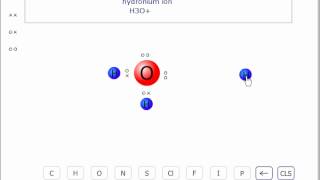
Hydronium ion has the formula H3O positive. This means that there must be one oxygen atom bonded to 1, 2, 3 hydrogen atoms.
Now, we know that oxygen can bond to water very easy.
Sorry, Bond as water can bond to hydrogen very easily.
Sharing a pair of electrons with one hydrogen atom. Sharing a pair of electrons with another.
Hydrogen atom and having two lone pairs of electrons, one, two lone pairs of electrons.
If one of those lone pairs of.
Electrons coordinates to a hydrogen ion, that's an H plus ion, a hydrogen atom without its electrons. This species then becomes a positively charged hydronium ion. H3O. The shape.
Well, it's based on a tetrahedral organization.
Of electron pairs or negative charge density.
But only three of the four of the tetrahedral sites.
Remember, tetrahedral has four sites in this organization.
These are unable to be seen. These are just the electron arrangements.
Well, only three of these are used in bonding.
And so we end up with 1, 2, 3.
This is actually a trigonal planar, sorry, trigonal pyramidal arrangement of particles.
We could try to show it a.
Little bit more like this, to show the arrangement.
A bit more three dimensionally.
A trigonal pyramidal hydroxonium ion or hydronium ion.