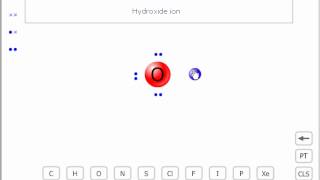
Charles Collingwood shows how to draw the Lewis structure of the hydroxide ion. Oxygen has 6 valence electrons, hydrogen has 1, and you add 1 more for the negative charge. The O-H bond leaves three lone pairs on oxygen, giving it a tetrahedral electron geometry.
Chapters
The Lewis structure of the hydroxide ion. The hydroxide ion has got the formula oh, so we can call up an oxygen. Now, oxygen is in group six of the periodic table. It therefore has six outer electrons. We can give it its six outer electrons to start off with. It doesn't really matter which way around we do this. Oxygen, with its six outer electrons, hydrogen, which makes up the hydroxide ion, has only got one outer electron. However, if we have a negative ion, the oh minus ion, well, the extra minus means we must add in an extra electron. So to get the minus charge, we bring in an extra electron and this extra electron can form a pair with the hydrogen to bond the hydrogen to the oxygen. So this is a representation of the OH ion, The shape. Obviously there are only two atoms, so it has to be linear. There is no choice. However, the electronic organization around the oxygen would be based on a tetrahedral structure with the hydrogen occupying one of the prongs, one of the four prongs of the tetrahedron, like this. This then is the hydroxide ion.