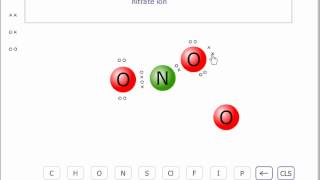
A short instructional explanation of the Lewis structure of the nitrate ion (NO3−). The narrator (Charles Collingwood) walks through bonding arrangements: one N=O double bond, two N–O single/dative bonds with a negative charge on an oxygen, electron counting to show 24 valence electrons (three octets), and concludes that the central nitrogen is sp2-hybridized giving a trigonal planar geometry.
Questions this video answers
NO3− (nitrate ion, one-minus charge)
24 valence electrons
sp2 hybridized; trigonal planar
5 electrons
Chapters
The Lewis structure of the nitrate ion. Nitrate ion has the formula no. 3 with a one minus charge. So we choose a nitrogen and three oxygens. No, three with a one minus charge. Now, if we attach one oxygen to the nitrogen by a double bond, this will fulfill the requirements of this oxygen. This oxygen starts off with six electrons, so it will have a further two electrons here and two electrons here. It will have altogether eight electrons around it. Out of the five electrons this nitrogen started with, we have used two. It's got three electrons left. If we share a pair of electrons with one oxygen, This oxygen would then have one and another five, which makes seven altogether around it. Obviously it starts off with six. Choose one here, it's got five left, five and the two here make seven. But we can add in one for the minus charge. So if we were to put this oxygen's electrons one, Five and we add in one electron for the minus charge, Then that just leaves us with another oxygen with six electrons to sort out. Well, the nitrogen has used one, two, three of its electrons. It has two more electrons. And so with this pair of electrons, it can form a dative coordinate bond to the oxygen. The oxygen then can have use its three pairs of electrons to fulfill the requirements or its requirements in terms of the full octave. So in summary, this would be the shape or the Lewis structure rather of the nitrate ion. Don't forget, we've added in one extra electron if you want to do some accountancy. We can think that each oxygen started off with six electrons. That's 18 for the three oxygens. The nitrogen starts off with five, that's 18 and five is 23. We added in one more for the minus charts. I mix 24 and that gives us 1, 2, 3 octets, adding up to 24 electrons. The shape of the nitrate ion. Around the nitrogen, there are 1, 2 and 3 regions of electron density. So the nitrogen will adopt an SP2 hybridized trigonal planar shape.