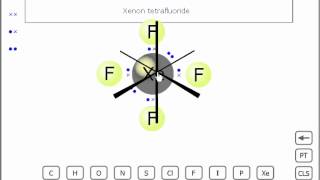
A short instructional narration by Charles Collingwood explaining the Lewis structure and molecular geometry of xenon tetrafluoride (XeF4). He describes one xenon atom bonded to four fluorines, shows that xenon retains two lone pairs (giving six regions of electron density), explains these adopt an octahedral electron arrangement, and concludes the molecular shape is square planar.
Chapters
The Lewis structure and shape of xenon tetrafluoride. Tetra means four. So we have one xenon atom and four fluorine atoms. Each fluorine is joined by a shared pair of electrons to the xenon. Put in one fluorine with one shared pair, two fluorines with another shared pair, third fluorine with a shared pair, And the fourth fluorine with a shared pair. Now, xenon is in Group 8. It's a noble gas, so it starts off with eight electrons in the outer shell. However, you can see here it's only used 1, 2, 3, 4 of its own electrons. This means that it still has another two pairs of electrons to make up its full original complement of electrons. So the question arises, what shape does this adopt? Well, we've got 1, 2, 3, 4, 5, 6 regions of electron density. These six regions of electron density will adopt an octahedral orientation. We take an octahedral shape, put it over the top here. Now we have to decide where the two lone pairs are going to go. Well, clearly, the only real constraint here is that the two lone pairs will not go next to one another. So wherever we put the two lone pairs, they must be as far apart as possible. They will be opposite. So we can put one lone pair here and one lone pair here, leaving our four fluorines to occupy the other four sites. Now, it may or may not be easy for you to see in this particular way. Perhaps we change the positions of the fluorines. We'll put a fluorine here and a fluorine here, and these, leaving these two lone pairs above and below. All these aren't lone pairs, so we'll just switch them around just to make it clear. There's our lone pair there. And there we go. Shift this lone pair to here as well, and this bonding pair back to this position here. Well, now you can see that the four fluorine atoms. I've left two floating lone pairs, two floating bonding pairs. These four fluorine atoms are now in an orientation which could be described as, or is described as square planar. They are in one plane and they are arranged in a square. So the electronic shape of xenon tetrafluoride was octahedral, but the actual molecular shape of xenon tetrafluoride is square planar.