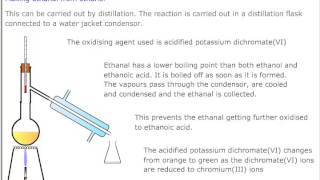
A short instructional video describing the oxidation of alcohols. It defines oxidation (electron loss, addition of oxygen, or loss of hydrogen), demonstrates this with ethanol → ethanal → ethanoic acid (noting changes in hydrogen count and carbon oxidation numbers), and explains laboratory control: distillation to remove aldehyde vs reflux to push oxidation to carboxylic acid. The video gives boiling points (ethanal 21 °C, ethanol 79 °C, ethanoic acid 120 °C), presents acidified potassium dichromate as the typical oxidant (dichromate reduced to Cr3+, orange → green), and summarizes that primary alcohols form aldehydes (then carboxylic acids if refluxed), secondary alcohols form ketones (no further oxidation), and tertiary alcohols resist oxidation.
Questions this video answers
Ethanal 21 °C; ethanol 79 °C; ethanoic acid 120 °C.
Dichromate ions take up 14 H+ and 6 e- to become 2 Cr3+ plus 7 H2O (balanced as written in the transcript).
Chapters
Okay, oxidation of alcohols. Oxidation is defined as the removal of electrons from species. You can see that difficult to say where the electrons are removed from. When we look at an organic molecule, though, this O in square brackets means oxidation. And this particular reaction, we've got ethanol going to ethanol. Well, we can extend our definition of oxidation to addition of oxygen or removal of hydrogen. If we look here, this molecule, ethanol, has got six hydrogen atoms, where the ethanal has got four hydrogen atoms and the same number of oxygens and carbons. So we're actually losing two hydrogens. So our definition of oxidation fits in terms of addition of oxygen or removal of hydrogen. We can, however, do the traditional count up to get the oxidation number of the carbons in the structure. We consider that each hydrogen is worth plus one, oxygen is worth minus two, and the sum of all oxidation states must be zero. We do our sums down here. Two carbons plus six hydrogens plus one oxygen gives zero, and this gives us carbon with an oxidation number of -2. A similar treatment for ethanal finds that the oxidation number of carbon in ethanal, or each of the carbons in ethanal, is minus 1. And so we've gone from minus 2 for the carbons to minus 1. It's less negative. And so we are losing electrons. In fact, each carbon is losing one electron. So overall, there are two electrons being transferred. In fact, ethanal can also be oxidized by exactly the same oxidation conditions as ethanol. So we have to be very careful here that if we want to make ethanal from ethanol, we must prevent this further oxidation. And this is done by removing the ethanal from the reaction vessel as soon as it's formed. We'll see how that's done in just a moment. There we go. In order to make ethanal from ethanol, well, we perform the reaction in our round bottom flask here, for example, connected to a jacket condenser full of cold water. Water coming in here, water coming out here. So as the ethanal is formed, it rises up, goes past the thermometer and recondenses in the reaction in the jacket condenser and drips into our conical flask or whichever vessel we have receiving it. This is possible because ethanal has a much lower boiling point than both ethanol and if it further oxidizes the ethanoic acid. In order to make ethanoic acid, we just must prevent the ethanol leaving. We see the three boiling points here. Ethanol is 79 degrees, ethanal is 21 degrees, and ethanoic acid is 120. So you can see that if the temperature is kept above 21, but below 79, we should get ethanol being produced. However, if we have the apparatus arranged so that the water jacket condenser is vertical, the ethanol will recondense inside this water jacket condenser and fall back into this vessel. This is known as refluxing. It's a very well known technique for ensuring maximum temperature of reactants in an organic reaction. If we have a look at the oxidizing agent that's normally used, it's potassium dichromate 6 in acidic solution. And this is the equation for the reaction here. Dichromate ions pick up 14 hydrogen ions, 6 electrons and become chromium 3 ions and 7 water molecules. This is balanced in terms of particles and in terms of electrons. It's quite a useful reaction because we can actually see the colour change. As the dichromate gets reduced to chromium 3, it turns from orange to green. Secondary alcohols are not oxidized in the same way as primary alcohols. Primary alcohols make aldehydes. But because the secondary alcohol has got only one hydrogen attached to the carbon that holds the OH group and two carbons, it means that the carbonyl group that's going to form here is in between two carbons. In other words, it's in the middle of a chain. This is called an alkynal or a ketone. And propan 2ol will oxidise under the same conditions as propan 1ol. It will oxidize to propanone. And once we get here, there's no further oxidation possible because there are no hydrogens attached to this carbon. And for the same reason, tertiary alcohols cannot be oxidized at all. There are no hydrogens attached to the carbon that holds the oh, the hydroxy group. Well, this allows us a means of differentiating between primary secondary and tertiary alcohols. Primary alcohols will oxidise directly to aldehydes. We can use distillation to remove the aldehyde if we wish, or we can carry on using reflux to re oxidise the aldehyde as it's formed to a carboxylic acid. Secondary alcohols, however, go straight to ketones and from there they can go no further. Whereas tertiary alcohols, there is no oxidation possible.