Titration answers
Charles Collingwood works through titration problems step by step, showing how to find moles, molarity, and purity using core equations like moles = M×V. He covers neutralization titrations with equivalence factors, back-titrations, and calculating relative formula masses from experimental data.
Questions this video answers
0.1 moles
0.00025 moles
250 moles
0.0752 M
40 L
Chapters
Okay, titration calculation answers. Calculate the number of moles in the following 2 liters or 0.05. Cupid lamb means moles per liter. So we use moles equals molarity times volume, MV, which in this case molarity is 0.05. Volume is 2. Let's tidy it up a bit. Times 2. And that comes to 0.1 moles. Can we see this better in blue? 25 centimeter cubed. 25 centimeter cubed. 0.01. Well, in this particular case. Oh, we're doing a C next. Doesn't really matter. Moles, Molarity equals. So MV gives us the moles. And this equals. Well, the molarity is 0.01 and the volume 0.025. And that gives us 0.00025. 50 liters of 5 molar sulfuric acid. Well, MV equals molarity times volume, 5 times 50. And that comes to 250 moles here. 250 moles. Let's go over to the next question. 10 centimeter cubed is 0.25 molar. Well, molarity times volume equals moles. Molarity 0.25. Volume 0.01 in liters, of course. And that gives us. Well, we move the decimal place two.
Place to the left.
0025 moles. Question two. Let's move up to question two. Calculate the concentration of the following. Well, we just change the moles equals MV equation. Let's go into here. Moles equals mv. If you want the molarity, the concentration M equals moles over V. All right, so let's. Well, let's put this check. Take it out of here. Let's put it into this section here so we could see it. I'm going to take it into here. This is our equation. Let's font that so that we can recognize it. And now let's just have a look at the questions. Well, what are we given? We're given the moles 0.04. So we want moles equals mole over V. So 0.0.4 divided by the volume in liters, which is 2, and that comes to 0.4. And its concentration is a capital M over here. Ah, we're given it in grams. Well, we need to change the grams to the relative using the relative mass. So we need to also use this equation. I want to put it over here now. So the moles equals the mass divided by the relative mass in this particular case. Then moles is the mass. It's 1.05 divided by the relative mass sodium is 23, no H adds up to 40 altogether. So that gives us the number of moles. 1.05 divided by 40. Let's have a look at that. 1.05 divided by 40. Take it in 1.05 over 40. There's our moles, which is 0.0263. 0.0263. This is moles. And we're going to put this into 500 centimeter cubes of solution, right? So the molarity equals the moles over the volume. So M equals the moles 0.0263 over the volume. And the volume is 0.5 liters. And that in turn is going to give us. So we divide our sum by 0.5 and it gives us an answer. 0.0525. 0.0525 molar. Let's take that back, run this back a little bit. Molar, And on to next part of the question. Remember, moles MV molarity is moles over V. Well, molarity M equals moles 12.5 over volume. And the volume in this case is 5. Well, 12.5 over 5 is 2.5. Don't even need a calculator. What a crack. There we go. Next one. Now we're going to get the relative formula mass of sodium carbonate. Well, that adds up to. We add it carefully. It's 106. So it's 2.56 divided by 106. This gives the number of moles. Bring this in 2.56 divided by 106. 2.56 divided by 106. And that gives us number of moles, which is 0.0242. 0.0242. And we're told it's in. Told that it's in 0.25 liters. So it's 0.0242 divided by 0.25. And what we do, just divide our number in the calculator by 0.25. And this gives me 0.0966. 0.0.0966 molar. All right, we'll go on to question three in the next video. Okay, titration calculations, part 2. Calculate the volume of each solution that contains the following numbers of moles. So we want to know, we're given the number of moles. We're given the molarity in moles per liter. So we have to find the volume.
So this is.
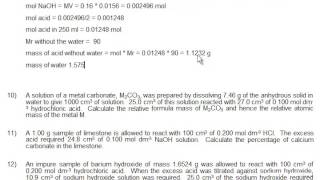
Well, let's go into here. Let's just put our original first, moles equals molarity times volume. Therefore, what does volume equal? Well, volume equals moles over molarity. It's as simple as that. There's our base equation. So the first thing we've got to do, then, we've got to say how many. What's the volume of this particular system? So V equals. And we've got the number of moles, 0.005. We've got the molarity, 0.1. Divide anything by 0.1 is multiplied by 10. So it's 0.05 liters DM cubed. DM cubed. It doesn't say any particular units. We have to put them in. So DM, we can leave it in. DM cubed. 0.05 is 50 cm cubed. Incidentally, the next one, well, it's going to be the same system again, isn't it? So we've got volume. Volume equals. We want the number of moles 1 times 10 to the minus 5. Okay, well, let's leave it as 1 times 10 to the minus 5. We divide that by. We divide that by the. By the molarity, which is 0.01 divided by 100 is the same as multiplying. So dividing by 0.1 is the same as multiplying by 100. So we just take our two decimal places. Times 10 to the minus 5 becomes 10 times 10 to the minus 3. So it's 1 times 10 to the minus 3. We just put that in there. 1 times 10 to the minus 3 is 0.00. One of those. You want to put it in here. V equals 0.001. And again, it's liters DM cubed. And into a nice pretty blue color. Question 4. Calculate the concentration of a solution of sodium hydroxide. Given that 25 cm cubed required 18.8 cm cubed of sulfuric acid, presumably for neutralization. We seem to have missed the words for neutralization out or for complete reaction. Well, we can see from our equation here that one mole of sulfuric acid is equivalent to two moles of sodium hydroxide. All right. Okay, so one mole. So however many moles of sodium hydroxide or sulfuric acid we've got, we must have twice the number of moles. Well, so we work out the sulfuric acid moles. Moles of sulfuric acid equals molarity times volume. Molarity 0.05. The volume is 18.8 cm. Kubed 0.0188. Okay, let's bring in a calculator for this. It's a bit of mental arithmetic. Otherwise, 0.05 times 0.0188 and that comes to three zeros, 0.0094 moles. Then we have to use our equivalence in the equation here, that one mole is two moles of sodium hydroxide. So then we have moles of sodium hydroxide. Moles sodium hydroxide equals this number of moles times two, nine, four times two. And we're going to bring in our calculator for this, as we've already got the number on there multiplied by 200188. 0.00188 Moles of sodium hydroxide. Now we must apply the relationship to get. Well, it's the same relationship, isn't it? It's the moles of sodium hydroxide equals molarity Assholm's volume. Only this time we've got the moles and we want the molarity. So we can say molarity equals. When we rearrange this equation, molarity is to take the volume to the other side, so it's moles over volume. In this particular case it's 0.000188, which the moles we divide by the volume and we're told it's 25cm cubed 0.025. We bring in our calculator. Again, divide by 0.025 and that gives us 0.0752, 0.0752 and it's moles per litre. Moles per litre. We can represent as a capital M, Calculate what volume of this potassium hydroxide is required to neutralize 25cm cubed of that amount of nitric acid. So we can work out the amount of nitric acid we have first of all. So the moles of acid. Moles of acid equals molarity times volume MV. Let's keep reinforcing this molarity. 0.015. The volume 25 centimeter cubed 0.025. And we'll bring a calculator in here for that point 015 times zero, 0.025 and that comes to three zeros. 375 0.000375 moles of acid. Well, you can see from the equation, hopefully you can see from the equation that one mole of acid is equivalent to one mole of base. So this is also equal to the mole of base. Now we can use our. This is our fundamental equation, isn't it? Moles is mb, whilst in this case it's moles of base is mv. We want the volume. So V equals mole over. Whoa. Mole over m. And this moles is 0.00375. Divided by the molarity. And you're told is 0.05 moles. 0.05 moles per liter. So we divide our divide by 05 and that comes to 0.0075. 0.0075 its volume. So it's DM cubed. Now of course that's 7.5 cm cubed. Is that a realistic answer? You can always ask yourself is it a realistic answer? Well, what are we talking about? 50cm of potassium hydroxide. About 0.015. So about 50. That's 0.05 molarity. And the molarity is a lot less. Yes, it's a realistic ballpark figure. Question 6. A 250 centimeter cubed solution sodium hydroxide was prepared 25 centimeters cubed. This solution required 28.2 centimeters cubed of zero. So we can work out the actual amount of hydrochloric acid in the titration. Let's have a look at this then. Okay, so and let's change this to an arrow while we're at it. Now you can see it's a one to one reaction. There's one of those hydrochloric acids. So it sows the same moles of hydrochloric acid as sodium hydroxide. So let's work out the hydrochloric acid first of all. Then 28 centimeter cubed. So the moles mole moll mole equals 0.0282 multiplied by the molarity 0.1. Well, we can see the move the decimal place 0.00282 moles of acid. And this is equal to exactly the same moles of base. So this only moles in 25cm cubed of the solution. But the original solution has twice as big. So therefore in 250mil of solution they are 0.00282 times 10 mol. And this is equal to 0.0282 mole. Well, we know how many moles sodium hydroxide there are. So now it's just a question of working out the mass. Mass equals moles times relative mass. Let's be consistent, use the same symbols. Moles times the relative mass. And the relative mass of sodium hydroxide is 40. So it's 0.0282 times 40. And this is going to give bring in our calculator. Don't know what this value is for. So take that off point zero two eight two times forty is 1.128 grams. Right. So that concludes the second part of the titration solutions. Titration calculations. Part 3. What volume? 5 molar hydrochloric acid is required to neutralize 20 kg. Wow. Of calcium carbonate. Okay, first thing we do is we work out the moles of calcium carbonate. Moles of calcium. Spell it right. Calcium carbonate. What's the mass divided by the relative mass? Well, the mass is 20,000 divided by the relative mass, which is 100. It's actually quite easy to work out. You just cross two naughts off and it comes to 200 moles. Right. Now we apply moles equals MV. This is our equation for solutions. Don't forget. What do we want? We want the volume. So we want V equals moles over M. The moles we've got is 200. M is 5. So we're left with 5. 240. So it's 40 liters. 40 DM cubed bucket chemistry. All right, next question. Question eight. We're given the number of grams of a monoprotic acid. That means it's got one hydrogen. Mono means one protic means hydrogen or proton was dissolved in water and the solution made up to 250. We took a tenth of this 25 and titrated it with solution. And this is how much of the solution we required. So the information we can get first of all is the number of moles of sodium hydroxide. Right? So go moles. Moles of sodium hydroxide equals what's molarity times volume MV and it's 0.095 times the volume, which is 0.0. Not a particularly nice calculation. Let's bring this one in calculator for this 0.095 times 0.0465. And that comes to 0044-1750-0004-4175 moles. Now we're told it's monoprotic. And that means that we'll have the same number of moles of acid because there's one OH group in sodium hydroxide. And a monoprotic acid will have formula of ha. So moles of HA will be the same 0.00. Whoa. Moles. Now this is in 25 centimeter cubed. Of course, the original solution had 250. It's 10 times as big. So the moles moles of HA in 250 mil equals 0 point. Just take one naught off multiplied by 1025 into 250 is a factor of 10. This is the number of moles. Now we're given the mass and we know the relationship between moles and mass and relative mass. Moles equals mass over relative mass. We want the relative mass. So we take that, become the subject of the equation. Relative mass equals the top. It equals the mass over the moles. Mass over moles equals. Well, the mass we've got is 3.88. The moles we've got is 0 point. All this. So this is a calculator. Let's bring our calculator in. And remember, we've got to multiply that by 10. We haven't done that just to get the correct number of decimal places. And then in fact, if we take 1 over X, then in other words, the reciprocal of that. Then divide. What have I done? That's the reciprocal of whatever. Then multiply that by 3.88. There's my calculation. And the answer comes to 87.8. Relative mass. So it has no units. I wonder what it is. I have no idea. 87.8. We take one hydrogen off it and you get 86.8. HCLO3. What would that come to? Just out of curiosity? 48 +35.5 comes to 83.5. No, not quite. Doesn't quite make it. Never mind. Okay, on to the Next question. Question 9. What are we given a sample of Ethan? Dioic acid crystals. They contain two hydrogens to diprotic acid or dibasic acid dissolved in water to make up to 250cm. Give one mole of the acid reacts with 2R1. There's our information. We need that inner titration. 25 centimeter cubed of this solution of acid reacts exactly with 15 of 0.16 moles per L Sodium hydroxide. So the first thing we can do is we can calculate the moles of sodium hydroxide. Moles of NAOH equals. Well, it's molarity times volume. Remember, always moles is molarity times volume. For solutions. 0.160 times 0.0156. What does that come to? It's 0.16 times 0.0156002496. 0.002496 moles. Now, we're told that one mole of acid reacts with two moles of sodium hydroxide. So moles of acid will be moles of acid. I wouldn't call it H, not HA moles of acid because it's actually got two hydrogens, say 2A. Well, it will be half the number of moles of sodium hydroxide. 0024892496.
Sorry.
2496 over 2. So we take our calculator in and we just divide this number by 2001248. But remember this was in 25 centimeter cubes. We're actually interested in having it in 250. So let's multiply it by 10. So moles of acid. Moles of acid in 250 mil equals the same copy zero point that times 10. So we change the decimal place one moles. Right. Now we're given the mass of the acid. Now how do we relate the mass to the moles? Well, the moles equals mass over the relative mass. Relative mass, we're interested in the relative mass. So relative mass make it the subject. We take it to the top, bring the moles to the bottom is mass over moles. All right, well, the mass we have, let's put the mass.
Let's do it all the way through.
This time the mass is 1.575. And we're going to divide that by the moles, which is 0.01248. And that comes to 126. Now then this gives us the mass of the. I've done this wrong, haven't I? I've used. No, no, no, no, no, no, no. Sorry, I'm jumping ahead of myself. This is the moles of acid only. And the acid only is H2C2O4. So the relative mass of the acids, the relative mass of the acid only without the water equals. Well, H2, 2 and 24 is 26, 26 and 64, 2664 is 90. So therefore. So the mass of acid without water is equal to the moles times the relative mass without the water equals 0.01248 times 90 that. So now we bring our calculator in. Point01248 times 90, that comes to 1.1232. 1.1232 times 90. Just what am I doing? I've multiplied by 90 grams. That means the actual water. So the mass of the water is the weighed out mass, which is 1.575. Subtracting the mass of the acid only. 1.1232. Let's take this into the. So minus that plus 1.575 and that comes to 0.0 point. I've just put equal. Should be equal. Sorry, equals zero point. Just lost the calculator. 4518. 4518 grams. So now from the mass of the water, we can work out the moles of the water. Moles of water equals 0.4518 over the relative mass, which is 18. Bring our calculator. Again, divide that by 18 and that comes to 0.0251. 0.0251. So now we have a ratio of mass of water to the ratio. So moles ratio moles of acid to the moles of water equals the moles of acid. Remember, where's the moles of acid? Moles of acid in zero. There it is. Copy. To 0.0251. And to get that into a simplest ratio, integral ratio, we divide ratio, we divide by, divide through by the smallest. So it equals. If you divide this by this is the smallest one. Divide that, that comes 1 acid 2 and that comes to that divided by 0.125, approximately 1, 2, 4, 8 is going to come to 1 to 2. So in other words, the value of x value of x is 2. So in order, it's actually N, the value of n is 2. So the formula would be. Just replace that N with a two and that is the entire solution.
Titration calculations, Part 4 Question 10. A solution of metal carbonate M2CO3 was prepared by dissolving 7.46 grams of the solid in water to give 1 litre of solution 25cm cubed, reacted with 27cm cubed of 0.1 molar hydrochloric acid. Okay, so we can find out first of all how many moles of hydrochloric acid there are. So moles of hydrochloric acid, moles of hcl and it's zero point. Remember, molarity times volume all the time. It's a molarity 0.1 and the volume is 0.027, which is equal to 0.0027 mole.
And this was in 20.
This was reacting with 25 centimeter circumflex of the carbonate. Now, the reaction between hydrochloric acid and M2CO3HCl plus M2CO3, well, you should be able to see that it requires two hydrochloric acids for each carbonate. And it's going to.
You're going to give.
M Cl2. Now, if it's M2, sorry, that's wrong. If it's M2CO3, it means the metal has got a valency of 1. So it's MCl plus H2O plus CO2 and we just check that out, it must be 2 MCl for the two metals, 2 HCl and so this is our equation for the reaction. Now, we've already decided how many moles of acid there are. You can see from this relationship that the moles of carbonates will be acid as moles of acid over 2. So that's going to equal for us 0.0027 over 2. If we need to write it down 0.0027 divided by 2, that's 00135. Moles. Now this is in 25 centimeter cubed.
And we need how much the carbonate.
In a liter, which is a thousand over 25. 1,000 over 25. 25 times greater. That's equal to 40. So it's 40 times the number of moles carbonate in a litre. So we take our value and multiply it by 40 and that gives us 0.054. 0.054 moles.
Now we know how much of the.
Anhydrous carbonate there was. And this is equivalent to 7.46 grams. So now we can apply the relationship that the relative mass. Well, first of all, remember that the. Mass equals, sorry, the moles. Moles equals the mass over the relative mass. So from this, the relative mass equals the mass.
Over the moles and that.
Equals 7.46 divided by 0.054. We've already got 0.54. Let's reciprocate and times it to 7.46 and that comes to 138.
So now we know then the relative.
Mass of this M2CO3. So if we take off CO3 from this mass, remember, this equals M2CO3, so take off CO3. Now, the mass of CO3, well, the relative mass of CO3 probably better. Relative mass of carbonate equals carbons 12. Three oxygens of 48 is 60, 60.
Hence, hence.
Mass of metal. And as M2 here will be equal to 138. Total mass of the compound minus 60 and the whole thing, because this equals M2 for M2CO3, we have to divide it by 2 to give the actual mass of the metal. Well, 138 minus 60 is 78. 78 over 2 is 39. So the metal is potassium. There's our solution. Highlight that. Just take a moment to have a look at that.
Now let's move on and look at question.
We'll have a page break.
And look at question 11. Okay, question 11.1gram sample of limestone is allowed to react with 100 centimeter cubed 0.2 molar HCl the excess. This gives us the total amount of hydrochloric acid. Well, we might as well put this down. To start with. Total HCL is equal to the moles of hcl. Of course, total moles of hcl, this in here, total moles of HCL is molarity times volume. As always, this equals 0.2 molarity and the volume is 0.1. This comes to 0.02 moles. Now, the excess HCl, what's left behind is reacted with 24.8 cm cubed of 0.1 molar. So sodium hydroxide. So moles of sodium hydroxide, again, MV is 0.1 molarity of the sodium hydroxide multiplied by 0.0248. That's the volume of the sodium hydroxide. And that comes to 0.00248 moles. Well, the sodium hydroxide moles is equal to the excess hcl. And the excess hcl, therefore, is what's left behind at the end. If we subtract that from the total HCL, we get the reacted HCL. So the reacted HCL equals 0.02 minus 0.00248. Okay, we bring in our calculator for this 0.02 minus 0.00258. And that gives us 0.01752. 0.01752 moles. Now, this is the acid that reacted with the carbonate, the calcium carbonate sample. Calcium carbonate. Calcium carbonate's got the formula CaCO3. It reacts with HCl in a 2 to 1 ratio. Calcium carbonate. So the moles of carbonate. The moles of calcium carbonate. Calcium carbonate equals moles of HCL over 2 equals. So we bring in the moles of HCL divided by 200876. 0.00876. And we told this number of moles came from a 1 gram sample. So if we work out the mass of the mass equals the moles times the relative mass and the relative mass of calcium carbonate is 100. So that equals 0.876 grams. Now, the original sample was one grammar. So the percentage of calcium carbonate. Calcium carbonate is the 0.876 divided by 1 1.0 multiplied by 100 to make it into a percentage, and that comes to 87.6%. That's the end of this question. 87.6%. Let's highlight it in blue. It's a back titration experiment. Okay. Titration calculations continued. An impure sample of barium hydroxide with a mass of 1.6. Okay, so it's impure. So we don't know if it's all barium hydroxide. So what we're going to do, we're going to react it with 100 cm cubed of hydrochloric acid and then the excess acid is going to be titrated against sodium hydroxide. We're told that 10.9 cm cubed of sodium hydroxide solution required. 25 centimeter cubed of the sodium hydroxide required. Alright, so the first thing we do is we analyze the sodium hydroxide. It's a bit confusing, but what they do is they're using the sodium hydroxide in the titration of the excess acid. But this is the piece of information we need. First of all, in a separate titration of the hydrochloric acid. All right, so what we need the hydrochloric acid, we need moles of hydrochloric acid, moles of hcl. This is from the separate titration number and we're told it's 0.2 molar molarity times volume number times 28.5. Well, 0.0285. All right, so let's just. 0.2 times 0.02 and that comes to.0057 equals 0.0057 moles. Now then, 25 centimeter cubed sodium hydroxide. So now we've got the moles of sodium hydroxide, moles of sodium hydroxide. NaOH equals MV. So in other words, so the molarity of the sodium hydroxide M equals moles over V, mole over V which is equal to 0.0057. It's a one to one reaction. So we can just use the moles of hydrochloric Acid divided by 0.025. That's the volume of the sodium hydroxide that was used. So we divide this 0.057 divided by 0.025, 25 centimeter cubed, that comes to 0.228. 0.228 moles. This is a sodium hydroxide. Remember NAOH concentration. All right, so now we can go back into our question, armed with the knowledge that this is the molarity of the sodium hydroxide. So when the excess acid was titrated against sodium hydroxide, 10.9 cm cubed of sodium hydroxide solution was required. Okay, so now the moles, moles of Na oh required was is the molarity. Remember it's MV. Molarity times volume equals molarity 0.228 times 10.9. 0.0109. And this gives us the moles. And this equals the moles of excess acid, remember? So. So multiply the 0.228 times 0.0109 and that comes to. 0.02485. 0.002485 mole. And this equals excess acid. All right, so now what we know we need to get is the total acid originally, right? So the initial acid. Initial acid, I suppose. Initial rival. No, let's just do it. Right. Initial acid equals. Times volume. Equals 100 centimeter cubed 0 of 0.2 molar. 0.2 molar times 0.1. And that equals 0.02 moles. Initial acid moles. Remember, acid moles is that this is the moles of excess. So the moles of acid reacted. Moles of acid reacted / the initial 0.02 minus 0.002485. All right, so let's just take this in here. Minus + 0.02. Plus 0.02. That's better. Equals 0.0175. 0.0175 moles. Now, this reacted with barium hydroxide, okay? So the reaction ba OH two reacts with two.
Two hcl.
I've just sneezed. So this means that the moles of barium hydroxide. Moles.
Ba.
Whoops.
Brackets.
Oh, close brackets. 2 is 0.0175 over 2. When you're back in, divide by 2. Equals 0.008. I sneezed again. 0.0875. 076876 to three significant figures. Right, so now what we're going to do, we work out the mass of that mass of barium hydroxide. Let's just tidy up the. That mass of barium hydroxide is moles times relative mass. So we need the relative mass. Barium is 137. So relative mass moles times relative mass is moles. Is 0.00876 times its barium is 137. 37 plus 2 1734. Let's calculate that. Well, 137 and 34 is 171. 171. Gives us 1.498. 1.1.5 1.50 grams. We're told the original. So the percentage purity. Percentage purity equals 1.5 divided by 1.6524 multiplied by 100. Bring our calculator in. Divide this by 1.6524 equals times 100. And we get 90.6%. Equals 90.6% pure. I don't know the pure there. Do I. So that's the end of this rather complicated question.










