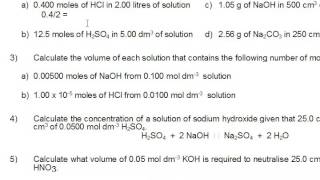
Charles Collingwood walks through titration calculations using three core formulas: n = M×V, M = n/V, and n = mass/Mr. He converts volumes to liters and solves practice problems step by step, finding values like 0.1 mol, 0.2 M, and 0.966 M.
Chapters
Okay, titration calculation answers. Calculate the number of moles in the following 2 liters or 0.05. Capital M means moles per liter. So we use moles equals molarity times volume, MV, which in this case molarity is 0.05. Volume is 2. Let's tidy it up a bit. Times 2 and that comes to 0.1 moles. Can we see this better in blue? 25 centimeter cubed. 25 centimeter cubed. 0.01. Well, in this particular case. Oh, we're doing a C next. Doesn't really matter. Moles Molarity equals. So MV gives us the moles. And this equals. Well, the molarity is 0.01 and the volume 0.025. And that gives us 0.00025. 50 liters of 5 molar sulfuric acid. Well, MV equals molarity times volume. 5 times 50. And that comes to 250 moles here. 250 moles. Let's go over to the next question. 10 centimeter cubed is 0.25 molar. Well, molarity times volume equals moles. Molarity 0.25. Volume 0.01 in liters, of course. And that gives us. Well, we move the decimal place two place to the left. 0025 moles. Question two. Let's move up to question two. Calculate the concentration of the following. Well, we just change the moles equals MV equation. Let's go into here. Moles equals mv. Well, if you want the molarity, the concentration M equals moles over V. All right, so let's. Well, let's put this, take it out of here. Let's put it into this section here so we could see it. I'm going to take it into here. This is our equation. All right, let's font that so that we can recognize it. And now let's just have a look at the questions. Well, what are we given? We're given the moles 0.04. So we want moles equals mole over V. So 0.0 0.4 divided by the volume in liters, which is 2, and that comes to 0.2. And its concentration is a capital M over here. Ah, we're giving it in grams. Well, we need to change the grams to the relative using the relative mass. So we need to also use this equation. I want to put it over here now. So the moles equals the mass divided by the relative mass in this particular case. Then moles is the mass. It's 1.05 divided by the relative mass sodium is 23. And, oh, adds up to 40 altogether. So that gives us the number of moles 1.05 divided by 40. Let's have a look at that. 1.05 divided by 40. Take it in. 1.05 over 40. There's our moles, which is 0.0263. 0.0263. This is moles. And we're going to put this into 500 centimeter cubes of solution, right? So the molarity equals the moles over the volume. So M Bengals the moles 0.0263 over the volume, and the volume is 0.5 liters. And that in turn is going to give us. So we divide our sum by 0.5 and it gives us an answer. 0.0525. 0.0525 molar. Take that back, run this back a little bit. Molar, And on to next part of the question. Remember, moles is MV. Molarity is moles over V. Well, molarity equals moles 12.5 over volume. And the volume in this case is 5. Well, 12.5 over 5 is 2.5. Don't even need a calculator. What a crack. There we go. Next one. Now we're going to get the relative formula mass of sodium carbonate. Well, that adds up carefully. It's 100 6. So it's 2.56 divided by 106. This gives the number of moles. Bring this in. 2.56 divided by 106. 2.56 divided by 100 6. And that gives us number of moles, which is 0.0242. 0.0242. And we're told it's in. So that it's in 0.25 liters. So it's 0.0242 divided by 0.25. And what we do, just divide our number in the calculator by 0.25. And this gives me 0.966. 0.0.966. Walla. All right, we'll go on to question three in the next video.