Titration problem - amino acids
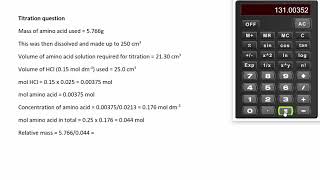
Charles Collingwood walks through a titration problem to find the molar mass of an unknown amino acid. A 21.30 cm3 aliquot was titrated with 25.0 cm3 of 0.15 M HCl, and the calculations yield a molar mass of approximately 131 g mol-1. The video shows two routes to the same answer.
Questions this video answers
5.766 g
250 cm3
0.15 M HCl, 25.0 cm3
21.30 cm3
0.00375 mol
Chapters
All right, we've got the essence of the question here on the screen in front of us. You're told that the mass of amino acid that was used is 5.766 grams. Now from that, if you knew the relative mass, you would be able to work out the number of moles. But we don't know the relative mass. That's in essence is what we have to find from this. So this 5.766 grams was dissolved in some water and then made up to 250cm cubed. So all of the 5.766 grams goes into the 250cm cubed. Okay? So any small amounts taken out will take proportional amounts of this 5.766 grams out. Okay? Right. Now, when we carried out the titration, or when the titration was carried out, you found that we titrated it against hydrochloric acid and the hydrochloric acid volume was 25 centimeter cubed. Now we know the molarity of the hydrochloric acid and we know the volume of the hydrochloric acid. So we can work out the number of moles of hydrochloric acid directly from this. The moles of hydrochloric acid HCl will be equal to the molarity, the concentration times the volume. So that's 0.15 times 0.025. Alright, so we call up our calculator at this point. So we've got 0.15 times 0.025 and that gives us 0.00375. 0.00375 Moles of hydrochloric acid. Now this was a titration, so you know that all of the hydrochloric acid reacted. All right, so if we assume that the reaction between hydrochloric acid and the amino acid solution is a one to one reaction, which is a fair, fair bet for a moment. Actually, I didn't have a look at the amino acid choices that we had. But let's just assume that there's only one amine group. Therefore it's a one to one reaction. That means that this will also equal the moles of the amine. Sorry. The amino acid. Amino acid will also equal 0.00.375. Okay, so we know then that when we've taken a 25 centimeter cubed sample out of this. No, that's wrong. Sorry. We know then that the all of the solution of amino acid that we had here, the 21.30 centimeter cubed of amino acid contained this amount of moles. All right, so we've got the volume of the amino acid and we've got the number of moles of amino acid. So we can work out the concentration. Okay, so we could say the concentration of the amino acid. Equals. And then we just. So it's molarity. It's the moles divided by the volume, which is 0.00375, divided by 0.0213. Okay, I'm going to show you a different way to work this out in a minute, but this is the. This is a very conventional way of doing it. All right, so we've got 0.00375. We divide this by 0.0213 and that gives us 0.176, 0.176. And this is moles per liter. I'm going to just copy this here. Moles per liter. That's the concentration. Right? Now if you know the moles per liter and you know that we had 250cm cubed. Let me just check that. I've written it down. Right? I'm just. Yeah, that's the moles per liter. So in every one liter you've got 0.176. So in 250 centimeter cubed, which is a quarter of a literature, you will have. So the moles of amino acid in total now will be equal to 0.25 times because it's 0.25 of a. Of a liter times 0.176. Okay, so let's call up our calc again. So we take our number and we multiply it by 0.25. And that gives us 0.04, 0.044. Let me just check it again. I did look at it very quickly. 0.044. Yeah, near enough moles. Okay, now if we know the number of moles, which we do here, and this represents everything that was in the 250cm cubed. So that means this is the mass of this number of moles. So we can now work out the relative mass. The relative mass will be equal to 5.766 divided by 0.044. Let's have a look at this. Can I do this easily on the calculator? Can I, Can I, Can I. If I take that number, reciprocate it and multiply by 5% multiplied by 5.766, and that gives us 131 approximately. All right, so now it's quite a question of looking at your possible Choices. I'm going to throw up your question. I don't know what the possible choices were. I can't remember. Well, you just have to work. You just have to see which one of those. Which one of those amino acids matches. All right? Now another way to do this. This is the conventional way to do it. The other way to do it is you could say, all right, once you've worked out the number of moles. So let's do alternative. Alternative method. Some people like the alternative method. Okay, so we know the moles of HCl, which equals the moles of amino acid in 21.3 cm cubed. Okay, So the moles. So what is it equal to the moles of HCl? Was. We worked it out here somewhere. Where is it? 0.00. Let's put it down here. I want to write it in this line, which is equal to that. All right? So you know the volume of the amino acid and you know the number of moles of amino acid. So you can say. You could use simple proportions. So you know that 21.3 is a much smaller amount of 250 by a factor of 250 divided by 21.3. So if we said that the. So here we'd have the moles of amino acid in 250cm cubed will be equal to 0.00375. Whoops, that wasn't very clever, was it? 00375 times 250 divided by 21.3. Right, so this is our alternative method, just using simple proportions to work out the number of moles in the solution. So we. Let's call up our calculator. Let's just cancel everything now. So we say.00375 times 250 divide by 21.3 and it gives us 0.044, which you will notice is exactly what we had here. So then you do the last step exactly the same, all right? And it's the same answer. So one, you just scale up from 21.3 to 250 to get the total number of moles in there. The other you work out in a more conventional way by getting the concentration of amino acid and then saying, well, you haven't got a full litre, you've got a quarter of a litre or 0.25 of a litre. So you get the moles that way. Doesn't matter which way you do it, you get an identical answer. Hope that helps.










