Valence shell electron pair repulsion
Charles Collingwood explains how to predict molecular shapes using VSEPR theory and Lewis structures. Water bends at 104.5 degrees instead of the tetrahedral 109.5 because lone pairs repel more strongly than bonding pairs. Expanded octets let phosphorus in PCl5 arrange five bonds in a trigonal bipyramidal shape.
Questions this video answers
Approximately 104.5 degrees (reduced from tetrahedral 109.5° by ~5°).
Approximately 107 degrees (reduced from 109.5° by ~2.5°).
120 degrees.
120 degrees between equatorial positions; 90 degrees between axial and equatorial positions.
90 degrees.
Chapters
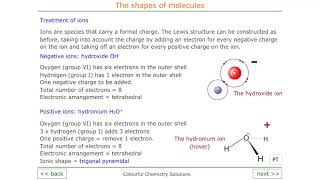
The shapes of molecules and ions. The first step towards identifying the shape of a molecule or ion is to draw out its Lewis structure. The Lewis structure is otherwise called a dot cross diagram. This means that you put in all of the electrons that are in the outer shell of each atom when it's bonded together into the molecular ion. Remember that for an ion, you must add the electrons that appear as a charge if it's a negative ion, or subtract them if it's a positive ion. So the first step is to count up the electrons around the central atom. Remember that each atom has the same number of outer electrons as the group number or the old group number. Carbon now is group 14. It used to be group four. So carbon's got four electrons in the outer shell. Oxygen six, sulfur six. It's. And then you try to make structures with full octets around each atom. Remember, that's just not possible for compounds with odd numbers of nitrogen atoms, because nitrogen itself has got five electrons in the outer shell. It's in group five or 15, which means no matter how hard you try, you cannot get an even number of electrons in a compound that contains an odd number of nitrogen atoms. Lets have a look at a few examples. Water. Water is one of the most commonly asked questions in exams. The central atom is oxygen. It's in group six or 16, so it provides six electrons. And there are two hydrogen atoms each providing one electron, which makes two, obviously. So six and two means the total number of electrons around the oxygen is 8, which can be separated into 4 pairs. So there's a picture of our oxygen atom with four pairs of electrons, although we've borrowed two electrons, remember, from the hydrogens. This makes the electronic structure tetrahedral. And the angle between electron pairs would be 109.5 degrees or 109 degrees, 28 minutes. But only two of the electron pairs are involved in bonding hydrogens. This means that the molecule is angular because the lone pairs are ignored because they're invisible. So here is our picture of the water molecule. What would be the electron or Lewis structure picture of the water molecule, where hydrogen is only this bond each height. There are two hydrogens bonded by pairs of electrons and there are two lone pairs. Now, this picture here gives a misleading impression that the molecule is going to be linear. But of course, this is a three dimensional representation down here. And you can see that the hydrogens will actually adopt positions as angles to each other, corresponding to the tetrahedral bond angle nearly. In fact, the lone pair, lone pair repulsion and the lone pair Bonding pair repulsion is greater than the bonding pair. Bonding pair repulsion. This is known as the valence shell electron pair repulsion theory. And so the effect of having two lone pairs repel the two pairs, bonding pairs of electrons that are holding the hydrogens. So the hydrogens get squeezed closer together and they get squeezed down from about 109.5 degrees down to about 104.5 degrees. So the result is a squeezing of about 5 degrees. And we could say that there's 2.5 degrees of squeezing per lone pair. Let's have a look at the next example. Ammonia NH3. Consists of nitrogen and three hydrogens. Well, the nitrogen starts off with five electrons. One, two, three, four, five. Here. And each hydrogen shares one pair of electrons. Therefore, three hydrogens provide three more electrons and. And the nitrogen gets its full octet. These four pairs of electrons arrange themselves tetrahedrally. But of course, only three of the positions are used for bonding. And so down here we get a shape where we cannot see the lone pair, but the lone pair is there. And the three hydrogens are in an organization which we would call trigonal pyramidal. With the nitrogen. There's our original picture with the three pairs. But this then turns, it looks like this because we can't see the lone pair. Once again, it's invisible. Now, the bond angle here, the bond angle, the HNH bond angle, because there's one lone pair here, squeezing the hydrogens closer together by about 2.5 degrees. This bond angle drops from 109.5 down to 107 degrees. These numbers are very useful if you can remember them. Let's have a look at an ion. Ions are species that carry a formal charge. They carry a plus or a minus or two plus or two minus. So a hydroxide ion here. Oh, well, again, we can count up. Oxygen's got six electrons, hydrogen's got one that makes seven. But we must add in one more for the minus of the. Oh, that makes eight. So once again we have four pairs of electrons. The electronic arrangement around the iron is tetrahedral. Clearly, the molecule has no shape. It's linear that you can't. The only way you can join two nuclear centers is a straight line. So it doesn't make sense really to talk about its shape. But the electronic shape would be tetrahedral. And the hydroxide ion has got a full octet of electrons around the oxygen and it has a pair of electrons around the hydrogen, which is what satisfies the very first period. Now, if we look at the next ion. This positive ion is the hydronium or hydroxonium ion, H3O. This time we've got three hydrogen electrons plus six from the oxygen. That makes nine. But we're going to knock one off because it's got a positive charge, that makes eight. So once again, the oxygen has an octet of electrons and the electrons will arrange in a tetrahedral orientation. But this time, three of the pairs of electrons are being used to bond hydrogens. And so we can see from the dot cross picture down here, the hydronium ion, that we've got four pairs of electrons around the oxygen, so it's got its full octet. Each of the hydrogens has a pair of electrons. So it's got its pair, which it needs to satisfy the first period requirement. But the shape, if we hover over, will be once again trigonal, pyramidal, because of the electronic organization being tetrahedral. And only three of those sites are being occupied by hydrogens. Let's move on to the next one. Now, some molecules are said to be electron deficient, because no matter what we do, we cannot get to a full octet. And these such molecules are only exist in the gaseous form. This particular molecule, boron trifluoride, well, boron is in group three or 13. It's got three electrons. Three fluorines provide three more electrons for the boron, and that satisfies the fluorine's 8 or the octet around the fluorine. But of course, the boron now only has three pairs of electrons around it. So if the electron, the electron domains form a trigonal planar shape. And that trigonal planar shape has a bond angle, the FBF bond angle of 120 degrees. The boron trifluoride is said to be electron deficient. And in the solid state, the boron trifluoride molecules will join up to make a polymeric structure in which all of the borons do in fact have a full octet, but in the gaseous state, it's electron deficient. Now, nitrogen dioxide is one of the cases I talked about earlier, saying nitrogen has five outer electrons, and with one nitrogen you cannot make a full octet. So here nitrogen has to bond to two oxygens. The form is no. 2. Well, we can share a pair of electrons with one oxygen, share two pairs of electrons with one oxygen rather. And this satisfied this oxygen's requirement for electrons, it has an octet. Now, we've used two of the nitrogen's electrons, so it's still got three left. It could share two Pairs with this oxygen as well. But if it were to do that, it would end up with nine electrons in the outer shell, which is too many electrons for an atom in period two. Instead, what the nitrogen can do is it can coordinate a pair of its own electrons into the oxygen's outer shell. This forms a dative coordinate bond. It's a shared pair of electrons like any other shared pair. And this means the nitrogen has only seven electrons around its outer shell. It is electron deficient. And what happens. Nitrogen dioxide is sometimes called a free radical molecule. It's got this single unpaired electron, and it's very reactive. In fact, in under normal conditions, two nitrogen dioxide molecules will get together to make dinitrogen tetroxide, where they share this electron or share a pair of these electrons between two molecules. So here's a bit more of a treatment of nitrogen dioxide. Nitrogen group 5 has got five valence electrons, 5 or 15. Remember now, five valence electrons each oxygen has six. Each oxygen bonded shares one pair of electrons per bond. In this case, only one oxygen could be double bonded, as the two double bonds would exceed the octet around the nitrogen. The second oxygen makes up its octet by accepting a lone pair of electrons from the nitrogen. This is a dative coordina bond. So this is our Lewis structure of nitrogen dioxide. Now in period three, Some of the elements in period three, such as phosphorus and sulfur, can expand their octet. That means they can fit more than four pairs of electrons in their outer shell. And we find this with molecules such as phosphorus, pentachloride, phosphorus. Phosphorus starts off with five electrons in its outer shell. It has to share one pair with each chlorine. That means chlorine donates or provides one electron for the pair. So there are five chlorines. That's five electrons, five from chlorine, five from phosphorus. That means the phosphorus has 10 electrons in its outer shell. That makes five electron domains. And the organization of five electron domains is this trigonal for the three in the middle bipyramidal organization, It's a trigonal bipyramid. The bond angles around the center are 120 degrees. And the bond angle between the apical chlorines and the equatorial chlorines is 90 degrees. Equatorial means they're around the middle, like the equator, apical, the apex, the top and bottom sulphur hexafluoride has got the same kind of issue. Sulfur's got six electrons. Six fluorines provide six electrons. That makes 12 electrons or six electron pairs. Those six electron pairs arrange themselves in an octahedral orientation or arrangement where all the bond angles are 90 degrees. Seven regions of electron density does also happen with things like chlorine heptafluoride. And this would be a trigonal bi sorry, a pentagonal bipyramidal arrangement with five fluorines around the Ecuador equator and one up and one down. This is not covered by the IB syllabus. Moving on to the noble gases, Xenon from group number eight provides eight electrons. Now there are two ways that this can this can happen. This can bond. But we'll deal with the simplest one. Here the total number of electrons again is six pairs. Because each xenon provides eight, each fluorine provides one. It eight and four makes 12. That's six electron domains. Those six electron domains arrange themselves as a octahedral shape and in this case there are four fluorines and they adopt the positions which minimize the repulsions between the lone pairs. And this is square planar. So the bond angle, the f xef bond angle is 90 degrees.










