Charles Collingwood explains that acid strength depends on how completely a substance dissociates in water, not its concentration. Strong acids like HCl dissociate fully; weak acids like ethanoic acid only partially. Ethanoic acid has a pKa of 4.75, while chloroethanoic acid's is 2.86.
Chapters
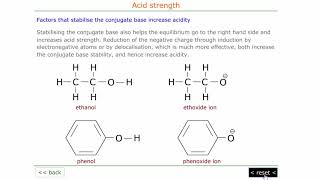
We're going to have a look at weak and strong acids in this short video. Now, this mustn't be confused with concentration. Acid strength is characteristic of the particular substance that we're discussing. And acids can be weak but concentrated. And likewise acids can be strong but dilute. So we must be very careful how we use the term acid strength. The strength of an acid is a measure of how far the interaction with water lies to the right hand side. If we have a look at hydrochloric acid, HCl, when it interacts with water, it moves completely to the right hand side and dissociates fully into ions. So hydrochloric acid is a strong acid. However, a weak acid, such as hydrocyanic acid, when it interacts with water, only produces a few hydrogen ions and cyanide ions. The equilibrium in this case lies less than 1% to the right hand side. So a solution of hydrocyanic acid contains mainly hydrogen cyanide molecules and some cyanide ions and some hydroxonium or equated hydrogen ions. This doesn't have any effect stoichiometrically because, for example, when we neutralise a weak acid, the OH ions that we add to neutralise the acid remove the hydrogen ions from the right hand side. And what happens? More hydrogen cyanide responds by dissociating to make more hydrogen ions, which then can react with more base. So the process continues until all of the acid has been dissociated and, and all of the hydrogen ions have been neutralized by the addition of the base. So stoichiometrically there is no difference between a weak acid and a strong acid. If we compare weak acids, well, we can see that for some weak acids, this weak acid, ethanoic acid, has got a PKA of 4.75, whereas chloroethanoic acid has got a PKA of 2.86. Now, the lower the PKA value, the stronger the acid, because the PKA is a measure of the dissociation. It's measured, it's the negative log of the hydrogen ion, sorry, negative log of the dissociation constant, the acid dissociation constant, so that greater the acid dissociation constant, the greater the dissociation and hence the lower the PKA value. Now, in these two species, it is easier to remove, to break the OH bond here because the chlorine is pulling electrons away from the carboxylic acid group, that makes this bond slightly weaker. And so the chloroethanoic acid is more easily dissociated. It's a slightly stronger acid. Anything that stabilizes the conjugate base, that's the negative ion that's produced when the hydrogen leaves, that also increases the acidity. If we compare ethanol and phenol, for example, here, ethanol is the structure here. Ethanol, it's not really classified as acid because it's very, very weakly acidic. If we were to break the OH bond here, we would produce the ethoxide ion, which is not at all stable. It's a very strong base. So the. When the base, or the conjugate base formed by a loss of a hydrogen is very, very strong, the acid, in other words, the species before it's lost, the hydrogen ion, is very, very weak as an acid. In fact, as I said, ethanol is too weakly acidic to be classified as an acid. However, if we look at a similar situation down here for phenol, phenol, when it loses the hydrogen, becomes the phenoxide ion. And the phenoxide ion is capable of stabilizing itself by delocalizing the negative charge around the ring that allows the phenoxide ion or affords the phenoxide ion a little bit of extra stability, enough. So phenol can be categorized as an acid. In fact, it's called carbolic acid. So, to quickly summarize, then, a weak acid is a species that only partially dissociates in solution. A strong acid is a species that fully dissociates in solution.