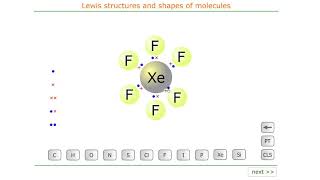
A short instructional video by Charles Collingwood explaining the Lewis-structure reasoning for xenon hexafluoride (XeF6). The speaker counts valence electrons (xenon + fluorines), places six bonding pairs and one lone pair, and concludes the geometry is best described as a distorted pentagonal bipyramid often called an "umbrella" shape.
Chapters
Okay, the shape of xenon hexafluoride. Let's take a xenon atom. Xenon is a inert gas and it has eight electrons in its outer shell, but it's going to have to share with six fluorines. So if we take six fluorines out, each fluorine is going to share a pair of electrons with xenon like this. And six times. There's not much room for this, but we're going to try to get six fluorines around the xenon. And let's put another one here, pair of electrons, and we'll compress there 5 or a 4. That'll do a 4,45. And another fluorine or another fluorine atom. Okay, so our Lewis structure, we can basically see the Lewis structure is going to get very, very, very packed, isn't it, here in the situation with our six fluorine atoms. So what's going to happen? And when we add up all of the. Add up all of the electrons. Let's have a look. Let's put a fluorine there. It's moving a bit further away. So, 1, 2, 3, 4, 5. Let's put this fluorine up here. Let's turn it. Put this electron pair there and rotate it a little bit. There we go. So now we're going to put another fluorine round. And down here, say, okay, so we'll add up the electrons that we've got. Remember, the xenon as provided already. The xenon provides eight electrons, and each fluorine is going to provide one. So there's 1, 2, 3, 4, 5, 6 electrons from the xenon. That means there's another pair of electrons somewhere. So this pair of electrons is going to have to go somewhere. We're going to have to put this pair of electrons into a place where it minimizes repulsion. Well, with six, with seven sites, the shape that we get is actually a pentagonal bipyramidal shape. So we take, is we take five fluorines in a pentagon around the central part of the xenon, and with one fluorine underneath at the bottom, like this. And the lone pair of electrons, lone pair of electrons will be at the top. And it will, it will provide a kind of. Let's just put that round like that. It will get a shape which looks a little bit like an umbrella. And sometimes this is what it's called, it's called an umbrella shape. So we have this, this, this pentagon, and I haven't shown it very well here. So let's see if we can get a pentagon of fluorine atoms. There we are. These five fluorines are in a pentagon, flat planar pentagon around the xenon with the lone pair of electrons, which pushes them down slightly, and so we end up with this kind of umbrella shape.