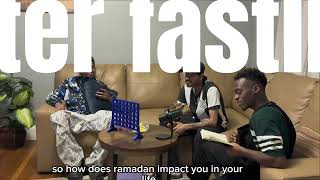
In this informal YouTube podcast, host A and co‑host B welcome two guests, Rawad (Rahman) and Uma, to discuss Ramadan from a layperson’s perspective. The dialogue covers the basic definition of Ramadan as the annual lunar month when Muslims fast from dawn (Suhoor) until sunset (Iftar), explaining how the Islamic calendar is determined by moon sighting and why the month shifts each year. They describe the daily fasting routine, the required ablution (wudu) before prayers, and special prayers such as Tahajjud. The participants talk about practical challenges—age of first fasting, health concerns, work schedules, and modern distractions like phone use—while also noting cultural customs such as the Eid celebration and the role of the Imam in announcing the month. Interfaith reflections appear when they compare Muslim practices to Christian ones, emphasizing shared humanity. Personal motivations for fasting beyond food, such as digital detox, are also shared. The conversation ends with a brief discussion of prayer direction (Qibla) and cleanliness before worship. The overall tone is conversational, educational, and supportive, aiming to introduce Ramadan to listeners unfamiliar with the tradition.
Chapters
What is up, podcast?
Uh, in the house.
So today I'm hosting two guests, Rahman and Uma. So let's introduce you.
You're very elated, man.
See how you're already smiling. All right, I count on you to give us some education on Ramadan, because me too, I don't even know a lot about it.
Okay, this is really interesting. Thanks. This is a good question. So Ramadan is like a month that every year, like, the Muslim people, they have like a lot of good things. Good things. Yeah. So, and then we have to do something called fast, like fasting. Yes. So we have to fast all the month, like 30 days without—
how many days? Dairy.
So without eating food in the morning, without drinking water, start around 5, uh, 5 AM, would you like from sun— like sunrise to sunset? Like sometimes, you know, the times is changing. Sometimes the sunset around 5 and then sometimes 7, but for now during just like, you know, like really short days, the sun gonna stay like to early.
Is it every month?
Is it, or is it every month, or it's just doing this month?
No, it's like, no, like every year is just like one month specific, one month like we have to do Ramadan. And then sometimes it came on June or July, you know. Yeah, it changes. But in the Quran, like in the Quran they have like specific like count, and then this is not gonna change for, for for that, but sometimes it's gonna be different than like, uh, like, I don't know how to say that.
It's fine, it's fine.
Yeah, but how do you know?
How do you know that this is the exact one?
Because they, they have like count the way that, for example, the, these people are counting like January, February into like, like they focus on and then, you know, like I thought you would say I will like 4 kids, you know. Yeah, yeah. Every year is like one.
No, that's— this is for the reason for the religion. It's gonna be not control of the everybody about the child, the guy, you know, the pop. Yeah, that's like they have one in the Imam, they have the calendar. Every month changing, every year they're one month they're gonna change it. If this year is going to be February, next year coming to one month is January. Between January is like 15, 16 round that they start the Ramadan next year. But this year February, last year March, already passed the March. Every year counting that like monthly, one year, one month after one month, every year they're changing. That's Imam, he took the schedule And he gonna decide that when they coming the Ramadan. He know that because he have in the Quran and already Quran, they write everything. Yeah, next year they coming January. This year is February, next year coming at January. That's every year, every year change the month. Every year they change the month because The, uh, the art is coming so fast.
Sure, you know, you know, it might be a little like confusing for you because like you have no fasting and then maybe you sometimes at night— have you seen the moon? Yeah, yeah, like, yeah, you see the moon. So this is for the Muslim people, this is, this is what, what they count on. Like for the Muslim, the moon that you see like sometimes at night Yeah, like every 30 days this moon going to change, change, and then it's going to repeat like the same. Like every 30 days is what we say, like the moon like die, it's disappearing like for 2 to 3 days, and this is going to appear.
Okay, again.
Yeah, it's going to appear. This is what we call Ramadan. There's no changes, it's the same moon.
You said a lot of things. You are— so, so I'm going to go to— I'm going to go to the To the next question. My next question is for right now. So what are the challenges, the challenges that you face, you may face when you start fasting? Like what can, what can be difficult to begin fasting?
Difficult thing is that, you know, the fasting that only one month.
Yeah, for me is not one month is a lot.
Yeah, that's for me easy and That's some people because, you know, they're sick. The people want to be sick. This is the reason for the break the Ramadan. Or alone. Yeah, yeah. And you're gonna cook, go to work, come back. Yeah, this you can do that, but mostly Muslim people, the fasting mostly don't break because The right age to start fasting? They don't say right age. No, it's gonna be for parents. They say, oh, my children, maybe this month, this year, he can do it. If United States, it's not long time, it's— I think it's small that, you know, that, you know, the long time is just 10 hours, 12 hours, like something. You started 5 and round 5, you're gonna break. It's so short, I think. Start the fasting. You don't watching the video like that, you know. You don't watch that. No, you don't watch the video. You don't use the too much phone, like, because if you're gonna use— yeah, no, no, no, no.
If that—
the, the Quran said no. You can do that. People that believe, they don't do that. Now is technology, you know, that the people gonna so smarting. And then, but they have reason. Yeah, this— you don't use the phone, you don't watching the girls, your eyes gonna be closed. Just gonna watching girls, even the out of the country girls, they have the clothes so very different. Yeah, is that so very difficult? And you don't watching because that the Muslim, the people, all of the dress is so longer, so very different, it's 100% different.
When you're fasting like this, can you do like, if you fast maybe, maybe one week, you see that now you can, you have to break, can you break and start again?
Only 30 days, sometimes 19, uh, 29 days, sometimes 30 days. It's different for them, different for them.
Thank you very much. Welcome. So my next question is for you, Mark. Uh, as I said, this one is a specific question. How does Ramadan impact your daily life? So now you're fasting. Let's say in two versions of you, the version where you're not fasting and the version where you're fasting. So what's the difference?
You mean like about our life? How is it gonna impact our life, health, or just like our beliefs?
That is a good point.
Into. I mean, if you can just tell me how this going to impact your life also after fasting.
But I want to tell you, like, actually this the way you fast, so it's March, February, so in January you were— so how, how was, how, what's the difference between the January you and February you?
Like the difference between when, while I'm fasting, and then the And then they write that at this time.
So how is life now? How is your day?
What has changed? So, um, I mean, so I know you used to—
now you wake up very early.
Yeah, during the Ramadan, you know, or like, is the month that you have to be like really serious about the religion that you're doing. And they like, they're doing the right things because Allah can forgive like many people. And then, and then the things that are required to do in the Ramadan, like praying on time, like not talking bad words, you know, like, you know, just like being like serious. Yeah, like not watching like some videos, like some videos like, you know, like, you know, bad things, you know, like it's a good thing to do. But sometimes you might be like hungry or like thirsty sometimes, like want to drink some water, like, you know. So, but I don't know, maybe they have like some secret or something like that. But you know, at the end of the day or the end of the month, you're just gonna feel normal. You're just gonna be like the normal people, like the same people that they don't even fast. Yeah, and then yeah, just that. I mean, like, I don't know what they're— maybe they might have some secret or something like that, but it's not a big difference.
What do you think of that, everyone? You want to ask something? And what's the difference between the special day, new version of you during fasting and new version not fasting? This is so special. This month is so special.
Everybody, every Muslim people, for example, that you were like feel like so, you know, upset. You feel so upset like that.
You are alone like that.
If you can fasting, try to fasting and start the fasting, you feel so good. Start the prayer, yeah, and you feel This time we both gonna— yeah, the opinion is every religion is same, just culture is that different.
Yeah, every religion is same.
You go to your church, I go to my mosque, you go to his church. Some people go to the— I don't know what's the people they're gonna be fighting or separate the people, you know. Some people they're gonna be separately. Oh, you are Muslim?
They're like, oh, you are Christian.
But don't do that because every human is same. The one God that created your God. What's your God name? Yeah, the God is— my God is Allah. The Prophet is Muhammad. Yeah, just like saying everybody human, love everybody. Everybody have heart. You have eyes, I have eyes.
Everything.
Yeah, the human. Yeah, yeah.
And I like the fact that you mention something important, like since you upset or in your own— in your past, it's really going to change yourself.
That's that beautiful.
You mentioned something too about— you were talking about if after passing there's a big difference.
I feel like, I feel like there's no, no big difference. There is a lot of requirement that your life, you have to respect. So that's why. But even after fasting, you guys can keep praying? Yeah, absolutely.
Prayer is all life.
Last, last question. So we're going to talk about the direction. Sometimes when before you guys start to pray, you just can't put your mouth anywhere. Is there like a precise place to put it?
Yeah, they need some places because not put anywhere because, you know, the people go to use the bathroom and they use the floor and it's so dirty. Where you gonna mop in the floor and after you gonna put is the cleaning.
So I'm using— it's fine, I'm just gonna plug it here. That's interesting. I'll be waiting for you. Uh-huh. A little bit. Yeah, go ahead.
Okay, so what is ablution?
Ablution? Yeah, ablution. So this is the one of the thing that anytime that you want to pray, like the prayer time, you have to You have to do lavation before praying. So you have to wash your hands and then wash your mouth and wash your face. After that, hands, head. After the last one gonna be the legs, legs, feet. So it's just like to be like prepared. And then they required like any, it's required like anytime that you want to pray, you have to do this first before praying. Let's say if there is no water, for example, pray on the ground. You can just like, like to put your hand on the ground and, you know, just like to believe. And the most important for the Muslim is just for your heart. You know, just like doing things or like trying to make, like pretending to be some, someone or something that you are not. Yeah, you have to believe and implement in your heart.
I'm with anyone watching, so hope is going to be here to do this.
And yeah, every day, every day, try to fasting, everybody.
So what about you? Is there something like special that you have to do in your religion, like every year? Yeah, like what this thing that you often to do?
Yeah, like, like At least we're going to start fasting. We're going to start something called— we're going to start it around the middle of March. So what was they saying? Fasting was for these 40 days.
40 days. So, but so, okay, so there is like some requirement like age or like the way that like, you know So there's no age restriction, it depends on your lifestyle.
It depends on your lifestyle. And for my personal experience, I used to fast too. I fast, I mean, I fast. So I'm actually waiting for the 7th of March to start fasting. The only issue with us is that when you start fasting, fasting is not something that is consistent with us.
Special.
It's very special for you.
What's that? Because fasting is the thing that we are supposed to do when fasting is—
but you can drink water like you in the world.
Listen to music. Some people fast, you know, so I'm sure that people even do 40 days.
40 days? Last.
Never know. Okay, just for food, fast for maybe if I'm someone who's been using a lot of my phone, maybe the fasting will be for that. I will say maybe for these 3 days I will use— I will bring my phone to school for 3 days. It's a way of fasting, so it's a devotion. Thank you for asking that question.
Okay, that's cool. I'm happy to share that with you.
I'm happy. Just for your reason, you also behind the camera, you fast, you do try to fast and it's possible. Yeah, okay, it's fine. And if you can do that, yeah, okay. If you can—
whatever. What's up, man?
Hi, bye-bye.
Okay, it's the hour of the time.
Welcome again to this new podcast.
This is how I'm going to call it now. Uh, in Kordi Space, the house.
So today I'm hosting two guests, Rawad and Uma. So they're actually going to share their own experience about Ramadan. I know, Rawad, you're very elated, man. See how you're already smiling. All right, I count on you to give us some education on Ramadan because me too, I don't even know, I know nothing about it. So I always want to know. Oh, I am too. You guys can see.
All right. Am I ready?
I'm gonna start.
Uh, okay, this is really interesting.
Thanks.
Uh, who wants to start? Should I start with you?
So whatever, you can just take a shot, like whatever, like anyone you want. So far, or you can just ask the question, like anybody that who got the answer, they can answer easily.
Okay, I'm gonna start with you. Seriously, let's check. My question is for you, what is Ramadan?
Um, this is a really good question. So Ramadan is a month, it is like a month that every year, like, the Muslim people, they have like like, uh, like it's like this month, like something like special in the month, like this month include like a lot of like good things.
Good things.
Yeah. So, and then we have to do something called fast, like fasting. Yes. So we have to fast like all the month, like for 30 days without—
how many days? Theory.
So without eating food in the morning, without drinking water, just like, for example, you're gonna start around 5, uh, 5 AM until like from sun— like sunrise to sunset. Like sometimes, you know, the times is changing. Sometimes the sunset around 5 and sometimes 7, but for now during this time is Just like, you know, like really short days, the sun gonna stay like to early.
So this is your next question. Is it still, still on what is Ramadan? So, uh, is it every month? Is it, or is it every month, or it's just really smooth?
No, it's like, no, like every year is just like one month we have. Like every year there is like specific one month like we have to do Ramadan, and then this month Uh, like, uh, like sometimes it changes. Like, I mean, like it can like sometimes came on June or July, you know, but it's different. Yeah, it changes. But, but for like in the, in the, in the Quran, like in the Quran they have like specific like count and then this is not gonna change for, for that, but sometimes it's gonna be different than like, uh, like, uh, like the month, like how the— I don't know how to say that.
Yeah, but how do you know?
How do you know that this is the exact one?
Because they, they have like count the way that, for example, the, these people are counting like January, February into like December. And then for the Muslim, they have like specific count, like, like like they need— they have— they— we don't usually say like January or February, like, like the month, you know, the month. This is what, like, this is what they put it like, they put this on, and then, you know, I thought you would say— no, I mean like focus, you know. Yeah, they're just like focus on that, like, you know, like Like the specific day and then like the month is gonna be every year. It's like once in a year.
That's—
this is for the reason for the religion. It's gonna be not control of the everybody. This— they have, you know, the— they have church, you know, they have big— how to call the church— the guy, you know, the Yeah, that's like they have one Imam, they call that Imam. Yeah, and it's all of this counting the calendar, is the counting the calendar. They have the calendar belong this for every month changing, every year they're one month they're gonna change it. If this, this year is going to be February, next year coming to one month is January, between January is like 15, 16 round that they start the Ramadan next year. But this year, February— last year is March, already passed the March. Every year counting that like monthly, one year or one month after one month, every year they're changing. That's Imam, he, he looked the schedule, he looked the for calendar and gonna decide it when they coming the Ramadan. It's all of those Arabian country, you know, the Saudi Arabia, that's the all of Muslim people, the dream big of the people, dream of the Makkah. They call the Hosh Makkah. It started there. Some people go around 1 week, some people go 2 weeks, depend the people how much have money they gonna go over there. Yeah, if you have money, I have money, that's everybody, every Muslim people, that big dream, go to the Mawlid. They call them— oh yeah, yeah, this, this Imam, he gonna decide it. He look for the calendar, he look for the moon, he'll look for the— I don't, I don't know what's the call the another thing. He looking for that, the schedule, and he know and he going to announcement for everybody. And then after, all of the country they're going to announcement for that.
So is—
yeah, is all of the Imam for that. Imam, he know that's because he have in the Quran. And already Quran, they write everything. Yeah, this why they're going to changing every year, every month. Next year they're coming January. This year is February, next year coming at January. That's every year, every year change the month. Every year they change the month because the, uh, the Earth is coming so fast.
Sure, you know, you know, it might be a little like confusing for you because like you have never fasting and then maybe you got like, you don't have like any experience about that. But you know, like, sometimes at night, have you seen the moon? Like, yeah, you don't see the moon. So this is for the Muslim people, this is, this is what, what they count on. Like, like, like, for example, like, like, like the end, end of the month here, like from, for example, from January to February, you know, they, they you know, they don't care like if there is like moon or there's no moon. They like, they like, they don't focus on the moon, you know. So, but for the Muslim, the moon that you see like sometimes at night, yeah, like every 30 days this moon going to change, change, and it's gonna repeat like the same. Like every 30 days, it is, uh, there is something that we say like Moon like that, and it's gonna be disappearing like for 2 to 3 days, and it's gonna appear. Yeah, it's gonna appear maybe like in, like, for example, when you are in like some, like some area like where like is like dark or something like that, you might see like sometimes this is gonna like bright, it's bright, you know, like brightening. So every 30 days this Moon is gonna like disappear. They're gonna appear in like 2 to 3 days. So when it's April, it's new month, is like, can, like, you're gonna say new, new month, like, and then we're gonna move on. This is how. And then, and then in this month, we have like one month, like, like, like specific month, like every year when this month, like, uh, like, uh, like, like come, like came again, and then we're gonna— yeah, and then this is what we call Ramadan. We have like, like specific month, like every year when this, when this month began, they're gonna begin to fast in this month. There's no changes, it's the same one.
You said a lot of things. I didn't even touch— yeah, you said a lot of things. So So I'm going to go to— I'm going to go to the next question. Just first question was Ramadan, you guys go to— okay, it's going to go fast, but my next question is for— so I know you're very responsible boy, responsible man. So this question is for you. Okay, go ahead. So what are the challenges The challenges that you face, you may face when you start fasting, like what can, what can be difficult to begin fasting?
Uh, it's not for me. Is the difficult thing is that, you know, the fasting that only one month here.
Yes, only one month. But for me it's not one month, it's a lot, right?
Yeah, that's for me easy and There's some people, because, you know, they're sick, the people want to be sick, this is the reason for the break the Ramadan. Or some people can do that, you know, that they don't have family, alone by self, yeah, alone by self and don't cooking, how to eat everything.
They have some reason they're gonna break it down, but you have Are you have good position that you're—
oh, you have family, or you are by yourself, you are alone? Yeah, yeah. And you're gonna cook, go to work, come back. Yeah, this you can do that. But mostly Muslim people, the fasting mostly don't break because after 70— after 14 or maybe 15, around 15 years old, the people gonna start the fasting. 7, after 7 years old, start the prayer for the God, start the prayer for the God, how to learn and start the prayer for the God. This same like this, the, the children, little children, every country they have children here, they start the fasting at around 13 years old or maybe 14 years old.
Like, so what is the right age to start basketball?
They don't say right age. No, this, this gonna be for parents. They say, oh, my children, maybe this month, this year, he can do it. If he can, yeah, it's fine. But this is reason for that mostly after 13 years old or maybe 14 years old, the people can fasting, can do that. Because little children, you know that he can do that, yeah, he can do that, he can do like the fasting.
It's so, so it's so difficult.
Because when they start the fasting, first of, before they start the fasting, nighttime, you're gonna pray to the God. And then after, at around 4, some country that start at the 3, after 4 o'clock, don't drink water, don't drink anything, don't eat.
Nothing.
Start that at 4. But the United States, it's not long time. It's, I think it's small that, you know, the, you know, the long time is just 10 hours, 12 hours, like something. Started 5 and round 5 you're gonna break.
It's so short.
I think this is maybe third or maybe third country that short time.
Therefore Ramadan.
And yeah, this one. And mostly difficult thing when you start the fasting, you don't watching the video like that, you know.
You don't watch that.
No, you don't watching the video. You don't use the too much phone like— because if you going to use—
yeah, no, no, no, no.
If The Quran say no, you can't do that. But the people can do because you know that this generation, the people so smart, this why they're gonna texting or talking. But old people, they believe they don't do that. Now is technology, you know that the people gonna so smarting and that. But they have reason. Yeah, this— you don't use the phone, you don't watching the girls, your eyes gonna be closed, you don't want to set up. Yeah, just gonna watching if they're watching, that's your family, or if their parents, but out of the girls, you know, the, the American girls, even the out of the country girls, they have the clothing is so very different. Yeah, is that so very difficult? And you don't watching because that the Muslim, the people, all of the dress is so longer, all of the dress is the longer. Very difficult. The culture is very, very, very difficult. The Muslim girls and the, the out of the country the girls. It's so very difficult. And then it's so very different. It's 100% different. 100% different the culture there.
So what your first— like, is— can you do like, if you first maybe one week you see that, can you break? Can you start again?
No, you don't want to break that.
You're gonna—
yeah, you're gonna finish the only 30 days. Sometimes 19, uh, 29 days, sometimes 30 days. It's different for the moon, different for the moon, you know. And you don't want to break the Ramadan, you know.
If you start, you're gonna continue.
Yeah.
Thank you very much. So my next question is for you, um, as I say, this one is a specific question. So how does Ramadan impact your daily life? So now you're fasting, let's say in two versions of you, the version where you're not fasting and the version where you're fasting. So what's the difference?
I mean, like, the way that we believe and/or had, or just like, uh, like how it's going to impact, like, for example, the way that we staying like almost like 12 hours without eating and drinking anything and like, what, like doing like many things for, you know, you mean like about our life, how is gonna impact our life, health, or just like our beliefs?
That is a good point you bring. I mean, if you can just tell me how this could affect your life also after fasting. But I want to tell you, like, actually this is my first since March, February. So in January, how was—
how—
what's the difference between the January you and February you?
Like the difference between when— while I'm fasting and then the— and then And then, then they write that I did something.
So how is life now? How you feel?
Want to change? So, um, I mean, so I know you used—
now you wake up very early.
Yeah, during the Ramadan, you know, or like, is the month that you have to be like really serious about the religion that you're doing, and they like, they're doing the right things. Because like during Ramadan, Ramadan, and they, they would, they say there's no Satan. They, you know, there's no Satan. Like, I like, you know, so Allah can forgive like many people. And then, and then we like, if you are like, you have a good heart and like good heart. And then like you, like you did like the right things, that the things, all the things that required to do in the Ramadan, like praying on time, like not talking bad words, you know, like, you know, just like being like serious. Yeah, like not watching like some videos, like some videos like, you know, like, you know, bad things, you know, like it's a good thing to do. But sometimes you might be like hungry or like, like thirsty sometimes, like want to drink some water, like, you know. So, but I don't know, maybe they have like some secret or something like that. But you know, at the end of the day or the end of the month, you're just gonna feel normal. You're just gonna be like, like the normal people, like you're gonna have like energy that can, you know, like, you're gonna be the same the people that they don't even pass. Yeah. And then, yeah, just that. I mean, like, I don't know what they're— maybe they might have some secret or something like that, but it's not a big difference. It's only the difference sometimes you, you're gonna stay like a long hours, like long period without like having like a lot of fun. And then like, uh, they like eating or drinking or something like that.
What do you think of that, everyone? You want to ask something? And what's the difference between you, you, you doing fast, you not fast? That's whatever.
The Ramadan is coming, I don't know when. This, this year is going to be said, I I always say that before this, this year coming so early, next year coming so early, but Ramadan is totally special of the Muslim people, the big of the special day. And when done the last day in Ramadan, the big of the celebrate of the Muslim people, they call the Eid.
Eid. Yeah.
Yeah, they call the Eid. Every Muslim people, they call Eid.
This is so special. This month is so special.
Everybody, every Muslim people, because is they give the special. If example, for example, that you are like feel like so upset. You feel so upset like that.
You are alone like that.
If you can fasting, try to fasting and start the fasting.
You feel so good.
Start the prayer.
Yeah, you feel so good.
This time God gonna— yeah, this only one month, especially the shaitan, you know, is gonna be The shaitan is gonna be out of the Muslim people that, you know, the shaitan take all of those people. And that's all of the Muslims special of this, this day. And anything was the people, you know, feel bad like, but Ramadan, every Muslim people is so feel happy everywhere in that life, not sad like upset or Ramadan, especially the Muslim people, is so make them happy, happy of the day. Every day, every day, every day. That 30 days is so special. 30 days, God gives so special 30 days. Even you, you, you can even, uh, you need something You're gonna pray for God and you're gonna say Allah give something, blah blah blah.
That's it.
Then God gonna accepted quickly this only one month. So special day that all of the Muslim people.
Yeah, so special.
And they're gonna believe that all of the Muslim people now the, the Christian, the people gonna believe that Islam is the real.
Islam is the real.
But you know that some people, you know, that crazy, that some Muslim people have that crazy. There's some Christians, some— every, every religion they have the crazy people. They're gonna fighting with the religion. But every religion, I think my opinion is every religion is same.
Yeah, just culture is that different. Yeah, every religion is same.
You go to your church, I go to my mosque, you go to his church, some people go to the—
I don't know what's the call—
go to your church.
Yeah, everybody, you know, that follow that.
And I think every religion is same, that's going to be culture is so different.
And some people, they're going to be fighting or separate the people. You know, some people, they're going to be separately. Oh, you are Muslim?
Like, oh, you are Christian?
But don't do that because every human is same. The one God that created your God— what's your God name? Yeah, the God. My God is Allah. The Prophet is Muhammad.
Yeah.
That's like saying everybody they have, but it's all of the human. Just don't neglect the people, therefore with religion fighting, oh, this guy's blah blah. No, everybody human, love everybody, everybody have heart, you have eyes, I have eyes, everything. Yeah, the human. Yeah, it's not for anything different. They have different something?
No.
And this is the time. Yeah, yeah, that's gonna be— culture is so different.
Yeah, and I like the fact that you mentioned something important, like if you're upset or if you're doing it in the past, it's really going to change yourself. Yeah, yeah.
So, and the path for that, especially the people gonna read the Quran this time, especially this time, read the Quran. But there's some people, you know, that a lot of country, the people out of the country, the people not the state, same like country, this the people don't pray. Sometimes they miss the prayer, sometimes don't read the Quran. Yeah, is the reason because God know everything.
Yeah, they gonna know everything.
Allah know everything.
This why is not big fault of that something. You mentioned something too about you were talking about after fasting.
I feel like, I feel like there's no, no big difference. The only thing is like, you know, um, you stay like long period without like eating or like doing like many things this time in Ramadan, like the month of Ramadan. So there is a lot of requirement that you like, you have to respect. So that's why. But even after fasting, you guys can speak freely?
Yeah, absolutely. Prayer is not for Ramadan, is not only for all life, or everybody they have life. Muslim, everybody, 5 times they're gonna be start the prayer. Is the morning, it's the morning when the before sun wake up. After at 11 or 12, like something one. Uh, third one is 4 o'clock. Last one, uh, yeah, third one, last one is the 7 o'clock, something like that. And the Tahajjud, his name called the Tahajjud, is mostly powerful. Mostly Muslim powerful, this prayer. That's Tahajjud, is so powerful. If you can do that, especially this month, especially you can do that and go pray for the God, anything you can need it.
God gonna accept it fast. Tahajjud, their name of the Tahajjud is so stronger, the prayer. But it is this, this time, this, this prayer now can do everybody because this time gonna be sleeping at 3 o'clock, at midnight, the 3 o'clock, start at 3 o'clock.
No, no can do everybody. Because this time the people gonna sleeping. Some people can do it, you know, the Imam, the people get here, the people gonna— yeah, the people gonna pray for that. And some people, they have problem.
Yeah, you can do that and then solve that, this problem.
Yeah, yeah, it's the name of Yeah, that's every, every Muslim people that's know everything about for the Quran, because Quran said that everything.
When the people read the Quran, they have everything inside the Quran, that ever your religion.
Yeah, you're gonna read the Quran, everything they have it.
Thank you for sharing.
Thank you.
After the last— last is the last, last question. So we're going to talk about the direction. There's sometimes when before you guys start praying, you just can't put your mask anywhere. Is there like a precise place to put it?
Yeah, they need some places because not put anywhere. Because you know the people go to use the bathroom and they use the floor and it's so dirty. If— yeah, you can use before prayer, you're gonna mop in the floor, and after you're gonna put—
is that cleaning? Is the cleaning?
And you don't want a cleaning and start the prayer, is not good. It's not good in this Depends for the situation.
What situation? If your situation is good, you can cleaning and start the prayer.
But your situation is so bad, oh, I don't want to clean this, this thing. How can you do that?
Okay, you can do that.
If some people go the forest, they must— they're gonna prepare like the dirty I think you're gonna search the Google, they're gonna show in the video. Some people prepare for that in the, uh, bark, you know, the bark. Yeah, the boat, the boat. The people gonna prepare for boat, but this place is not good.
But because the people gonna pay because it's not good, they don't—
they know people, but it's gonna be start that way because it's accepted. They don't have any situation, they're gonna change it like that, or go to the back, you know.
So I, I'm using—
it's fine, I'm just gonna plug it here.
Yeah, let's make sure.
I have a question for you now. A little bit. Yeah, go ahead.
Okay, so what is cognition?
What? Obligation. Obligation?
Yeah.
So this is the one of the thing that anytime that you want to pray, like the prayer time, you have to, you have to do liberation before praying. So this is like, you have to, you know, you have to like to be prepared, you know, like to prepare, and then and then to take water. And then, you know, there is like specific way to do that. And then you have to wash your hands and then wash your mouth and wash your face after that. Hands, head, after the last one gonna be the like, like, yeah, feet. So it's just like to be like prepared. And then they required like any, uh, that it's required like anytime that you want to pray, you have to do this first before praying. So unless if there is no water, for example, you are in there like somewhere there's no water, water, you can use the ground. Like you can use the, um, like you can just pray on the ground. You can just like, like to put your hand on the ground and then, you know, just like to please. And the most important for the Muslim is just for your heart. You're not just like doing things or like trying to make, like pretending to be some, someone or something that you, you are not. Yeah, you have to believe in it to make in your heart. So that's why, all right, most important is to believe.
Yeah, thank you guys for sharing inspiration. With anyone watching. So hope is going to be there to do this.
And yeah, every year, every year, try to fasting, everybody.
So what about you? Is there something like special that you have to do in your religion, like every year? Yeah, like what's this thing that you often to do?
Yeah, like, like Where we're going to start fasting, we're going to start something called Karem. We're going to start it around 2nd of March. So what was they saying?
Fasting was for this 40 days.
So, but so, okay, so there is like some requirement like age or like the way that like, you know, so there's no age restriction.
So it depends on your lifestyle. It depends on your lifestyle. And for my personal experience, I used to fast too. I fast. I mean, I fast. So I'm actually waiting for the 2nd of March to start fasting. The only issue with us in this country is that when you start fasting, fasting is not something that is consistent. It's, it's, it's, it's personal. It's very stressful for you. Okay, but for fasting, the thing that we are supposed to do with fasting is—
but you can drink water like during the morning, listen to music.
So I'm sure that people even do 40 days, which will last Never do.
Yeah, okay.
Maybe when I fast, I don't fast just to eat, just for food. I fast for— maybe if I'm someone who's been using a lot of my phone, maybe the fasting will be for that. I will say maybe for these 3 days I will use my phone, or I will bring my phone to school for 3 days. It's a way of fasting, so it's a devotion. Thank you for asking me that question.
Okay, that's cool. I'm happy to share that with you.
I'm happy. Try to fast.
Yeah, it's possible.
Yeah, okay, it's fine. And if you can do that, yeah, okay. If you can, whatever.
What's up, man?
Hi, bye-bye.
Okay, it's the hour of the time.
Hello, hello there.