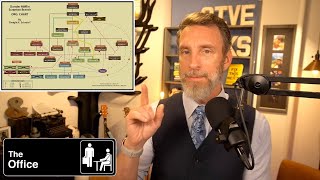
In this episode of The Real Entrepreneur, host Mike Michalowicz breaks down a brief scene from The Office where Dwight attempts to seize emergency authority over the office. Mike uses the clip to illustrate several entrepreneurial leadership lessons. He explains the existence of two overlapping org charts—the formal, structural chart and the informal, social‑influence chart—and how the latter often wields more power. He critiques Dwight’s power‑grab as a warning sign of leaders who seek authority for its own sake, contrasting it with Michael Scott’s reluctant but responsible decision to retain control. Mike highlights hidden promises as manipulative tactics, stresses that great leaders must step up in crises even when uncomfortable, and emphasizes service‑oriented leadership over power‑driven ambition. The episode ends with a call to action for viewers to subscribe and submit questions.
Chapters
Hello, it's Mike Michalowicz here. You're watching The Real Entrepreneur. Make sure you hit that subscribe button and that notification bell right now so you don't miss a single episode. Today I'm reviewing a little scene from The Office, one of the best time shows ever, and I'm going to give you the entrepreneurial insights within. Here we go.
Jim is in charge of Stanley only in sales-related matters, hence the green—
The org chart already. Look at all the lines and stuff. And you know what's happening as Dwight is pointing to this org chart. There is a structure that was envisioned, and then there is the social. And all the little dotted lines are the social influence. There's always two org charts. There's the one you envision, envision structurally, and then there's the social one. And the social one has more influence.
I mean, for money, sales, get it? There is this yellow zigzag that does give Ryan the authority to discipline Stanley.
Great.
However, in so doing, it zigs past your name hence zagging you and making you appear weak. That's the yellow color. Yellow, cowardly.
So I will tell you, uh, Michael Scott is already avoiding responsibility. Great leaders stand up to any challenge, and it's particularly when the most difficult things present themselves that the great leaders come forward. It doesn't mean they have the right solution. That's the key here. They are just the ones who take responsibility to see through the circumstances. They're honest and integral about it. Michael's shirking that responsibility, but his right-hand man here may have some other plan. Let's see.
Emergency disaster mode for the org chart. This gives me full authority over every single person in the office. I never said you could. All you have to do is say it. I'm just saying. Okay, I'll think about it. Say it.
Just do it.
Don't think.
Say it.
Do it. 5, 4, 3, 2.
So I'll tell you what Dwight's doing here. Obviously he's strong-arming Michael Scott to get this authority, which is a surefire indicator or sure indicator that a person is not, uh, should not be put in a position of authority. They're going for the power to have power as opposed to be of service. Great leaders are leaders of service, and Dwight is demonstrating he He surely isn't. Do it. Michael at least is trying to be of service. Control.
Michael, I promise to give authority back to you when this crisis is over.
Hidden promises too, that's another technique. Uh, when people try to assert authority and aren't getting their way, it's a— to me it's a little bit narcissistic, but they seek other ways to get leverage by making promises that they don't intend to fulfill. Um, and You should never, never shirk responsibility of leadership when you're needed most in an emergency and give it to someone that's going for a power move here with a promise that they'll return.
Do it, Michael.
You can see the clock spinning with Michael. Do it.
Hey, this office needs a strong man. Say it.
No.
All right, well, you're gonna have to deal with this yourself.
So at least Michael right there demonstrated true leadership. He decided between someone else inserting themselves and taking total control and not having to be responsible for it, or being responsible for something he does not want to do, and he made the right move. My lesson here is this: whatever decisions you make as a leader, even if they're uncomfortable, the fact that you're leading by by making decisions that's in service to your organization is the best leadership move. No one expects you to be perfect at it. People expect you to improve and you should expect that of yourself, but you are gonna be in situations where it's the first time ever and don't acquiesce to someone else who's yelling for authority. Do it yourself, even when you're uncomfortable. That's my insights from this episode of The Office. I hope you got some additional value out of that. And I invite you to hit that subscribe button, that notification bell, so you don't miss a single episode. Also, don't forget, any questions or suggestions, go to mikemichalowicz.com/question. I'll see you on the next Real Entrepreneur.