Is Your Business Stuck? Discover the #1 Problem Holding You Back
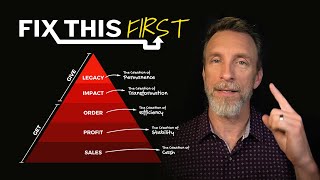
In this video, Mike (Sandy Waggett) argues that the biggest obstacle for business owners is not the lack of tools but the inability to identify their single most critical problem at any moment. He uses Maslow’s hierarchy of human needs as an analogy to introduce the Business Priority Pyramid (BPP), a five‑level model that maps business needs to physiological (sales), safety (profit), love/belonging (order/efficiency), esteem (impact/transformational value), and self‑actualization (legacy). The core process is to locate the weakest link in the pyramid, fix it, and then move upward, rather than arbitrarily tackling visible issues. He outlines practical methods for each level: - Sales – differentiate by being “different” and use client‑cloning or the Vendor Well to multiply ideal customers. - Profit – adopt a Profit‑First cash‑allocation system (similar to a 401(k) for the business) to force profitability and avoid cash crises. - Order – implement systematic efficiency (Clockwork) and extract the owner from day‑to‑day operations, illustrated with a 4‑week vacation test. - Impact – shift from transactional sales to transformational experiences, redefining industry standards (e.g., Geek Squad, Zappos). - Legacy – view the founder as a steward, ensuring the business’s lasting purpose beyond personal gain. Throughout, he stresses data‑driven decision‑making, the chain‑link analogy (strengthen the weakest link first), and concrete exercises (drawing arrows from “A” to “B”, asking best customers what you do right, and probing industry pain points). The video concludes with a call to action to adopt the BPP, use his companion books for deeper fixes, and subscribe for more guidance.
Chapters
The number one problem business owners face is knowing what their number one problem is. In fact, I've been approached, and I'm flattered by it, by so many business owners that say, "Mike, of all those books you've written, which one should I read next? What order do they go in?" And it's in that question I know the business owner already is facing a problem. You see, if you try to fix the right thing at the wrong time, your business will struggle. In fact, it'll trigger frustration. "But I'm doing the right thing." Yeah, but you didn't time it for your business's biggest need. Conversely, some people will do the wrong thing at the right time. It's clear the business is at an inflection point and they need to take action, but they apply the wrong method or they try the wrong process. Result's the same thing, frustration, giving up. Of course, they could do the wrong thing at the wrong time, and that's disastrous. The key to a successful business is doing the right thing when your business needs it most. So it's the prioritization of these needs and then addressing them at the right time in the right way that's gonna move your business forward. And that's what we're gonna discover together in this video today. What to do right now. What does your business need from you in this moment that's gonna be of the greatest impact? What I'm gonna share with you is based upon research I did for one of my books called "Fix This Next." identified is many business owners try many different things, but it's arbitrary. It's based upon a consultant coming in and saying, I have expertise in, for example, HR, therefore we gotta fix your HR problems. When the real question is, what does the business need right now? It's the identification of the right thing and then fixing in the right way. That's what we're gonna discover in this video together. So let's go right to my overhead. This is my favorite thing to refer to. I'm not a big fan of PowerPoints. I call these paper points. And I wanna give you a quick background story on Maslow's hierarchy of needs. Maslow was studying human needs and identified effectively there's 5 foundational layers of what people need, starting at the most core component to survivability to the highest level of what he ultimately calls self-actualization. Now, the base level need for all of humanity is our physiological needs. You and I need to breathe air, we need to drink water, we need to eat food. And at the physiological level are these needs to breathe, eat, and so forth. It is the essence of our survivability. And if you don't have enough Oxygen, for example. Nothing else matters. In this video I'm doing right now, you're watching it, but if there is a lack of oxygen, if you're suffocating, if you start choking on a piece of food you're eating, that becomes the physiological necessity. Your survivability depends on it, and this video ain't so relevant in the moment. The base of all human needs. Above that, we have According to Maslow's hierarchy, safety needs. I'm just gonna put Maslow up here so you know what we're talking about. And safety needs are shelter, protection from harm. Similarly, if there was a fire in the space you're in right now, we are going to get out of that space. The roof over your head, if you're inside, is protecting you from the elements, protecting you from harm. So we need safety. But interestingly, if you are choking, I wish this upon no one. While there's a fire going on, the priority is first to expel whatever's preventing you from breathing and then escaping the heat of that fire. So we have a different level of needs based upon its imminence, if you will. Above safety needs are belonging. This is where we need to be part of a community, have significance and importance in the community. We need to be a contributor. Esteem means that we are seen by self and others as important, impactful, relevant. The highest level is self-actualization, living one's life purpose. What Maslow pointed out is that each one of these levels need to be adequately satisfied before we can address higher levels. So if in that example I shared, you aren't breathing oxygen, the community you're in doesn't matter so much. But if you are satiated on food and oxygen, you can breathe. If you have comfort and protection, now your ranking in society becomes— when I say society, not in general necessarily, but your society, the people you congregate with— becomes relevant and so forth. So these levels go up. We climb, if you will, only if these foundational needs are met. And should they be compromised, we go back down the Maslow hierarchy of needs to address those needs. If all of a sudden there's a hurricane blazing through, I'm gonna revert to safety needs. What's key and essential about the Maslow hierarchy of needs is that it is effectively a ping pong match more than it is a ladder. I think people see this and say, well, I've addressed my safety needs and therefore I'm going to elevate to self-actualization or whatever it may be. The reality is you will touch on those components, but safety concerns will come up. Physiological needs will happen. You'll have to eat. You'll have to use the bathroom. You can't ignore those things. They're the essence of survivability. So we're always moving around. The question is, where do we have our biggest need right now? And that's what we need to address. Now, the funny thing about humanity is it's wired into us. We know inherently when we're hungry or have to go to the bathroom. We know when we feel unsafe. They're gut-level checks. You just feel it instinctually. Now, the problem is in our business, we don't feel it instinctually. And yet most business owners think that they can trust their guts. Most business owners say, "If my heart says it's right, it's right." But the reality is, while we are wired into ourselves, We're not wired into our business. So our gut is perfect in like, "Oh, I'm hungry right now. Oh, I don't feel safe right now. Oh, my friends, I really need to spend more time with them. I feel disconnected." But in our business saying, "Ah, I think we need more sales right now. Ooh, my gut just says we have to land that one big client," those gut instincts aren't naturally wired into us. So the review of data and understanding that, especially empirical data, Data with significance to it is absolutely critical, yet often ignored. Here's the ironic part. When starting a business in the early stages, you don't have enough data, enough information in the business, enough history to identify what the business needs now and what it doesn't need now. But when it comes to the early stages of business, we don't have enough data and our gut becomes extremely important. We need to listen to our instinct. So what gets us started in our business is trusting the instinct, but what moves us along in our business is trusting the data. The first thing we need to know is how the Maslow Hierarchy of Needs translates to our business. What I did over my years of studying this and preparing the book "Fix This Next," I studied the priority of needs a business has, and this is what I called the business priority pyramid. I love that term too, because priority pyramid points to the fact to, at any given point, you are somewhere on pyramid. Again, it's not a ladder we climb to the top and wave to our friends from Business Successville. We're going to go through different challenges at different times. Even the mighty organizations like Amazon and Google and Spanx and all these mega companies go through challenges and have to reorient their business. Do you remember the COVID pandemic? During the COVID pandemic, Amazon reoriented its organization. It was putting a lot of money and time into things like self-driving cars. But then the pandemic happened. They moved to essential goods deployment and reoriented the organization. They went back to the base of the business priority pyramid in order to care for their clients and care for the business. So this model you're about to learn is for any stage of the business. So regardless of your size or how long your business has been established, we have to live by the essence of how businesses are made up. So let me switch my PowerPoint here. Now that you know Maslow's hierarchy, and I'm gonna keep this handy so we can pull it up again, we're gonna explore the business priority pyramid. Now let me cut to our overhead so we can do this together. But similar to Maslow's hierarchy of needs is we have this business priority pyramid, which has a same structure. Now the similarities between the two are relevant because a business is essentially an organism. It's made up of humans, it's made of people, so it has organism-like components. But it's going to be the data that's going to indicate where we sit as opposed to our gut. At the base of our needs, we have a need for sales. I want to be very clear what I mean by sales. The sales is the creation of revenue for your organization. I call I call it the lifeblood of an organization. The creation of revenue for your organization through sales and marketing. I wanna underline marketing 'cause I didn't put sales and marketing. Sales is anything that generates interest and leads and translates into new revenue. So at the foundation of the business priority pyramid, we have sales. And if we look at this, this physiological level is the equivalent of breathing air and eating food and water. This is the oxygen for an organization. If you want to equate the two. The next level need for an organization is profit. Now, profit is equated to the safety of an organization. It is the health. Perhaps if we're relating to an organism, safety is the absorption of that oxygen into muscle. So profitability is the muscle of an organization. Now, there's already confusion of how this works for business owners at these two levels. So many business owners will see sales and say, this is oxygen, profit is muscle, but my business is not profitable, therefore I need more sales, I need more oxygen. So I'm not strong, so I need to breathe more. And clearly in the human species and in the human organism, that makes no sense that if you're not strong, you need to breathe more. Could you imagine in reality doing that, saying, oh, I need more oxygen. I'm going to start breathing faster and quicker. You could actually hyperventilate. You could over-oxygenate. You can get dizzy, if you will. So it doesn't serve you, yet that's what many business owners do. The classic scenario that comes to mind right away is the business owner who achieves that mission or goal they had to get to $1 million in revenue or whatever the arbitrary number is. And then when they get there, they say, "Gosh, I'm still barely scratching by." The business is generating money, it's making money, but I'm not taking money. What's wrong? Oh, I need to sell more. And that's rarely the case. In fact, 15 years ago I started investing in businesses and I took a hold or a stop on that to really investigate what makes a business successful. I was not a good investor in the beginning, and today I've started investing in businesses again. Actively looking for businesses that are in some form of struggle. They don't have profitability, there's inefficiency, the business owner's overworked, they're generating sales, but for whatever reason, they're not making the turn. Well, what I realized is in most of those scenarios, the business owner believes the solution is to sell more. Their gut says sell more. And in almost all the cases, that's the absolute wrong thing to do. Sales creates more stress on an organization. Sales is a responsibility. Imagine this, you sell something to me, you now have an obligation to me. You sell something to someone else, you now have an obligation to them. And if you sell yet again to another person, you have an obligation to them too. The more you sell, the more obligation you have, and the more diversified the obligation because we're talking about many Consumers. Puts more stress on an organization. And as a small business owner, that stress is often on the shoulder of a business owner. So what's so interesting is we believe the solution to the health of organizations is to sell more, but the more we sell, the more we get stressed out, the more we're exhausted. Can you relate? Can you relate? Strongly suspect you can. And it's at these first two levels right here that we get confused and say, keep breathing, breathe more, breathe faster. My God, we're struggling. Breathe, breathe, breathe. What I'm saying, start flexing your muscle, start building the muscle. Now we're gonna go through the other 3 layers in summary right now, but I'm gonna go through 'em in detail afterwards 'cause I do have a story I wanna share with you. Order is the next level. Order is the efficiency that we build into the organization. So sales creates cash, profit creates, sustainability. So I'm going to put stability or sustainability. Order creates efficiency. Then we have impact, which creates transformation. Many businesses focus on the transactions they have. Can I sell more? Let's get this deal done. Great organizations move from transactions with clients to transformation of clients. So transactions for clients versus transactions of, transformations of clients. So impact is transformation. Highest level, legacy. Legacy is the creation of, it's an E, I misspelled it, but it's permanence. You got what I'm saying here. And we're gonna talk about this in a second, First, I want to share another story. Now, we just talked about the business priority pyramid. Now we're going to talk about why business owners get trapped. And as you hear this, I strongly suspect you can relate. Now, you may not be familiar with this specific story, but you've heard this type of story before, how hikers get lost in the woods. And it goes something like this. A hiker walks into the woods. Some form of distance, then they follow a unique path to get to this pinnacle spot in the mountain. They then start hiking out, they get lost of what the way out was, they start moving in these circles, and they get lost permanently in the woods. That's a summary of a story that broke back pre-COVID of a hiker named Amanda Eller. And I had to share her story because it epitomizes What happens? Amanda Eller is from the state of Hawaii, and she was hiking, I think, on the island of Maui. She's lived there for a long time. She's hiked this particular national park countless times before, and she decided to park her car and go for a hike through the woods. I believe it was 5 miles or something like that. Well, halfway through her hike, she saw a tree that had fallen off in the distance off the path, and she decided this is a good opportunity to meditate, a practice she enjoys. So she went the 100 or 200 yards to that fallen tree, closed her eyes, started meditative practice, and for 20 minutes, when she completed her meditation, she got up and started to hike a path out. Now, the key variable here is she hiked a path out, not the path out. She went on the wrong path. After a distance, it didn't feel right. She tried intuition and gut, and she went back and she changed paths, and she continued this process. It went on for I believe it was 17 days. I hope I'm not misquoting that, that she was stuck in the woods. At one point, she fell off of a small ridge. She broke her ankles or severely sprained them. Another time, she was hiking a path that wasn't a human path. It was a boar's path. You know what a boar is? It's half dog, half mini rhino. You know those animals? And there she was. She was found clinging to life by survivalists who were out searching for her, and they found her next to a creek. She was eating insects to stay alive, drinking out of the creek. She was severely dehydrated and burned. She was lucky to be found alive. The ironic thing is this: she was a short distance from the escape, back to where her car was. She was moving in circles. Now, again, you may not be familiar with Amanda Eller's story, but you're familiar with these stories of these hikers who get lost in the woods. There was research that came out of Germany that identified most people, when blindfolded with no beacon, no direction to head, can't even walk across a football field without starting to move in circles. They don't make it to the end before looping around. And this is the short distance, the halfway across, not the long distance of a football field, going across from one side of the midfield to the other side of the midfield. They're starting to move in circles. What we need is a beacon, and that's what I'm hoping the business priority pyramid will do for you. But I wonder if you can relate to that story. Now, let me show you how it manifests in so many different businesses. I call it the survival trap, and maybe you can relate to this. Right now, and actually, let's try a little experiment. I'm being real hardcore here. On a piece of paper, write down the letter A in the middle of the piece of paper, just like I have here on this handout. And put it in the center of the paper and put a circle around it. And why we're putting the A here is it stands for point A, where your business is right now. And A could stand for apparent, because I bet you if you look at your business, there's a lot of issues going on, a lot of apparent things we could address. One of them may be a sales issue, you know, not enough money. One could be something else. And another, you know, someone's not working out. Someone is, just left the cut to start a new business. A new competitor appeared. But let's just pick one of those apparent issues. So we don't have enough sales. The way to address it is to escape the challenge. So I don't have enough sales. One solution may be to run a discount, you know, 50% off. Another could be hire a rainmaker. What I want you to do is draw a letter A and draw 3 arrows in any direction you choose. They can go any which way you want. And what it simply signifies, these arrows that you're drawing, is it's a way out, if you will, of this challenge that we're facing right now. So I can run a discount, hire a rainmaker, I could call all my best clients, I could, um, make a new product, you know, something like that. So just draw 3. If you want to go crazy, draw 4 arrows pointing away from A in any direction you choose. Now what I want you to do is draw the letter B in the bottom right corner of your paper and put a circle around it. What B signifies is what the business needs. So here's the apparent challenges, but here's what the business needs. So my question for you is how many of your arrows point to B? How many are pointing here? Now, be honest. Is it none? Is it one? Are you giving yourself extra credit? Maybe one kind of points that way. Again, I'm gonna kind of get there. Is it all of them? And it should be all of them because if this is what the business needs, this is what we need to do. So why aren't all your arrows pointing toward B is the question. And the answer is really obvious. If I don't know where B is gonna be, how can I draw any arrows toward it? Don't I have to know where I'm needed first? The answer is of course. Without knowing that, how can you ever go in that direction? And yet most businesses don't know where B is. We just know the challenge is in front of us and we keep trying to randomly address it. We have to know the challenge in front of us and where we need to head. What the business needs from us and correlate the two so we can move totally in that direction nice and clearly once and for all. You see, we don't have to make many decisions. We just have to make one that's congruent with addressing our challenge so we can escape the challenge and moving toward the B. I call this channeling a business. And if we simply know the path of where the business needs to head, we can walk consistently with it. That's what we're gonna discover here, what your B is, and then we're gonna find a pathway to blaze toward that. Hope that makes sense. Let's go back to this chart, but let's recap quickly together. Most businesses are stuck in the woods. We are walking the circuitous path of looking at our apparent challenges in front of us and just picking a path forward. The Amanda Eller story, it's a hunter or a hiker lost in the woods, moving in circles. And if we simply knew where the parking lot was, where it's B, we can then navigate a path. Will obstacles present themselves? Sure. There's mountainous terrain, there's cliffs, there's water, there's animals. But when you know you're headed, you can avoid those obstacles and still navigate forward. We need to put the beacon down first of what the business needs from us. This is different than goal setting. Goal setting is the vision we have. You know, I wanna have an amazing hike today is my plan. The B is what is the next move that we have to get to to complete that vision? The next thing we need to do. What we have to do with the business priority pyramid, it's similar to Maslow's hierarchy. We need to know that foundationally, every business has to address its core level needs adequately first, before it can elevate to higher-level needs. So what we do in the Business Priority Pyramid, we ask ourselves at each level, are these adequately addressed to support the level above it? Like building a structure, I want to build a 5-story building, I need to put an adequate size foundation in place in order to put the structure above it. If I want the structure to be taller and taller, the foundation needs to be stronger to support it. But if I simply build a massive foundation and put a very small structure on top of it, It's tons of wasted effort, and the structure won't properly be in relation. It'll collapse within itself. So these all relate. I call it linking. So sales links with profit, profit links with order, order and impact, and so forth. These are the links of the chain. So we ask ourselves, according to Maslow, is look at the foundation of the business and say, does it have adequate sales to support profit? If we say yes, it does have adequate sales and there can be profit, then we got to consider maybe profits are challenged. If it has inadequate sales to drive profit, then we say, well, we have a sales issue. And the only way to determine this is to understand, to have our hands really wrapped around what is necessary for profit and what is necessary for sales. So we have to always consider the two levels linked together. Let's just say in this example, sales are adequately addressed. Now the question is, do we have enough profit in the organization to support the building of more efficiency? For example, if I have no profit, meaning I'm living check by check, I can't focus on organizational efficiency. I'm throwing myself and my team into the fire every day. We're in the cage fighting out, we gotta keep cranking away. But once I have reserves of profit, my business has runway of 30 or 60 or 120 or 365 days, that frees up our ability to bring more efficiencies. Efficiency links to impact, which is transformation of clients. Can we build efficiencies and build in elements into these efficiencies that transforms a person to a loyal family member? Talk about that a little bit. And once we have this, we can discover legacy. And that's the last thing I'm going to talk about because it's probably formed in a way you've never heard of before. But the first concept I want to get across is instead of using highlights, I'll use this, is the linking that happens between these different levels. I like that link or chain analogy, and I want to use that before we move much further. So let's do a little experiment together here, if you will. I'm based out of Northern New Jersey, west of New York City, and you are where you are. Imagine there's this massively long chain between the two of us, and our job is to make this chain stronger. You know what most business owners will do? They'll say, well, gosh, to make this chain stronger, if I simply make every link stronger, chain will be stronger. And that's absolutely true, but it's exhausting finding all the resources necessary to fix and improve every single link. And that chain between me and you will continue to break until you and I fix the weakest link. A chain is only as strong as its weakest link. So imagine, just to make this real simple, there are 10 different links in our chain. Our job is make it stronger. Every time we pull on that chain, it will snap at the weakest link. Let's pretend it's near the center. But let's just say we pick a different link to fix, one near the edge. We make this link stronger. We invest the resources and time and effort. It is clearly stronger. We pull the chain and it snaps again just as easily. It's just as fragile as that weakest link. Now let's say we try to fix another rando link and make that link stronger. Yes, that link is stronger too, and maybe the first one we worked on, but the weakest link in the middle or near the middle continues to snap. That is the challenge that we have is even if you're making improvements, if it's not the weakest link at the moment, the chain won't get stronger. The fragility is still at that same point. So as a business owner, what we need to do is first identify the weakest link. But then the beauty presents itself. Once we know the weakest link, fix that one thing, and the entire chain has gotten stronger, which means everything's elevated with one fix. Now we fix the next weakest link and everything gets elevated again. You fix that next weakest link, wherever it may be, and the entire chain gets stronger again. First identify the weakest link, then fix it. Don't fix everything. Going back to my chart here. So here's all the links between the levels. There's also links within the levels. I don't think I drew that perfectly, but there's sales challenges. There's actually many forms of sales challenges. Then there's the association of sales to profit. Are they working in complement? Then there's profit challenges, and there's many potential profit challenges. Profit working in concert with order and so forth. So there's many links within your business. In fact, I believe in any organization there's roughly 20 to 25 key links. But what we need to master now is this model. The first thing we need to focus on and what we gotta ask ourselves is this: are there any sales in my organization? If the answer is, Yes, then you look for the link. If the answer is no, you found your next fix, found your fix need. So if I say, are there any sales? No. Okay, we've addressed that level. Are there any sales? Yes. What about the link? How's the link performing? In this case, the link is profit. So I ask myself, I do have sales, is it profitable? Well, the only way to know that is to implement a profit system. So if I have no profit system, so if the link is no, that is where you focus first. If the link is yes, then we have to analyze. I'm running out of paper. If it's yes, just say analyze. I'm trying to fit this in. We analyze the link between. So is there any sales? Answer is no. Okay, fix sales. Are there any sales? Yes. How about the link, which in this case is profit? No, there's no profit. We need to address the profit level first because that will reveal if that's sustainable on its own or not, or if it's the link between. If there is profit, then we're going to, I mean, if there is profit and sales, then we're going to analyze the connection between the two. I hope that makes sense. And it's going to be best that we move through this in examples. So let's go through an organization that does $1 million in annual sales. They say, "We are struggling and we need to fix it." So the first question is, we pull out the business priority pyramid, and I invite you, you can print this online, type in business priority pyramid, store it above your desk, you can hand draw it, but keep this model ready. I believe all business owners need a simple compass, and that's what this is, to navigate their business. Got $1 million in sales. Okay, so I do have sales, yes. I now look at the link above. Link above sales in this case is profit. I say, do I have any profit? No, no profit. There's no profit on sales. I have a priority of focusing on the profit problem. How do I fix that? And until you fix it, you can't understand the link between the two. So if I say I have sales, I have no profit, let's figure out if my sales can support profit, that's going to be challenging because you don't have a profit model first. So the profit model that I strongly suggest is Profit First. I designed that around human behavior. And the core concept is it's human nature that when we prioritize something, when it becomes first, we care for it. What comes last, it's the mañana syndrome. So one example I like to say is if your health matters to you, do you ever say, "My health is so important, I am putting it last"? Of course not. When something's important, you say and you act by putting it first. My health is so important to me, it comes first. So what you do first gets done, what comes last gets ignored. So if you're not profitable, Profit First system says allocate your profit first as it comes into your business, remove from the business so you're not tempted to steal it. Like a 401(k), the greatest savings mechanism in US history has been the 401(k). This is the same model. We have a gross income as an employee of a company, say $1,000. Well, I don't get $1,000 that comes right to me. What comes out first? The 401(k) and the taxes. So maybe $100, 10% goes to my 401(k), maybe $100 goes to taxes. It doesn't work out exactly like that, but I get net pay of $800. My lifestyle, I adjust to live with $800 and it's fine and comfortable, and I have savings at my 401(k) piling up. Here's the irony. For most people, if you don't participate in a 401(k), let's pretend that full $100 comes through to you. I know that's not actually how it works with tax implications and so forth. Well, let's say I have $1,000 gross. I don't participate in the 401(k). My taxes of, in this case, $100 comes out. Now I have $900 for myself. I will grow my lifestyle to support that $900. And they'll say, I can't participate in a 401(k). I can't afford to do it. But that is not the That's the reality of human behavior. We adjust to the circumstances around us. It's the definition of a concept called Parkinson's Law. So it's ironic, but when you take your savings first, your lifestyle is just as happy, often just as comfortable. There's not much necessarily compromise because it is a slice that consistently comes out and we adjust to what's left over. That's exactly how Profit First works. So back to our scenario. I have sales, I don't have any profit, it's probably the profit issue I need to address first. Almost definitely, that's the weakest link. Now I have a profit system in there and I have sales going on, but my profit's struggling and my sales don't seem to support profit. Now it's usually the link in between, margin, cost. There's other things that present itself. So again, you look at the level that you're starting at, which is always the base, and say, is there any, If yes, then is it the link above? If the link above is adequate, we can continue to elevate too. So I have adequate sales to drive adequate profit, and we'll determine the definition of adequate profit. I would work with an expert that can help you with that. But let's say you have 60 days of cash on hand. You can run your business with no new revenue for 60 days Without an issue. That's a good scenario. 150 or 180 days or whatever would be even better and so forth. But you have that adequately addressed. Then we ask, do I have any profit? Yes, I do. Do I have any efficiency in the organization, or is the business fully dependent upon me, meaning there's no efficiencies? Business owner has to keep swooping in and saving the day. That's the scenario. We look at what's the order systems we have in place. Have we applied A system like, if I may, Clockwork that would fix that and so forth. So let's go through this entire model and I'm gonna give you the solutions that commonly address each level here and you can leverage these. But the key is in your analysis of identifying what to do next is start at the base and ask, is there any and is it adequate? So is there any sales? Is it adequate? At the link level and then go to the next one. Is there any profit? Is it adequate to support order? Is there any efficiency in the order? Adequate to support impact? Is there any impact? Is it adequate to support legacy of the organization? Recognizing that wherever you're focusing on your next fix, that it is normal to revert or need to adjust back down and around over time as things change in your business. Okay. I hope you're with me and you're understanding the core concept is a business is effectively a chain of events, a sequence of things. There's different core elements like sales and profit and efficiency that make this chain stronger. But if you focus on a link that's not the weakest one, it actually does not improve the chain. So now you have a simple tool. Always start at the base like Maslow. Work your way up. To the level where there isn't any or it's not adequate, and that's what we gotta fix. I'm gonna show you the business priority pyramid again. Just to make it nice and succinct, I'm gonna call it the business priority pyramid, the BPP. Okay, we have 5 layers. Layer 1, sales. If you don't have any sales, we have a sales issue. If you have it but it's not adequate to support profit, you have either a problem in the link or a problem in sales. So what are the common fixes to sales? Number 1, I wrote a book called "Get Different," and in the book, I talk about what customers actually buy and consume. They don't buy better. This is the key lesson here. Let's say you and I are in competing businesses, and you answer the phone for your business when it comes to customer service in 2 rings. Me, I answer the phone, we'll say, in 1 ring. That is measurably better. I do it twice as fast as you, 100% better. You answer in 2, I answer in 1. But does the customer notice? And the reality is they won't notice. They don't notice because it's not extraordinarily different. It is a form of expectations they have, and they may be defining as, "Yeah, they answer the phones quickly." Now, if you had a customer on hold for hours, and I answer live on the first ring, that is a big differentiator. But when there's these incremental improvements, it's not noticeable by the customer. Therefore, the number one way to attract new customers, to have them recognize you exist, is by doing something unexpected or inconsistent with your industry, something different. I used to have a business in computer networks, It was called Olmec. I ultimately sold it to private equity, but not without substantial struggles before I had the opportunity to sell it. As I was running the business, we achieved that magic million dollars in revenue. I didn't have any profitability. I didn't know what to fix. And what I kept on doing is simply saying, we need to sell our way out of it, which is rarely the solution, but that's what I believe to be true. And I was fighting with my competition, and what I would do is constantly point to my prospects and customers that I was better than the competition. I had more credentials, I had more experience, I had more testimonials, I was better. And guess what my competition did? They had more experience, more testimonials, more deployments. They would argue the same things I did. So it was very confusing and difficult for a customer to make the best choice for themselves. And one day, a company came in and beat us all by simply being different. Geek Squad. Here's a bunch of dudes, I'm from New Jersey, so dudes, men, women, it's people, dudettes, I guess if you want to do that, that were wearing these super narrow neckties, flood pants, glasses with some tape on them. And they were these super geeks fixing computers. And who doesn't want that? The funny thing was all they did was dress better. And I can argue a million ways how they weren't better except for their outfits. They didn't have the credentials. They didn't have the experience, they didn't have the ability, but gosh, they brought something to the industry that no one else was doing. They did different. Different gets attention. It's how our brains are wired. When you walk down the street, you ever notice you do a double take sometimes? Because your eyes are hearing something is inconsistent with what you expected, it forces our minds to pay attention to it. That's the key to getting different and getting sales. Stand out. And ironically, it's like 1% of things. Geek Squad was 1% different. They did something that was remarkable and odd and unexpected and fun and glorious and all those things in the way they dressed. And what happened? They got all the attention. They were acquired by Best Buy. I believe collectively it's a billion-dollar-plus organization. It's massive. I sold my business, but it wasn't for a billion dollars. Let me say that. So To get more sales, one core strategy is to get different. Another strategy I call client cloning. I write about this in my book, The Pumpkin Plan. Client cloning— I mean, just imagine this: your best customer, whoever that may be, your best customer— imagine getting 10 clones of them, or 100 clones of them, or whatever. There's a real simple way to do it. What you do is you find out where they congregate, because at the end of the day, birds of a feather flock together. There's two strategies to doing this. So I go to my best customers that identify— a best customer, by the way, is someone that loves doing business with you and you love doing business with them. In the Pumpkin Plan, I talk about the strategy for doing this evaluation. I don't want to spend the time on that right now because it's an extensive training, but identify your best customers. Then we find out from those customers where they congregate. Birds of a feather flock together. So think about the events they may go to. There's different areas we go to to learn and share. Maybe it's not live events, maybe it's online networks or groups like Facebook. Maybe it's podcasts or media they listen to. But you have to go to your best customers and say, where do you learn? Where do you share? Where do you connect with others just like you to improve your business, your life, whatever the circumstances are? Maybe it's a local club, whatever it may be, where people are finding people like themselves. Remember this, people always like people like themselves. So we're attracted to people who are similar to us, which means if you have an ideal customer, chances are they are congregating with other customers, ideal customers or prospects in this case, for you. But you have to ask where they congregate. My favorite strategy that I write about in Pumpkin Plan is called the Vendor Well. This is how it works. Here is your ideal client, the great one, and you are out here as a vendor to them. So you're providing these vendor services to your great client. And what we see is, this client is everything to me. This is what we can visualize. But to the client, we are just one provider of many. So there is a company here that's doing something for them. I'll give you my own scenario with that computer company that I had. I was providing their computer systems, but this was a security guy. This here was their cleaning company. You know, here was another one that provided information feeds and just kept on going on and on. These were Bloomberg terminals, I remember, back in the day. All these different things, all these vendors. So from the client's vantage point, They have all these relationships going back out that they're managing. We just see the one, but the reality is all this. So what most people do, most organizations do, and perhaps your competition's doing, is we just try to build this relationship. If you want to really amplify sales and invoke client cloning, tap into the vendor well or the vendor network. This is how it works. Ask your best customer, who are the other vendors that you work with? And your best customer will likely say, well, why do you care? Why do you wanna know? What you say is, if I know, in my case, I'm your computer guy, if I know what your security company does, maybe I can integrate the technology to work with your security so it's more seamless, it serves you better. What we're doing is we're concentrating our energy. Every time we focus on another vendor, We're focusing our energy here. Here is the grand mistake. So many experts say, "Ask for referrals." And I'm challenging you to not prioritize asking for referrals, but prioritize asking for the vendor network. Why would I say such an absurd thing? If I ask you for a referral and said, "Hey, is there someone else like you? Do you have family or friends that could also use my services or products?" What I'm doing is triggering dilution. I'm saying, "Hey, I don't have enough time to pay full attention to you." "Give me someone else so I can serve them too, and I'll be back with you, but I'm gonna focus my attention here." I'm asking you to dilute our relationship. Conversely, if I ask you, "Tell me the other vendors you work with so I can collaborate with them and we can team up in the greater service of you," now instead of diluting my attention, I'm concentrating my attention on you. So the Vendor Well is a technique of caring more for this customer. They are likely to introduce you to everyone. What I did was I asked my best client, tell me about your security company. I will partner with them. I will call them and see how we can serve you better. This client said, that's amazing. I didn't say I'm going to call them to ask for referrals. I didn't say, hey, can you refer me to other clients just like you? I simply said, can you make an introduction? We'll form an informal board with the commitment of serving you. I called the security company and said, I have a great client. I understand they're a client of yours too. What can I do in your service to them? Is there something I can do to make this a more fluid, stronger relationship? I'm supporting you in your support of them. And all these vendors loved it. And then I did the same, this vendor and that one. And you can see the model continues out this way. And I built this relationship. Well, here's the magic. These vendors, they have their network of clients too. I'm just picking this one 'cause I got some space here. But these were all great clients of theirs, and many of them were similar. I had one or two great clients, and they all had one or two really great clients just like this one. And collectively, I had all of these potential referral points to this network, not because I was asking for these referrals, but because I was caring for this vendor They naturally wanted to introduce me to their other clients. And this is exactly what happened and happens in how I grow all my businesses today. I called that security company, said, "I love our mutual client. What can I do to serve you better in being of service to them?" They did say in this one example, "Hey, our technology integrates to the computer system. Here's some techniques you can do." Our mutual client calls back and says, "This is fabulous. The tech is so accessible now. I can see our security through our computer networks." And this was back in the '90s before stuff like that was necessarily happening. They were all these disparate systems. We were integrating it. That security company calls me months later and says, "Hey, we have another client of ours that doesn't like their current computer company, and they asked us if we knew anybody. We think so highly of what you do. We'd love to refer you. Are you interested?" I'm like, "Heck yes." So you see, this vendor network, by caring for the community around your great clients, exposes you to the greater community of clones for your best clients. That's client cloning, and it's better than the, "Hey, can you give me more business by referring me to someone else?" It's, "Hey, can I be of greater business service to you by you introducing me to your network of vendors?" It's the magical way to grow a business. All right, I want to keep going through this business priority pyramid, but I hope you're starting to get the essence of it. You know the system now. Always start at the base and ask yourself, right now in this moment, do we have Do we have any sales and is it adequate? If we have some sales, we may not have a sales issue, but is it adequate to support profit? We have to analyze both layers. If we say, yes, we have sales, yes, it's adequate, we ask ourselves the exact same questions all the way at the pyramid until it stops. When it comes to profit, do we have any profit? Is it sustainable? Is it adequate? Yes? Okay. Let's look at order. Do we have any order, any efficiency? Is it adequate? No, we're not that efficient. I, as a business owner, keep on swooping back in to save the day. We have an efficiency problem, but we do have profit. Let's focus there. That's how you find your fix. Now you have a couple tools to find your sales solutions. Let's go into profit. Remember from the earlier diagram, profit is the creation of stability. So sales creates the auction money, Profit creates stability for the organization. What's the way to do it? It's a real simple solution. It's S minus P equals E. I'm telling you, it's a game changer. Actually, more than telling you it's a game changer, follow the 1.X million companies that have deployed Red Profit first. Speak to those folks and see how it's improved them. I remember reading a statistic that's haunting, and I don't remember the source. I know it was a major US bank. Don't recall which one, they identified in their analysis that 83% of businesses are in cash crisis. Another actually bank called Relay, it's an online banking platform, Relay did another study and they found a metric that's very similar. 83 to 85% of businesses at any given moment are in a cash crisis, which means they don't have enough money today to support the operations of the business tomorrow. If they don't get another sale in right now or another deposit comes in, They're in crisis. In fact, what many businesses do is they start playing that game of moving money from here to there. A real dangerous one is, I remember a company was effectively paying payroll through credit cards, but they couldn't even see it. They did, they said, "We only have, say, $10,000 in the bank right now. We need to buy $15,000 of inventory and pay $10,000 in payroll. So we have $25,000 of stuff we have to pay out." He said, "But we have this credit card. Let's buy our inventory on credit card. That'll cover $15,000. And now we will pay with cash $10,000 to payroll and we've cleared the day." And what they said is, "We will be able to manage it. We have enough cash." No, you paid payroll with effectively credit cards. You took a credit card and you swiped it and it says for inventory, freeing up the cash to pay payroll. So you're swiping to cover effectively payroll. If you had $0 of payroll and $15,000 of inventory, now you could have paid $10,000 to our inventory and would have to wait for $5,000. You're still taking a loan, you're still using credit, it's still a major problem, but at least you're not playing that game. Many business owners do that. We start stealing from Paul to pay Peter, or from Peter to pay Paul, however that saying goes, but we start stealing from ourselves and we try to convince ourselves that this is a healthy form of practice. The business needs to not only pay for all of the expenses we're incurring, there has to be residual money left over, which is profit. Profit, very clearly defined, is not an accounting profit where you say we made money this year, but we don't know where it is. What profit is, as I'm defining it here, is cash that's distributed to the shareholder, the owner of the business, or it's cash that is on specific reserve not to be used for any other purpose but future distribution to the shareholders. That's what profit is. We need profit. And here's how we do it. What we do is simply that 401(k) process I explained earlier. When revenue comes in, cash deposits, we take our profit first, and what's left over is what's available for expenses. If you want to have a, say, 10% profit, then start taking 10% of any deposit, hiding away. And if you can't operate your business, there's something fundamentally flawed with your business. You want 10% profit, you deserve a 10% profit. What are you doing wrong in the business? Sometimes expenses are too high, often margins are too low, efficiencies may not be in place, but there's causes to it. If you can't take your profit first, your business is fundamentally flawed. Now sadly, many business owners say, "Well, I can't be profitable now, I will sell my way out of this. I will try to get to profit." My experience is 83% or more of businesses say they're gonna get to profit and they never get there. It is ludicrous to me that business owners say, "I started a business for financial freedom, for personal freedom," and it's the exact opposite of what they're achieving. When you take your profit first, you force your hand to profitable. You are forced now in this moment to run a healthy, effective business. That's why profit first is so effective. Simply mandates you're profitable and it forces hard considerations upfront right now. The essence of Fix This Next. All right, let's continue on. So the solution to profit is take your profit first. We have million-plus businesses doing this, and, uh, to me that's just scratching the surface. We need 300-plus million businesses doing this. That's how many small businesses are globally. More businesses need to do this. I'm hoping every business does this and see how it serves them by taking it By making it a requirement, you fulfill that requirement. The next level is order. Order is the creation of efficiency. I wrote a book called Clockwork on this. And Clockwork, what I found in our research is that most business owners become beholden to your business. It's funny, in surveys, when I ask audiences why they started their business, I will give you the top 3 reasons. And our surveys indicate about 95% of businesses I started the business for all 3 of these reasons. Number 1 reason is financial freedom. I don't ever want to worry about bills personally or for my business ever again. I want to be able to do what I want, when I want with my money and not be concerned. That's financial freedom. The 2nd reason, and it's right up there with financial freedom of why people start a business, is the desire for personal freedom. I want to have the freedom of choice of working or not, doing what I want when I want, that I have the ability to exercise that freedom anytime. And yet for very few businesses it happens. In fact, they don't experience financial freedom. They just want it, but they're not making any money. They're forgoing salary. They're actually more financially strapped as a result of their business when they wanted the opposite. And personal freedom, out the window. It's work all the time. The third reason is impact. I want to be of service to my community, my society, our globe, our world. And it's ironic, without financial freedom, without profitability and sustainability, without personal freedom, you can never have impact. So his top 3 reasons go unfulfilled for almost everybody. Well, when it comes to personal freedom, in Clockwork, what I discovered is there are ways to go to this through a throttling mechanism. When Michael Gerber wrote the book E-Myth, he and I went out to dinner. It was actually well after he wrote E-Myth. He was keynoting an event. I was also keynoting there, and we decided to have dinner together. That dinner was in Mexico, interestingly or not. I asked Michael, I said, "Hey, what challenges do people have with E-Myth and the deployment of it?" Because I love that book. It is a necessary read. If you haven't read it, it sets the standard for how to stop working in the business and start working on the business, as he has in his thesis. Michael looked at me and said, "Gosh." He goes, "So many people that try to deploy E-Myth think that if they work in the business harder and harder, that one day this magical switch happens and now you're working on the business." He goes, "It's not working more aggressively, it's aggressively removing yourself from the business in the first place. It's an extraction of yourself." So when I wrote Clockwork, it was to teach people this throttling process of where you're in this in-state to the on-state. There's 4 distinct layers. There's this doing of work, to ultimately designing of outcomes. But we have to go through phases like deciding and delegation to get to this ultimate designing phase. I will give you the one essential thing. And if your heart palpitates on this one, metaphorically speaking, if your heart palpitates, that means that this is probably the way you need to go. Here's the challenge. Right now, I invite you to go in your calendar and 1 year from today to maybe 18 months, but 1 year minimally and 18 months maximally, I want you to put a 4-week vacation. 4 consecutive weeks disconnected from the business. No physical connection, no digital connection. You're taking 4 weeks off from the business. And I'm asking you, commit to this. How does it make you feel even just thinking about that? If you're panicked or nervous, that's an indicator that your business is in hyper need of you. It's manically needing your attention, or maybe you're the one who's being manic because you always have to be there. If there's a dependency on the business owner, it's not an independent business. You become this kind of crutch on the business. I remember there was a tree where I was growing up and my mother had hung a washing line from one tree to the other with these screws that went into the tree. As the tree got bigger, it kind of morphed around it and became this kind of mass around it, and it absorbed in the line, and the tree kind of bent around it, kind of morphed around it. But that line can never come out now. Metaphorically, it's what happens with businesses. The business kind of morphs around the business owner of always doing things and becomes an integral part of the business. There is no extraction anymore. The business has become so dependent upon it. The business is the owner and the owner is the business, and they will never be departed. That's a major problem. We need to disconnect you now. And it is a surgical process. I'm not going to say just walk out of your business tomorrow for 4 weeks. We're going to schedule this out. But if it gives you heart palpitations, there's already an ultra-high degree of dependency, and that's a problem. When you commit to this and actually do it, then we start the extraction process. What can we take off your plate? Can we true True delegation. Most people don't do delegation. We think we are. We're actually doing what's called task rabbiting. Do step 1 and come back to me for step 2. You have step 2 done, come back to me for step 3 and ask questions throughout. That is not delegation. Delegation is not the assignment of tasks, it's the assignment of outcomes. You need to extract yourself from the business. And if we don't set a hard line extraction from the business, the business will become more and more dependent upon you. So in Clockwork, I wrote about the 4-week vacation. That is the core step we need to take to start the extraction. The next level we talked about is impact. Impact is the creation of transformation. What transformation is, is the customer doesn't see themselves as consuming a commodity. They see themselves belonging to something, that it's a statement of something, that there's something of significance. One of my favorite examples is Harley-Davidson. I don't ride motorbikes, but I do know guys that ride Harleys, and they are part of a family. You can buy any kind of bike, Indian or Kawasaki or BMW, or there's a million different choppers out there. But when you own a Harley, you're part of the Harley family. There's terminology, you know, you've got a hog and you're a weekend warrior or whatever the terms are. Some of those people have Harley tattoos on. Think about that. That's the company logo. People are permanently tattooing their skin unalterably with a company logo. My gosh, if you own a business, isn't that your dream? Your customers want to put your logo on their body forever? That's what Harley does. Because Harley, when you have one, you see it as belonging to a community of something of significance. If we sell a transaction, there is no degree of loyalty or attachment. But if we sell a transformation, there's something of significance. The thing you've sold now is part of them, or they're part of you, or they're part of a community, or it's a brand statement or something like that. But transformation, how's it happen? What you need to do is go to your best customers, we talked about that earlier, this great customer in the middle, and ask them two extraordinary questions. I call it the right and wrong questions. These questions are so powerful, they're like Jedi mind tricks. Here's how it works. Go to your best customer and ask them, "What am I doing right?" Now, here's what I love about this question. It is a Jedi mind trick because they won't tell you what you're doing right. They'll tell you how they judge you. Let me share a story. My first business, computer company, I went to my best customer. I said, "What am I doing right?" They said, "Mike, your company responds quickly." This is back in the mid-'90s, but they said, "The prior company took a day or two to come on site when our network went down. They were trading stock and so forth, and they had backup systems, but when the main network went down, they were still dependent upon that. They wanted that up quickly." They said, "Your company gets on site usually same day, within 4 hours. You respond quickly. That's what you're doing right." Now, here's the thing most business owners do. We hear we're doing right and say, "Okay, that's been addressed. Let me move on to the next thing." But here's the reality. When you ask your best customers what you're doing right, they don't tell you what you're doing right. They're telling you how they judge you. So my customer, when they said, "You respond quickly," he told me, "Mike, I observe how quickly you respond." Here's the ultimate irony. What they say you're doing right is the number one thing you need to fix. Yeah, you heard that correctly. What you are doing right is the thing you need to improve because That's how they judge you. So when my customer said, "Mike, you respond quickly," I said, "My gosh, I'm being judged on my responsiveness. How do I get on site every time within 30 minutes?" Now, this is back before we used remote support or the internet much at all. Most of it was what was called break-fix. A computer broke, you would be dispatched, a person would be dispatched to go and fix it. We were a small company, it was me and a handful of other technicians. When Larry's network had problems, I determined Myself or one of my technicians would always be within a short radius of Larry. At any given time, I have one person that could get to Larry, that was the owner of the hedge fund, his office within 30 minutes. And that's what we did. Well, Larry, the hedge fund client, called me up maybe a month later. This is my best client. He says, "Mike, I don't know what you guys are doing, but the business has improved even more. You all are extraordinary. It's the best company I've ever worked with." I fixed one thing. The one thing I was doing right. So an extraordinarily powerful question is go to your best customers, ask them, "What am I doing right? What am I doing super well?" That's the thing they're measuring your service or quality of product by. That's the thing you actually need to do even better. That is your differentiator. Goes back to your sales and differentiating in the market. Now you have an impact component. Impact component brings about Transformation. What you're doing right, something you need to do better. There's a second question. The second question is, "What am I doing wrong?" But let me reword that, because if you ask your customers what you're doing wrong, they may not give you the truth. I write about this extensively in The Pumpkin Plan, in Get Different, in my other books, actually even in All In, my most recent book, that customers, people, don't speak the truth to each other when it comes to social consequence. If you and I were hanging out right now, I said, "Hey, how do you like my shirt?" And you're like, "Oh, it's really not a good fit for you. It's kind of—" Whatever you say, you know I'm going to get on edge. It's like, "What are you talking about? Whoa, whoa, whoa. I don't think it's that bad." I become defensive. When you criticize someone, it can cause conflict. So in most social settings, we avoid criticism. It's better to say, "Yeah, like it. Looks good. See you later." And then behind the scenes, we're like, "My God, did you see that getup on McCallowits?" So because people know social consequence, conflict is often avoided, but we need that critical information back. So here's the better question. Don't ask your best client what you're doing wrong. Ask your best client what the industry is doing wrong and let them gush. You see, the industry is the person outside the room. If I left the room right now and you're talking to someone else, you could say, "Oh, that guy's outfit, that shirt of his is not working." You can be very candid. When I ask my best client, "Tell me what's wrong with the industry," they can come back very candidly. Larry, my best client, came back and said, "Mike, you know, what I don't like about the computer industry is the billing practices. It's confusing. The same problem sometimes has a different charge to fix it. Why is it? I don't get it. It's very frustrating. There's no predictability." We were one of the very first companies to move to a predictable flat rate. Now, it's ironic today, 25 years later, it's standard practice, but it wasn't in the '90s. We moved to it very quickly because we saw that if we challenge the industry's biggest problem, if we resolved it, we'd redefine the industry. That's the lesson here. If you fix the industry's problem, you can redefine the industry, and then you become the one that generates impact. Remember the story of Zappos and their transformational statement was deliver happiness. Why? Because the industry sucked at customer service, and they still do. Have you ever called customer service for any company? Have you been put on hold? Your call's very important to us, therefore we wanna torture you with shitty music and put you on hold for hours. That's the treatment we get. And they said, gosh, customer service should be a joyful experience. People should leave here happy. We're gonna deliver happiness. So they determined what was wrong with customer service and then redefined it, hence redefining the industry. That's the opportunity you have Transformation. The last one I want to talk about is legacy. Legacy is the creation of permanence. And how you do this is by realizing you're not a business owner. That sounds kind of weird, but let me explain. I was meeting with a company called Eco Filtro, and what they do is create these clay pots infused with silver because of its miraculous quality. It's a silver mesh that bacteria, when it touches silver, it kills it. Now, why is this important? Well, they're based out of Guatemala. It's a very poor region they serve. In fact, Guatemala City is where all the wealth is and the rural areas are very poor. It is hand-to-mouth living and people go to the river to get the water and the water is putrid. It's ridden with bacteria and It's horrible conditions. Therefore, when you have this water, you need to come back to your hot boil water. And when you boil the water, while it doesn't clear or purify the water, at least it's consumable because it kills the bacteria. Well, it's hand-to-mouth living. People don't have much income at all. So you have to use most of your savings to purchase firewood or accumulate firewood on some behalf. Everything is just this survival. It goes back to Maslow's hierarchy of needs. Physiological needs. Well, the founder of Ecofiltro said, "My gosh, we can make these clay pots that when you pour putrid water into it, it filters out, kills the bacteria, but also filters the water." And what you may call Avion or bottled water comes out of these pots. And the pots can be bought for the cost equivalent of a cord of wood or whatever. So now these families are buying these pots and they can be used for hundreds or not if not thousands of gallons of water. No need to buy wood. So what's so interesting is you get better quality water, you don't need to burn wood, which you're spending money on, so that frees up money to do other things with your life, to improve the quality of your life. I said to the owner, his name's Thomas, I said, "Thomas, this is amazing. You must feel so great owning a business like this." And he looked around almost like there was a secret to behold and said, "Mike, I discovered I'm not a business owner." I said, "I don't understand. Don't you own the whole business?" He's like, "Yeah, but I'm not a business owner. I'm a business steward." That's the ultimate lesson I'm going to want to leave you with is that permanence, legacy comes from stewardship. And what the realization is, what you've created is more than just a platform for generating income. It is impacting and transforming lives. And if it is, "You have the opportunity, may I say the responsibility, to let it live on for generations, to encourage it, to support and continue to have the great impact it is on the community you're serving, whoever that may be." I said, "Is it because you're changing people's economic impact?" He said, "Yeah, but that wasn't the thing that triggered me and why I realized this." I said, "Is it the fact that people aren't getting sick?" He said, "Yeah, yeah, but that wasn't it." I said, "What was it?" He goes, "There was an environmental study." I don't know if you know this, but there's all these environmental studies going on about air quality, among other things, and they use satellites and so forth. And this agency identified that the air quality in Guatemala was improving faster than most nations. Guatemala of all places. So they dispatched a ground team and the team discovered that people weren't burning firewood, which is a form of pollutant. They said, "People aren't burning firewood anymore. It's improving the air quality. They're changing the planet for the better in a cascade of wins." And that's when Thomas said, "My gosh, I have to continue this at a higher and higher level." This level, and I wrote a book called All In, I talk about legacy and impact. At this level of legacy, it's the realization of stewardship, the need for you to do this not because of what it gives you, but of how it changes the world around you. The first 3 levels of this model here is all about what you get for your business. And I wanna prioritize the get because this is absolutely necessary for you to sustain. If you don't get sales or get profit or get efficiency in your business, you can't serve at the higher levels, which is the give. Ironically, many business owners say, you know, I gotta give more, I gotta give. In order to get. And the reality is you need to get this all in place in order to give it this level. So I hope what you discovered in this video together is the methods of analyzing where your business is right now and what the weakest link is. Don't just arbitrarily pick things because someone recommended it to you or you— your gut says what you need. Always start at the base of the business priority pyramid and work your way up until you don't have any thing happening at that level that's appropriate, or there is no adequate activity at that level. I don't have adequate sales or adequate efficiency, whatever it may be. Stop there, resolve that, and then you go back to the base, ask the same questions of any inadequate until you hit another stopping point. So we're always ping-ponging around as events happen in our business, as we move forward in our business. Once you identify your level, now you have the quick fixes. I'll give you a little secret about myself. Every book I'm writing since my very first book, which was called The Toilet Paper Entrepreneur, to my most recent book, which is All In: How Great Leaders Build Unstoppable Teams, I've been working on companion books that solve this challenge, that identifies the fixes for all these different levels. It's fix this next, that'll help you identify where you are and the core solution. Then you can explore perhaps my other books or books that I haven't even written that Some other folks have written, and there's such extraordinary books out there that will see you through to the solution. Here's my ask for you as a business leader, as a business entrepreneur. Don't arbitrarily try to grow your business by picking what someone else suggests or whatever you think is right. Instead, go through an analysis like this to identify what your business needs from you, and then go all in on that thing. Maybe more resources, like more videos or more books. There's countless beautiful things out there that can serve you. But you'll never find them if you're just arbitrarily picking what's next. Do have one more ask for you as you deploy the Business Priority Pyramid is if you'd subscribe to this channel. I'm asking because selfishly, if you subscribe to this channel, it's the greatest way for me to spread the word. So yes, it serves me if you subscribe, plus hit that notification bell. Starting today, use the Business Priority Pyramid to your advantage. I'm wishing you tremendous success in your business.










