Chime Didn’t Disrupt, It Understood the Customer Better
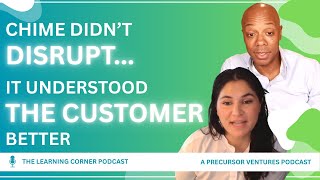
Charles Hudson and Mia Farnham discuss why Chime succeeded in fintech not by disrupting but by understanding underserved customers better than incumbents. They also cover how the 2021 seed boom created a glut of companies, tanking seed-to-Series A conversion rates and pushing more startups toward acqui-hires.
Chapters
Whatever is in the moment or in vogue at the time that you start the company. If you decide not to do that, I think you have to accept that there's going to be a whole set of people who don't pay attention to what you're doing. And for a lot of those companies, I tell them there's nothing wrong with your company other than the fact that nobody cares. And I think it takes a certain kind of founder to be able to just live with that.
It's the week of June 16th. Welcome to the Learning Corner, a Precursor Ventures podcast.
Welcome to the Learning Corner by Precursor. I'm Mia Farnham and I'm joined by our GP and Managing Partner Charles Hudson, where we will be talking through the articles and goodreads that caught our team's attention over the past week. Our first topic is an episode from the podcast Invest like the Best where Patrick o' Shaughnessy sits down with previous GP of benchmark Bill Gurley. In the conversation, he walks through a series of market realities across vc, from insights on zombie unicorns and derp era investing to the desire to stay private longer and the misalign of incentives to mark companies appropriately. It was a really thorough conversation around larger discussions that are happening across venture and addressing the so what of it all? I really enjoyed this episode. It was actually one of the first times I've heard someone frame the LP liquidity issue through the lens of arbitrage disappearing once everyone copies the same playbook. Bill asks the question, if everyone pours capital into illiquid vehicles and alternative assets, a reference to chasing the Yale model. Wasn't this eventual squeeze almost inevitable? Basically, what happens to the promise of non consensus returns when the strategy itself becomes consensus? Wanted your thoughts?
I think I've concluded I think this is my favorite podcast episode other than the Learning Corner I've listened to all year, mostly because I've listened to some really good conversations about the micro, and we've had a lot of conversations about the micro of individual firm decisions and individual investment decisions. I've listened to good conversations about the macro of just what LPs are doing, and it felt to me like this was the first podcast I listened to that really weaved together the macro and the micro in a really nice way. Mia, you've listened to me talk about this a ton internally. I feel like we didn't learn any lessons from the ZURP era SaaS investing, and Bill also seems to feel the same way, and he also articulated something that I've been wrestling with, which is this notion of the game on the field. And I've talked a lot about, well, what do you do with the game on the field as a venture firm? Should you be investing in these companies at 100 post pre product market fit, pre launch when sort of most traditional business judgment would say that's not good, or is that the game and you should be doing it? And he talks a lot about kind of analogies from the Uber Lyft era, which I thought were interesting. And while there were big winners, there were also massive losses, massive losses during that era of investing. And you know, for every Ramp and Brex that managed to survive the gladiatorial combat of spend management, there were tons of other companies that raised a lot of money and didn't work. And the thing it made me realize is we talk a lot about the scale of winners in venture and how much bigger. I don't think we talk as much about the scale of losses probably because it's not as much fun. In listening to that post, I was like, you know, there's probably a handful of people who are going to get directionally right on AI and are going to be in some of the best companies. They're going to make a lot of money. There's going to be a lot of people who are in, not in one of the one or two winners in a category. And something he said that really stuck with me and this is kind of my default assumption when people ask about, well, what about competition? Any good idea is going to have at a minimum five well funded competitors because each of the very large platform venture funds is probably going to want to have an investment in that category. And you should just assume that the best companies have very, very, very deep access to capital until or unless the people who write checks to VC funds decide that the illiquidity premium isn't worth it. And I've always thought that's what would slow the cycle down is it's not so much individual decisions of oh, I like Sequoia more than Andreessen. It would be more someone saying the fundamental physics of this asset class in terms of when money comes in and when money comes out is just no longer attractive and I want nothing to do with it at all. Not at the firm level, but at the industry level.
He talked about it from the founder lens too, of playing the game. And I used to think that you could kind of maybe not keep complete blinders on, but stay focused on what you're building even if you have competitors in the market. But he makes a good point that if you see competitors getting funded with a hundred $200 million checks, you will eventually get pummeled. So how do you think about this from a founder's perspective too?
I think at the tail end of the podcast they talk about non AI, and I think if you're not in AI land, some of the stuff you'd be like, people are doing this, what are people doing? It's a different world. And I think the issue is what are people doing with the money? And so I think in Uber, Lyft And Instacart and DoorDash, those hundreds of millions of dollars were going into customer acquisition and we're building user moats and network effects that really enhance the. I continue to wrestle with this paradox, which is that, oh, AI in theory makes these companies much cheaper to start. I'm not sure it makes them cheaper to build, but we'll go with the premise. It makes them cheaper to start and it makes them more efficient. Then I'm like, well then why are they raising so much money and what are they going to do with it? And to me it's unclear. Yes, you need to fund the purchase of credits or what's called compute. You have to finance that. But some of these companies, it feels like the money they're raising is growing faster than COMPUTE costs. So I don't know if the dynamics are the same. If you're a cursor and you're competing with Windsurf, you probably need money to fund compute. But a lot of these companies aren't hiring massive, gigantic sales teams or hiring salespeople, but not massive sales teams. I think the analogy for me isn't quite the same because those were network effects driven businesses where you could argue that like, we want to have the biggest, strongest network. I don't think some of these other businesses work the same way.
But I guess going back, if you're a founder and you're not building an AI, it does probably feel like everyone else's money is going in those directions. So how do you actually now find pockets that resonate with what you're building so that you can continue to build what you're building?
We feel it every day. I talk to our portfolio companies that, you know, more than a significant chunk of them are not building businesses that are enabled by AI. And I think the hardest thing is getting people to pay attention and care. I think if you're going to build something that is whatever is in the moment or in vogue at the time that you start the company, if you decide not to do that. I think you have to accept that there's going to be a whole set of people who don't pay attention to what you're doing. And for a lot of those companies, I tell them there's nothing wrong with your company other than the fact that nobody cares. And I think it takes a certain kind of founder to be able to just live with that and not have it really, like, make them depressed or cranky or angry. It's hard. It's really hard.
Yeah.
But I don't know. Every time I listen to Invest with the Bat, I think in venture, we don't talk enough about the supply and demand element of our business. And I think, you know, every year it feels like the supply of capital available to invest in private companies goes up. So unsurprisingly, the amount of money invested in private companies goes up. And this money has to find a home. And so I think that's why you see, even at the first hint of momentum, someone the other day reminded me, they're like, remember, for a lot of these big firms, a 20 million check is meaningful, but it's less than 1% in some cases of the size of the fund. He's like, you should think about it as, what percentage of the assets that, that they have available to invest out of that fund does this check represent? And you look at it that way, like, wow, it's a $5 billion fund. A $20 million check actually isn't life or death meaningful for sure, right? It's not life or death.
Patrick asked Bill, what are some of the things that maybe LPs aren't saying out loud, but they're thinking in their mind that are actually the real reasons why they're getting uncomfortable continuing to put money in specific pockets that the Yale model used to use as a gold standard to get everyone ahead.
I actually think a lot of institutions. He talked a lot about the macro, about the pressure on research dollars and dist Domitech. All those things I think are real. This is my sense, and maybe I'm wrong in talking to most LPs. As long as the money comes out eventually, in the end, there's probably a place for venture in their portfolio. But as Bill mentioned, for a while, venture was just a DPI business. Then we argued that, oh, it's really just now becoming an IRR business. I'm like, we're both. We're going to get measured on both. Like any financial instrument. How much money did you give you back in total and how long did it take to get it back. I think what's for me a plausible version of the future is that Venture takes longer and returns the same amount. That was good before. You know, 3x in 10 years and 3x and 18 years are very different products. And it's not just that the IRR is different. The feeling of getting three times your money in 18 years is very different, particularly if it's backloaded. And I think if we're moving into a world, as Bill mentioned, being public is not really on most people's bingo card. If we move into a world where you're going to get 2 to 3x but it's going to take 3 to 5 years longer, that's a worse product. And so I think what LPs will do is they'll say, I still want Venture, maybe I don't want as much of it because instead of a 20% chance of getting all of my money back in the first 10 years, it's a 5% chance. And even over a 15 year horizon, the chance of me getting 3x is the same or lower than before. So I'm getting less money and it's taking longer to get it. That's a probably a smaller pool of what LPs want to commit to.
And actually a question for you. I mean, when you were in diligence conversations as a fund manager for Fund one, how often did you get the question on how do you think about returning Money back to LPs before the 10 year horizon?
Never.
Never. And now I assume that it must be a question that people are getting asked as, how do you think about it from a strategy perspective?
I think the IR money for Venture is when you're a small part of someone's asset allocation, they just don't worry about you in the same way. They're like, okay, I have this tiny pool of money in venture and it's high alpha dollars and it's supposed to give me some high alpha return at some point in the future. As you pile more money into the asset class, you start to care a lot more about the performance of those dollars. And this is the extension of the Yale model going all the way. You have people putting more money to work in venture and people caring more about the performance of those dollars and when those dollars will come back and at what multiple.
Great podcast, everyone. Definitely take a listen if you have the time. In our next piece, Alex Lazzaro reflects on the evolution of the newly public company Chime. In his recent post on substack called 99% tech, he uses Chime's journey to highlight a broader lesson that sometimes seeing opportunity in innovation takes noticing how other markets, sometimes much more different in size and structure, take hold in their respective spaces. He talks through how there were other global first movers before Chime, such as Brazil's nubank, Korea's Toss and Russia's Tinkoff, all platforms which rose to success because they build for their customers who are seeking a modern banking experience to counter for what the more legacy banking rails of their geos just couldn't create. Chime's success with understanding what the current financial landscape of the US was lacking for the average American and understanding the regulatory arbitrage opportunities that existed to build an ecosystem for modern banking. Alex says this is a great reminder on how the best ideas aren't all started in Silicon Valley and flow out to every market and geo thereafter. Innovation can flow in every which direction. He talks about the concept of geo arbitrage, so essentially spotting a model that works in one geography and applying it to another. Of course not every idea travels well. One that came to mind for me would be live commerce. Right now it's like a $500 billion industry in China, but hasn't quite taken off in the US despite a bunch of attempts by major platforms to make it work. What do you think are the ingredients that make a geo arbitrage play successful? And how can founders or investors better assess whether a model will resonate in a new market or will it fall flat?
It's interesting. As you know, fintech is the one category where we will look at things outside of the US and I've always felt that money has both a global and local component to it in terms of how things work. I look at my friends who are in Revolut and Nubank and there's so many really interesting companies that have been started. I think a lot of what helped crystallize before I read this article was a conversation I had with the team at Axion and they showed me this map of where all their portfolio companies were and all the linkages and I think we talk a lot about oh like things from the US going abroad and things from major markets coming back to the us, things in China. We were still trying to build a super app here in the US and doesn't seem to have worked out as well. The thing I found fascinating was also just the leaps between countries. So oh, a technology that worked in India being exported to Brazil without going to the US first. And I think the interesting thing about finance and most regulated industries is in many cases in finance in particular, the problems are the same. People need access to money, people need access to credit. People want to find some way to deal with foreign exchange volatility. But the specifics of behavior, technology and regulation in each country have an impact on, like, what the ideal solution for that customer looks like. And in most cases, if it works in one place, you could take the same concept somewhere else, but you probably have to modify it. I didn't look at Chime when they were getting started, but I wonder how many investors who aren't. The Chime target customer just said, I don't have that problem. I can't really relate to this. But. And so the irony is you don't even have to go abroad. The United States is so large that people in different income strata experience the world differently. And sometimes it's even the ability to put yourselves in the position of somebody in your own country who's having a different experience can be hard.
It's actually a good talent. To my next question, he said that a large part of Chime's success wasn't because it was a disruptor. It was because it was an ally to the everyday average consumer. So thinking about no overdraft fees and transparent communication, building solutions for the everyday person is something that I find investors all claiming that they do every day now because that would create the largest tam. But how have you seen this ally innovator approach take form across our own portfolio? Because I know investors say it and they don't actually mean it.
Yeah, I think the hard thing with those businesses is I think a lot of investors say, oh, we're going to start with really rich people and we're going to provide a product for them because they can afford it. And then eventually we'll go down market. And they never, they never do either because they never quite nail it for rich people, or they get there and they get comfortable, or it was never the intention to begin with and it was something you put on the TAM slide in order to make people feel like the idea was bigger. And I think, think serving everyday people is hard because you have to figure out a way to reach them. And oftentimes the answer is you have to spend a lot of money on marketing. Which means you also have to have a model where you feel like, I know my cost well enough and I know LTV well enough to confidently spend hundreds of millions of dollars on marketing. That's really not easy. It's really not easy.
I think about the story like Bobby, when you made that investment, that was like an average everyday American. But I would think that maybe for most investors that'd be a tough one to spot just because because one probably be difficult for them to experience it themselves. And then it'd be difficult for them to imagine like people would want to run out and get formula at mass scale.
And that company still has, I think, an opportunity to make a product that's even more accessible. I think about peer eyewear. The glasses they make aren't that expensive in the grand scheme of what glasses cost and their audience and the people who buy the it's a pretty wide swath of America. I think the prize for serving a large pool of people is so it's so great, you gotta give it a shot.
Well, our last topic, Thomas Tangas, outlines how these seed boom of 2021, with U.S. software and AIC deals spiking by 49%, has created a structural pressure in the startup funnel and a forthcoming wave of Aqua hires. As a result, while seed rounds surged to 4,300, the number of Series A rounds remained relatively flat, leading to a dramatic 86% drop in the seed to series A conversion rate. Some contributing factors include seeds dropping, the impact of AI, and simply a smaller amount of Series A slots to advance into. This setup mirrors what we saw in 2015, when a similar surpl of early stage companies led to a rise in aqua hires under $20 million. With the growing demand for AI native talent, Acqui hires are poised to resurface as a key trend, particularly as large incumbents look to refresh their teams and integrate new capabilities quickly. Wanted to ask you first for your reactions to the piece, because I know we've talked about it a few times on the podcast.
One of the things I like about the Theory Ventures posts is they're very short, they're very to the point, and they're almost always supported by data. I've been in a lot of rooms with other seed stage managers who we've had these argum about, well, where does seed graduation rates ultimately land? We had the salad days of 75 to 100% graduation. Now we're in the trough of, I guess, according to Peter Walker's data, 13 15%. And I've heard all these elaborate theories. I'm like, guys, it's just supply and demand. There's only so many Series A slots. If we create more seed companies than there are Series A slots, fewer companies will get chosen. And that's just math. But saying the average and your firm's experience are not the same thing. To me, it seems Inevitable that we're going to go to a world where the average rate of graduation is much lower because there's a lot of seed firms with money and it's Lake Wobegon and everybody thinks they're better. As Hadley Harris from Enex Post the only reason do this is you think you're better than average. And statistically half of us are wrong. The real question is like, well, what's the ceiling on graduation? If averages come way down and I think the ceiling is still 100%, there will be some people who get every one of their companies through seed. The question is, but what does that mean? Because it's not getting through is the end of the road. It's not going public. Series A investors don't bet a thousand. So I guess for me, I hope we can de emphasize this seed to Series A graduation. That's like saying what percentage of your preschoolers get into 6th grade? A lot should be the answer, right? Like, and so I think they're all.
Going to like, the best schools are getting the top jobs.
Like, yeah, yeah. And so I think how creatively do we have to think about outcomes? And to me, the answer to VCs is if your whole business is predicated on getting companies to series A, say you got to make one or two choices. One is, if the averages go down, what can we do to make sure that we're not slightly above average, that we're two to three times better than average, and can you engineer that? Or second, can we come up with a path for the 2/3 to 3/4 of our portfolio companies that are never going to graduate? They can still be very successful, they can still have great outcomes, but we need to have a plan and a program for what we're going to do for those companies that don't graduate. And I think that's the other opportunity people have to think. I spent all my time thinking about that. Just saying, assume we can't meaningfully improve our our graduation above wherever it is, it'll be better than average because we're better than average. The real question is, what advice and guidance do we give to the companies that don't or shouldn't raise the Series A. Those playbooks haven't been written yet.
It goes back to our conversations last week of that's why price always comes up as being so important. Because if this is going to be a rise, like coming in as low as possible or where it feels fair is actually very important.
And what the article describes, I'm already seeing it in our portfolio we have a handful of companies that are being acquired for under $20 million where we should get back most, if not all of our money. The founders will get some money. It's not a huge win, but they spent five years of their life on this and it's, it's not going to be OpenAI or SpaceX or anthropic or some huge win. And I think the history of venture is like, those businesses should get sold. People should go find a different use for their time and maybe try again later.
My last question on this one was Tamash actually wrote this almost as an extension of the post that he wrote in 2015 on Aqua Hire, since that was, was all bubbling up at the same time. That was the year you created Precursor. So I was actually asking you, like, what was the impact of the rising Aqua hires count back then on the overall venture market? And did people talk about it in the way that we're talking about it now?
I think so. And I think anytime you get one of these platform shifts, there's always this ability, if you have some early expertise and it's not working, to partner up with somebody more successful. I think historically, venture capitalists have been bad at two things. Predicting when Aqua hires will pick up and predicting how long that cycle will last. Because eventually two things happen. One, back in the day, Yahoo was Aqua hiring everybody. And then at some point Yahoo was like, oh, these people don't stay, or these Aqua hires aren't doing what we thought they would do for our technology stack. We're going to do fewer of these. So there is a half life. And at some point also I think a lot about mobile. Big tech companies eventually figured out how to build in mobile and then it wasn't, oh, we have to go. Aqua Hire. People who know Swift, we know Swift too. So I think these Aqua Hire ways are far more transient than investors would like to think. And so if I were a founder who was thinking about selling and maybe thought my company had peaked, I would take advantage of this window now because it, it never stays open as long as you'd like.
Yep, absolutely. Well, we are all out of time today. Thank you, Charles, for jumping in. Thank you to our listeners for stopping by. Please like and subscribe and we will talk to you all next week. Thank you. Bye.
More from Charles









a16z Launches Its Own College | The Best & Worst Time to Build | When the VC Music Stops


VCs Only Fund Trillion Dollar Ideas Now | Funded Teams With No Plan | How to Be Legible to Capital