102-Year-Old Doctor Shares Her Secrets to Longevity | Dr. Gladys McGarey
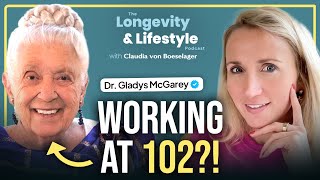
In this hour‑long podcast, host SPEAKER C interviews Dr. Gladys McGarey, a centenarian physician and co‑founder of the American Holistic Medical Association. Dr. McGarey shares her personal philosophy of "living medicine," which she structures around five core principles she calls the 5 L’s – Life, Love, Laughter, Labor, and Listening. She emphasizes continual movement, listening to the body’s signals, and individualized nutrition approached with gratitude. The conversation weaves through anecdotes (a shoulder‑pain patient, daily step counts, a childhood story about a messenger dog) and deeper spiritual concepts such as "femifesting" and the balance of masculine and feminine energies in manifestation. Dr. McGarey discusses her new book, The Well‑Lived Life: A 102‑Year‑Old Doctor’s 6 Secrets to Health and Happiness at Every Age, and explains why she believes longevity is a matter of mindset, lifelong learning, and community building – exemplified by her vision of a "village for living medicine" where love and caretaking replace dominance. The interview also touches on brain health, fear, the future of holistic medicine, and practical advice like setting 10‑year plans and walking ~3,800 steps a day. Promotional interludes from Claudia von Boeselager for a peak‑performance training are interspersed but do not alter the core content.
Chapters
No matter what aspect of your living body is, it has to move. There has to be some movement to life. If you stop moving, you die.
Hi there, it's Claudia von Boeselager, and I'm super excited to invite you to my free training on achieving peak performance and increasing longevity without burning out. Even if you're short on time or dealing with health issues, this is for you. As a peak performance and longevity coach, I've helped entrepreneurs and business professionals like you accomplish more while enjoying vibrant energy to live their best life. If you're ready to unlock your peak potential, grab the training, a free training, by signing up at LLPeak.com today. Plus, I have a special gift for you just for joining. So don't miss out on this life-changing opportunity. Just go to LLPeak.com. That's LLPeak.com today. See you there.
Today's special guest is Dr. Gladys McGarry with a golden age of 102. Yes, you heard correctly, 102. And as we speak Today, she is still a practicing doctor and consulting physician, so quite an inspiration for us all. Dr. Gladys is regarded as a pioneer in the allopathic and holistic medical movements. She is the co-founder of the American Holistic Medical Association and has had a family practice for more than 60 years. She maintains a healthy diet and enjoys a good piece of cake every now and then. She has spoken at TEDx. And she's also an author of the brand new book, The Well-Lived Life: A 102-Year-Old Doctor's 6 Secrets to Health and Happiness at Every Age. Welcome to the Longevity and Lifestyle Podcast, Dr. Gladys. It's a real pleasure and honor to have you with us today.
I'm so happy to be here. London, can you believe it?
Yes, I'm in a heat wave in London without air conditioning. So if you can tell my glow on the face, It's all in the view of health and sweating, I think. Dr. Gladys, I'd love to start with understanding. You are— have the pleasure of taking the seat of my oldest podcast guest at the ripe, tender age of 102. What is life like at 102? Can you share with my audience and myself?
Well, it's just like it's always been. It's just very exciting. I mean, there's every day there's something to do. Sometimes it's kind of a drudgery, but you know, you drag yourself through that day and you get there and wow, there's another one day that's exciting. It's a, a, a matter of living in the moment enough that you're not carrying a lot of baggage that you don't need.
Would you say mindset and that mentality of living in the present and finding the joy in things has been one of the contributing factors to your happy long life?
Absolutely. And, and having something to live for because we're each one, so our own person, no one else can do what I can do. I mean, that's pretty awesome. You know? Yeah. There isn't another person in the world that can do what I can do or what you can do or what my son can do. You know, and each one of us has a special place in the jigsaw puzzle of life. That no one else can replace. It's truly an honor and awesome.
Dr. Gladys, what would you say are some of the most important factors for living a longer, healthier life?
Just kind of be sensible. Do what— tell what your body tells you is good for you to do. I'm not going to be a gymnast and I'm not going to do major stretches or anything, but my body's gonna let me know what it is that I can do. And what I can do today isn't the same as what I could do yesterday or the day before, because today is a different day. I got different things to do. So it, it's a matter of being aware enough of you, the lessons that our bodies And our minds have to teach us.
Do you have secrets for tapping into listening to the body? As you, I'm sure, very well familiar, like nowadays people were so cerebral, right? We're always in our heads and people are stressed, et cetera. And you've mentioned a few times, you know, re-accessing the wisdom of the body. What is, what is your advice for doing that in the best way?
Well, it's kind of like I had a patient in the leg, a story I'll tell you.
Sure.
Lovely lady came in. She was really struggling with shoulder pain. I mean, she was having a lot of trouble with shoulder pain. And we sat in my office and we talked about this, that, and the other thing. And what, uh, and finally, um, we tapped on a couple of interesting things, but when she got up to leave, She reached over and picked up her purse, and it was a huge, heavy purse. And I said, there's your problem. You know, it's a matter of being aware, and our bodies can teach us that. If, if something that I do is twisting me in a different way, I better stop doing that because that's what's hurting me. However, there are times when it's not what it's doing, it's what it's not doing. I, I'm insisting on, well, I don't always do it, but I try to get daily steps in with my walker because I'm not steady enough now to walk without a walker. So I walk with a walker. His name is Skywalker. And so we walk together. And it's a, I try to do 3,800 steps a day. Some days I can't do it. Some days I have other things that take up my time and I'm just tired and I can't do it that day. But my attempt is to do it daily. And I have a cell phone that records it, you know, which is— can you believe that?
Yeah, I know. I've got the, the Apple Watch and things as well. It's, it's amazing what technology can do today. So aging well is a very popular and important topic. What is the one thing you think people often get wrong in how they think about aging?
They don't understand that you, that you can actually age into health. Because the kinds of things that you find as you get older are different from the kinds of things that you do when you were younger. Like right now, my eyes are a big problem. I have glaucoma and I have a blind spot and all of this kind of stuff. So I can't read. And so I may not have my eyesight But I still have my vision. Can you get the difference between it? Because there is something that is always lighting up my day. I mean, the vision is what keeps me going because there's something always look to, to look for into the light. Instead of going back into the darkness and saying, oh, I can't see, I have to say that sometimes. And I say it quite often during a day. Oh, I can't, I didn't see that, or I can't see that. But it's just like a, it's not important that I can't because the kinds of things that I as an individual person, I'm becoming aware of now. Are so awesome, like the whole business of Femifesting. Do you know about Femifesting?
Can you share further details for my audience?
Absolutely. Actually, this also tucks into it, a dream, because I think it's important for us as conscious beings to pay attention to our unconscious being, which has a lot of stuff to tell us sometimes. And if we do, life goes, just takes on all kinds of dimensions. So way back, oh, must be 10 years ago, I woke up one morning with a huge crash. I heard this crash and I woke up and I was both in and out of my dream, like you can be. And I saw myself in the valley of the high Himalayas. I grew up in the Himalayas and in the valley of the high Himalayas. And on my right hand, there was a young woman splayed out on the ground and just barely breathing. On the left-hand side, there was a huge man dressed in armor in exactly the same position. And the voice came into my head. And said, it's time that, that you people stopped doing this and hurting each other. It's time for you to do this and move your fingers together and learn how it is that you can work together. And I, I was, I thought, wow, that's, that's pretty interesting., and I have a friend who is a psychic in Virginia Beach, Rosalie Dearhart. Anyway, I was talking to her about manifesting something, and she says, you know, I've been thinking about another word that I think is useful. And she says, why don't we ever talk about femme-festing? And I just love that because In reality, when you take my dream that I had just had into context with some other words, the woman was lying on the masculine side of our being. The right hand is our right hand. So she had almost killed herself by trying to be more masculine, manifesting things. And the guy on the left side was same thing. We had gotten things mixed up. We thought that we women have to be masculine enough that we can manifest. Now, in my way of looking at things, manifestation is like Jacob's ladder. It's you take one step, you go, you get your degree, and then you buy a house, and then you this and you that. All of that is manifesting and climbing the ladder. But manifesting is a spiral. And a spiral, you can be up on the 5th level and know what's going on down in the 2nd level. It's, yeah, I mean, that's how we do things. If we can get ourselves back into the position where we can really understand How it is that we need both the manifestation and the feminization. We can age into health because as we do that, we find out what it is that makes our heart sing, what it is that's going to manifest in a way that we wake up and say, wow, is that great.
Beautiful. Thank you for sharing that. Dr. Gladys, in your book, you share 6 Secrets to Health and a Happy Life. Which of these secrets is the closest to your heart? And can you share a bit about how it helped you in your own life?
You know, that's almost like asking me which of my 6 kids is my favorite.
So you love them all.
Of course there is no, there is no favorite, but, but there's definitely a relationship of one to the other, to the other, to the other. I mean, life without love can't exist. Mm-hmm. I mean, love is the great healer. It takes, for instance, a seed in a pyramid. It's been there for 5,000 years. It's had all the energy of the universe within it, but it can't do anything until love in the form of water and attention and so on. Allows it to crack its shell and then it can manifest. But manifestation is like a pregnancy. In a pregnancy, the— it's one unit. The mother and the baby are one. What the mother eats, the baby eats. What the, you know, it's, it's a, a complete unit. But the moment that baby takes its first breath, that baby becomes a complete unit. It manifests as who it is, but it could not manifest if it had not manifested for 9 months prior. And once it, it's manifested, the work of the person who's manifesting completely changes. I mean, now you have to, uh, uh, take care of diapers and stuff. It's, it's, it's that amazing sequence of events. So there can't be any one of these that's more exciting or important or enlightened or anything else. It's a sequence. It, it's what life has. It grows, it lives, it becomes.
What was your inspiration to write your book? And, um, what is the, some of the key messages you, you want to get out there in the world?
Key message, I guess, is I've lived this long and, you know, and I've written other books. Most of them are basically medical books. This one is the essence of the others. So it's, you know, you get to a point where you have to live into aging to health and get some answers to some questions and, and understand how Everything that you've lived is a teacher, and it's my job to share what I can with whoever is available to listen to whatever I can do.
I'd like to switch gears and talk a bit about brain health and improving brain health also to build a more resilient mind. What is some advice that you share with your patients and your community?
Keep it working. You know, find something that you're stretching for, you're looking for. If you think that you've done everything and you just let your brain be there without outgrowing into anything, it's going to just be there. You know, it's like if I tell a patient that they for some reason they have to rest, you know, they, they have, uh, whatever. And I tell— I do what I have to do, and then I say, and now go home and get a good rest. I'm not telling them to go home and do nothing, because resting is something. You go home and you go to rest. You don't just go home and, uh, do nothing. You go home to rest. If you go home to rest, your mind will rest and it will allow itself to refocus, and you might even dream. And if you dream, it might even give you something else to understand and awaken to and So on. I mean, it, it's a process of un— of understanding that no matter what aspect of your living body is that you're thinking about, it has to move. There has to be some movement to life. If you stop moving, you die. No matter whether it's your brain. If I stop moving my finger,, it'll get stuck either that position or this position or something. It won't be able to move.
Yeah. The body's made for movement, right? So, I mean, you're doing your almost 4,000 steps a day. I think you're putting some people to shame who are like, oh, I don't even do that. And I'm, you know, whatever age it might be. So hopefully it's an inspiration to everyone listening. Dr. Gladys, I'd like to shift gears to discuss nutrition because we know that nutrition is a key role in longevity and peak performance and living Well, is there a rule or a routine you've applied that has proven to have the greatest impact on your health and vitality?
Yes. What works for me? You see, one of the problems is I can have something that is just really good for me. Like, I get up in the morning and for years I've had Raisin bran with prunes. I mean, come on. I had a lactose-free milk. Okay. That's it. Now, everybody can't eat raisin bran with prunes. And you find what works for you. And if it works, you may not have to have it every day. But it may be something that becomes habitual and your body gets used to it. And you want to have something that's alive, salads or fruit or something. But what, what I can get here in Arizona, when I've got a citrus tree in my backyard, you in London, you can't eat the same thing that I eat, or it's not available to you. I had mangoes and papayas and stuff when I was a kid. They're difficult to get now. And so I don't have them very often. So when, when, when we outline a specific diet for everybody, I think we're stretching it.
Mm-hmm.
I think we need to say there's certain basic principles. Of good health that are well to pay attention to, and then find out how your body and how you work with it. It's like I have a son who can't eat onions and garlic. Well, my goodness, growing up in India, trying to do something about onions and garlic is silly. It's, it's a matter of Whatever it is, how your body is going to accept and how you are going to be able to respond to what you've taken in, because that's your, that's the physical evidence of what you're fueling your body with. If you're fueling it with fats and too much in the way of sugar and so on, You're kind of just kidding it, trying to tease your body into what you would like to do. On the other hand, if chocolate, you know, a chocolate now and then, or even maybe one piece of chocolate a day or something works for you, bless it and eat it. But I think that Underlying factor of all this is blessing your food. If you take your food in with an attitude of gratitude, your tummy says, oh yeah, this one's a good one. And it settles in. But if you say, oh man, I shouldn't be eating this, you know, it may be a huge thing that is wonderful and you should, it's a a celebration or something, if you're sitting there saying to yourself, I really shouldn't be eating this, what's your poor tummy going to do?
That's true. Claudia here again. Don't miss out. Grab the free training on how to achieve peak performance and increase your longevity without burning out. Just go to LLPeak.com today.
Holistic medicine and impact on the quality and longevity of your life. I'd like to dive into this area where you are a specialist as well. What are the biggest holistic medicine takeaways for people looking to be at their best each day and peak performance?
I didn't start out with this 5 L's, but I've kind of morphed into this, and I think it's a nice— it's a good foundation for how we can structure how our life goes. And let me just go through these 5 L's. The first L is life. The second L is love. The third is laughter. The fourth is labor, and the fifth is listening. Now, the first L, like I said before, life, but life without love can't really do anything. But when the two of them get together, love activates life. And once it activates life, we're on a roll, you know. Now, now you have to keep going because love has to move. If love stops moving, it dies. But love can move into the light, into hope, into all things. But love could move into lack laughter. And laughter without love is really mean. It's cruel. It's, it can do very uncomfortable things for people. But laughter with love is happiness and joy. The fourth one is labor. Labor without love is drudgery. I gotta go to work. There are too many diapers. It's just too much to do. You know,, and you sort of drag yourself through it, and it becomes harder and harder. But labor with love is bliss. It's what you do today. I mean, why are you doing what you're doing? Because it, it makes you aware of something that you came to do. It's your part of your purpose. It's why a singer sings. It's why a painter paints. It's why I became a physician, why I still consider myself a physician. You know, it's the whole energy aspect of ourselves that says, well, this is what gives me juice. This is bliss. And the fifth one is listening. Listening without love is empty sound. It's a cog and gong, you know, it's just kerfuffle. But listening with love is understanding. So I've kind of put this like a carpet on my floor for what I consider a good path to take. When we're considering holistic medicine, which now I'm calling living medicine.
Why did you change the name from holistic to living?
Because of the 5 Ls or, well, actually I, I must have been about 15 years or more ago. I was in the grocery store and pushing my cart and I heard over the PA system, the hardware store down the street. Announcing itself as a holistic hardware store. So I stopped my cart and I said, well, there you have it. They, it's become a household word. Everybody knows what, you know, this, but they don't know what it is. But here it is. So we started using what we had been using is the concept of living medicine. But the whole, When we started the American Holistic Medical Association, we started it and it took us 2 years to figure out what, how to spell it. Because the root word that we were looking for was health, healing, holy. And so it was that spiritual aspect of the whole concept of, of living medicine that was essential to starting it. And that's why on my 103rd, first, second, I'm halfway there, so 2 and a half, okay, birthday, I rode a tricycle into the audience because it, the, a tricycle is a perfect example of the whole structure of holistic medicine. First of all, the things that we learned in, that I learned in medical school had to do with my body and my mind. And we, it was during the war and everything was a war against disease and pain. So we were trying to get rid of Disease and pain. And we're still doing that. But those are the two back wheels of a tricycle. They're there. They're put together with a strong structure. It has a good infrastructure and it's very stable and all of that. So you've got those. So when we got, when I got my degree in medical, as an MD, I was well instructed in and had access to working with the body and the mind. But someplace the spirit was not being considered. And I'd grown up with parents who had taken their osteopathic medical training out to India as a whole process of their life, which is of course impacted by life. And I knew that the whole aspect of body and mind was essential to connect, but it had to be connected also with the spirit. So it took us 2 years to find out that the health and holy, you know, for holistic. But then as you're looking at a tricycle, you have the, the structure, but it can't really go anyplace until it has that one wheel in the front. So you have the wheel that directs it and can go, but even that can't work Until somebody climbs aboard and, and gets hold of the steering wheels, I mean the handles, and starts pedaling. It's the reality that the connection of life to life to life to life is essential. And if we can understand that one day does lead to the next, the next, the next, the next, the next. And be looking towards, you know, how could I possibly imagine doing what I'm doing today with you?
I love the analogy of the tricycle and the importance of incorporating that spiritual component in as well. Otherwise it's just a structure that, you know, two-wheel is, is not gonna get you very far, but the tricycle is that perfect unison, right? In your renowned, obviously for your work, and I'm sure you meet a lot of new people every day, Dr. Gladys. And what is the one question you get asked constantly? The thing that everyone is dying to know the answer to?
People ask the same question in different ways. Okay. They all wanna know why I'm so old and what I'm doing. And some of the stuff I'm doing, I'm not telling anybody, you know, I mean, it's, I have my own private life too. And, uh, But anyway, the, uh, my dream is, and I'm gonna switch it up now, not answer you directly, but, but, but this is true. I really am working towards creating a village for living medicine, a village where, and you, the moment you step onto the property, your healing starts. Wow. And that can happen in any place in the world where love and healing and the awareness that we as human beings are really the caretakers of this earth and that what we're doing on this earth is what is our job. And, uh, see, I, I have the notion that when God created us as human beings and he said, okay, now you're the one group of living aspect people. You have choice, you have decision making, you can do this, and I'm going to give you dominion over the rest of the world. And we got really proud and we sat back and we said, that means dominance. Now dominance means you're gonna just do what you wanna do and make the Earth do what it will do to make you do what you wanna do. Dominion means you take care of, you're the caregiver for the Earth. And if we could really recreate in our minds the fact that we're caregiver for each other, starting with ourselves. We've gotta learn to love ourselves and once love and respect ourselves. Once we can do that and really be aware that what I have is universally what every other person has. It's just mine. And, and work with it in that way. And then be aware that my job is to take care of me so that I can take care of the world around me. It's, it's, we're not in this alone. We're in it together. And unless we can reclaim our dominion, which means we humans are here to protect and take care of the Earth, we're going to destroy everything if we just think it's dominance.
You've shared the importance of building a community also for health and longevity and for taking care of the planet. What do you see as the biggest challenge? You think it's because people are focusing only on that dominion, that dominance? Or do you see other challenges that have come to pass either over the recent past or in a more longer term that are preventing people from coming together and having that community and allowing for better health and longevity as well?
Fear. People get frightened. When you get frightened about anything, whether it's your age or the fact that you're, you're too hot in London right now, or, you know, if you can get stuck in dark places, sometimes they're totally irresponsible dark places, something that you just kind of latch onto that got stuck and, and you can't get get it off your mind. Maybe somebody said something that, that hurt your feelings and you took it in. If you keep building on that, you'll never get unstuck. But if you can actually realize that it's your choice to whether you reach for the light and say, oh, That's, that's just not important. It's, it's just, I can, I can have a cut on my arm and, uh, sit and all day long pick at the scab and it'll never heal. But if I let it, I look at it and do what I need to address it and then go on with my life. There'll come a time and I'll look at my arm and I'll say, oh, hello, I know who you are. You know, the scar will be there, but not the pain. And it's that kind of a shift of awareness that these are things we're here to learn lessons. And if we accept that and learn the lessons, it's like the whole concept of dyslexia. I, my first 2 years in school were Horrible. I was the class dummy. I couldn't read, I couldn't write, and it was just really, really painful. But when we started the American Holistic Medical Association, we were sitting around a table one time. There were 10 of us, and we suddenly realized that of the 10 of us, severely, we 6 of us were severely dyslexic. And we sat back and we said, well, that's why we had to start something that would include people who, who are in a, a mindset or a life position or a, a way of working with their lives that is not just body and mind. And, and we incorporated the, the, the R as a spirit, you know. Uh, but it was that ability that we had, cuz I don't know how I learned to read. And they, we, we tried to tell each other how it was that we learned to read and we couldn't because each one of us had found out a way in which we were able to do that so that we got through medical school, for crying out loud.
Yeah.
A lot of reading textbooks.
Yeah. In the process, I was sent to the psychiatrist twice, but that didn't stop.
I know. I mean, thankfully we've moved on in terms of understanding and the benefits and yeah, how many almost superpowers you have with that in terms of thinking outside of the box, creative thinking, et cetera, which are great for entrepreneurs. Like yourself as well, setting up new associations. And I'd love to touch on a point around lifelong learning. What makes the principles of lifelong learning so fundamental for maintaining good health and longevity?
It keeps your juice going. For one thing, lifelong learning is something that we can say to ourselves, there's always something new. There's always something that's different today than it was, uh, yesterday. It's that ability to be aware that, uh, you, you can reach for what it is that you're longing for. Uh, and, and it'll show itself in different forms and different ways of doing it. Like for instance, When, when I was a kid, my older brother was dating a woman who was a nurse. Now, the way, um, she was in nurse's training and she was on at a place that was 10,000— that was 1,000 feet lower than where our house was up on the mountain and a mile. So there was no way of him setting up time with her so that they could meet, so they could go on with their getting to know each other. We had black labs, and they were good hunting dogs, and they were just great dogs. One of them, Laddie, was John's particular dog., and John could write a note and say to Laddie, take to Ada, and he'd tuck it in the collar, and Laddie would go running down the hill and down to the nurses' stud, and the nurses, one of the nurses would look out and say, Ada, your mailman's here, and she would go out and get the note, and she'd give it back to Laddie and say, take to John. Well, you know, it's that kind of, they were reaching for love. All right. And they found a way to do it. I mean, no one else had a laddie that could go doing that, but they did. See, it's that kind of looking for what it is that I have that I can use. Mm-hmm. My daughter has things that she can use today in the field of medicine. She's a doctor. She lives in the big house in front. I can't use those things because, you know, in my day we did it differently. It's, it's a, it's life grows and it's part of just actually saying it's so awesome that at this moment in time, here we are. You think that's easy?
It's a wow. It's a definite wow if we think what goes on. And you talked about gratitude before, how grateful we need to be. I mean, we don't have to think about a lot of things. Our heart beats without us thinking about it. We can hear, we can speak without really thinking about it. All these wonderful things that are available. And One point you made there, which I love, a mentor mentioned to me before, it's not about the resources. A lot of people say, I can't do it because I don't have the education, or I don't speak that language, or I don't have the money, I don't have the time. But it's not about the resources, it's about the resourcefulness. Right. Because if when there's— and my mother always taught me this as well— where there's a will, there's a way. Yeah. So it's just, you know, you might fall down a few times trying to get to your destination, but if you pick yourself back up again, you know, you will get there. So just to highlight one of the points you made there, I really love that reminder. So thank you for sharing them. You talked about love and choosing love. Can you share a story or a situation where choosing love helped you overcome a challenge in your life?
Oh my, do I? I mean, it's every day of my life. When Bill McGarry and I started our practice, in family medicine in Wellsville, Ohio. And then he was called back into the Korean War, and I was there with 4 children under the age of 5 and a whole practice, 9,000 people in the town. So I would be so tired and worn out by the time I'd get home in the evening or at sometimes at noon. But the thing that allowed me to keep going was I had an 18-month-old son, knew I'd be coming home pretty soon. He'd be sitting on the steps and, and the house. And I'd pick him up and take him in, sit in my rocking chair and rock him, and he'd pat my shoulder. Now, it was that whole process that allowed me to keep on going. I mean, these kids were my juice. They, they, they were the ones who were really doing things that I thought was amazing, like this, this little one at 18 months, when he was 3, he came in one day and he said to me, Mama, I know something. And I said, what's that, Bobby? He said, if I make a friend and he makes a friend and he makes a friend, it's gonna go all around the world and come back to me. Of course, a psychologist, you know, of course he came to do that. And then my son, that's a retired Presbyterian minister, he came, he, he was 7, and he came in and he said, I wish Jesus was here. And I said, well, I do too, but why you? And he says, 'Cause I've got questions. And I said, okay, ask me, see, maybe I can help you. He says, but you don't have the answers. And I said, well, just try me. So he says, okay, how can God be if he never got started? And I said, oh yeah, okay, well, maybe it's like a circle. It doesn't have a beginning or an end. He said, I knew you didn't have the answers and run off. But you see, it's, it's that kind of capturing a moment in time with our relationship with the world around us that allowed us to have memories that can keep going for 102 years, you know?
Mm-hmm.
Beautiful. What does the future of holistic medicine look like to you?
What is ideally, where would it be going? Ideally, we as humans, I think, are reaching for our true humanity. I think it's what ET was doing when he was talking about home. Mm-hmm. I think in our core, we know that there's that. As a matter of fact, that's an interesting thing. I heard from a speaker that the Welsh people, when they get up in the morning and they go into town, they don't say, good morning, how are you? They say, How is your weird this morning? Weird, the word weird means for them your inner core. How is this inner aspect of yourself this morning? So if we can really look to that as our guiding source, The, the whole concept that the healing of our body, mind, and spirit is our responsibility. And as we begin to really understand the immensity of what that is and use things like stem cells and use things that are becoming available to us and so on. In ways that are life-giving and loving, we'll, we're, you know, life can become even more joyous.
Dr. Gladys, if you could continue to live to 150 or maybe even 200 years old with excellent health, how would you spend it?
You know, I never think about how long I'm gonna live. Until I, I, I just think about tomorrow and what it is. I've got a 10-year plan because that's something that I think is doable. And, but then by the time I'm on the 9th year, if I have that option, am I gonna have another 10-year plan? Probably. I'm not gonna say I wanna live to be 150. I can't even imagine being this old, you know? I mean, I can't— I can imagine it now, but I never thought about how old I'll be when I die. It's just unnecessary. I'm grateful for what I am and where I am and how I am. And I'll take what I can do with that. Beautiful.
I'd love to dig into your 10-year plan. Maybe for people listening are curious to understand, is this something that they should focus on too? What do you put into your 10-year plan? Is it an all-encompassing? Is it your favorite goals?
Could you share a little bit about it? It's a village for living medicine. It's a whole community for living medicine where We understand what we're talking about when we're talking about what we're talking about. You know, it's, it's not, uh, there, there'll be times we'll, we'll have debates and we'll have discussions and all of that, but we won't be so, uh, caught up in our own concept of what is right and wrong that we actually don't even listen to what the per— the other person is saying. It, it's just a clanging gong, you know, it's just empty sound. If we actually listen to what other people are saying and, and find some little thing that we can agree to, or just decide it's just not important. But do something with it that isn't battle to get rid of, you know, either disease or, or whatever it is, pain or whatever.
I mean, accept it as a teacher and learn what we can and then let it go. Mm-hmm. It's that reframing of something that might be perceived as negative to actually see it as, um, something to learn from.
Yeah.
I think that's really powerful as well. What excites you most about the future of health and wellbeing and longevity over the coming years and beyond?
I don't think there is a most, you know, it's again like trying to pick a child that's the favorite or a time in my life that, that would be as best. I just think it's amazing to be able to do and be moment by moment.
Most important moment in time is right now. For my audience wanting to follow what you are up to, where is the best way they can find you online? GladysMcGarry.com. And we'll link that in the show notes. And your books are available on Amazon and on all books or resources. Yeah, we'll, we'll link those too. Dr. Gladys, do you have a final ask or recommendation or any parting thoughts or message for my audience today?
I would love it if the physician within the person that is listening to me right now would become my colleague in working with the person that's listening right now, and we could work for you as a, the healing aspect and the living aspect of your own life. That's your divinity, your, your own divine power.
It's the God within you. Beautiful. Dr. Gladys, thank you so much for taking the time to come on today. It's been an absolute pleasure. You have so much wisdom. We could continue forever, but I won't, I won't succumb to that. I know how busy you are. And continue to be. So, um, thank you again so much.
And thank you. Okay, thank you, Great Britain.
More from Claudia









Can Psilocybin Slow Aging? The Study on Telomeres, Inflammation & Survival with Dr. Louise Hecker

