Boost Your Brain with Meditation + EEG Feedback (Muse Explained) with Ariel Garten
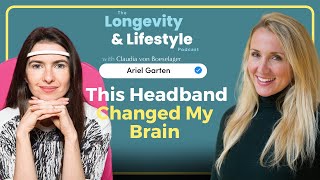
In this Longevity and Lifestyle Podcast episode, host Claudia von Boeselager interviews Ariel Garten, co‑founder of Muse, about the evolution, science, and practical applications of consumer neurotechnology. Ariel shares his personal journey from neuroscience and psychotherapy to creating a wearable EEG headband that provides real‑time neurofeedback for meditation, sleep, and prefrontal‑cortex oxygenation training. The conversation explains how EEG captures brainwave bands (delta, theta, alpha, beta) to infer mental states, and how Muse translates these signals into auditory and visual cues that guide users toward deeper meditation, improve sleep quality, and train attention. Ariel cites dozens of peer‑reviewed studies—showing meditation reduces amygdala activity, thickens the prefrontal cortex, and can make brains appear up to 7.5 years younger; Muse‑based protocols improve sleep by >20 % and cut burnout in clinicians by 54 %; and ongoing research links Muse data to outcomes in long COVID, cancer recovery, ADHD, autism, and early‑stage dementia. The new Athena device adds functional near‑infrared spectroscopy (fNIRS) to measure prefrontal‑cortex blood‑oxygen flow, enabling a game‑based oxygenation training. Practical guidance is offered: start with 5‑minute daily Mind Biofeedback sessions, progress to Mind Flight (prefrontal oxygenation), and use the 14‑Day Sleep course or Digital Sleeping Pill for insomnia. Safety, privacy, and ethics are addressed—low‑energy Bluetooth, age restrictions (≥13/16 depending on jurisdiction), EMF reassurance, and the Center for Brainwave Ethics’ standards. Ariel discusses broader trends, including multimodal devices, 40 Hz light‑sound stimulation for glymphatic clearance, photobiomodulation, and the regulatory landscape. The episode ends with rapid‑fire biohack recommendations (exercise, VO₂ max training, modest iron reduction) and a motivational message.
Chapters
Hey there, I'm Claudia von Boeselager, a former investment banker turned entrepreneur, longevity coach, biohacker, and mother of two. Once burnt out and overwhelmed with chronic health issues, I've transformed my life and helped thousands of people do the same. I've even reduced my biological age by 17 years. Yes, I'm 26 again. Now I'm here to share the tools, strategies, and inspiration to help you live healthier, happier, and longer. On this podcast, I interview world-leading experts in health, biohacking, mindset, and performance, and share personal stories and learnings to bring you the latest insights and tips. Think of this as your go-to space for real talk about all things health and optimizing your life. Ready to unlock your best self? Let's dive in. This is the Longevity and Lifestyle Podcast.
Welcome to the Longevity and Lifestyle Podcast. It's such a pleasure to have you with us here today, Ariel. Thank you so much for coming on.
Oh, it's my joy and pleasure to be here. Hello.
Can you share a little bit about your journey and your backstory to co-founding Muse?
Sure. So I was always fascinated by the brain, even as a small child, and I was really curious about how the brain works and how it creates our experience of life. So, you know, why is it that we perceive a table as hard or we see a color as red? And so I went to school for neuroscience And along the way, I did many creative ventures in my life. My mother was an artist, and so from her, I would see her paint beautiful pictures and just imagine things that were in her mind and bring them to life. So I knew I always wanted to do something where I was making a tangible impact in the world, where I was creating something tangible. And so neuroscience, as, you know, amazing as it is to work in the lab and to uncover discoveries, I also always had this yen to make something physical. And so I also went to school for psychotherapy and was a psychotherapist for a decade and began the process of working with an EEG system, an electroencephalogram, first in a lab at school and then a lab with Dr. Steve Mann. He's actually one of the inventors of the wearable computer. And we started to create experiences where you could put an EEG electrode on your head and by focusing or relaxing, by shifting your state, we could make that change the the sounds that you heard in the room or the lighting that we had in the room. And so we started this experimentation of shifting brain state to actually shift something real and physical and tangible. And that was really the genesis of Muse. I said, oh my God, we're like, we're in the lab and we're able to interact with the world with our mind that allows us to not only interact with things but also to have a tangible expression of our, of our mind. To be able to have a sense of what's going on in there. And as we're having people focus or relax to make the sound get louder or quieter, we were also telling people when they were focusing and relaxing, we're giving people feedback on their state. We weren't doing it, their brain was doing it. Their brain was causing the sound to change, which was then showing them, letting them hear what was going on in their mind. And from there I said, this is extraordinary, let's take it out of the lab. And I got together with my co-founders and we started the incredibly long process of taking this lab technology and miniaturizing it, making it easy to use, making it so that anyone can easily put an EEG on their head and get brain signals, and then create the experiences around it that let you both understand what's going on in your brain and then be able to train and improve your brain.
Really exciting. And I'd love to break it down a little bit because some people might be new to the concept of EEG and they might be like, why would you do something like this? If you could share a little bit about what you're actually seeing, like what is the EEG measuring, tracking? So if you could expand on those points.
So our brain communicates electrochemically and we can pick up those electrochemical signals using an EEG, an electroencephalograph. We do it by putting EEG electrodes on the head. And as our neurons fire electrical information back and forth, the sum total of that electrical activity can be detected from the surface of the head. In the same way that you can put an EKG on your heart and hear the heart's rhythm, you can put an EEG on the head and hear the brain's electrical rhythm. And this can give you really important information about the brain. It can tell you when it's functioning normally, and it can tell you when you're in different states. So as you're asleep, for example, you have these loud, big, slow delta rhythms. So your brain is all synchronizing in a beautiful delta state. When you are actively thinking and engaging, you see more beta rhythm. As you start to relax into a calmer meditative state, you see increased alpha rhythm. So the state that your brain is in, the electrical activity, can give you an indication of how your brain is doing and then also give you keys and tools to help you shift those states when they're useful for you, like giving you feedback to help you sleep better and get more delta waves or feedback to help you meditate more effectively. Or showing you your different frequencies and where they land relative to the general population. So you get a sense of the health of your brain.
I think it's so exciting because it's between our ears, it's a supercomputer, and we know so little about it even to this day. So having that real-time feedback is just magical, right? What are some of the use cases? You mentioned understanding how to access that delta state for sleep. How does that look like?
So we, do a lot of work with different research scientists. There's probably 50 different researchers that currently use Muse for at-home sleep research, and some of them are specifically looking at stimulating delta waves to improve sleep. So we have a program within Muse which allows both researchers and actually consumers to have the system respond to a shift in brain state. So we use this system to consumers, anyone who has a Muse, to help you fall asleep by tracking your brain as it moves from wake into sleep, and then shifting the biofeedback in a way that actually encourages your brain to fall asleep. And researchers have taken this to the next level in their experiments, and they use Muse with a special research setup that gives audio stimulation during deep sleep at delta frequency. And doing so, it seems, is improving deep sleep. And research has demonstrated that it actually improves cognitive function the next day. So the deep sleep entrainment is currently in the research, and as soon as it is sufficiently proven out in the research, it will also be put into our consumer experience. And in the consumer experience, what we currently have is biofeedback that responds to your brain to help you fall asleep. And that's already been demonstrated to improve sleep quality by over 20%.
Can you share some of the other use cases of it and how the process also works in terms of wearing the headband? Maybe people are trying to imagine like how exactly is this? Is it a big device on your head? Can you share a little bit about that?
Certainly. So for people watching, this is the Muse device here. And for people listening, what I'm holding in my hand is basically like a slim little headband and it slips behind your ears and it has sensors on the forehead and behind the ears. So basically the way that you might have a Fitbit or a monitor for your steps or for your heart rate on your wrist, This one goes around your forehead, and we have two different ones, one that just tucks behind the ears and another one that's more kind of like a sweatband that goes all the way across, and they're both quite comfortable. And on them are little silver and gold sensors. Those track your EEG, and these are the same sensors that you use in a clinical-grade EEG. And as I said, this is commonly used for research as well, and it comes with experiences that help you understand your own mind. So for people who've been listening, if you go to the website choosemuse.com, you can actually see a picture of what I've been talking about. And there's various use cases. The first one that we came out with was a meditation tool. Everybody knows that meditation is really good for you and really good for your longevity and really good for your brain health, but meditation is incredibly hard to do and hard to sustain a practice. So what Muse does is it gives you real-time feedback during your meditation to help you know when you're meditating, when you're focused, and then cueing you when your mind has wandered in order to bring your attention back to your breath to reinforce you for meditating. So basically it's like having a little meditation coach or guru who's there giving you guidance when you're meditating and in focused attention and staying there and doing it right. And we give you neurofeedback that really tells your brain like, yep, that's the right state, you're doing it. And then when your mind wanders off your meditation and onto thoughts, as all our minds do, what you hear is the sound of rain pick up or weather that lets you know that your mind is getting stormy, you're moving away, and that becomes your cue to bring your attention back to your breath. And then when you hold your attention to meditation, we have little birds that chirp. So you're really getting this like real-time feedback of when you're meditating that's telling you both cognitively you're learning what to do and intuitively, because it's giving feedback, operant conditioning to your brain. And then after the fact, you get data, you get charts and graphs and scores that show you what your brain was doing and also let you track your progress from session to session. So it's been incredibly impactful at helping people not only begin their meditation practice, but deepen or create a more efficient practice for people who already practice, giving you new insights into the brain. And up to this point, it's helped about half a million people with their meditation.
As I was researching for the interview, I was looking at the study that mindfulness has been shown to reduce anxiety, which I know so many people suffer from, by 30%. So having a tool to optimize how you meditate and have different practices is, is really, really powerful.
Listen, I feel like we should dive into meditation and the brain for a minute, 'cause this is like such a rich topic. So you mentioned that meditation has been demonstrated to improve anxiety. Well, meditation actually makes real change in your brain. So when you look at subjects who've been meditating for a short period of time, you can see a decrease in activity in their amygdala. The amygdala is the part of your brain that's really key to this fight or flight, key to the anxiety process. And meditators who've been using meditation for a long time have even been shown to have reduced sizes of their amygdala. This is one organ that may be better to have a smaller size because it correlates to less fight or flight, less anxiety, and less fear. And meditation's also been shown to have incredibly positive effects in the parts of your brain called the prefrontal cortex that's responsible for your planning, your attention, your inhibition, kind of our higher-order processing. So studies of long-term meditators have demonstrated that meditation can thicken your prefrontal cortex. So bad news, as you age, your prefrontal cortex thins. But good news, if you're able to maintain a long-term meditation practice, you can maintain the thickness of your prefrontal cortex as you age. That's the work of Dr. Sarah Lazar from Harvard and the work of Dr. Eileen Lueders. She shows that meditation can stave off aging by an average of 7.5 years. So the brains of long-term meditators look 7.5 years younger than the brains of non-meditators, which is quite extraordinary.
I'm curious, like, in their research, what was defined as a meditator? Was it once a day, 20 minutes, twice a day, 20 minutes? Um, what is the, the right protocol for achieving that 7.5-year reduction?
So in this study, the idea of a meditator is somebody who is doing it consistently. So it's just like going to the gym. You can't just do it once and be like, I'm going to be strong forever. So somebody doing it consistently. And the key The key here is that they defined a long-term meditator as somebody who'd been meditating for 5 years or more. Now, there are lots of people who've been meditating for much longer than 5 years or more, but if you look at the average being 7.5 years reduction in age of the brain, including people who've been meditating just for 5 years or more, that's— it's a pretty great investment.
What is your— I'm curious, what is your meditation and brain training protocol, Ariel? Can you share a little bit more about that?
Oh, sure. So meditation is obviously key to the Brain Training Protocol. I meditate primarily in the morning for as long as my kids will let me. Sometimes it's 10 minutes and just 10 minutes is fine. And then I meditate in the evening before I fall asleep, again, for about 10 minutes. Some days it's shorter, some days it's longer. In our research with Muse, there have been over 200 published studies using Muse in a variety of ways. And in the research with Muse, it demonstrates that typically 5 minutes a day gives you impact, because using Muse makes it much more efficient to meditate. You kind of get into the state faster. You're trained on knowing when your mind is wandering, so you're not wasting all that time with a wandering mind. You're really training your attentional loop. It's kind of like, you know, going to the gym and doing the targeted exercise. So there's a study from the Mayo Clinic looking at doctors using Muse to avoid burnout, and they used Muse on average like 5.4 minutes per day and had a 54% reduction in their burnout and improvement in their cognitive function, decrease in stress.
Wow, 54% reduction. That's huge.
Yes, yes, yes. And so, you know, when you think about, oh my God, I have to do this every day, it's like, well, it's just 5, 6, 7 minutes and it makes everything better. So for me, I try to do morning and evening. In the evening, it helps me unwind and fall asleep. In the morning, it kind of sets my brain up for the day. And then I also now do a different form of training that we have with Muse, which is prefrontal Cortex oxygenation training. So our newest Muse device, the Athena, has a brand new set of sensors in it called fNIRS, functional near-infrared spectroscopy, and it tracks the blood flow to your prefrontal cortex, and it comes with neurofeedback to help you increase the blood flow to your PFC.
This episode is brought to you by Prolon. We all know fasting has powerful health benefits, but it's not always easy to stick with. That's where Prolon comes in. Prolon is the first and only patented nutrition program that supports longevity through cellular rejuvenation. Backed by science, it's been shown to support healthy cardiometabolic markers. Fasting isn't just about weight loss, it's about resetting your system and setting your health journey up for success. That's why I love Prolon. With their fasting-mimicking diet, I can eat while fasting so my body stays nourished while still getting the full benefits of a prolonged fast and more. And now with Prolon's Next Gen program, it's even easier. It's designed for busy lives like mine. You get everything pre-packed and labeled by day, so there's zero guesswork. In just 5 days, Prolon can help shift your relationship with food and jumpstart lasting results. To help you jumpstart a plan that delivers real results, Prolon is offering the Longevity and Lifestyle Podcast listeners an exclusive chance to be among the first to try Next Gen with 15% off sitewide plus a $40 bonus gift. When you subscribe to their 5-day program. Just visit prolonlife.com/claudia. That's prolonlife.com/claudia to claim your 15% discount and your bonus gift. What if you could wake up every day feeling unstoppable, limitless energy, razor-sharp focus, and a body that's biologically years younger? This is your invitation to upgrade your life. For those that don't know me, I'm Claudia von Boeselager, former Goldman Sachs investment banker and serial entrepreneur turned longevity and peak performance coach. After reversing my biological age by 17 years and counting, I now help high achievers like you do the same. My peak performance and longevity coaching is designed exclusively for visionaries, entrepreneurs, and leaders who refuse to settle for burnout, fatigue, or suboptimal health. Together, we'll optimize your energy, longevity, and performance so you can thrive in business and life. This is a bespoke, science-backed coaching experience integrating cutting-edge biohacking, longevity science, and high-performance strategies tailored to your unique biology and goals. If you're ready to unlock your next level, let's talk. Book a complimentary exploratory call now. Just answer a few quick questions to get started. Head to the show notes for the link, and I look forward to speaking with you.
How does that work? That sounds amazing. And also blood flow and blood oxygen levels into the prefrontal cortex specifically is what it's looking at. Yes.
Yeah. Yeah. Yeah. So for those of you who can see the video, this is the new Muse Athena and it has an emitter in the center that sends out red and infrared light. For those of you that can't see it, it's a little center box that sends out red and infrared light. Then there's detectors on either side of it to the left and right, short channel and long channel. And what they're doing is it's looking at the oxygen levels in your vasculature in your prefrontal cortex. And it's specifically looking at the area just in front of the blood-brain barrier as the oxygen goes to diffuse into the brain. So what we're looking at is the amount of oxy versus deoxy hemoglobin. So in the oxyhemoglobin, we're looking at how much, basically how much blood your prefrontal cortex has demanded. And in the deoxy, we're looking at how much oxygen has been used up. Consumed. And that gives us a sense of the blood flow to the brain and the efficiency of the use of that blood by your prefrontal cortex. Why is that interesting? Well, just like every muscle in our body, our brain needs blood. Why does it need blood? In large part because it needs oxygen. Why does it need oxygen? Because oxygen turns into energy. So in our muscles, oxygen is turned into ATP, which is like the energy currency of our body, and then our muscles consume that energy and it lets us build, it lets us lift things, it lets us get stronger. Our brain works in a very similar fashion. So the oxygen goes into the mitochondria and it produces energy that the cells use to then communicate, grow, make new connections, and work efficiently in a function. And so in Muse, we have this new system on your forehead, your prefrontal cortex, that tracks your blood flow and then lets you train to increase the blood oxygen going to your prefrontal cortex.
Is it through breathing techniques to increase the blood flow, or how do you increase it with the EEG? I haven't fully understood that.
So the idea of neurofeedback is that you give the brain or the body, in the case of neurofeedback, the brain, reinforcement for doing the thing. So in the Muse, we have a game with an owl.. And as your prefrontal cortex oxygenation increases, the owl flies faster. So what you do is you're basically staring at this owl and you're trying to figure out how to make the owl fly. And you try different techniques like counting, thinking, imagining blood flow to your prefrontal cortex. And as the system detects that there's more oxygen there, then it starts to make the owl fly. And your brain begins to learn, like, this is what I need to do to increase oxygen to my prefrontal cortex. Right, do more of that. And it's getting reinforced by the owl flying and points and scores and, you know, cool musical changes. And it teaches your brain how to do it better. The same is true of EEG neurofeedback. So there's different ways that you can do neurofeedback. The most typical one is using EEG. And some of you listening might have gone to a neurofeedback professional where they've tested your brain, they've looked at your EEG, they said, oh, you're a little bit low in this you're a little bit high in this brainwave here. And what they'll do is they'll give you a protocol where you try to make a balloon fly or you do something and your brain is rewarded when it enters into the right EEG state. And it starts to give your brain what it's missing and teach your brain what to do. And so you can do that with EEG. In research labs, they do that with MRI where they can give you feedback, neurofeedback in an MRI machine. And in this case, we're doing it with a tiny little device which is giving your brain feedback on the oxygen and showing it when it does it, when it gets more oxygen, that it's doing the right thing and encouraging it to do more. And the cool thing is our brains learn really quickly, so with that reward, it learns what to do. And research has demonstrated that this kind of prefrontal cortex oxygen neurofeedback has been shown to increase attention and increase prefrontal cortex functioning.
How simple it can be with like a fun little game. It's just teaching the brain so quickly, almost passively, right? I was looking at some of the statistics. A 2025 meta-analysis of 411,000 adults found that regular use of tech, tech like wearables, was linked to 40% lower odds of cognitive decline. And I know you mentioned the statistic, and I'm curious as to use cases or scientific research around helping maybe early stage dementia or other neurodegenerative disease patients in perhaps even regaining full cognitive function. Have you seen much research on this?
So here's the moment where we need to moderate what we say in order to not create false hope, because, you know, having dementia, there's possibility of regaining function, but we, we need to really set the right stage here and not create false hope or false expectation. However, a ton of research that's beginning to demonstrate that having a predisposition for Alzheimer's or having the beginning stages of mild cognitive impairment doesn't mean that the disease needs to progress quickly and that there are, there are a lot of things that you can do to improve it. Some of the basics are making sure that you're sleeping well because sleep is high— good sleep is highly correlated with better brain health. So making sure that you're sleeping well, that you're eating well. So an increase in saturated fat in the diet has been linked to dementia and likewise a decrease in saturated fat has been linked to people who have less instance of dementia. Exercise is is huge. So for individuals who exercise well and exercise regularly, which includes both the guidelines of, you know, 150 minutes of moderate exercise as well as more intense periods of exercise and increase in VO2 max, there's also significant decreases in the chances of dementia. And I've even seen studies with individuals who are already beginning to have MCI, including exercise at that point. So it is never too late to make changes, including exercise at that point can demonstrate a reduction in symptomology and a reduction in the progress of those symptoms. So that's huge. Another good one, it's quite interesting, is photobiomodulation. So there's a wonderful company, Vielight, and they make a photobiomodulation system. So photobiomodulation is shining red and infrared light into the cells that upregulates the mitochondrial function, upregulates their ability to Create Energy. And Dr. Lou Lim is the head scientist there, and their work demonstrates improvements in Alzheimer's symptoms and reduction in Alzheimer's progressions using photobiomodulation.
The photobiomodulation is really powerful. I try to do it regularly too. We have— my mother also has a panel. I've had Sarah Turner also from Sarah Thrive on, who has the combination of the gut red light panel with the headband as well. It's just so powerful of focusing on the mitochondria for the production of ATP and just bringing back the vitality of the brain and also, of course, of our gut as well. Can you explain for people interested in, in Muse and, and doing the brain training, what are the different protocols that you offer, um, as part of it? How often do you recommend? Is it like once a day or multiple times a day, perhaps for someone getting started and doesn't want to be too overwhelmed, so not the hardcore biohacker, let's say? What would you recommend?
Sure. So Muse has a lot that you can do with it. It's possibly one of the downsides of Muse. There's too many options. But I would say if you're starting with Muse, so when you get the device, it comes with an app. And we have two different devices, Muse 2, that is focused on more on meditation and brain health. And then the Athena, which does the meditation, sleep, as well as the fNIRS prefrontal cortex neurofeedback. So it really is like a total brain health device. So I would start with mind meditation. We have various different forms of meditation. We have neurofeedback on the heart, the breath, the body, but start with the mind meditation for 5 minutes a day. And we have a beginner program, Discover Mind Biofeedback, that's just very easy 3-minute sessions that teach you what to do. And that's been demonstrated in many, many studies to be quite efficacious. So Mayo just published a study using Muse with Long COVID patients, and that protocol has been shown to improve Long COVID symptoms. They did an early study with with breast cancer patients going through surgery and the Muse Mind Meditation has been demonstrated to them to decrease stress and fatigue in the cancer care process. So, you know, mind meditation is key. And then you only need to do it, start at 5 minutes. It's fine. It'll be easy. And then I'd also add in Mind Flight, which is the, if you've got the Athena, the prefrontal cortex neurofeedback, and that's going to help you strengthen your brain. You can start with just 5 minutes a day. You don't need to do any more of that. Just, you might feel a little tired afterwards, which is fine. That's your brain working. And just like when you go to the gym, it gets stronger and stronger. And then if you have difficulty sleeping, improving your sleep is key. And so we have a course, 14 Days of Sleep, which teaches you all the basics of sleep hygiene and how to think about sleeping in order to sleep better. And then we have what we call the Digital Sleeping Pill, which is the neurofeedback that helps you fall asleep at night and fall back asleep. Sleep if you're still wearing the Muse and you wake up in the night. So people who have really bad sleeping problems really find it incredibly helpful to shift their sleep, to recognize, hey, I can sleep, and then to have a tool that they can use to help get better sleep night after night.
Is there any concern for EMF radiation by having a device close to the brain? I'm sure some people are wondering.
Yeah, so it's incredibly low energy. So it is the newest Bluetooth protocol, which is very low energy, and the radio is facing outwards. So the signals are going outwards, not over towards your brain. And it has been, you know, extensively tested to be very benign.
I also want to talk about an important topic in terms of the brain-computer interfaces and legality, ethics, et cetera. What is your view of where the market is in general in this field? And what would you like to see going forward?
Sure. So in 2014, I started something called the Center for, um, Sarah of the Center for Brainwave Ethics in order to try to create a set of standards that really anchor on the pillars of privacy, safety, agency, efficacy, and security in these kinds of systems. And there's been great uptake. So there's now lots of committees, there's brain ethics There's legislation that's being created in Colorado. They now have a law that protects brain data, which is great. And so, you know, advocacy from the Neuro Rights Foundation and others are really creating more of a structured foundation to make sure that brain data in these types of systems is always held in the highest safety and, and privacy and security. So I think that's great and it's incredibly important and something that I and others and my fellow scientists have been advocating for for a really long time. When we look overall at where it's going, we're seeing more and more devices coming out that help people with their brain. So, you know, 20 years ago, it was impossible to, as a consumer, get a device that could tell you anything about your brain, frankly, not much about your heart or your SpO2 or any of these things.. So we're starting to see a huge shift in the ability for people to gain new insights and information on their body. You know, I'm wearing a fitness tracker and I am far more fit because of it, because I can check my, my heart rate and my strain and all of these other metrics and they become very encouraging. And so I think it's fantastic that we now, we have tools to do that with the brain as well. We're starting to see more things like vagal nerve stimulators come out. The key is to make sure that you're using technology from somebody who's very reputable, who has lots of studies that back it. Maybe they themselves are PhDs that came out of a university to, to start this because there are, you know, hacks and it's really important to, with your brain, stay away from the hacks and just make sure that you're really working with people who are credible in the tools that they've, that they create.
That's really good advice. Is there any risk of like overusing or any use cases for people who shouldn't use Muse at all?
Um, so we say nobody under 13, um, because we comply— we're best as we can complying with the different legislature globally around data privacy. So for GDPR, um, actually we now say nobody under 16 to comply with GDPR, which is the European privacy standards. There are people that use Muse with their children which is, you know, the parent's own choice, but we say that's the parent's choice, not our stance is nobody under 16.
But just to be clear, that's not from a risk perspective, it's just from a privacy perspective.
Is that right? Yeah, just from a privacy perspective. I mean, there's been studies done with Muse. There's a study by Kansas State University looking at grade 7 and 8 students using Muse, and it reduced the number of times that they were sent to the principal's office for detention by 74% in this particular study.
Wow.
That's a big number. Yeah. So, you know, we— but we always want to be on the right side of privacy. Laws. Um, and let me think what else. If you have extreme electrical hypersensitivity, then, you know, any electrical device may not be a good fit for you.
Epilepsy, would that be any case perhaps?
No, actually epilepsy is not an exclusion. I'm, I'm not a doctor. I'm not your providing doctor. Please speak to your doctor about it. But we actually have a number of different groups that are looking to create epilepsy monitoring systems using Muse. Devices. So there are studies where people with epilepsy are currently wearing these devices around to gather data to then allow those teams to try to create an algorithm to detect epilepsy. That, you know, the solutions for those are quite far out. All of that is in the research stage, but all to say that I haven't seen that be an exclusion, but of course, speak to your doctor.
I'd love to touch on neurodiversity and how Muse could help also with things for children, but also adults, ADHD, ADD, potentially autism, things like that as well. Has there been research or have you looked at this space as well?
There are actually a number of studies running with kids with autism. In the case of Muse and autism, it is using the device to track their sleep or brain state. So I was just at a center in Ontario where they're doing a study using Muse to look at the brainwaves of children with autism and test different interventions. And then there are other studies that are tracking the sleep of children with autism to look at the difference in brain waves and sleep. Again, these are research studies, not something you do at home, but it is being used with autistic populations. And then on the ADD/ADHD side, it's a tool that helps you improve your focus. Yeah. So not a doctor, I can't say it will treat or cure ADD/ADHD. However, it is a tool that is helping to improve your focus in your attention, training you to notice when your mind wanders, and training you to bring your attention back to the topic at hand, and strengthening your prefrontal cortex's ability to monitor and manage your attention. So anecdotally, it has been demonstrated to be very efficacious.
Very exciting times ahead. What does the future of brain training look like? Where do you see things going in the next sort of 2 to even 5 years?
Oh, great question. So in the short term, we're going to see, you know, more and more protocols around brain training, more validation from the science about what's really working. And then in the longer term, you know, we're going to see more rolling in of modalities. So for us, combining EEG and fNIRS is brand new. It's actually, I think, the only consumer device that does that. And so now that we have these dual modalities, I think we're going to see more, more different training protocols from different modalities. There are also other companies doing electrical stimulation modalities, and those are, you know, progressing through research. Some of it is being shown to be safe and efficacious. So we're gonna see more and more devices and modalities around to help you track and train your brain.
What do you think of the pulsating light as a brain training mechanism? I know there was research last year out of MIT that was saying that it helps to clear even amyloid plaque potentially. What is your view on that pulsating light?
Sure, I can, I can speak to that at depth. So my friend and colleague, Dr. Rudy Tanzi, developed a device many years ago. It was actually branded with Deepak Chopra, the Deepak Chopra Dreamweaver, in that he was giving audio and light stimulation. Rudy is one of the professors at Harvard who discovered the very first Alzheimer's gene and ApoE, and he was using this device really for stimulation and relaxation.. And over time, a similar concept was tested by his colleagues at MIT, and they were using 40-hertz stimulation at that point in a rat model. And the simultaneous sound and light stimulation at 40 hertz seems to activate the glymph network in your brain. So in our bodies, we have lymph, lymph moving the fluid around your body. In the brain, we have glymph, So the lymphatic fluid moves around, flushes things in your brain into your CNS and then out your body. And so it seems that what's happening is when you have this 40-hertz sound and light simulation, and I was talking to the lead scientist on the work at MIT, and she said it's the combination of the two that seems to stimulate the brain into the sort of pulsating behavior. So your brain becomes entrained and the glymph starts to sort of like, it's like if you have a plunger on the toilet, this 40-hertz pulse starts to move the glymph with this pulsation. And in doing so, it seems to be clearing amyloid beta out of the brain. This has been demonstrated now significantly in mouse models and the team at MIT, including Ed Boyden, another colleague, they are moving the device it's called Cognition. They're moving the device through FDA, and so it is a sound and light pulsation device. So again, we're going to see more and more of the human research evolve there as they go through their FDA trials to demonstrate the efficacy. But it's, you know, should be quite benign, kind of a do no harm, and seems to have real promise to impact amyloid levels in the brain, which could be useful both for people with actual onset of Alzheimer's as well as those people at risk.
There's also a device, NeuroVizr, which I actually have. We've had Garnet on also, who was 76 years old and super sharp. He's amazing. So I think what we can do to keep our brain in peak performance for as long as possible is so important. I'd love to ask you some rapid-fire questions, Arielle, if you're up for them.
Sure.
So what's a surprising biohack or longevity tool that has had the biggest impact on your health?
Okay. So before you said the biggest impact, the The one that came to mind, and this is a terrible one, but just interesting subject, yeah, was bloodletting. I never do it, but I was talking to some biohackers at a conference and we were talking about anemia, iron, and I'm like, I've always been a little bit anemic, and they're like, great, that's going to be great for your longevity. It's like, what? So apparently having lower iron is one of the things that is linked to longevity. It's a kind of strange concept because you also want to have sufficient iron stores so that you have you know, good hemodynamics, good blood oxygen. Yeah, exactly. Um, but they made reference to— one of them actually did bloodletting as part of her longevity protocol. Not something I would ever do, but it's just what sprang to mind as you asked the question. Certainly not one that's had a big impact in my life that I can see yet. And, uh, probably the biggest— honestly, the biggest impact for longevity in my life, as basic as it is, after meditation, is exercise. You know, all the rapamycin and all the fun things that you can do, exercise still remains key.
What is your exercise protocol actually?
I'm curious. So I have an exercise bike. I make sure that I get my heart rate up to 170 and stay there for a couple of minutes, drop it back down, heart rate back up to 170 and stay there for a few minutes. So, you know, at the very least I try to get in that kind of VO2 max training. VO2 max has been highly correlated. Well, not highly, but you know, it seems to emerge as one of the strongest markers of correlation to longevity. And I also do Pilates, exercise with my friends, run with my kids. So, you know, on top of making sure that I have targeted sort of cardiopulmonary training, I also make exercise fun and engaging with part of my social life.
How often do you do the VO2 max training up to 170?
Try to do it so minimum 3 times a week. Try to do a little bit every day.
Have you calculated what percentile you're in, in the VO2 max category?
Actually, I haven't. I don't, I don't currently have my VO2 max, although it's, it's something that has been on my mind.
I actually wanna do not just a wristborne test, but a, a really professional one as well. Yeah. I actually came across researchers out of Denmark who have a device that you can just put on your sternum, which you don't need to do then the more painful VO2 max one, which apparently has quite a good, uh, uh, accuracy. So I'm still looking into it a little bit more to understand the science, but that would be a nice workaround to the VO2 max test.
Oh, tell me what it is when you find out more about it.
Sure. Happy to share. Happy to share as well. Yeah, I'm gonna dig into the science with them just so I fully understand it, and then I'm happy to recommend it as well. What's a book or resource on health that you find yourself recommending over and over? Or it can be in general, doesn't necessarily need to be on health.
So my colleague Patricia Karpus has a podcast, the Untangle Podcast, and it has a ton of resources on brain health and meditation, and I often send people there.
Beautiful. What's a piece of advice you'd give someone in their 20s or 30s looking to set themselves up for healthy aging?
One, reduce your stress. I know it feels like you wanna push yourself to all these limits, and it's such a fascinating balance between pushing yourself to limits and then recovering. So being aware of when you're stressed and then recovering. Two, sleep well. This whole sleep when I die thing, you know what it means? You're going to die sooner.
Really sleeping. I used to think that in my 20s as well. I was a fiend for that.
Amazing. Reduce the amount of alcohol you have, but have fun. So there's lots of ways to have fun without damaging your body. Create healthy friendships and healthy people around you that do spin-up behaviors, behaviors that encourage you to be healthy, to be fit, to laugh a lot, to enjoy life together, to be productive, because your friend group can really determine who you become. Get off the couch, watch what you eat. However, and this is the kicker, don't stress too much about all this. It really doesn't matter one calorie versus another. You can have some potato chips someday, you won't die. So it's also important to keep a light touch to all of this. Make sure you're doing the right things, but don't make it such a focus of your life that you're not living your life. I know that sounds like even more pressure potentially, but strike the balance. Don't, you don't have to go overdo it into extremities. Find the things that spark you joy, find ways that they fit into your life and enjoy.
This has been such an inspiring and informative conversation. For listeners who want to dive deeper into brain health and neuroscience and what you do at Muse, where can they find you? Where would you send them? And we can link everything in the show notes.
Certainly. You can find me on all the socials at @choosemuse, and you can go to the website choosemuse.com.
We'll link all of those in the show notes. Ariel, do you have a final ask or recommendation or any parting thoughts or message for my audience today?
Absolutely. We are all amazing, capable, wonderful, beautiful humans, and we don't need to let the voices in our head that tell us I'm not good enough or, oh, I have to do this better. Don't let those voices get you down. You don't even need to listen to them or believe in them. You are amazing and capable and awesome. So go live and be your amazing self. And anytime a voice in your head or voice of a parent or somebody else brings you down, you're allowed to push that away and just enjoy being you.
Well, thank you so much for joining us today. And thank you, dear audience, for tuning in. Don't forget to subscribe, share, and leave a review if you enjoyed today's episode.
Thank you both so much. Hi everyone, it's Claudia again. Before you take off, would you like to get a short email from me to you several times a month with top tips, insights, and strategies to help optimize your life, health, and business. This could be interesting posts or articles I've read on life and longevity optimization, cool biohacking or lifestyle products that I've discovered, and other fun things to help you be at your best. It's a very short piece of inspiration for you, so if you want to receive it, check it out by going to llinsider.com. That's llinsider.com, and leave your email to get the next
More from Claudia









Can Psilocybin Slow Aging? The Study on Telomeres, Inflammation & Survival with Dr. Louise Hecker

