Bridging Holistic Healthcare, Spirituality, and Traditional Medicine with Julie Freeman
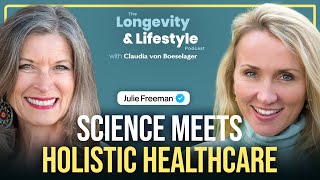
In this Longevity and Lifestyle Podcast episode, host Claudia (Speaker B) interviews registered dietitian and co‑founder of Intrinsic Wellness, Julie Freeman. Julie shares her personal health journey—from early childhood sugar addiction, obesity, hormonal and gut issues, to a rare hairy‑cell leukemia diagnosis—and how those challenges led her to functional and integrative medicine. She describes her pivot to holistic care in Germany, incorporating quantum science, family‑lineage (family constellation) therapy, energy modalities such as Reiki, dowsing, and pendulum work, and the development of her eclectic “toolbox.” Julie outlines practical strategies for overcoming sugar addiction, the role of intuition, and self‑love practices, especially for women navigating perimenopause. She explains her use of micro‑dosing psilocybin for addiction, eating disorders, and menopausal symptoms, and how she integrates genetics, epigenetics, and spiritual frameworks (Gene Keys) into her Intrinsic Wellness/Intrinsic Wholeness program. The conversation also touches on future visions of rapid, chemosensory health profiling, energetic diagnostics, and community‑building initiatives like a nonprofit retreat modeled on Blue Zones. Throughout, Julie emphasizes personal empowerment, purpose, and the integration of body, mind, and spirit.
Chapters
Know your internal power. Stay committed to your purpose, your passion. We need your gifts. You need your gifts. The world needs your gifts. So embracing the power and the spirit within.
My guest today is Julie Freeman. With over 40 years experience, Julie has worked in healthcare, mental healthcare, both traditional hospital and clinical environments, as well as integrative centers that use a more holistic approach to care. Julie is the co-founder of Intrinsic Wellness, which was born out of a shared vision to bridge the best of physical medicine and energy medicine, both Western and Eastern, ancient and modern. It's such a pleasure, Julie, to welcome you on today, particularly because today is your birthday as we're recording it. So happy birthday and welcome to the Longevity and Lifestyle Podcast.
Thank you so much, Claudia. I am so pumped to be here today. Thank you.
Yay, my pleasure. So Julie, can you share more about your incredible personal journey and what were some of the pivotal moments that led you to explore the connection between food addiction, obesity, immune dysregulation, cancer, and much more?
Yes, yes. I oftentimes joke and say that I'm the perfect poster child for functional medicine. So I started my journey very early in life, very sugar addicted, very obese. And bullied and name-called, you know, back in as early as the second grade. I had morphed over 50 pounds and was pretty well out of my weight range by that time and started dieting with my parents, who were also, you know, kind of food junkies, food addicted and obese as well. And our doc at the time handed us the 1,000-calorie meal plan, you know, which we would be on and off. But what was interesting is there wasn't a shutoff for me. If I had one cookie, I wanted to eat the whole batch. And then I started to actually get very interested in food preparation, cooking, and baking. And now I've written 3 cookbooks. Of course, they're all healthier versions of delicious food. But I would cook and bake, and my mother and I would sit there and eat, like, the whole batch of donuts or the whole batch of cookies. And so move on forward, I had a lot of hormonal issues, lots of allergies, lots of gut issues and things like that at a very young age. By the time I was 17, all of my nails had come off my fingers. My skin was bleeding, and I was wrapped up in about 10 different Band-Aids. And at that time, you know, our good old general practitioner said, well, just put nail polish on it, which is a terrible thing to do, we now know. And then he finally sent me off to a dermatologist who had me on antifungals. So that whole world of Candida and small intestinal bacterial overgrowth. And all of that was groomed very early in life. And both my parents actually had those skin disorders as well. So, move on ahead, lots of hormonal issues, infertility, things of that nature, on and off shots, pills, hormones, and things like that, and had a real challenge with the traditional hormones from way back when and really responded negatively. But it wasn't until later in my journey when I started to feel really unwell that my oncologist, he was a colleague of mine but became my oncologist. He was a hematologist at the time. And he said, you know what, it sounds like Lyme. But, you know, in this traditional world, we don't accept Lyme as a diagnosis, but that's kind of what it looks like. And then I wasn't getting any better. So finally he did the bone marrow biopsy and found out that I had a rare leukemia, less than 2% of the leukemia population. Called hairy cell leukemia. And I just posted about it this weekend because I was at a cancer retreat that I'll be presenting at next year. And he said, you know, the good news is it's a slow-growing cancer. The bad news is we don't know a lot about it. So he said, and I know you're going to want to do your alternative, you know, work. He said, but I'm going to keep an eye on you. I said, that's fine. And I actually went to Germany. I went to Stuttgart in order to embrace a holistic approach to cancer care. And at that time, totally revamped my healthcare website and my model of care and really did the deep dive more into functional and integrative medicine. I had always envisioned that in my early on in my career as a registered dietitian, knowing that there was a lot more than being, you know, the dietitian with the hairnet in the basement of the hospital. But when I went to Germany, that's when I really embraced all of that and even came back to concepts that I had been intrigued with back in college— quantum physics, quantum science. And was introduced to Bruce Lipton and Gregg Braden and got to read, you know, German and Dutch sub, you know, subtitles in English. And I said, oh my God, this is my world. So, you know, going through the journey of cancer care and whatnot, it really opened up a whole new world of practice for me. And so I've been pioneering since that time. It was also my first introduction to plant medicine. So, you know, I'm a child of the late '50s, early '60s, but I ran the other way when it came to drugs. I was actually part of the D.A.R.E. population, which was really very anti any kind of drugs. And so I was very afraid of that world and just kind of kept that aside. And it was a client of mine who said, have you ever heard of shamanism and ayahuasca? And I said, neither. And I should have known about shamanism because I have American Indian on both sides of my family, both on my mom's and my dad's. And so I started to do the deep dive in the research arena. And for me, I combine the best of science, spirituality, and intuition. So it's really about sort of bridging all of those worlds together. And I said, you know what, this is really calling to me. So I began to work with a shaman and did an ayahuasca experience that was profound. I would have to say it did not cure the cancer, but it really set, I would call it, forward vision in terms of the challenges, the trials, and what I was going to encompass over the next number of years. But there was a little bright light at the end that knew, that let me know that I was going to come out the other end okay. So, you know, I've opened up so many different worlds since back in the days of my dieting and compulsive overeating, my cancer journey, my hormonal interventions and things of that nature.
Such a beautiful journey. And thank you so much for sharing that as well. And I'd love to hear from you, Judy, like what were some of the biggest ahas when you went to Germany in terms of a different approach? And I mean, this also bearing in mind, we talk about, you know, the Western and Eastern medicine, obviously Germany is considered Western, but they have a lot of holistic approaches, homeopathy, etc. So would love from your perspective, if you could share with my audience, like some of the things that you found most fascinating in terms of philosophy or way of treating patients then.
So there was a real deep dive into your family lineage, you know, and even like family constellation therapy, which I have embraced also here in the States. And with family constellation, you really are looking at your parents, your grandparents, you know, the lineage of your family and what are some of the physical as well as the emotional and spiritual challenges that you have brought into your own life. And so one of the things that it opened up for me was to really do a deep dive specifically into the kind of leukemia that I had, which was hairy cell. So, lots of toxin exposure that I can identify. I am huge on nontoxic skin cleaning products, household fabrics, things of that nature. But, what it also allowed me to look at was how I felt about myself. And, a lot of that came down to that self-loathing, that self-hatred, growing up as a child who had learning challenges and felt sort of disconnected in terms of being able to learn adequately and also having obesity and things of that nature. So I had to really start down that path of learning how to re-parent and love myself. And there was a wonderful woman I knew, her name was Hannah Laurie, that did some of that energy work with us when I was in Stuttgart.
So I'd love to touch on that also as well in terms of that self-love journey. I know for me myself, like, that's been also a journey for me, and I'm sure for people listening as well. You know, we want to make sure everyone else around us is okay, and everyone else is happy. And we tend to forget ourselves, or we put ourselves last, or we end up beating ourselves up all the time, right? I mean, some of the stuff I teach is around you need to be your biggest cheerleader, and not your biggest bully. What was that self-love process for you? And maybe what are some tools and strategies that you used along the way that were really profound that you teach also today? So people listening can start applying some of them.
I think one of the things that we need to do in our society these days is to really quiet oneself, go within. So it's, you know, it's part of that meditative process. But it's that process with also setting an intention for wanting to embrace the God within or the spirit within, the energy within, in terms of what are my areas of light? What are my gifts that I bring forth in this world? I now work a lot with women going through perimenopause, menopause, you know, that change of life, that pivotal time in life when we are called once again as women to really look at, am I on my path? What are my unique passions, gifts, purpose? And I think that when we can tap into making that list of our gifts, what our purpose is, what is our intention, we can begin that process of coming back to the self and beginning that self-love process. I also use Reiki as another way of really kind of focusing in on areas of the body that may feel tension or a dis-ease, a challenge. And then again, send some of that white light, some of that warm healing light into those areas.
Yeah, I'm actually a trained Reiki master myself. By chance, I did my first level one in Madrid. And then when I lived in Buenos Aires, I ended up doing level two and level the mastery one as well. I don't practice enough. So I love the fact that, you know, energetic medicine as well is also spreading in awareness and how beneficial it is and all its different modalities. I'd love to understand how you in a sort of, let's say, a typical or what would be like a typical patient that comes to you just for people listening so that they can relate and like what is that healing journey that you bring them on?
So I tend to attract people with chronic complex health challenges. You don't want to necessarily even call them illness. Sometimes they don't even fit neatly into any one box called a disease. And these are the clients who have been everywhere, have seen everyone, and they still don't have anything definitive, but they're feeling really poorly. And oftentimes they're the ones that really feel unheard, unheld, not listened to. And I really try to make a safe space So, you know, the first thing that I like to do is, although I will be looking at the last couple of years of labs and tests and office visits and all the medical records and things like that, the very first question that I will ask someone is, how can I help you today? What is it that you would like to gain from our time together? And I oftentimes begin with a grounding exercise. So I want to bring people back into themselves and also into that energetic space that we're about to, to meet in.
Beautiful. And what does the, the journey, if you will, look like into healing, especially if you said that these are a little bit more challenging ones? So some people go to their doctor and they say, well, you know, you, as you yourself, like, okay, we know what it is, it's, but it's so rare, we don't have much research on it. So obviously, hearing even a diagnosis like that, for a lot of people is very challenging. Or if somebody hears, you know, you have a very complex case, medicine can't really help you, Western medicine, I should say, What is that process like and what would you encourage people to know in terms of hope and what can, can be done?
I also will address the fact that, you know, science and medicine has finite knowledge and it's always changing. And even when I began, you know, again, as a dietitian many years ago, as my start-up career, that area has changed. And one of my friends used to say to me, well, nutrition really isn't a science, you know, he said, because it's changing all the time. And I said, well, you know, all of our medical arenas are constantly evolving and changing, and we will never keep up with what that intuitive sense is. So again, I ask people to really kind of go inside and ask them a little bit about, you know, you're the expert on yourself. What do you feel that you need at this time? We need to rest. So I think one of the biggest things— and I listened to one of your other podcasts, you know, sleep is a huge one. And if we cannot rest, then we cannot digest and we cannot detoxify and we cannot absorb nutrition. And so I really start to work on— I call them the ADLs, the activities of daily living. So I used to do some moonlighting at nursing homes years ago. We need to focus on all of those areas that sound so insignificant. Oh, how is getting out in nature going to make any difference for me? How is it being out with the trees and the nature and the grass going to make any difference for me? It will, and I will provide articles and things like that. I also ask my clients not to do a lot of doctor Googling because that can really send you down the rabbit hole of self-diagnosis, more anxiety, more fear. And as we start to look at all the complex pieces, we will prioritize the areas so that it's not so overwhelming. Like, this is the most important thing that we need to work on right now. I would say that with most of my clients, as much as they say they're eating healthfully, diets are oftentimes really a mess. And so getting back to a whole foods diet where people are really eating lots of vegetables and adequate amounts of protein and quality starches and good quality oils and fats sounds simple, but it's not so easy to really put into action. So I really help people with kitchen skills, or even if it's just a assembly skills because they don't have the desire or the knowledge to prepare for themselves. So, those are just some of the areas that we will begin. I also use a wonderful genetics program. I've been using genetics since it came out about 20, 20 years ago, have tried a number of different programs, but the one that I use in my practice really utilizes a food-first lifestyle medicine approach first. To epigenetically override a gene that's not functioning properly. So I love using that in my practice because that gives us a little bit of a roadmap and a blueprint. And it's not deterministic because we can epigenetically support systems that aren't functioning to their, you know, their optimal level.
I think that's also really exciting out of functional genomics and what's possible. I've had Kashif Khan from The DNA Company also on as well. And it's so empowering. And that's why I love the work that you're doing too, is like empowering people to trust themselves again, to not give their power away like, oh, somebody else will know better. It's like, no, you actually do. You just need to re-tap into that unbelievable wisdom that the body has as well. I want to talk about intuition, but before we do, I know a lot of people struggle with sugar, sugar addiction and things like that as well. And you've obviously gone through this and it can really wreak havoc on many areas of our health. For people really struggling with sugar addiction, what would be some steps that you would recommend to start with to really try to shift away from sugar, sugar addiction, know that it is a controlling factor and similar to cocaine in the brain, right? So it's a really terrible, powerful influencer. What are some steps people can do?
So the first thing is that I really educate people that our taste is learned. So the good news is you can learn to like a new food. You can learn to expand your taste buds to really prefer sour and bitter to sweet, but that's gonna take time. And so I oftentimes will start with a little bit of something along with a food that they enjoy. And it's the same way that we train children. It's like, here's a food that I really like, and I'm gonna add a little bit of something else that's gonna be healthier for you. Together and then you gradually kind of work away from the very sugary food. I also do label information education and we can start— so even cereals, you know, the Environmental Working Group, which is a wonderful organization. It's a nonprofit here in the States. I don't know if it's around the world, but EWG does a lot of work in terms of, again, just education. So we could take a sugary cereal like Cocoa Puffs And then maybe mix that with, you know, an organic Cheerios, so to speak. And then you gradually increase the Cheerios, decrease the Cocoa Puffs, and then now all of a sudden your taste buds are saying, hey, you know what, I know that food. I like that food. So one of my, my second cookbook was called Sweets and Treats. And what I did is I took, you know, brownies and different kinds of cakes and cookies and quick breads and things like that.. And I gradually increased the fiber, decreased the sugar. The two little hacks are more vanilla extract and more cinnamon will actually sweeten things up and you can actually cut back on sugar. And another key area is to make sure that there's adequate protein. So when your brain and your body has adequate protein, you crave less because your blood sugars aren't going all over the place.
So that can be really helpful. Beautiful. I'd love to shift over to intuition, right? And what you were saying is, well, some people might be like, well, what does intuition have to do with all of this? But it is so powerful, obviously, on so many regards. So why should people be paying attention to intuition and relearning it, right? Because little kids are very intuitive and we train them not to be. And then we try to tap back into it again as we, as we grow. So why is it important and what are some modalities for helping people to re-tap into intuition?
I love this topic. And there's a wide variety depending on the person who is sitting in front of you. You need to kind of meet them where they're at and what they're open to because intuition can sound like woo-woo science, spirituality, like, oh my God, I'm not sure I really want to go there. But we've been trained to really trust someone outside of ourselves. Trust the physician. The physician knows. The physician will heal you. But actually, now what we're doing is we are at a point in time where we are creating partnerships. Our doctor may know the best about the medical science and the, you know, the mechanics that go into testing, but we know ourselves. And so the first thing is reeducating both physician and client or patient around the fact that we're now partners. Being a partner also means you have more responsibility for yourself, but tapping into your intuition. So I oftentimes use a phrase for many, many years because I used to work in diabetes. I also worked in eating disorders many years ago, is get out of your head and into your gut. But, you know, how do we get into our gut? And Reiki is a wonderful way of doing that. So oftentimes I'll teach people Just take your hands and place them on your abdomen. You know, just allow yourself to connect with your body so that you can actually feel and feel the different sensations that are going on inside. Now breathe deeply into that. So it's almost like doing the relaxation response, which I was trained at back in Boston with Herb Benson, is really kind of relaxing oneself in feeling into your body. Once you begin to feel into your body, you can begin to do a body scan and feel where there are areas of tension or distress or dis-ease, you know, discomfort. I love using dowsing as a technique. So for those who are interested in, you know, crystals and those kinds of areas, I have a beautiful rose quartz crystal that I use for dowsing in terms of my supplements. And, you know, dowsing is a great way to be able to let your body know. You can also, you know, just allow your body to move forward or backward and ask it which is yes and which is no. And there's lots of, you know, online tools and resources, books and things like that to really help you get into your body for understanding what it's telling you intuitively. Applied kinesiology, I studied that many years ago. So there's so many different modalities if people just kind of open up to Yeah, I can actually regain that which I lost when I went into training in order to go through school. I mean, basically our education unfortunately needs to go through a big revamp as well because we are trained to trust outside rather than inside.
Yeah, I mean, it's a 200-year-old education system based around the Industrial Revolution. So I definitely think it's ready for an upgrade as well.
I agree.
Yeah. So Judy, for my guests that are not that familiar with the connection between material world and sort of unseen spiritual realm, can you explain how this spiritual perspective influenced also your approach to healing and well-being and maybe some success stories that you have seen amongst— I know, obviously no name, but just sort of a generalized thing to make it a little bit more granular for people listening?
Sure. So there's an exercise that I do with my clients that I love because most of us are behind the computers these days. I know, I know most of my work telehealth, you know, with Massachusetts and here in Texas, California. It's called wide-angle vision. And a wide-angle vision is basically using a technique where ideally you would walk outside or even go into a window and you start to see the expanse. And even though you can see your hands at the side, you're not focused on any one thing. You're focused on the expanse. And then you experience what does that feel like? Generally, when I do that with my clients or in a group situation, all of a sudden there's a deceleration. There's like, ah. And from a neurological standpoint, that hyperfocus— and I also see that in my clients as they get hyperfocused. I have a client this afternoon who's very anxious right now, hyperfocused on the illness, the disease, the label— that when you do this wide-angle vision, you all of a sudden, you start to see the big picture. So, you know, I start with a connection exercise again for someone, you know, during COVID I had a lot of anxious people that wouldn't leave out, wouldn't leave the house. Go to your window and look at the trees and look at the green and the nature. And then once I get people outside and say, what does that feel like? And start to tap into the feeling. I grew up, as many, with a dysfunctional family, alcoholism, you know, things like that. So, you know, I'm continuing to to do that deep dive into some of those areas for myself. But we oftentimes become disconnected to our feelings as a way of self-preservation, a way of just surviving. And we need to kind of reconnect with those feelings. So getting out in nature, and again, I think for me, trees, I love trees. Trees are amazing. Energetic connection between trees is great. But those colors, the colors of green and the browns and the blue skies, are all amazing. And even in the areas of AI where they're starting to use, you know, artificial intelligence and virtual reality to help people get into that relaxation response, they're having some amazing, amazing responses to that.
Yeah, I mean, as a biohacker as well, right? So I have like there's BrainTap. I don't know if you've come across it as well, which is amazing for accessing like different brainwave states as well, theta, alpha, et cetera, and just training these beautiful things and many other devices as well that are personalized to you. So it's, it's exciting when you can find that beautiful combination of technology, but also well-being and spiritual wellness as well. Yes. So where did the original idea— how have you brought it together with Intrinsic Wellness, your company that you co-founded, of combining physical medicine, energetic medicine, Western and Eastern traditions, which I think is just absolutely phenomenal. How did that come to pass and where have you seen, I feel like this is the model that everyone should be doing, but can you expand a little bit on like how does this work? It just sounds for people, I think maybe a little bit mind-blowing that it's combining so many different modalities. So how do you combine them? You were sharing some of them as well and you know, can you talk a little bit more about how it works?
Absolutely, absolutely. So it's funny 'cause I do not fit into a box even when I try to describe like, well, what do you do? This, this, this, and this. It's— I call it my eclectic toolbox. Definitely an alchemist for sure. So I've been a visionary since, as I mentioned, you know, when I was in undergraduate school, I knew that I wanted to create the healing center of the future. So my vision has always been there. But a lot of, you know, detours along the way. I actually wrote one of my books. It's called Sunflowers, Sapphires, and Seraphim, which is about my own personal journey of transformation so that others can be aware of the fact that you can have so many roadblocks in the way. But if you have that passion and that vision to keep moving forward, it provides the energy to do so. So started out, as I said, a registered dietitian, but always had the vision of the expansiveness. And so always connected with other departments to create a more holistic approach. When I worked at Joslin Diabetes Center many years ago, which is, you know, one of the premier diabetes centers in Boston, I went to the president. I said, Dr. Quiggle, can I go next door and train with Herb Benson on the mindfulness, you know, relaxation response, bring that back to the diabetic population, create a program? So I've always been in that arena. I was one of the first dietitians back in the Boston area to go into private practice. That was kind of an unheard thing. Everybody else was, again, still in their hairnet in the basement of the hospital. And, you know, continue to pioneer forward and started to work with Jeff Bland's concepts. Love Jeff Bland. You know, he's also known as the father of functional medicine and started to bring some of that toolbox into the work that I did. And a lot of these docs knew me. These are the conventional docs, but they said, you know what, she's getting results. I really trust her. Not sure exactly what she's doing. And really started to develop a network of physicians, which I still am very close to the docs back in Boston. Austin. And so that started to grow, and that started to grow, and then I wanted to create more of a concierge model and started to do that on my own. Over this past year, my office manager who has started Integrative Clinics, and she knows the technical side of life and the startup side of life and all of that, but her passion actually is in coaching and soul, you know, soul development. And so I said, you know what, Denise, I would love to have you come with me because as much as I do some of that, I can't spend all the time when I'm also reviewing 2 years of labs and tests and office visits. I can touch upon it. So we are now together birthing and we'll be rebirthing a new website within the next 2 months called Intrinsic Wholeness. And that will be our full program of bringing together the mind, body, the spirit. And we're using genetics as part of our, what we call our secret sauce. So I have the epigenetic program that I told you I use. And Denise is going to be bringing in some of the astrological aspects from the Gene Keys. And so we'll be looking at genetics from the spiritual, emotional birth aspects, as well as the physical biochemical world.
Very exciting and very futuristic. I love it. And, and super important as well, because I think if you go to traditional medicine doctor and they're like, well, I'm just best guess, right? But I'm a, you know, I'm, I don't know, a shoulder specialist and we're trying to figure out what's wrong with your shoulder. Let's, you know, inject it with cortisone and, you know, off you go instead of actually looking at the fundamental root cause and how holistic our body is and that it's completely connected and it might even be a liver issue or a gut health issue, you know, and trying to get to the root cause of it as well. So it's so beautiful how you really combine the body, mind and spirit into that as well because a lot of health issues are also emotional, as I think people are beginning to realize more and more as well. Julia, I'd love to touch on plant medicine. You discussed it a little bit before. So how do you incorporate this in your practice, but also what excites you about what's being published and research being done and the effect that plant medicine can have to help people?
I am totally in love with this world only because I see the benefits across the board. And I'm focusing more in on psilocybin, In my private practice, I feel comfortable with microdosing education and support with people that choose to do that. I have a cohort of providers that I would potentially refer to for more, you know, high-dose, macrodose type things. But psilocybin I love because it is great for addiction. It is great for eating disorders and disordered eating. And it's wonderful for women's health as they're going through perimenopause. Because many of the attributes can far supersede what's going on with using traditional SSRIs. So I've been on a couple of international panels actually discussing the differences between SSRIs and microdosing with psilocybin. And I've had some wonderful results with women who feel so much better using that approach as opposed to the traditional medications.
So I'd love to dig into that because this is a really big thing. And I think the awareness of actually perimenopause and the existence of perimenopause is becoming more and more awakening for people because I think traditionally people heard about menopause and thought it was sort of this cliff you hit when you get to turn 50 or 52, but before then you're fine and thereafter, well, it is what it is, right? So thankfully, as we know, women have been completely left out of research for so many years, but obviously it's so important to talk about it. And one important point which you touched on there that I really want to highlight is that a lot of doctors are not trained in menopause or addressing what symptoms are or alternative therapies, what can actually be done, and are sticking women on antidepressants. And obviously there is health implications of being on antidepressants, let alone the difficulty getting off them again, etc. And so it's a knowing that approximately from the age of 35, women can be perimenopausal and that it's normal. And obviously, you know, if they've had kids, hormones are all over the place, lack of sleep, it's hard to pinpoint, you know, what is really going on. But it's again, that trusting yourself, looking into yourself and thinking, you know, what could this be? Where are my hormones? Having those checked as well. But I'd love to hear from your experience and your work, how microdosing psilocybin— and just as a side note, for people who are like, psilo-what? Psilocybin is a compound known as magic mushrooms. It's plant-based medicine from mushrooms, certain mushrooms. That can be used in a microdose. So again, definition, right? So is that 0.1 grams, 0.2 grams? I don't know how you would officially describe microdose, but can you share how microdosing small dosages of psilocybin can be beneficial for perimenopausal women to avoid them having to go down that antidepressant route?
So part of it is again, the education around, you know, what it is. It is in the serotonergic family. But, the benefits are that it allows the brain to be more flexible, more plastic. And, one of the things that ends up happening oftentimes during menopause is increased anxiety, increased hyperfocus on symptoms and management and all of that. So, there's a little bit more of a flexibility. There's a little bit of that uplifting, you know, very ever so slightly so that you— it's almost imperceptible, but you just notice like, you know, my day actually doesn't feel so bad. So instead of having these real highs and these real lows, but I also like to touch upon the health benefits in terms of bone density, brain wellness, cardiovascular health. You know, there's so many things that can be offered from microdosing that can target other systems in the body that are impacted by, by women going through menopause. The other thing is that we can actually stall menopause by being healthier. So, by being less anxious and eating more plant foods and getting lots of those leafy greens and detoxifying properly, we can actually push that menopause button even a little bit further later into life. So, that's a wonderful thing. So, I also love to use my pendulum. I use this with myself. I use my pendulum for microdosing myself. I started out with the— I think it was the Stamets stack or the— I forget which other. There's a couple of different protocols out there. One day on, two days off, one day on. So I started that way just in terms of getting introduced to it. But now I use my pendulum and I let my pendulum sort of say, you know, yes today or no today. That can be really beneficial.
So for some people who might be unfamiliar, what do you mean by using your pendulum?
So my pendulum is, again, it's called dowsing, D-O-W-S-I-N-G. So if you look up what dowsing is, it's again, it's using your intuition to help you to determine what you need on that day. Some people even use it at the grocery store to go. So I have never brought my pendulum to the grocery store, but some people will actually use that in terms of, like, choosing foods. But I oftentimes use it in terms of my supplement days. And I, as with my clients that are open to that, I will say, let's take back some of that power in terms of what I need and what I don't need. Today. So that can be really beneficial.
Yeah. So it's a modality as well, which is beautiful for checking in with intuition. I think that's funny with the grocery store, but I think that's very good, particularly with people with food addictions or that have become so disconnected from their bodies in terms of understanding what the body actually wants versus what the mind wants and those cravings as well. So that's really beautiful too. Could you share more how your organization is dedicated to helping people reach their highest potential? Right, so in terms of health, passion, and purpose, and empowering them to really offer their unique gift to the world.
Yes, and again, this is a great question to ask women around that time of life when transitions are occurring, caring for elderly people, children are leaving the nest, work changes may be happening, relationship changes may be happening, but for anybody. Taking that quiet time to really do some intentional work, like what's my intention for this quiet time? Journaling, looking back at things that you loved as a child. You know, what is it that really drew me in as a child? Was I, you know, was I drawn to nature? Was I drawn to art, music, you know, things of that nature? And then begin to list those things and then see what is it that I would like to bring forth in my next chapter in life? You know, we are all living longer. So what used to be considered old age is now middle age. And so I really like to have people talk about some of those areas that they like. And we use some very dedicated handouts— not handouts, but actually intake forms to get an idea of like where people's passions are and then helping them to really hone in on, okay, what would that look like if you took steps towards changing your career or changing what it is that you're doing or bringing this into your life? Or for people who are retired, you know, how would you like to volunteer that time in an organization? So again, it's really bringing those passions and then bringing them out into the world.
Which is so beautiful as well to really reconnect with what you'd love. And also I love the idea of the next chapter, right? So some people like, okay, this is the, I'm retiring, can't do anything anymore. It's like, no, you've got more time. Like that's a gift in itself. Plus how do you want to really make an impact with that time as well? So. That's really, really great journey for people to be on and to share as well. Julie, if you could live to 150 years old with excellent health, how would you spend it?
Ah, yes. Well, I have no— first of all, I have no intentions of retiring. So again, just turned 66 today, but have so many things on the agenda that need to be continued. I am very interested in creating a nonprofit retreat that also is a place of gathering, community collaboration, incubation of ideas that are going to bring our world forward in terms of sustainability, livability, health, health hacks, spirituality, and to make that almost like the Blue Zones. I don't know if anybody saw the recent Blue Zones document, docuseries, but love that. That's on my list of taking these prototypes. So I would like to incubate and create my prototype and then bring that forth to other communities because we are a world that desperately needs healing and we desperately need to break down the walls of divisiveness and polarization. There was a wonderful documentary done a number of years ago called The Peacemaker. And it was filmed partly in Boston. And the fellow was Padraig O'Malley. He was born in Ireland, settled in Boston. I know many of the different places that he showed there. But one of his lifelong passions was to bring leaders from around the world that were fighting and at war together to sit at the table. I've also been a cantor in my church for many years. I actually embrace all spiritual traditions, but I love spiritual music. And there's a beautiful song called The Table of of plenty, where saints and sinners are friends. And so again, we all are saints, we all are sinners, however we want to define that. But it's the idea of bringing people together all at the table to be able to communicate, collaborate, share a meal. I love to cook and I'm always feeding people.
So that's one of the things. Yeah, it's so beautiful in that sense of building that community and communication as well. I think a lot of Fear is out of ignorance of the unknown. And so it's when we familiarize ourselves with it. My mother was involved in the Northern Ireland peace process actually for many years and just taking away the anxiety of the unknown and realizing, hey, we're all people. We all have likes and dislikes and the rest of it as well. So, so beautiful.
I have actually, I have a commentary to make on that.
Excuse me. Good.
I was doing a program many years ago. I've done a lot of these different transformation programs, but one of them was with a group of 200 people. And we were all together and we had to spend a minute going next to the next person and just looking into their eyes. I actually did a post one time and I just made— took a picture of my eyes. And when you are looking into someone's eyes for a minute and not looking elsewhere, what happens is the body dissolves and you see the soul.
Wow. Beautiful.
Yeah.
Thank you for sharing that as well. I was privy to a cacao ceremony thing where you look into strangers' eyes as well and tell them, I love you, which is also a very interesting experience. And it really breaks down that thing where you actually see the person and it's less about, you know, they're in a room of strangers or people you might know and just really reconnecting with the person as well, also energetically. So, yeah, very, very beautiful. Thank you for sharing that. Julie, what excites you most about the future of health and functional medicine? And well-being and longevity over the coming years and beyond?
I see that in the future we will walk in, we'll do a little cheek swab, put it, put it into the computer, and within 5 minutes we will have sort of what needs to happen on a biochemical level. But I'm thinking that we can also kind of gather some of that even from an energetic perspective as well. I don't exactly know what that technology would look like, although HeartMath and some of these other places are really tapping into those areas where you can actually kind of read the energetic exchange. But that's one of the things that I see is that we will have, we'll have the plan available. And, you know, and again, part of it is getting people geared up to, you can be at your optimal, you know, potential. It's not climbing up this big mountain that seems like that's impossible. It will be possible. So I see that as part of what's going to be in the future.
That's really beautiful as well, because I think from an energetic point of view and, you know, people who follow yoga or chakras and things like that as well, you know, you have these sort of energetic auras around you. It would be so interesting if kind of AI could pick up on any energetic blocks you may have or previous trauma that's still unresolved and unhealed as well, and just kind of the top to bottom detox and cleanse you so that you're ready to embrace the day afresh and anew.
So looking for. Absolutely. Well, Kirlian photography, if anyone's familiar with Kirlian photography, it will actually look at your aura and it will, it will ascribe, you know, different colors and all of that. So I've been yoga certified twice. I use yoga in my work all the time in terms of the breathwork and some of the twists and things like that for digestion. But that's definitely on the top of my list of things. That's amazing.
Yeah, that's so exciting. Judy, for people listening or watching, looking to find out more about what you're doing and what you're up to, where can they find you, be it on social media or your websites? And we'll link everything in the show notes.
Yes, yes. So website is, like I said, it's under development at this point, but at the present time, it is intrinsicwellness.net. And we're also on Instagram and Facebook, but that's going to be transitioning as well as we move over to Intrinsic Wholeness over the next few months, but I still continue to post different ideas, recipes, things that are going on, and just holistic health type things. Beautiful.
Julie, do you have a final ask or recommendation or any parting thoughts or message for my audience today?
Know your internal power. Stay committed to your purpose, your passion. We need your gifts. You need your gifts. The world needs your gifts. And I think that that's probably the important thing. So, you know, embracing the power and the spirit within.
Yeah.
Beautiful.
Thank you so much, Julie, for coming on today and sharing your beautiful wisdom and futuristic way of helping people thrive in life and resolve trauma and work past things. So it's been such a pleasure.
Same here. Thank you, Claudia.
Thank you, Julie.
More from Claudia









Can Psilocybin Slow Aging? The Study on Telomeres, Inflammation & Survival with Dr. Louise Hecker

