Can OLIVE OIL Improve Your BRAIN Function, Fight CANCER & Benefit Longevity?
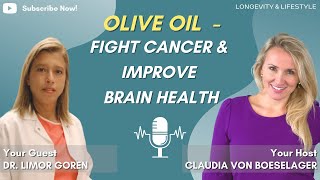
In this episode of the Longevity and Lifestyle Podcast, host Claudia von Boeselager interviews Dr. Limor Goren, a molecular biologist and founder of KYOORD. The conversation begins with Dr. Goren’s unconventional career path—from Israeli army service and advertising to a late‑stage PhD focused on cancer metabolism. She describes her discovery that the olive‑oil polyphenol oleocanthal selectively kills cancer cells by inducing lysosomal membrane permeabilization, a mechanism distinct from classic apoptosis. Laboratory experiments showed a linear relationship between oleocanthal concentration in extra‑virgin olive oil and cancer‑cell toxicity, prompting her to test whole oils rather than extracts. After publishing the work, Dr. Goren founded KYOORD to educate consumers and sell high‑phenolic olive oil (the “Governor” and her own KYOORD brand). She explains how oleocanthal also shows neuroprotective effects in Alzheimer’s models and contributes to cardiovascular health through anti‑inflammatory and antioxidant actions. Practical advice covers dosing (often a spoonful on an empty stomach), cooking considerations (polyphenols degrade gradually, not instantly), storage, and how to identify high‑oleocanthal oils by a peppery throat‑sting. Dr. Goren details the olive‑oil production process—early‑season green harvest, cold‑pressing, malaxation, centrifugation—and why extra‑virgin, cold‑pressed oil is essential. Myths such as “olive oil is carcinogenic when heated” are debunked. The interview wraps with broader dietary recommendations (leafy greens, blueberries, nuts, lentils), personal lifestyle philosophy (food as medicine, freedom through entrepreneurship), and advice for young professionals about experiential learning over formal education. Links to KYOORD’s website and product listings are provided.
Chapters
Welcome to another episode of the Longevity and Lifestyle Podcast. I'm your host, Claudia von Boeselager, here to uncover the groundbreaking strategies, tools, and practices from the world's pioneering experts to help you live at your best and reach your highest potential. Did you know that high-quality cold-pressed olive oil can facilitate your longevity, support brain function, and well-being? Check out today's episode with Dr. Limor Goren, molecular biologist and founder of Kyoord, K-Y-O-O-R-D, to learn all about the longevity and health optimization benefits of olive oil, what polyphenols are and their healing properties in fighting cancer, how olive oil improves brain function, why olive oil harvesting families keep the first bottles of the harvest, and much more. And don't forget to please help spread the word by sharing the show with your family, friends, and colleagues. The more people we can help with this message, the better the world will be. So thanks so much for sharing. Please enjoy.
Welcome to the Longevity and Lifestyle Podcast, Limor. It's such a pleasure to have you on today.
Thank you so much, Claudia. I'm really excited to start our discussion.
So I'd love to start with your journey to becoming a molecular biologist and then cancer research and where this has brought you since. But was this a childhood passion or how did you go down this path?
You know, in fact, I think it was a childhood passion that I left behind and I didn't pursue for many, many years. I grew up in Israel and I went to the Israeli army. And after the army, most people go to university and I always thought I would like to study biology, but for me, one thing led to another and suddenly I found myself in a whole different career in advertising and I pursued that and I never had time to go to college or to go to university. Then I moved to the US. I moved to New York when I was 23 and started different companies in New York in a totally different industry in interior design. But I guess in the back of my mind, I always wanted to do something with my passion for science and especially biology, genetics. Molecular biology. I was always interested in the little things that power our life as we know it. And then when I was in my late 30s, an opportunity arose and I was able to financially afford quitting my job and not working and dedicating myself to studies. And then I went back to school and I got a PhD when I was about 20 years older than the rest of the PhD candidates. But that was, that was a great experience and I'm super happy I did that.
That's so exciting as well. And I love that that didn't deter you because I know some people are like, I'd love to go back and study, but like, I'm older than everybody else. So the fact that you're just like, you know what, I'm just going to do it and it's my passion. So very, very cool. And so can you talk about the work you were doing in cancer research, particularly around polyphenols and what you discovered?
Yeah. So very fast after I started my PhD, I knew I wanted to specialize in cancer and I started working in a cancer lab at Hunter University. The lab was specialized in cellular metabolism.. And actually we are working— most of my projects have revolved around dysregulation of a pathway called the mTOR pathway, which you probably know about, that control nutrient sensing in every cell in our body. And often cancer take advantage of this pathway. It gets deregulated, mTOR gets overactivated, and that's how tumors grow often. So we were concentrating on that, but then an interesting molecule landed on our bench. From a collaborator in Rutgers University, and that molecule is called oleocanthal. And oleocanthal is one of those polyphenols that you probably heard about that comes from olive oil. At the time, this molecule was fairly newly discovered. It was only discovered 5 or 6 years before that. And there's some early indication that it's a very strong anti-cancerous molecule. It really kills cancer cells almost upon contact. It's very toxic to cancer cells, and not very toxic to normal cells. So that was interesting. The mode of death, the mode of cellular death was also really interesting. It didn't look like a classic apoptosis. So normally when you work in a cancer field, you're always looking for those compounds and, and for molecules and ingredients that cause apoptosis in cells because cancer is so good at evading apoptosis. But this molecule, it didn't cause classic apoptosis. The cell that had different characteristics to it. So that was really interesting and, and I thought that held the key to the mechanism to what it does. And lo and behold, we found that this molecule causes a really interesting form of cell death that is pretty selective to cancer. And that mechanism is called lysosomal membrane permeabilization. So that's a mouthful, I know. Yeah.
Can you define what, what's happening there for people in, in lay terms?
Sure. Yeah, absolutely. So every cell of our body has little organelles inside of it called lysosomes. Often they're referred to as the recycling centers of the cells, and lysosomes get rid of toxins. So lysosomes are really interesting organelles in the cells because they have many functions in normal cells. But apparently cancer cells are very, very reliant on lysosomes, much more than normal cells. So they use lysosomes as their means to achieve nutrient sufficiency. To get enough nutrients from other cells, because often tumors, you know, they start very poorly vascularized. They don't have blood vessels feeding them, and they don't have other ways of getting nutrients. So they're very reliant on lysosomes to provide them nutrients that they require for growth, much more than normal cells. So using that logic, when you hurt lysosomes, cancer cells might be more affected and more sensitive to that. So that is one likely explanation why oleic is so potent against cancer cells. And what it does, it kind of pokes cells in the membrane of the lysosomes and makes them nonfunctional. And also because those lysosomes often contain— they sequester materials that are pretty toxic to the cells. Once those are released into the cellular environment, that creates havoc, and the cells normally don't survive. They just burst. Poorly vascularized, they don't have blood vessels feeding them, and they don't have other ways of getting nutrients. So the very, um, reliant on lysosomes to provide them nutrients that they require for growth, much more than normal cells. So using that logic, when you hurt lysosomes, cancer cells might be more affected and more sensitive to that. So that is one likely explanation why oleocanthal is so potent against cancer cells. And what it does, it kind of pokes cells in the membrane of the lysosomes and makes them nonfunctional.. And also because those lysosomes often contain, um, they, they sequester materials that are pretty toxic to the cells. Once those are released into the cellular environment, that creates havoc and, and the cells normally don't survive. They just burst. Mm-hmm. Um, so this was our understanding of what's going on.
Yeah. How exciting, right? And so talk a little, can you talk a little bit more about what the use cases and, and where things are in developing, you know, anti-cancer treatments around this?
Sure. So that's always something that comes up when you discover something in basic research in a lab in that field. You always think, all right, can I make this into a drug? But for me, I always thought, you know, we don't need to make this into a drug that already exists in nature. We know from evidence from generations and generations that people around the Mediterranean basin, people who adhere to diets that consume a lot of olive oil, are much more protected against many types of disease, including cancer, and experience longer and healthier life, both in terms of heart disease, cancer, and neurodegeneration, which are the big 3 causes of, you know, premature death, I would say, or the enemies of longevity. And I was always torn with that idea, like, should we try to make oleocanthal more potent? And there's definitely labs in the world that are working on that, trying to tweak its chemical structure to make it more specific, more potent. But for me, I don't I'm much more attracted to the concept of food as medicine. And, you know, and like all the big Greek philosophers always knew, and every, you know, every drug can be a poison or it can be a drug, can be beneficial. It all has to do with the dose. So I started playing around with that and I started testing different olive oils and trying to see if olive oils themselves are— could be toxic to cancer cells and not to normal cells. And I found that they could be. And actually, that was a really interesting story, how the discovery came along. Yeah, please share. So when we published the first study about oleocanthal, we were contacted by olive oil producers from Greece that their olive oil that they were making was tested, and it was found to have the highest concentration of oleocanthal ever found in olive oil back then in 2014. So that was exciting, and they offered to send us the olive oil. So they sent us a bottle of the olive oil, very fancy. It's called the Governor. And I, since I started actually selling that olive oil because I believe in it so much, I tasted it and it was nice and spicy and peppery. And that is something I knew at that time that is a sign of oleocanthal. So when you try different olive oils in a supermarket or in a specialty store, if an oil gives you a sting in the back of your throat, that's the sign of oleocanthal. So I knew it has a lot of oleocanthal and they sent me the proof that it does. But I was wondering if I can treat cancer cells with olive oil. So I poured some of that Governor olive oil on, on a plate of, I think it was prostate cancer cells that I was working with at the time. And I went home and I came back in the morning, all the cells were dead. Wow. So I was thinking to myself, geez, all right, is it every olive oil? I go to the supermarket, I pick up a bottle of, you know, the most common $10 olive oil. Would that be the same? I went down to the supermarket, I picked up a bottle of a $10 olive oil, I poured it on a plate of the same processed cancer cells. I went home, I came back in the morning and there were double as many cells in the plate.
Oh, wow. Why do you think that was?
Because that's what cancer does. Cancer doubles every day. Cancer grows. So basically the olive oil from the supermarket did nothing. To the cancer cells, while that fancy olive oil from Greece did something. So I knew there's something in it. And then I started sourcing many, many different olive oils from all over the world, from many olive oil producing countries, and start comparing their ability to kill cancer cells in a dish. And what I found was that some olive oils are better and some olive oils are worse. But the common denominator and what should really beautiful linear correlation was the higher the oleocanthal concentration in the olive oil, the better it was at killing cancer cells.
So that was very encouraging. And so, yeah, so what happened from there? So you have— and you literally just poured olive oil on the cancer cells? You didn't do any extraction process or anything?
It was just— I didn't extract it. I made sort of vinaigrette, I guess, because you grow— if you know, like, images of how cells are grown in a lab, they're growing petri dishes with this like reddish liquid. It's basically a buffer, a salt buffer. So I vigorously shook that together with the olive oil in a centrifuge and kind of made it vinaigrette so it would be, it would absorb better. But yeah, I didn't extract it. Other labs would extract phenols from the olive oil and test purified, but I was really wondering whether just like olive oil as we consume it have any effect and whether that would be the explanation for this phenomena that we know that people who consume more olive oil are healthier.
Yes, exactly. And so what happened from there? You made this discovery, and what was your next steps?
Well, um, publish it. You know, it was published in the scientific literature, and then I finished my PhD. I graduated. That was my thesis project. And I just knew that I need to do something with it. I didn't feel ready just to move on to a different research project and take a research job. And I knew I wanted to bring this to the masses or educate consumers and advocate for that. I felt my life would be better served outside of the lab, but with the knowledge that I acquired. So then I started my company called Kured. It's pronounced cured, but it's spelled K-Y-O-O-R-D.
K-Y-O-O-R-D. But the name is great. And then the interesting spelling as well. And we'll obviously link it in the show notes.
And so I started a company at the beginning as an advocacy platform of educating people about the benefits of high phenolic olive oil, olive oil with a lot of those polyphenols like oleocanthal and the other members of the polyphenol family that are found only in olive oils. And explaining how it works and explaining the importance of consuming the better olive oils that contain that because every olive oil if it's made right, has the potential to be so beneficial and contain high levels of polyphenols. Depending on the variety of the olive fruit or the olive tree, you would find different polyphenols, but every olive tree has the ability to produce excellent olive oil that is high in polyphenols. Just some varieties produce more of certain polyphenols. And then I just got so many requests— people ask me, which olive oil should I buy? Where can I buy it? It's not available. And then I just said, okay, well, I guess, you know, I'm going into business. I'm selling olive oil now. And I started importing that oil called the Governor that I use in my research. It's, it's made in very, very small quantities and batches so that I knew that would not be enough. So then I started developing my own olive oil that we're able to produce in slightly bigger quantities. It's still made in very small batches and it still, you know, have the highest levels of polyphenols and oleocanthal that we can get. And it's called Kured.
Where can people find it? Is it available online or how can people find out where to get it?
Yeah, it's available at kured.com, K-Y-O-O-R-D.com. And The Governor is also available on Amazon. And by the way, for your UK listeners, The Governor is also available in the UK through a British distributor. If you just look for The Governor UK, you'll find it too.
Okay, great.
Thank you.
And so let's talk a little bit about the compounds that promote longevity and optimize well-being that oleocanthal has.
So my work centered mainly on cancer, but other labs around the world study the same molecule and again, the other polyphenols in other contexts of health and disease. Another big one is neurodegeneration. Oleocanthal has been shown to alleviate some symptoms of Alzheimer's, namely prevents aggregation of tau proteins. And that was shown both in vitro and in vivo in animal models. The reason for that, and probably another reason why it's so effective against cancer and also to maintain cardiovascular health, is because of its anti-inflammatory properties. So it's an extremely anti-inflammatory molecule. And basically, you know, if you try to abstract the way our bodies work and life and death, what makes us older and what eventually causes death is too much inflammation or too much oxidation. And these two processes, they're the source of, you know, pretty much every disease I can think about, inflammation or oxidation. And olive oil contains polyphenols of both classes, antioxidants and anti-inflammatory. Oleocanthal is an anti-inflammatory, and many, many other polyphenols such as hydroxytyrosol or oleicin are antioxidant. So once you digest powerful antioxidants and anti-inflammatory compounds, you boost the natural ability of the body to fight disease that are caused by inflammation or oxidation. And voilà, that's it.
It's so exciting.
Yeah.
Is there a particular dose that people should take? Is there certain foods it should be mixed with for better absorption?
I would say in most studies, in clinical studies, they like to give olive oil isolated on empty stomach, just like any other compounds. I don't think it's necessarily because I haven't seen any study that compare that, but I think it's just like a standard that, you know, scientists and doctors always like, okay, take this on empty stomach. It probably, you know, doesn't hurt to take it on empty stomach, but most of the data that available in the world about the correlation between high olive oil consumption and health doesn't exclude people who just take olive oil with food and with their diet. So I believe that consuming it in any form is fine. In Mediterranean countries, traditionally, in traditional societies, a lot of people would start their day with a spoonful of olive oil. So that idea of taking it first thing in the morning on an empty stomach probably has some justification. I think the bigger question that I get a lot is whether it loses properties when cooked. So, do you get the same benefits if you use olive oil for baking or for sautéing or roasting vegetables? And the answer is somewhat yes. And that's because it's not an all-or-nothing sum. So once the oil is heated, it definitely degrades, but it's a very gradual process. So it depends which temperature and for how long, but the polyphenols don't just— or they don't break right away the moment they contact heat. It's a gradual process. So if you start with olive oil that has a lot of those nutrients, a lot of polyphenols, and you sauté some vegetables with it, or you roast something in the oven with it, the level of polyphenol will gradually decline. But if you cook for, I don't know, 10 minutes or an hour, you'll still have plenty. So it's on a level of, I would say, you might lose 15%, 20%, 25%, but you would still have 70% or more of the polyphenols you started with. So that's why the higher initial concentration of polyphenols is more beneficial, even if you cook with it.
That's true as well. I mean, I typically recommend people to cook with like, you know, even scent— odorless coconut oil, and then you can clean it off for meat and then just put the fresh olive oil on at the end.
That's, that's definitely another taste. Also, the elephant in the room is that because it's actually very labor-intensive and very, I would say, almost wasteful to make the best olive oil, it doesn't give you high yields as lesser quality olive oil. It tends to be expensive. So those olive oils are more expensive. So if somebody's more budget-conscious, that's a great idea. You know, if you afford to buy one bottle of better olive oil, then, you know, don't use it so much when you cook and just use it raw so you get all the benefits. And use something like coconut oil or avocado oil maybe for cooking. Yeah.
Can you just talk for people, explain the actual process of producing olive oil? Because I think for a lot of people, it's—
Oh, yeah. Yeah, sure. That's super fun. So, by the way, when I say olive oil, I pretty much always mean extra virgin olive oil. There's a lot of non-extra virgin olive oil in the world. Please, nobody— don't spend your money on that. It's not worth it at all. And it's not bad for cooking. Use a different oil from a different vegetable or fruit and not like refined olive oil. It basically kills all the active ingredients in it. So when I say olive oil, I mean extra virgin olive oil. And extra virgin olive oil must be cold pressed. That's, you know, sometimes even us, we refer to ours as cold pressed, but every extra virgin olive oil is cold pressed because if you add too much heat, it's not going to be extra virgin anymore. So you start with raw olives that are picked from the trees. And again, the best thing is to harvest very early in the season when the olives are still green. So when the olives are still green, they have the highest level of polyphenols. Then slowly, as they mature and they become more purple and then eventually black, some of those polyphenols oxidize and you get less of them. Some very good and tasty olive oils are made from very ripe black olives, and they can still be extra virgin, but they always have less polyphenols. The reason people do that is because they get more yield. So if you harvest early in the season, in October, your olive is green and hard and doesn't have a lot of oil in it. If you allow it to mature on the tree for another 3 months, you'll make double as much olive oil, but the quality would not be the same. So you start with olives from a tree, you pick them. It's also best to mill them in the same day before again, before they get bruised and the acidity level rises. But you bring it to the millhouse, you wash the olives, you crush them into a paste with pits and everything. That doesn't matter. And then you let that mixture kind of brew, I would say. And it's a process called malaxation. And malaxation is when the olive oil actually separates from the cells of the olives. So little olive, little oil droplets separate from the cells. And that's when those mature polyphenols are generated. Because for example, oleocanthal, olives don't have oleocanthal in them. Only olive oil has oleocanthal. And the oleocanthal is created during an enzymatic reaction. During the malaxation process. So that time in the tank—
eating the olives are not going to give you the same oleocanthal content?
Right, no. So during those magic 15, 20, 25 minutes of malaxation, that's where a lot of enzymatic activity happens, and that determines both the taste and the quality of the olive oil. And then the next step is to separate the oil from the rest, and that's usually done using a centrifuge, and the lighter olive oil goes to the top, and then You decant it and you start getting this beautiful golden green juice right away. It's a process that takes probably about an hour total from olive to olive oil. And it's been made like that for generations and generations. There might be like better machinery and a little more sophisticated processes, but if you follow it and you don't cut corners, you can get excellent quality olive oil.
Yeah, it's, it's beautiful. I mean, I've had the pleasure in Tuscany and then also in France of seeing it happen live. But I think it's incredible the amount of olives that needed to even just make, you know, a liter of that. So maybe you can share with the audience, like, what is the typical ratio?
So again, for most producers— and I'm talking only about extra virgin olive oil, but I would say run-of-the-mill stuff you can get in the supermarket— it is about 6 or 7 kilos of olives will give you 1 kilo or 1 liter of olive oil. And then the The more that ratio grows, the better the quality. So for example, our oils, we use about 10 kilos of olives and only get about 1 liter of olive oil because the olives are so unripe. They have less oil in them. It's more concentrated.
But to concentrate it more. Yeah. So I'm excited to try it as well. I'll have to, because I love that peppery taste and I didn't realize that's the oleocanthal. So that's actually the good part of it as well.
And yeah, actually, canth in the name, canth in Latin means stink. So that's how they named olive oil, because it's distinct ingredient in the olive oil, the one that stings your throat. It's beautiful.
I mean, it's not easy to find as well because I think everyone's used to just buying it in the supermarket, but the quality, I think it's—
yeah.
So now we have a really good source with Curate as well, which is exciting. What other ways— we talked a bit about brain function, but there's also, I understand, studies that are showing that it can help make, well, around Alzheimer's, right? And supporting Alzheimer's treatment.
Can you talk a bit about that? Yeah. So these are some studies that were done in the US, again, both on in vitro and in vivo. And they show that oleocanthal treatment actually increases the efficacy of one of the most common and available drugs that they give to patients of early onset Alzheimer's, because Alzheimer's right now, one of the problems, it cannot be diagnosed before symptoms start appearing. And there's really no cure and no management for that except taking a medication. And what they saw is that the brain function in the animals was improved. I don't remember the percentage, but something very significant with a combination of oleocanthal and that medicine. As well as oleocanthal alone. But the way you work with clinical trials and trials in this country, you have to partner with a pharmaceutical to get the budget. So it would be hard to find us a trial that shows, all right, you don't need any drug and just take oleocanthal or olive oil.
Olive oil as well. So are you familiar with the work of Dr. Dale Bredesen of Apollo Health? He has the book The End of Alzheimer's Program: Reversing Cognitive Decline at Any Age. I literally just did an Instagram Live on this topic as well because my mother suffers memory and dementia. And Dale, and I've actually had him on the podcast as well. He and his lab have discovered that there's 38 different underlying drivers that can cause dementia, memory loss, Alzheimer's. So there's never gonna be one drug that will actually cure anything. But I think maybe I might connect you to afterwards as well, because he does actually have a protocol and there's clinical trials that have been done that, so from cognitions measured on a MoCA score, and if it, even people who were dropped from a perfect 30 down to 18, they were able to get back to 30 and reverse the cognitive decline by following the protocol as well, which is really, really exciting. So there is happening in this space because so many people are suffering and it's just horrendous.
So, and it's going to get worse and worse.
Well, unless the people realize what they can actually proactively do, and oligocantal is obviously one of the factors to that as well, right?
Yeah. I love your optimism.
I mean, I think it's just awareness and the more people that know, because I've had this conversation with Dale and I think that if people realize, as you were saying, food is medicine. And that's where it's what you feed your body every day. And if you're aware of what's doing your body good and what's actually poisoning your body and doing less of that one, obviously, you know, combined with some other factors and being on top of your tests and making sure that everything is aligned, then I think there's, you know, a huge potential for many people to thrive and live at their best state every day.
So that's my— I completely agree. And that's my spiel too. I agree with that. Change is at our fingertips by the choices we make every day.
Correct. Yeah, exactly. So I'm excited to discover more about Oleocanthal as well. And plus, I love it. It tastes delicious. Delicious olive oil. So, Limor, I'd love to ask you some rapid-fire questions, if I may. Thinking of the word successful, who's the first person who comes to mind and why?
Ooh, successful. So not good at things like that.
You want to pass?
It's okay, don't worry, we can jump over. You know, for me, success ties very much to happiness, uh, you know, because I mean, success, it's not monetary, it's not, you know, achievement or fame. It's really whoever can live their life happily and joyfully and be fulfilled. So this is my goal, to be fulfilled and to know that I'm doing something that helps other people and helps me sleep well at night.
Yeah, no, I love that. That's beautiful. Do you have any particular morning routine to start your day as a success?
Absolutely. I start my morning with a spoon of high oleocanthal olive oil, either a little shot glass or a spoon. But yeah, that's always in the morning.
And then I drink coffee. So I wonder, was also the coffee— because you have that Bulletproof Coffee idea. I mean, that's MCT oil. It's a little bit different as well. But is there any correlation or is there any benefit of combining like the, the oil with the coffee? Has there been any studies around that?
I am not aware of any studies, and I'm also not 100% sure that, you know, a dose of caffeine in the morning is really very good for all of our systems. It's good for my happiness. Yeah. And as I said before, happiness equals success. So a cup of coffee in the morning is the right thing for me. Exactly.
And I think in the morning it's okay too. I try to avoid it after 2 PM in the afternoon. But yeah, morning time is a good one. In the last 5 years, what new belief, behavior, or habit has most improved your life?
Trying to work less and enjoy life more. I made a huge change by starting my own company. I can work from anywhere in the world just with my laptop. All the people that are helping me are freelancers that are located in different parts of the world. I pretty much try to automate everything as far as the fulfillment, and I love writing, I love I love writing scientific articles. I love creating recipes and I can do it from everywhere. So that idea of freedom, not being tied to a place, is a huge one for me.
Amazing. Especially coming from a lab to being able to— Yeah, exactly. Yeah, I'm a big fan of that myself.
So yeah.
What are some of the bad recommendations you hear potentially even around olive oil and oleocanthal? What are some things you would avoid?
Yeah. So the number one, the number one is do not cook with olive oil. It's carcinogenic, which is a complete myth. Actually, there have been studies that show that all cooking with olive oil improves nutritional value of the food, and it's, it's really the opposite of carcinogenic. So that's a weird myth that I love. I'd love more and more people to know that it's a myth.
A myth as well. What has been your most exciting purchase in the last 6 months?
Oh, I got a new surfboard. Really, really fun. Yeah, I get a new surfboard about every 6 months. I always love my new surfboards.
Where did you learn to surf?
No, I learned to surf where I live in Montauk. We have great waves here, you know, for East Coast. I, but I, I travel a lot for surf. I love— I longboard. I always have longboards. I always buy longer and longer boards. I think as I age, it's easier. But I got this really nice glider that I'm very excited about.
Oh wow, like an airplane glider?
No, no, it's a— it's in a surf world, it's called a glider because it glides on water.
Okay, I thought, you know, like the plane. It's a small purchase that we just did there. Yeah, really exciting. If you had to give advice to a college student or an 18-year-old sort of starting out in the real world, what advice would you give and what advice should they ignore?
Well, that might be controversial, but it depends on the type of person you are. I don't think college is the most important thing. I think going out there into the world and experiencing and interning and trying different ways of acquiring knowledge and skill, I find those to be way more powerful. For some people, you know, college is the right choice. I'm not saying that it's not, but if in doubt, I think getting real-world experience, try to offer a company that you would love to work in. Send them, you know, an email and tell them you'll work for free for a couple of months just to learn. I think that's much more valuable. And try a lot of different things. Don't, don't decide that, oh, this is what I am and this is what I need and this is what I like, because it's never going to materialize so linearly. So try a lot of different things and find your passion.
That's great advice. And I mean, I love your story as well about doing so many different things. And, you know, ending up doing something really exciting as well. So I think it's, you know, there's Joseph Campbell's hero's journey. It's like, follow your bliss, like follow what makes you happy and happy in that moment as well, which is beautiful. Then if people are interested in following you and what you're up to, where can they find you? Social media, websites, where would you send them?
Absolutely. Both social media and our own website. They're both Kyoord, K-Y-O-O-R-D. We post science news. Any different type of like nutrition tidbits and a lot of recipes.
Excellent. So we'll, we'll link those in the show notes for, for people listening as well. Do you have any final ask or recommendation or any parting thoughts for my audience?
Food is medicine. Watch what you eat.
Just a quick question, what are your top 5 food choices? Olive oil, high quality extra virgin cold-pressed olive oil, of course. What else would you recommend?
Leafy greens, Enjoy, embrace them. Anything from parsley to kale and spinach and everything in between. Blueberries, nuts. Actually, most studies that use olive oil often also study effects of nuts, and it's also very high, almost as high as olive oil, not quite, but things like almonds, pistachios, walnuts, of course, if you're not allergic to that. So I would say this would be— and lentils. Lentils are great source of protein as well as healthy carbs. So that would be my 5: olive oil, leafy greens, blueberries, nuts, and lentils. That sounds like a salad.
It sounds perfect. Sounds delicious as well. Thank you so much for coming on today.
It's been such a pleasure. Same, same here.
Thank you. Hi everyone, this is Claudia again. Before you take off, would you like to get a short email from me with some short but sweet fun tips, tricks, and updates on all things longevity and lifestyle? This could be cool products that I've discovered, interesting posts or articles I've read, and other fun and helpful things around longevity and lifestyle I've found for you. It's a very short piece of inspiration for you a few times a month. So if you want to receive it, check it out by going to longevity-and- and-lifestyle.com. That's longevity-and-lifestyle.com. And leave your email to sign up for the next one.
More from Claudia









Can Psilocybin Slow Aging? The Study on Telomeres, Inflammation & Survival with Dr. Louise Hecker

