Cellular Senescence and the Anti-Aging Powers of Senolytics | Dr. Nick Bitz
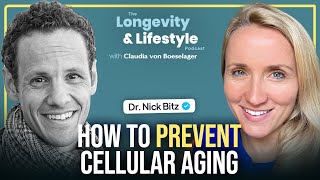
In this Longevity and Lifestyle Podcast episode, host Claudia von Boeselager interviews Dr. Nick Bitz, a naturopathic physician and Ayurvedic practitioner, about cellular senescence—the accumulation of "zombie" cells that drive aging—and the emerging field of senolytics that aim to clear these cells. Dr. Bitz explains how senescent cells arise, their harmful secretory profile, and why the aging immune system (immunosenescence) fails to remove them. He outlines the discovery of senolytic compounds (e.g., fisetin, quercetin, curcumin, piper longumine), their mechanisms (targeting anti‑apoptotic SCAP networks), and the current clinical landscape, including the hit‑and‑run intermittent dosing strategy and the Neurohacker Collective’s Qualia Senolytic product, with pilot data showing joint and skin benefits. The conversation expands to practical protocols (2‑day dosing cycles, repeat intervals), use‑case scenarios (skin rejuvenation, brain health, muscle anabolic resistance, long‑COVID, lung health), and lifestyle adjuncts that support senescent‑cell clearance (exercise, fasting‑mimicking diets, immune‑boosting nutrients, spore probiotics). Dr. Bitz also shares his background in naturopathic and Ayurvedic medicine, explains spore probiotic technology, touches on the nuanced role of senescent cells in cancer, and looks ahead to energetic medicine, psychedelics, and meditation as future longevity tools. The episode ends with a strong recommendation to adopt a regular meditation practice.
Chapters
The immune system is our internal system for getting rid of these senescent cells. The older we get, the more diminished our immune function becomes. There's a lot of things you can do on a daily basis to really increase your immune vitality.
Hi there, it's Claudia von Boeselager, and I'm super excited to invite you to my free training on achieving peak performance and increasing longevity without burning out. Even if you're short on time or dealing with health issues, this is for you. As a peak performance and longevity coach, I've helped entrepreneurs and business professionals like you accomplish more while enjoying vibrant energy to live their best life. If you're ready to unlock your peak potential, grab the training, a free training, by signing up at llpeak.com today. Plus, I have a special gift for you just for joining, so don't miss out on this life-changing opportunity. Just go to llpeak.com, that's l-l-p-e-a-k.com, today. See you there.
Welcome to the Longevity and Lifestyle Podcast, Dr. Nick. It's such a pleasure to have you on today.
So good to be here. Thanks for having me on.
So I'd like to start with cellular senescence, AKA zombie cells, and, um, which are also considered a hallmark of aging. Can you share with my audience what it is and why its importance in aging?
Yeah, absolutely. Um, cellular senescence has become, um, a passion of mine over the last year. It's a rather new discovery for me, um, It's in general, it's just a new discovery for the scientific community as well. It is one of the 12 hallmarks of aging. And we know that these 12 hallmarks of aging are really what underlie the aging process overall. But what I think is so interesting about cellular senescence is that it is perhaps the best example of taking this concept or this theory and within a very short amount of time, creating these clinical therapeutic or clinical applications that can undercut that whole cause of aging, which is remarkable. And, um, just so, just in short, senescence means to grow old, right? And, and so it's a, it's a widely used term, comes from the Latin root senex, that means old man. And so cellular senescence then is really a cell growing old and aging. And so, you know, we have 37 trillion cells in our body. They make up every tissue organ and every part of us. And all of these cells go through the same life cycle. Generally, they, they will replicate and duplicate on average about 50 times during their lifetime, at which point that cell moves into this kind of limbo, no-man's-state, where it's no longer functioning in a healthy way. It's no longer contributing to our tissues, but It's not dead. It's just there in the tissue and it lingers. And that is the state of senescence. And so anywhere throughout the body and virtually every tissue, we get senescent cells, these cells that go through their life cycle. They either have replicated that 50 times, which is called the Hayflick limit, or they've been damaged enough where they essentially just move out of the cell life cycle. And so senescent cells are interesting. They can take up physical residence in any tissue in the body. You know, they, as an example, in the skin, they take up physical residence in the skin and they not only impact the structure of an organ such as the skin, but they impact the function. And that becomes the issue that we see with senescent cells. So in and of themselves, They're neither healthy nor bad. They're needed for normal physiology. But when they linger and they take over healthy tissue, that healthy tissue no longer can function in the way that you want nor need. And so you get a decrease in tissue function. And so again, that can impact every tissue in the human body. And we're linking it up to several health conditions that arise over the course of the aging process.
Can you explain how the linking up, if you will, with the healthy tissue, like what is going on there and why is that detrimental?
Yeah, so I alluded to the first point, which is it's just taking up physical residence. So it's taking up space where an otherwise healthy cell would reside. And so the tissue function then decreases. But these senescent cells are also known as zombie cells because they secrete these inflammatory compounds and they, they can impact all of the healthy cells around them and turn those cells into senescent cells as well. And so these senescent cells have an immediate impact on the kind of microenvironment that surrounds them. But we know they get systemic as well and they can cause this low-grade inflammation throughout the body.
So for skin, for example, just to take a bit of a deep dive into this, and I've had Carolina Rice from the OneSkin, I'm not sure if you're familiar with that. So they have— yeah, exactly. I find it so fascinating. And just for people to maybe like help to visualize it as well. So the whole like natural bodily process, and they say the cell has gone through that, the 50 rhythms, right? And so it's occupying space, let's say on your face, right? So your skin on your face, and it then, as you said, has this like seismic effect. So it's in essence, aging the cells around it, if it's not cleared. So I would think naturally the body has a rhythm that would clear it out straight away. But as we age, that ability to clear the senescent cells, does that decline? Is that what's happening?
Yeah, you nailed it. And so again, all of these cells age, they move into senescence. And generally speaking, the body does a very good job at targeting these cells and getting rid of them. It really is the job of the immune system to do that. But we know that the immune system cells go through senescence themselves.. It's a term called immunosenescence. And so the immune system ages, it becomes less functional, less effective over time. And so over time, because those cells are aging, they do a worse job at targeting senescent cells and eliminating these senescent cells. And so over time, we see this accumulation of senescent cells throughout all tissues in the body, the skin being one of the examples. And the other way that we get rid of them is just through a process called apoptosis. Um, apoptosis, a very technical biology term. Um, it essentially means self-destruction or cell suicide. It's this kind of programmed cell death that all cells go through. And in essence, the cell just implodes. It breaks off into little pieces, it's absorbed by the other neighboring cells, and its parts are recycled to regenerate new cells, new tissues, as it were. And so these senescent cells are really interesting because they are basically secreting proteins that are anti-apoptosis. So they actually prevent cells from going through the apoptosis process, much like a shield. And so that is in essence how these things work. And we've just identified that, which is really exciting. And, and the reason I think that it's so exciting, because once you understand the mechanism of these cells, you understand how to undercut those mechanisms. And so that's when you get into the of senolytics, and they're really starting to target these anti-apoptotic pathways in very significant ways so that these cells then can re-enter the life cycle and go through apoptosis, which is normal and healthy.
So let's dive into senolytics, another beautiful term. So again, just to help people understand, what is it, and then where do you see the potential applications of this for and what type of applications as well in terms of diseases or even just to maintain a healthy lifestyle? Yeah.
So senolytics. So it really all started in 2015 with one study. It was a group of scientists from the Scripps Institute and the Mayo Clinic, and they had identified for the first time two compounds that had this anti-apoptotic, anti-senescence property. And so they coined that that term senolytic. And again, it's just a conjunction of two different terms, senex, which means to grow old, and lytic, which means destroying. So, these senolytic compounds are fascinating, and there's a lot of energy, a lot of money, a lot of big minds moving into this space right now, trying to identify various senolytic compounds and to prove their efficacy over time.. And these senolytics are interesting. I mean, they can be synthetic, they can be pharmaceutical, or they can be natural. But in essence, they go in and they're disturbing those upregulated proteins that senescent cells express. And by disturbing that or disabling that, even temporarily, the cells go through apoptosis and they self-destruct, as it was.
So from a skin perspective, right, from a little bit more vanity one, but Essentially means that you are rejuvenating, regenerating more youthful looking skin. Yes. While you still have the benefits of the protein so that, that, that self-destruction is still happening and it's not being protected. Is that correct?
Yeah, that's right. I mean, and if your skin's not functioning properly, if you have senescent cells in there, that is at the root of lack of skin elasticity, lack of skin moisture, wrinkling, all of those physiologic processes that we know that you can see visibly. Senescent cells are directly related to that. And so the thinking is if you can get rid of those old nonfunctional cells, new cells, new stem cells are going to come in, turn into fibroblasts, dermablasts, all these different cells that you need to be functioning properly and to have beautiful, glowing, radiant skin overall.
Mm-hmm. Beautiful. And so let's look at senescent cells and, for example, brain aging. What's going on there?
I mentioned we have 37 trillion cells in the body. Virtually all cells turn over. They turn over at different rates. We know, you know, blood cells turn over at about 120 days. We know the intestinal lining cells turn over, you know, somewhere between 3 and 7 days. However, brain cells, neurons, never turn over. We're starting to learn that maybe some of them are capable of that, and that's getting into the world of neuroplasticity and neurogenesis. You know, some of the medicinal mushrooms we're finding might have some benefit in that area. But what we know right now is that neurons don't turn over. And so you have one set of neurons. And so neurons then don't become senescent, right? So they just exist. But these supporting glial cells in the brain that kind of support these neurons that are important for cleaning up the metabolites, the toxins, the byproducts that are important for facilitating cell-to-cell communication, and on and on. Those cells do turn over and become senescent. And so, we know that the brain, just like any other tissue, is impacted by senescent cells. And so, there are studies going on right now looking at how can we utilize senolytics to undercut a lot of these cognitive health diseases such as Alzheimer's, or even just day-to-day functioning around, you know, brain fog, depression, mood disorders, and such. And so, we're, you know, it's still early days. We're just starting to get into the science there, but it's really, I think, quite amazing that we know already that there are senolytic compounds that cross the blood-brain barrier and can help clean up those surrounding cells in the brain space specifically.
So we know also that there's neurons in the gut as well, assuming that they're the same type of neurons as the brain. I mean, I find it fascinating that they don't turn over. So like 120-year-olds, right, will still have the same neurons as they did as, as a baby, a newborn baby.
You're spot on. Yeah, and a neuron is a neuron. So, uh, yeah, we have millions if not billions of neurons in our gut lining as well that make up the enteric nervous system that are directly linked to the brain. And so the gut-brain axis is a very real thing. They are one in the same. I know we we talk about them as two separate systems, but it really is just one system and it's all related. And so a lot of that information from the brain to the gut happens through these permanent neurons that, that need support. And so senolytics do give you some of that support.
So fascinating. I love this space and it's a new frontier of science. I find it really exciting. What is anabolic resistance and how does it connect to senescent cells?
Oh, that's a great question. Anabolic resistance generally is an inability to grow muscle as we age. And so it's a, you know, again, scientists are exploring muscle development and trying to figure out how can we optimize muscle growth at all ages, especially over the age of 50. And we find that after exercise, we do produce senescent cells. And the older we are, the less efficient we are getting rid of those senescent cells, of course. And so the muscles then become less efficient at growth. And so there are studies showing that certain senolytic compounds can go into muscles specifically, clear out those senescent cells, and improve muscle growth, especially in aging individuals.
And we know also for living a long and healthy life, maintaining muscle mass is one of the key criteria. There was a research study correlating grip strength in older years and the, the state of aging basically in humans as well. So I think for hormonal health, et cetera, just making sure to maintain healthy muscle mass is so fundamental. So with the compounds that you're discussing, it would be really exciting if that can complement each other. What type of timeline do you see in terms of developing these compounds to assist with The research is ongoing.
There's, you know, anywhere between 20 and 30 human clinicals that are registered right now in this space. But we already know a lot. We know, you know, fisetin as an example, which is a plant polyphenol. It's a yellow pigment found throughout the plant kingdom. We know that that's one of the most potent senolytic compounds, and it can be pretty powerful in its effects overall. Um, we know quercetin is another natural agent, has that similar effect. However, these nutrients don't focus on any one tissue, meaning you can't take one compound and expect to have a full senolytic effect throughout the body. You're only getting a limited effect on a subset of the cells in the body. And so what we're finding is that you need a broad array of senolytic compounds to get a broad effect in the body. And so that's, that's critically important. We're learning that more and more here. We also know that an intermittent dosing cycle looks to be the most favorable. And so that is generally how senolytics are used in a clinical setting. And by intermittent dosing schedule, I mean that they're using a big dose of a compound or a mixture of compounds for a very short amount of time. Generally 1 or 2 days, and that's it. And so it's called a hit-and-run dosing schedule. And so it's not like you should be— you shouldn't be using senolytics every day. There maybe are some potential safety issues around that, but more than that, it's just not effective in that area. And so scientists have really identified that short-term dosing schedule to be the most preferable way to dose these compounds.
How much testing or how much research do you think is still needed for this to become a more wide-scaled application form? Like, where, where are we, would you say, in the stages of development and understanding the dosing? I mean, you said that the hit and run, right, is the current one, but where do you think we are in the development of things?
You know, I think in the next 12 months, we're going to have a better idea about the, the promise and the potential and how, how real these agents will be, because we're now running the studies in humans. We have a little bit of data, but certainly there's a lot more needed. Right now we're relying mostly on animal studies. And if you look at fisetin, which again is the most, perhaps the most compelling senolytic compound out there right now, in animal studies they're using a dose of 20 milligrams per kilogram of body weight.. And so we know that there's an equivalency dose in humans that is quite effective. And so if you take that same dosing schedule and apply it to us, that gets you in the ballpark of about 1,400 milligrams of phycetin. And so when you look at the studies that are being done in humans now, they're using that equivalency dose above 1,000 milligrams per day of phycetin in hopes of getting that beneficial effect. And so It really is really early days. There's a lot of promise and potential and a lot of energy in this field right now, but there still is a lot to learn. I think we're going to uncover a lot of compounds that we never knew were senolytic. Curcumin from turmeric, we know, is a senolytic. And, you know, we've never really talked about curcumin or turmeric as a senolytic compound, and it's never really been of interest. But the more and more we dig into it, we're finding all of these pretty common nutraceutical ingredients are really powerful senolytic compounds. And so one by one, I think we'll start to tease those out and figure out amongst all of them which ones are the most effective in humans.
And then you're saying that the combination of them would be the most powerful to drive that, that senolytic process. Is that where you think this is going to be?
Yeah. And I talked about senescent cells and their mechanism. You know, they basically produce these anti-apoptotic proteins that prevent them from going through apoptosis. But they do that in different ways. And so there's no one way to get in there and undercut all senescent cells in the body. And so they all have slightly different— they're called SCAP networks. And so we need to disrupt as many cells as we can to have the broadest effect in the body. And so multiple ingredients will target multiple SCAP networks and give the body the greatest amount of effect. So again, we're teasing apart the science there to figure out the full profile of all SCAP networks in the body. But so far we know it's very complex. And so the recommendation now is not to lean on any one ingredient, but to use a variety of ingredients to make sure you're getting that big effect.
Have you tested this on yourself yet? Is this something for, like, some biohackers?
It's something that's alive and well in the biohacking community. Of course, there's a lot of N of 1s. Studies on Reddit forums and such. However, I'm working with a company called Neurohacker Collective. We did in the last 12 months create a product called Qualia Senolytic. So senescence is not a quantifiable thing in the body yet. There's no lab test to quantify the amount of senescent cells in the body. And so the only way to show that these things are working presently are to do much broader outcome studies. And so we did run this through our small pilot clinical program, and we tested it in 10 individuals using 3 rounds of the product, dosed intermittently, as we spoke about. And we tested its effects on joint health as well as activities of daily living. And we did show that almost across the board, it increased joint comfort, and some aspects that we know are directly related to senescent cell health. So I think there's a lot of development that needs to happen upfront from testing. But from my own personal experience, I'm probably on my 6th round now of doing Sinalytic, and it's been profound. I mean, I'm fairly young, right? The older you are, the more that you've accumulated senescent cells and the greater the effects or the benefits you will notice. And so I think I'm getting less benefit perhaps than somebody who might be 60 or 70, but I'm certainly noticing changes in skin health. I'm noticing less joint inflammation or pain after exercise. So I'm noticing some subtle things, but overall I just feel well. I feel like it's making me more vital and more strong. And so we're getting input from our broad customer base and they're telling us their experiences with the product. And it's been pretty amazing to hear these different stories. And I will say that there is really no one way that people experience senolytics. It really depends on the person and where they have that senescent cell load in their body. So again, certain people can have it in the brain, others can have it in their skin, others in their joints, their bones, their liver, their lungs. Literally all of these tissues can be impacted by that. And so it depends on the individual's needs. So it's been interesting. It's been 12 months now with this product. I'm gonna continue to use it because it's just fascinating. I'm, I'm feeling the benefits and again, I'm just fascinated with this whole area of, of science.
Yeah, me too. So I'm gonna ask you a few follow-on questions to that. So first of all, what is your protocol for doing it? And obviously this is what you are doing and everybody's different and please seek medical advice from your healthcare professional, right? And then I'm curious to also think about use cases like people who maybe have some lung damage from the pandemic we had, right? So there's some people with like these long COVID symptoms to people experiencing brain fog. I mean, what are some of the anecdotal stories you've heard from your customer base and user base, but also from yourself? So protocol and then some of the different use cases and benefits that you've, you've heard.
Yeah, so our formula has 9 botanical extracts. You know, we went and we looked at all of the different compounds out there and we chose some of the most powerful ones. We did introduce 2 new compounds that are just, um, really aren't in the literature, but we know how they work and we know that they can impact SCAP networks. And so we've put these 9 compounds together.
They're all natural.
Sorry, Dr. Nick, just to say they're all natural. Yeah, so we have, um, it's a dietary supplement, um, right now it's only available in the United States, um, but it's all natural. It's, it's from, uh, plants and roots and fruits, The primary ingredients, if I had to choose just a couple, the first one is phycetin, as we've talked about. And phycetin is that plant polyphenol abundant in our diet. However, we only usually eat about 4, maybe 4 milligrams per day, and that's on a heavy plant-based diet. And we need upwards of 1,400 milligrams to give you that animal equivalency dose. So, um, fisetin is a major, major ingredient in there. Quercetin is another one. Turmeric, as we've talked about. We've also incorporated an ingredient called piper longumine, which comes from the Ayurvedic tradition, which is another passion of mine. I'm an Ayurvedic physician, and it's powerful in terms of its rejuvenative effects, and that's how it's always been used for thousands of years., but we know that in part it's working through that senolytic action that it imparts to the body, which is amazing. And that seems to have an affinity for the lungs. So this, this 9-ingredient blend, I use it on 2 days. So I do 6 pills of the formulation on day 1. I do 6 pills on day 2, and then I take a break for 4 weeks or more.. And it's critically important to take that break. You don't want to keep hitting the body too hard. You want to give the body a chance to rest, recover. We do know that senescent cells take a while to start accumulating again. And we do know that senolytics in general tend to have a lingering effect. And so, the animal studies show that even one round of senolytic compounds can have these kind of amplified lingering effects for up to 7 months or so, I think is what the data shows.. And so you don't need to do these things every day. And I like that because I have a whole supplement regimen that I use day in and day out, and I don't want to complicate that more. So it's nice.
It's just 2 days and then you stop. And so what was the gap between the first one? Did you say 6 months?
Was it so every 6 months, 2 days and then 6 months and then 4 weeks? We recommend a minimum of 4 weeks. I would say the older you are, the shorter that gap should be.
The healthier you are.
Define older. Please, Dr. Nick. So generally, generally over the age of 40, over the age of 40, you start to accumulate senescent cells much more rapidly. And we don't have hard data to show exactly how many senescent cells were accumulating and when. But we know that there, there tends, there tends to be this threshold point when you don't accumulate senescent cells and suddenly you do. And so I will say just from experience and working with patients, 40 tends to be that age when people are like, wow, Okay, I actually feel different. My sleep's different, my skin's different. I don't recuperate as quickly from, from colds or flus. My digestion's changed. I feel old. And so it's, it's that moment, I think, when people start accumulating senescent cells. And I think there's a lot of variance. But I will say, you know, it's good to find a regimen that works for you. For a lot of people, maybe this just means doing this product one time per year. Other people might need it seasonally every couple of months. But for people that are more interested in biohacking, being super proactive about their health, yeah, we recommend just taking that 4-week break and then getting back into it again.
And that can continue on as we age and grow younger. Are you doing any research around biological age before and after?
Have you tested things like that? So we're just now getting into that. So we're now working with the lab to get into some of these biomarker tests to figure out, um, how do we quantify and track senescent cells over time. Um, but we are working with a few of our influencer friends that are amazing, um, that are using the product, um, on, on several doses, several times, um, and they're testing their biological age before and after. And so that's in progress. We don't have data from that yet, but I'm hopeful that that can be a useful tool for people to follow and track the benefits of senolytics.
Claudia von Boeselager again. Don't miss out. Grab the free training on how to achieve peak performance and increase your longevity without burning out.
Just go to LLPeak.com today. Are there further diets and lifestyle behaviors? Obviously, we all know healthy diet, etc., but are there anything in particular related to senescent cells and cellular aging that you recommend in order to optimize that even further?
Yeah. So, there are a couple of things that are not dietary supplement related. Exercise is definitely number one. You know, it's probably only mildly senolytic, but we do have— we have human studies showing that even moderate exercise can reduce the biomarkers of senescent cells in the body. So, we all know exercise more, but in part because of its senolytic effects, which is really amazing. Fasting, or even a fasting-mimicking diet, seems to be really helpful. And in part, we know that fasting really helps turn on autophagy, or cell repair, in the body. And so if a cell can repair itself, it won't actually reach that senescent stage. And so that's a really good thing. If you can keep cells functioning and turning over, that's good. It prevents them from getting into senescence. But we do know that it looks like fasting or a fasting-mimicking diet, which is a low-calorie diet, looks like it primes senescent cells for elimination. So I think that there is an autophagy benefit as well as that senescent benefit. We talked about this earlier, but one of the major ways that we get rid of senescent cells is through our immune system. And so we, you know, suddenly we've all begun talking about the immune system through COVID and the challenges over the last couple years. But it is critically important for daily maintenance, not just when you become ill, because the immune system is our internal system for getting rid of these senescent cells. And so, the older we get, the more diminished our immune function becomes. And so, there's a lot of things you can do on a daily basis to really increase your immune vitality. I talk about this a lot, but some of my favorite things would be beta-glucan, which is a polysaccharide from mushrooms, medicinal mushrooms. Really great for just really turning on the immune system on a daily basis. So I think about them kind of as coffee for the immune system. And so you're just awakening your immune system every time that you consume these substances. Vitamin A, vitamin D, zinc, fantastic. A lot of interest in spore probiotics as of late. Recently, we developed a gut-brain product using spore probiotics, and there's some really good studies showing that it can actually increase a number of parameters of the immune system.
So huge proponent of spores. Can we dig into that for a moment for someone who might be like, what is he talking about?
Spores?
What is this? Can you share a bit more what you mean by spore probiotics?
Yeah. So traditional probiotics are Lactobacillus and Bifidobacterium. They're thought of as live. Probiotics. You know, everybody thinks, oh, you eat yogurt and you're getting those live bacteria and they're making their way down to your GI tract and they're populating your intestinal lining. In fact, that's really not how those things work at all. Generally, those types of bacteria are dead before they even arrive to your GI tract, which doesn't mean that they're not beneficial. Your body does initiate a whole cascade of responses once you consume these dead bacteria, which are beneficial for the immune system and for inflammation, etc. So they have benefit, but those types of bacterias that everybody knows and loves and eats, they generally are not arriving alive and populating your GI tract. So spores are another type of probiotic, and these are really dormant cells. They are probiotics or bacteria, beneficial bacteria, that have these protein shells. And so these, these cells are essentially asleep. They're, they're alive, but they're dormant. And when you consume them, it moves through your GI tract. And as soon as it reaches your small intestine, the pH change in the small intestine will awaken the bacteria, and that bacteria then becomes alive. So it always reaches the GI tract alive, which is a benefit. And, and they tend to have this temporary effect. So they take up residence for about 2 to 3 weeks. They shift the microenvironment in the GI tract. They change the pH. They help to get rid of the bad guys. They help promote the good guys. They do everything that you want for a probiotic, but they're temporary. Your body then gets rid of them after about a 3-week time period. So So these things are going in and really helping to restore the microbiome and kind of the inner ecosystem in the gut in a very effective way. And so I'm a big fan of spore probiotics, namely Bacillus coagulans, Bacillus subtilis, Bacillus clausii. These are all really traditional bacteria that are found in the dirt. And so back when we used to eat foods and they weren't really overly sterilized and they had a lot of dirt and soil already embedded in them, we were getting a lot of those organisms. But now I think the food chain supply has really removed most of this bacteria, and so we don't get it on a daily basis. So it's important to continue taking that. Our bodies know how to use these substances, but we're not getting them on a daily basis.
And I love the idea that they're— well, so first of all, thank you for explaining that as well, and that the spores are really only becoming activated when they hit the GI tract because of the pH changes as well. Because I think so many people are like, oh, well, I eat a lot of yogurt or I do these different things, but they're not realizing that it only has a limited benefit. So it sounds like with the spore probiotic that you're really solving for that, which is exciting. I wonder, is there use cases or I'd be interested to hear your view with senolytics and cancer and cancer research.
What do you think of the potential there? So in the US, generally, dietary supplement companies can't talk about diseases, right? So it's always one of those areas that we kind of shy away from generally. But it's a very interesting area. And we know that in part, senescent cells are not all bad. And so when a cell becomes malignant or there's damage to the DNA, You don't want that replicating throughout your body, right? And so you want it to move into that senescent mode. You want that cell to become dormant or, you know, non-functioning. You don't want it to replicate anymore. And so cancer cells, in theory and ideally, you want them to become senescent so your body can go in and pluck them out and get rid of them. And so senescent cells are really important for a couple different functions. Wound healing is another one, but we know that you know, it seems to be you don't want too many or too little. I think you got to find that sweet spot. And so I think when you get in the area of cancer, it's kind of like the Goldilocks syndrome. You want to be somewhere in the middle, but most people tend to have too many of these cells over time. And so we know that generally speaking, in order to create balance, in order to kind of swing the pendulum you need less senescent cells overall. So, so it's not totally clear right now, and I'm not the foremost expert when it comes to cancer because again, we generally don't touch that here in the US. But I, it certainly is an interesting area and I think we're going to learn more here soon.
That sounds exciting, Dr. Nick. I also want to tap into something very interesting. You said that you are an Ayurvedic doctor, so I don't think I've had an Ayurvedic doctor on yet. I'm just thinking, but I have not. So can you explain for my audience exactly what an Ayurvedic doctor is and does? Obviously based in Indian medicine, but would love to share if you could share a little bit about your journey and how you ended up becoming an Ayurvedic doctor.
Yeah. So I'm actually a naturopathic physician, which is an old school form of medicine, comes out of the 1800s. Um, really comes out of Germany and kind of the nature cure philosophy of medicine, but it became alive and well early in the 1900s in the U.S. There were a lot of naturopathic medical schools, and then when you get into about 1913, there was something called the Flexner Report where these organizations and the government only decided to fund certain models of healthcare in medical schools. And so naturopathic medical schools got pushed aside, and then what we see in the U.S., this conventional allopathic model became the gold standard at that time. And so naturopathic medicine really kind of fell away for many years. Um, it— in, in the last few years, with the interest in integrative medicine, functional medicine, Eastern medicines, I think people have started to open up to the possibility of naturopathic medicine becoming more prevalent in the U.S. And so we now have naturopathic medical schools in the U.S. that are a 4 to 6 year medical school program, very rigorous in terms of academics. And then on the tail end, you do the clinicals. And so it's very complementary, I think, to the, the current conventional medical system we have in the U.S., but it definitely takes a more holistic, natural approach. And then, you know, I started out studying allopathic medicine. I transitioned over to naturopathic medical school because it became just really my passion. And then I discovered Ayurvedic medicine my first year at Bastyr University up in Seattle. And, you know, growing up, I had exposure to traditional Chinese medicine and acupuncture. I had practiced a lot of yoga. But I never really understood Ayurveda, which is the sister science of yoga. And, you know, it's often considered the first form of medicine. It comes from India. It's incredibly vast and fascinating. It's really all based in Sanskrit, which may or may not be one of the first languages ever, and is a really powerful, powerful language.. And, and so I just, I became interested in that. It was the mystery of that that I was, I was really allured by. And so I stopped my medical training up in Seattle and I moved to India. Wow. I, I, I did a what's called a panchakarma detox program for a month, and that's a whole other topic, but that's this really comprehensive detox program that is the core of Ayurvedic medicine. And so I jumped into that that. And then after that program, I started studying with a mentor over in, in South India where Ayurveda is still alive and well, started working out of an Ayurvedic hospital there and, and really just started doing a deep dive into that form of medicine. And so I brought that back to the U.S. I continued my naturopathic training, but I started mentoring with a lot of Ayurvedic physicians in the Pacific Northwest. And so that became kind of my thing. And still to this day, Ayurveda is the lens through which I see the world. It's the lens through which I work with patients, and it's really the lens through which I formulate a lot of these natural health products that I currently formulate.
Oh, phenomenal. So beautiful. And I spent a bit of time in Shanghai, and I remember my first encounter with traditional Chinese medicine, and I have such respect for it as well because the actual training goes on for years and years and years. But honestly, when they were explaining how— what they were going to do, my Chinese at the time was pretty bad. Well, it continues to be, but a few words. But they said, yes, yes, the doctor— when you go upstairs and do the tour of all these amazing medicinal products that are out, including scorpions and all these interesting things, yeah, then the doctor will go upstairs and will look at your tongue and check your pulse and tell you what's— how you are. And I was like, with what else? You know, like, no, that's it. And I obviously highly suspicious at the time. Clearly, I've gone 180 in my thing. But I was so impressed. And again, this is obviously not Ayurvedic, it's traditional Chinese medicine, but there is the overlap. She was able to tell me that in my meridians, there was imbalance. And this is, again, based on looking at my tongue and my pulse, that there was a meridian imbalance with my left knee and my lower back on the left side as well.. And at the time, those were the two points where I had pain, and I had done something, a ski injury to my left knee as well. And then I needed to have more ginseng and certain things like that as well for my type. And then another friend who was there at the time was drinking too much coffee. He had to rebalance. This was the type of person. And I was like, how did she see that in his tongue? I literally was mind-blown at the time, but it was spot on and really phenomenal. So I have such respect for these incredibly wise traditions and medical history that have been going on for thousands of years that we in the West are a little bit less familiar with. You're clearly quite the pro. And I still, to this day, an Ayurvedic doctor here in London was doing this cooking thing with a few friends, and she said, yeah, turmeric if you have any inflammation in the gut is beautiful, and cinnamon for the lungs. And my youngest daughter, suffers with lung issues. So I always sprinkle cinnamon on things with her. She, for years and years and years, has not had any chest infections or any issues as well. You know, some people listening might be suspicious, but I'm happy that she doesn't have any lung issues. Whatever it is, it's working phenomenally as well. So it's exciting that you're bringing that obviously to the US as well, but that more and more people are open to understanding this phenomenal history of medicine and what it can do.
You know, I'm a little fearful that The medicine's going to disappear. You know, I think people are very progressive right now and they're very interested in technology. And I think we're moving away from a lot of these traditional aspects of living and especially medicine. And so it'll always persist. But I wonder if it's going to continue to grow or if it's going to be pushed to the side as we look to technology. And so it's For me, it's the end-all and be-all. It's, it's, it's based in truth. And, you know, I'm, I'm, I'm all about technology and I think it can be wonderful for especially for diagnosis. But I think when you get into treatment, it really gets down to the basics. And that's where TCM and Ayurveda just get it right. I mean, they, they look at the body as a whole unit and, and it's personalized. Their recommendations are personalized to you. You so that you can create balance. Um, and, and they definitely look at the body in a different way. It's a very different worldview, which I think can turn people off, unfortunately. But, um, the mystery is still alive and well. And, and when you apply these kind of esoteric laws and strategies to your own body and your own life, you can see that these things, um, create change, and you can experience that change. And for that's the most powerful thing. I personally have had great benefits using these Eastern medical systems over time, and so I definitely am an advocate for them. I'm trying to keep that wisdom alive. And in part, we're seeing that there is an emphasis in the US, at least, looking at energetic properties of foods and botanicals and matching those things up with people based upon their body type or their constitution. And so So I see the door opening here. I think this interest in natural medicine is suddenly opening up. And so overall, I'm hopeful, I'm excited, but I just don't want us to lose this wisdom over time.
And just to share maybe with people for a moment that wisdom. I mean, just if you had a patient comes to you and says, I'm not really sure what's wrong with me, my energy levels are down. How does your body scanning happen?
What analysis do you do? What do you look for? Yeah, I mean, in part, there's face diagnosis, there's a tongue diagnosis, there's the pulse diagnosis. It really is a true science. There's a lot of intuition that goes into these things, but it is a science. And the Ayurvedic physicians and sages over time have mapped the 7 layers of the pulse. And so you can, with a lot of practice, you can get in there and start to experience the pulse and read somebody through and through. And so all of those things go into it. For me, the most important thing is sitting down with somebody and hearing their story. People will always tell you what's wrong and what they need to do to get healthy again. And so if you can just pinpoint that and give it back to them, it's quite amazing. And so I find that that really is the gift of naturopathic medicine. We work with patients. For 30, 60, or 90 minutes at a time to really get the full comprehensive intake and to do a thorough physical exam. And I think that's lacking in a lot of the conventional medical systems today. People come in, they have a symptom, the doctor does a couple things for insurance reasons, listens to the heart, takes the blood pressure, um, but they're not actually listening to the full story and, and then using that information to provide a customized regimen. And so in part, that's— it's, it's everything at the very end when I can tailor a program for somebody that is unique and hopefully effective. And if not, you know, again, working with them at the next offices that we can figure out what is working and what's not working and make those changes.
Yeah, that's exciting. I think that now the statistic is the average, let's say, traditional Western doctor has 6 or 7 minutes per patient. I mean, it's like they're a machine, right? It's like, okay, what's wrong with you? No time for the story, no time for chitchat, like getting, you know, to speak with the patient at all. So having that almost luxury of 60 minutes, 90 minutes to go really deep on the history and understanding is, is really powerful. Yeah. Dr.
Nick, if you could live to 150 years old with excellent health, how would you spend your time? Oh, wow. Hopefully I will be able to with the help of Ayurveda and such at Sinalytics. You know, I, I, that's a really good question. You know, my, my grandfather right now is at the end of his life. He's 93. He's lived a long life, a happy life. He's done a lot. And I think everybody in my family is happy that he's happy. For me, I would want to continue giving back.. And, and that is the most important thing. And I don't know what that looks like quite yet, but giving back to my family, giving back to my local community, giving back to, you know, the larger framework from which I came, that would be critically important, as well as just new experiences. Travel would be critically important. I love camping. I love, you know, getting outside in nature. So I would love to buy buy an EarthRoamer, which is this huge truck with a trailer in the back that's beautiful and you can live out of. Crazy expensive and over the top, but I would love to have that and be able just to roam free, um, and, and to be able to be outside all the time. I would love that. So, um, and little by little we're checking off the national parks, uh, in the U.S.
So I, I want to continue to check off all of the national parks, uh, here in the Beautiful. Well, yeah, there's quite a few. I have some on my list too. You mentioned Yosemite coming up on your list soon. Beautiful as well.
What excites you most about the future of health, well-being, longevity in the coming years and beyond? I'm excited that we're getting into energetic medicine. Reading or listening to Joe Dispenza is really powerful and just really excites me. Again, when I lean into Ayurvedic medicine too, they're looking at the subtle energies of the body, the subtle energies of food. And I think that once we can put science to that, it'll be that much more convincing for people. And I think that whole area will just explode. And so I'm seeing that energy medicine is starting to emerge and I really want to play a part in that. And so I'm doing my best. In the US, psychedelics are starting to emerge as well. And so, you know, it's, it's more of a cause rather than an industry so far, which, which I love, because I think we need better tools for mental health and mental wellness. And so I'm intrigued by that for those purposes. And so I think if at least in the US, if we can grab a hold of it and do the right things with the science, I think that a lot of people can get benefits in that area. So the idea of microdosing or using megadoses of psychedelics can be profoundly impactful for people. And I think we're, again, just starting to get into that area.
And so I would say energetic medicine and psychedelics are really fascinating areas right now. Yeah, agree. John Hopkins University in the US and Imperial in London, and they collaborate as well, have some phenomenal research coming out as well. Dr. Nick, for my listeners interested in understanding senolytics, senescent cells, and Ayurvedic medicine as well for longevity, where would you recommend they start with in terms of online resources or books?
Well, neurohacker.com is a fantastic resource. We are a science-first organization. We have enormous amounts of information on our website. So there's blogs, there's monographs on all botanicals, a lot of really cool information there. So that's always a good starting point. We also have a podcast called Collective Insights where we bring on amazing guests and have some really cool conversations. So that's always good to tap into, you know, in terms of Books. When I start getting into Ayurveda, there really is no one resource. There's no really amazing schools that people can tap into and become a student of and in the end become an Ayurvedic physician. It really is a philosophy and a self-discourse. It's something that everybody needs to discover themselves through books. The author that I probably most respect is a gentleman named Robert Svoboda, and he is a Texan MD who moved to India by chance, got stuck there with a health condition, and cured himself through Ayurveda and became this Ayurvedic guru. And so he communicates Ayurveda, I think, in the most poetic ways to the Western mind. And so he's written a number of books that I think are really good intro points for people into the world of Ayurveda.
How do you spell his last name?
It sounds like a bit of a tricky one. It is a bit. Yes.
Let me see if I can do it. S-V-O-B-O-D-A.
Svoboda.
Svoboda. The Texan with the Scandinavian sounding name. Exactly. Dr. Nick, where can people learn more about what you up to, be it social media or websites. And we can link all of these in the show notes as well.
Yeah, I think again, Neurohacker is probably the best avenue there. I'm active on that, on their social media accounts. I'm actively writing for their blogs. Otherwise, I don't do social media. Unfortunately, I need to. Good for your mental health. Yes, in part. But so, you know, that's probably the best, the best way um, neurohacker.com.
Beautiful.
Do you have a final ask, recommendation, or any parting thoughts or message for my audience today? I've started doing more and more podcasts. People are like, what is the one thing that you would recommend for people across the board? Um, and it's so hard to do. Like, I— Claudia, I just downloaded your, you know, your 10 hacks for life and lifestyle, and I was like, oh, these are all great, like, recommendations. I'm like, those— oh Yes, yes, all 10 of them. Yes. You know, if I had to just say if there's one thing, it would be start a meditation regimen. And it just is the most powerful one thing that you can do. And it has so many different benefits, especially with the mind. And we know the mind is central to everything in terms of health and well-being and longevity. And so it really helps to focus your mind. It helps you to control your mind and clear it in a way that's meaningful and tried and true. And so I would recommend diving into a specific form of meditation so that you have a tool. You know, I wouldn't recommend sitting on a pillow by yourself and being left with your thoughts on a daily basis. Not very useful. Very effective. Yeah. And people go crazy sitting there watching their thoughts, you know, and then they're off, you know, the monkey mind. They're all over the place. It is important, I think, to get plugged into a tradition, and it doesn't have to be religious-based. For me, I plugged into the Vipassana tradition, which is Buddhist-based, but not the system or the religion of Buddhism, more of the philosophy of the mind. And in the U.S., and I think worldwide, there are 10-day silent meditation Vipassana retreat centers They're free. They teach you how to meditate. You will meditate for, I think it's about 11 to 13 hours a day.
But you walk away— For those listening, they're not for the lighthearted.
I know people who had to leave them. They couldn't serve. They are— it definitely takes grit to get through it. But when you walk out, you're pretty blissed and you have that tool that then you can go home and you can use that tool to really develop your meditation regimen. And so for me, that's been invaluable. I've done maybe 10-day silent meditation Vipassana retreats. You can find out more about that on dhamma.org, and that's D-H-A-M-M-A, dhamma. And there's centers all over the world, but very hard to do. But again, the results ultimately are amazing because then you know how to meditate.
And you can take it home and do it every single day. So yeah, if you want to dive in the deep end, dear audience, you can do that. But the people that I know, yourself included, that have done these, they say that they have been so transformative. And you can— I almost feel almost tell— it's this very calm aura. At the weekend I was at an event that was a health optimization summit here in London, and I met the DJ Now, N-A-O, but he also has this beautiful system, and where he— of helping people kind of reawaken to themselves, clear baggage, rejuvenate, and then find their purpose. And he was saying what he does is a Vipassana 2.0 almost. He sits in a dark cave by himself for a week, 10 days, with only water. So I was like, I know Vipassana is hardcore, but like, that was amazing. But But he was just blissed out. So, yeah, I think if you're up for a challenge, Dr.
Nick, you can try that version as well. Yeah, but even 5 minutes a day, I mean, just try to get hold of your mind.
It's just got to start somewhere. It's a game changer. Yeah. And I've trained in different things in TM as well. And yeah, I love it. I tried to do once a week, 1 hour of deep meditation. I think it was Naval Ravikant, I heard, who said his Buddhist monk advisor, that it's the, the bliss point comes after 40 minutes. So if you're able to be a bit more trained and able to calm the mind, that you just enter this altered state from 40 minutes to the 60 minutes. So for those of you on a journey to continue, it's worth it. Although I'm still at the beginning, the eternal student over here. So I love it. Dr. Nick, thank you so much for your time today.
It's been such a pleasure to have you on.
Yeah, thanks for having me on.
This was fun. So much fun.
More from Claudia









Can Psilocybin Slow Aging? The Study on Telomeres, Inflammation & Survival with Dr. Louise Hecker

