Dr. Anna Yusim - On How Intuition and Spirituality Elevate Mental Health
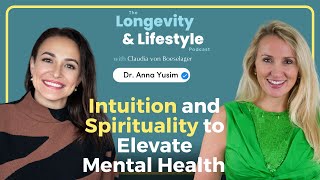
In this episode of the Longevity and Lifestyle Podcast, host Claudia von Boeselager interviews Dr. Anna Yusim, a Stanford‑ and Yale‑trained psychiatrist, executive coach, and author of Fulfilled. Dr. Yusim shares how extensive travel to over 80 countries sparked a quest to understand the soul, leading her to study Kabbalah, shamanic traditions, and Buddhist meditation. A vivid dream about a Kabbalah sign prompted her to enroll in the New York Kabbalah Center, where she discovered that only 1 % of reality is perceivable by the senses, with the remaining 99 % constituting a mysterious, potentially quantum‑compatible dimension. She defines mental health as a balance of mind, body, and spirit, critiquing the conventional focus on brain and mind alone. The conversation explores practical tools for disciplining the mind—labeling thoughts, cloud‑visualization, meditation routines, and automatic writing—to tame the “monkey mind” and cultivate intuition. Dr. Yusim outlines four primary intuition modalities (clairvoyance, clairaudience, clairsentience, claircognizance) and suggests practices and mentors for their development. She discusses the therapeutic promise of psychedelics, emphasizing their capacity for rapid paradigm shifts and spiritual connection, and details integration strategies such as journaling and regular reflective practice. The centerpiece of the interview is the emerging Yale Mental Health and Spirituality Center, a collaborative effort with Dr. Christopher Pittenger and Yale faculty to research intuition, neural correlates of spiritual experience, and the spiritual dimensions of psychedelics. Dr. Yusim describes the center’s goals, funding needs, and educational ambitions. The episode concludes with calls for personal oneness, resources (books, websites), and encouragement to pursue growth, balance, and fulfillment.
Chapters
One of the things that you learn in medical school, right, is that reality is that which can be seen with your eyes, touched with your hands, heard with your ears, like basically experienced with the senses. That which is real is empirical, can be seen and heard. And in Kabbalah, the idea is actually only 1% of reality can be seen and heard. 99% of reality is unseen and unheard. It's actually this world of mystery, which is also, you know, not inconsistent with quantum theory and a lot of more, you know, theoretical physics concepts.
Welcome to another episode of the Longevity and Lifestyle Podcast. I'm your host Claudia von Boeselager, here to inspire you to step into the highest version of yourself, improve your life and longevity for longer. Before we dive in, I just want to say thank you as always for being part of this tribe, for sharing, for listening, and for leaving comments below in either on YouTube or on your favorite podcast channel. It helps to allow me to continue to bring you amazing guests us for free. Without further ado, let's jump in today's conversation. My guest today is Dr. Anna Yousim, a globally recognized board-certified psychiatrist, Stanford and Yale-educated executive coach, and bestselling author of Fulfilled: How the Science of Spirituality Can Help You Live a Happier, More Meaningful Life. Dr. Anna is creating a mental health and spirituality center at Yale University. Her diverse clientele includes Forbes 500 CEOs, Olympic athletes, and A-list actors. She has a background in neurobiology research and extensive international experience studying various spiritual practices and brings a unique perspective to her work. Please enjoy. Welcome to the Longevity and Lifestyle Podcast, Anna. It's such a pleasure to have you with us today.
Thank you, Claudia. It's really a pleasure to be here with you.
So I loved, loved, loved our initial conversation, which I think we had just a short time scheduled, and it went over, and we went very deep in the short space the space of time. And now that we've sorted out some lighting things, which I loved, we were just improvising there. I'd love to start in our conversation today with the fact that you have traveled, lived, and worked in over 80 countries. What were some of the most profound experiences that you've had amongst these 80 countries that has really impacted you and shifted things in your life?
Yeah, it's such a great question. You know, travel has always been such a huge part of my education, and I would say that it was as important of a part of my education as my formal education, perhaps even more important in many ways. And what travel always does for me is it shows me other ways that people see the world and that people see the same situations that I am grappling with day by day, and they have a totally different view on it, a completely different cultural standpoint, a completely different anthropologic perspective. And it's really, really just fascinating. My last set of travels, it was really trying to understand this very arcane concept of a soul because I went to medical school residency and ultimately became a psychiatrist, a doctor of the soul. But the idea of the soul was never really mentioned in medical school and residency. And so I decided to travel the world to understand what do different healers and different cultures believe about the soul? And those travels took me to ashrams in India and learning Buddhist meditation in Thailand and working with shamans in South Africa and South America, and ultimately finding a really brilliant shaman in Mexico whose definition of soul I really, really loved. And he really helped me to encapsulate this concept. His name was Fernando Broca, and his definition of soul was a two-part thing, right? In the first part, the soul is that which connects you to everybody and everything. They often say that we're one unified soul, and so it is our interconnectedness. And then the soul is also our uniqueness, that which sets you apart, which is your unique set of talents, skills, abilities, interests, and contributions to the world. And so I love this definition of soul, which at once encompasses your interconnectedness with everybody and everything, and your uniqueness.
Oh, I love that. Because sometimes in sort of spiritual work, right, there's the oneness piece, but then it's like the ego and the not so good ego is the separation. But by defining both aspects as the soul, I guess it brings it together and that both are positive and both make the contribution. I think that's a really unique and interesting perspective. Wow, I love that. And I'd love to touch on where did your spiritual journey begin, um, which is not from the traditional Western way, as we know. Um, where did that sort of initial whispers come to, to pass, and, and how did that lead you on to now, um, starting at, at Yale, the, the spiritual center? So, um, yeah, would love to hear about that journey.
Definitely, Claudia. You know, some people are born spiritual, they're like always seekers. I was absolutely not that. And had anyone told me 25 years ago that I would become a spiritual person or that this would be central to my work, I would have laughed. It was like the furthest thing from my mind. And then, you know, interesting things happen in life that take you in unexpected directions. And towards the end of my psychiatry residency, really interesting things and unusual things started happening in my own life and in the life of my patients that I couldn't quite explain using the Western medical model in which I was trained. Case in point, at one point I remember sitting in an ice cream shop and a psychic and a baby, like with her baby, comes up to me and says, I have a message for you. I'm a psychic or an intuitive. Can I give you a message? And she looked relatively harmless. So I said, sure, give me a message. And then this woman sat down and started telling me all these things about my life that like nobody knew, that nobody could know. It was not even things I'd written in my diary. And it was these very deep, profound truths, including the name of the guy that I had a crush on, which all also nobody knew. So it was very— it was just like, what in the world? And I had that experience, and it just made me think, wow, did this person read my mind? How did this person know that? Because we have this preconception that every mind is separate and distinct. I'm thinking my thoughts, you're thinking your thoughts. But somehow this person, like, accessed something somewhere and was able to communicate that to me. So it was experiences like that. And then my patients also. Had things like they would have a dream about something that happened in my life, or I'd have a dream about something that happened in their life. And so there was like this bleeding in of, you know, inner worlds. And this really led me down this path of really starting to understand, which then led me to study Kabbalah in New York City, which created, you know, for me, a whole different perspective of like really a different theory of mind, a different theory of how the world works. And after my formal medical education was complete, it was my spiritual education that was just beginning.
Oh, so what, what was that path like with the spiritual education? I know you mentioned before with the traveling, but what, what called you? Like, where did you know to go? And people may be curious of being yearning to go more down the spiritual route, you know, what were some of the steps you took or what would you recommend? Do you listen to something internally or Can you share a little bit about what you— your steps were and what you would recommend?
Yeah. And so this is all part of, you know, one night in the midst of all this, this is over like a 1-year period, I had this dream and the dream was of a sign that said Kabbalah Revealed on it. And my mother had studied Kabbalah. So my mother is a very spiritual person, always. My father's super rational, physics professor, biomedical engineer. My mom's also a computer programmer. So she's also very rational, but very spiritual. And my father's just wired very differently. And it was my father's way of knowing, intellect, that was more touted in the family. So I developed that and didn't really develop spirituality. And so it was interesting when this Kabbalah dream came, I thought maybe my mom had at some point sent me a book about Kabbalah. And so I went to my bookshelf and there was no book on Kabbalah. And so I just remember this dream. And then I was walking to meet a friend for dinner a few weeks later, and I saw the exact sign from my dream, Kabbalah Revealed. It was the New York Kabbalah Center. I'm like, this is so strange. This was in my dream. So then I went in and I thought, this is just such a strange, interesting thing. I'll sign up for a class. So I signed up for their Kabbalah One class to learn. And that's where I started learning these, you know, very interesting theories that was in stark contrast to what I'd learned in medical school. For instance, one of the things that you learn in medical school, right, is that reality is that which can be seen with your eyes, touched with your hands, heard with your ears. Like basically experienced with the senses. That which is real is empirical, can be seen and heard. And in Kabbalah, the idea is actually only 1% of reality can be seen and heard. 99% of reality is unseen and unheard. It's actually this world of mystery, which is also, you know, not inconsistent with quantum theory and a lot of more, you know, theoretical physics concepts. But it was those ideas that started to just create this counterpoint of this is what you were taught and here's this other way of seeing things. And then for myself, it was just curiosity. It was interest, curiosity, and yes, the spiritual principle, because Kabbalah teaches a lot of spiritual tools. So they taught me a lot of tools as to how to elevate your consciousness, how to go against your nature, how to identify what your dominant response is and how to overcome that. Like if your dominant response is to get angry or to get sad or get depressed, What is— how do you go against your nature and elevate your consciousness? How do you do that, which is more difficult, specifically for the purpose of growth, healing, and transformation? So those are a few of the things that were in my stack.
Oh, I love that. And what were some of the tools? Like, what would you recommend? Because obviously, you know, awareness, as, as many of us know, right, is, is number one, so that we even notice what we're doing. But people who are challenged or struggle with a bit more that ego sense and trying to find a bit more that spiritual path, what are some tools you recommend and people can start with?
Yeah, definitely. So since, you know, that time, I've really branched out beyond Kabbalah and have pursued so many different other practices, etc. And so maybe I'll give you some general tools for people. And you want tools for people struggling with ego in particular?
Well, ego, or I guess trying to get onto a more spiritual path and not be in that sort of monkey mind state that even people who are on a spiritual path can end up having, right? So just to really reconnect with self and to feel like you're growing spiritually? What would you recommend?
Absolutely, absolutely right. So, so I think, okay, so the monkey mind, let's talk about that for a second, right? So the monkey mind is when something enters our mind and it takes control of us as opposed to us taking control of it. And one of the most powerful things we can do for our mind is slowly but surely learn to discipline our mind. A disciplined mind is a beautiful thing. And at the end of the day, The majority of issues in life come not from outside of us, but come from an undisciplined mind when we're unable to control something within, and then it starts to take over, you know, it starts to grow within us. And so there's some very powerful exercises on essentially changing your relationship with your thoughts. Because usually the thoughts come in and they're gonna be in your mind until they're done with you. And so now it's for you to start to take control. And so it's, you know, like you said, First and foremost, awareness. It's a very powerful, and probably you've heard it before, very simple meditation where you essentially let whatever comes come into your mind and then you label it. I'm having a thought about the breakfast I'm going to have after this podcast, right? And then you imagine a cloud floating by in front, and then you take your thought, taking my breakfast, putting it on the cloud and watching it float away. And then as that thought leaves, there's a vacuum in your mind for the next thought to come in.
So, and I'd love to touch on the mental health piece. And, you know, that's a word that's thrown around a lot of the time and people are like, yeah, mental health and I'm doing things and whatever. But I guess for me, like, what is for you the definition of mental health? Like, why is that so important? And what are things that you have learned and seen that have been so impactful in helping people?
Absolutely. It's such a great question because, you know, we're all talking about this mental health crisis that we are in the midst of right now. And this has been since COVID but actually way before COVID as well. And the way that I define mental health is people being in balance in mind, body, and spirit. Oftentimes mental health for people is limited to the mind, the mental part of their world, but you can't have stability and balance in the mind without the body and spirit also being engaged and recognized and heard. And so this is actually one of my missions is to broaden our definition of mental health, to bring in spirituality and the spirit, and then to bring in the body and other somatic practices that are so crucial to our understanding of mental wellbeing. You know, and when I say the body, that refers to so many things, right? Nutritional psychology, you know, the food is medicine movement, But then there's also a lifestyle is medicine movement, a spirituality is medicine movement, right? And so the nutritional psychology or psychiatry is one aspect. Then exercise psychology, how that affects your mental health, our connection to nature, longevity and fertility, healthy sexuality and pleasure, all those things that are such crucial parts of body and body intelligence that are often overlooked by mental health. And so my definition of mental health is balance of mind, body, and spirit.
And how does one— the next question— go about figuring out where they're out of balance, right? Because sometimes we're so in a rabbit hole, we don't actually realize that we're even there. So how does one bring that awareness to, you know, is it balanced, is it not balanced? And then, you know, how do you help, you know, clients, for example, that you work together with to realign? What are some of the methodologies that you've seen that have brought great success?
Yeah, and, and that's such a great question, right? You know, how do we know that we're off balance, especially if we're so high functioning and we're used to pushing ourselves and we're not necessarily super in touch with ourselves because being too in touch with ourselves would reduce our productivity and we wouldn't be able to push ourselves and drive ourselves as hard and accomplish and be ambitious in the same way. And so for most people, they are off balance through a source of pain. You know, pain comes up in some way and that pain could be something outside of themselves, a breakup, a death, losing a job, or something inside that they're burnt out. They can't get out of bed. They're suddenly depressed. They have overwhelming anxiety. They have obsessional thinking that they don't know what to do with. They're starting to have suicidal thoughts, right? Those are sort of the stark ways that somebody is not, you know, like off balance. And many of these things, like the transitions in life— breakups, divorces, deaths— those are natural and parts of life. And so everybody's going to have those things happen in their life. And it's how is your constitution suited to deal with those changes from a mental, psychological, spiritual, and physical standpoint? And how do we help people where there may be have some weaknesses around transitions like that, how do we help bolster them and help them be even stronger in their capacity to overcome adversity?
And so let's talk about like life transitions or, you know, setbacks. Maybe someone lost a job that they really identified with, or be it a divorce or a breakup, or, you know, losing somebody, you know, a death in the family or something like that. Where people feel completely lost. What are the, the first steps in order not to go down the depression route, or maybe, you know, sort of tending there, but what are some practices? Um, you talked about bringing in body practices, exercise, things like that too. So what are some of the protocols that you recommend people keep in order to support them in such difficult times?
Yeah, definitely, definitely. So I think the first thing is whatever is coming up, to let yourself feel your feelings, to really feel your feelings. And sometimes that could mean going into the darker parts of our nature, right, into our sadness, into our depression, into our rage, into our anger, and letting yourself feel, metabolize, and express those feelings. Because ultimately, what we don't own, what we push away, will begin to own us. And if we don't own those feelings, they can come back in other ways. And that could be hard for a lot of people because Not everybody likes to be processing their feelings because feelings slow you down, right? We want to be fast and productive and ambitious, and, but feelings, you know, you might need to just take a day off and cry. There could be something that is, and then you're like, what am I, a baby? What am I, a sissy? No, you're a human being who is going through something really difficult. And so it's giving people permission to take the time and space to be kind with themselves, to slow down a little bit, to feel. And then from that place of feeling, to start to metabolize, right? Because we want people to feel and metabolize emotions, but we don't want people to get so caught up in their emotions that they can't move forward beyond them. You know, it's why, for instance, when somebody grieves the loss of a loved one, to grieve for a few months, healthy, stable, normal. To grieve consistently and not be able to start to pick up life activities again after about 6 months, that's, you know, considered more pathologic. And then you want to— how do we help that person? How do we help them move them past their grief? You know, so that's one framework that you can use. And there's a number of others, including frameworks like DABDA for death and dying as people have passed. And, you know, like the 5-step process for how people can deal with grief and despair in the passing of a loved one. And that was by Elizabeth Kübler-Ross and her ideas.
So beautiful. And how about meditation, Anand? Like, what are some of the practices that you do to maintain your spiritual awareness and your practices, especially with such a busy and exciting life that you go in all the different projects? And I'd love if you could share a little bit about what you're, what you're up to at the moment.
Definitely, definitely. You know, there are some people who've been practicing meditation in one way their whole life. For me, I usually over the course of 6 months a year Well, try for 6 months this meditation for 6 months. So for 6 months to a year, I was doing the Joe Dispenza meditations. I'd gone to multiple of his week-long retreats, which I found so enriching and so expansive and just lovely. And so I've been doing some of his meditations. And then lately I switched over. I've been working with Marisa Peer's work and her subconscious reprogramming. So my meditations are more around that.. And so you identify what you want to manifest and then you program essentially through recording your own subconscious mind. And so you do the 30-minute meditation around that every night. So that's sort of been my practice. And in addition to that, I do some spiritual meditations by Steve Noble. If I ever wake up too early or, you know, I will do one of his meditations. So meditating for me is always in the back, you know, in the back burner and something like a stable, steady burn in my life.
This episode is brought to you by Nuchido TIME+. NAD+ has gained a lot of attention recently for its role in promoting healthy aging. There are many NAD+ products on the market, but unlike NR or NMN, Nuchido TIME+ is clinically proven to fix the root causes of NAD+ decline by switching back on NAD+ production pathways and reducing inflammation so the increased NAD+ can be used to enhance cellular health. Nuchido TIME+, is also clinically proven to reverse your biological age. Nuchido was founded by Dr. Nicola Conlon, a molecular biologist specializing in cellular aging. To try Nuchido TIME+, go to nuchido.com, that's N-U-C-H-I-D-O.com. And for 10% off, use code LONGEVITY at checkout. Mm, which is so important for the realignment as well.
Yeah.
And Anna, can you share about some of the exciting projects that you're working on at the moment?
Definitely, definitely. Probably the most exciting is at Yale University where, um, together with Dr. Christopher Pittenger, we're working to begin the Yale Mental Health and Spirituality Center, which is gonna be a bridge between Yale Divinity School and the medical school. And it's to research and draw attention to and create educational opportunities and clinical opportunities around all the different topics at the interface of mental health and spirituality. And so that's many different things like the nature of intuition, how we receive intuitive information like clairvoyance, claircognizance, clairaudience. You know, we're looking at the neural correlates of spiritual experiences. So when you have a spiritual experience or think about a spiritual experience, what part of your brain lights up? Where is that localized? And why does that matter? And looking at the spiritual side of psychedelics because they study extensively the neurobiology of psychedelics, but they don't have anybody currently doing work on the spiritual side. So we're looking and doing work on the spiritual side.
It's so exciting. And thank you so much for doing this work. And maybe you can even just share the beautiful story about how this came to be.
Yes. Okay. So it was— it's interesting because I wrote a book called Fulfilled in 2017. On the science of spirituality. And at that point, I was not on clinical faculty anywhere. I'd gone to Yale Medical School, loved my experience at Yale, but I was very happy being a private practice practitioner, studying my different spiritual practices. And I wrote a book about that. And I didn't affiliate with an academic institution to be completely unencumbered in my thinking because I was writing about a topic that was a little woo-woo. And I just wanted to be able to write what I wanted to write. And so I did. But with that comes a fear. You write what you want to write, but what if it's too woo-woo? And what if you're judged by your colleagues? Are undermined or discredited or— and so after I put my book out, I was very happy that did not happen. And actually, the book was very well reviewed by a number of my psychiatric colleagues, as well as several past presidents of the American Psychiatric Association, Dr. Pedro Ruiz and Dr. Rodrigo Núñez. And so, and based on that, Yale actually invited me to come on their clinical faculty after the book came out. And that's when we started talking about this. Mental health and spirituality center. And so I was thrilled. I was like, what a great outcome. It's not something I anticipated, but I was like, this feels very right. And at that time, I knocked on a few doors to create the center. That was in like 2017, 2018. And it was so clear it was not the time for the center. You know, it was like a no from the universe. Like, okay, well, Yale seems relatively open. I'm going to put this on the back burner. And then when the time is right, I'll know. And so I continued. And at one point, you know, about 2 years ago, I'm sitting in a Joe Dispenza meditation retreat and I literally hear a voice. The time for your Yale center is now. Go knock on the doors again.
Okay.
So I knock on the doors again and this time the doors swing wide open and the chair of psychiatry, John Krystal, says, this is a really important idea. And then he calls Dr. Rohrbach, who's been my supporter. He's the one who brought me into Yale. So Dr. Rohrbach and Dr. Pittenger and their high-ranking faculty at Yale and Dr. Pittenger comes on board to co-found this center. With me, and then we were off. So, so interesting, you know. And then the question is, what happened between 2018 and 2 years ago? I think what ultimately happened was psychedelics came into the picture. And psychedelics are such an interesting medicine because not only do they offer a novel biological mechanism for the treatment of our most treatment-resistant conditions, they also offer a connection to spirit. So just through being You know, in like the public consciousness, spirituality was on the map. And I think that's why Yale was much more open to the idea of the center and was like, you know, that was why the time was then. It's really interesting.
What are some of the outcomes that you are excited about, what you envisage this center will be able to bring about?
Yeah, I mean, I think that having world-class research on these subjects would be amazing. And my ultimate goal is really to expand our definition of mental mental health. Because right now, our definition, like we talked about before, is very mind-focused— actually, mind and brain-focused. And my field, psychiatry, has two primary modalities: psychotherapy to address the mind and psychopharmacology or medication to address the brain. What's missing from this is the body and the spirit. And so for me, my goal is to create a mind-body-spirit medicine framework where you have spirituality that's prominently considered in people's mental and physical well-being, as well as all practices and body consciousness. So that is what I hope ultimately through the center to do.
So amazing. And so how, how does it work? Because you look then for volunteers, or these students and researchers to do the investigations, to do the clinical trials. Like, how can you walk us through that process? I'm just personally so curious.
Definitely, definitely. So that the key thing is funding right now, right? Because the center is going to be a center once it's funded. And so we are fundraising for that. And We have a number of faculty that already have been doing work in this area, and so we're incentivizing them to do more work. We want to give them funding to be able to pursue work at this. We want to hire an endowed professor who's going to be running the center. We want to bring in faculty doing work all from all over the world to come to Yale for this. We want to create conferences. We want to eventually be able to apply this to the clinical care of patients, to create lecture series. Ways to create courses at the undergraduate level, medical school level, residency level, to be able to expose, you know, and there's a ton of research already done on this that is not very often taught in medical school and residency. So really to be able to bring that into prominence and show that there's so much. And, you know, when we say spirituality, like people are like, but spirituality, isn't that like church and state? You know, but the reality is Spirituality is how you connect to something greater than yourself. And, you know, that, that is core part of people's healing, of their identity, of their being able to live a healthy, fulfilled life.
I love that. And I think no matter what religion or belief people have, I think it's that being, feeling, being part of something bigger than yourself is so essential. And we know that one of the longest running studies since 1938 out of Harvard is that one of the keys to happiness and later in life and for longevity is social connection. And I guess it's that piece of just feeling that you belong, right, to something that's greater and bigger than, than oneself. So it just sounds so fascinating and exciting, Anna. So, so well done for spearheading this and pioneering it and pushing it forward.
Thank you, Claudia von Boeselager.
Yeah, you also touched on intuition, and this is something I I'm so fascinated about. And for the last few years, I've been trying to activate more. And I know I have a few friends who are like super intuitive and unbelievable. And growing up, my mother, the phone would ring and she'd be like, oh, that must be so-and-so. And she was always right.
I'm like, how does she know?
This is, we're talking about the phone that was fixed on the wall. Like, I mean, really old school. And so some people I think are very sort of attuned to these things. And Have you been, you know, working on your intuition? Have you always been super intuitive? I know you said there was like a voice at the Joe Dispenza thing. And what are some modalities that people are curious about becoming more intuitive that you find helpful in practicing this?
Yeah, yeah, for sure. It's such an interesting question because, so, you know, I was telling you a little bit about my own childhood and how I grew up with a very rational dad and a mother who was much more spiritual intuitive.
A little bit like mine too, by the way.
Totally, totally. And in my family, it was my father's way of knowing that was put on a pedestal a little bit more, and my mother's was not. So there was this hierarchy. And so as I grew up, I became a lot more like my dad, really brainy, intellectual, you know, developing that part of myself, but not developing the intuitive part of myself. It was essentially a part that I disavowed. And so, you know how I mentioned when that psychic came in and gave me that intuitive download, it was almost like something was awakened. I'm like, there's this whole other way that we as human beings could be, right? There's— and it was like, and it was, I think, since that time that I've essentially been reintegrating that part into myself. And like you said, developing that. And there's so many different ways. There's tons of books. There's books by Laura Day and many other brilliant intuitives who've shared their work with the world, who, you know, have medical intuitives. And then I have a number of awesome medical intuitive friends that I spend time with. And I think it's also just progressively getting in touch with deeper and deeper levels of subtlety and awareness. That's essentially what intuition is. And, you know, there's 4 primary types of intuition, and we all have 1 or 2 main types of how we receive information. And so that's You know, clairaudience— some people hear voices to receive intuitive guidance. Then there's clairvoyance— some people see visions in their mind's eye in order to get intuitive guidance. Then there's clairsentience— you can feel it in your body or have an emotion of how you receive intuition. Or claircognizance, which is how sometimes you just know without knowing how you know, like your mother, you know, like she just knew who was calling. She didn't know how she knew, you just knew, right? And so for most people, one or two of those are dominant, but you can develop the others as well. And there's also a woman, Annalisa Eitelberg. She has a mystery school where she helps people develop the different forms of intuition. So there's a lot of people doing this work and a lot of people very curious to learn more about how to do precisely this work.
Why is intuition so important or powerful? And I'm like, what is— what have you come across in your work?
Yeah. So As I see it, the intuition is that still, quiet voice that can only be heard when the other voices in your head, like the screaming voice of reason and the screaming voice of emotion, temporarily cease to be. And as I see it, the intuition really is the voice of the soul coming full circle to like, what is the soul, right? And so the intuition can cut through the noise and help us to make good decisions. It can help you to know the answer to a question without having to reason it out or without having— you can use retrospective rationalization later to reason it out, and we often do. But, you know, we think that we're purely rational beings, but actually Daniel Kahneman's work in Thinking Fast and Slow shows that we're more intuitive beings making more instinctual, intuitive decisions and then using reason afterwards to back up and, you know, to come, you know, back up into why we did what we did, to retrospectively rationalize it. So that's, I I think why intuition is so important, because it really can help us make the most important decisions about the most important things in our life.
I love it. And you said it's also like the soul speaking. So it's personal in a way, right? Yes, we're connected, but it's our greatest path, right? The, the road, road that we should be taking. And it sounds, you know, you've been having these profound downloads that are setting up this beautiful center at Yale, right? So it's like tapping into that more often. Um, and yeah, seeking guidance that way. And I think it's also really empowering, right? Because We've been taught traditionally to give our power away. Somebody else knows better, like always look externally for guidance, etc. But it's actually going, okay, maybe I know the answer. And, you know, looking within. Do you have a journaling practice, Anna?
You know, some— I did for a long time. Currently I don't. But I think a journaling practice is wonderful, and especially automatic writing, which is essentially journaling but it's almost like you make the command to your soul, like you ask a question of your soul, and then it's almost like your soul and not you is writing back to you. So it's like you're asking the command of your soul and not your mind, and then you're seeing what comes back. So sometimes you'll get unexpected answers. It's like a step removed from yourself.
How does that work? I'm sure some people listening are like, well, how do I know it's really my soul and not just my ego answering questions?
My mind. Exactly, exactly. And it's, it's really difficult, right? Because sometimes you don't know. And so there's like a part of you, you almost have to go into your imagination and trust. And I think that for people who do this practice repetitively, automatic writing, it's something that they could pick up over time and see what is the difference in cadence and tone and voice when my soul's responding to me versus when my Is there a difference? It could be very subtle, could be very profound usually.
Oh, I like that. That's good.
Yeah.
You can probably tell very obviously, like the perfect handwriting and things. That's the mind. And then the more flowy piece, that's potentially the soul and the spirit as well. Beautiful. And you touched before on psychedelics, and this is obviously a very big topic and there's a lot of, you know, commotion, positive news going on and there's a bit of a renaissance happening around it. And we've had several guests on also who've discussed this too, but what excites you most about what is happening in the space of psychedelics and the research that's coming out, especially from a mental health and psychiatry perspective?
Yeah, definitely. I feel like these medicines are offering people real paradigm shifts, you know, in their experience. And usually therapy progresses over time in a steady way. And it's continuous and problems are repetitive. But for some people, psychedelics have actually proven through just a few treatments to really create a shift that ends a lot of their suffering. And that's super exciting. That's not the case for all people in all situations, but there are cases of that. So that's one of the things. And the other thing is that for many people, it creates a paradigm shift where it also helps to connect them to spirit. So it brings spirit into the medical practice, unlike most other medications that we presently have.
So you said connect to spirit, and maybe for some people listening, they're like, what, what is that? Like, how does that happen? Can you describe as best as possible— I know it's not easy— what that means to be able to connect to spirit?
Yeah, exactly. So what, what is So let's, let's define first spirituality, right? And so my favorite definition is a definition from British professor of theology Christopher Cook, and he believes that it's a universal dimension of the human experience concerned with the most important things in life, purpose, love, meaning, and values. And it could be experienced as something deeply imminent and inner, like very subjective and internal, or something that's transcendent and beyond the self. So that is a spiritual experience. And people have these spiritual experiences through all sorts of means. They can happen unexpectedly, or they can happen sometimes with a substance like a psychedelic, or certainly with meditation or prayer or going to church or breathwork or so many other things. That are designed sometimes to create and open people to that. And in psychedelics, um, the spiritual experiences— like, for instance, people can have— sometimes people can connect to somebody who has passed. And this is patients that I've had that have reported sometimes they could experience a healing in the course of the psychedelic journey. And this is many different— because I've had many patients do many things in the country, outside the country, things that, you know, they— we did together, or things that they did separately and then came to tell me about, you know.
And so this is psilocybin or, um, ayahuasca or ketamine?
All of those. Exactly, exactly. Yeah. And yeah, so that's, that's, that's a little bit of that. Yes, that people deeply enriching, expansive things that then shift their perspective in a very profound way.
And so people in, in the space especially will know, but maybe the integration piece is such a core piece to, you know, after having these experiences. And how do you support people integrating that so it's not just kind of a once-off experience? Yeah, but actually that they can incorporate it into upleveling their life thereafter.
Yeah, yeah, I love that. And you're exactly right, that's the most important thing, because they can have this experience, but then how does it change you? And so journaling is actually, I think, one of the really powerful ways for people to keep connecting to that experience if it was indeed a profound experience. And sometimes the experience could be just strange and unfamiliar, and then you still keep connecting to it because usually those experiences have meaning that will be revealed over time. And then I think a really important part, especially if it was a really profound experience, is to set up concerted practice to go back to that experience on a regular basis, at least once a week for a few months, to really be changed by it, to really be shaped by it, to remind yourself what you learned. And then, of course, after the experience, as in the integration with the group, to write down your main takeaways. How would you like to go forward from this experience? And what do you feel compelled to do from what you were shown and revealed? Because also part of the integration is to take action. You're often given some wisdom, some knowing. You can have the healing, but it's also contingent upon you taking action in a new way and actually changing your life thereafter.
And I think that taking action piece with so many things is just, you know, taking that first step. And building momentum and keep going. So a lot of people are like, oh, well, I had this insight or that or the other. It's like, well, what are you doing about it? Like, oh no, I just had this insight. It's almost like a gift that's given to you and it's like you have to run with it and continue, be it from intuition or from other experiences that we can have as well. Before we finish up today, Anna, I'd love to also ask you, what are some of the messages? What are some of the things what you've seen in the work that you're doing and what's happening in the world today. How would you like to encourage people to educate themselves, to create more that sense of oneness and unity that is so needed? And maybe what are some resources, online resources or books you would recommend that they start with?
I love that. Yeah, it really is all about oneness and unity. And you're exactly right that what's happening in our world is increasing polarization and echo chambers where people are being reflected back their own perspectives and then not really being challenged to expand their perspectives, to be more loving, to be more open-hearted. But I think that that's what we all have to do for ourselves precisely because of the polarization and because ultimately we do want unity. And I think that there's amazing people doing work at that interface trying to elevate that. And I think that this is individuals from all walks of life and all levels. Jeffrey Rediger at Harvard wrote a book called Cured. Lissa Rankin has written numerous books also in the mental health space on overcoming fear, on elevating consciousness, on sacred medicine. So I love other physicians doing work like this, and I feel very inspired often, you know, by these sorts of things. And what can we do really to look within our hearts and what we see as a problem externally, to find the antecedents of it within us. And if we see anger, hatred, violence, look for that within you. What's the anger, hatred, violence within you? And how do you shift that? How do you become more loving? How do you expand your consciousness? Because as you do that, that then naturally will multiply out and go out and go forward.
Oh, beautiful. That's beautiful. I love that. Anna, where can people find out what you're up to? Be it social media or website, and we can link it all in the show notes.
Absolutely. The best place is probably my website, which is www.annayoussem.com, and they can follow me on Instagram, Twitter, LinkedIn, Facebook.
Beautiful. Before or as we finish up today, Anna, is there any parting message or thoughts or recommendation or ask for my audience today?
Just to be the best version of yourself, to keep challenging yourself, always look inwards, to be introspective, and always always look for what is the next way that you can grow. Kind of balance your growth and your fulfillment to push yourself and enjoy life.
Love it, Anna. Such a pleasure to have you on today. Thank you so much for the time. Thank you everybody for listening and tuning in as well.
Thank you.
More from Claudia









Can Psilocybin Slow Aging? The Study on Telomeres, Inflammation & Survival with Dr. Louise Hecker

