Dr. Dale Bredesen - On Groundbreaking MethodsTo Prevent And Reverse Cognitive Decline of Dementia
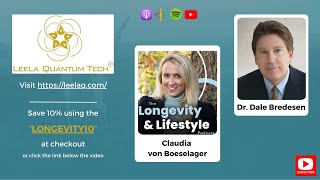
In this Longevity & Lifestyle Podcast episode, host Claudia von Boeselager interviews Dr. Dale Bredesen, a pioneering neuroscientist and leader in precision‑medicine approaches to Alzheimer’s disease and other neurodegenerative conditions. Dr. Bredesen explains how new blood biomarkers (P‑tau217/181, Aβ42/40 ratio, neurofilament light, GFAP) enable early detection of pathological changes decades before symptoms appear, allowing intervention during asymptomatic or mild‑cognitive‑impairment stages. He describes the ongoing Dementia Reversal Trial (dementiareversaltrial.org) that enrolls participants with MoCA scores 18‑28 (or CNS Vital Signs) and uses a multi‑modal, personalized protocol that addresses up to 38 distinct drivers of cognitive decline, including reduced cerebral energetics, systemic inflammation, sleep apnea, metabolic syndrome, biotoxins, oral‑microbiome dysbiosis, and hormonal changes. The protocol combines a mildly ketogenic “KetoFlex 12:3” diet, aerobic and strength exercise, sleep optimization, stress management, targeted detoxification, supplements, brain training, and, when appropriate, hormone replacement, stem‑cell or intranasal neurotrophic factor therapies, and micro‑dosed psychedelics to boost neuroplasticity. Dr. Bredesen critiques single‑target anti‑amyloid drugs, arguing they remove a protective immune response and offer only modest slowing of decline, especially in ApoE4‑positive women. He emphasizes that Alzheimer’s is now an optional disease if early prevention or treatment is applied, urging listeners over age 40 to obtain a “cognoscopy” and begin active prevention. The conversation also covers the documentary “Memories for Life – Reversing Alzheimer’s,” which showcases patient stories of dramatic recovery, and the expansion of the precision‑brain‑health program at the Pacific Neuroscience Institute to address ALS, Lewy‑body disease, and macular degeneration. Dr. Bredesen discusses challenges to protocol adoption—behavioral inertia, need for micro‑step changes, and the importance of personalized coaching—and highlights emerging research collaborations (e.g., with Dr. Lee Hood’s Phenome Health) aimed at building large omics datasets to refine individualized treatment, especially for severe cases (SARA trial). The episode ends with a call to action: get screened, adopt the lifestyle protocol, and view the documentary to spread hope.
Chapters
This episode is brought to you by Leela Quantum Tech. In the past two centuries, our understanding of longevity has revolutionized. From a mere 30 years average lifespan in 1800 to nearly 80 years today, we've made incredible strides. Now it's time to embrace the future of aging with Leela Quantum Tech. Leela Quantum Tech brings you products charged with quantum energy designed to restore balance and vitality. These products can help in managing stress, improving sleep quality, and promoting mental clarity, contributing to a younger biological age. Our modern lifestyles can accelerate aging, and EMF radiation is everywhere. With Leela Quantum Tech, you can combat this trend and focus on utilizing the balancing effects of quantum energy to maintain your youthfulness and shield yourself and your loved ones' well-being. To bring balance to your everyday life, boost your health and vitality, visit leelac.com, that's L-E-E-L-A-Q dot com, and embark on a journey to a longer, healthier life. And for you, dear audience, get a 10% discount on Leela Quantum Tech products with code Longevity 10, that's L-O-N-G-E-V-I-T-Y 1-0 at checkout today.
My guest today is Dr. Dale Bredesen, a pioneering neuroscientist whose research has significantly impacted reversing Alzheimer's disease throughout his career. In 1998, he became the founding president and CEO of the Buck Institute for Research on Aging, an adjunct professor at UCSF. From 2013 to 2023, he returned to UCLA as a professor and director of the Easton Center for Alzheimer's Disease Research, and he is currently senior director of the world's first precision medicine program for neurodegenerative diseases at the Pacific Neuroscience Institute. As many of you will know, my mother suffers from dementia, and had we caught it sooner and been able to apply some of Dale's strategies at an earlier stage, my mother would not be where she is right now. I also want to highlight Memories for Life, which is a new documentary. I've watched it recently with my kids, something for the whole family and very hopeful for seeing so many cases of people who have made significant improvements despite being diagnosed with dementia.
So please enjoy our conversation today. Welcome to the Longevity and Lifestyle Podcast, Dale. It is such a pleasure to have you back on the podcast today.
Great to see you, Berenice. Thank you for having me back.
Thank you, Dale. Dale, I, since our conversation, and I realize it's going back to 2021, time flies when you're having fun, as they say. What has been happening in the world of your research in changing the face of how we interpret Alzheimer's and dementia?
Yeah, you know, we're really entering a golden age. We have been kind of in the dark ages where people didn't understand what actually drove these neurodegenerative diseases. And for the first time, we can now begin to look at the right various biochemical, genetic, epigenetic parameters. And we can see, for example, for the first time, there are blood tests for P-tau 217, P-tau 181, A-beta 42 to 40 ratio. Neurofilament light, GFAP. These are all things we can look at very simply now, and we can see whether we're headed for this because people have thought of Alzheimer's as old-timers. You know, you get this when you're old and it happens late in life. That's not the case. You can see changes in your 20s that were— that will be diagnosed much later. So in fact, we can all improve our cognition no matter what it is, and we can also reduce our likelihood, reduce our risk for cognitive decline later in life virtually to zero. If people get on early, and as you know, you go through these 4 phases, there's an asymptomatic phase, there's a subjective cognitive impairment, there's a mild cognitive impairment, and there's the dementia phase. If we could get everybody to come in on the first 2, get in on active prevention or early reversal, we see virtually everybody get better and do very, very well. You know, I just submitted a paper on people who have sustained their improvement for over a decade, which is unheard of in the past. So now we're seeing results like we've never seen before. New blood tests, new trials, and we are in the middle of a trial. We are definitely looking for more people. So there are 6 sites. Please look at Dementia Reversal Trial.
And just to point on that, and I'd love, you know, for people listening, if you know someone to get involved with the trial, but what would be the stage someone is at? And maybe someone has not been fully assessed for early cognitive decline or dementia. So what would be some of the symptoms where you'd say, yes, this would be an ideal person to participate in the clinical trial?
Great point. So this is very much like any of the drug trials, except it is a precision medicine protocol, and it is at the MCI, mild cognitive impairment, or early dementia stage. Stage. So if you've had a MoCA score, something between 18 and 28 is typical. If you've had a CNS vital signs, that's more sensitive, so you may be down at, you know, 80, 90, something like that. And so there are, so, you know, it's mainly about complaints, people who are saying, you know, I can't remember where my keys are, or I'm having trouble, my memory's not what it was 5 or 10 years ago, those sorts of things. So it doesn't have to be too severe, but it can be. We are including people with early-stage dementia as well.
That's really helpful. I have a few ideas for you, Dale, that I will share with also to reach a larger community because I know, as we know, that my mother suffers from dementia. Unfortunately, it's very late stage now and it's such a sad, sad disease. And I love that you are really made this your life's passion and life's work and have found modalities that are helping to improve it. And perhaps for people who missed our first episode, episode, can you share what this groundbreaking research that you've been doing in protocols and clinical trials and case studies that you've been able to, you know, what has been happening? What have you been able to do and how have you been able to do this?
Yeah, great point. And we spent 30 years in the lab looking at this, but I should mention for anyone who is already in late stage, and we've had some mild improvements in late stage, but it's hard to bring people all the way back because there are so many things that contribute. To this. So for anyone who's in late stage, please ask all of the children who are, as they turn 40, or if they are already over 40, please get on active prevention. Get a cognoscopy. It's fairly easy to do. I have to say it's much more pleasant than a colonoscopy. Easy to do, and get your tests evaluated and see where you stand, and please get on active prevention. So what we found in the lab is that what we call Alzheimer's, what has been called Alzheimer's for over 100 years since Dr. Alzheimer first first described this in 1906, people had thought it was about simple things. Oh, protein misfolding, reactive oxygen species, some simple thing like that. And it turned out it's not quite that simple. It is a network insufficiency. So in that sense, it's very much about supply and demand. There are two major things that drive this process. One of them is reduced energetics. So if you have reduced blood flow, reduced oxygenation, so many people with sleep apnea, for example, they're at increased risk, reduced mitochondrial function, which is why it's so great to be getting out there and exercising, reduced ketone levels. Any of these things are reduced energetics supporting your brain. The other piece is driven by inflammation. So, and that, as you know, there are so many things in our current world that can produce inflammation. It can be biotoxins, toxins that we're exposed to, for example, from molds and things like that, change in your oral microbiome, leaky gut, chronic sinusitis, a tick-borne infection, any of these things, metabolic syndrome, one of the most common ones. There are over 80 million Americans who have metabolic syndrome. So any of these things that will cause this chronic typically systemic, including the brain inflammation, is calling out your microglia, your cells in your brain, to come and try to protect your brain. And so as part of that protection, you are literally changing, you're switching over your resources from making synapses, making memories, keeping memories, you're switching it over now to protecting yourself. It's very much like changing from building bridges to supplying an army. That's basically what's happening. And when, you know, when the army is firing, there are gonna be some people who get hit and killed. And that is the problem. You are literally doing a protective downsizing. And the problem, as you well know, it can sneak up on you so that you can have years where things aren't quite what you thought they should be. But yeah, people say, "Oh, it's just normal aging." I think that's one of the most damaging things that doctors do. You go and you say, "You know, my memory isn't what it used to be," and they say, "That's normal aging." We had someone recently who was all the way into the fourth stage, all the way into dementia, and he went to a neurologist who said, "That's normal aging." Oh my gosh, I mean, this is the worst thing you can do. So we want to get in early, then we want to look to see what actually drove it. As you know, it's different for each person. For someone, it might be sleep apnea. For someone, it may be a change in their oral microbiome. Often it's 5, 6, even 10 or 15 different different contributors. So changing diet, exercise, sleep, stress management, brain training, detox, some targeted supplements, these are all things that can enhance our cognition for normal people and can help people who have cognitive decline to reverse their decline. And, you know, when we first reported this, people just didn't believe it. They said that you can't reverse cognitive decline, but if you understand the science of what's actually driving it, then indeed you can, and we've now published a trial. Dr. Heather Sandison, whom you may know, published a separate trial doing our same protocol, got very similar results to ours. These are— all these are available freely online, so you can look at the data, you can look at the patients, and you can see how well they did.
What were some of the biggest challenges of people who I'm thinking of people listening right now and thinking, okay, I want to jump on this. I want to do this. Where do you see are some of the biggest challenges that people have in adopting the protocol? And what are some of the tools and strategies that you think would be most helpful so people can adhere to it to really see the results?
Such a good point. And you know, Arianna Huffington has been making a point and she started Thrive Global several years ago and she's made a point that it's those micro steps. You just do a little bit better tomorrow than you did today, and then you just keep doing that. And after a while, wow, you're doing really, really well. And so you're right, the biggest challenge is to realize that whatever it is that you've been doing for the last few decades is not working. Your brain is now downsizing to protect itself. So you need to start changing. And so, as you know, behavioral change is not easy.. But when you get the positive feedback, when you say, wow, and I got one just to— and I get these all the time, these wonderful emails, which is one of the reasons they did this wonderful documentary and talked to people who went through this and got better. And so this is actually now streaming. You can get it on Amazon Prime. You can get it on Google Play. You can get it on Apple TV.
Let's discuss that in a moment, exactly, yeah, where about Memories for Life, yeah.
But getting people to do this. So you have to start with the basics that I just mentioned. You have to change their diet. We have, as in the Western world, we eat a relatively unhealthy diet with a lot of processed food. And, you know, as a scientist, I used to pooh-pooh these ideas 20, 30 years ago. I thought, oh, come on now, this— it doesn't matter that much what you eat. And I was wrong. My wife, who's an integrative physician, said, you know, whatever you guys find in all your test tube experiments, it's going to have something to do with the basics. How, you know, are you getting the right amount of sleep? Are you getting deep sleep? Are you getting REM sleep? All this. And I said to her at the time, no, no, no, no, no. We're gonna find one fold of one protein and we're gonna get a drug that hits that one fold and we're gonna cure this disease. And I should have listened to her 25 years ago. She was absolutely right because it's more complicated than one little protein. This is like running a country or running a big company. You have a lot of different moving parts and you're literally changing a network function. And so when you change network function, you don't take a hammer and go wham. You make little changes here and there. So you're changing your diet. You're now getting a plant-rich, mildly ketogenic diet. We call it KetoFlex 12:3, and it's a way that actually helps your cognition. We've had lots of good results with that. You're now going to get both aerobic and some strength training. You're literally now going to change a few things, and you don't have to change them all at once. You have to remember, By the time you're having cognitive decline, you've typically had the underlying biochemical changes for about 20 years. That's well documented by serial PET scans and by serial spinal fluid analysis. Good news, don't have to have spinal taps anymore. You can now get blood tests. That is another step forward in what I'm calling the beginning of a golden age. We are not only reversing aging that we're all hearing about every day, we're also reversing cognitive decline. And we've now started the first precision medicine program in the world to reverse all neurodegenerative diseases. So we will have larger data sets. We will now be able to look at ALS and frontotemporal dementia. We've already had some good results with Lewy body disease. We've already had some good results with dry macular degeneration. So I'm very enthusiastic. And this is going to be at Pacific Neuroscience Institute down in Los Angeles. So very excited about that.
Can you share a little bit more about that? Because this is really phenomenal. And I've had, you know, people come that their parent has been diagnosed with ALS, etc. I've seen, you know, parents of friends who have passed because of ALS. It's, I mean, these are really cruel diseases. Can you share more about the work that you're going to be doing there?
Absolutely. Thank you for asking. So, you know, it's so interesting. We're all used to hearing about Silicon Valley disruption. Oh, you know, when you first heard about Twitter, like, whoa, this is completely different. When you first heard about Facebook, when you first heard about these different things that you can you first heard about web browsers and all these things that have been so disruptive and really changed the way we live each day. We don't think about that for medicine, but we need such disruption in the whole area of aging and neurodegenerative disease. These degenerative diseases that we get, then they are huge. Alzheimer's will kill 45 million of the currently living Americans, so many times what the pandemic has killed. So it's a very, very common problem. So what we need is we need to change the idea of you go in late. They often, you know, start these very late, as you know, and then they give a medicine that hits one little thing. As we always say, there are 36 holes in the roof. You got to patch all the holes, you know, to get things to do better. And so they go in late, they give a drug, and it just doesn't work. So we need to change that formula. So that we are now going in early. We have early detection, we have early treatment, and we have appropriately directed— we're targeting the things that are actually causing the problem. This is so important. And so have a wonderful opportunity now. And actually, I just had a wonderful meeting with Dr. Lee Hood, who is the inventor of the automated DNA sequencer, really is my hero. Incredible guy. He's now in his mid-80s. Brilliant, brilliant scientist and physician as well. And he's looking at whole genomes and epigenomes and all this. So we are now in the new trial, we are looking at genetics, epigenetics, biochemistry, all these different pieces so that we can understand for each person what's happened. So actually, I went into the Pacific Neuroscience Institute, talked to Dan Kelly, who's the director there, and also Dr. David Merrill, who is the director of the Pacific Brain Health Center, which is part of the institute. And they were enthusiastic. And so we are now establishing this first new program that will take people from all over the world who have neurodegenerative disease, and we will study the disease and we will also develop treatments for this. As I say, we've already had some good outcomes with Lewy body, with macular degeneration. So I'm very excited We need to get rid of this idea that all of these things are hopeless. This will really offer hope to people. Again, as you said earlier, it is tough when you come in really, really late, when you've had this for, for years and years and years. It is tough, no question. I hope someday we'll be able to do better with those as well, but we need to understand them better. And so we need to get the people who are early or who are interested in prevention and start with that to look to see what is actually driving this problem and how do we get best outcomes.
Yeah, it's such an exciting time. And so when is early for you, Dale? Like if someone's there, let's say they're maybe late 40s, early 50s, and they don't know, is it just lack of sleep or stress that maybe they've become a bit forgetful or whatever it might be? So when should people already be sort of waking up? Or do you think it's just from the age of 40, cognoscopy is like the way to go? What would you suggest for people listening?
Yeah, such a good point. So there are two situations here. One is, yeah, when you hit 40, it's best to get a cognoscopy and get on active prevention, but if you didn't do that, that's okay, then when you notice that things have changed, when you say, you know, I just can't do what I used to do, I can't remember phone numbers, I occasionally will have trouble when I'm driving remembering, you know, where am I going here. We had one woman who got on a plane and she got to the other end and she said, where, you know, why did I come to this city? She ended up getting on the plane and going back. She didn't remember why she had come to that city. And so when you're having changes that you know something's not quite right, don't wait. Do not let your doctor tell you, oh, this is just normal aging. No, there are people who are 100 years old who have great memories. So please, when you've got changes coming, and sometimes it'll be organization, we have people who say, you know, I got a new "phone, new iPhone or whatever, and I just, I can't work it the way I just can't kind of figure out how to get this working." That's organizational skills. Calculation, one person said that she couldn't figure out a tip anymore. Things like that, you know that something is not right. You're getting in early, and to be fair, you know, we in our trial took people down to MoCA scores of 19, which is fairly significant dementia. The new trial, we're going down to 18, but you know, you're right, if you're down in the single digits, it is definitely harder. We've seen people go from 18 to perfect 30s. We've seen people go from 0 to 9, which they still, they start speaking again, they do better, but we've never seen anyone yet go from 0 to 30. That's my goal. That's what I'm hoping. And it may take stem cells, it may take intranasal trophic factors, this is what we need to understand.
Yeah, yeah, which is really exciting. And if people want to participate or if they want to be involved, where would you point them to, Dale?
Yeah, great point. So if they want to be in the trial, go to dementiareversaltrial.org and check that out. If they want to come to Pacific Neuroscience Institute, please check, look at Pacific Neuroscience Institute or Pacific Brain Health Center, which is the part within the institute that is going to house this Precision Brain Health Program.
And that's people around the world that you would take in?
Absolutely. People could come from anywhere. And I should add, you know, there's been a lot of interest in psychedelics recently. And the interesting thing is they do have a potential role here. As you know, one of the things that they do is enhance neuroplasticity. So what we're looking at now, and that's one of the projects we're going to be doing at at PNI, Pacific Neuroscience Institute, is, look, let's start by removing all the inducers. If you've got, you know, if you're having no sleep, if you're having sleep apnea, if you've got a change in your oral microbiome, we can remove those problems. If you're living in a moldy house and that's triggering your brain fog and triggering ultimately your cognitive decline, let's remove those things first. Then the second step is, let's get you to be resilient. So, let's get you on the right nutrition. Let's get you, if you need specific medications, whatever it is, let's get your resilience up there. One of the things we need to do is optimize your immune system because just like in long COVID where you have too much inflammation and too little adaptive clearance of the virus, in Alzheimer's it's the same thing. You have this ongoing inflammation, you have much less here, you've got much less of your adaptive system. So same idea, so we need to optimize. Now, after we do all of those things, Now we want to rebuild because you've lost some synapses. Let's rebuild that plasticity. And there's a lot of promise, especially in starting with these microdoses and just getting people to enhance their plasticity. Now, essentially, to regrow and get synapses where they were lost before. You don't want to do it while you still have the inducers because they're just going to be damaged as soon as you make them. But once you've controlled all that, That's the time to look at these. So I'm very enthusiastic about that. There's so much in the armamentarium, Claudia, stuff that we just didn't have 5 or 10 years ago. The armamentarium is huge.
So exciting. And I was having conversations. I was speaking at the conference at, in Miami, people doing, you know, ketamine-assisted therapy for healing chronic pain, trauma. I mean, it's so beautiful. I know Dr. Pamela Crisco up in Canada. With the Roots to Thrive program, what they're able to do to help patients to recover within months, what 20 years of talk therapy was not able to do with ketamine-assisted therapy as well. So there's really exciting time and space for this as well. I'd love to talk, Dale, about Memories for Life. Can you talk about this beautiful documentary that you've put together, and obviously with a team? What was the goal of this, and can you share for my audience a little bit more about the documentary?
Yeah, thank you so much. So, you know, NHK is the CNN of Japan. There is a big concern in Japan because of the fact that there are so many older citizens in Japan, and so the government has said that dementia is the number one concern in Japan. So back in 2017, I was approached by a director, Yuki Tokugawa, fantastic director who's an award-winning director in Japan, and he said he would like to do a documentary about the work we've been doing and talk to the various patients who've gotten better and, you know, let's get, let's get it from the horse's mouth. Let's hear, you know, what did you go through? What, what did you have before? And so he started to collect stories and indeed has completed the documentary. And in fact, interestingly, one of the patients who's from a very famous family on the East Coast said, you know, I would like to support this documentary and I'd like you to make specific edits, etc., and really try to enhance it because I think the The first version was a little too scientific and maybe not as watchable. He's done a very nice job. I give great credit to Yuki and his team. He has interviewed, as I mentioned, various patients. He talks a little bit about the work we did in the lab and how did we come to the conclusion that this wasn't about just giving a single drug, that you have to actually look at these different parameters. And then, of course, the skepticism. People say you just can't reverse cognitive decline. Well, you know, we've seen it again and again and again. So he talks to some of the patients and shows how much better, you know, one of the people that he interviews was an attorney who was also working in Broadway and off-Broadway productions and things like that. She lost her ability as an amazing person. She spoke some Chinese, some Russian, and played the piano. She lost all of those. She got them all back. So she's now playing piano again. She's now able to speak Chinese again, and she's now able to speak Russian again. And it's not— she's not perfect with her Chinese and Russian, but she went where she had zero. And she said as she was driving along one day when she was on the protocol, the Chinese just started spilling back. I mean, such an amazing vision to imagine yourself kind of driving along, and all of a sudden all these Chinese words are just like reappearing, things that you knew before you lost, and now they're just streaming back in. One of the things that people had always wondered, if you actually do get better, Have you lost the memories that you lost forever, or do they come back? Well, she showed they often come back. You can actually get things back that you had truly forgotten. She had a point where she would sit down at the piano, couldn't read the music anymore. And then suddenly she sat down at the piano. This was like a year later and said, oh my gosh, I can read music again and just started to play. So if you see these stories and it doesn't choke you up a little, then you probably haven't lived with someone with Alzheimer's. It's something that touches so many of us, as I mentioned, and to see people getting better, it certainly makes my day anytime I hear about someone getting better. It's so exciting, and as you know, not everyone does, so we're still trying to understand how can we make it so that every single person gets better. In our trial, 84% of the people got better. But to be fair, we didn't take people in the trial who had single-digit MOCA scores. As I mentioned, we went down to 19. Yeah. So, you know, so the, you know, there's, there's so much more work to be done. And as you mentioned, what about people with ALS? What about people with other diseases? ALS has been one of the toughest. I used to see it as a practicing neurologist years and years ago, and it was, it was the least, it was my least favorite thing to see walking into the clinic because it was 100% death sentence, and typically within 3 years or so. So now we have some hope that we may be able to do something, and there's a wonderful neurologist from Duke who's published some work showing occasional cases and why did they get better. Something, you know, they had a number of things that happened to them. Is there something we can learn from these people? So it's a new day, and I think, you know, even 5 years from now, we're going to see a lot of improvements.
Which is so exciting that these things are not death sentences, as you said yourself, anymore, and that there are modalities to do. And obviously, the prevention is better than cure. Getting on top of it and being proactive is so fundamental. Yeah.
And I should mention to follow up on Memories for Life Reversing Alzheimer's. Sorry about that. I kind of got off track there. And it's— so it's called Memories for Life Reversing Alzheimer's. And it is now streaming, actually starting yesterday, streaming on Amazon Prime, on Apple TV, and on Google Play. Soon it will also be on Vudu and Tubi.
Beautiful. And I mean, I've seen it for anyone interested. I was even watching it with my 7-year-old daughter who found it very interesting as well. I think it's for the whole family to just realize that there are so many beautiful cases and it is reversible if you know somebody who's suffering to take action sooner than later. Yeah. Jill, I'd love to touch on the, the naysayers, right? So, um, I've been to, with also my mother, to many neurologists as well, um, that are just like, no, there's nothing you can do, or, oh well, the FDA has approved this drug, we should try this drug, um, but nothing else is going to work. What is, to help people understand that may have gone to the neurologist and said either, oh, you're fine, or, oh, this is just age-related cognitive decline, why is this happening in the first place? So can you just shed a bit of light to that? And then also, why has there been some people who don't believe fully in the protocols that you're doing, etc.? What is— let's discuss the skepticism a bit there.
Yeah, such a good point. So what's happened is because for over 100 years this has been disease, have been a disease where there's nothing to do, and therefore everything is upside down. What they say is don't bother to check your genetics because there's nothing you can do about them. Well, actually, now there is. And there's a wonderful website, as you know, started by Julie G called ApoE4.info. If you find out that you're ApoE4, and that's a quarter of the population. So 75 million Americans, about 7 million have 2 copies of ApoE4, so 1 from the mother and 1 from the father. If you have 0 copies, your lifetime risk is 9%. Not too high, it's not 0, but it's not too high. Single copy, you're at 30%. 2 copies, you're about 70%. So yeah, so you want to get on, you know, get on some prevention. And listen, you should never have to worry. As I told our daughters, who are now both in their 30s, You are in the first generation that does not fear Alzheimer's. You don't have to fear it. Either get on prevention or get in early treatment. You will never have to worry about this problem. And I know, again, that sounds crazy and people will push back. And so the idea is that because people had nothing, they tell you it's just normal aging, there's nothing you can do. Oh, you can try a drug, but it's not really going to help you. You know, all these things. Don't check your genetics. My gosh, this has all changed. Now, the modern view is there's a lot you can do and start early, get in there. Don't keep saying— that's another thing doctors kept saying, you know, pretty good chance it's not Alzheimer's, just come back next year. And they'd keep saying that until they say, oh yeah, it is Alzheimer's. Sorry, you're going to die. I mean, what a barbaric way to practice medicine. Now, as you can imagine, we came out with the first paper in 2014 and said, we have now been the first to reverse cognitive decline in patients with Alzheimer's disease. And to be fair, they weren't late-stage Alzheimer's, they were early-stage Alzheimer's. We got very good results with them. And so people said, well, we're not going to believe it until you have, you know, 1,000 people and have double-blind placebo-controlled trial. Well, there's something in medicine that these people obviously weren't thinking about, which is called compassionate use. If you have something for, let's say you've got an untreatable cancer, let's say, you know, late-stage esophageal or pancreatic, these are kind of typical ones that are very hard to treat. If you have something that is promising, then there is something called compassionate use where you say, okay, let's try this even though it hasn't had many, many years and FDA approval, let's try this. So this is what we've been doing, compassionate use to help as many people as we can. We've now had over 7,000 people go on the protocol. But meanwhile, in the background, of course, we're building the plane as we're flying it, right? So we are doing— we've now had over 100 people. So we documented, we published that. These are all peer-reviewed publications. Then we did a proof-of-concept trial. Then Dr. Heather Sandison did her proof-of-concept trial. Now we're doing a randomized controlled trial. So we're getting all these things going. But to tell If you tell the people who've gotten better between 2014 and now, and I just, by the way, I just had lunch yesterday with Patient Zero who started this in 2012. She is now 79 years old. As she pointed out, she would be dead and gone by now. She is now a brain health coach and is doing absolutely great. She just did a 100-mile bike ride.
Wow.
And so that's amazing. Yeah. If we had told all these people, no, you can't do any of this because we're gonna wait until it may take us 15 years to do all these trials. Mm-hmm. Then we'll, you know, then we'll offer it to you. They would all have passed away. Is that, you really think that's the right way to go? Yeah. So, interestingly, the one who was patient zero was sent by her friend. Her friend had two friends at that time who were both at about the same relatively early stages, but clearly both struggling. One of them came west and came and started this, and she's the one who's 79 and doing well. The other one decided not to. She passed away about a year and a half ago and did develop, you know, more significant cognitive decline. We know what the, you know, what the natural history of this problem is, so let's not pretend that that's not what it is. Let's get people in as early as possible, and as I said, you know, youngsters like you are the first that you really don't have to worry about this problem. Get on active prevention or earliest treatment, and you really don't have to worry about this.
So exciting. And so, Dale, I'd love to— if you can shed light with my audience to why the Alzheimer drugs that are there that look for one specific cause, why that doesn't work, and why there's, I believe it's up to 38 different underlying drivers that you've identified that lead to it. Maybe you can expand a little bit on this and what they are, just to help people to understand why we need to look at this from a different perspective.
Right. So, you know, a lot of people have talked about Twitter now becoming— now has become X thanks to Elon Musk and said, you know, they want to make it better. In fact, when Elon Musk bought it, he said, I want to make it better. So if you say, how are you going to make it better? And he says, well, you know, what one, you know, what one janitor are we going to hire that's going to make X suddenly the whole world be using it? It's not that simple. You're going to have to look at the content and, you know, who's allowed, who's not allowed, how do you control that? There are all sorts of, you know, this is a complex system, whether you're talking about a company like X or whether you're talking about a country, you know, you've got to look at how the whole thing works. So when you look at Alzheimer's, unfortunately, it hasn't turned out to be a simple switch. You just go from, oh, just let's remove the amyloid. So the thought was in the past that amyloid was the cause of Alzheimer's, and many people still believe that, but it's not that simple. So what is amyloid? It's turned out that amyloid is part of your innate immune system. So when you get exposed to various insults, and they can be the things we talked about before, it can be biotoxins, it can be some, you know, oral microbiome, they show repeatedly that oral bacteria show up in your brain. So they do get in there. And what does your brain do when it gets assaulted like this? It now coats these bacteria with amyloid. It is a sequestrant and is an antimicrobial peptide. So it's like putting, you know, little igloos around that actually have an atmosphere of, you know, of cyanide. So you're killing these bacteria and you're coating them so that they can't get and they can't cause more inflammation. So amyloid is really just part of inflammation. And of course, we know your microglia get activated. It's much more than just amyloid. Your astrocytes get activated. All these changes that occur, your brain is not trying to give you Alzheimer's. It's trying to protect you from these various problems. So what happens when you take this anti-amyloid drug, you're removing one of the protectants. So we see fairly frequently people actually get worse. And in fact, Sally, who's one of the ones who's in the film, went on an anti-amyloid trial and actually clearly got worse with each injection, which was once every couple of weeks, she would get worse. And so after 8 injections, she said, something's wrong here. I'm getting worse with each of these.. And so she went off, she then went on our protocol, she went from 24 on her MoCA to perfect 30. She's done great. She's now 7 years in, still doing very well. And interestingly, she did have one backslide after 6 years. And so we looked for what's causing that, and she had 3 new insults that we identified. Those were treated by her physician, she got better again. So this is a response. Now, Now, let's be fair to the pharmaceutical companies. There is a time when you want to get rid of the response, and here's an example. If you are dying of cytokine storm from COVID in acute COVID, people will give you dexamethasone or prednisone. They'll give you steroids because you've got such a strong response. You are dying of cytokine storm. So essentially, you're giving up something to get something. You're saying, I'm gonna lower your immunological response, that's not a good thing for the long run, but it's going to save you from dying of this hyper-response. In Alzheimer's, you are dying of a chronic mild— it's not cytokine storm, it's cytokine drizzle. And so to remove some of this, you are going to remove a little of what's essentially a long-acting cytokine. However, in the long run, what you need is to reduce the actual insults themselves,. Then you want to start cleaning up the amyloid down the line and not with such high doses. They're using these massive doses to just rip out the amyloid. Well, the amyloid is in the blood vessels. So what happens when you rip that out? You bleed. And so people have developed hemorrhage, they've developed brain swelling. I mean, it's just barbaric once again. So I look forward to the day when people do the right things, identify things, and then fine, use the drugs later. At lower doses to begin to remove that slowly so that you're not just ripping this stuff out of the brains. And so if you actually look at the data, they're quite clear. They do not— you take those drugs such as Leqembi, Donanemab is one that they're looking for approval on, Aducanumab was the earlier one that failed a trial, barely succeeded in another trial— they do not make you better.. That's something that people don't understand. They don't make your cognition better. They don't keep it the same. What they do is instead of going down this fast, you go down slightly more slowly. And in women, by the way, it didn't work as well. And of course, women are the majority. It's about two-thirds of people with Alzheimer's. So you have only an 11% slowing. Also, people who are ApoE4 positive, and again, that's most of the people with Alzheimer's. The drugs didn't really work in those people. So it's the early people who are ApoE4 negative who are men, those are the ones where there seemed to be a little effect to slow the decline, about 27 to 30% in that range. 27% was for the overall group of men and women, and since men, women didn't do very well, the men did a little better than that.
Why are women so affected? This is a really important point. As we know, they've been omitted from clinical research for so many years of childbearing age, but what is going on and how much does estrogen and its neuroprotective factors play a role when menopause strikes, etc.?
What is going on there for women? Yeah, that's such an important point, you know, and as Maria Shriver has said, this is a woman-centric disease. 65% of patients and 60% of caregivers in Alzheimer's are women, unfortunately, And so there are multiple mechanisms, and many of them are hormonal, and I'm sure there are others that we don't know about yet, but here are a few. Number one, estradiol, as you know, is a very good trophic support for brain. And Claudia, you can literally trace the molecular pathway. Estradiol binds to the estrogen receptor. That complex then enters the nucleus of the cell and actually triggers hundreds of genes. And guess what? One of the genes it triggers comes back out. It's called the alpha secretase. It cuts the APP, the parent of amyloid, to make non-amyloid, to make the side that goes toward productivity, making synapses, keeping synapses. So estradiol, just as you said, is actually support for your brain for making memories. Now, what happens is you drop off fairly quickly at perimenopause and menopause, as you know. And the worst thing you can do is that rapid drop, which is why I really believe in BHRT. And, of course, Dr. Anne Hathaway and Dr. Kat Toops and Mary Kay Ross, and on and on and on. So many wonderful people. Prudence Hall is a world expert, and there's so many people who've done such a great job with BHRT. So, I think that's so important. And then, the second thing, is that you also have progesterone. Progesterone turns out to be very important for detox. So when you start losing your progesterone, you're actually not doing as well. We're, you know, we all have toxins we're exposed to. We're not living in a detoxified world. We're exposed to things all the time, and that's air pollution, and it's the mercury in some fillings, in the amalgams,— you know, it's the food that you're eating, it's the mycotoxins, it's the mold in your house, it's the cosmetics, it's— oh my gosh, there are just so many things. So we are constantly fighting that, which is why things like sauna can be so helpful. And so what happens as you lose the progesterone, your detox capability is going down. So now you're accumulating. And if you're already kind of close to what you can handle, you're now over the top. If you're low, great, you're gonna be, you're still gonna do well for a while. And then there's a third mechanism. As you know, during the time you have what's called an osteoclastic burst. So you're now changing, normally you're making bone, you're laying it down with your osteoblasts, and you're picking it up with your osteoclasts. And you're doing that constantly remodeling to make your bones strong. As you enter the perimenopause and menopause, you now have more osteoclastic and less osteoblastic. So you are now picking up the bone and these, you've sequestered these toxins, some of them in your bones. So now you're re-releasing these. And we see so many people, you know, 52-year-old woman going through menopause who's developed Alzheimer's. It's something I never saw when I was training back in the 1980s. It was rare. Now we see it all the time. It's one of the most common presentations we see, late 40s, early 50s, getting a toxin-related Alzheimer's due to this osteoclastic burst and this, you know, entering menopause. So I recommend to everyone, keep an eye out for that. Make sure your detox is good. Make sure that you are optimizing things and preventing yourself from cognitive decline. And, you know, talk to an expert in BHRT because it may really help you and certainly may help your cognition tremendously.
Yeah, and for those maybe unfamiliar, BHRT is bioidentical hormone replacement therapy, in parts of the world called body identical hormone replacement therapy, um, just, just to be clear, so there's any ambiguity there with that. Um, you were mentioning the hope of people who are in the single digits MoCA score, so the Montreal Cognitive Assessment score, perfect cognitive cognition is 30, right? And it declines over time for people listening. What do you believe, or what are your hunches? I'm just curious, Dale. What do you think could be the drivers that would help people that are already down to a single digit get back up to ideally 20s or even higher up to 30?
So one of the projects, we've started one called the ARC Project, which looks at different diseases. But the other one that I'm very excited about is called the SARA trial, Severe Alzheimer's Reversal Attempt. And at this point, it's only an attempt because we just don't, you know, no one's done it. As I say, we've seen people go from 0 to 9. We've never seen them go from 0 to 30. So what we'd like to do is literally just take a couple of people, look at their entire genomes, epigenomes, look at everything possible and see what actually drove this. And then this is now going to have much more on the rebuilding phase because, you know, you've lost a lot of synapses. So what I would include in that would be, number one, stem cells. You're going to need to rebuild these synapses, and the stem cells can be helpful. They have multiple wonderful effects. They have effects on your immune system, as you know. They have effects on your trophic factors, for example, all of those things. Second thing is intranasal trophic support. Intranasal trophic neurotrophic factors, things like C-Lanc and C-Max and ADNP. There's an interesting molecule called davunitide that was tried years ago intranasally, but it was tried as a monotherapy. That's not the way to test these drugs. And so as a monotherapy, it failed. No surprise. I think it has great potential as part of an overall protocol because it has tremendous— it's highly potent as a neurotrophic factor. And I would put as number 3, after the stem cells, the, you know, trophic support, things like intranasal. And I like intranasal because it gets into the brain much better when you do intranasally. And so I think there's tremendous— now, the, the problem has been that the FDA has just come out against compounding peptides. I think that's a huge mistake, and I'm very, very sorry to see this. I think they're really kind of throwing the baby out with the bathwater. They're not realizing there is such great potential here. So I hope that they will at some point wise up and, you know, come into the 21st century and actually allow people to use these, because I think they can be very, very helpful. And until then, I think people will use them in trials. And then there are, and then, you know, there are other things that can be helpful as well. I like EWOT, exercise with oxygen therapy. I recommend that for everyone, though. That's something relatively easy it can get better oxygenation into the far reaches of your brain, these sorts of things. And then this is where I would add the psychedelics because they are supporting neuroplasticity. Remember, we're now, you know, it's, you're trying to rebuild something. And so, of course, the earlier you start, the more there is there to work with. When you're starting with MoCA scores of 0 or 1 or 2, you have lost so many synapses. And Cyrus Raji is a professor at WashU that we work with, fantastic neuroradiologist, and he was showing just recently on some of the patients, and this was a person with a score of 17 on the MoCA, so dementia, but not too late stage of dementia yet. But looking at the support for that region of the brain, you could see how much was lost already. It was just a striking view of what this does to your brain. So what we need to do now is everything possible to return and enhance neuroplasticity. And the good news is that the psychedelics do support plasticity. So done in the right way, at the right doses, in the right time, I think they have a real potential to be part of the armamentarium to improve people. So for the SARA trial, we would want to include all of those things.
Very exciting. And I'd be curious, first of all, for the psychedelics, is it psilocybin? Is it LSD? Like, what psychedelics would you be looking at for these trials?
You know, it's interesting. They all interact with the same serotonin receptor. So I think that it really— it's going to be more getting the right dose, getting, you know, not hurting people, but just getting to the point where you're actually tweaking this receptor. So, yeah, it would probably be psilocybin, but it could be others. And, certainly, people are using ketamine a lot, and LSD is another possibility, actually. You want to be careful not to scare people, obviously. People have so-called bad trips from— boy, that's from the 1960s, and Timothy Leary and all that stuff. But, I think I think bringing this back under the umbrella of neuroscience could definitely help people if done in the right way, at the right doses, with the right other things. I think, again, you've got to have the right armamentarium. And Claudia, we're seeing there are physicians— this is a lot like surgery. There are physicians who are doing this really well and getting people to respond and do very, very well. When I say this, I mean the protocol, the approach, and getting a lot of people to do better. There are others who are cutting corners and just not doing it the right way, and they're just not seeing people get better. So it is a real skill to be able to use the right things in the right way at the right doses at the right time for the right people and to get the best outcomes.
Yeah. And I think for people perhaps unfamiliar with the psychedelic research that is out there, I mean, John Hopkins and Imperial College in London have some phenomenal results, but many other institutions now around the world that are working on psychedelic-assisted therapy for many different cases. It's really, really promising and very exciting. So I think if people are interested to just educate themselves a little bit more on this. Yeah. Um, Dale, at what stage are these, um, SARA trials? What is happening there? And are you directly involved with it?
What, where, what's your role? So I proposed this, um, but this, yeah, we're, we're probably, you know, 6 to 9 months away from having this start. We're starting with the ARK, the other pieces, we're putting these all together at PNI. So yeah, I will have to convince others at PNI that a SARA trial is a good thing. I've also, as I mentioned earlier, Dr. Hood, my hero and role model, such an incredible and brilliant scientist and physician, he's doing these very large datasets, omics work, and he's published with his team. He's started a new company, which is called Phenome Health, which is actually a nonprofit looking at things like Alzheimer's disease and diabetes and getting these much larger datasets. So this would be the sort of thing that I would love to collaborate with his group to see whether, if you look at these much larger datasets, can we really get a firm understanding for each person exactly why this happened and what are the things that we need to address? Now, that's still you're going to still have to rebuild things when that's over.
But starting with looking at what caused the decline is critical. Dale, as we finish up today, what are some things that you would want everyone listening to really realize from our conversation to take action for?
What do people really need to know and really understand? Yeah, the most important thing is that Alzheimer's is now optional. That you, and I know this sounds crazy, and you mentioned the pushback earlier, yes, there have been pushback for people who want more and more trials, fine, but let's not withhold this from people who need it today because we've helped a lot of people by you having compassionate use. So I would recommend everyone please get a cognoscopy if you are 40 or over, please get evaluated, get on active prevention. It's becoming easier and easier. There's now meal service. We work with Nutrition for Longevity that will deliver plant-rich, mildly ketogenic diet to your home. So it's very easy. You don't have to go and search for all the different things. And so I think, you know, let's all change from hopeless to hope because that's what has been proven again and again by the studies that we've done.
So beautiful, Dale. Thank you so much for your time for coming on today. It's always been such a pleasure, and, um, I want to share afterwards actually a few things with, uh, with some ideas for you as well.
But thank you so much for coming on. Great to talk to you, Claudia, always.
Happy holidays to you and your family.
Thank you so much.
More from Claudia









Can Psilocybin Slow Aging? The Study on Telomeres, Inflammation & Survival with Dr. Louise Hecker

