Dr. Jeffrey Gross - On STEM CELL Therapy & Advancements in Regenerative Medicine
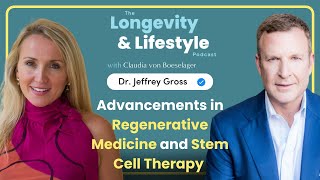
In this Longevity and Lifestyle Podcast episode, host Claudia von Boeselager interviews Dr. Jeffrey Gross, a neurosurgeon turned regenerative‑medicine pioneer and founder of ReCelebrate. Dr. Gross explains how patient demand led him to retrain in stem‑cell‑derived therapies, now comprising 75‑80% of his practice. He details the clinical protocol of intra‑osseous (subchondral) injections of stem‑cell‑derived exosomes into weight‑bearing joints—especially knees—highlighting MRI evidence of cartilage thickening and functional improvement. The conversation covers patient selection, contraindications (e.g., anticoagulation), same‑day procedure workflow with fluoroscopic guidance, and the minimal downtime compared with surgery. Dr. Gross describes why targeting the bone‑marrow stem‑cell niche is more effective than intra‑articular injections, and why he now uses perinatal‑derived exosomes rather than whole cells, noting advantages in storage, cost, and tissue penetration. He outlines emerging “designer” exosomes, mitochondrial transfer, and immune‑cell exosomes for future therapies. The interview expands to biohacking strategies—exercise, breathing, HRV wearables, supplements (NMN, berberine, omega‑3), sauna/cold exposure—and the role of AI in precision monitoring. Dr. Gross offers practical advice for patients skeptical of surgery, stresses the importance of multiple opinions, and shares his vision of regenerative medicine as a pathway to healthspan extension. Contact information for ReCelebrate (website, Instagram, LinkedIn, Facebook) and a final encouragement to breathe and move are provided.
Chapters
My guest today is Dr. Jeffrey Gross. Dr. Jeffrey is an accomplished medical professional graduating from UC Berkeley in biochemistry and molecular cell biology with a doctor of medicine from George Washington University. He specialized in neurological surgery, contributing to virology research. Since 2020, he has been acknowledged as a top doctor and received HealthTap's 2022 Top Doctor Award. He's the founder of ReCelebrate and emphasizes anti-aging regenerative medicine, prioritizing modern biochemical treatments over surgery. Dr. Gross is a leading figure in advancing neurological surgery and holistic healthcare practices. Welcome to the Longevity and Lifestyle Podcast, Dr. Gross. It's such a pleasure to have you on today.
Thank you, the pleasure is mine.
I'm so excited to dive into this topic. As you were— we were just mentioning before, we've had Dr. Harry Adelson on, who's also in the stem cell and I think it's just such an important topic for people to better understand the modalities and what's available. And I think where I'd love to start is to understand where did your passion for stem cells come from?
Thank you. So I was practicing, and still am to some degree, some traditional medicine. I'm a neurosurgeon by training. I have a spine fellowship. The vast majority of my practice is taking care of people with neck and back problems for decades now, applying traditional treatment modalities and options. And it was my patients who sort of keep pounding me with the idea of, you know, stem cells. What would happen is I would see many patients, give them advice, and walk them through the path of treatment from therapies to injections. And then when those things failed and they still had problems of significance, we would start to talk about the option of surgery unless there was something, of course, urgent that needed surgery, which isn't that common in the office setting. And in, in, in those patients, my menu didn't have anything else on it. It had therapy injections. And then if that didn't work, well, let's talk surgery. But so many patients were smart enough to say, yeah, I'm just not ready for surgery, even though I'm still hurting, even though the other treatments were inadequate. So they would say, how about lasers? How about, you know, this? How about that? How about stem cells? And you hear stem cells enough. And of course, I do have the undergraduate background in that. And a lot had happened in the 30-plus years since my undergraduate training. So I finally woke up and said, I'm going to go get retrained and add this tool to my toolbox. And it has blossomed more than I could have ever imagined now because I do probably 75%, 80% regenerative medicine and all its ramifications now. Without thinking I would. I got into it to add to my tools and really it's my main tool now. I'm proud to say I have a great new tool to help many patients avoid surgery. Not all patients. I mean, there still is a role for surgery, but surgery is probably overused in the community. So I'm happy to contribute to reducing its utility.
Yeah, no, thank you for sharing that. And so that's obviously an astounding number, right? 75 to 80% of your practice is now focused on this regenerative medicine piece. Why is that? What's happening? What are you seeing that has made it take over from all the different modalities and tools that you've had?
Well, a few things. First, efficacy. I'm quite surprised sometimes at the results that that we get. That's not a guarantee that everyone is cured by it, but I continue to be amazed on a daily basis. So I feel this renewed sense of sort of scientific pursuit and enjoyment in treating new things and different things that I compared to my prior practice. And it's much less invasive. The risks are minimal if any compared to surgery. And cost effectiveness is there, the cost of surgery, the downtime from surgery, the pain of surgery, all that, the missed work and what have you. I mean, a regenerative injection is minimal compared to that.
So maybe you can explain a few use cases for people listening who are kind of you know, they're like, I've heard of it, I don't really understand it. When is stem cells really beneficial? Like, have you seen amongst your patient body and maybe you can, you know, explain some before and after.
Sure.
Walk us through a few examples.
Sure. Thank you. I think I caught the low-hanging fruit or some of our best cases are weight-bearing joints like the knees. And the knees are common problems. And even though I didn't often treat knees. I would refer those to knee surgeons in my career. I treat them now. So we're looking for people who have what's called arthritis, vaguely. It's probably a poorly used term, but it generally means inflammation of the joint. And usually it's a painful inflammation. Sometimes more aptly called osteoarthritis. The other form of arthritis is a disease process called rheumatoid arthritis, but those patients can also benefit. And sometimes the doctor might call this bone-on-bone condition where the cartilage wears away. The fancy term is chondromalacia, wearing away of the cartilage layers, the squishy stuff in between all the bones and in our body. Well, when those wear down and cause pain, you know, the, an orthopedic doctor might offer you cortisone injections, physical therapy, and then eventually joint replacement surgery, which is a pretty big deal still. So we, we take patients like that, we do proper imaging, and that, that requires some, some precision MRI sequences and things. And we do some targeting based on what we see in the joint and near the joint. And we inject the regenerative biologics to the subchondral bone. And that means the bone just above and below the joint space, just adjacent to the cartilage. Because one of the best banks of our own stem cells are the cells in the growth plates in the bone marrow. So Even though those growth plates have closed, there's still a bank of stem cells there. And sometimes they just need a little kick in the pants. And that we hope help to reawaken those. And those are the cells that help produce the cartilage that makes the surface of the joint, what's called the articular surface. And, and because there aren't a lot of cells in the joint, in the cartilage itself, cartilage is sort of biological rubber. And for most of the research done in the last couple decades, stem cells or other biologics were injected into the joint space. And there are some good results, some not so good results. Recent publication from Emory University looked back at all the studies of joint injections. I think it was limited to the knee, and I have to go back. And found that it was not a better outcome than surgery. But I followed the protocol of a French orthopedic doctor named Philippe Hernigot, and I probably mispronounced his name. I'm sorry, Professor, but I— he has published now over a 15-year follow-up on injecting the subchondral bone of the joint compared to the in the joint. He had both groups in his study and he has found significant long-term benefit in the bone-injected group compared to the joint-injected group.
Oh, wow. Why do you think that is?
Yeah. So I follow that protocol. We inject the bone or we call that intraosseous injection. And we are seeing results with, within the earliest we have, I think, is a 9-month follow-up MRI. We don't always get MRIs after, but some people are super curious. So we do an MRI and we have seen enhancement of the cartilage layer by thickening the cartilage, return of some of the cartilage protein thickness, and with it, the moisture content that helps that cartilage be a cushion again. So, and with that, we've seen the clinical benefits. So we've been very happy. I think knees do the best because they have a lot of surface area. Sort of a lot of, you know, contact area.
Yeah.
Ball and socket joints tend to take a little longer. And I think non-weight-bearing joints like the shoulder takes even a little bit longer.
Why do you think there's such a significant difference with injecting into the bone? Do you think because it's really reactivating the own stem cell bank, you were saying, that's in the bone area?
I think that's the main reason. You're right. I think that, and I've said this before. I, I think it's cute. The party is in the bone. That's where the biology is. That's, that's where the activity is. That's where the cells are. There's, there are very few cells in the joint space, in the cartilage. The cartilage is sort of an appendage of the joint, if you will. And if you think about it, we have follicle cells in our scalp that make hair. The hair is not a cell, it's a protein extension of the cell. And the same happens with the cartilage. It is sort of this protein byproduct of the local cells that make those proteins. So we need to go to the source, the factory of those cells, those proteins rather. And that is the bone marrow and particularly the stem cells in that bone marrow, regular cells too, at end-stage or differentiated cells, but also the stem cells. Which have the most potential to reanimate. And that's really what we're tapping into.
That's really exciting. And would you say it's for patients of any age or are there any sort of knockout criteria after a certain point? It's not gonna have the same results. What are you seeing?
I'm seeing that we haven't restricted anyone by age. We tend to get the best results in people who are less inflamed. So we like to optimize patients first, meaning, you know, let's talk about your diet and your sleep and your breathing and your supplements and things around you, like what's your water source, what, you know, is there bad, bad things in your neighborhood, in your air? And, and, and if you have a disease of inflammation, like an autoimmune disease or something, we want to help address that first because If we're going to do one of these procedures, we, we want to stack the deck in your favor for success. So I think that the more inflamed and, and the inflammation of a joint causes the degeneration of the joints. So to reverse that, to go from degeneration to regeneration, we need to knock out as much inflammatory cell activity that we can. So we want to do that holistically and comprehensively. And therefore sometimes we have a fairly healthy octogenarian that can do well with the procedure. And I also have young people who might not behave in lifestyle choices very well and not do as well. So we— the only contraindications or reasons we wouldn't do the procedure was, you know, if you're on a blood thinner that you cannot come off of temporarily. Because it's a needle-based procedure, you know, we can't do that. That's really the main thing.
And in terms of, you said you do the MRI scan and then people just come into the clinic, there's the injection and then they're walking out of there the same day. Is there, what's the recovery periods?
Yeah. So when we do this type of work, because it's in the bone, you do feel it. So we do these actually at an injection facility. And there is sedation involved, not general anesthesia. And, you know, it takes me anywhere from, you know, 15 to 30 minutes to do, you know, a joint. I'm very precise. We use fluoroscopy, which is an X-ray guidance based on the MRI so I can target. I do a lot of work ahead of time measuring exactly how deep to go, where to go. Sometimes the MRI tells us exactly where the where the changes are. And we want people walking out. So we, you know, give them a Band-Aid and a hug and send them on their way. And we want them using those joints because the physical use of the joint stimulates sensory endings in the joint called mechanoreceptors. And it basically tells the local cellular activity Hey, this is an area where I need help. I need to withstand stress here. And those cell receptors come up and the activity and the protein production can focus in those areas. So we don't really have downtime. We don't want downtime after these. So that's wonderful right there.
Yeah, it's really wonderful because years ago I had keyhole surgery for meniscus. And I mean, I had one week I was told, you know, to have crutches, to not use it. And already, I mean, I was early 20s at the time, but I could see within one week the muscle degeneration that happens. It's so incredible how quickly that goes. And so if you can not have any downtime and just continue, you don't have that whole long recovery period as well. So it's really exciting. Can you talk about the type of stem cells? I know that people are always like, you know, is this from a baby? Where are getting them? Can you—
Yes. Well, you did a wonderful job about going over that in a recent podcast, and I don't want to completely reeducate your audience, but I've really moved beyond stem cells, and I'm using almost 100% now stem cell-derived exosomes or cell signaling nanoparticles.. And as you know, these are the small, and of course cells are already small, but these are even smaller nano, right? Cell-like particles that a stem cell derives. All cells make these extracellular vesicles for acute, we call them exosomes, E-X-O-S-O-M-E-S. And those exosomes are not cells, but they do have a little membrane like a cell. And in them they have instructions, communication from one cell to another to program into more of an anti-inflammatory mode, which is a healing, restorative, regenerative mode, as opposed to our typical defense pro-inflammatory mode, which degenerates us. Right. And causes disease and causes us to age. In fact, many believe, and I think I'm in that camp, that, that really this chronic inflammation is aging our cells and aging us. And, and to age slower, you need to slow or even reverse that inflammation. Yes. Right. So, so I'm using almost exclusively these stem cell-derived exosomes from perinatal source. I don't source biologics. We call these regenerative biologics. I don't source biologics from the same person because when I take my car to have the oil changed, I don't put the old oil back in. So I want the, the best, freshest, most youthful, most active material that has been unexposed to the pro-inflammatory stresses in our world.
Exactly. I'd love to— I heard recently about like a drinkable version of stem cells as well. Are you familiar with that?
Have you used that? I'm not, you know, stem cells struggle to pass through certain areas. So cells don't pass through our gastrointestinal tract well. They don't get through the skin well. They don't get— even if you have them intravenous, they do not even get into the nervous system well because they do— they're too large really to cross into the blood brain barrier. So stem cells, really, we look at these as a delivery vehicle for the most part. And although they were very exciting a few years ago, and still in some areas, it turns out that these exosomes are really doing most of the work. That's the medicine, if you will.
So that's why you mainly, you said, focus on the exosomes.
That's one of a list of reasons why I mainly focus on them. The others, if you allow, are, they are easier to handle in terms of the freezer. They only need to be kept at -30°C instead of -80°C for cells. They're less likely to break and what we call lyse or rupture, probably having to do with size and stability. They are more abundantly concentrated. I can get a more concentrated dose. And they travel further in the tissue if you want that dispersion, particularly IV, where stem cells, if you do IV, tend to get hung up in the heart and lungs to some degree. Great for the heart and lungs, but the rest of the body, you know, is still thirsty. And maybe the largest benefit, particularly these days, is they're about half the price of a dose of stem cells.
Which is pretty huge as well. Yeah. What do you find most exciting about regenerative medicine and what you see in the advancements? What's coming?
Great question. So I'm personally working on a few projects, but we, you know, are cautiously looking at sort of enhanced or designer exosomes. There are already some publications on, designer exosomes for production of collagen for cosmetic purposes. There are exosomes that can be, we'll call them, stuffed with mitochondria to deliver mitochondria in what's called mitochondrial transfer therapy to help, let's say, aging patients who are losing muscle mass. You know, and many diseases deal with poorly functioning or loss of volume of mitochondria. And then cells tend to move into senescent or zombie phase if you don't take care of them. Yeah. There are some immune cell exosomes that seem to have some benefits in early studies against hard-to-treat cancers. So we've got some really cool projects to hopefully patch some areas in medicine where we're not succeeding right now.
I think it's really fascinating what is possible, and I think we're at the cusp of, you know, I think with the advances of technology to support the research, it just expedites things tremendously, right? And I think, you know, people being brave and trying different things as well. But it really sounds phenomenal. What would you say for naysayers, people who are saying, well, my doctor said I have to have surgery. There's no other way. How should they help to have a better dialogue with their surgeon to explore looking at alternative modalities, for example, like stem cells?
Well, I want to answer this cautiously because I never want to talk anyone into anything. And the people that seek this type of treatment already have an idea of it or have heard of it or even just the buzzword stem cells, even though we're using mainly exosomes, they are stem cell-derived. But I would say this, and I would say this even before I went into regenerative medicine as an adjunct to my practice, is, you know, before having surgery, make sure you've looked at every option and have multiple opinions from doctors of diverse backgrounds and maybe diverse ages, because it occurred to me when I was deciding to make the flip to add this, you know, new area of medicine to my practice, that what I did as a spine surgeon and what most of the spine surgeons do has been done for 50, 60 years, hasn't changed drastically. You know, we have two main surgeries. We either open up the spine to make more room somehow, or We fuse the spine, which is somewhat, you know, significant. Yeah. Of course, sometimes we do some of both. Yeah. That's really what's done. There's, there's nothing new or different for many, many years. And I was trained by professors who were trained. I was trained 25, 30 years ago by professors that were trained 25 or 30 years earlier. So really what I'm doing now is no different than what happened 50 or 60 years ago. So that's why I think you should always see a young whippersnapper and then someone who's a sage old experienced doc and, and make sure that you have a list of all options.
So we are back now after a fire alarm interlude, but thankfully, Dr. Gross is safe. So just picking back up on our conversation. What I wanted to ask as well, obviously, people listening to Longevity and Lifestyle Podcast are very keen on optimizing their health now to live really well for a longer period of time. Do you foresee, or would you think, that stem cell therapy would be for every human body? Because the body ages, right, over time. At some point, do you see that it's a nice sort of top-up of rejuvenation that is applicable across the board?
I do. I think that, you know, there may be more specific uses, you know, as we learn more about the individual, you know, cell signaling and specific types of conjured exosomes by, by how we might manipulate stem cells to give us these signals, which we're not doing at this time except in the research setting. So I do, I think that for healthspan and healthy longevity, this would be a path towards extending our ability to fight off, stave off inflammation, and slow the aging process, which slows the disease formation process, because those are really the same, right? Inflammation, aging, and disease.
So you said a point to stave off inflammation. So I just want to Jump into that for a second. So stave off inflammation. Do you think that by having higher, or like having stem cell therapy, that that helps with reducing inflammation? Or because you mix it with the protocol of reducing inflammation from the lifestyle choices before having the stem cells? Or is there a proven way that having stem cell therapy actually reduces inflammation in the body as well, separate to the lifestyle interventions?
Yes. Separate from the lifestyle or what we call epigenetic strategies to reduce inflammation, biologics like stem cells or stem cell-derived exosomes and certain peptides are known and have been shown to reduce inflammatory cell markers through different types of tests. So through, through that proof, we have demonstrated that these types of treatments or augmentations are helpful to reduce inflammation. And then we all know what inflammation does to us. So, so by, by that extension, we can say that these treatments do help slow disease formation and slow the aging of the cells. And if you slow the aging of the cells, you slow the aging of you. So, Now, we don't yet have longitudinal studies going out decades for these things. We will at some point, but they will take a long time to do. But we do have them in animal models that have a shorter lifespan. So we can measure generations of them or longstanding. And the results are wonderful in different species.
So I'm just thinking, you know, for example, I have like a shoulder thing. I have a thing. So I'm like, you know, maybe one should consider sooner than later looking at stem cell therapy than waiting for the degeneration to be so acute, right? That it's then more difficult to recover. Is there any, is it ever too early to go down the stem cell?
So we do this and I'm accumulating a number of patients to look at this. It's usually people in their 30s who might have been an athlete or maybe a college athlete or, you know, something like that, or, or had an old knee injury and had like, like you did, maybe had an arthroscopy surgery. And they've got a little bit of aches and pains, maybe when the weather changes, a little something. And they know they've been told down the line they're going to have accelerated arthritis, and I say that word funny because it's so vague. It really, it's, it's, it's post-traumatic degenerative osteoarthritis causing chondromalacia. But most doctors, that's a mouthful, so they don't say it. But that would be the— you're right, that's the ideal. Your idea, it converges with what we, we believe is the ideal person to get to that joint earlier because it's easier to have a regenerative benefit before it's— the joint is completely worn out and remodeled and changed. Yeah, the less work the regenerative biologics have to do, the easier it is to do it. So what we have often is someone who comes in with a pretty bad joint for some reason, but they also have this old, old knee injury. It's giving a little bit of trouble, but they wouldn't have come to me otherwise. So what we normally do is, okay, let's take care of your joint, but while you're sedated, let's do the other one that's only mildly bothersome. Since you're already here, it's a little bit more just to do that. And we do get clinical benefits in those patients early, but they're so focused on their other joint that, you know, they're happy with both. So really, we need to look at those long-term and see how they degenerate. And I'd love if we have enough to do a controlled study, right? Where we have some patients who don't get the regenerative treatment and they just go down the path of time and cortisone shots and things like that. And then some that do and then match those up 20, 30 years later.
Yeah. Is anybody doing that research, the longitudinal ones as well? I mean, that's tricky, right? And funding and—
I don't think it's very expensive to do. It's more of a, just observation, which we would do of these patients anyway. But I'm not aware of anyone doing that yet. And it's very difficult because most studies require approval and funding, even a little funding. And, you know, at least here in the States, the governmental and politics and economics don't make it easy.
Yeah, there's definitely challenges in that as well.
Yeah.
Let's talk about enhancing things with biohacking. What type of biohacks do you love and do you recommend and what are the use cases?
Well, biohacking, you know, can be, you know, something very simple and minimal, like, like flossing extra all the way up through, you know, doing an exosome IV 4 times a year. So I've just really enjoyed learning about all these things. It can be, you know, when people come in and we do a little bit of a you know, slow your aging makeover, we biohack their exercise. You know, someone might come in and say, oh, I run, you know, 3 miles every other day or something. We might put them into a high-intensity burst type workout to get more out of the muscles. We want people using the larger body muscles to release the myokines, which stimulate, you know, cognitive enhancement and slow the development of cognitive disorders and other problems. We, we work with supplements, very basic supplements we recommend. I don't actually have my own brand or anything, but, you know, we start out with some anti-inflammatory supplements, just some basics, and we build on those and we can, you know, add the, you know, dihydroberberine and the, and, you know, all the different things that help our cells and help our mitochondria like NMN. So although, you know, altogether, you know, these aren't exciting biohacking, they really can help reduce inflammation towards that healthspan goal. But in terms of, you know, tech as applied to biohacking outside of regenerative biologics, I'm very big on the sleep apps. Some kind of tech, wearable tech, tracking your HRV, because the more measurements we have, the more we can tweak. And it's— we might find something very odd and interesting on a subtle measurement. For example, I have patients and we've done some blood tests, and I have them on a good amount of omega-3 and fish oils daily. They still had low fish oil numbers, and we had to even go up from there. Or fish oil numbers, but EHA and the other omega-3s. Yeah. Or we had someone, a very young, healthy, athletic guy who did the IV exosomes. He didn't really have that typical energy burst and cognitive burst that people get, but his HRV, if your audience knows what that is, it's heart rate variability. Very subtle measure of sort of your nervous system balance and your health went from the '60s on average, which is fantastic already, up into the '90s. So we see some very cool biohacking results. But everyone— the key here is everyone's different. So we really have to practice what's called precision medicine and treat that individual, not just give, okay, here's the recipe that everyone takes. It could be it's got to be customized.
Which I think is so exciting. And that's the beauty of wearables. I actually have a separate AI company that we're building, Athena Healthspan, that will incorporate all of this. And we, we are an AI SaaS solution for clinics. So they're also excited. They're like, how do we get this? Because we want to help our patients understand what's happening before and after. And just seeing, you know, your sleep score is improving, your HRV is improving, your resting heart rate is going down, your metabolic score is improving, it's just, it's so rewarding. And, you know, we humans, we forget, you know, as you said, one comes in, they're like, oh, my shoulder's really sore. It's like, yeah, I have this knee injury for like 20 years, but my shoulder's the one that's the issue. It's like, well, let's treat both, right? And then they can see the difference, notice the difference too.
Yeah. Well, that's fantastic. You know, AI has helped us so much look at what is driving the outcome, right? So what, what the, helps us add weight to, hey, it was, it was the sleep that was causing most of your issue. You know, it was, it wasn't this lack of exercise or something like that. So it, what we learned from that is really helpful.
Yeah. Cause it's just so, so much data, right. To process, to understand. And so that's what AI does beautifully and to help as a tool, right. A further tool in the practice to see what's going on. Have you looked also into like red light therapy, sauna, cold exposure, and, uh, do you think of those?
Big fan of hot sauna and/or cold plunges and/or contrast therapy. Um, uh, I, uh, red light therapy, uh, you know, I, I've learned some of that. I haven't done a deep dive on it. We don't, I don't offer those technologies at my office or anything like that. I'm, I'm more on the little bit old school, you know, interventional medicine side of things where we want to, you know, be able to do procedures for people. Yeah.
Yeah. Exactly. Maybe one day you'll see. Yes. What excites you most about the future of health and longevity in the years to come?
Well, I, we talked a little bit earlier today on, you know, what's coming in regenerative medicine. And I'm, really enjoying being sort of on that cusp and pushing the envelope on that. It's almost tapping back into our own natural body's ability to fight off disease and heal that we've had all along. This isn't, you know, we— this is this new great technology in one way, and in other ways, it's tapping back into our own youthful healing potential. When you think about it, when we talked about joints, those bone marrow stem cells created that joint in the first place. So we're tapping back into the factory specs and just turning that factory back on for a bit to get some better healing. If you think about it, Claudia, you know, when we were very young, you know, you were a 3-year-old, you scrape your knee on the ground and you have a scab. And after your mother Cleans it up, kisses it, and sends you on your way. You know, that scab is like healed in 3 days. You know, it's gone. But if you're, if you're my age, you know, and you bruise your arm and it's there for 2 weeks, you know, and, and it's the same body, it's the same genes, but something is not the same over time. And that's the beauty of tapping back into our own regenerative capabilities, our healing capabilities. And That is the most exciting thing because it helps us reduce the need for pharmaceuticals and helps us slow disease and the pain burden, the cost burden that goes with managing those diseases. Of course, to the detriment of big pharma, which is probably pushing to slow these things. But I think I see them dipping their toe in the regenerative waters, and as soon as they can monetize it, then you know, they'll be, they'll be right back in supporting it.
They'll be in full force. I mean, same with the peptide scenario, right?
And the— Exactly like the peptides, which, which are one of the very cool biohacking elements that I failed to list earlier.
Yeah, that's wonderful. For my listeners interested in understanding stem cells more, what online resource or books would you recommend they could start with?
Well, there's a lot out there and you need to be a good consumer and good shopper. And the reason for this is, at least in the States, we really can't advertise. We can't advertise stem cells. We can't advertise any claims. We can't make any claims because we don't want to be non-compliant with governmental agencies. Who determine what we can say and not say. I'll leave my editorial comment out for that. But there are certain clinics outside the country that advertise in a blanket way, you know, they can cure or treat things. So you have to be a little bit cautious because we don't make those claims. But you know, I would, I would search the internet. It's still a great tool. I would look for all the options for a particular problem that you seek to deal with. And then I would look for, you know, testimonials or case studies with results. Now, of course, one person's result doesn't guarantee someone else's, like in anything in life.
100%.
Yeah. Why we have to restate that. I don't know, but it's true. And there are, you know, seek, seek the most educational thing without the sales piece on the internet. There are some wonderful YouTube videos on, you know, the biology of stem cells and the types of issues. Don't be afraid to read a medical article and at least skim the abstract and see what the conclusions are. To gain an understanding and then meet with someone or more than one someone and ask the questions. Okay, what does this really mean? What are your personal results, doc? What do you get? There are many regenerative medicine doctors in the States and well beyond. Europe and Asia is way ahead of the States. Most of the good research comes out of Europe and Asia because it hasn't been suppressed there like it is in the States. The States are now pushing so much and catching up. So hopefully we'll get there as well. And then, you know, I think, I think there are great YouTube videos and some of them are pro-regenerative and some of them are, hey, it didn't really do much for me. But you should know the spectrum because this is not necessarily a cure-all or panacea, even though we touted all the good things it can do. You know, it may not be right for everybody.
Yeah, exactly. I think everyone just needs to make their own judgment, right? And have those conversations. So I think that's great advice. Where can people learn more about what you're up to in your clinic? And we can link everything in the show notes, website or social media. Where would you like people to find you?
Thank you very much. We're at re-celebrate.com. And on Instagram, we're @reCelebrate and LinkedIn and Facebook, reCelebrate. Everything's reCelebrate. So you should be easy to find. And, and I love to meet new people and, and get to know them a little bit. And sometimes it takes more than one meeting. We do a lot of Zoom or remote consultations before anyone even thinks about coming here. I want them ready to go. And we try to make it very easy for you. And luckily, most people don't mind coming to Vegas for a few days. And if we need to help them and they can enjoy a dinner and the show and have their knee spruced up while they're at it.
Amazing. What a nice combination, right? I think that's a travel.
Wonderful.
Do you have any final ask or recommendation or any parting thoughts or message for my audience today?
Today? Just breathe and keep moving. If you could do, you know, the most simplest things to biohack and to promote your stem cell activity, to prevent cognitive decline, it's exercise and breathing. And of course, when you exercise, you have to breathe, so it forces you to breathe. But if you can't exercise someday, just make sure to breathe. Use the full aspect of your lungs does stimulate immune cells in the lining of the lung, and it does stimulate your brainstem and brain in ways that we haven't fully measured yet. But we know and we see on, you know, functional MRIs and things like that. So those are very simple daily things you can do without much effort.
Excellent. Thank you so much for coming on today and sharing your wisdom, and congratulations on the work that you're doing. Saving joints and other issues people are having.
Thank you so much. No joint left behind. Thank you so much, Claudia. I appreciate it.
Wonderful. Thank you.
More from Claudia









Can Psilocybin Slow Aging? The Study on Telomeres, Inflammation & Survival with Dr. Louise Hecker

