Dr. John Gray: “THIS Is What Causes Low Testosterone Levels In Men!”
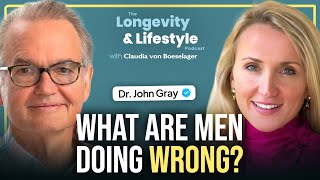
Dr. John Gray explains how stress raises men's cortisol and lowers testosterone, while financial pressure and modern relationships compound the problem. He recommends water fasting, intermittent fasting, strength training, and daily yoga to boost testosterone naturally, and shares a couples exercise where partners exchange reassurance statements to trigger hormonal balance.
Chapters
Longevity for men is all about healthy testosterone levels, and it's not about taking testosterone. It's taking action that gives you a feeling of, I'm making a positive difference, will increase testosterone.
Today's returning guest is none other than Dr. John Gray, one of the most popular podcast episodes that we have had. And as many of you will probably know, John is the author of the most well-known book and trusted relationship book of all time, Men Are from Mars, Women Are from Venus, listed by the USA Today as one of the most top 10 most influential books of the last quarter century. Dr. Gray has written over 20 books at this stage, many New York Times bestselling authors, and is a world-renowned speaker and expert on relationships and helping men and women better understand themselves and in their relationships as well. John, such a pleasure to have you back on the Longevity and Lifestyle Podcast. Welcome back.
Well, I'm really happy to be with you. And maybe today we can also go into the genetics of longevity and how that relates to our relationships. You know, my whole focus is finding different ways that are relevant to our lives to help people reinvent the importance of relationship, the importance of family, the importance of making love, the importance of creating commitment and monogamy and how powerful that can be. People don't realize how powerful that can be, particularly for longevity. As well for our civilization that we still make babies and we have marriage, but also longevity. We want to live a long, healthy life, but most importantly, healthy. And if we have a good life, why not long? And here I am at 72 years old, married and very, very happy and very, very healthy. And I know how I did it. And I love to share those ideas with people.
I would love to hear more about that on such an interesting topic. I think the longest-running study out of Harvard showed the importance of successful relationships yet to live longer into life, right? So the study that founded in 1938 and is still ongoing, there's still a few participants in their 90s left. But I'd love to see and understand your research that you've been doing around genetics, longevity, and love and relationships, John. So could you share that with us?
Well, yes, but first, let me address that study at Harvard, which is 38 years ago. I don't know much about it. But I do know that 38 years ago, those people would have had a relationship based upon more traditional values.
I would just interrupt you, John. It was started in 1938, so 85 years ago.
85 years ago. So there people had an understanding, a positive understanding of how men and women were different. Now they're going to last a long time. This is true. However, today it's literally impossible to have a relationship based upon those values because our values as a society have changed and that it's not enough for women to feel, I want to spend my whole life raising my children. She wants to do more than that, and that's fine. There's a time where you focus on raising your children. There's a time before that where you be educated and feel more independent raising children. You can devote your much of your time to that, to creating a beautiful family. And then as they grow up, now you have more independence to be more financially secure, etc. All of this financial security for women dramatically affects how they relate to a man, to a husband, to a partner. So let me just give you a little example for one of my counseling clients. Okay? She has $10 million, dot-com investor, and her husband, they're both Harvard graduates, and her husband makes $700,000 a year. And in her experience, it's never enough. He should be making more. That's her number one complaint. He's not using his full potential. He's not making more. And two, his other complaint is he works too much. You can just immediately see a disaster there. So the dynamic is if she— and I point out to her, and it's helpful, but there's not just knowing. You have to experience shifts and changes to fall in love again. And I teach them how to do that. I said, theoretically, If you weren't a Harvard grad or you are a Harvard grad, but you didn't make $10 million and your husband was making $700,000, you'd be pretty happy with your husband. And so happy that you would say, honey, you don't need to work so hard. We can spend more time together. It's a simple concept is that when women are financially independent, one of the major reasons they fall in love with men is gone. Women's primary, generally speaking, a woman's primary need in a relationship is the need for security. We all know that, you know, women want to feel secure. Now, there's a small subset of women who say, oh, I don't care if a man makes any money or whatever. Well, I'd say she's pretty naive because biologically, we'll get into the biology. We'll also talk about genetics, too. One of the major biological differences between a man and a woman is a woman can have well-being whether she's working at a job making money or not, if she has money. Okay, you need money to survive. A man primarily, if he's not working and making money in our culture, he will be depressed. Now, why do I say that? Or he will be unhappy. He will be needy. He will be demanding. He will lose interest in his partner. He's not capable of having a successful relationship because he doesn't have a job that makes money. Because for men, that's very important. Now, there's always exceptions, but when a man works hard to make money, that will make him happy if he's getting paid enough to satisfy his need. Okay, so men should never look to women to make them happy. Men should look to women to make him happier. If he can't be happy with his own life, he's not a good prospect for a woman. And I'm saying this biologically because the number one hormone producer, male hormone producer. We could think about Mars hormones and Venus hormones. Men are from Mars, women are from Venus. It's just a metaphor. But it's like we live in different worlds. And what's interesting is under stress, the division, the differences show up even more. That's why some people go, well, you know, I can relate to this. I relate to that because you're not under big stress. But when you're under big stress, that's where the differences show up the most. And now I'm going to explain that hormonally. Because it is biological stress. We say stress. We're not just talking about what's going on in your life. We're talking about how you're reacting to what's going on in your life. And today, when women are in the workforce, now, these are averages. These are studies of hundreds of millions of women. Okay. When they're in the average woman in the workplace, which means she's working for money primarily. Okay. What's happening there is her stress level, as measured by cortisol, is twice as high as men's.
Wow. Twice as high.
Twice as high. That's the average. Now, there's some women who say, I love my job, I feel supported. Then you're not so stressed. But we're looking at the average woman. And so the feminists came up with this big study because they want to say we need to change the workplace to be more supportive of women. Absolutely. I have no question, no doubt about that. That's great. But we should— to change the workplace to be more friendly towards women, we have to first recognize the workplace was designed by men for men. And these men knew nothing about women. And biologically, they're not women. So they have different motivators inside. So it's not about against women. It's, it's just for men. And now as women go into that place to get ahead, they often feel I have to become like a man. That's a problem. Okay. The problem there is when you're doing male traditional male jobs, you're going to make male hormones. We'll call those Mars hormones. And the major one is testosterone. So when a man is stressed, he's producing cortisol. Oh, what's the other side of that example I gave women? They're twice as high cortisol as men in the workplace. And when women come home, their stress levels double from the workplace and men go down. So we can say from this perspective, women are way more stressed than men. Hormonally, we can measure it. So this is not so good. Yes, we can focus on gradually over time creating a more friendly workplace for women. But we won't be able to do that until we really have an understanding, biological understanding of how to bring out the best in women. So that's what I'm focusing on, how to bring out the best in women, how women can bring out the best in men. So this is— I'm not teaching women how to make men happy. I'm teaching women how to bring out the best in men. We've all heard that old phrase, you know, women turn men on. I'm reminded of, you know, my background. I studied Chinese history and religions. I studied Qigong 10 years in China, going back and forth. India, 23 trips to India, studying the Vedic tradition, Hinduism, Buddhism, and all those things. I personally was a monk for 9 years. So I have all these eclectic ideas that kind of go together. And one of them is, if you will go to the, I'm remembering some temples in India where white men can't go. I had connections. I fly in a helicopter. I would explore these things. And I'm sitting in a temple and there's these, we might call them pornographic pictures. These are naked women and statues all around you and all these pictures of men in deep meditation. Okay, so men are just sitting in meditation and you get these statuettes of women whose breasts are out and they have little bells around their waist to say, look at me, and they're dancing. So what's the concept of that? Well, there's this tradition there. The male energy is called Shiva. The female energy is his wife, Prakriti. And she has to dance and be alluring sexually to pull her husband out of meditation. Otherwise, he'll stay in meditation forever. So literally, women turn men on. We have to realize this is the oldest story in the book. And what turns men on is a naked woman turns on a man. Every woman knows in the beginning of a relationship, as you started getting more naked, he was more turned on to you. The problem is that doesn't last. Okay. When people did not have higher consciousness, more superficial consciousness, just physical attractiveness could sustain his attraction for her. Okay. That was because what is becoming undressed? But becoming undressed is revealing to him what she doesn't reveal to anybody else. That's called intimacy. That's called vulnerability. We put on clothes so people won't judge us, but we feel safe with someone who loves us. Then we can reveal more of who we are. Okay, now that turns a man on. Well, what we have to realize today is that what turns men on to make them attractive to women, to make men motivated to please her, to bring a man out of himself into selflessness for her— that's his journey in life. Is she has to now learn how to become emotionally vulnerable. So you take off the clothes around your heart and reveal what's inside. And I'm going to start out, even though I don't have a lot of basis for this, but some of the people listening have heard my other talks. But the bottom line of what reveals when you're a therapist and you help people go deeper into themselves, this is self-awareness. This is what used to be called enlightenment. Which is self-awareness. Well, everybody's got self-awareness today. Historically, they didn't have it. But now you can ask somebody, what are you feeling? What are you thinking? What's going on inside? Instead of just believing what's in books, you would actually look inside of your inner feelings, your inner thoughts, your deeper wishes and wants. Traditionally, you're not supposed to look at what you want. You're supposed to think about the community, what they want. Traditionally, you're not supposed to look at what your feelings are. Matter of fact, if you go back beyond 200 years, there's never any record of using the phrase, I feel, in literature. Doesn't exist. There was a professor who studies literature pointing this out. A great book called The Breakdown of the Bicarmal Brain. Because see, we have this left and right hemispheres. As we've evolved as human beings, we have more connective tissue. In the past, if you had strong emotions, it was like somebody talking to you. You couldn't own that as your own emotions inside. And so what you'll see is gods would talk to people all the time, tell them what to do. It was like a voice coming out of the sky. This is the premise of this amazing book. But if you want to take away the practicality of it, it's just this is a new thing to be on both sides of the brain at the same time, which means to embrace your feelings. It's not some external force, but this is what I'm feeling inside. And just because you're feeling it doesn't mean it's fact. See, I can't dispute that you feel something. Therefore, it's fact that you feel that. But what you feel may be a complete lie. So this is another step of what we might call emotional intelligence, is realizing just because you feel unloved, it doesn't mean you're unloved. Just because you feel your partner's lost interest in you doesn't mean they've lost interest in you.
You make it mean about you, right? It's your perception of it.
That's right. You just have your perception. And feelings are very strong. If you say, I think you don't love me, now you're in an analytical part of the brain which says, well, maybe you do, maybe you don't. Let's discuss it and understand it. But when you say, I feel you don't love me, well, no one can dispute that because you do feel it. And I can't tell you you can't feel it. And of course, it's one of my practical techniques is men, when women are ever talking about feelings, don't dispute anything, but instead simply say, help me understand that better and tell me more and why you feel that way and what do you think? You see, you take her from the feeling world, one side of the brain, over to the thinking world. It takes a while. And why is that? Because genetically, female hormones lower stress for women. Male hormones, Mars hormones, lower stress for men. So whenever you're analyzing something, you're producing Mars hormones, you're producing testosterone, you're detaching, you're stepping out of the picture, you have no feelings at all. You're analyzing. And a lot of forms of therapy, which are very effective, just are about analyzing. Other forms of therapy are about talking about your feelings. And I think either one is incomplete if you don't do both. It's very important. That's what we're needing today is wholeness because women being more independent, whenever you're more independent, that produces Mars hormones, primarily testosterone. Now there's nothing wrong with that except that Mars hormones, generally speaking, do not lower a woman's stress level. Matter of fact, whenever a woman is producing cortisol, she's making more Mars hormones than normally she would. So testosterone is going up. Now think about that. What is testosterone? Is you have to protect yourself. It's up to me. I have to do it all myself. So if you're feeling threatened, then if you don't have help, then you're going to go over to Mars hormones. When you have help, you say, hey, honey, help me, protect me, take care of me, make some money for me, help me make dinner tonight, do whatever. Whenever you're asking for help, you're depending on someone and you're trusting that they're going to be there for you. That's huge female hormones. That's estrogen. And so when we get into genetics, what we see is the genome, which is unique for every person. But men have this Y chromosome that it's only like 23 different chromosomes. They're called sex differentiation chromosomes. For example, this is not totally science. We know that we have these different chromosomes, but here's what I've observed in terms of what's really different between men and women. One of them, I playfully say, is a gene, which is the efficiency gene. Now, not that a woman can't be efficient, but it's not their go-to. So you can learn everything, but their go-to is to overgive, right? Any woman who comes to me for counseling, if she's stressed, at some point I'll discover and she'll share, there's just too much to do. There's no time for me. I do this and I have to do this and I have to do this and there's nothing I can do about it. I say, well, I think you have a problem with efficiency. You take on too much to do. So the idea of efficiency is never do anything you don't have to do.
The deflect. No, not my job.
Delegate, delegate, delegate. This is the ultimate of men are always thinking, not thinking, their biology is such. Do I really have to do that? If I don't have to do it, why do it?. And there's a lot of psychology that goes along with that too, which is if, if particularly if I do something that nobody else can do, I'll always get paid more. So men like to specialize. So I only do this. And whereas women, they tend to take the whole picture in. And why do they do that? Well, they're designed to make babies biologically. They are the baby maker and the caretaker for these little babies, feeding them, protecting them, taking care of them. Teaching them, educating them, all these things. So they have 8 times more connective tissue, it's called white matter, connective tissue in the brain. So they're thinking about this and thinking about this and not only thinking about this and this and this and this, they're thinking about consequences. What if this happened? What if this happened? What if this happened? So insecurity is a big issue for women. Okay, they're always worried about what's gonna go wrong, what's gonna go wrong. Now some women will say, that's not me. 1 hour in therapy with me, you'll find is the basis of everything, which is a feeling that, you know, it's like go into— you can feel it right now, which is think about asking your partner to do something for you that they've never done for you. And what's your resistance to it? They're going to— they're going to say no. They're going to say, why do you need that? Okay. And why do you have a resistance to asking? Is because a part of you feels, I don't deserve to ask for more. You see how that is? It's real clear if you're working in an office and you want to make more, you want to get paid. Everybody goes, what do I deserve? You know, if I want to get paid as a counselor, what do I deserve? It's always an issue of, of course I should get this, as opposed to, are they going to accept me and so forth. So this worthiness thing, I remember it was coming out with all these commercials back in the '90s where they're selling things to women and they were saying, and you deserve I totally picked up on it as well. As a man, I thought, what a silly thing to say. If you say that to a man, it's like, of course I deserve it. Why? Exactly.
It doesn't even resonate at all. And so what do you advise women in that regard as well? Like to step up a bit better. And also I'm curious, John, I'd love if you talk a bit more about those stress levels because as we know, stress is one of the leading causes of disease and health issues as well.
So totally impacting longevity. Chronic stress is going to inhibit your longevity and create all kinds of problems. So when a man is stressed and we know that impairs his health, his testosterone levels are going down, down, down. I mean, like, just like that. Okay. If I suddenly— if something stresses me out, my testosterone is going to shoot down and my estrogen shooting up. That's what happens for men. Let's just look at that one basic thing. Men's testosterone goes down, estrogen goes up whenever they're in fight or flight. When a man's estrogen goes up, estrogen is the emotional part of us. You can't have emotions without a surge of estrogen, whether it be a positive emotion or a negative emotion. And when men's testosterone is low, then when their estrogen goes up, all of their emotions will be negative. It's fight or flight, it's anger, it's sadness, it's despair, it's hate. All negativity in men is their estrogen levels are going up, but their testosterone is going down. If his testosterone is high, and that means I feel confident, I feel capable, I can solve this problem, I'm a can-do guy, I'm cool, calm, and collected, nothing's bothering me. You see, then when my emotions come up, they're all positive. So this is opposite of everybody knows about men and relationships and so forth. They think testosterone is causing them to be angry. No, it's fight or flight that causes anger in men and fear in men and also other emotions of despair and also shame and guilt. And all these things hold us back. That only occurs in men when their estrogen is too high and their testosterone is going down. So it behooves women to understand what they can do to raise his testosterone and what he has to do to raise his testosterone, not dependent on her. Same thing I say for women. Now, when women are experiencing fight or flight, which is their reactions are going to be lowering of estrogen and raising of testosterone. As when you're in fight or flight as a woman, you're feeling like, my, I don't have enough time, I don't have enough love, I don't have enough support, I can't depend on anybody. It's a place of mistrust. It's a place of rejection. It's a place of lack of appreciation of others. Any time you're in that place, you're in a stressed state and you're also in a state of low estrogen and high testosterone. Now, women are a little more complicated because I just— what I just applied is what's going on in a woman's biology. From the day one of her period to ovulation. Now, after ovulation, if she's stressed, what's happening there is— could be a variety of things, but the major reason women will experience cortisol hormonally is something called estrogen dominance. Okay, so we're just talking about how important it is for estrogen for women. For example, from the period to ovulation, estrogen levels are rising and rising and rising. And about 5 days before ovulation, they need to start doubling. And if they don't double, then she's going to be very, very stressed. Okay, that's very, very important. The universe designed women so that you're going to go out and find a man because being dependent on a man, looking to a man for something, will produce higher estrogen. So it says, you know, if you're going to make babies, we need to make men really attractive to you so that you'll go after or be receptive to a man pursuing you. That's more accurate. All right. So once ovulation hits and estrogen hits a peak, now estrogen will come down, gradually comes down, but stays at a moderate level. And her progesterone levels have to rise higher than estrogen. So a source of major stress for women is something called estrogen dominance, which only occurs after ovulation, because if she has estrogen dominance, before ovulation, she's feeling great. But after ovulation, she still needs estrogen, which means I'm not all by myself. I have support in my life. Okay. The estrogen goes up when you're not feeling independent, but you're feeling dependent. And not for everything. I mean, you don't depend on someone for everything, but a lot of your well-being comes from having like a doctor, a coach, a husband, of friends, of family, of culture, of politics. All these different things are different forms of support. And if a woman doesn't feel that she has that support, she's in fight or flight. After ovulation, she'll go into fight or flight if her progesterone levels go low. Now, progesterone is a hormone, a little different from estrogen. Estrogen is going to be more like I'm depending on others through relationship with others. Progesterone is more an idea of doing what I like to do, doing what I enjoy doing. Now, if she tends to have what's called an extrovert personality, to various degrees, introvert or extrovert, if she's more extroverted, it's social bonding. It's literally making dinner with a bunch of women, having a dinner party, is going dancing with friends. It's all this social activity. Becomes very, very important after ovulation. Romantic activity, one-on-one, is more important typically for before ovulation. Now, after ovulation, when you can't make a baby, see, since it's all this biology. And so when it comes to our genes, to stimulate the right genes of feeling love and positivity and so forth, they have to be triggered from the environment. That's the whole thing we learned about genomics, is that you have these genes, but they get turned on and off. Based upon the stimulation we get. So the stimulation a woman gets for the first part of her period is going to turn on genes that say, I want to have a relationship with a man, I want to depend on someone, I don't want to have to do it all myself, and I care about relationships a lot. After ovulation, now that's still there, but it's not as strong. But what's stronger is I want to do what I like to do, and I like to interact with people. That would be the more extrovert. Or I like to take care of myself. So this is, you know, women would talk about, I like to go for walks in nature. I like my gardening. My wife really loves the gardening. And some women like to pamper themselves and go shopping and do things they like to do and make themselves look more beautiful. It can also be taking a hot bath. It could also be eating a good diet, if you're focused on loving yourself. See, a lot of you don't understand what loving yourself is. Loving yourself is doing things that make you feel good, that are healthy for you. It's not doing things that make you feel good that aren't healthy for you. Although it feels like I'm going to love myself more, but it really isn't love. It's a love which is doing something good for yourself. Like when I wake up in the morning, I do my stretch exercises and I do my muscle exercises. That's part of my self-love. I know that I wouldn't be so healthy and vibrant if I didn't do that. So I feel like a child. I'm going to take care of that child. This body's like a child. I'm going to take care of this. So that's what self-love is, is doing things that support the expression of positive traits inside of you, make you feel healthy, balance your blood sugar, support your different glands in your body. You know, these are all important things, but the most important And again, it's a bias when I say this, because I can say, but it's making love. There's nothing more powerful that puts you in line with the force of evolution, which is guided by God, if you believe in God. And by the way, having a spiritual belief is one of the most powerful hormone stimulators that exists. It's been throughout all history. And we've just taken it away for so many people. When a woman feels there's a, if she's good, good things will happen for her. That's like a universal spiritual belief, then she just has to do good things and she'll feel, okay, the universe will support me. God will support me. She prays to God. God blesses her. You know, this is that the feeling you're not alone will always produce estrogen. You're not alone, but you're in a supportive world. You know, some favorite quotes I have is to realize that everything that happened to you is grace. It's the universe or God rewarding you or giving you suffering so that you'll change your direction. All pain and suffering is, well, pain, we feel pain when we're not aligned with our soul. Okay, so it's the way our soul talks to us. It's one way you can look at how your soul talks to you. When you're in the right direction, it makes you feel good. And when you're in the wrong direction, when you're thinking the wrong things or feeling the wrong things, you'll feel pain. And so anytime we feel pain, we want to self-correct. So you adjust, you adjust. So that's very, very important. So sometimes if we're going in the wrong direction, things just keep knocking us down, knocking us down until we wake up. I mean, in my own journey, I was a computer programmer after being a monk, but I had to earn a living. So I became a programmer at Stanford and Stanford Research Institute. And it was high paying. I was very good at it, but it caused massive neck pain. I mean, just the worst neck pain. I said, okay, I saved up my money. I've got to do something other than this that I'm good at. And of course, I've always been good at teaching. So I could shift gears. As soon as I shifted gears, the physical pain went away. So again, we have to align ourselves doing what we love to do, which feels right for us. And that's a life, you know, that's our journey in life is figuring out what we're here to do and then to do it. And then do it. There's always going to be obstacles and we have to overcome those obstacles. But along the way, to bring us back to Mars hormones and Venus hormones and love and relationships, we need to have a mirror besides our own biology that tells us pain. We need to be able to see ourselves. And so before this talk, I had to brush my hair. You know, I have to look in a mirror to see myself. And that's what relationships are. Relationships help us to see ourselves. When our partners are loving us, we're able to see ourselves as loving. And when our partners are not loving us, then we can recognize at those moments that am I depending on them to know who I am, or can I depend on myself to know who I am? So this is so easy when somebody says nice things about you, just go, you're the source of my self-awareness. That's too far. When you go too far into depending on another for your well-being, then there'll be suffering and pain. You have to come back to what do I have to do to see myself again, to feel good? And when I talk about men, is your work is very important because it's work that produces biggest testosterone producer. Now, since we're talking also about longevity, let's just look at the number one cause of heart attack for men, not cholesterol. Half the people who get heart attacks have high cholesterol and half have low cholesterol. Half have plaque in their veins and half don't. Okay, so it's a different idea here. Certainly these things can play in, but the major thing is your stress levels. Oxidized cholesterol, it does contribute to heart disease to some extent. But you'd only have oxidized cholesterol because you're in stress. And you're only in stress if you're a man, if your testosterone levels are low. And there's no man that has a heart attack that has healthy testosterone levels. They're all, they're all too low. And we don't even know what low is anymore because you look at 50 years ago or maybe a little bit longer where they learned how to start testing hormones. The average male at every age had twice as much testosterone as men today. Twice as much, 100% more. I mean, double.
And decreasing, right? So I think from the age of 30, it decreases approximately 1% each year. But as you're saying, the overall research is showing that it— yeah, twice as much. I didn't even realize the number was that big.
Yeah. But if you want to go back to when we started testing, and before that, we don't even know what men were like. We know—
4 times as much.
Yeah. Who knows? What we know is that, see, there's kind of an evolution of males that maybe they don't need that much testosterone because they have more estrogen. Estrogen regulates testosterone, okay? So when estrogen goes really high, uh, unless you're making love, your testosterone will tend to go down. I'll give you an example of that. The men with the most testosterone for every age group— and why testosterone is important, by the way, is low testosterone is always associated with stress. It could be stress which is anger, it could be stress which is, which is passiveness, It could be lack of motivation, lack energy, lack of erections. All those things can be low testosterone linked. When it becomes very emotional, either anger or defensiveness, see defensiveness is really fear, anger and defensiveness, depression or lack of motivation, that's usually shame, is what's going on in his biology. His estrogen levels are high. It pushes down his testosterone. He's too dependent on others. Now, why men become too dependent on others, how it shows up, he either complains to his wife all the time. That's a man who's too dependent. It's a man who has to talk about his feelings all the time. He's way on his estrogen side. It's the biggest turnoff to women. The destroyer of marriage is men talking about their feelings. And all psychology is telling women ask him about his feelings, ask him about his feelings. And that should be talking about their feelings. If he's feeling good, talk about your feelings. If you feel negative, don't talk about your feelings. Because when you talk about your feelings, estrogen levels goes higher and higher and higher. It's just a major estrogen stimulator. Therapists mainly get you talking about your feelings. So naturally, 90% of the people who go to therapists are women because they get a lot of value out of it. Then there's 10% of the men who go to counseling, and usually they're looking for strategies. Because some counselors do give strategies more like a coach. More, more you'll get both men and women going to coaches because they don't focus so much on your feelings, but accountability and how can you achieve your goals and what's getting in the way of it and how you're getting in the way of it. That's very strategic, which I'm really in favor of that. But at the same time, I'm very much in favor of— it's very important for people to explore their feelings as well, but never to explore feelings and express feelings. And it's an important point. Don't express negative feelings with the intent to change someone. That's called complaining. As I said, it's using negativity, amping up your emotions to justify making a demand in your relationship. You know, it's like you forgot to turn off the lights. Okay, that's one level of emotion. Then it's 5 years later. You do it over and over and over. You never turn off the light. I have to follow you around. Ah, okay, that's a lot of emotion. All it did is just demotivate that man, just knocked his testosterone down. And it rewires your brain to be more and more upset about nothing. In a compassionate way, in a gentle way, I'll say that 90% of anything people talk to me about, a therapist is making a big deal out of nothing. And then it becomes a big deal. You see, if you're constantly using emotions to justify your pain, your suffering, your struggle to justify wanting more, then your brain is always looking for reasons to be unhappy, to justify wanting more. When in a healthy dynamic, you can ask for more without having any negativity at all. It's called learning how to ask for help. Ask for help. And guess what the biggest estrogen stimulator is for women? Asking for help. Learning how to ask for help. And women have such resistance to it because they're insecure deep inside. The thing we were talking about before. Which is I have to introduce this idea of insecurity. It's if you look at women wanting to know what's a man feeling, okay, they use psychology. I think you should be talking about your feelings. But why does a woman want to know what a man's feeling is? Because she's insecure. She's afraid he's mad at her. She's afraid he's not attracted to her anymore. She's afraid that she's on his bad list. She's afraid that he's thinking of somebody else. She's afraid that I'm getting older. I don't look as pretty. Do you still think I'm pretty? Are you still turned on to me? Am I still the one for you? Do you want to be always— are you happy you married me? Am I a big regret in your life? All these insecurities are there. And people say, I want my relationship to be like it was in the beginning. Well, in the beginning, you were in touch with your insecurities. Every woman at some point says, let's talk about the relationship. Do you love me? Do you like me? Do you want to be with me? Do you want to marry me? All these insecurities are there. If you want to bring back those beautiful hormones of falling in love, you have to go back to how you were at that beginning, which is in touch with your insecurity without any shame of insecurity. Every man has his insecurity. It's just a different kind of insecurity. A man's— and when you're feeling insecure, what is the antidote to that? Is to realize it's called love. It's called reassuring love. Now, when I married Bonnie, for years she would always John, I need more reassurance. I thought that was the stupidest thing. I married her. I work hard. I provide all this stuff. What am I supposed to do? You know, what more can I do? And I found out reassurance was in the beginning, reassurance was 4 hugs a day, just walking into another one was walking in a room, just occasionally stroking your hair. Now, some women don't like that, but my wife did. So let me go. I'm not just a pet, but my wife was secure enough to know that I like being petted. Okay. Nothing wrong with that. Being interested in their day. You know, in the beginning, men show interest in you. That makes you feel secure that somebody cares about me. Well, now that I care about you, why do I have to ask you questions? Nothing is new. So let's just forget about the talking part. Oh my gosh, women become so insecure with no talking. And this is— first of all, there's a biological misinterpretation of each other that increases more insecurity. But I just want to say, as human beings, women, when they feel adored, when they feel loved, when they feel prioritized, when they go on a date, all these things, why do they feel good to her? Because there's a need inside of her that says, I need to feel special and loved. And if I'm not getting it, I will feel insecure. So now from that place of insecurity, what you do is you basically provide more security. Now, Now let's shift gears to men, which is we don't want to say just women are insecure. Men are insecure too, but it shows up differently. You know, the guy who has the fancy car, you know, he's showing off his car, that he has insecurity and he's seeking reassurance that he is capable and confident. When I talked about men need to be making money, it's because in this culture that we live in, money says you make a difference. If I make a little difference, I get a little money. If I make a big difference, I get more money. And, or, you know, it happened to me in my own life as a teacher. If I got a big audience, then I was more, I was more happy. And now I'm over that. I don't have that much insecurity about it. I feel secure if I have a little audience, big audience, one person, whatever. But that took a long time. I was constantly looking for how many people were coming to my seminars and so forth. And now people are looking for how many views they're getting online and all that, you know. But that's our insecurity as a man. We look for, am I good enough? See, that's the female is, am I worthy? If I feel unworthy, then I hesitate to ask for help. And because he might say no. And so you have this sense of insecurity there. And I know women don't have all the clear words for this, but just go with me here because there's a solution to all this. For men, it's the feeling of not good enough, not good enough. Whenever I get a message, and this is where genomes are important, okay? This is where The external environment stimulates your genes. My genes make testosterone. My genes give me the benefit of these different hormone mixtures. Our genes do that based upon the input from the environment. Now the environment comes in and people are clapping for me in a talk. Suddenly my testosterone shoots up. What just happened? I psychologically, what I might not be thinking about, but I'm thinking what a good job I did. I just, I just felt it. 500 chiropractors, standing ovation. You know, I just, I felt great. Matter of fact, it took me hours and hours to sort of come down from the mountain. I couldn't even figure out how to get my Uber to get to the airport. My wife was just like, whoa, out of my body was so much. Not important. Exactly. You know, it was just a lot of energy coming into me. So, but my testosterone was just off, off the chart. You know, you just, you achieve this great goal because you want to be of service to other people. They're clapping for you. I look at, you know, my, my every day I look at my, my bank account. It's just a little reassurance that nobody stole my money. But also, look what a good guy I am. I made this money. You know, this is so it's, it's, it's, and women have a male side too. So they'll relate various degrees to what I'm saying on my male side. And men have a female side and they can relate to their own insecurities. Are they deserving love and so forth? But it's not the major player. It's estrogen that gives you the— when you're getting support, you're getting reassurance and your estrogen goes up. So reassurance of your worthiness and that you're— the worthiness of having more, worthiness of having what you have, worthiness of being better than you were in the past. You know, all these sort of worthiness things is reassurance. And men need reassurance again and again that what they do makes a difference. And how do, how do I get reassured from my wife? I get reassured from my audience. They gave me a standing ovation. I go, man, this is so great. I feel guilty charging money for it. But the, the testosterone that comes from it is the expression of my well-being biologically. And what we talked about before is longevity for men is all about healthy testosterone levels, and it's not about taking testosterone. Some people misinterpret me to think that I'm just saying that taking these hormones will give you all these benefits. No, it's, it's having behavior, particularly taking action, making a difference in relationship to the world, to others, and so forth. Taking action that gives you a feeling of I'm making a positive difference will increase testosterone. And some men are not so much in touch with their values as much, and the body isn't always thinking what your values are, but Basically, if you're a man, just take a gun and shoot it and your testosterone will shoot up. Because you see, you had such a big impact. You made a big loud noise. It's like video games. You're ready for people, maybe. It raises your testosterone. But if it doesn't produce a result that's life-supporting, your testosterone goes right down. So for example, for men, it's very temporarily testosterone-producing to do porn. When they do porn, because the dopamine levels will be higher than any woman could ever stimulate them to, produce. The more personal stimulation does not produce as much dopamine as impersonal or fantasy or not real. It will produce higher levels of dopamine. That's proven. Okay. Now I could explain all my theories why that's so, but that's just another discussion. We just know that digital stimulation produces more dopamine than relational. Okay. It's like a way to understand this is if you eat sugar, produces refined processed sugar shoots big dopamine levels. Okay. When you eat a lot of sugar before a meal, the vegetables don't taste that good. Okay. You desensitize your ability to appreciate normal life. Healthy things are no longer well-being producing. What you need is the high, high stimulation. And when men do the porn, they will get a shot of really high testosterone, but it will go right back down to their baseline. Which will then continue to go down over their life. And that's what we now know is one thing to understand the relationship of men and intimacy. When men are single in every category, their testosterone will be highest for their, for their category, like for a 40-year-old, a 50-year-old, a 60-year-old, they'll be highest if they're single. These are averages. Now, remember, I'm talking from the point of view of this is all nonsense, but they're, they're real studies. They show this. It doesn't have to be that way. I'm 72 years old. My testosterone levels are baseline 50% higher, 50% higher than when I was a young man giving this talk. They've gone up at least 400%. Okay, they go up, they go. But my baseline is 50% higher than when I was a young man. I have more libido, more stamina, more energy than I've ever had in my life because I've learned the secrets of how men can produce testosterone, which we'll get to. But first we have to understand the basic things that nobody will agree with me on, except if you look at simple logic. I was just giving a university talk with some professors who are just going nuts telling me I'm completely wrong. Okay? They say hormones can affect your mood. I say, have you ever had a wife having her period? I mean, give me a break. You know, it was just nonsense. Everything I think— I'm thinking everything out of universities can be very, very smart, but also very, ridiculous as well. Okay, so like there's such a thing as— there's no such thing as a woman. Okay, so what you decide, these are nonsense ideas from my perspective. Okay, I'm talking biology. So that from that perspective, women are women, men are men. And when men are producing male hormones, their well-being goes up. When they're producing male hormones and female hormones, their well-being goes to a much higher level. And that's called making love. It's one of the only places, the most powerful place that I know of at least, where my testosterone just goes off the chart and my estrogen levels goes off the chart. That estrogen is, I love you, I can't live without you, I always want to be with you, this is the greatest experience of my life, I'm one with you, you're my wife, I'm yours, surrender, you know, heaven is here, the gods are enjoying our making love here on this planet Earth. Okay, so that's my, that's my sexy experience. That's when my estrogen levels go so, so high, my testosterone goes so, so high. And but so we look at the norm today, the average, the single man has the highest testosterone. As soon as he's in a relationship, a committed relationship will knock down his testosterone. A marriage will knock it down again. Having children will knock it down again. And quitting your job will knock it down and you'll die. Okay, so that's, that's the averages. Those are statistics. This is insurance companies saying that 3 years after a man retires, he'll have a heart attack and die. Maybe they can keep him alive with stents. That's them talking about this. What we know to be the case is vitality for men, longevity to men. A lot of things, you know, blood sugar is a big issue here. And you can look at all the different factors, but you can also realize that blood sugar issues will lower your testosterone. You know, all these issues, which, by the way, one of the biggest testosterone producers is besides regular making love is fasting. Okay, so I fast, I fast from various things. Okay, I fast food for sure. So I'm right now on a 3-day fast and that will amp my testosterone at least up to like, you know, I mean, I don't know, the research says it goes up 1,000%, but that's—
it's a water fast, John. If I— what type of fasting are you doing?
Well, what I'm doing now is going to be just a water fast. I just—
okay, wow.
And that will up it to a high. I have a water fast, but I have decaf coffee in the morning because I'm used to that every day. It's tricky when you go off of a stimulant. It will affect you. And so it's decaf, so it's not much, but I love it. I like it. So I continue with that, but only water. Generally, I'm intermittent fasting all the time unless I'm doing a social event. I'm not too rigid. If I'm having lunch with friends, I'll have lunch with friends. A business meeting is always a lunch. Otherwise, I just have dinner. And that also keeps me very healthy, I believe. But the 3-day fast is when testosterone goes through the roof. And it also afterwards, and eating a lot of meat and chewing it well will help my muscles. So I'm not losing muscle mass. So there's a variety of things I do. I also do Anyway, I think it's very powerful when you fast. Another fast I'll do is the decaf coffee several times before lunch with a lot of— what's the name of it? MCT oil. MCT oil, right. I did MCT oil and I put some butter in. That really helps me lose weight fast, okay? Because when I'm— I just got back from a vacation and I'll eat ice cream on a vacation and boom, I suddenly have a belly. Okay. So that's why I'm on a 3-day fast now. It'll be gone. But I also do the MCT oil, which really knocks the fat off very, very fast. And I do exercise every day. It's very important. I don't do strenuous exercise, just enough to test my willpower, just enough to go, I don't want to do this, but I'm going to do it. It's where you got to push just for a little while. And so I do a set of Tibetan yogic exercises, which I like very much. It's called the Five Tibetans, if people are interested.
What type of exercise? Can you expand a little bit on that?
It sounds interesting. Well, you twirl around and then you You do stretches with your back and you do leg stretches up and you do upside down stretches. And you do 21 of each. So it puts you out of breath. I mean, it's not like a yogic stretch. I did yoga since I was 3 years old, but this is hard yoga. You actually have to repeat it and do it and do it. And then it's the salutations to the sun 21 times. So, you know, that can put you out of breath. It pushes you. So, you know, I want my muscles to be there. I think one of the most important things for longevity is besides love and lower stress and everything is muscles. You know, you've got to keep your muscles And so if you're a faster, you got to make sure that you're not losing your muscle mass. That's very, very important, which is why the MCT oil is very helpful there. Keeps you in ketones. So this is what I've been giving the foundation. So people may try this technique I'm about to suggest if you're in a relationship. I talked about deep inside we have these insecurities and we're looking for reassurance. And for women, they're primarily why they want men to talk often is because they want the reassurance he still loves her. And so insecurity brings that up. Now, along with ignorance in psychology saying that men need to always talk about their feelings, okay, this is all nonsense. Usually it's when women don't feel safe to talk about their own feelings, they want him to talk about feelings, and then she'll feel more safe. So here's a— here, let's transcend all those problems in a little exercise couples can do every day. Which is, and she can start it at any random moment, but do you know what you're doing? She's going to say, do you love me? And the man's going to say, yes, I love you. How much do you love me? And he's going to describe, I love you with all my heart. Are you still happy to be married to me? Are you still attracted to me? I'm so attracted to you. Am I the only one for you? Yes, you're the only one for me. Are you happy that you're with me? Did you have a fun time when you went on that date? Were you glad to take me to that place? All these fine phrases that allow you to reveal what you normally would never reveal. But it's sort of a hint of a feeling deep inside. You want to give words to that vulnerability. And we're going right back to the beginning of my talk where I says when women get naked, it turns men on. Now, you know, you're not going to say to your partner, do you love me? You did in the beginning. That's when you had that much. And then that goes away. And for him, the power of him giving you what you need dramatically increases his testosterone. But he has to know he's giving you what you need, and you have to know that you need that reassurance. Then it all works. And so it's not like he's going to share his insecurities. No, the fact that you're happy that he gave you that, the fact that you even want that reassurance for him implies that you trust him, you accept him, and you appreciate him. He's important to you. That knocks his testosterone up if you do it in this little simple process. Now, if you don't do it as a sense of process Then you say to your husband, do you love me? His response is going to be like mine was years ago. Of course I love you. I work so hard for you. Why are you doubting me? You don't trust me? You take it the wrong way. As opposed to I want to share this part of me because it feels good. Just like when I give a talk and people give me a standing ovation, which isn't always, I feel really, really great. Okay, so this is the number one estrogen stimulator for women to undress emotionally, the depths of get completely naked. I love you, but never saying things about him asking for reassurance. That's all. So you don't say, you don't love me anymore. No, you say, do you love me anymore? So you're opening that vulnerability up and you have to first discuss it with your partner, say why you're going to do it. It makes you, you know, it just makes me feel good. Like we said in the beginning, you'd say, I love you. And it's not like I doubt, I don't doubt you love me. There's just an insecure part of me that when I say these things makes me feel at ease and comfortable. And biologically, it makes estrogen. And just know it will also raise his testosterone up. So this is the dynamic of how bringing back the attraction in your relationship and opening your hearts more to love.
Beautiful, John. I would love to talk for hours, but I'm aware of the time now, and I'll need to let you go. But thank you so much for coming back on. Love all the different biohacks you're doing. I think it's really, really important for men also listening to be aware of what's going on with testosterone levels in general worldwide. We're exposed to so much estrogen. In the water we drink, in the plastics. Yeah, yeah, yeah.
And it's— plastics do a big number on us all.
Exactly. Yeah. So, John has great advice in his 70s where he has exponential testosterone levels than many, many years ago. So lots to learn from that as well. John, such a pleasure to have you on today. Thank you so much for coming back on.
Thank you.
More from Claudia









Can Psilocybin Slow Aging? The Study on Telomeres, Inflammation & Survival with Dr. Louise Hecker

