Dr. Kelly Starrett - Crossfit, Mobility, Optimal Range of Motion & Training Professional Athletes
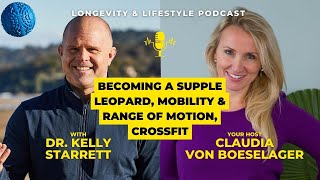
In this episode of the Longevity and Lifestyle Podcast, host Claudia von Boeselager interviews Dr. Kelly Starrett, a physical therapist, author, and co‑founder of The Ready State. The conversation traces Kelly’s upbringing in the Bavarian outdoors, his injury‑driven path to physiotherapy, and the founding of The Ready State and his bestselling books. Kelly defines mobility as the body’s innate, controllable range of motion and explains why preserving it matters for health, injury prevention, and performance across the lifespan. He introduces the concept of “session cost” – the cumulative physiological toll of training, lifestyle, sleep, nutrition, and stress – and proposes simple “vital sign” checks (e.g., air‑squat depth, floor‑sitting) to monitor it. Practical, low‑tech daily habits such as sitting on the floor, the couch‑stretch, and brief exposure drills are offered as scalable ways to maintain or regain mobility. Recovery is framed around sleep, heart‑rate variability, resting heart rate, and subjective desire to train. Stretching, foam‑rolling, and other soft‑tissue tools are discussed as means to reduce soreness, improve parasympathetic tone, and restore range. Nutrition basics, protein, micronutrients, and the emerging role of genetic testing for personalized recovery and injury risk are covered. Kelly emphasizes building a 24‑hour duty‑cycle of movement, allowing flexibility around work and family life, and warns against the “out‑work‑everyone” myth. He clarifies the terminology of movement compensation versus strategy, and illustrates how simple tests can reveal hidden restrictions. The interview also highlights the Stand‑Up‑Kids program, which redesigns elementary classrooms to promote movement, improve focus, and support neurodiverse learners. Finally, Kelly describes The Ready State methodology, its app, and the mobility test that provides red‑yellow‑green feedback, positioning the system as a practical, evidence‑based framework for anyone seeking durable, high‑quality movement.
Chapters
Welcome to another episode of the Longevity and Lifestyle Podcast. I'm your host, Claudia von Boeselager, here to uncover groundbreaking strategies, tools, and practices from the world's pioneering experts to help you live at your best and reach your highest potential. To get top tips, insights, and strategies on optimizing your life, health, and longevity, grab my weekly newsletter by going to llinsider.com/newsletter. Today's guest is Dr. Kelly Starrett. Kelly Starrett is a doctor of physical therapy, a coach, author, speaker, and I like this, chief tinkerer and movement optimist. Along with his wife Juliette, Kelly is co-founder of The Ready State, which is revolutionizing the field of performance therapy and self-care. Kelly is the author of the New York Times and Wall Street Journal bestsellers Becoming a Supple Leopard and Ready to Run. Kelly's clients include professional athletes in the NFL, NBA, NHL, and MLB. He also works with Olympic gold medalists, Tour de France cyclists, CrossFit Games medalists, ballet dancers, military personnel, and competitive age division athletes, to name yet but a few. Welcome to the Longevity and Lifestyle Podcast, Kelly. It's such a pleasure to have you on today.
Absolutely. Thank you. And I'm sorry for everyone to have to suffer through that list. That was, I was like, who is that guy?
It's long and amazing, so definitely own it, Kelly, right? So Kelly, I'd love to start with your journey to becoming so passionate about performance therapy and self-care and founding The Ready State. Where did all this stem from?
Holy moly. Uh, I grew up in Europe, which is probably the way to frame this, in that I was a child who was— grew up in a small Bavarian hamlet in southern Germany in Garmisch.
Beautiful place. Yeah.
Yes. And we were exposed to everything. We rode mountain bikes, we skied, we had a kayak team, we played in the woods, we all played soccer. And the, the person that we sort of valued the most in our group was the person who was the most competent across those domains. And what's interesting is I have clear memories of seeing very, very old grandmothers riding their bikes to the market and that so much of the culture was built around fresh food, built around shopping daily, built around walking. We went to Volksmarches as a kid, which are like little, basically imagine if your town has a little 5K walk or a 10K walk and you just go weekend to weekend collecting medals and seeing the countryside. And what that really did was this framed me feeling like I was deeply connected to the outdoors and deeply connected to my body as it related to having connections with other people. So I was exposed to lots of sports and fast forward, I end up paddling on the US canoe and kayak team, which is whitewater slalom where you chase the little gates. I learned to paddle in Garmisch on the Loisach and I ended up paddling myself right off the team. And what ended up happening was I created a neck injury for myself that made my right hand numb and I couldn't turn my head. And when I really kind of drilled down on that, and 'cause I, I went through the kind of classic athlete experience there in that moment where all we did was we thought we could just outwork you. We would just do more volume. We, we killed ourselves. There wasn't very few conversations about nutrition, very few conversations about recovery. Again, this is, think the '90s. And so it's a little bit of the dark ages. We don't have all the resources then. And when I started asking questions, a lot of people said, well, yeah, usually this usually happens. And I, you know, kind of pushed back like, you knew I would get injured. You knew there was nothing we could do about that. And that ultimately led me to physio school where I really started asking a lot of questions. And some of those questions were, why is physical therapy so far removed from the athletic training experience? And Ultimately, that led to this greater conversation about who owns what and are we not serving people as well as we might around how they might take care of their bodies. And so we started out and really Becoming a Supple Leopard, which is our first big book, came out 10 years ago and really was pretty subversive because we intended that we try to move as many things from behind this sort of imaginary wall that we had kind of typically sort of sequestered people away from owning how their bodies worked, self-soothing. At the time, there was still a conversation that pain was very much a medical problem and to be controlled or managed or discussed with only by a medical professional. And what we saw was we looked around and we said, well, everyone's in pain, and that's such a common experience as being an athlete, and we're still competing and we're still going about our day-to-day lives. So that when pain is really bad, it must be a medical problem. But if it's not really bad, we must need to have a different kind of relationship with it. So we really have been trying over the past decade to re-empower how people might take care of their bodies and how that might ultimately lead to better durability and quality of life and simultaneously improve athletic performance.
Thinking about it now, it seems so logical and of all the wasted years of all these athletes that they had to suffer through the pain and just push through because it was just How you do things, right?
That's right.
So many people are just so grateful, professional athletes, of allowing you to give them longevity in their careers, right? And all the people you work with.
Well, imagine, and let me just say that, imagine I'm almost 50 years old, but I'm starting to finally be good at my job. Finally, it's taken me a minute to finally to figure out how this works, to be emotionally mature enough to work in complex psychoemotional environments with complex human beings. And, you know, for a lot of our athletes, oftentimes we have treated sport much like circus, especially here in the United States. And, you know, we value our athletes until they're broken and then we discard them and we throw them on the athlete gladiator pile. And what I want to say is that oftentimes we discover that we need to come out of this unharmed and we can apply those same lessons. Ultimately, what we've learned is that we could ultimately treat sport a little bit more akin to like a teaching hospital or living laboratory where we might stress test behaviors and tactics and nutrition and really kind of come to understand ourselves through this lens. And ultimately, the highest calling of sports and performance is to transform society, is to transform our communities. And if we are holding up our end of the bargain, we need to take those lessons and actually transmute them to moms and dads and our neighbors. And that's what we're sort of currently obsessed with.
I love that. And I, I wanna touch on more of that in a little bit as well, but love if you could expand a bit on the concept of mobility. Most people have heard the term, but you know, we're so stiff, you know, and we're so immobile and it has a consequence in the long term on higher rates of diseases as well, disabilities, hospitalization. Even death and an overall poor quality of life. And I know this is an area you're really passionate about. So could you expand for people unfamiliar with the importance of mobility? Why is it so important? What are some of the strategies and things that you see are happening that are both positive and, and things that people need to really avoid?
Yeah, we should probably start by defining our terms. So when, as a physical therapist and a strength coach, I think when I say mobility, I say, does your body have its innate built-in access to its range of motion? Can you put your arms over your head in the amount of range of motion that every physician, every orthopedic surgeon, every physical therapist, every chiro says that is normal range? And remember, while we're all unique, the way our bodies function is less unique in terms of gross motor gross movement. So what we can say is the difference between your hips and my hips might be 3 degrees based on our genetics and anthropometry and, and even our gender. But ultimately the hip moves this much in human beings. So we can start there and say we have this range of motion language, and that can be said about all your joints, right? And that shouldn't be so strange. Like zebras all run like zebras, right? And then we can say, well, Range of motion without control isn't very useful. So mobility is ultimately the ability to control that range of motion in space. Okay. That sounds all well and good, but again, I'm just a 50-year-old dad. Like, what does that mean? What it means is, do I have access to my full movement choice? And can I move through my environment in ways that are important to me? Or am I inadvertently limiting my movement choice? And the ways I can interact with my children and my friends and in my environment. So ultimately what we're trying to do is say, hey, look, let's get you back to this baseline of what your body should be able to do so that you have more movement choice. And the implications of that, as you point out, can potentially be early fall risk, less desire to play, can't walk, can't care for myself independently. And some things that certainly if you've ever cared for an elderly you know, an older family member, it becomes very real very quickly. The irony is that of all our physical capacities, strength, muscle mass, et cetera, et cetera, our range of motion is the one aspect of our physical carriage that doesn't have to go away. You don't have to get stiff. It ends up being sort of an inadvertent poor choice because we're very much shaped by our environment and our environments, our modern environments in particularly, sometimes don't ask very much of us. And so suddenly, because we're not getting these pain signals or there's not something I want to do, like learn a new dance or, or learn a new skill or go to yoga, I can miss or not sort of expose myself to some of these positions for very many years and be surprised when something I was easy to do when I was a kid or easy to do in my 20s, something that's very difficult.
I'm laughing and smiling because I was once upon a time a gymnast. I saw in some of the photos that you had as well, you're still doing splits. I'm like, hats off to you, Kelly. Do you, you're still able to do splits?
I'm still able to do splits. You know, and I, I'll say that partly it's probably par for my business that I keep an eye on my range of motion. Otherwise I'd be a poor student, right? A chef who doesn't eat his own cooking. Yeah. But simultaneously being exposed to this means that it's a lot easier for me to appreciate that maintaining is a lot easier than reclaiming or developing for the first time. So this is a stoop I don't have to sweep very often.
So let's say for those listening, let's say midlife, right? I mean, I plan to live to 150, so I'm not even a third of the way there, but that's right.
I like that.
Let's say people sort of from mid-30s, I think things kind of start changing a bit more, right? So upwards. What are some things to look out for in terms of like range of motion, first of all? And second of all, can you expand a bit on how someone can educate themselves better on what they should be doing regularly to maintain?
Yeah. The first thing that we do, if you are coming to become fitter or train for something, is if you were terrible on the bike, bike, for example, and we're gonna use the bike for some conditioning. Everyone can wrap their heads around that. I'm going to fit spin class to get a little fitter. You wouldn't do bike-like things and we wouldn't talk about biking and we wouldn't send you to a bike class. We would put you on the bike and we would have you do the best you could on the bike. So the first rule of business is always exposure. That's really the where we're gonna do it. And your brain is very clear that it will value shapes and positions and behaviors that it sees all the time. So for example, the way that we can begin to pull at a seemingly very complex Gordian knot is to take small steps. So here's an example. Tonight, we know that getting up and down off the ground is an excellent indicator of morbidity and mortality, but also sitting on the ground is a really excellent way to restore and maintain necessary and vital hip range of motion. So don't lie to me. I know you're watching the telly. You're watching a little bit of TV, whether it's the news or it's Ted Lasso, whatever you're watching. I want you to just spend 30 minutes tonight sitting in front of your sofa on the ground and pay attention to how that feels. You sit crisscross applesauce and that's uncomfortable for a while, and then you sit side saddle, and then you sit with your legs out in front of you, and then you kneel. It doesn't matter. But the first order of business is exposure. The second order of sort of magnitude is consistency of exposure. So if it's important for you to put your arms over your head because you like to swim, or you want to rework on your handstand again, 'cause you're a gymnast, you would go to a yoga class, for example, and you'd be like, why are we spending so much time in downward dog? It is insane. It's almost like this is such a valuable position for humans that we're gonna put our arms over our head and we're gonna, you know, build a house here in this position. So you can see that in so many of the movement traditions that we have, there are fundamental truths about shapes and positions and geometry of our body that end up being sort of reinforced and highlighted because multiple people have found, multiple traditions have found, multiple movement systems in sports have found, they've been really good ways of influencing how the body moves. So again, sitting on the ground is one of those fundamental truths around ways that the body can retune itself or rewild itself. And the first order of business to untangle this thing is to begin a conversation with your body.
That's really powerful. And I, I love that tip because anybody can do it at any time, you know, sitting on the floor. They even say what, we do with babies, they call it here in the UK, tummy time, right? So, and it's the complete opposite, especially if people are sitting at their desks all day, leaning forward to just actually reverse the position and just open up the chest and, and breathe again. Right. You can talk about this a lot better than I can, but I think that that's a great starter tip. And then just to build up, I guess, to get to a handstand, for example, although I don't do a handstand, but what I know is my my wrist strength is nowhere what it used to be.
Funny. Isn't that weird? You just like, I don't understand. I just had launched international podcast and had some family life and became an adult and my wrists, what happened?
Like from my mouse, which is just like completely horrendous. So after our conversation, I'm going to be, make sure to stretch a few times a day.
Let me give everyone a way of thinking about sort of what's happened to their bodies. Yeah. So in, in high-level sports, we've had the good fortune of working with some premier football there in the UK. And one of our friends is a coach there, has this idea that he loves. It's called session cost. And when we do a session, and that can be whatever you want, imagine it's weightlifting or cycling or yoga or whatever you like. The next day, are you sore? Well, how was your resting heart rate? Is your heart rate variability off? Can you generate as much force? Can you go just as fast? Could you do it again? So the cost of the session is impacted on your ability to adapt to that training stimulus, right? And that's a lot of things. Did I go out drinking, right? Did I, did I eat good food? Did I sleep? Did I engage in some recovery behaviors that look like walking? Very simple things., you know, that allows me to adapt to that training. So we can, what we're always doing with athletes is, and teams are, is asking, can we reduce the session cost? Can we basically have full adaptation to some kind of stimulus to our bodies and then really adapt to what it is and then do it again? Well, we can start to think about our lives and some of the behaviors in our lives as having session cost.. So if you happen to sit a lot as part of your job, the session cost might be that it's more difficult for you to extend your hip or get into a lunge-like shape or put your arms over your head. And what this session cost idea does is it allows us to move away from sitting is bad to, wow, I didn't realize that it changed my ability to have access to my shapes, access to my range of motion. Access to my physiology. And then we are clever enough to say, well, what inputs do I need to put in to maintain those minimums? And that's why we're really keen on trying to help people develop what we think are movement and physical behavioral vital signs around their bodies. Because then I don't need to worry and obsess about my body. It's designed to last 100 years. It really truly is. But if you can, if I say to you, hey, your blood pressure's 120 over 80, You're like, eh, it's not great. It's not bad, but it's also not good. But it, it lets me know that I should keep an eye on it. Or if it goes above that, hey, I can engage him to other different behaviors to try to bring it down. Well, let's start applying those objective sort of sensibility to some of these behaviors around our bodies to help understand how we might improve and, and restore and maintain our movement choice.
You mentioned there that it's about finding out what is the minimum that you can do.
Yes. The minimum. I love it.
Yes. So what is the strategy there? Like, how do you ascertain that for each client that you see?
Well, in our new book, Built to Move, what we've tried to do is say, these are the 10 behaviors that we think are the, the hinges that open the largest doors. So one of the things, again, I'm always thinking about how things scale. How can we regress and progress essential behaviors? So if we take nutrition, for example, we're pretty clear now on that fruits and vegetables are pretty good for people and that micronutrients probably matter. Vitamins and minerals and all the polyphenols and all the amazing things locked up in fruits and vegetables. Fiber, turns out it's pretty great. And there's probably really important that you get enough protein. Why? Because we really want you to have a healthy gut and nice skin and the linings of it, you know, in your brain and all your organs. They all require protein. Didn't even mention muscles, but they need 'em too. So suddenly we can say, well, let's establish some minimums here around your nutrition. And then suddenly we can ask, well, do we wanna try to change your body composition? Do we wanna try to fuel you for a marathon? Well, we can see how these principles can be made to order by tweaking the foundations to regress and progress the concept. So as we're trying to help people for the first time, maybe who don't identify as athletes or don't identify with diet culture or dieting, or they don't eat a specific way because it's their identity politics, right? Because nutrition's gotten a little bit crazy. I'm a vegan, I'm a carnivore, like let's fight, right? We want everyone to appreciate that it's all important and that no aspect or system in your body works independently. So I'm a physical therapist by training. Why do I get interested in nutrition? Because if I'm gonna talk about creating tissues and bones that are durable and springy and don't, you know, become more easily sensitized, then I need to make sure that you have the raw building blocks. If you ever have an injury or surgery, do you have on hand what is required to rebuild your tissues? If you're trying to keep your lean body mass, your muscles as you age, well, it's really important that you get enough protein to do that. So suddenly what we can begin to do is sort of say, hey, we don't have to get perfect today. If you go work with a coach, for example, if you've ever worked with a coach, the coach doesn't try to smoke all your metabolic systems. They don't try to get you strong in every movement and every body part. Today we're gonna work on one piece. And tomorrow we'll work on another piece. The key here is that as we sort of tug at the fabric of consistency, we can start to see that there are absolutely fundamentals around being a person. Then we can have the next conversation about what kind of training you wanna do and what your goals are and what your intentions are with your body.
I think that's really fundamental is that there's, you know, a stepped approach to it. I think where I see also with clients that I work with for performance coaching, they want to do everything right at once. And like by next week it needs to all be perfect.
It seems so reasonable, right?
I know, exactly. It's like, well, this is the quickest way to fail and be frustrated with yourself, etc. I mean, I'm always also one that like I want it done yesterday, but it's the bit by bit and making it manageable. That's how you set yourself up to wins.
What we might do here is we might think about Okay. We're talking about the care and feeding of the human person, right? And again, no single aspect of our physical behavior selves works independently. Sleep turns out to be highly influenced by how much movement I get during the day. So if I don't move my body enough during the day, it actually is going to be more difficult to fall asleep. If I don't sleep well, guess what happens? I'm more likely to have higher pain sensitivity. Or if I've got some kind of chronic back pain or chronic pain problem and I'm not sleeping, it's gonna be a lot harder for my brain to wrap its head around what's going on with my body and how it's interpreting my body as a threat if I'm not sleeping. Oh, that came back to moving that. Oh, that came back to how much caffeine and alcohol I was drinking. Oh, that came right. Suddenly we start to see that it's very complex. So when we're trying to get people to wrap their heads around this, what we really want to start to do is say, well, what does a physical practice look like? Because right now we think it's a 1-hour yoga class or 1-hour CrossFit class, right? It's prepackaged meals that I meal prep for myself. What we want to do is expand that conversation because there'll be times in your life where, God forbid, you have children or a busy job or have to jump on an airplane or someone in your family gets sick or you get injured. Where your perfect little schema just sort of falls apart because your plan met reality. But if we expand the idea of what it means to have a physical practice, suddenly what I'm realizing is, boy, I have a lot of agency from when I wake up to when I go to bed. And all of those small inputs compound, and it all aggregates into a bigger picture of what it means to take care of the body.. So some days it may be I walked 6,000 steps today, ate some fruit and got some protein in, and I sat on the ground and that's what I did. And that was amazing versus, hey, I didn't get much in, so I'm going to throw it out. Or, you know, I wasn't able to go to my spin class, so give me the chips and the curry, right? I don't have to do all or nothing here. And when we begin to expand that, we do two things. One, we start to separate out sort of the care and feeding of the body, and we make it a discrete thing that also happens to serve as the base for all elite performance. So if we want you to go to the World Cup, we want you to win an Olympic medal, we want you to be 10 outta 10 on these things. We give these practices to our Olympic athletes and our world champions and try to get them to be 10 outta 10. And most people have 1 or 2 blind spots. But if you're not into exercise, you're not into diet, these physical practices will still allow you to create a very durable, healthy, vibrant organism that's independent from breathing hard necessarily. Of course, we do. You think you should lift weights? Yes, we think you should lift some weights, whatever that looks like to you. But let's get to first things first, because honestly, if we ask the question, of this trillion-dollar fitness industry. Is it serving us? It turns out it may not be. We have unchecked rates of obesity. We see depression and substance abuse, ACL injury rates in kids, social isolation. Choose something that you feel passionate about and say, is it going in the right direction? And then we can really say, well, this trillion-dollar fitness experiment doesn't seem to be working. So maybe we need to think differently about who owns the problem and how we might try to solve it.
So that concept of agency, do you help your clients understand what the baseline is? It's like the only thing you can do today is sit on the floor cross-legged. That's already amazing. Just so they feel that they can have a little win to a much more complex spectrum of this is the workout you need to hit today. How much wiggle room is there in the protocol that you recommend to your clients? And I, I appreciate you have a large spectrum of clients.
Well, remember, if we give people a baseline, an objective measure, then we can empower them to make decisions about what's going on in their life. So here's an example. As I've gotten older, I find that drinking doesn't really do me right. Look, I'm an Irish kid. Kelly Starrett is as Irish as it gets. We're from County Cork. There's 5 generations of people who like the whiskey in my family. And I grew up with this specter of alcoholism in my family. So I didn't drink until I was much older. However, what I'll tell you is the reason I really don't like drinking now is, man, it really wrecks my sleep. I feel terrible. And the next day I don't feel like I can kind of kick butt and do the things I want to do as well. However, an old-fashioned good margarita, that is proof of God's intelligence. If I'm having dinner at your house and you're gonna, you pour me a glass of wine, I'm gonna have a glass of wine because I'm your guest. And what I'm gonna do though is say, hey, I'm going to appreciate that that's going to have an impact on my sleep. So what I'll say is I better maximize, I better get off the caffeine earlier in the day. Maybe I'm gonna plan on celebrating tonight, so I'm gonna make sure I max out my steps so I feel that sleep pressure. I'm also gonna try not to eat too late because I know that that messes me up. So now I'm sort of empowered because I know that if I want to change my body composition, if I want to get out of pain, if I want to grow, I want to learn a new skill, 8 hours of sleep is the magic number. If I want to survive, I try to get 7 hours of sleep. So what ends up happening now is I have this metric in there and says, well, I maybe I can extend and I'll have a bad night's sleep, but I'll sleep an extra hour because I have some flexibility., but it gives me this window of understanding minimums. And then I can start to fold in some of my other behaviors. So lemme give you another example of real life. Dad, 50-year-old dad, right? Intermittent fasting becomes very popular, right? Everyone's heard time-restricted eating, a little bit of microfast. Well, it turns out, I think people are really lazy. They don't like to eat breakfast. They're not really motivated. It was an easy way to hide the calories from yourself, right? You just drink black coffee. I can do that. Eat at 12 o'clock. Well, I'm so busy in the morning, it doesn't matter. So it turns out that the research supports that intermittent fasting was just a really another mechanism of calorie control. Okay. There's nothing wrong with that. That's, that's a great way to control calories. But we also found that people who did intermittent fasting tended to lose a lot of lean muscle mass in addition to their body fat. Okay. So that sounds like Ozempic, right? I can, I'm losing a lot of muscle mass. So I experimented with this, but what I found was it became very difficult for me to eat enough fruits and vegetables and eat enough protein so that when I exercise in the afternoon, 'cause I love to train, it's how I cope and manage my stress and I'm not in jail. So I learned to exercise as a kid is that I was underfueled. So my performance was terrible. I was getting dropped by my friends on the bike or my lifting was awful, or I just didn't, you know, I was like, wow, what's going on? Well, it turns out I just hadn't eaten enough to do that. But then I was also super hungry at 9 or 10 o'clock at night cuz I was really deeply undercaloried. So I would not make the best food choices or I would eat a big meal at like 9 o'clock at night. I eat another dinner and I don't know the last time you went to bed on a full stomach, but that is a recipe for disaster of sleep. So I did this for a few days and I was like, wait a minute, this isn't serving me. So it allowed me as my big boy intellectual self with two thumbs, cuz I'm an ape, I was like, well, I guess I need to eat some fruit and some eggs for breakfast.
And that solved that problem for me. Mm-hmm. Just to reiterate for people as well, because it's everywhere about fasting and it's so good for you, et cetera. For women, it can be very detrimental to hormonal health. Kelly, I wanna ask you about movement compensation.
Why is it so important to understand this correctly and what can one do to fix it? We inherited a language around performance and the shapes of our bodies from our movement traditions, from Olympic lifting, from gymnastics. When we teach little kids to jump and land in gymnastics, when they're working, we teach them to jump and land with their feet together, right? Knees together, feet together. Why? Because they don't have the control or the strength to manage a good landing. So what ends up happening is we put their feet together, knees together, Those things collide when they jump and land, and we protect them from potentially injury. If I put a young child's feet apart and said, jump off this ladder, right? They're not going to hurt themselves. But what we might see is that they land and they don't have the control and the knee starts to come in in a big way. Well, they didn't get injured. We've seen 1,000 kids playing like that. But what we start to see is if at some point that doesn't self-correct, that position hints at not the best way for the body to generate force, to be the most resilient. And so what we used to say is that's a movement fault. And that language definitely came out of kind of performance and, and physio, but we don't really like that word. So we started using the word compensation. And if you don't like compensation, 'cause that still has negative connotation, then we can say strategy. That what we're seeing is that your body and brain are going to solve a movement problem. I need to pick this up or do this thing. But certainly what we used to say was, don't do this because you might get injured, right? Don't round your back because your back might explode one day. Well, it turns out not true. The case for better quality movement is to enhance our power, our wattage, our efficiency, right? The replication of high motor skills. If you set up for the golf ball and your back is rounded, and the next time your back's overextended, and then your feet do different, you notice that we try, when we address the ball, we try to do the same thing over and over and over and over again. We try to minimize the movement variability when we're learning a new complex skill. That's skill acquisition. So we can say unequivocally, for example, hard to run your fastest with your feet turned out like ducks. Just hard. You may or may not get injured with your feet running like a duck with turned out at 30 degrees, waddling down. But I guarantee you, you're gonna be slow. And if that's your goal, cool. But as you start to work in a way that doesn't suggest your body is using its geometry, its organizations, its tissues in a more advantageous way, it may be eventually that you cannot tolerate those positions. That may be a lot of reasons. You may or may not ever have a problem, but eventually you may find that you can't do something or it's taken away another movement choice. So here's an example that everyone can relate to. If you're sitting here, just go ahead and slouch. Let it, let it just back round. It feels so good. Let your shoulders come forward. It actually feels good. Ah, right. I'm loving, just feels like a different position. My body craves some flexion. This is why I fold over and touch my toes once in a while during the day. Just put my spine, make sure my body can do what to do. But if I hold this position for a long time, and if you're sitting here slouching, listening, go ahead and see if you can take the biggest breath in you can. And let's measure that. So go ahead and take a huge breath. Okay. That wasn't very huge. Now, holding that position, look over your right shoulder. How far can you turn your head? Okay, now watch this. Get into a position where you can take a bigger breath. Notice I didn't tell you what to do with your body. I didn't say adjust your pelvis or head. So let's confirm that with an objective measurement. Go ahead and take a breath. Oh, much bigger. Now turn your head. Wow. My head turned a little bit further. What was that about? Well, it hints that there are positions that influence how much access we have to our abilities, our movement choice, and ultimately our movement solutions. And this is why we teach technique to gymnasts, why we teach technique to tennis players and soccer players, because those techniques continue to leave us movement options and hint at the best expressions of what the body is supposed to be able to do and do for a long period of time. And those things have been honed because humans have been obsessed with this forever. We started throwing rocks, then we started throwing spears as, as far as we could. We carried stones around fields. We have been doing this, having running races for as long as there have been humans. I guarantee it. So we've always been obsessed with lifting weights and going fast. And those things started to come together. And when you start to overlay our movement traditions on top of elite physiology of going the fastest, you start to see that yes. There is in fact more variation in waltzing than there is in sprinting. And that you can waltz at low speeds, at low loads, but sprinting hints at that there are more unique ways to run faster that all look a little bit more homogenized. And when we see that people don't have movement instruction, and again, I'm not talking about don't do this cuz you'll get injured. That's the wrong conversation and not even supported by literature.. But also we say that, hey, if you are really restricted in your tissues, chances are your body's gonna allow you to solve that problem until it can't, until you hint at you can't solve a problem, or we've sensitized the tissue because we didn't have access. So one of the things we can do here is help people parse out what seems like very complicated movement problems or movement-related problems. By asking simple questions, we build a problem list, and on that problem list might be sleep and it might be nutrition and it might be stress, but it also might be this thing called, do you have full range of motion or not? And isn't that an easy thing to work on yourself without having to go talk to a professional? And if we give people minimums, we give them vital signs around specific positions, then we have a unifying language. To be able to start to say, hey, I see this is a problem for you. Let's check your minimum. Your back hurts, your knee hurts. Huh? I don't know. That could be related or connected to the fact that you can't put your leg behind you in a lunge-like position and hip extension. I don't know if they're connected, but I see that you can't do this. Let's see if we can improve that. Turns out you use your knee and your back for both of those things. And oftentimes we can make ourselves feel better. Simply by restoring our native ranges of motion, something novel, the brain no longer sees it as a threat. We became hydrated, less stressed, better nourished.
All of those things seem to matter. You mentioned checking a few vital signs, some quick tests. What are some tests you could recommend for someone listening at home or in the office to check if they really truly have a range of motion that they would want to have as a baseline level?
One of my favorites is squatting down. Very, very simple. So if I was looking at, when I was a young physio, we had a book by two authors, Norkin and White. That's how it was referred to. And it was the sort of the manual for every range of motion of every joint in the body. And we basically were like, what is your second digit of your finger? How much should it flex? What is normal? What, right? And we had to be responsible for this whole thing. But that doesn't even hint at what the body does. It just tells you what the knee should do. The knee should move this much. That's great, but I'm not a cadaver laying on a table. So it turns out if we really start to put these pieces together, normal ankle range of motion, and again, normative, just what an ankle should be able to do, how much your knee should flex, how much your knee should come to your chest. We could do all those things, isolation, or we can put 'em all together and we can squat. And, and, and what we say is you should be able to squat all the way to the ground with your heels on the ground. That would be typical. That would be average. That would be, hey, I'm, I'm taking a poop in the woods. I'm picking a baby up. I'm in, you know, getting up from skiing. Like it doesn't matter what it is, but a lot of people struggle with getting below parallel or, Their feet have to do weird things. I'm not even talking about keeping your back flat, or I'm just saying, can you lower yourself to the ground with your balanced foot pressure? So you have 50% of your weight on your balls of your feet and 50% of your weight on your heels. Lower yourself all the way to the ground. Now take 5 breaths there. Can you do that? And that's a great sort of diagnostic to start to say, huh, what's tight? What was the session cost? How stiff am I for my run? Boy, that long airplane really messed me up, or I haven't moved very much this week. We use that simple air squat, butt to ground, kind of ass to grass air squat. That's how we start every session with every athlete we do. Because now I start to say, huh, wonder what's feeling tight? What do I need to work on? It turns out that that hip flexion position is really a fundamental shape to being human, not exercise, human.
So I'm guilty of tight hips as well.
Sure. If there's a dumbbell in play and I can put my heels on that, I can definitely— this is a good example. My wife is a 3-time world champion in whitewater paddling, and she was also a state champion in rowing, and she was a rower at a university. So she is a monster. Her ankle flexibility is lacking. She does not have good dorsiflexion. She's stiff. Some of the problems she solved as a kid. So Juliet had juvenile rheumatoid arthritis as a kid and was born with a little hip dysplasia. So she learned to use her ankles by walking on her toes as a way of improving her hip extension. So instead of being able to extend the hip, which she couldn't do because she had hip dysplasia as a child. She used her toes as another way of getting her leg behind her body while she was running. And then isn't it interesting? She adopted sports that didn't require massive ankle range of motion, right? And she was still 3-time world champion. But what I'll tell you is it doesn't say that she has pain. She doesn't have pain. It doesn't say that she wasn't an ex successful person, but it does start to limit her movement choices and movement and balance. Because she doesn't have as much range of motion and freedom that a normal or typical human ankle would. So it's something that she has to work on a little bit. But remember, it's not good or bad. This is how she solved the problem with her body. But that solution sort of truncated other movement options available to her.
A lot of people, you can even tell by the heel of shoes, right? For sure. I feel like it's probably so ingrained in a neural pathway that this is the way to walk. How difficult is it to help people correct themselves? And you were saying at the very beginning, you know, range of motion, the human is a human, there is a certain range of motion that everyone should be able to do. So is it always possible to come back to center?
Or is it just something that's too far gone? The cool thing, something about walking, for example, is that it doesn't need that much range of motion. Because can you imagine humans have been, we needed to walk to get water and to reproduce and to find food and resources and move and So walking is something that's a very small range of motion. Sprinting, bigger range of motion. We're gonna need, you know, that's why sprinting is one of the most dangerous things a middle-aged adult can do, right? Because your tissues can't take it. You haven't exposed yourself to it. You think you can still do it. And also it's basically like doing the running splits. So what I'll say is, first and foremost, at what age does your body stop healing? It doesn't, it continues to heal. It doesn't heal at the rate of a small child. You literally cut off a child's hand and it grows back in the night. I mean, it's amazing. Do you remember how great your 17-year-old body, you could just destroy it and the next day arise from the grave and do it again? So I cannot do that anymore at age 50. So I still heal, but I heal slower. What I'll say is muscles and tissues are like obedient dogs. So at no point in your life does your body ever stop with the ability to repair or remodel or improve or grow muscle or lay down bone density. But it sure is a lot harder to change my bone density when I'm 60 than it is when I'm 20. Right? So range of motion very much can always be improved unless you've got some kind of bony block or you've created some kind of you know, really gnarly arthritic change where you have bones that are running into bones. But even then, we see that there's always capacity to be had. But the first order of business, as you said, is exposure. So if we want to start to change your range of motion, we better start spending time in those shapes and positions, and we better make sure we can breathe and tell our body these shapes and positions aren't a threat. If you've ever gone to a yoga class, most adults have done at least one session of yoga. You get into some really weird shapes and then you gotta breathe there. It's almost like they said, these shapes are important and they're so important.
Let's make sure you can take a breath there so that your brain knows they're important. Claudia, let's talk about recovery. You touched on it a bit before, but why is recovery so essential for maintaining mobility, maintaining a good physical state and mental state, I guess, as well, and How much recovery should one look at? Is there a way of measuring it with this amount of input? This is the amount of recovery that's needed.
And let's say what we're recovering from, we're adapting to stress. So that stress may be traditionally exercise or training, but it also may mean, boy, I'm in a really difficult time in my life at work, or I have a sick family member. How can I manage that stress? My brain doesn't know if I've manufactured the stress., or, you know, if it's a gym workout or if my life is coming apart at the seams and that's the stress I'm dealing with, it doesn't matter. What we can start to say is, well, we could use any third-party validation that we wanted. So you could look at resting heart rate, you could look at the quality of your sleep, you could look at heart rate variability, you could look at even something as desire to train. So I have a nearly ADD-like need to train. My desire to train is through the roof. I wake up and I'm like, oh, wonder what I'm gonna do today? Where am I gonna go? That's really how I, I think I am, you know, have again, have self-medicated for years and years. I discovered movement and exercise and play, but my recovery from those things is not very good. I have generally lower recovery skills than some of my mutant friends who literally can do the same thing day after day. So, One of the things that happens, I think, is we have told ourselves that I can outwork the competition, I can outgrind the competition. And what I want to say is that is horse crap. That ship sailed a long time ago where you could just outwork your competition. Everyone today is working really hard and everyone is training really hard. And so are you really telling me that Arsenal is training harder than Chelsea? Like, no. No, no, no, stop that. What you're seeing is whoever can adapt to the training the most effectively is the game. And what we know is then the reason recovery is so important is that one is it allows us to handle greater stressors and show up and be more complete the next day. Again, reduce that session cost. But one of the reasons that we want people to think about all of the behaviors that we've sort of talked about today, walking, eating, sitting on the floor, is that you actually think you're working at the limits of your ability and you're not. You just feel like you are. Universally, when we have our athletes get 10 out of 10 on these things, on our, these kind of, these essential, you know, benchmarks, they end up saying, we're like, wow, I was able to increase my volume. Oh, I was able to actually get more work done during the day and I was more fresh in the evening when I got home. Not only could you work harder, but you were able to handle that stress more effectively. And that ultimately shows up in everything that you do, whether you're showing up more lucid for your family on Friday night or in the evening, or you want to play with your kids, or man, we're getting together to play pickleball on Thursday and I want to show up and destroy you. I'm going to show up on Thursday fresher than you are because I was able to manage those stressors more effectively. And then sure, we can get into the weeds and talk about tissue quality and and how your tissues, you know, manage that.
But ultimately it's about you feeling better so that you can do more and handle more. What role does stretching play in recovery? And what are your thoughts on stretching and using things like a foam roller, trigger point, whatever it might be, golf ball?
Yes. Well, I'll tell you what, um, we can start with this simple idea. Like, why am I doing this behavior? So if I ask 100 athletes, should you stretch? 100 athletes would be like, yes. And I'll be like, do you stretch? And they'll be like, no. And it's because we didn't really connect stretching to whatever that means. And we'll define that in a second to an outcome, right? It was just some behavior you need to do. Hey, I just need you to eat this block of broccoli every day. Like, why am I eating that broccoli? It's not helping me, right? I've got all my 800 grams of fruits and vegetables. I'm just, but you need to eat the broccoli. I'm like, I'm not gonna eat the broccoli. Eventually I'm just like, screw the broccoli. So what ends up happening then is that we have found at the very least that some kind of soft tissue mobilization practice, rolling, static stretching input into your body is a really great way of reducing delayed onset muscle soreness. So at the very, very top of the pyramid, the hierarchy of, of needs, you've trained hard, your body's sore. We found that, and the research supports that, some soft tissue work means that you'll be less sore the next day, which, sign me up, because if you've ever done a lot of work and then had a hard time getting off the toilet, I'm not into that experience. Like, I wanna just be able to pop up and be regenerated the next day. We also found that people who engage in some soft tissue work, mobilization, trigger point, foam rolling, whatever you wanna call it, they tended to, and they did it in the evening, they tended to fall asleep faster and stay asleep longer. It was like massage. And, and this, this tracks with what people understand. If you've ever gotten a massage, you did not get up off the massage table and try to fight someone. You were like, I feel so— your voice is low. You're very relaxed. You didn't. That's right. You're like, let's fight. Like that doesn't happen. So what we know is that it's a great way of getting some parasympathetic input into the body. That can be very powerful. For downregulating. I'm very stressed. Let me give myself a self-massage. I'm just gonna roll on the ground, take care of, ask what's tight, what's stiff, what doesn't feel good. Can I improve blood flow to an area? There's good data support that we change blood flow. Well, garbage in, groceries out. That's part of the game. We also know that static stretching, if that's what you got, long hold pigeon, it, it's not harmful. So it doesn't cause harm to people. So if it makes you feel good, Guess what? I'm all about it. And notice we haven't even talked about restoration of range of motion. We haven't even talked about, hey, if I have something painful, I might be able to reuse the same sets of tools to address some kind of painful area or sensitized area in my body. So suddenly you have this huge, huge set of behaviors that can help me manage my knee pain. Help me feel better, help me fall asleep faster, help me recover more effectively. And you're saying it's free and I can do it in the last 10 minutes of the day before I go to bed by myself.
Sign me up. Do you recommend stretching just in the evening before bed, or would you say the muscles need to be warm, there needs to be blood flow to the muscles before actually doing any deep stretching?
I think good is the enemy of great. And if I look at a busy working schedule person, And I'm like, yes, I need you, Claudia, to lay on the ground in the middle of this podcast and stretch. You're like, it's not going to happen. I'm wearing a cute outfit. I'm not getting on the ground. I'm at work. Like, what are you talking about? It's never going to happen. So the first order of business for any of these behaviors is to ask ourselves, when is this person going to engage in this? When can this become part of their lives? And how are they going to be consistent with it? If I say to you, hey, I need you to go to the stretching class, it's across the city, it's gonna take you an hour to get there. I need you to go there 5 days a week. You're like, I'm out. I don't have time for that. I gotta get my kids home from school and make dinner and do all the things I wanna do and I wanna train. So what we found is if we can protect people's training time, right? And if you, it means you love to go to dance class, you go to spin class, you go to CrossFit, I don't care what it is. You've actually made this heroic effort to go engage in some activity. Let's not muck up that activity with a whole bunch of preconceived notions of things you need to do. Yes, if you got out of your sauna and then engaged and you had your collagen shake and then you went to your yoga room and that, yeah, that might be more effective. But I'll tell you what's great is get on the ground when it works. You've been moving around all day, do some isometrics on your hamstrings and you'll see that, wow, I can improve my range of motion. I can make myself feel better and I can start to noodle on these things. When it works in my day. And when we start to look at that, then we certainly have this really remarkable framework, something we call the 24-hour duty cycle. That 24-hour duty cycle means that when I wake up to when I go to bed is the time in the day where I can start to engage in certain behaviors. And we can start to ask, where does this person have control in that 24-hour cycle? And we, turns out a lot of people have a little control before they leave the house and they have a little more control of their life when they get back to the house. So let's start stacking in behaviors that really respect how an average or honest person is living day to day. And lo and behold, there's a lot of time and agency and control there. That's really, do I sound reasonable? I sound too reasonable. Like you're trying to like, should I deadlift my body weight 3 times? And like, yeah. Yes.
I've gotten so old and reasonable from my gymnastics training days. I guess obviously they didn't want any injury and it was always, you know, make sure to do a warmup, 100 jumping jacks, whatever it is before you actually stretch.
To get those deep stretches in. So I, I feel sure that let's, let's take that on. So imagine that we got a kid warmed up and the reason you had to do these stretches was that you were engaged in a sport that required you to have access to enormous ranges of motion. And we needed to make sure that you touched those range of motion because you couldn't actually do your sport unless you could do the splits. You couldn't do your sport unless you could put your arms over your head. You couldn't, you know what I mean? Unless you could backbend, you actually can't do your sport. So the problem is you can do a lot of sport that looks like biking or elliptical or right Pilates class. So what we see is we have a different requirement for what are the activities I need to prepare for. Look, who doesn't think that getting hot and sweaty before you get into a fight is a good idea? That's what training is, right? We're going in and we're gonna lift these weights or we're gonna do this activity. Yes, some kind of warmup probably makes sense, but simultaneously, I guarantee you and I are, I'm like, hey, I've got 100 quid on the line. You and I are gonna race right now. You're gonna win because you're a human being. You can do it cold. It just turns out it's not the best practice. But what we can start to say is, well, what is good enough practice so that we can again have you spend your credits where you'd like?
Mm-hmm. What are some of the basic maintenance people can do on themselves? Mobility drills that you talk about and, and some basic exercises to get that range of motion or to maintain it.
If you didn't have any equipment, use your body and get into the shape that you need to get in. So we have something that we talk about a lot. We talk about it in the new book, we talk about it in all these other things, and it's called the couch stretch, for example. And we originally made it so that you can do it on your couch watching television. But honestly, the couch stretch, and now let me describe it for you. If you imagine if you're on your knees facing away from the wall, so the wall's towards the soles of your feet, you're kind of kneeling. Mm-hmm. And you're gonna put your knee in the corner where the wall comes down into the floor. So your, your shin is going up the wall and you're just in quadruped, right? You can see that. And then your other leg comes up into a lunge position. Mm-hmm. So basically it looks like kind of a modified lunge or a little bit like a running position. Mm-hmm. But what we're really doing is starting to make you extend your hip with your lower leg flexed a little bit, like your heels coming to your butt. And all you have to do is take 5 breaths there and squeeze your butt. And what we did there was, first of all, was that same order of business. The thing we should do is expose you to the thing we want to get good at first. We want to get good at biking, let's go bike. If we want to get good at hip extension, let's do some hip extension, right? That's basically an exaggerated running position, exaggerated lunging position. It's like your knee is behind your butt, like you're in a big kind of splits-like shape. But we can do a couple things. We can just hold it for a long time and hope that that helps by pulling on stuff. And it does. We can make you actively contract there and teach your brain, hey, I have control in this position. And we can also even bring in breath here. And so you can take these huge breaths where it says your body's like, oh, I'm going to give you access to this shape because you're breathing here and it's safe to breathe in this position.. So you don't have any equipment, but you suddenly have your body and you have breath and you have a contraction. And that can go a long, long way towards even upgrading your static stretching. So if you got into like classic hurdler stretch where your leg is out, you can lean forward, you can take a big breath, you can hold that isometric, contract, contract, contract, and then slowly relax. Take some more breaths. If you just spend a few minutes noodling on those shapes with those two concepts, can I breathe here? Can I contract here? You can go a long way, but we can then slide in a roller or a ball, which all it does is put in a vector right in the middle of the system. And so instead of just tugging at the tissues at the end, suddenly, prrrt, I'm putting in a load in the middle of the system. And now I can do that same contract relax. I can use that same breath technology. I can use the same mobilization. And I can start to look for areas that are sensitive, that don't feel good, that do feel good. And I can just roll around kind of simultaneously contracting and breathing. And a simple model we use, if you push on any part of your body, it should be painless to compression. So that is typical that if I push on your body with my hand or you're laying on a roller or something, shouldn't hurt. It should just feel like pressure., but if you feel something that feels sensitive, uncomfortable, stiff, painful, I'm not trying to use my words on your experience, but all you need to do there is recognize, oh, I found something my brain is asking me to pay attention to so I can take a big breath in. So here's our model. We take a 4-second inhale, we contract and just hold whatever you is over the ball. Don't worry about what muscle it is. Just contract into the roller, contract into the ball. Hold that for 4 seconds., and then exhale for 8 seconds. Long exhale as you relax. So we've got isometrics in there. We've got breath holds, we've got long exhales, and suddenly your brain will go, oh, that's not such a big spot. And it'll start to feel better. And if it didn't feel better right away, stay on it, do it one more cycle. And I guarantee you it's gonna start to change. And as soon as it starts to feel like Switzerland, start, as soon as it starts to feel beige and just like tissue, Move on. If you roll on something that feels really good, keep rolling on it until it feels average. But that simple technique of finding something that feels uncomfortable to compression, contracting on it, breath holding on it, relaxing, can go so far to improving how your body feels. It may be that we're just changing proprioception. It may be that we're bringing blood flow in. It may be that we're addressing trigger points. It may be that we're restoring— I don't care. It could be all those things. But the bottom line is, does it feel better? Does it change your range of motion? What's my objective measurement? Can I go faster? Can I, right?
And it turns out those are the techniques involved to do that. So I'm literally after a podcast going to grab my foam roller and work on those and do that exercise against the wall. So thank you for sharing that, Kelly. Do you have any particular favorite devices that you use or like to use on your clients? Be it the foam roller is your go-to or the trigger point, or I don't know, maybe even the Theragun, something like that. Are there some that you're like, they're really powerful, these are your go-to?
Believe it or not, I think the one of the things we teach all of our young people and all our teams is how to work on each other. Mm-hmm. We want hands and feet to be our primary set of tools. And that if you work with someone like, hey, my hamstrings are really stiff. I'm like, cool. Let me hold onto a chair and put my heel on your hamstring. You could contract, relax, and I can walk up and down your hamstring. It's remarkable how much better you can feel because humans need touch. We need interaction and helping our athlete compatriots feel better in their bodies is what training is all about in the first place. That's why we do it. I think everyone on the planet should have an empty wine bottle and some kind of cricket ball or baseball or crossball lying around. And what you'll find is with a small roller or cans of Guinness taped together, whatever it is that you need, and a ball, you can really go a long ways to having a lot of net positive input into your body. Really remarkable. And what we like to say is that 10 minutes a day, 10 minutes, that's it. That's all I'm asking you to do. You brush your teeth for 3 minutes. You can do this for 10 minutes. You don't have to fix your whole body. Ask yourself today, What's sore? What feels overworked? Is it my feet? Is it my forearms? Is it my calves? You said hip flexors a couple times. Great. Let's just spend 5 minutes on the left side, 5 minutes on the right side, and then cross the box. I brush my teeth. So now tomorrow, right, you can say, well, do I still need— oh, something else is bothering me. But 10 minutes a day aggregates into a lot of time over time. That's 50 to 70 minutes a week. And now we start to see that, holy moly, you got hours a month doing this and your body starts to feel better. And when something pops up, you don't freak out and you don't think, oh, something's uncomfortable. I should take this, you know, Percocet and this THC and this, this Ambien and this, like, I should get an MRI. You're like, hey, it's cool. I have some tools that make me feel better. If you like percussion, you like using a Hypervolt, if you like scraping, if you like cupping, All of these things have their place, but ultimately they'd sort of do a couple things. They may just desensitize the area. My brain suddenly was like, this is a threat, and now it's not a threat anymore. We used to take percussion devices, the Hyperice, and we'd line 'em up at our gym right by the front door. And we just watched people come in, grab 'em, hit what was sore, and then they go work out. And so I think the thing is, when people critique these things, it's because what they've said is, this is how you manage pain or restore a stiff hip. No, they make you feel better. And if you feel better, you can then go move, right? That's what it's about. So they're gonna desensitize, they're going to reperfuse, they're gonna help bring blood flow into areas that could use it, right? Or they're gonna restore a range of motion. It could be that. So desensitize, they could, you know, again, they could reperfuse something, they could restore range of motion. All of those things, they, and some of them may even decongest. They may help us evacuate the normal waste that would happen if we walked around, like compression. You jump into those NormaTec boots and they squeeze your body, dude, those things are about helping you manage the congestion of your life. That's the normal process. But ultimately what we're looking at are what are the essential tools? And then if I have the resources and the scale and the time, where else can I be amused and sort of add these things in?
I wanna ask you, Kelly, about genetics and injury rates.
Is there a correlation between the two? Well, I think we're starting to see that there is good research to support that not all of us have the same bombproof spines, right? That not all of us have the same propensity to make tendons that are just, you know, steel cables. So. There are probably some good genetic markers that tell me about, hey, I'm more susceptible to a specific thing. Absolutely, that thing is not written, as we know from genetics and genomics, that we can very much influence the expression of our genes. So if, for example, I, I had my daughter Caroline, we had both our daughters, their genes tested through like an athletic panel when they were kids. And one of the things we learned with Caroline is that she had lower than average recovery scores. When compared to a bunch of like, like 1,000 Olympic athletes. So we learned early on that we needed to control her sleep and help her really protect her sleep. And Caroline still today sleeps 9 hours a day. She's 15. She's a, a, you know, superstar goalie. She's grown, she's almost, she's 5'10". She's 4, like literally just about to turn 15. But that kid goes to bed so early and sleeps until the last second. And if she does that, She does better and better and better. So here we have this really interesting genetic implication that isn't necessarily the way we like to use genetics. Like, will I have an Achilles rupture? But what we have here is, boy, my genetics tell me I have a certain propensity to do something a certain way. That's my gift or whatever. And if we can administer to those things, maybe I need to make sure that I'm doing some collagen or I'm more susceptible to tendon injuries. So that means I do a little bodybuilding and I make sure I'm really warmed up before I go smash it. Right. And what it means is that there's a lot of things we can do from a simple behavior. I think it's called the MTFHR gene, right? That really measures how well we can manage B vitamins ultimately. And Juliette, my wife, is always lower on her B vitamins because she has this mutated version of the MTFHR gene. Right? Like you. So she's always supplementing, but if she's low vitamin B, a whole bunch of bad things happen. But since she knows that, all she has to do is wait for it, take some vitamin B. So, you know, we can get really complicated in behaviors and also have some really simple solutions. And ultimately, I think as we get into sort of your unique genetic blueprint, we'll be able to make more and more really concrete recommendations. Around your best behaviors that will help you to remain the most durable. And genetics is very much going to be a part of it. I love it that you're even mentioning that because no one talks about it.
It's really, really exciting. And I think what you said is that so much is epigenetic as well, our environments, which I think is really refreshing. Some people are like, oh, it's my genes.
I can't do anything. Well, it's like, actually, you can. Well, that's because you're 5'5" and you're probably not going to be a pole vaulter. So, I mean, I think we, our genes tell us a lot. You know, and sometimes it can be even like the ding on my endurance athletics for everyone is that I don't process small chain fatty acids very well. So if you wanna give me diarrhea, feed me a coffee with lots and lots of MCT oil and butter in it. Like, like fast track to the bathroom for Kelly. I'm not keto adapted very well. If I just eat fat, my, my triglycerides go through the roof. My blood panel goes off. Why? Because I just don't burn fats very well. So that means that I start to make different fuel choices. I have some friends who are like, gimme that butter, we're going skiing. And I'm like, gimme that bagel, we're going skiing. So I get to make different decisions about how my body preferentially uses fuel sources and substrates to fuel. We both do the same thing, we just have slightly different needs in there.
Would you recommend for most people to actually go and have their genes tested?
To be able to make better choices? I think it really comes down to some resources and, and ultimately what your goal is. Mm-hmm. I think now for very few hundred dollars you can get your whole genome sequence and we're gonna see that personalized medicine absolutely is gonna become part of this. But there are still fundamental principles. Like people are like, I don't need a lot of sleep. I'm like, mm, the research doesn't support that. Genes don't support that. You know, like, oh, you don't need fruits and vegetables, you don't need protein. Oh, I see. You just eat bananas and air. Well, it turns out that's a lie and science is pretty awesome. And I think we're going to start to understand first and foremost that we want people to control what they can control, and then we can layer on complexity. Sometimes if we start with complexity, it's difficult for us to see primary governing principles underneath that. But I think in the future it'll become part of our healthcare because we'll start to see personalized medicines and really sort of unique individualized approaches, especially on nutrition deficiencies and even sometimes tissue modeling, that it does make a difference. And 10 more years and you'll see that it's pretty ubiquitous, I think.
Mm-hmm. Yeah, it's exciting. The advances of medicine and technology as well in the right direction.
Precision medicine. Just so everyone knows, one of my best friends was the CEO of a gene company and we actually made a, a panel for people around the ready state where they could get their genes. And then so his whole life is this, so That's why I know what I know, just so everyone knows.
Let's talk a bit more about the ready state.
What is it and how can people find out more about it? Well, when we originally started this project back in 2010, we called ourselves Mobility WOD. But mobility, we were the first people to really use mobility, but then it became sort of synonymous with stretching. It was nonspecific and WOD meant workout of the day. Mm-hmm. But ultimately we realized that that didn't really capture what we were trying to do, which was help people feel better in their bodies so they could go be more physical in the world, whatever that meant to them. So the ready state is sort of a methodology. I think we, what we've done is ultimately created a movement model. I think that's what people don't understand underpins all of this thinking. It seems like it's seemingly very disparate, but ultimately we have a movement model that we created to help us understand complex movement behavior. And like any good model, it should explain what current phenomenon is. It should be able to predict future phenomenon, and we should be able to communicate about it. That's, those are the definitions of good models or all models that are actual models. So what happens is we're trying to take that model. So when people come in and say, hey, I want you to work with this surfer, I want you to work with this gymnast or this pole vaulter, what's going on? I have a model to understand what's happening in the body. Independent of what the application is, because the shoulder is still the shoulder and it only does a few number of things. The shoulder goes above your head, it goes behind you, it goes out to the side, it goes in the front. That's it. And everything else is just one version. Either the elbow is bent or the elbow is straight, but your shoulder goes behind you, out to the side, over your head, or, or front, right? That's all it does. So suddenly what we've done is we've got a really simple model that helps athletes and coaches understand what the root shapes are and where their potential restrictions or limitations lay or opportunities lay. What we've tried to also do is say, hey, look, you should be able to, as a user, take a crack at improving how this body moves in space. And that's why if you go to thereadystate.com, we've got the world's biggest library of how your body works and self-soothing and pain techniques, but also we've got a mobility test. On our app that I think is pretty good cuz I made it that will help you understand sort of the underpinnings of essential ranges of motion. And again, I don't think we need AI here. I don't think we need computer vision here. You need red, yellow, green. How am I faring on this? Do I need to keep an eye on this? And eventually you'll start to understand how those things relate to your sport.
We've already taken that guesswork out of that for you.
And just for people interested, the name of the app so they can download it. What is it? It's the Ready State app. Go take our mobility test. And you can see I'm a big fan of third-party validation. So if your secret squirrel life program is really great, I'm gonna bring you over into a foreign environment and see how well your operating system works. Mm-hmm. And you can always test your session cost or what's going on. If you're like, I swing a kettlebell and go to Pilates, I'm like, cool. Let's test how well you're maintaining all your ranges. That's probably a really good system. And so this can really help you find your blind spots.
And ultimately that's what we want people to do. I think that's such a valid point as well, because I know some people, and I had phases as well where I was just doing 2 or 3 different sports and I was like, oh yeah, no, I'm doing really well.
And then I deviated to something completely different and I was like, this is pretty— wait a minute. I thought I was fit and strong and mobile and what happened? Yeah, I know, I know, I know. I know, and it gets worse as you get older.
Trust me. I know. I know. Well, that's keeping me stretching in as well. So I'm definitely gonna download your app as well.
Can you talk about your books and what was the drive behind it to write the actual book? So if you wanna gouge your eyes out and not have friends, you should definitely write a book. I grew up in Germany and I didn't have TV and books were really important to me and all my, probably my only real skill besides eating cookies. I'm really good at that. So I'm pretty good at pattern recognition. I see sort of the relationships, seemingly disparate things. I understand first principles very quickly. And what I'll tell you is that anytime I ran into a seminal book, it absolutely helped me understand something. And so I really was, you know, it's easy to get into YouTube and, but ultimately sitting down and writing and having to explain yourself in a cogent, holistic systems way really does help you to understand if there are problems or weak linkages in your thinking. And that's why not everyone writes books. Everyone is, it's easy to just shout on the internet and, and be a, you know, a tempest in a teapot. But what we saw was that we had an opportunity with Supple Leopard, which is now 10 years old, which is our first book. Built to Move is actually our 6th release, believe it or not. But what we keep doing is saying, hey, we're interested in this. Let's see if we can improve this and let's explore it. So my wife and I have done a, I think, a reasonable job of becoming interested in our world. And then we kind of deep dive on something a little bit. And right now we're obsessed with the fact that we need to do a better job of inviting those of us in fitness and wellness and health. I think we're doing better. We're getting very sophisticated, but we really, we also wanna create a resource that allowed you to become the node in your family or household to invite everyone along with you. So whether it, you know, the first book is really a textbook on movement theory and mobilization. And then we, you know, wrote a book on running and better prep. And then we looked at sort of sedentary behavior and, and work culture. And then we wrote a book, we put a second edition of Supple Leopard out, and then Wrote a book about paddling that we self-published, which was just a passion project. And now we think we finally have gotten enough practice to do a good job on explaining what we mean and really understanding how we might serve humanity a little bit better. I love that. Where can people find your books? They're all on Amazon if you search our name, Starette, or The Ready State. But really right now you can go to builttomove.com. And because we specialize in making so much video content, we've got a 21-day program that will drip out. All we need is your email. We're not gonna sell anything, but it'll, it's an accompanying video program that goes along with the book. 'Cause we, we realize that some people like a book, some people aren't even on social media, that if we can, you know, do a better job of serving people where they are, that's what we're about. But, you know, everything, we are at the ready state and you can find, if you, if you're brave enough to, you know, wade into my crazy brain, you can see me there.
I will definitely check that out myself. I just wanna touch on one last point, Stand Up Kids that you do with your wife.
What are you doing there for Stand Up Kids? Well, you can see ultimately we have a model of trying to understand how we work and how our bodies interact in our environments. And in 2010, I was invited into Google because they were having a lot of problems with what they thought were people engaged in a lot of sedentary behavior.. So again, sitting's not bad, standing's not good. It's just that not moving is the problem. And that they were having people adopt static postures for very long times and they were seeing a lot of back pain, a lot of neck pain. So we came in 2010 and did a talk called Deskbound. That was the original talk and solutions for thinking differently about the environment. And again, none of this was happening in 2010. This is a long time ago and very early. There's no Instagram. Right. There's, I mean, it's, it's, it's the dark ages. And, um, one of the things that we recognized then was, well, if, if this is good for adults, why are our children engaged in the same behaviors? And why aren't we looking at that? And at the time, my wife and I were volunteering at our daughter's elementary school, and we were horrified to find that some kids couldn't hop on one leg. Some kids couldn't do the sack race. Some kids couldn't even get into the sack to do the sack race. Some kids couldn't do a somersault and like, these are 5th and 6th graders and 4th, you know, like we were like, what is going on? We also noticed that when we were writing Ready to Run, that all the kindergartners ran like Usain Bolt. They all ran like little perfect sprinters. And then halfway through 1st grade, they change and that some of the kids start heel striking, which is really shocking to see a fundamental alteration in a primary movement pattern happen spontaneously and the cohort. So I mean, that's crazy. That's bananas. It's like halfway through the first grade, all the kids start writing with the other hand. That's what it's akin to. And we were looking around, we're like, what is going on? Well, the only environmental change is that kids start doing a lot of habitual sitting. So what we did was we were said, well, hey, could we create a more movement-rich environment for our kids? And so we went to the principal and we went to one of their teachers and we said, hey, we have this hypothesis that we would like to convert your desk your whole classroom to a standing dynamic classroom where kids can put their foot up, they can sit on the ground, they can perch, they can lean, but they have movement choice and they're not pinned into everyone at the same size desk. Because if you've ever been to an elementary school, you got some kids who are in the 6th grade and 6 feet tall and some kids who are like 4'1" and they're at the same size desk and the same size chair, which is kind of crazy. And they were like, yeah, we, we get it that the research supports that kids who move take brain breaks and walk more, they learn more effectively. We have fewer behaviors. So we started with one classroom and it was a resounding success. And all the rest of the 5th graders were like, what about us? So we did the rest of that class age. And again, it was one classroom at a time. It was the teachers driven, not the principal, not the administration. And then the next year we had so much clamoring that we converted the entire school. So we had the first all-standing moving elementary school in the world. And it wasn't remarkable. Like, you go into a classroom, you're like, oh, I thought this would be crazy, but it's not. This is a bunch of kids whose furniture fits them, who are sitting on the ground. There's a bar underneath the desk, allows them to fidget. They lean up. They just worked better. The only pushback we had was that some of the teachers were getting through their coursework a whole month early, so they were having to go and actually do a whole lot more work prep Teachers have been teaching for 20 years. They're like, I finished in May and we have to go to June. And so I had to go create all these extra lessons because they were, they had fewer behavior problems, kids focused, and they reported feeling better about school.
This is phenomenal. I'd love to see this at my kids' school. Um, especially now I've been diving into the sort of neurodiversity topic and the amount of kids with autism, like they need fidgets.
The moment they're all into different fidgets going on and trying to help. We had parents pull us aside and say, my son was in the principal's office 6 times in 2 weeks. And then he moved to having, being able to dance at his desk and put his foot up and move around and had zero behavioral problems. And, you know, his ADD meds were reduced and he was able to focus more effectively. Again, you know, we know David Epstein highlighted this research in his book, The Sports Gene, that there's different genetic drives to move. And we know that boys are getting their butts kicked in school right now. The negative associations. Last year, one of our friends went to college and he was in a class of 70% women and 30% boys. So things aren't going well. So maybe we need to think differently because the environment has changed at home and in the world.. And it's reflecting itself how particularly young men, everyone needs to move, but how young men particularly are interacting and fidgeting and feeling terrible and acting out. And so, you know, this ends up being a very simple solution. And what we want everyone to know is that the functional unit is not the school district, it's not the principal, it's the teacher. And the teacher has total autonomy over her or his classroom. And that's where we started. And when we brought everyone in and said, hey, let's run this experiment.
People were on board. It was super simple. I'm excited. I'm going to look into this a bit more. I'll connect with you separately because it will save the lives of so many kids who are feeling they have to conform for hours and hours at a time. I mean, my 9-year-old has stiff hips, right? And she's 9 and she does sports, but it's just because she has to sit for so many hours a day. So, um, crazy. You're going to change the life of a lot of whole generation with this. I love it. Where can people find out more about what you're up to, follow you?
Where's the best place? We'll link it in the show notes. Sure. If you're interested in the whole system, you can go to thereadystate.com. On social media, on Instagram and all the platforms, even TikTok, we're @TheReadyState. But if you want to see how goofy our family is, you should follow my wife Juliette. She's @JulietteStarrett. And I like to say I'm actually not on social media at all. Because I'm just, my professional self is on social media. But if you really wanna see what our family looks like and all the goofiness, follow Juliette and you can see, uh, our crazy life.
That sounds like lots of fun as well.
Do you have any final ask recommendation or any parting thoughts or message for my audience today, Kelly? I tell you, in my reasonableness, I think we cannot stress enough that the glacial pace is the breakneck pace, that it takes time. And really that shorthand for consistency. You just be consistent before you're heroic. Your body, I don't know where we started to get the message that our bodies were fragile or disease-ridden. They are not. And when we just correct some of the inputs and think differently about how we interact with our environment, this thing will last you 100 years and it will be pretty extraordinary till the very end.
So I'm going to hold you to this because I'm going to be 150, so I've got 108 years to go. So I will come back to you, Kelly.
Yeah. Amazing.
Thank you so much for coming on today. My pleasure. Thank you. Hi everyone. This is Claudia again. Before you take off, would you like to get a short email from me with some short but sweet fun tips, tricks, and updates on all things longevity and lifestyle? This could be cool products that I've discovered, interesting posts or articles I've read, and other fun and helpful things around longevity and lifestyle I've found for you. It's a very short piece of inspiration for you a few times a month. So if you want to receive it, check it out by going to longevity-and-lifestyle.com. That's longevity-and-lifestyle.com.
And leave your email to sign up for the next one.
More from Claudia









Can Psilocybin Slow Aging? The Study on Telomeres, Inflammation & Survival with Dr. Louise Hecker

