Dr. Molly Maloof On Love & Longevity : Trauma, Psychedelics & Oxytocin
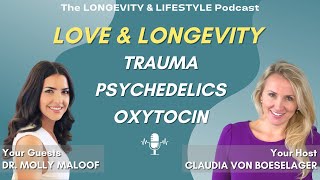
In this Longevity and Lifestyle podcast episode, host Claudia von Boeselager interviews Dr. Molly Maloof, a physician, Stanford instructor, technologist, and entrepreneur. Dr. Maloof explains how social connection and love are fundamental drivers of healthspan, linking mitochondrial function, oxytocin biology, and metabolic regulation. She describes mitochondria as "social organelles" that integrate stress responses and fuse/fission in response to relationship quality, arguing that poor relationships deplete cellular energy and promote inflammation. The conversation covers the impact of adverse childhood experiences and chronic psychosocial stress on cellular methylation of oxytocin receptors, and how this contributes to obesity, trauma, and disease. Dr. Maloof discusses psychedelic‑assisted therapy, especially MDMA, as a way to reopen critical periods of social reward learning, and reviews other trauma‑healing modalities such as somatic experiencing, EMDR, tapping, and narrative work. She shares personal anecdotes about weight gain during pandemic isolation and the restorative power of reconnection. The episode also details her entrepreneurial venture: an education platform and consumer‑product line that teaches mitochondrial health, relationship skills, and responsible psychedelic use, including a forthcoming Stanford‑based course that participants can also teach. Throughout, she emphasizes that love and trust (mediated by oxytocin) are “nature’s medicine,” protecting mitochondria, reducing inflammation, and enhancing cardiovascular and metabolic function. The discussion ends with a call to spread love, sign up for a newsletter, and consider community‑level interventions to combat deaths of despair.
Chapters
Hello and welcome to another episode of the Longevity and Lifestyle Podcast. I'm Claudia von Boeselager, your host, and I'm here to uncover the groundbreaking strategies, tools, and practices for from the world's pioneering experts to help you live at your best and reach your highest potential. Have you ever wondered how love and longevity are connected? Well, this is exactly what my guest today, Dr. Molly Maloof, Stanford University professor, pioneering physician, technologist, and entrepreneur, is working on. And we discuss, um, so you can learn today all about how to build stronger and healthier connections, why relationships should also be considered as a health area to optimize, solving trauma with psychedelics like MDMA, how oxytocin is linked to childhood trauma, the role of relationships in metabolism, how to build connection in a constantly changing world, and much more. And don't forget to please help spread the word and share this show with family, friends, and colleagues. The more people we can help with the message, the better place the world will be. So thanks so much for sharing. Please enjoy. Welcome to the Women for Longevity Club. We are talking about love and longevity today, which I'm really excited about with Dr. Molly Maloof. Such a beautiful, amazing topic. Dr. Molly Maloof, maybe you can give a quick introduction to yourself and then we can kick off.
Sure. So I'm a medical doctor by training. I spent about 10 years in Silicon Valley in San Francisco, working with executives, investors, and entrepreneurs. Helping them to optimize their health. I have also worked with over 50 companies in the startup space, as well as a few big brands, helping with product development, clinical strategy, scientific marketing, clinical research. And I'm currently writing a book with Harperwave Publishing. It's a book on biohacking for women that comes out in January 2023. And I started a company— I'm an entrepreneur, so I've started a few companies, but the most current one It started out as a pharmaceutical company aiming to work on an MDMA alternative, but what we've shifted to is to build an education and a CPG company. And so we're building a platform dedicated to educating the world about the biological imperative. So essentially energy metabolism and then relationships and social connection. There's quite a lot of interrelationships between the two, which a lot of people don't realize. And so we're building this education platform around that, and we're also building CPG products, including a legal version of a legal experience similar to MDMA. So legal Molly, and as well as food products. So that's what I'm up to. And I'm happy to be here today. I've been studying healthspan for quite a long time, and I taught a course at Stanford on how to live better, longer, extending healthspan for a longer lifespan. And one of the things that kind of surprised me when I was creating the course, which was largely about metabolism, movement, mastering stress, and maintaining connection to like your environment, to yourself, to your family members. Started teaching a lecture on relationships. And I started to feel like I had been missing something in my practice for a long time. And I really wasn't emphasizing relationships as an area of optimization because as a medical doctor, you really just are tasked to focus on the biological and not the psychological or the spiritual. But I was studying mitochondria and The weird thing about mitochondria that most people don't realize is that they are also not only the powerhouse of the cell, not only do they act as signal transducers deciding where the energy goes, whether it goes to survival or reproduction, they also control the immune system. They actually have a major role in the inflammatory response. But on top of that, they actually are social organelles. So they behave similarly to humans. They actually have similar— and Tim Bacardi is actually one of my companies, he's coming on as an advisor of my company. He wrote some papers that really blew me away. And it was all about how mitochondria are basically integrating our stress response. And a big part of our stress response is our relationships, but they do this thing where they come together and they fuse and it's called fusion and fission. They come together, they share information, they share energy, and then they break apart. And they are these incredible organelles that we just don't pay attention to because we think that all their job is to focus on metabolism. So when I really got obsessed with mitochondria, I started really asking myself, like, if energy deficiency is the root of most chronic disease, then what is the root of energy deficiency? And I realized that our relationship quality has a massive influence on how much energy we have, because if we have struggles in our relationships, the quality of our relationships really determines the quality of our life. And there's actually really great research that's all about how different psychosocial stressors, including adverse childhood experiences, caregiving stress, divorce, grief, loss, all deeply affect the body on a cellular level. And I wanted to understand this because I was trying to figure out why is it that when I was putting glucose monitors on people and I was seeing that people were getting this information about their body, and I was one of the pioneers in blood sugar monitoring. I was one of the first doctors to put these on healthy people in 2014. I didn't understand why some people, you put the glucose monitor on them and you give them the direct information of what they're eating is damaging their body. And they still reach for the cookie and the donut and they still reach for the chips. And there was something else going on in their body that was pushing them to eat emotionally and to choose the things that they know are damaging to their health. I was like, what's this all about? So I started really under— trying to understand the role of trauma in health. And so last year when I started my company initially, I was working on how do we solve trauma with psychedelics and the Multidisciplinary Association of Psychedelic Studies has basically shown that Molly, MDMA, can play a major role in helping reset this early social reward learning in the brain to actually open up the capacity to like reframe traumatic memories as not traumatic. And they can actually help people. Diminish the valence that these memories have on hold on them, specifically a PTSD. I wanted to understand why does MDMA work and why do adaptogens work? Why do these love drugs actually make you feel love? And why do they help heal trauma? What's actually going on at a cellular level? And so that took me down this rabbit hole of meeting these advisors, including Helen Fisher, who's one of the world's experts on love. She is Match.com's resident scientist. She's written multiple books on love. And so I talked to her quite a lot about the role of dopamine and love, the role of all these different neurotransmitters. And then I met Sue Carter and Sue Carter is an absolute legendary scientist and woman who I'm actually meeting with this week in San Francisco. She discovered pair bonding in prairie voles. And she's been one of the world's foremost leaders on understanding oxytocin. So I spent a lot of time getting to know Sue. Her husband's actually Stephen Porges who developed polyvagal theory. So it was through talking to Sue and Stephen that I really started to shape my beliefs around love and why loving relationships are so incredibly helpful for health and why toxic relationships are so incredibly detrimental to health. It turns out that social connection is a bigger driver of health and happiness than any other factor that we know, according to this longevity study on men specifically. Basically at the end of men's lives, they did an 80-year study. They basically showed that close personal relationships are what brought health, happiness, and satisfaction of life. Social disconnection, on the other hand, is actually potentially a bigger driver of disease than smoking, drinking, sedentary behavior, and obesity. So when I started looking at this data and these numbers, I was like, what is social connection and how do we improve it? How do we build it? How do we make it stronger? Basically, One of the problems that we have right now is there's quite a lot of deaths of despair because we're not dying from as many infectious diseases, although COVID has certainly killed a lot of people. Prior to COVID, we were mostly dying from chronic diseases. And then as we started to prolong life, we actually started to see more and more deaths of despair develop. So deaths due to isolation, deaths due to social conflict, social rejection and exclusion, And I was wondering, so why is this happening? If you actually look at the history of oxytocin and you look at the history of humanity, we evolved alongside a bunch of other hominids, but we won out of all the other hominids. So like we succeeded, like we were the ones, Homo sapiens won. And it's thought that part of the reason why we succeeded is our ability to create social bonds because Essentially, this is the kicker. Love and social relationships. If you think about love itself, like what is love, right? Like we always, we know it, we feel love, we have love, but what is love? So I was obsessed with love last year and I was studying the science of love and I discovered that love is a motivational force similar to hunger or thirst. It actually drives people towards one another and we get this dopamine from connection, but oxytocin is what creates these bonds. And love is driven by a bunch of different neurotransmitters, but dopamine acts to play a pretty big role. And love is this motivational force that drives us together because proximity, closeness actually increases the chances of information sharing and energy sharing. So we share resources and information and resources and information are what help us survive right now. Love also increases the chances of reproduction, right? So if we have close social ties, We're more likely to connect with people of the opposite sex and/or the same sex, but have children. And so when you look at love as this absolute fundamental facet of biology, that is so important to survival, just as important as hunger or thirst, just as important as food, you understand why lack of love and lack of social connection is so unbelievably detrimental to human. That's one of the things that I started trying to figure out. So communal support is actually really important for people to flourish, right? Because we need to share information and resources and we need to maintain proximity to reproduce. And life basically evolved oxytocin signaling for a reason. And this is the coolest thing about being a woman because women are basically oxytocin dominant. So we are literally the keepers of life. We create it and we propagate it. We nurture it. Men are all about protectors of life. They make sure that they're more vasopressin dominant. So they are more likely to be aggressive. They're more likely to defend. They're more likely to protect. This is life's basic design for a reason. Before I go into oxytocin, I wanna get back up to like evolutionary biology. The endosymbiotic hypothesis suggests that we engulfed bacteria, the single-cell organisms, the original form of life found on Earth engulf bacteria in order to harness energy from the environment, which enabled evolution. So this pattern of energy gathering And information sharing, sensing and integrating, and reproducing. This goes back to the very earliest forms of life. And so this is why I'm so obsessed with biological imperative as a foundational way to teach health. Because if you understand that life is about survival and reproduction and your biology does not care about your job, your biology only really cares about you staying alive and you making another person. And that doesn't mean that our minds believe the same thing because obviously I care about All sorts of stuff that's not related to survival reproduction, but our biology, this programming is running the show under the surface all the time. And when this programming gets disrupted, all hell breaks loose. And I'll give you a few examples of this later. Let's talk a little bit about oxytocin. We evolved oxytocin signaling for a reason, right? It creates this felt sense of safety and trust. It facilitates birth. You cannot have a baby without oxytocin. This is why people get Pitocin to induce labor. Facilitates lactation, it facilitates child-rearing and maternal behavior, it facilitates the growth of the neocortex in babies, it facilitates nurturing necessary for intellectual development, it facilitates social sensitivity and attunement necessary for human sociality and prosocial behaviors, which is also mediated by dopamine, it facilitates sexual behavior and orgasm, it facilitates partner preference, it facilitates pair bonds and familial bonds, So like literally this hormone is like what ties us together. And that's why when I met Sue, she's really hammering this into me. Initially I was like, why do you care so much about oxytocin? But the cool thing about MDMA is that it releases a ton of oxytocin. And it's thought that basically oxytocin is an important target and mediator of experience, experience-dependent learning in early life. And it affects adulthood because the early environment programs adult levels of oxytocin and oxytocin receptor activity. And so early life experiences can change the methylation status and set you up lifetime functioning of oxytocin system, which is— this is part of the reason why adverse childhood experiences are so fundamentally detrimental to long-term health, because they will literally— like childhood trauma can actually contribute to methylation of the oxytocin receptor. And especially in kids with autism, there's actually evidence that in autistic kids, they have extra methylation of the oxytocin receptor. And it's thought that this receptor being open for business, able to be touched by the oxytocin, it's basically thought that that's what mediates the ability for us to feel these connections and the safety and this feeling of being connected to our family, our friends, and our, our parents. So. The thought is that MDMA can reopen this critical period of social reward learning and enable people with trauma from whatever path part of their life to potentially reprogram that trauma, not as fearful, but as just another life story that they have. Let's get a little bit into the role of relationships in metabolism, right? Turns out that there's evidence in people with obesity that you actually talk to Bessel van der Kolk and read his books. One of his first work, he wrote the book, The Body Keeps the Score. One of the first things he discovered before opening his own trauma clinics was when he was working in an obesity clinic that almost every adult with major obesity had some sort of trauma that was unresolved. And so it's thought that early life trauma, midlife trauma, all these like really challenging experiences contributes to the body going into a response of trying to protect itself. Okay. So the body's always trying to protect itself. You have to look at all maladaptive behaviors as a physiological protection mechanism. When you see the body this way, it makes everything in life make more sense. Obesity. First of all, we live in a very obesogenic environment, but we also live in a fairly traumatic world because America is filled with all sorts of stupid dangers we shouldn't have. We shouldn't fear for our lives going to school. We shouldn't fear for our lives walking down the street. Like we live in a very strange world where the media is sending us tons of fear-based messages. Honestly, a lot of our social networks are dissolving, which is a huge problem. We need these social connections because we need this feeling of safety and comfort in order to be able to let go and relax into our lives. But if someone is under chronic stress or someone has a history of trauma, what happens is their body and their mitochondria actually go into a different function. Okay. So there's this concept of sort of peacetime and wartime metabolism. And there's this thing called the cell danger response. And when I discovered the cell danger response, I was like, oh my God, this makes so much sense. So basically when you are under threat, your metabolism says, I'm not really gonna focus on like rebuilding the house and like doing these upgrades. I'm gonna focus on turning the alarm system on and protecting the house so that it doesn't end up falling apart. So if, if you're in a hurricane, you're not gonna bring in contractors to go install a new bathroom, right? You're gonna have someone try to keep the doors closed and the house protected. So this is part of the reason why when people are under chronic threat, people have a history of trauma, which by the way, trauma creates a threat-based state and hypervigilance at baseline. So for a lot of people with, a lot of people under chronic stress, a lot of people who are impoverished, people who have to work multiple jobs, people who don't have strong social ties, people who have dysfunctional family systems, people who are exposed to violence, drug addiction, alcohol, alcoholism, their nervous systems are at a state of hypervigilance at a baseline. They're not really gonna be able to have a normal metabolism because they're not actually able to relax. And so when you look at this, you actually understand why people are constantly feeding their fear with food, because food is the most accessible addiction that we can find. And hyper-processed foods, as we know, are designed to be addictive. They're designed to hijack the brain's reward systems. They're designed to hit the bliss point. They're designed to release a lot of dopamine. They're designed to make people feel that they need these things because of these advertisements that they're getting right after watching fear-based news on television. But the interesting thing about oxytocin in my own personal experience, I'll give you a little anecdote. So 2020 sucked. I'm sure you all knew that. I ended up gaining like 10 pounds and honestly, I looked great, but I didn't feel great in my body. I just, I didn't feel good having 10 extra pounds on my body, but I couldn't lose it. I could not lose 10 pounds for the life of me. I was extremely disconnected from my family, from my friends, and even my family because my parents were staying in a different house. And I was like working remotely alone from a house in Florida, teaching at Stanford. And I remember the isolation really screwing with my mind. And I ended up getting very burned out and just feeling like nothing's working physically. Like none of my traditional biohacking things were working for me. So 2 months go by, I decide I'm going to leave the Midwest and go back to California and start visiting my friends in different cities. And as I started, as I got vaccinated and I started traveling again, it was feeling of connection that I had with my friends was like the greatest high I've ever felt in my entire life. Cause I was like, oh my God, I've met people again. These are my friends. This is my community. I need these people. And the weight just started coming off, like without even trying. It was just like the moment that my nervous system felt safe and my nervous system started to feel connected again. And as I started to travel to different communities in different cities, and I felt so much more connected, my nervous system started to relax and my metabolism shifted and my metabolism just went back to normal. And what I learned is that oxytocin, is an anti-inflammatory. It's an antioxidant and it's mitoprotective. So it actually protects the mitochondria and the mitochondria, as I'm telling you, they're like basically telling your metabolism, they're responsible for whether your metabolism is like peacetime or wartime. Oxytocin is really interesting because it influences mitochondrial function. It's very cardioprotective as well. So it increases AMPK signaling, which increases autophagy and increases insulin sensitivity. It increases UCP2, which decreases reactive oxygen species and decreases inflammation. It increases PGE2, which decreases sarcopenia, increases wound healing, increases repair of damaged myocardium and damaged cells, increases PPA or gamma, which decreases inflammation and decreases plaques. It improves glucose and lipid homeostasis, and it increases ANP, which decreases blood pressure, and it increases vagal tone, which also decreases blood pressure. So I decided, Okay, where am I gonna move? Because I wanna, like, the world's only gonna get crazier and things are probably not gonna get necessarily better before it, it's probably gonna get a little worse before they get better. So I found myself moving to Austin because it was the one place in the country where I felt a deep sense of connection to a community. And it felt like this sense of joy of being with people was so palpable that even though the weather isn't crazy hot, I feel healthier there because I feel more connected to people. And now what I'm doing with my company is basically trying to take this knowledge. I just taught all of you and turn it into a course that teaches people fundamentals of mitochondrial health and energy metabolism, and then social connection, sexuality, love, and attachment. Because I believe that if we can teach people how to survive and how to properly build these social relationships, whether you want to have kids or not. It's like really not the point. The point is that we are here to connect. We're here to live in a connected state. We're not designed to live alone. We're not designed to be isolated. The isolation of the pandemic was one of the biggest social experiments ever done. And it had massive ramifications for society. We've had record numbers of suicides, record numbers of drug overdoses. And there was an interesting article I read today in Time about how in the Philippines there's essentially a lot of guns in the Philippines, but they have no mass shootings. And the reason why they believe that they don't have mass shootings in the Philippines is because of— they really believed in social connection, and social relationships are really valued, and families are very valued. And the idea of bringing dishonor to a family is that they just— people are super, super connected. They talk to each other, and they would catch someone before they would end up causing a mass shooting. So it's really interesting to think about how we have a problem with mass shootings. One of the things that all these kids have in common is they come typically from a broken home, from violence, from drug addiction, from abuse, neglect, lack of love, and they're not being paid attention to. And to me, if you look at some of the biggest problems of today, if we could really look at this problem of disconnection as like a thing that we can actually address, we could potentially improve life for millions of people downstream. We could really change the quality of life for many people for a lot longer. Thank you.
So exciting, Molly. And thank you so much for sharing that. And I love the structure of walking through from the mitochondria to love and connection for the whole world, the meta view as well.
I want to open it up to questions.
Molly, I'd love to ask you as well, just exactly, is it a course you're creating?
Yeah. So the course is basically going to be taught to people and then anyone who takes the course, it can teach the course. And if you teach the course, you get paid to teach the course. So it's designed actually interestingly, the company's kind of designed with the same principles of mitochondrial function. So people come together, share information and resources, and then they break apart and they go off into their communities and share information and resources. And the idea is we want to create a health platform That's different than a lot of what we see in the world because I was not taught sexuality, love, or attachment in medical school or college. I was not taught about energy metabolism from the perspective of like the relationship of our, of our human relationships to our metabolism. I wasn't really taught about mitochondrial health. Almost everything that I learned, I learned after medical school, after residency. And I'm actually working with Harvard students to write a white paper on this theory and to, to, I'm working with Princeton students to develop new questionnaires for social connection. So we can actually put on the website a way to evaluate how connected you are. And we are gonna be teaching people about psychedelics. We are going to give people knowledge on how psychedelics have been used historically to enhance social connection through ritual. And so the way I see it, like psychedelics are used currently today in pharmaceutical medicinal realm, in the spiritual realm, a lot of people are building psychedelic churches and then recreational. Of course, companies like Delic are all about partying, which is great. I actually think there's a role of help partying and health, but what we're really aiming to do is figure out how do we bring people an understanding of how to create deeper connections in their communities with or without psychedelics. We're really teaching people. The most interesting thing I'm learning is like, when you start learning some of the most basic communication skills that can enhance relationships, even things that are designed for couples can totally translate to friendships. So like, for example, Imago Therapy by Harville Hendrix. It's so simple. It's literally the most simple thing. Like, it's all about mirroring, validating, and empathizing. Okay. It's not rocket science. And yet I've started to use this in my conflicts with friends or colleagues. And I cannot believe the outcomes that I'm getting with people. There's, it literally diffuses conflict so quickly because the other person feels seen and heard. So we're basically trying to give people, we're summarizing 50 books right now. And I already have this whole course that's been designed for Stanford. So we're breaking down the Stanford course into all the most actionable things. And then we're, and I'm also launching the course, um, as is right now, because I had a waiting list about 400 people. So we're launching the Stanford course just as is because We're trying to get feedback this summer on what works, what doesn't work, what people like, what they don't like. And then, and then the, I've got about 20 people working with me on this course. So there's this incredible website called Handshake. So we've recruited like top-notch students from all over, like undergraduates, grad students, and graduates from all over the country and world. And we've got 20 people working with us to really comb through the best research, summarize the best literature. And create this course that will be like— it's basically Human 101. It's like, how do you prepare for your life? And that's what the brand is going to be based off of. It's all— it's going to be very much based on love, connection, energy, metabolism, because who doesn't want more energy, more love? I want all the energy and all the love. And so given the fact that I have more energy now at 38 than I did at 28, I'm like a walking testament that this stuff works. And the coolest thing about when you hack your energy metabolism and you hack your relationships, it's like everything in life just gets easier because you have more capacity to meet your demands. So mitochondrial function is all about capacitance, right? You're building literally capacitors, flux capacitors, and batteries. And so when you teach your body to take care of these two really important organelles, your body has more capacity to meet your demands. Now, right now, this month, I'll be honest, my capacity is about here. My demands are here. And so I've been like overstressed a tad because of moving, finishing a book, finishing launching a course and advising companies and hiring for my company. So it's been beyond crazy, but surprisingly, like I actually, like I'm, I haven't gotten sick. I've been like healthy. I've been working out. Like, I definitely have partied probably a little too much the last 3 weeks because Austin had a bunch of live music shows. So I've been to a lot of like live music lately, but I feel like I— these tenets of health, they give you superpowers. So if you can diffuse conflict, if you can have the energy to meet your demands, like your life just changes because you actually believe like you just have more resources to go around. So it's all— it's like if you think about mitochondria function, like making money, like all these health habits that you create and all these relationship habits that you develop, when you can diffuse tension and not spend a whole day in an anger, angry, or emotional state, you've saved yourself a ton of emotional— like a ton of cellular money. Like ATP is cellular money. And if you build a lot of money, like cellular money, ATP in your cells through this compounding interest of these health habits before you just have like you can actually handle the level of crap that I'm doing right now because you're like, I saved up all this cellular cash and I'm spending it. Now I'm at the point where I'm like not broke yet, but I definitely am like, okay, the bank account's really getting kind of low right now. I need to go back. So once I finished moving, I've like really, I just joined a phenomenal gym and I like, you kind of have to rebuild your health. So health is this dynamic thing that doesn't just, You don't just have health. It's like health is a constant dynamic state of you and your environment. It takes lots of care and attention and attunement to build health into your body. But the more health that you create for yourself, the more you can get hit with a major stressor like COVID and you can bounce back because you have enough capacity that if you get knocked out a little bit, you still aren't knocked out here. But the problem with most Americans is when they when they got hit with COVID their capacity and their demands were about equal. And so they just got knocked down to here. And that's when the body starts to break. When your energy capacity drops down and your demands are this high, you can't have enough energy to maintain the integrity of the structure. So life is very simple. It's energy plus information plus structure. The mind, even simpler, energy and information. So when you look at life in the mind very simply, this, you can understand how physical health and mental health are super dependent on energy. And that's why I've basically committed my life to understanding mitochondria because they are responsible for creating energy. So that's part of the reason why I'm obsessed with them.
It sounds amazing. I like that. I want to touch on trauma, Molly, because this is like the blueprint for like how to be a good person, assuming that there's no trauma things as well. But I think what are some of the strategies and tools you recommend around trauma for releasing it? You've obviously talked about MDMA and doing therapy there, but what are some other powerful methods you've seen for helping people to release trauma?
I'm a really big believer in somatic experience, somatic type therapies. There's a bunch of different kinds and a lot of it's trial and error, but I was, I worked with a guy who was like his own, he did it, created his own version of trauma healing and really involves just shaking a lot. Like, it's almost like animals— and interestingly, animals in the wild, often when they get attacked by another animal, they survive, they will shake a lot. And some animals even go as far as to recreate the entire sequence of being chased, and then they go into this process of— they, they actually will re-experience the whole thing over again. And then they will, and they'll play it out potentially with part, with, with other, their other animals, almost as though they're trying to like re-experience the thing, but not make it as threatening, not make it threatening. So there's, there's a bunch of different things that I think are fairly effective, but I think anything that can get you into your body and help you really almost move the physical trauma out of your body. That's really key. And then the narrative, I think the narrative work is really important. So being able to create a coherent narrative around the trauma and be able to revisit that narrative and slowly not have it— if you're basically finding yourself having an emotional response to a traumatic experience, you haven't resolved the trauma. So that's really important to understand. Like, for me in the last year of just starting a company where I was like really studying sexual trauma and I was able to start talking about it to people very nonchalantly, I was surprised at how just talking about it in a place of not reacting was extraordinarily healing for me because I did, because I really love the book Power Versus Force by David Hawkins. And in that book, there's a scale of consciousness. And in the consciousness scale, the very bottom of it is shame. And midway through is courage. And then you get to like reason, love, peace, joy, enlightenment. And I love this scale because even my friends who are scientists can actually grasp this. Yeah. But when I lifted all the shame away from any of the experience that I had, I was like, oh my God, I feel like I have this burden that's off me because I don't have any shame left. Why should I feel ashamed about this? It wasn't my fault. And then, and so I really think that there's always a spiritual component to healing. And, and so like rewriting your narrative is really key. I think also like some people try EMDR. I haven't done it myself, but EMDR is like aiming to use eye movement desensitization. It's almost using your brain's nervous system to reformat the memories. I think MDMA is important, but it's also extraordinarily— one important thing you should know about MDMA is that if you do not feel safe with the therapist that you're with, you will potentially— this is really important— when you have MDMA experiences and you get extremely anxious or unsafe in the middle of the experience, your body has a natural kill switch where it will not let you hit the oxytocin receptor. It'll block the receptor and it'll activate vasopressin, and it will do this to get you out of danger. You want to really create the most unbelievably safe container for all psychedelic use. You wanna know the people that you're with. You want to really know the therapist that you're doing work with. You want to be properly prepared for the trip. You want to be properly go through the trip and integrate from it. And I know women who've gone through MDMA experiences with therapists that they didn't trust, and they ended up more traumatized after the experience because they were feeling anxious the entire time. So very important to just not not attempt these medicines, not like a nonchalant way, making sure that you properly prepare yourself for them. And yeah, there's a— we're obviously like, we're reading a bunch of books right now on the topic of trauma. So there's a lot more to do there.
But, um, tapping, what's your view on that?
Tap? I find tapping personally to be very useful, but I But I do think that like, here's a, here's a very interesting thing. So a lot of tools that we don't have necessarily, like we don't necessarily have like hardcore science on, which I don't know if there's tapping science or not. I don't know if the published literature is, but one of the most interesting things I discovered is that the placebo response is also likely mediated through oxytocin. So the placebo response is all about expectation of improvement of health. And placebo response is also highly dependent on the therapist and the trust you have for the clinician. And it's also highly dependent on the experience around the healing of the actual healing experience. So if you think about it this way, like a lot of the research on compassion in medicine is like actually demonstr— and a lot of the research on placebo the research suggests that like compassion, the placebo, and even gratitude, the underlying neurobiology of all this stuff works is oxytocin. So the theory is that oxytocin is nature's medicine. This is Sue Carter's paper. I highly recommend reading the paper by Sue Carter, Oxytocin: Nature's Medicine, and then Love and Longevity. Those two papers are particularly good because if you can understand a lot of these things that may or may not have good science, can act, but they can activate the oxytocin in the body and make you feel safe. That's lifting the stress on the body, enabling the mitochondria and the nervous system to relax and enabling you to be able to start to heal. So I think like most importantly is you surround yourself with people that you can love and trust, and you find really good— one of the biggest factors in outcomes in healthcare and psychology is the relationship you have and the trust that you have with the person, right? So it's like the therapist or the doctor. So why is that so important? The hormone of trust is oxytocin, and oxytocin is very healing to mitochondrial function and enables the body to drop into a state of lowered hypervigilance and enables your body to start to do the repairs it needs to do. So this is my sort of grand unified theory of health, whether or not I can prove prove it. I think I can. I think direct experience is all you need. And to me, but we are gonna be doing research on our company. We're gonna try to do a study with Stanford. And I think the more we align ourselves with these like top institutions and we create this consumer brand, but we back it up with the good science, the more we're gonna be able to propagate. We can teach people that human decency and love and connection and kindness is the way to healing our communities and our society. And I don't think there's enough doctors like this doctor and enough therapists out there to be able to offer the kind of care that people need. So it's gonna have to be through grassroots efforts. It's gonna have to be through galvanizing community leaders and getting people to realize that they can be responsible for helping their communities heal and their friends and family heal. And like, it was really studying love and realizing that This one doc, Dr. David Hawkins, he basically had a near-death experience and he almost died. And then he like saw the white light, came back to life, and since then basically had a spiritual awakening. And he had insane outcomes as a psychiatrist. Like he had incredibly profound outcomes and he barely prescribed any medication. And it was thought that in his books His belief is that love is medicine and that his love is actually what led to the healing. And this goes back to Jesus, right? Like, it's very possible that, like, the scientific underpinning of love being about safety, being about helping mitochondrial function better, being about helping the nervous system relax, being cardioprotective, mitoprotective. It's very possible that we can literally feel love from people, right? Like, we can feel it when someone loves us, and that is healing. And so if we can get people to raise their consciousness towards love, which is really hard, by the way, because we're all tired, we're stressed out. There are days where I'm rude to people and I don't want to be because I'm just tired. And it's a daily practice, though. Like, one of my best friends— and I'll just kind of leave you with this— is there's very little spirituality in medicine, but like, I have a few friends that are like genuinely enlightened. But one of them, I asked him like, what do you think enlightenment is? And he's like, enlightenment is a verb. You have to practice it daily. The more that you behave in an enlightened manner, the more you are enlightened. Some people can be like that all the time. I have friends that like literally are just in a state of fundamental well-being 24/7, and they are genuinely like unshakable. Like, they are phenomenal people to talk to. But for the rest of us, enlightenment is a verb. We have to spend our time working up the ladder of consciousness, trying to be in a space of love, trying to move past just reason, trying to be in a state of love and peace. And if we as women can like band together and like really try to lift society up in this way, I think we could actually save our own country. And that's part of the reason why I'm on this mission.
Wonderful. Molly, thank you so much. It's such a pleasure. Let's spread some more love today.
Hi everyone, this is Claudia again. Before you take off, would you like to get a short email from me with some short but sweet fun tips, tricks, and updates on all things longevity and lifestyle? This could be cool products that I've discovered, interesting posts or articles I've read, and other fun and helpful things around longevity and lifestyle I've found for you. It's a very short piece of inspiration for you a few times a month, so if you want to receive it, check it out by going to longevity-and-lifestyle.com. And lifestyle.com. That's longevity-and-lifestyle.com.
And leave your email to sign up for the next one.
More from Claudia









Can Psilocybin Slow Aging? The Study on Telomeres, Inflammation & Survival with Dr. Louise Hecker

