Dr. William Li on Metabolism Myths, Brown (Good) Fat, GLP-1 & the Future of Food as Medicine
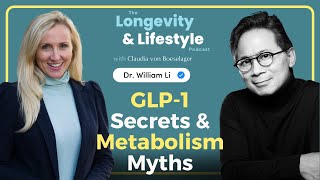
In this Longevity and Lifestyle Podcast episode, host Claudia von Boeselager interviews Dr William Li, a physician‑scientist known for his work on food‑as‑medicine. The conversation begins with a brief sponsor read for Pendulum, then moves into a deep dive on common misconceptions about metabolism. Dr Li explains that metabolism is not a fixed trait handed down at birth; instead, recent global research shows human metabolism follows four predictable phases across the lifespan, remaining stable from age 20 to 60 and only modestly slowing after 60. He reframes body fat, describing adipose tissue as a vital fuel‑tank and endocrine organ, and distinguishes white fat (subcutaneous and visceral) from brown fat, which generates heat via thermogenesis. Brown fat can be activated by cold exposure and by specific bioactive compounds in foods—capsaicin in chili peppers, quercetin in onions, sulforaphanes in cruciferous vegetables, polyphenols in olives and blueberries—each triggering the TRPV1 receptor and catecholamine release, which in turn stimulates brown‑fat activity and burns excess white‑fat, especially visceral fat. Dr Li cites studies linking visceral fat to increased breast‑cancer risk and explains that excess fat, not a slow metabolism, is what drags metabolic rate down. He outlines practical bio‑hacks—cold plunges, dietary choices, exercise, sleep, stress management, and intermittent fasting—to preserve metabolic health and leverage brown‑fat activation. A substantial portion of the interview focuses on the gut microbiome, especially the bacterium Akkermansia muciniphila, which appears to boost natural GLP‑1 production; foods that nurture this microbe (pomegranate, cranberries, Concord grape juice, Chinese black vinegar, hot chili peppers) are discussed. Dr Li explains that GLP‑1 receptors are present throughout the vasculature, so GLP‑1‑based drugs (Ozempic, Wegovy, Mounjaro) may lower heart‑attack and stroke risk and could have neuroprotective effects, linking metabolism to broader chronic‑disease prevention. The episode ends with a call to empower listeners to take control of their metabolism through evidence‑based lifestyle changes and a reminder that health should be joyful, not stressful.
Chapters
Hey there, I'm Claudia von Boeselager, a former investment banker turned entrepreneur, longevity coach, biohacker, and mother of two. Once burnt out and overwhelmed with chronic health issues, I've transformed my life and helped thousands of people do the same. I've even reduced my biological age by 17 years. Yes, I'm 26 again. Now I'm here to share the tools, strategies, and inspiration to help you live healthier, happier, and longer. On this podcast, I interview world-leading experts in health, biohacking, mindset, and performance, and share personal stories and learnings to bring you the latest insights and tips. Think of this as your go-to space for real talk about all things health and optimizing your life. Ready to unlock your best self? Let's dive in. This is the Longevity and Lifestyle Podcast.
Hello, dear audience. After an incredible impact of our first conversation, I'm delighted to welcome back Dr. William Li to the Longevity and Lifestyle Podcast. Dr. Li is a world-renowned physician, scientist, and author celebrated for transforming the way we think about food and health. As the author of the New York Times bestsellers Eat to Beat and Eat to Beat Your Diet, he has pioneered the concept of using food as medicine to both heal and optimize the body, a concept we love at Longevity and Lifestyle. His groundbreaking research has contributed to the development of more than 40 new medical treatments impacting over 70 diseases, including cancer, diabetes, heart disease, and obesity. Dr. Li's TED Talk, Can We Eat to Starve Cancer, has been viewed more than 11 million times, and his insights have been featured on Good Morning America, CNN, CNBC, and Rachael Ray, positioning him as a leading authority on harnessing the power of food to prevent and fight disease. As president and medical director of the Angiogenesis Foundation, Dr. Li's mission is to empower people everywhere to take charge of their health and longevity through scientifically proven nutrition strategies. Please enjoy.
Brief pause. Claudia von Boeselager here again. This podcast is possible thanks to sponsors I've personally vetted and truly believe in. Supporting them helps keep the show free for you and supports your own longevity journey. Now, a quick word from today's sponsors. This episode is brought to you by Pendulum. If you've been listening to this podcast, you'll know that longevity isn't about quick fixes. It's about supporting your body at the root. And one of the biggest realizations I've had from talking with experts is that so many foundational systems, from your energy and metabolism to immune health and even mood, all start in your gut. That changed the way I approached my own health, and it's exactly why I'm such a fan of Pendulum. They're a science-driven company pioneering a whole new approach to gut health. In fact, Pendulum is the first company to bring live akromancia to market. This is a game changer. I recently started taking their Metabolic Daily, and I can tell you, I'm already noticing a real difference. My digestion feels smoother, I have more consistent energy, and I love knowing that I'm supporting my gut at such a foundational level. For me, this is a cornerstone of longevity. If you're serious about your health and lifestyle, this is where to start. Because when you support your gut, you support your entire body. And for you, dear audience, get 20% off your first Pendulum membership order by heading over to pendulumlife.com/claudia. That's pendulumlife.com/claudia20. The discount is automatically applied at checkout.
So welcome back, Dr. Lee, to the Longevity and Lifestyle Podcast. It's such a pleasure to have you back with us today.
Thanks, Claudia. It's a pleasure to be back. Thanks.
So I'd love to start with metabolism myths. There's so much misinformation out there, and you've challenged the popular idea of a slow metabolism. What are the biggest myths you see around metabolism? Why are they misleading, and what's the real truth people need to understand?
Yeah, you know, I would say that the reality is that our understanding of human metabolism is changing at a rapid rate, and it's really based on science. And so it's less about misinformation and more about how advanced we are becoming in our, in a better understanding of how our body actually works. Now, let's just, let's just acknowledge for one moment that metabolism is something that everyone feels like they know something about really, even at a young age in high school and maybe even earlier where we have always said, oh, I've got a fast metabolism or a slow metabolism. You know, the thing that I've always heard myself is that, you know, somebody I know who's sort of heavyset, maybe a little overweight, says, you know, rats, I've got a slow metabolism. I was the unlucky one in my family. You should see my sister. She's skinny as a stick. She can eat anything. And she was blessed with the genetics to have a fast metabolism. So that's kind of the, I would say the dominant mindset that many of us have is that our metabolism is really the roll of the dice at the beginning of our life. And that, you know, who knows, fate assigned us a metabolism at birth. So that's one common belief that in fact new research is teaching us is not really true. So I want to kind of set what we understand now out first before kind of tackling them, like, you know, sort of giving them a real body blow in terms of the myths. The second common understanding is that if you have a slow metabolism, that is what causes you to gain weight or get fat. All right. And especially this is true. In as we head into middle age. And, you know, all of us who were lucky enough to make it past our young adulthood, get into middle age. And without a doubt, it's a real phenomenon where people begin thinking about their energy. They're beginning to rue in front of the mirror that their body shape changes and their clothes don't fit as well anymore. And then they look to their friends and family members and they see similar things happening with them. And so this idea that, you know, I've reached middle age, my metabolism is slowing. And therefore I'm gaining weight and my body fat is increasing. That is also another common belief. And it's not just a belief, it's an observation as well. But how we think that happens, which is that's a slow metabolism that causes that, actually that is being upended as well. In fact, it's the other way around, and I'll get to that in a second. The next thing that actually is a commonly held belief is that body fat is actually a bad thing universally. You know, I mean, if you think about it, the typical— and this starts when we were very young, even in grade school. You know, first of all, when we're children, boys and girls, pretty much their body shape looks all the same. Somebody might have be stockier, have bigger bone structure, but actually we're all basically lines straight up and down. All right. And it isn't until we hit puberty and then into young adulthood that we begin seeing those changes that characterize our, our identities, our physical builds, and therefore our sensitivity to how much body fat we actually have., right? Who hasn't stood in front of the mirror after taking a shower and, you know, cursed at what they actually saw and then stepped on a scale and looked for the number and, you know, sort of kind of then really felt that they needed to get in better shape because that number isn't the one that they were hoping for, right? So these are the things that are so commonly, so common, I think, across society, any society that I wanted to maybe bring everyone listening and viewing up to speed on how things are evolving in terms of our sharper understanding of metabolism. And the great news, Claudia, is that this sharper, newer understanding actually puts control back into our hands. Whereas previously the idea of metabolism, the way that I just, I think, shared that I think everyone would nod their head and is like, this is so totally outta my hands. There's nothing I can do about it. It's my fate. And I've just gotta learn how to deal with it.
So disempowering, right? What, what, what, what do you have to share?
Right. Well, so look, this is where science gives us the ability to jujitsu the, the commonly held beliefs out there, because as we begin to understand more and more about our body in general, it really turns out that we have a lot more power than we ever thought before. Okay. So, and we know this is true with cancer and heart disease and diabetes and probably dementia as well., but certainly due to metabolism, which I know you wanna focus on. So let's go ahead and think about, let's start with body fat. What do we think about body fat that is not true? Well, we think body fat is kind of a negative thing. And in fact, I like to give this analogy. Every, anybody who's been to the grocery store, even if you're a vegan, you're pushing your shopping cart. At some point you're gonna pass the meat counter and you're gonna look at a big ribeye steak and you're gonna see a big rind of fat around the outside and it's gonna make you automatically shudder and go, oh man, I hope nobody eats that fat. That's kind of disgusting, right? That's natural. And in fact, I think the lexicon in our society, modern society, is that anything fat, fatty is unpleasant and is also just something we don't want. We want to stay away from it.
Okay.
That's, I think that's part of the mindset that we actually have. The vernacular, the terminology is also very negative association, but I want to point out that we know that fat can't all be bad. And you know how we know this is because there is a situation in which we look at body fat and everybody smiles the biggest smile they can. And that is when we see a baby, a newborn who's big and chubby and fat. It makes everyone smile. Even now you're smiling. Super cute. Adorable. Yeah.
I'm imagining one.
Yeah, exactly. Right. And so, and by the way, We know that a fat baby, a cute, cuddly, fat, pudgy baby is a healthy baby. And we also know that if you saw a baby that looked like a runway model, chiseled cheekbones, long, thin arms and thin thighs, you would know that there is something seriously wrong with that child. Right. So this is an example that clues us in from the beginning of life that fat can't be all bad. And that leads us to really ask the deeper question. What does, what is fat all about anyway? And what is new science teaching us about body fat and why is it good? Is it good at all? And the answer is that fat is extraordinarily important. So important that it is one of the first tissues that forms in our body. Okay. So when your dad's sperm met your mom's egg and they got together and you were just a ball of cells, we were all just a ball of cells. We had no face, We had no waistline. We had no chin to have to double, no double chin. We had no, we had no arms to have a flap underneath. You're like, we had nothing. All right. No, no belly. All right. The first tissues to get laid down is your circulation. You are the first thing that forms in your body that you're developing body are, is your circulation. We know that's important because every organ, every cell in your body relies upon a blood supply, oxygen, nutrients, what have you. All right. So that, and that's what I study. I study angiogenesis, which is how the body grows blood vessels. Yeah. Well, this is what drew me to this. It's like a really, a common denominator of how critical for the wellbeing of your organs and therefore critical for your health. So that's one of the first organs that form. The second organ that forms is your nervous system. Nerves track along blood vessels just like power lines do along a highway. And the reason that nerves are the second most important tissues to form is because every organ needs to have an electrical signal to turn them on. It's like the wiring in your house. You need to be able to have those on and off switches and the wiring needs to be put into place. Okay. Guess what? The third organ, that tissue that forms is body fat. We call it adipose tissue. All right. What is fat forming before we even have a face? Well, it turns out that, well, not, not yet, because the way that fat forms at that early stage in life is it forms wrapping itself around like a like bubble wrap, a sheet of bubble wrap wrapped around our circulation, wrapped around our blood vessels. Okay. Not under our chin, not under our arms, not, not around our waistline, but wrapped around our blood vessels. So you might be asking the question, why is it that body fat forms around blood vessels? Well, that is actually the first clue of what the role of healthy role of body fat actually is. That is, fat cells are called adipose cells. A mass of fat is called adipose tissue, like a, a sheet of fat. And adipose cells, fat cells, actually function in part as fuel tanks for the body. Fuel tanks, just like the fuel tank in your car. So think about it like if you are at a gas station, if you were driving a car that runs on gas or diesel or petrol in your case in London. You're gonna be driving along and you're not even gonna think about your fuel until your, the, the, the gauge runs low. And then all of a sudden you can't stop thinking about getting fuel. Where's the next gas station? You gotta find the petrol station. Yeah. Yeah. Where's the next gas station? So you're gonna like focus on just that, right? Yeah. And, and when you get to the gas station, you pull the car over, you turn off the engine, you take out the nozzle and you put it into the tank and you fill it up to the top. Well, that's how our fat cells work as our fuel tank, because when we eat food, the food gets absorbed in our stomach into our bloodstream, all the nutrients in our bloodstream and the energy from our food has to get stored someplace into the fuel tank. And our fuel tank is fat cells. The fat cells are parked right next to the blood vessels. So it's easy to put the fuel in the fuel tank. All right. Now, unlike the metal container of the fuel tank in your car where, and unlike the gas station where when you fill up the tank and it gets to the top, the nozzle goes click. Now there's no more fuel that goes into the tank. All right. In our body, there's no clicker. So you can keep putting fuel into the tank and our fuel tanks, our fat cells are not made out of metal. They're stretchy and they can stretch in fact 3 times their size, 300% from their initial size. So fat cells as our fuel tank, when you overload them with fuel, i.e., food, i.e., calories, you can expand this to 3 times as large as where they, when they started. And that's a good thing by design so that we always have enough fuel. You don't want to run out of fuel. Now here's the problem. Now think about your car at a gas station. If the nozzle were broken at the gas station and there was no clicker, okay, you just fill the fuel tank. The fuel flows up, overflows the tank. The gasoline runs down the side of the car, around the tires, pools around your feet, right? And now you're standing in the midst of a dangerous, toxic, flammable mess. Yes. Hazard. And that's exactly what happens when we overload on the fuel that we eat. You blow up this fuel tank to its max, like 3 times the size. You keep going, keep going, baby. What's going to happen is that you're actually going to overflow that fuel tank and then that fat spills out. And that fat then gathers in the liver and that can actually cause fatty liver or nonalcoholic fatty liver disease, which is of course a big problem we're hearing about everywhere. It's a metabolic disease. And, and I've just given you an explanation to how something good, fat for fuel as a fuel tank, can suddenly lead to an overflow, which then causes a problem. And therefore that is a good thing until it becomes a bad thing. Okay. That's a very important concept. And that's why when we— our fat forms as a child, we— it forms in a very deliberate way that actually serves our metabolism. And so that's one of the myths that I think I wanted to start off by addressing, which is that all fat is bad. Nope. Actually, fat is pretty good. It's a fuel tank. You need fat. And by the way, you know, you need fat because if you take a look at marathon runners, especially women, you know, who go down to 1%, 2%, or even 0% body fat, not only do they look very strange, they don't look right, but their body, their body also doesn't function properly as well. They don't sleep well. They're very stressed, right? They get fractures. Like their metabolism and their hormones are completely out of whack. And that's a second function of body fat is that it actually is a, it's an endocrine organ. So in addition to be a fuel tank, Mother Nature is very clever. She's given body fat, adipose tissue, multiple job descriptions. A second job description actually is to be a hormone or a hormonal organ, part of our endocrine system. And fat makes 15 or 16 different hormones that interact with other hormones in our body. All right. Of course, including our brain, but our bones, our muscles, our cardiovascular system. And so when you actually have fuel normally being stored and used up, just like a car filling up and burning down the gas when you're just going about your way, that's fine. But when you have to overflow your tank, now it's, you've got this dangerous flammable mess. And because fat also forms, has a hormonal role, when you actually overflow fat, you wind up having too much fat or too little fat. You wind up disrupting and overthrowing that orchestration of hormones that is so important for normal healthy function. And women in particular will feel this even more because of the complexity of the orchestration of hormones in a, in a female body. All right. So that, that's another really important point. And the theme that I'm setting out, Claudia, is that fat is healthy and we need fat for lots of reasons, including the thing that you said earlier, which is cushion. By the way, we didn't have any fat in our body. If you tripped on the rug and fell on the floor, your organs would rupture. So thank goodness we actually have some, some, some body fat for cushion. But these are just some of the many roles that body fat actually plays that are beneficial.
I love it. And I just wanna ask a question about that. Not all fat is created equal. Can you differentiate? Because avocados or avocado oil versus fat that is coming from fried food, et cetera.
I'm so glad you brought that up, Claudia. So what I've just been talking about, what we've been talking about is body fat. It's body fat that forms inside us, which is different than the fat that we would eat from— ingest. That's the different kind of fat. You know, the fat inside our body is more similar to the fat you would see on a cow or a pig or a chicken because it's actually a mammalian fat, you know, fat from an animal. Compared to fat from a plant. Now it turns out, and this is a parallel topic, equally important, that healthy fats in our foods actually are beneficial for lots of health defenses in our body. Healthy fats being omega-3 fatty acids that you can get from seafood and some plants. You get the precursor and your body can turn them into healthy fat, omega-3s. The more we learn about omega-3s, the more amazed we are at the benefits they have for our longevity and our healthy aging. Okay. And healthy development. Another kind of healthy fat would be polyunsaturated fatty acids. And this would be very similar to what you would find in olive oil. Okay. Or monounsaturated fatty acids as well. And those are also important ways of getting some healthy fats. But what I would say is that as a general rule, fat loaded into our body has to be in moderation because fat is fat and and this, by the way, speaks to some of the dietary trends like keto. I get asked about all the time, you know, should I just be on a high-fat diet and cut out all my carbs? Any type of extreme is not what our body wants. Our body really wants balance. So I just want to make that difference between the fat that we consume, we eat or cook with, is different than the fat we carry around with us in our body.
So is there always a consistency in the body of the fat that we store? Irrespective of the source that where we get it from, it's always stored the same way. Is that, if there was an analysis, would it be the same?
Yeah. Well, so yeah. So what you actually said something earlier is that's, that's really critical to understand is that not all fat's created equal. So in our body, we've got two main types of fat. One kind is called white fat and the other kind is called brown fat. Now, white fat and brown fat is kind of like when you go, when you're painting your, your bedroom in your house and you go to the paint store and you go, or you go to the hardware hardware store and you go to the paint section, you've got all these different colors that you can choose from, right? These palettes. And then you get, you ask the person to mix the right palette, the right Pantone color for you to paint the walls. Well, one type of fat is white colored, like white paint, and the other kind is brown color, like brown paint. And the reason I'm making this distinction is that the color actually makes a huge difference in recognizing where the fat's located. So white fat actually is the kind of fat that gives our body shape. You know, when you see breasts and hips and, you know, and facial features, that kind of fat is, can be subcutaneous, means under the skin, we can see it. Okay. But it can also be inside the tube of your body, in your belly. That's called visceral fat. Visceral is guts. So this is the fat, white fat can also be surrounding your guts. So under the skin or inside the tube of your body, that's white fat. All right. It's wiggly and jiggly. Pretty much that's the kind of fat that you see in the mirror. It's under your chin, under your arms. It's the muffin top that people, you know, talk about, the tire. All right. The other kind of fat, brown fat, is not wiggly jiggly. It is wafer thin. Okay. Like a sheet. And it is not where you'd find— think you'd find fat. It is in fact plastered around the sides of your neck. It's behind your breastbone. Okay. It's a little bit in your belly and a little bit between your shoulder blades. Okay. And brown fat is a special kind of fat that has another job description. We already talked about the cushion, the fuel tank. We talked about the hormonal function. Brown fat has another job description. That job description for brown fat is that it generates heat. Brown fat generates heat. And what happens is that when it's cold, brown fat serves the function to— it's like a space heater to warm you up in very cold climates, like in Scandinavia, workers who are outside, you know, the people who work outside on power lines and outdoor construction work. They have a lot of brown fat. You can actually see it on a scan and you can see it on a scan because when you scan them using a PET scan, their metabolic scan, the brown fat lights up like a Christmas tree. And it tells you that their body, their fat is trying to keep them warm. Now, how does brown fat get that energy to keep somebody warm? Well, first, how does it generate heat? Well, the heat generation process is called thermo heat genesis, generating heat thermogenesis. Simple, right? Simple to understand. Brown fat is thermogenic. All right. And how does it, what, what can trigger it? Cold temperatures, as I said. Now, some foods can also trigger it, which is really interesting. We'll come back to that, but cold temperatures will do it. Now, where does brown fat generate, get the energy to generate that heat? Well, it generates the heat using little mini batteries called mitochondria. Now, you know, you don't have to go very far on social media to hear all about mitochondria, mitochondrial dysfunction. Listen, I'm a scientist. I'm a biochemist. I'm a molecular biologist. I can tell you there's a lot of stuff that's being said about mitochondria that's very true in the lab, less clear how it actually manifests in humans. Okay. Or on everyday health. And so I'm somebody who always sticks to the facts and the evidence and what we know. So you're not gonna hear me go verge into, you know, kind of veer into that kind of like trendy territory talking about mitochondria. What I'm talking about now is really the nuts and bolts of how bodies stay warm in cold weather. And by the way, Claudia, do you know where brown fat was discovered? Guess, take a guess of where, where was it? Great, great guess.
Great guess.
It was actually discovered in the Caucasus Mountains in Eastern Europe. It was discovered by— exactly. And it was discovered by a zoologist in the 19th century who was looking at rodents that were hibernating. Wow. In the cold winters in the Caucasus Mountains. And what they found when they were dissecting these animals, which is, you know, what happened in the 1800s, um, you know, we were still discovering the natural world. They were dissecting and they found that, you know, in warm weather when you dissected them, they looked just like any other animal. But in cold weather, when you popped them out of hibernation and did a dissection, there was this big brown mass between their shoulder blades.. And nobody knew what that was. In fact, they called it a hibernoma for hibernating mass. And it wasn't until the '90s at UCLA that using a modern microscope in the 1930s, that physiologists actually looked down deep into that mass of hibernating animals, bats, bears, all these other animals that hibernate and discovered that OMG, this is actually fat and it's brown fat. And the reason it's brown is because it's packed with mitochondria, the little batteries that actually generate heat. And the reason that mitochondria cause it to be brown is that mitochondria is packed with iron. And iron, when it oxidizes— think about a tiny pile of nails that you leave outside just for a few days. Yeah, it will turn brown. Yeah, it'll rust. And that's exactly what happens in brown fat. You've got lots of iron in mitochondria. That kind of rust, and it's a telltale— it's a dead giveaway that the mitochondria are there. And cold weather and certain foods will trigger brown fat to start generating heat. But I haven't gotten to the punchline yet. Okay. The punchline has to do with body fat. So here's good— a beneficial fat is helping us stay warm in cold weather and can be activated by certain kinds of food. Here's the other question: where does the mitochondria and brown fat get the energy from? To generate heat. The brown fat gets the fuel from the white fat. White fat, the good fat draws down the energy from the brown fat. It actually sucks up that fuel that's been stored. So brown fat, good fat burns down bad fat, white fat when it's in excess. And that's actually an interesting system.
And is that irrespective of being in ketosis? It doesn't matter. Irrespective.
Irrespective.
So as soon as you go out into the cold, you're working in the snow, brown fat is triggered. It's pulling from the white fat, or you go into a cold plunge. And the brown fat is triggered to keep you warm.
Is that correct? Yes, actually, that's exactly what'll happen. And in fact, human studies have been done looking at this phenomenon seasonally. There's a long-winded story, which I'm, I'm going to shortcut for the purposes of getting to other material for, for this episode to say that, you know, some of the first studies, important studies of brown fat in humans was done in Boston at Massachusetts General Hospital, which is one of the big Harvard teaching hospitals, because they had There was a woman who had a tumor in her chest and nobody knew if it was cancerous or not. And they did a PET scan, which is a metabolic scan, and found that it lit up like a Christmas tree. And, and so, but when they biopsied the tumor, the quote tumor, they found it was not cancerous. It was actually just made of fat. In fact, it was brown fat. All right. And so it was the first sign that brown fat could be detected in humans on a regular clinical scan.. All right. So then they, then the researchers said, well, you know, how come we haven't seen this before? Were we, have we seen it before? We just missed it.
Right.
So it was hidden in plain sight. So they went back and looked at all these past PET scans they had done. This is in the 1990s. And sure enough, there were some scans that they found brown fat and it was like, geez Louise, we missed this. We, it was here all along, but not in everyone, but not in everyone. I was gonna ask that. So some people don't have brown fat. Well, wait a minute, wait a minute. So then they said, what's the difference between the scans of people who— what's the difference between people who had the scans that had the brown fat versus not brown fat? So, you know, you look at the genetics, you look at the gender, you look at the comorbidities and all those other things that a good medical researcher does. You know what? The only difference was the season in which the scan was done. Wow. The people who had their scans in the winter in Massachusetts, which is chilly and cold, Yep. Had brown fat. Amazing. Mm-hmm. Just like a hibernating animal. And it makes total sense that cold would trigger on brown fat. So summertime, your brown fat kind of just, kind of like just isn't needed. So it kind of goes away to a little wafer thin sheet. And then in the wintertime, depending on where you are, it might activate back up. Very interesting. And it makes total sense, right? So another example of how fat, not all fat is created equal. Even in a normal healthy person, you've got some good fat, a brown fat, you've got some white fat, which is, can be good fat as a fuel tank, but if you have too much of it, it can be bad fat. Okay. And it's overloaded with fuel. But guess what? You can burn down some of that excess dangerous body fat and that fuel by activating your brown fat. Do you need to go to a cold plunge? Well, that's one way to do it. Kind of extreme. I mean, I don't know if you've ever done a cold plunge.
It's pretty intense.
Yeah. Right. Gotta breathe. Breathe. And you know, like actually after a while you get used to it and almost, almost crave it as sort of like a, an addiction almost.
Yeah. It's the dopamine response, I guess, off the bat.
You get a hit, you get like, it's, it gives you a dopamine hit. But I think, you know, for most people it's kind of taking things to an extreme. And, and I like to think, you know, when, when I talk to people, I like to sort of say we can, we can all do extreme things, you know, but what's the thing that most people can actually do? Well, what if I told you that you can eat foods to turn on your brown fat?
Yeah. This is great. Amazing.
Yeah.
So it's like you can eat and turn on the brown fat.
So please share more. Exactly. All right. Now most people think that if you eat food, you're gonna grow bad fat. You're just gonna get pudgy, right? Mm-hmm. And that, and that's the classic thing. Oh man, I gotta stop eating because look at me, you know, I got too much fat. I can't afford to eat, be eating like this. Okay. Let's talk about volume of eating because the more food you eat by volume, the more fuel you're putting into your body. Now we back to the car for a second. So depending on where you are filling up your tank, if you're in the UK, you're, or, or, or in, or Europe, you know, you're putting liters of fuel into your tank, so petrol into your tank versus gallons. All right. Well, so that's just a unit of measure, a gallon, a liter of gasoline. What is the unit of measure of energy from food that we put into our fuel tanks or our fats or fat cells? It's called not gallons. It's called calories. Calories. Calories are just the, like, that's another term everybody thinks they know about. Yeah. All right. But calories is just the label for the amount of fuel that you actually have in your body. Simple. Okay. So, so if you eat a lot of calories, a lot of food volume-wise, you're going to have a lot of fuel. So that's not good. All right. So if you want to try to lose weight, you want to try to be as healthy as possible. You don't want to overload your fuel tank. You don't want to eat too many calories., but the quality of the calories, whatever you eat, that is actually what matters because some types of foods that you could consume actually activate your brown fat. Not only do they give you energy, it's like fuel for your fuel tank, but they also trigger your brown fat.
And do you want to hear some of them?
I'd love to hear. Yes, please. Okay. So here are some foods that I think would be very surprising to most people that can trigger brown fat. The first one I'll tell you about, because this is actually where maybe the most research has been done, is chili peppers. So, you know, what you would, what you put on top of a pizza or maybe on a hot sauce.
But again, you'd want the quality ones. So like the jalapeño pepper, Mexican cuisine type of focus, or is there any particular ones?
Like, let's— any, any hot pepper, any hot pepper. So it's really the pepper, not the cuisine. Okay.
Okay.
Uh, but the, but the pepper itself, you know, the plant, plant-based food. Right? That the thing that gives you the zing, that, that, that is a chemical called capsaicin, a natural bioactive chemical found in a chili plant, by the way. So I like to cook. So I wanna, I wanna share this with, with you is that, you know how most people say, oh, you gotta get rid of the seeds in a chili. So, 'cause that's where all the, that's where all the heat is. You don't want too much heat. You gotta get rid of those seeds. That's not where the heat is. Mm-hmm. The capsaicin is actually in the pith, the white part. That the seeds are connected to. So you want, when you're, when you're trimming a chili pepper in the kitchen, sure, get rid of the seeds. They, they're just texture that's not gonna be helpful to you. But if you wanna decrease the amount of heat, okay, you wanna control the heat, you gotta trim off that white layer that the seeds are stuck to. That's called the pith. That's where the capsaicin is.
The turns out— but you want the capsaicin.
That's what you want. But you want the capsaicin.
Yeah.
And I, you know, it depends if you like hot food or not.
Like I love spicy food. How spicy?
Yeah. Can you manage it? Yeah.
Do you like, do you like spicy food? Uh, not ex— it depends who you're talking to. I have Indian friends. It's a whole nother level. Oh yeah. Yeah. Mexican friends that we joke that they grew up with a jalapeño pepper as a, like the secret spice.
But you could do mild, you could do mild, you could do mild spice, right?
Yes, I can.
Mild to medium. Yeah. Mm-hmm. Right. Okay. Mild to medium. So, and I think most people can do mild to medium. Yeah. All right. And the, by the way, the people who have a hard time with hot chili peppers, spice, it's because they're supertasters. They have a lot of taste buds, more taste buds than normal, than the average person. And so whatever you put in your mouth is gonna taste a lot more intense. It's amplified. All right. So it's a, it's, it's kind of like a superpower is you've got a lot of taste buds on your, in your mouth, not just your tongue. But here's the thing, capsaicin from chili peppers, when you put it in your mouth and you, and, and it starts to create the burn, the zing. Yeah. I do call it the zing, but for some people it's called a burn. Actually, the capsaicin's activating a receptor, a switch on your tongue. Hmm. Okay. It's called a receptor and there's even a name, a scientific name for it. And I always tell people, don't worry about the scientific names.
You know, I, people like me who do the research can worry about it, but it's just—
Very few people know it. Well, but, but you know what? There's some people who are biohackers and they're like real, like geeks on this stuff. So I will say it, it's called TRPV1. That's called the receptor. TRPV1, vanilloid receptor R1. And TRPV1 on your tongue. Is a receptor for capsaicin, the, the molecule from chili peppers that causes the burn, the heat. And when capsaicin activates that trigger on your tongue, the TRPV1, your tongue sends text messages, a signal to your brain. Mm-hmm. And your brain begins releasing norepinephrine and catecholamines. These are the stress hormones. Mm-hmm. And in fact, if you, and, and, and by the way, catecholamines, stress hormones will cause you to sweat, causes you to tear up, right?
Yeah. And so, nose starts running.
You see people. Starts running and that's it, you know, and that's exactly what you see when that's what you feel. Right. But what's interesting is the catecholamines also, the neurotransmitters also run down from your brain to the sides of your neck and they activate your brown fat and also the fat, the brown fat also in the rest of your body. Now, here's what I'd encourage everyone to do if you're, if you want to experience something interesting. Next time you have chili peppers, you should be in a quiet room, close your eyes. For the first time you put the chili pepper in your mouth and you will actually feel your brain activating. You can actually like a tingling feel the neurotransmitters actually being released. And if you're really, really quiet and pay close attention and calm, you'll actually feel the sensation going down your neck. Yeah. Okay. And this is as you start to bead up sweat.
So I've had this experience and you'll laugh at this, but this is going back many moons ago, beautiful Thai restaurant. And obviously when you cook chilies, they become even spicier, right? And it was a whole chili. Candlelight, hard to see the food. I thought this was just some decorative thing, and I put the full chili in my mouth and I literally saw stars. I could feel the blood rushing to my head.
So I 100% can understand the sensation that was going on. Well, and that, and that's how powerful capsaicin actually is. It really creates a full body response. Yep. Well, one of the responses, it activates your brown fat, which is pretty cool. Yeah. So actually eating chili peppers helps the brown fat, good fat, burn down extra fuel from your bad fat, your white fat, especially the visceral fat.
All right. And I have to ask the question, have you ever done a cold plunge and had chili peppers at the same time?
You know, like a cold plunge chili party? Stacking, stacking the biohacks. Stacking, stacking the biohack. No, I have not. I don't know. I, I think that, that, that would probably be super stimulating. I don't know if I could, I don't know if I try it, I'll let you know. Okay. Yeah, that's, that's the hot cold kind of, uh, uh, sensation, right? Anyway, so Chili peppers is one mechanism that can actually stimulate your, your brown fat, but other foods can do the same thing. It turns out onions contain quercetin. Quercetin can also do the same thing. So can garlic and other forms of allium. Scallions can actually do the same thing. The sulforaphanes, which are the bioactives, the polyphenols that are found in broccoli and kale and bok choy, also can have a similar effect on your brown fat. And so can the polyphenols in olives and to some extent in olive oil. You can actually get these polyphenols to activate your brown fat. And so there's a growing list of foods, and I write about this in my book, Eat to Beat Your Diet, big tables of foods that can actually activate and stimulate your brown fat. Blueberries can also activate your brown fat remarkably. They also do all kinds of other things. They also activate your immune system. They, they help your circulation become healthier. Brain health. But they also contribute and be good for brain health, for cognition, but they also help your metabolism. And so this is a great example of where there's a growing repertoire of foods that we are beginning to discover that can help activate our metabolism by turning on our brown fat, turning on our mitochondria to give us heat and energy. And that energy comes from the brown fat burning down excess fuel stored in the fat cells, the fuel tanks of our white fat, especially the visceral fat. So we, by the way, you know, like, you know, I know everybody wants to burn down the muffin top or the thigh fat or the double chin fat or the arm fat, but actually from a health perspective, if you want to live long and prosper and live well, you really want to burn down your visceral fat and visceral fat. By the way, it's not just in people who are obviously overweight or heavyset or obese. Visceral fat's very sneaky because you could be skinny as a stick, very thin person, and you can have be packed with visceral fat. Okay. And that's the dangerous fat because it's wrapped around your organs and it becomes highly inflamed. And just like that leaking gas tank, I told you, you know, like if you don't have the clicker, that leaking fat around your organs is really dangerous because it's hyper-inflammatory. In fact, there was a study done at Cornell Medical Center looking at women who were normal or thin, looking at their outside visceral fat from the outside, looking at their visceral fat. So they did these DEXA scans. These are scans that really measure the body composition in your body, body composition. And they found that these women, they found to measure the amount of visceral fat for all these women. They followed them for 13 years and they found that those women, and then at 13 years they wanted to figure out like, okay, how did they do? What kind of conditions they develop? And here's what they found. They found that those women who developed breast cancer, okay, had more visceral fat. Wow. And in fact, women with visceral fat had a threefold increase in the risk of developing breast cancer.
Wow. And women who had any visceral fat or above a certain threshold?
Above, you know, like above, above their, what their body composition should be. So should be. This is the other thing. This is the other thing is that, you know, like we have these artificial fashion industry formulated norms that are not necessarily what's, what is, what Mother Nature and our metabolism designed us for. You know, I mean, and I guess I'm not trying to make any kind of political or social statement here other than to say that healthy metabolism is very, over the course of our lives, is very individual and has to be tailored to the needs and the conditions and the lifestyle and the circumstances of the individual. And that brings me to the next myth to bust. Well done. Hopefully we've Cause, cause hopefully we've already like, we stomped on a bunch of myths already. Like, beautiful. That's not bad. That's, that's not bad. It's good. Fat's not all the same. There's good fat and bad fat. Yeah. You know, you can eat foods, you can actually burn down fat by eating foods. Yeah. All right. So let's, let's address the biggest one of all, which is that we're born with different metabolisms. Mm-hmm. And when we hit middle age, naturally we're gonna actually get, our metabolism's gonna slow and we're gonna become fat. We're going to get body weight and our body shape's going to change. Yeah. All right. So this is probably the gold mine of what people want because I mean, if you think about like all these GLP-1 agonists, you know, the prescription weight loss drugs, listen, I mean, they, they work. I mean, you know, you can't argue with it. They work really, really well, no matter what, what body size you have, they will cause you to lose weight. But the question is, does what, how does a body normally control its weight? Are we really, is it really a genetic throw of the dice that, that, that we're born with different metabolism? Turns out, okay, think about it. When we are born, when you and I were born, our kidneys pretty much worked the same. Our hearts worked the same way. Our ears were designed the same way. Our eyes were designed the same way. Our taste buds were designed the same way. You know, our muscles were designed to function the same way. What makes us think that our metabolism would be just randomly distributed where One person would have a fast metabolism and one person would have a slow metabolism. In fact, point of fact, research now shows that when we're born, our metabolism is like the operating system of a computer, of a laptop that you pull out of the box from a computer store. So if you go, if we bought the same laptop and you went to the nearest Apple store or whatever kind of computer store you go to buy your laptop, and I buy it from where I live near, we pull the same model out of the box, plug it in. Hit the button, boot it up, that operating system is going to be exactly the same.
Exactly. That's exactly how microbiome— I feel like I'll wait till you get to it, but like, I feel like the gut microbiome would be different depending on what the mother ate during pregnancy.
Well, that might be true, but largely programmed to be the same. Okay. This is the hardwiring of our body or of mother nature. So our metabolism is actually hardwired to be the same when we're born. Obviously, you know, the maternal health, you know, healthier mom, healthier baby. Mom that's not healthy is not gonna actually have as healthy a baby. So those things can, can actually have a, you know, smoking mom, drinking mom, you know, crack mom. You do, sure. You're gonna actually affect the health of the baby and all those parts. But that's like the laptop that was dropped out of the truck, you know, or was put in really up there, run over by the car. Right. So what I'm saying to you is that for most people, our metabolism is like the operating system of your laptop out of the box. When you're born, we all have the same operating system. And now modern research has now figured out what the normal hardwired operating system of human metabolism is over the course of our lives. This is like jaw-droppingly important as a discovery and just a few years old, by the way. So this is like smoking hot research. Okay. So there's a researcher named Herman Pons out of Duke University that led 90 colleagues. That's a really big research study with 90 collaborators across 20 countries around the world. And they studied 6,000 human beings. Okay. In exactly the same way for how their metabolism is over the course of their lifespan. So they looked at people who were 2 days old, and they looked at people who were 90+ years old. Okay. I think most people would, would agree that's probably the course of human lifespan for most people. Yeah. All right. And at every sector they looked at what metabolism was to try to build a picture of what it is. So how do they measure this first of all? And by the way, it's around the world, 20 countries. Amazing. So different cultural backgrounds, different food, different cuisine, different, um, environment. Yeah. Different genetics. Everything is a little bit different. Different races, ethnicities. So this is like a real like groundbreaking, game-changing research studies. Very audacious, actually, is what I would call it. You know, this is not your typical, you know, geek in a university, uh, uh, in a white coat kind of doing this study. This really requires, uh, daring thinking that we could design this kind of global study of human— of humanity, really. Okay. Now, so what— the way they studied everybody the same way is super simple. They gave everybody a drink of water. Now, water, as you know, is H2O. Okay. Everybody knows that. Two hydrogens and an oxygen. But what they did is they tweaked the hydrogen chemically and they tweaked the oxygen chemically. Still water. But when you drank it, you could measure how your metabolism handled the hydrogen and the oxygen to get a measure of human metabolism. Wow. Innocuous substance. Anybody can drink it from a baby to an elderly person. And you can measure the output of your metabolism in your breath, in your blood, and in your urine. Wow. Okay. That's how they measured this. I mean, really, I mean, this is mind-blowing how this experiment was actually done. This study was done. Yeah. And here's what they found when they measured 6,000 people. When they first looked at the results of metabolism, what they found was, wait for it, all over the map. Just like you'd expect. Just like we always thought. No one had the same metabolism. It looked like it was just a random, like darts on the board. You see, this is what we always thought. It's just a complete crapshoot. We're powerless. But, but because they knew the age, the gender, the size, the weight, and the height of every subject, they could use a computer, machine learning, artificial intelligence to right-size by removing the effect of excess body fat. They could remove it from the data to figure out if you corrected and remove the effect of excess body fat, what the metabolism would be. And when they removed the effect of excess body fat, it was like pulling off the cloak off the statue of David for the first time. Wow. It was revealed what the pattern of the hardwiring of human metabolism actually is. And it turns out there's only 4 phases of human metabolism in the course of our lives. Phase 1 is from 0 to 1 year old. Phase 1. Okay. First year of life, metabolism skyrockets like a rocket ship. In fact, it's so high at 1 year old, it is 50% higher than adult levels of metabolism. So baby, super metabolic active, it's growing fast. Okay. And then from 1 year old to 20 years old, metabolism is going down to adult levels. Now, what's interesting about this is that if you ever had seen a teenager, You know, they're eating 2 or 3 dinners, they're bouncing off the wall with energy, they're eating a lot of food. You, you're thinking, man, their metabolism must be getting really high as they're growing up. Well, actually that's not true. It turns out that from 1-year-old to 20-year-old, right through adolescence, metabolism going down, down, down, down, down. It's going down to cruising altitude at adulthood at 20. So phase 2 is from 1-year-old to 20 years old. Phase 3, and this is really The mic drop. Phase 3 is from age 20 to age 60. That's adult years, 20 to 60. Okay. It turns out human metabolism, when you remove the effect of excess body fat, is exactly the same at 20, at 30, 40, 50, 60.
It's exactly the same. No more excuses.
Everybody listening, they can't. Well, what it tells us is that our body's hardwired to control our metabolism. It wants to control our metabolism. It's the operating system to be completely completely rock stable throughout our adult lives from 20 to 60, and only from 60— that's phase 3— and only from— and by the way, that means that 60 can be the new 20 if you actually pay attention to your metabolism, all right, and, and remove excess body fat. Key. And then at 60 to 90, there is a slowdown of metabolism only by 17— 17— 1-7% by the time you're 90, your metabolism is only 17% slower than when it was at 60 or 20.
Wow.
All right. So this is actually the reveal of human metabolism. Okay. So you're kind of probably saying, well, but wait a minute, I know that I know people, maybe even yourself or ourselves that, you know, like we gotta get new clothes. Our shape does change in the mirror. Let's look at the photographs in the, in the album. Obviously the body size changes. Okay. So here's what actually happens. Okay. Middle age. Lots of things change in middle age that cause us to accumulate excess calories, excess fuel, and build excess body fat that we don't burn off.
Okay.
So think about it. When you're in your 20s, like right at the time in phase 3, you're active, you're vibrant, you got lots of energy. You know, you might not sleep as much, but you're still like full of You're powering up and all that kind of stuff. What happens when you're— yeah, and you don't need much sleep. What happens when you're 40 or 50, you know, getting right into that middle age? You got a family, you got children, you're worried about education, you're worried about your economy, you're worried about your job, you're worried about war, you're stressed out. Okay, and then if you're women, if you're a woman, now you reach perimenopause and menopause. Now the hormones change. Now your brain changes. Now your behavior changes. Now You know, circumstances change around us. And so in modern society, even against the instincts of our operating system, forces collude on an individual level to lead us to exercise less, sleep more poorly, eat not as well, you know, and also just start to gain more weight in general.
So it's bad choices that are being made at a micro level day to day.
That are impacting? I would say they're sort of a consequence of life. I don't like to use the word bad versus good. That's so generous. There's a, well, there's a judgment aspect there. Sure. What I would say is that these are the things that once we know that they can affect how much fuel that we're consuming, we now are empowered to be able to control that. If you don't know what's going on, you know, you're why would you know what to do? Why would you take any action? But if you know that all these things are happening as we get into our 30s and 40s and 50s, you know what? We need to exercise more. We need to get better sleep. We need to manage our stress. And these are basically the ABCs. That's not even a biohacking of just good general health. We know that's true. And now we know how it can affect our metabolism and we need to eat healthier, less ultra-processed foods, a less intake of saturated fats through red meat, eat more whole plant-based foods, healthy oils, nuts and legumes, you know, all the things that are already coming out, less sugar. Now we know that you can actually— that, that sort of is the siren song for the hardwiring of our inner metabolism that we came out of the box with. All right. And that— and so look, it's not that easy to pay heed to all those warning signs that we just talked about, you know, the quote, so-called bad choices to get to better choices. But actually, better choices aren't that difficult to do. Do, even small choices, small, better choices can start to make a difference over time. 'Cause think about it, 30 to 40 to 50, you're talking about, you know, 3 decades worth of life. Like, come on, you can do some things. You definitely can do something over 3 decades, right? Yeah. Okay. Now, so what happens is that those choices actually cause us to gain extra body fat, accumulate more fuel. All right. And on top of the other problems that stress, overeating, poor nutrition, lack of exercise, to the other damage that those inauspicious lifestyle habits cause in our body, one of the things that actually happens is we gain body fat. Now, here is another myth. So we used to think that slow metabolism causes you to gain weight. Nope. Think about what I told you about the experiment. It turns out that that extra body weight slows down the metabolism. It's the opposite. Positive. All right. It's a different thing that actually happens. It's the extra fat. It's the overload of calories and the gain of the big fuel tanks that sits like an elephant on top of our metabolism and slows it down. So if you wanna unleash your inner metabolism, your inner operating system, kind of like doing an antivirus program, you know, a cleansing of your laptop, you wanna actually remove some of that extra body fat. And guess what? Your metabolism will float back up to its natural baseline level. That's the unlock. That's the key. Okay. And although I've made it seem like it's pretty simple, obviously it's quite complex. But, but the concepts are actually— the concepts are breakthrough in terms of what we can do compared to that brick wall that we all used to think that was our metabolism in middle age. No, actually, there are things that we can actually do, which is then empowering.
So empowering. So thank you so much for sharing that. And I think for many people listening, it's another motivation to really take care of yourself, to work out, to do the exercise, to build muscle and eat the right foods as well. And I'd love to touch on a point, and I appreciate we're getting towards time, but gut microbiome GLP-1s. So you've shared that the, a peptide from the gut microbiome, which I believe is called Akkermansia, can trigger natural GLP-1 production similar to Ozempic. And I'd love if you could just share a little bit about this because we know everyone's talking about the GLP-1s. So how do we empower people to better understand the natural GLP-1?
And where do you see the science heading in food supplements and therapeutics in this regard? Yeah. So first I gotta just sort of say this. I'm a medical researcher. I'm a scientist, and my work has always been on the frontiers of discovery. So I'm kind of like on the, on the prow of the ship, looking out at where the new discoveries are coming from. That's sort of what, that's my turn on. That's what, that's what I get energy from doing.. And for me, the effectiveness of the GLP-1 agonist drugs, prescription weight loss drugs like Ozempic and Wegovy, okay. And Mounjaro, it's pretty amazing as a doctor to see you can actually give a medicine, an injection that would, could cause that kind of weight loss. Boom. That's pretty amazing. But that's to me as a scientist and as somebody who is focused on discovery, that's not the most amazing part. The most amazing part is that this is just a way of amplifying what our body normally does. Okay. And to your point, like, so if our body does it, can we make it? Like, what makes it happen? Well, it turns out a lot of, not our body's natural GLP-1, okay. Glucagon-like peptide 1 actually is made in our gut. And so what causes GLP-1? Well, this is a hot area of research, but it turns out that the gut microbiome, healthy bacteria in our gut, can influence the amount of GLP-1 that's made by our gut. And so we now know how important gut health is. You don't have to be— I mean, you have to— you must be stranded on a desert island if you haven't heard about the gut microbiome and gut health. But here's the— God is always in the details. So it turns out there are about 39 trillion bacteria in our gut. Most of them are healthy. Most of them, by the way, the gut microbiome lives in a part of the gut called the cecum, which is kind of a sac near the beginning of the colon. The colon is like the big part of the large intestines. It's the last third of our gut. And there's one pouch that contains most of the 39 trillion bacteria, healthy bacteria. All right. They live there. Okay. That's like, you know, like that's Manhattan for microbiome or— high-rise skyscrapers.
Exactly.
All right. So now, and by the way, interestingly, that same area is where the appendix is. And we used to think the appendix was a throwaway vestigial organ that nobody needs anymore. I've had mine removed. So what happens? Well, we, we're beginning to rethink the role of the appendix. We think the appendix might be one of the body's way to restore the gut microbiome, possibly by keeping an extra ammo of healthy bacteria that when you need it, it just flicks out more healthy bacteria into the cecum. Wow. We don't know that for sure, but that's a, that's a, that's a running hypothesis. Yeah.
Wow. And so if you've had it removed, you're out of luck?
No, we, well, we don't know. We don't know. I mean, and, and what I'm saying is that surgeons used to pick it out like, it's like, nah, no biggie. You don't need it anyway. Like tonsils. Yeah. We now realize that in fact it's part of our immune system and it's, it's, you know, these are actually quite important and so we don't want to take them for granted any longer. So we don't know about the appendix, but possibly has something to do with the microbiome. It's in the same neighborhood. So we didn't think that, that, that we didn't know the microbiome was there. Now we know. Okay. Now here's the thing. Of the 39 trillion bacteria, we're beginning to pick through one by one functions of certain bacteria. So anybody who says that they know the end game of gut health and gut microbiome is really not accurately reflecting the state of knowledge because we're just at the beginning of a whole exploration, interstellar exploration of our gut microbiome. All right. But I will tell you that we've already made some important discoveries. There are different bacteria that are really, really helpful. Lactobacillus is one species of bacteria that's very important, and so is one species called Akkermansia. It's not a protein, it's actually a bacterium. Okay. It's got a first name and a last name, a genus and a species. It's called Akkermansia mucinophila, and mucinophila Just is exactly, if you studied Latin or Greek, it loves mucin, it loves mucus, and the colon has a lot of mucus in it. So basically it loves to grow in that, that, that mucus and that naturally lives in our colon. But this Akkermansia is super, super important. We knew that, we've known for a long time that the Akkermansia actually helps your metabolism, helps your metabolism by helping to improve lipids, your blood lipids, helps improve your insulin sensitivity, your blood glucose levels can be influenced by it. Improves your immune system. This is, this was my discovery in terms of like how important macromancy is, is that in cancer patients receiving immunotherapy, I convened a conference with some colleagues in France in which there, there was a, um, uh, first ever announcement by a colleague of mine, Dr. Laurent Sidfogel at the Institut Gustave Roussy in Paris. It's the biggest cancer research center in Europe. Found that those patients who responded to immunotherapy, meaning their tumors actually shrank because their immune system got that jacked up had Akkermansia. And those people who did not respond, it's a really bad thing when you don't respond to cancer therapy. They were missing Akkermansia. This one bacteria made the difference between response versus non-response. Jaw-droppingly, like, and all the people in the audience that were there at that conference in 2017, like literally you could hear a pin drop and then you could also hear our, our jaws hit the floor. Like, wow. That is so profound. One bacteria. One bacteria. Okay. And there's a whole litany of work that's followed on that, that, that like really nailed it. But I will tell you that now we've discovered that Akkermansia does a couple of things. One of the things it does, it helps our gut produce natural GLP-1 back to where we started. So that is one of the healthy gut bacteria that connects the gut microbiome and gut health to our body's natural ability to produce GLP-1. Now, does that mean that you can just have more Akkermansia probiotics or whatever? We don't know yet. I'm just describing the state of research and the state of thinking. We don't know the final answers to any of these things, but the observations are so astoundingly important because we now realize, oh, should we be drinking more pomegranate juice or having black vinegar or having dried cranberries or having concord grape juice or having chili peppers? Which also grow Akkermansia. So some foods actually can grow Akkermansia mucinifila. Can you repeat them again so people can write these down? Okay.
All right.
First of all, pomegranates. Pomegranates.
Both the juice and the seeds.
Do both the juice and the seeds. Okay. Yeah. Cuz, cuz it's the seeds, it's the juice around the seeds. The polyphenols in pomegranate can actually grow Akkermansia. Cranberries can actually grow Akkermansia. There's polyphenols in cranberries as well. Mm-hmm. Now I like to talk about dried cranberries because you can eat more of them. Cranberry juice. In its raw unsugared state is really, really sour. So most people can't take that, but dried cranberries, anybody can pop a few dried cranberries. It's natural sweetness. Concord grape juice. Have you ever had grape candy as a kid? It tastes like grape. That's actually, that flavor was modeled after Concord grapes. So what we associate with artificial grape flavor is actually how grapes actually taste. So Concord grape juice or Concord grapes, those are a specialty grape, not that common, that you find these days. Black vinegar has been discovered to grow Akkermansia. Chinese black vinegar. So you might say, what is— so you're just—
I can watch the gears in your head turn, like, where do I get Chinese balsamic?
I'm like, I know balsamic. I'm like, is that considered balsamic? But have you ever had— have you ever gone to dim sum and had soup dumplings at a Chinese restaurant? Of course. Yeah, I love it. Okay, so soup dumplings, delicious, right? I just had some over the weekend. What's the dipping— the condiment they use Black vinegar. Okay. So that black vinegar they serve on the side is exactly what grows— is a fermented vinegar that will grow Akkermansia. Yeah. Right. It's not the soup dumpling, it's the black vinegar. Supermarkets. Okay, great. Yeah, exactly. And you can buy it. And then it's also interestingly hot chili peppers, dried chilies, hot chili peppers, again, good for metabolism, but can also grow Akkermansia, which then helps your gut produce natural GLP-1. So I'm not saying that this is a replacement. For medically indicated prescription weight loss drugs that are GLP agonists. But I think that because there's so much interest in this out there, this is a really interesting area that I'm actually working on now. My own research is how do we get foods that can help us produce more natural GLP-1? Now, I want to just say one more thing, which is that why am I interested in GLP-1? Well, I think I mentioned this earlier. My field of research is angiogenesis, the circulation. That first tissue that gets laid down when you're still in your mom's womb at the very beginning of a conception, it's our body, our circulation, so important for health. And it turns out that although there are GLP-1 receptors in our brain that can control appetite, as it turns out, every blood vessel in your body also has a receptor, a trigger switch for GLP-1. Wow. That tells you that GLP-1 does something a lot more than control your appetite. And it regulates vascular health. And in fact, big studies have now shown that people who are taking GLP-1, whether you're obese or not, whether you've got diabetes or not, which is what GLP-1's approved for, actually you can lower the risk of fatal heart attack and stroke by taking GLP-1, probably because of this ubiquitous, all-important vascular nature of GLP-1. So for me, the, benefits, the knock-on effects of discovery from this whole Ozempic of the world is actually peeling back the layer of the onion and revealing, uncloaking a whole other system of health in our body that might, just might help us tackle some of these other vexing chronic diseases, including possibly dementia.
Dementia as well, which I saw. So this is going to be the Nobel Prize for you, Dr. Li, when you uncover this. I see great things ahead for your future. So if listeners could adopt as we finish up today, could adopt one change from your latest research or research that is upcoming, what would it be and why?
Okay. So we've talked a lot about metabolism and burning down excess harmful body fat in order to be able to help your body reattain its own waterline, its own hardwiring, the operating system. So I'm trying to give people something very easy they can do. That can help them burn down extra body fat. And that is this. I call it— it's called— it's known as intermittent fasting, which sounds complicated and out of reach for most people, but I'm gonna show you what I do and how any— what anybody can do to get a little bit more fasting time. Because what happens is when you're fasting, meaning not eating, your body switches metabolism from storing fuel into the fuel tank to burning fuel out of the fuel tank. So when you're not eating, you're actually burning fuel. All right. And that's just the way that that's part of that hardwiring. So how do you do this? Well, when you're, when you're sleeping, you're not eating. So when you're sleeping, you're fasting and you know, you're supposed to sleep 8 hours a day. That's true. Beneficial for all kinds of reasons. So that's the best way to take advantage and get started. Jumpstart your intermittent fasting, which is your metabolic fat burning period, is when you're sleeping. So, you know, you think sleeping, you're not exercising, you can't be burning fat. Wrong. You are actually burning fat when you're sleeping. Flat in the sack, you are actually burning body fat. Okay. So how do you actually extend that by that burning period? Okay. Very, very, very easy. Here's what you do. So we're talking about sleep. So before we're going to sleep the night before, here's what you do to get extra time that you're not eating. Let's say most people eat dinner at 7 o'clock. Let's say most people eat for about an hour. I know it's different in Spain and Italy and Greece, you know, but let's say for most people, you eat dinner at 7, you're done by 8 o'clock. When you put your dishes away at 8, that's it. Don't eat again. Let's say you go to bed at 11. You got, you just gained 3 extra hours of fasting, non-eating time, i.e., fat burning time. All right. Now, so then let's say you're going to sleep 8 hours. That's 3 hours from putting the dishes away to the time you sleep and wake up in the morning. That's 3 plus 8. That's 11 hours of fat burning time you've gained just by that simple act of having not eating after dinner. Okay? So that's a, that's a habit that, you know, that late night snacks, stop it. Don't do it. When the dishes away, you're done for the day. Don't worry, you're gonna be fine. Right? And then when you get up in the morning, don't do what our moms taught us to do. When I, when I, when I was growing up, my mom always told me, hurry up and get outta bed, roll down, eat some breakfast. You need to get enough nutrition in so you can go to school and learn. You know, and all have enough energy for the day. Rubbish. Not, not necessarily true. When you get up in the morning, you don't need breakfast. It's not the most important meal of the day because you've loaded up on fuel the night before. So in fact, what happens is that what I tell people to do to extend their fasting time, their fat burning time, is when you get up in the morning, take your time getting ready, take your time getting a shower, getting dressed, preparing when you actually, yeah, whatever you're doing, making the bed. And then when you actually get journaling and you go down, you know, to your, to your kitchen, don't eat right away. You know, check your email, maybe go out for a walk, read a couple of pages of a book, you know, catch up on the news. Wait for at least 1 hour before you eat anything. Okay. So now let's do the math. Dinner, dishes in the sink, 3 hours to bedtime, 3 hours of fasting and 8 hours of sleep, 11 hours of fasting, 3 plus 8. Now you can send it 1 more hour in the morning. It's not, I'm not asking a lot. Before you eat anything. Okay. That's 11 plus 1, 12 hours. Now, 12 outta 24 hours, 50% of your day, you have spent burning down body fat. Boom. That is my tip. If you want to actually flip the script on gaining weight and you want to use your body to do what it wants to do naturally, which is burn down extra body fat without going on a crazy diet and taking supplements and doing all kinds of crazy things or cold plunges or whatever. There is actually a simple way that anybody can do it. No food after dinner and wait for an hour after you get up before you eat. And obviously when you eat, you gotta eat modestly and you wanna eat good quality food. Yeah.
But that's, that's my tip for everybody. That's gold. Yeah. I've had Professor Sachin Panda, who you might know also on the podcast. So his thing is also stop eating 3 hours before bed so you can actually digest and then the body can be recycling and cleaning itself overnight while you're burning all the fat as well. And even Dr. Dale Bredesen for his Alzheimer's reversal program is the same. So all these experts, definitely, definitely worth it. And really that close to bed snacking is where people really fall off a cliff. So great tip. Thank you. Thank you so much, Dr. William Li, for coming on again. Where can people find you and your books?
And we can link everything in the show notes. Yeah. Well, uh, you can find me anywhere on social media. My handle is @DrDrWilliamLi. I have a YouTube channel where I'm continuously uploading new content on health tips and what you should lean into, what you stay away from. And I obviously can find my books on Amazon, Eat to Beat Disease, which is all about your health defenses and how to dodge those diseases that prevent us from living long. So you wanna not get taken out too early. And then Eat to Beat Your Diet is really like, that's the beating heart of what we've been talking about in this episode. What's about brown fat? What about the foods that activate brown fat? Do you wanna a big laundry list of foods that can activate your thermogenic brown fat. Check out that book. It's all in there. I've got lots and lots of really cool foods as well.
Beautiful. Any parting thoughts or message or ask for my audience today?
You know what I always tell people? Health should be joyful and not stressful. And I think a lot of what we are being told about how to be healthy kind of stresses people out. We don't need more stress. We need to actually relax. And so I think. But I like to tell people is you can love your food to love your health. And there are science-backed ways to do it as we've talked about today.
Beautiful. Thank you so much for your time. Thank you for coming on and sharing your encyclopedia of knowledge. I'm rooting for you with your research of getting towards that Nobel Prize.
Thank you so much.
Thanks, Claudia.
Have a good day. Thanks. Bye. You too.
Bye.
Hi everyone.
It's Claudia again. Before you take off, would you like to get a short email from me to you several times a month with top tips? Insights, and strategies to help optimize your life, health, and business. This could be interesting posts or articles I've read on life and longevity optimization, cool biohacking or lifestyle products that I've discovered, and other fun things to help you be at your best. It's a very short piece of inspiration for you, so if you want to receive it, check it out by going to llinsider.com. That's llinsider.com, and leave your email to get the next one.
More from Claudia









Can Psilocybin Slow Aging? The Study on Telomeres, Inflammation & Survival with Dr. Louise Hecker

