Dr. William Li’s Secrets - How to Use Food to Fight Aging & Boost Health Naturally
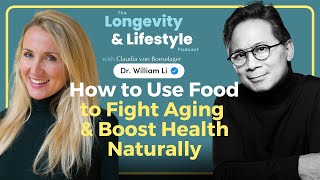
Dr. William Li, a physician-scientist, explains how food activates five innate health-defense systems in your body. A 1990s experiment at the National Cancer Institute found food extracts outperformed many experimental cancer drugs. Recent research on 6,000 people across 20 countries shows metabolism follows four life-stage phases, and metabolic changes are reversible through lifestyle factors like sleep, stress, and intermittent fasting.
Chapters
Welcome back, dear audience, to another episode of the Longevity and Lifestyle Podcast.
I'm your host, Claudia von Boeselager, here to share the latest insights and learnings to improve your health, life, and happiness for longer. Thank you so much for being part of this tribe. I'm so grateful to you. Make sure to sign up for my free weekly newsletter by going to llinsider.com.
My guest today is Dr. William Li, a world-renowned physician, scientist, and author best known for revolutionizing the way we view food and health. As the author of the New York Times bestsellers Eat to Beat Disease and Eat to Beat Your Diet, Dr. Li has pioneered the concept of using food as medicine to heal and optimize the body. His groundbreaking research has led to over 40 new medical treatments that impact more than 70 diseases, including cancer, diabetes, heart disease, and obesity. With more than 11 million views on his TED Talk, Can We Eat to Starve Cancer, and appearances on Good Morning America, CNN, and Rachel Ray, Dr.
Li has become a leading authority on how we can use the power of food to prevent and fight disease.
As president and medical director of the Angiogenesis Foundation, Dr.
Li's mission is to help individuals take control of their health and longevity through scientifically backed nutrition strategies. Please enjoy. So welcome to the Longevity and Lifestyle Podcast, Dr. Li. It's an utmost pleasure to have you with us today.
Thanks for having me.
So you've made such significant contributions to medical science, leading breakthroughs and treatments for over 70 diseases, including cancer, diabetes, blindness, heart disease, and obesity. And from your website, you made a statement which I'd love to quote here, is that you said that when I first set out on my journey to study food as medicine, I realized that I was up— what I was up against. The food industry did not care about health, and the health industry did not care about food. I'm a medical scientist and my mission is to bridge both of these worlds to help people everywhere become healthier while enjoying and not being afraid of their food. Dr. Li, can you explain your inspiration, which is so fundamental for everyone's daily life, right? Food is a medicine. Where did this inspiration come from? Where did this awakening, this shift, how did it transpire?
Yeah, well, I grew up in a relatively small city, Pittsburgh, Pennsylvania, that had a lot of ethnic communities. And there was a great celebration of culture and particularly the foods associated with the cultures. So I grew up, my childhood was always surrounded by these wonderful inspirations where people were very proud of their backgrounds and their heritage and the food that came out of it. So, you know, fast forward to my education, I'm a biochemist, so I was trained as a scientist. And in fact, I have now developed a very long career as a vascular biologist, which means I study blood vessels. And I'm also a doctor. I study internal medicine. And that means that I take care of men and women, young and old, healthy and sick. And my own orientation has always been towards health. Now, being trained in medicine, the focus of most Western medical training education is on diagnosing and addressing illness. And in fact, I have been actively involved with my research background in helping to develop new biotech-oriented treatments for cancer and vision loss and healing, wound healing. And so I sort of cut my teeth and I have real street cred in terms of the life sciences and what it takes to develop a treatment and intervention for disease. But one thing that always bugged me was the fact that when you're treating disease, it's the horse out of the barn, so to speak, where you've missed the biggest opportunity of all, which is to prevent the disease in the first place. And here we are, you know, in society lamenting about the unsustainable cost of healthcare, and yet we could actually upend that dilemma. We could actually solve that dilemma by really preventing diseases in the first place, and therefore saving the money so we can actually then have the resources to treat those people for whom prevention was not successful. And so that always led me to think about prevention. Now, when you talk about diseases, you can talk about drugs. But, you know, drugs are expensive. They're not always accessible to everyone who needs them, even in developed parts of the world, especially in developing parts of the world. And then they always have side effects. I mean, every drug can have a side effect. And so it's really not appropriate to talk about prevention in terms of drugs, pharmaceuticals. There are a few exceptions, but I think for the most part, you're gonna talk about prevention, you gotta talk about a different type of intervention. And this brought me all the way back to my childhood. And I always remembered the pride that people from the Mediterranean, for example, or people from Asia, they had in how they thought about food as a continuum of part of their health. And food actually is a much more equitable, safer, more joyful solution compared to drugs, right? And so you can use food as medicine as opposed to medicine as medicine for prevention. And that's what led me, after many years of being involved with biotech development, you know, why don't we actually study foods using the same rigorous science and systems that we do drug development? And so I'm one of the early people that actually studied food as medicine in that way. And when we did that, I'll tell you a quick story. I had a collaboration at the National Cancer Institute. This is back in the '90s where we were screening drugs or drug, possible drugs for their activity against cancer. And by then, my nonprofit organization, my charity called the Androgenesis Foundation, we'd been so successful. There were well over a dozen new treatments that had come out from our work. And so I got to be a little bit more daring. And so while we were screening cancer drugs, I pulled off the assembly line about a dozen of the test drugs and I swapped them in with food extracts that I had ordered. Now we disguised the swap so that the researchers, the technicians would have no idea what the samples were. But when the results came out, and again, this was actually a very, very serious test used to assess whether or not a chemical that was sent to us from different biotech companies would have potential to treat cancer. And the results came out, my jaw dropped because 50%, half of the foods that we were screening that I snuck in there were as or more powerful than the drugs that we were testing.
Wow.
So that was really an eye-opener for me to realize the power that science, that real science could bring to the table. And that's really what I do now. I mean, I take that rigorous, science-based, like an uncompromising approach. And that's one of the things that I, you know, am forced to do, really, or compelled to do as well, when I listen to all the opinions and claims and facts that are floating out there on the internet and social media. I think that, you know, it's very important for people who are listening to this podcast or watching it basically to recognize that there is a lot of information out there. I think most of it presented by people who have good intentions, right? So good intentions are important. They've got intentions. But what you really need to understand is that the stuff that seems too good to be true might be too good to be true. And you always need to ask about the source of where that information is coming from.
And not just the source, right? Because I feel like this is maybe an important point to raise. Clinical research, I always think, you know, follow the money. Who's actually financing it and what are the incentives behind it? Would you agree?
Yeah, you know, I mean, I think that who actually does the research is very important because as a researcher, I can tell you funding is so hard to get. I don't think that you can automatically dismiss the results of research that's funded by, you know, the government or by a corporation. You know, a lot of people don't realize this, but there's really fantastic research that's funded by pharmaceutical companies, but it's up to the researcher and the institution they work with to be able to maintain independence and objectivity. And so I think that it's, you know, again, I think that when it comes to health and wellness and the world that you and I work in, like, you know, our wheelhouse, I do think that there's a tendency to try to do good and evil, black and white, you know, good versus bad. And I And I think that when it comes to the real difficult work of generating the evidence, the clinical evidence, the scientific evidence, we need to step back and realize that this is quite a complicated enterprise. That yes, there may be vested interests that are involved, but again, the researcher, the venue, the, you know, the it really depends on how much integrity the individual doing the research or the group doing the research and the institution in which they actually do that research actually have. So the proof is in the pudding, by the way. And I think that when we talk about something, if it works, that's good. You know, and I think that that's one of the problems I have is that claims are made all the time about things that don't have the evidence.
Yeah, especially online as well. So I think, you know, for a lot of people, I think people are waking up to that as well. But typically, unfortunately, the ones that kind of go viral tend to sometimes be these interesting claims that are so far-fetched. So yeah, following the research is so important. Let's touch on metabolism. I think this is such an important point. And as we know, there is a metabolic health pandemic happening in the US, but also spreading around the world. There's a lot of misinformation, speaking of which, around metabolism. So what are some of the myths around metabolism and what are some practical steps that people can do to start repairing their metabolism?
Yeah, one of my favorite topics because this is actually very, very new research that's coming out to inform us that much of what we used to think, and this is the medical community as well, much of what we used to think about metabolism is actually not correct. So, I'm going to first throw out there some commonly held beliefs about metabolism, and then I'm going to tell you the truth about them, but what research has discovered. So, common belief number 1, that the metabolism that we have is really the result of some random process where your sister might actually have a fast metabolism, be skinny as a stick and can eat anything, and you might actually have a slower metabolism been struggling with food your whole life. I mean, we've all heard that or maybe experienced that. And that is a commonly held belief. The truth is, based on recent research that came out just a few years ago, that when you study 6,000 people across 20 countries, starting from the ages of 2 days old to 90 years old, this is the largest study of human metabolism done in exactly the same way. Everyone is born with the same metabolism. We're all born with the same metabolism, not different metabolism. What happens is that our metabolism evolves and takes on different paths as we get older due to the experiences, the exposures, and the behaviors that actually happen after we're born. And by the way, why would we think that, you know, our metabolism is just a roll of the dice, like in a casino? It's ridiculous, right? Like, when we're born, We're hardwired to work in a particular way. Our organs all are. You know, when you were born and I was born, our ears work the same way, our kidneys work the same way, our hearts were designed the same way, our thyroids were all designed the same way. What makes us think that, you know, it was just a crapshoot that, you know, somebody had a fast one and somebody had a slow one? So that's one myth. Second myth is that basically when you get into middle age, that your metabolism's automatically going to slow down, right? And I think a lot of us, I mean, a lucky few may not have actually experienced this, but I think many of us agree that the commonly held belief is that, you know, you're good when you're 20, you're good when you're 30, and then when you're 40, things slow down and you're, you know, you're going to change your clothing size and you're not going to fit into the same old clothes. You're not going to look so good. And by the time you're 50 or 60, you know, you're going to have to just accept the fact that you've gone through middle age and that your body and your metabolism is going to be different. And then a lot of people just throw up their hands and say, you know what, I just got to accept it. And, or maybe they don't accept it, then it winds up developing a complex or some other heavy weight that they carry around with them. And it causes, you know, dysphoria or body image issues. You know, this is very common.
Yeah.
And then sometimes people get so depressed they wind up taking on other habits, including eating habits that are, that are actually definitely bad for metabolism. Okay, so that's a commonly held belief. Middle age means that you're going to be changing, your metabolism is going to slow down. And along with that goes the belief that if you have a slow metabolism, that's what causes you to gain weight and get fat, grow more body fat. All right, what's the truth? So from this latest breaking research on human metabolism. It's now been established that not only are we all born with the same metabolism, but that throughout our lives, during our lifespan, humans go through 4 different phases of metabolism. So phase 1 is from 0, from birth to 1 year old, skyrocketing metabolism. Babies have a very, very high metabolism. In fact, 50% higher than an adult's metabolism at 1 year old. All right. And by the way, think about it. That metabolism means that we're absorbing everything as little babies and processing it. Should we be exposing, should we think about the wisdom of exposing them to microplastics coming from the teddy bears, from the binky, from the pacifier, from all the stuff that we surround them with? I mean, it's a, I throw that out there because this new research is making us reconsider what we're exposing our young people to, right? Like at the beginning of their life, which could influence their metabolism for the rest of their lives. Okay. Now, so the second phase of metabolism is during adolescence, just so we think that teenagers who are full of energy, eating 2 or 3 dinners, bouncing off the wall with energy, right? I mean, anybody who's had kids will recognize that, or if you have a niece or nephew, like you go, oh my gosh, that person's metabolism must be going crazy. Actually, between the ages of 1 and 20, human metabolism is going down, down, down, down, down from 1-year-old's high down to adult levels to 20 years old. And then from 20 years old to 60 years old, and this is the mic drop finding.
Yeah, really.
From 20-year-old to 60 years old, human metabolism is designed to be rock stable. Doesn't change. That's how we're hardwired. Howard Hardwire. That means 60 can be the new 20 if you want it to be. Like, if you're like, that's really the, that's how we are actually hardwired. And then from 60 to 90, we have about a 17% drop in metabolism. That means that by the time you're 90, you should still have be 17% of 60 or 20. All right. So human metabolism is actually hardwired to be very, very vigorous, hardwired. Now, I'm using the word hardwired, because obviously what actually happens is something different, right? I mean, we do see people with very different metabolisms. We do see people struggling with their weight and their, and their food and, and their energy levels, right? So what's actually really happening? Well, if I told you that the truth about human metabolism is that we are born with a hardwired program like the operating system of a laptop, okay? That's hardwiring, right? That's how our hearts work, our kidneys work, our brains are supposed to work that way as well. What happens over life? So let's say, Claudia, you and I buy the same model of laptop. You go to your computer store, I go to mine. We buy the same model, we plug it in and we boot it up. We charge it and boot it up. All right. Operating system out of the box is exactly the same. That's like our metabolism when we're born. Now, let's say that you are this absolutely meticulous caretaker of your technology because you have a background in tech field. So you know what it can do. So you shut down your laptop, you make sure that there's no viruses you download, you keep it in a warm place, you never drop it, you always have it. Okay. I'm a busy guy. I'm less careful. I'm in a rush a lot. So occasionally spill coffee on mine. I just wipe it up and I do it. I download all kinds of stuff because I'm a researcher, so I'm downloading everything. Viruses are accumulating and I drop my computer every now and then and I sometimes leave it in a hot car. All right. Now, what happens is that the operating system of your computer is going to maintain its really healthy system, whereas mine is going to start going off the rails. Okay? And that's what happens to our metabolism. We all start the same way, but depending on how we, what we're exposed to, how we are treated, how we treat ourselves, that can lead to radically different paths. Now, during middle age, all right, the 40s and 50s and 60s, this is actually where not only does the cumulative effect of our life experiences alter our metabolism, all right, but hormonal changes that naturally occur during that period of time lower estrogen, lower testosterone, by the way, the andropause gets underplayed compared to the very important topic of menopause or perimenopause. But I think both men and women actually experience changes. Those changes can affect our brain. Those changes can affect our energy level. Those changes can add on to everything else. So rather than pin the tail on the donkey of just the hormones. What I would say is that it's the cumulative life experiences and behaviors that can actually affect our metabolism by the time we're middle-aged. By the way, one last thing about middle age. Look, I'm sure you were the same as me. You know, we're teenagers and we're 20, like we're at the gym, we're working out, we're looking good. Like, you know, physique is an important thing and fitness is an important thing. Then you get towards middle age, right? Life changes because you got more worries, more concerns. You're concerned about your kids, you're concerned about your economy, you're concerned about your job and your boss. You're concerned about your parents, you're concerned about the war, you're concerned about all kinds of other things. Stress. Stress can actually affect our metabolism as well, not only for our mental health and mental wellness, which is so important, but also affects our physiology and is another force that can slowly derail that hardwired programming so that when we actually start to veer from the pattern of regular physical activity, eating healthy, managing stress, and by the way, when you're stressed, you're not sleeping very well and sleep is very important for metabolism. We start to kind of get off the beaten track and into sort of the The, the uncharted paths of broken metabolism. And this is actually what's happening. But I wanted to make this distinction between what we're discovering about how metabolism is hardwired and designed to work versus what actually happens. And because that's the fact, the good news is that we can actually take actions to be able to get back onto the rails, so to speak.
Yeah, no, excellent. And I'd love to dive into that. And I think it should be empowering for people to listen that they're not like got the, the bad luck of the draw, right? That they didn't lose at the the, the roulette game. So what are the key modalities that you would encourage and what you also see with your patients and, and people that you work together with?
Yeah.
What are the key modalities that people can start to do to repair their metabolism?
Yeah. One thing I gotta add to everything we've been talking about is that, remember I told you that we used to think the slow metabolism is the reason that you actually gain weight and gain body fat?
Yes.
Actually, The research is now showing it's the other way around. It's that when we actually undertake behaviors and lifestyles that cause us to gain extra body fat, body fat, by the way, is very healthy. We need our body fat. And any extreme athlete knows this, or weight, a bodybuilder. If you go down to like 2% body fat or 0% body fat, your menstrual cycle stops. You start getting tired and weak. Things that, you know, you think you might, you might like look really good, you know, or, That's a point of view. Some people think that doesn't look that great. But the fact of the matter is that we need our body fat because body fat, our adipocytes, the cells that make up our body fat, adipose tissue, adipocyte is a cell, is actually a fuel tank, nothing more than a fuel tank that holds the energy that we need to run our body. Just like the fuel tank in your car, when you actually put gasoline or petrol depending on where you live to be able to fill up the fuel. And then we burn down that fuel when we are operating and running around. Okay? So, the reason I'm telling you that is because the empowerment comes from diet and lifestyle. Because if you actually feel like, man, my metabolism is just off the rails, like I'm totally derailed, What do I do to get back into a more healthier track? I think a lot of people ask that question, particularly as they get into middle age. All right. The empowerment comes from this. Number one, that everything we just talked about is reversible and you can get back to your hard wiring. Laptop, take it to the Genius Bar and somebody there will actually help you fix it. And then you can debug it, take the viruses off of it. You know, you can even install a new operating system., in order to get to work properly again. Okay. So, how do we do this when it comes to our metabolism? Number one, I would actually say don't overload on fuel. What that means is don't overeat food. If you overload fuel in your car, the fuel is gonna spill outta the tank and pool around your shoes and you're gonna be standing in a dangerous, toxic, flammable mess. In your body, our fuel tanks are stretchy like fat cells. And so, while a car cannot actually accommodate more more fuel. That's why it spills out. In our body, we just make more fat. And so we build up our fuel tanks. That causes inflammation, that slows down your metabolism. And a simple solution that anybody can take is to eat less. Now, if you wanna really eat less and time your eating less to be able to optimize your metabolism, the simplest way to start is to do intermittent fasting. And you've heard a lot about intermittent fasting. It's a trend, but it's actually the most normal thing that we do in all human existence. Because when we are sleeping, we are not eating. And when you're not eating, that's called fasting. So when we're sleeping, we're fasting. And so in order to be able to actually lengthen the time that you are not eating, which decreases the energy requirements and allows your metabolism to heal, and you're loading less calories into your fuel tanks, your body fat, the thing you can do is just extend the time that you're not eating, taking advantage of the fact that if you're sleeping 8 hours a night, which you should, okay, that if you don't eat after dinner, let's say you go to bed at 11 o'clock, if you finish dinner at 8 o'clock and you don't eat for 3 hours, no midnight snack, no munchies after dinner, okay, don't save your dessert for before bedtime, you can gain 3 extra hours of fasting and not eating, which is helping to heal your metabolism. And then when you wake up in the morning, okay, and I can tell you, I do this every single morning. I did it today. All right. When you get up in the morning, take your time to get ready. You know, you take a shower, you get dressed, you know, before you roll out of bed to eat breakfast right away, which is what we all did when we were kids. Take the time, Read a book, check your email, go for a walk, get some fresh air, walk the dog. All right. You'll survive. Okay. I guarantee you, if you actually wait at least an hour after you wake up before you eat anything, let's do the math. 3 hours before bedtime, as just an example. That's 3, 8 hours of sleep, which you should for good, healthy sleep. Everyone should aim for that. 3 plus 8 is 11. Now wait one more hour, 12. 12 hours of fasting is 50% of the time you're alive. So 50% of the day you are not eating, you are not putting calories into your system, and you're allowing your metabolism to heal. That is the easiest first step that anybody can take on the journey towards healing themselves. Now, I wrote in my book, Eat to Beat Your Diet, a much more complicated explanation, more detailed explanation of all the additional things you can do. But I would say this is the number one thing you could do in addition to eating foods that help you burn down any extra fat you might accumulate.
Perfect. And I just want to touch on this point because intermittent fasting, I previously thought, you know, the longer the better. I was even doing like 20 hours. And especially for menstruating women, this is a really, really important thing because it can impact your hormone levels, energy, etc. So maybe you could give a bit of guidance for particularly women, but people in general, what is important to observe in intermittent fasting? Now, I 100% agree with you. I've had Dr. Satchin Panda on the podcast as well talking about circadian rhythms and that 12 hours overnight fasting is— it should be everyone. That's across the board for the most part, right? Unless there's medical conditions. But I'm talking about the people like, well, what if I extended it for 18 hours or 20 hours? Can you get some light on that?
Well, and this is the perfect segue to talk about, when it comes to health and wellness, more isn't always better. Yes. Okay. And there's this concept of homeostasis and hormesis, which is our body knows what to do. It actually wants to always live in a state of balance. Now, it's true, if you keep on beating it up in one way or one direction or another, it'll go off balance. But the goal in life, and I think this is actually, I'm sure you would agree with me, harmony. One of the prime directives of Asian medicine is really to maintain harmony and balance, not to go excessively in one direction or the other. And I think that's it. That's a little bit different than Western medicine where more is often more. We look for dose response. You know, the maximum tolerated dose is what we're looking for when for drug development. I mean, it's kind of ridiculous, right? But what's the optimal biological dose? We don't ask that question, but we should be asking that question. And so if you want to think about like the question about fasting, what's the optimal biological dose of fasting and what would be the side effects that you'd be looking for if you were doing too much for yourself, right? Okay. So first of all, fasting is beneficial in many ways in almost all people. And you reap the dividends, you feel the benefit of it. Because in the beginning it might be a little bit jarring if that's not what you're used to, but then you'll actually feel better. You'll actually feel a little bit better. You'll feel you have to have more energy. If you start feeling like, in fact, it's quite the opposite, you're worn out, you're worn down, then you should be— that's a warning sign. That's a red flag that should be looked at to say, you know, maybe you're overdoing it. Okay. How much should you cut back? It's very individual. You know, you hear about individualized, personalized wellness, personalized medicine. You gotta actually listen to your own body. Speaking of which, you know, for women, if you are, your menstrual cycle is a very, very sensitive indicator of balance in your body. And if you are having problems with menstruation, then, or aberrations or, you know, differences than what you normally would expect, Pay attention to that. That's another sign that something's not going well. Same thing as our belly, our abdominal feeling. Like, listen, we've all had this, right? You know, on the surface, you look fine. You're in a business meeting or you're presenting something and actually inside your belly feels crampy and crazy. You are just barely making it. Like, but on the outside, you're looking good. But you know, that signal of crampiness, gassiness, discomfort, weird belly stuff, you know, it's actually, I can tell you this as a medical doctor, it's never defined. It's probably a little gas, maybe something you ate last night. That's the teaching that we actually have. In fact, now we know it's probably your gut microbiome, the healthy trillions of bacteria living inside our gut that we need for our health and wellness. They are sending a distress signal out saying, you know what, we're not too happy right now. The neighborhood is not doing well. All right. And I think that we need to pay attention to these signals in our body. And that's one way to think about fasting. Okay, let's just talk about the timing of fasting for a second. 8 hours of sleep, 8 hours of fasting, no problem. Probably not quite enough. Like, it's not optimal. Like, you could do more for sure. So that 12 hours we were talking about earlier is a very natural way that most people can fit into their schedule, right? Don't eat after dinner, wait a little bit before you eat for breakfast. Now, if you're like me, or if you're somebody who's like really into biohacking and you want to be really disciplined in fitness, and you're like, you know what, I'm going to do 16 hours because if 12 was good, 16 is better because, and that's what people describe 16:8, 16 hours of fasting, I'm going to do that. Okay, look, here's an easy way to do it. Skip breakfast and eat lunch. All right, now you've got your 16 hours, right? Because, you know, it's 7 in the morning, you're not eating for an hour, you're not going to eat till noon. You just hit 16 hours very, very easily. I miss my breakfast and I get to lunch pretty easily if on a really, really busy day. Not difficult to do. All right, now the key, and again, this is individualized, I think that it's doable. The question is, well, if 16 is good, And both 12 hours and 16 hours have been studied clinically in humans. Both will actually help you lose weight. Both will actually help you have better insulin sensitivity. It is true, 16 is a little bit better than 12. You know, you'll lose a little bit more weight over a period of a month or so. But both work and you've got to figure out what works for you. But well, maybe I shouldn't eat until dinnertime then. Maybe I should just have one meal, right? So this is the mindset of the people who are really, really trying to hack into their bodies and figure out, Listen, if that works for you and you feel okay, try it, give it a shot. But I can tell you, for most people, extending beyond 16 hours is not only difficult for an ordinary schedule, I mean, it's actually probably not giving you enough calories, probably not giving you enough energy. And when you fast long enough, think about it, you're also depriving yourself not only of calories, which is a measure of energy, fuel, which is our food, as you know, the measure is in calories, like gasoline or petrol is either in gallons or liters, right? Okay. So, but basically calories are only one part of our food. You've got all these other micronutrients, the vitamins, the bioactives, the lycopene, the polyphenols, carotenoids, those are absolutely critical for our health. So the longer you go, okay, and then trying to limit only your calories like a bodybuilder, All right, you're gonna eventually deprive yourself of all these other micronutrients that are incredibly important for gut health, for immune health, for circulatory health, for your stem cells to be healthy, and ultimately for your metabolism as well. So I think that, you know, my general rule of thumb is to listen to your own body when it comes to fasting. More isn't more. And by the way, if you're fasting, when it's time for you to eat, Make sure you don't overeat. That same principle holds true. And make sure you are putting good quality fuel in your body, good quality food. So if you don't fill up your tank in your car often, and then finally you're gonna fill up your tank, please don't go to the cheapest form of fuel and load it into your car. Once in a while, that might be okay. But if you do that day in and day out, week after week to your car, car. Just like mistreating your laptop that we discovered, discussed earlier, if you are putting the poorest quality fuel into your car, that car is not gonna run very well and not last very long either. So if you're talking about wellness and longevity, good quality fuel, don't overload on the fuel and listen to your body. Those are the prime directives, I think, for intermittent fasting.
This episode is brought to you by OneSkin. If you're like me, you know the power of feeling confident in your skin, and that's why I'm so excited to share today's sponsor, OneSkin. Their products make it simple to keep your skin looking and feeling healthy, strong, and vibrant without the need for complicated routines. It's all about science-backed, effective skincare. OneSkin's secret is their proprietary OS-01 peptide, the first ingredient scientifically proven to target and reduce aging cells that cause lines and wrinkles and thinning skin. I've been using their products for a while now, and the difference is amazing. My skin feels refreshed, hydrated, and looks younger. But don't just take my word for it— OneSkin has over 4,000 5-star reviews. Now is the perfect time to try it for yourself. For a limited time, get 15% off your first OneSkin purchase using the code Claudia15. CLAUDIA15 when you check out at oneskin.co. That's oneskin.co. Start your journey to healthier, younger skin today.
In your book, Eat to Beat Disease, you dive into the body's 5 natural defense systems. What are some of the key foods that activate these systems? And maybe you can expand exactly on what these 5 different systems are as well.
Yeah. So earlier I was talking about hardwiring of the body for your metabolism. Well, it turns out that our body's ability to stay healthy throughout our entire lives, entire lifespan, is also hardwired into us, right? It's another part of our operating system. And my research has uncovered 5 different health defense systems. These are pathways in our body that formed when we were still in our mom's womb, So before we were born and the moment that we were born, we, you know, we got, took our first breath. Those health defense systems started firing on all cylinders, like really going to work hard for us. And they are firing on all cylinders from the day we're born until our very last breath. They are doing everything possible to keep us healthy. And I'll tell you how I came to this realization and then the discovery is because when I was in medical school, And so much of my story of where I am today goes back to my training and my education where I realized there were questions I had that were not being answered by my professors. All right. And so here I was following the professors around in medical school and learning about the different diseases. This is diabetes, this is emphysema, this is obesity, and this is Hashimoto's, and this is breast cancer, and this is a brain tumor. Okay, or this is dementia. All right, all right, all right. I'm like, okay, I get it. I gotta memorize all these diseases. All right. But I said, you know, now I understand the diseases. Can you tell me what health is? And my professors would look at me and scratch their head and look at me like, that's like a really dumb question. You're healthy when you're not sick. Like, why? What more do you need to know? And for me, that was completely insufficient. Health cannot be the absence of disease. It can't be. I mean, the absence of something doesn't explain something else. The absence of money isn't the cause of poverty, right? So I was always curious, like, okay, what is health in addition to the manifestation of absence of disease? And it turns out that my research and my journey has been really doing the research on this. There are these 5 health defense systems, I'll tell you what the defense system is and an example of a food that can activate it. So, the first health defense system is called angiogenesis. It's my field of study. Angio, blood, blood vessel, genesis, how they grow. We've got 60,000 miles worth of blood vessels packed inside our body. 60,000. Imagine that. If you were to pull out every blood vessel, Claudia, in your body and line it up end to end, you'd form a thread that would circle the Earth twice. Wow. That means that your circulation is super important for bringing the oxygen that you breathe and the nutrients that you eat to every single organ and every single cell in every single organ for your health. Now, our body actually uses that as a health defense system. When you don't have enough blood vessels, your body will grow more, like if you injure yourself. All right. And if you grow too many blood vessels, your body will prune them away like a gardener going to a shrub and just like cutting away those extra branches. So you always have the right amount at the right time at all times to be able to be nourished by your circulation. Now, if you actually have too many blood vessels, that can grow a cancer or can cause blindness. And so what are some foods that can actually help us cut off that extra blood supply, help our body prune away? All right. And it turns out that green tea is one of those foods that contain the polyphenols that help to prune the bushes. They can clip away extra blood vessels, but that means you can starve a cancer by cutting the blood supply with green tea. Okay. What about when you need to grow more blood vessels? Right?
Can I just ask a question? Ask a question about the green tea. So love that. And what I did at one point was overdose on green tea. So I think there is that effective dose, right? Because I didn't realize it was such a diuretic. Woke up one morning, felt super dizzy, didn't know what was going on. Doctor was like, you know, your heart is fine, your ears are fine. I don't understand why you're feeling so dizzy. And only after realized I'm dehydrated, even though I was drinking like 2 to 3 liters of green tea with fresh lemon, thinking I was doing a good job. So what would you say is the minimum effective dose of, or maximum dose of the green tea in a day, just so people are not overdosing on the green tea?
Yeah, yeah, yeah. No, well, listen, it's a great, it's a great question and a great example you're you brought up. So tea and coffee both are beverages that actually have multiple benefits for all of your health defense systems. And we'll talk about the other systems in just a moment, including your circulation. And many people have thought that tea and coffee are diuretics. You know, I think I believe that as well. The caffeine in your tea or caffeine in your coffee would send you to the bathroom all the time. Well, there's truth to that, but there's also some mythology to it. Okay. The truth is that if you drink less than 10 cups of tea or less than 10 cups of coffee a day, you're gonna be just fine because we call it euvolemic, meaning you're maintaining a normal amount of fluid in your body. Because don't forget, you're drinking liquid along with the other stuff, the polyphenols and the caffeine, which can have a bit of a diuretic effect. But studies have shown in humans, healthy humans, that if you stay underneath 10 cups, you're gonna be fine. Now what about the effective dose? Like people always ask me this. So like if green tea is good, like how much green tea should I have for cancer, for heart health, for brain health? It's not as precise as an antibiotic dose would be because we study food in different ways. But I will actually tell you that in general, most of the studies have shown for, tea and coffee, it's about 3 to 4 cups a day, 3 to 4, maybe 5 cups a day will be fine. You'll be in the safe zone. You'll still be, you'll be in the, you'll be in the zone of actually efficacy, effectiveness. All right. You go beyond that, you don't always get more. And you go way beyond that, you'll actually start to dry yourself out. It just exactly is how you experience this. So I think for the people who are your audience listening to this, Again, I'm going to kind of underscore this idea that balance is what we're looking for, harmony and balance. We are not looking to exceed. More isn't— when you have too little, a little bit is good. A little more is even better. And then you get into that optimal dose, which is going to be different for different people. If you've got a big body, if you've got a small body, if you're exercising, if you're not as physically active, I mean, it's going to be a little bit different. But for every, virtually every food, you know, if you overdose on something good, you're going to wind up actually suffering, paying the price somehow. And so more isn't always more. I think we need to get out of that mindset, which is kind of this linear mindset. Everything is on an X and Y axis. And if I can get to the far upper right quadrant for people who are in business, like I'm going to be really good, you know, a huge amount actually equals a huge benefit. It's more of a bell-shaped curve where we're looking to actually hit that optimal sweet spot.
Excellent. Thank you. So I interrupted you there. You were going through the different defenses.
Yeah. Okay. So, you know, in the interest of time, I'll try to be really focused on it. Androgenesis, blood vessels, your circulation, your first health defense system. Second are stem cells. A lot of people don't realize this, but we regenerate from the inside out. We heal from the inside out with our own stem cells that we were born with. And they live in our bone marrow and they live in our skin and they live in a lot of our, in our body fat as well. When we need to heal, when there is something that is broken or damaged inside our body, the signals inside our body that we can't see, we can't feel, call up the stem cells from the inside of our bones that go into our bloodstream like bees coming out of a hive. And they fix it, all right, which is quite remarkable. We actually get repaired from the inside out. Now, how do we know we regenerate? We're not a salamander. We can't grow a new leg, all right? And we're not a starfish. We can't grow a new arm. But we do grow new hair. We do grow new gut. We do grow new skin. We know that for sure. And I would tell you that, you know, if you wanted to really look at an extreme situation, if I remove two-thirds of your liver, snip, okay, the one-third that's left would eventually regrow the rest of the liver. And if I cut off the top of your lungs, snip, okay, just the tip of it, the cap of your lung, in about a year it'll grow back. All right. That's regeneration. Amazing. And nerves will also grow back as well. So one of the things that we can do is eat foods that can actually help our nerves, our body, our tissues regenerate a little bit easier and nicer. What are some examples of foods that actually can stimulate regeneration? Well, it turns out that barley and mushrooms and oats all contain something called beta-D-glucan. Beta-D-glucan is a soluble fiber that does feed your gut microbiome and lower inflammation, but it stimulates stem cells to come out of your bone marrow. And so does dark chocolate. Dark chocolate, not because of the confection and the sugar and all this other stuff in it, but because of the high levels of cacao, which is packed with polyphenol. And so the darker the chocolate, now this is an example where you got 100% chocolate, you're probably not gonna be, most people aren't gonna be eating, it's too bitter. But 70 to 80%, that's the sweet spot.
Or 90%, right?
Or 90% if you wanna go up That's what I have. Okay. And, and by the way, 90%, like have a, have a little square of 90% chocolate with some coffee, you know, that you're actually gonna get that mixed together, right? It's called mocha, right? So like the, the, the idea is that, you know, the idea that I wanna give is that like you could actually enjoy the, these foods as well. Yeah. But the key is that the polyphenols in cacao have been shown to call out stem cells. Outta your bloodstream. In fact, you can double the number of stem cells in your circulation just by having 2 cups of hot chocolate made with dark chocolate over the course of a month. And so it improves your, the regeneration of your circulation. Third health defense system's our gut microbiome. We talked a little bit about this, 39 trillion bacteria living inside our gut. They lower inflammation, they boost our immunity, our health, healthy defensive immunity. They help us become more insulin sensitive. So if you wanna actually refine your metabolism, treat your gut well. When your gut feels funny, your belly feels funny, you know what? Pay attention to that. You might need to heal your gut. What's the easiest thing to do to heal your gut? Stop eating ultra-processed foods because they really damage your gut. Artificial sweeteners, emulsifiers, all those kinds of additives, Yeah. Artificial coloring, artificial sweeteners, artificial preservatives. All those things basically are assaulting the healthy bacteria. Come off that for a little bit and then it's better for your gut. What's good for your gut? Dietary fiber, prebiotics like polyphenols that you can actually have. Now people say, well, what about just having a probiotic and some supplements to do that? I always tell people supplements are fine. I do take some supplements myself, but supplements, meaning the word supplement means to top off. And what I think people should do is to eat whole foods whenever possible to get that repertoire of the polyphenols and the dietary fiber and the macronutrients and the micronutrients. So you get the whole package whenever possible without overeating, we're talking about metabolism here. All right. But able to get it. And then if you need to top off, go ahead, top yourself off with something. But gut health is another really critical part of our health defense system. We're beginning to realize, by the way, poor gut health might set you up for cancer. Poor gut health might set you up for dementia. Poor gut health definitely sets you up for metabolic disease as well. And while we are just at the beginning of understanding the biology of our gut health and how to treat it better. So anybody who's watching a program and they're like, oh, I've got a workshop for you to completely— the complete gut healing workshop. Listen, I'm a researcher, I'm a scientist, and I'm also a doctor. So I got to be really honest with you. What we're just at the beginning of this. What we're discovering is so exciting, so important, but we don't know everything yet. Okay? And so when somebody tells you the complete package, We don't know the complete package yet. The story is still being unfolding as we're actually speaking right now. But prebiotics and dietary fiber, fermented foods, the prebiotics, just think about colorful foods, colorful whole foods that you find in a produce section. Those are actually good ways to feed your gut health. Your DNA, antioxidants to protect your DNA. Your DNA protects itself because it knows how to fix itself., right? So think about it. You go out, okay, everybody knows don't go to a sun tanning booth or get sunburned, right? But if you're stuck in traffic, all right, in a sunny location like California or Florida or Sardinia, okay, and you're getting a ton of sun, even in traffic, you're actually getting your DNA assaulted through the windshield. All right? Or if you're flying in an airplane, above the clouds, that radiation, ultraviolet radiation is penetrating the fuselage and affecting your skin. So pilots, by the way, have more DNA mutations in their skin 'cause they're working above the clouds. Okay, so by eating antioxidants, foods with antioxidants, polyphenols, you're going to actually have more protection of that DNA protection system. Your DNA can fix itself, But why not shield yourself from the damage? And some foods can actually make your DNA repair itself better. What's an example? Kiwi. A kiwi will actually not only protect damage, your DNA from damage, it'll help you heal DNA that's actually damaged faster. And then finally, your immune system. We've already talked about the importance for lowering inflammation. Tons of anti-inflammatory substances. Green tea is polyphenols, anti-inflammatory. Coffee is chlorogenic acid, anti-inflammatory. Lycopene in tomatoes are anti-inflammatory, but you wanna boost your immune system to really make it strong as well. You can actually have brassica vegetables, Brussels sprouts, broccoli, kale, bok choy. These are all vegetables you find in the Mediterranean or in Asia. They taste delicious. And the sulforaphanes, these are bioactives, natural chemicals found in these plants. Light up our immune system. And in fact, it's been shown for people, this was studied in young people who are just getting a flu vaccine. I read about this in my book, Eat to Beat Disease. Getting a flu vaccine, if they also ate 2 cups of a shake that was made with broccoli sprouts. Now, a broccoli sprout has 100 times more sulforaphane than a big adult broccoli. So, it's small but mighty. All right, you wanna really get a lot of that, good stuff, all right, the polyphenols, have broccoli sprouts. And what it did, the people who, yes, they did a study with people who just had a placebo versus broccoli sprout shake. Everybody got the flu vaccine and they studied the immune cells of the people in their blood. Broccoli shake eaters had 22 times higher immune response, really supercharged their immune system. And the only thing they did different was to eat broccoli sprouts. Amazing, right? Amazing. This is really the eye-opening aspects of food as medicine. I work in this field, so every day is an amazing new kind of day for me because we get to discover all these cool things that can help us improve our metabolism, protect us against disease, elevate our health, and just in general, help us overcome those behaviors that we might have had earlier in life. Like, so people always ask, well, you know what, I didn't live such a healthy life before when I was younger. Is it too late for me? You know, should I try something? Absolutely. That hardwiring in your body is ready to spring to action. That the operating system is ready to go to work. If you can actually get yourself back on the rails.
Dr. Lee, you have so much wisdom. I have so many further questions, but I appreciate the time that it is now. Maybe we have a chance in the new year for round 2. But before we sign off, 2 things. One is, where can people find out more about your work and follow you? Maybe website, social media. What would you like to share with people?
Yeah, well, first of all, I have been really diving into my YouTube channel, and you can find me @DrDrWilliamLee, L-I, same handle as my social media on Instagram, whatnot. My website is DrDrWilliamLee.com. And, you know, I do masterclasses. You can order my books wherever they're sold. I'm working on my next book right now. And I'm super excited by the research we're actually doing. Listen, I mean, the life of a scientist is to keep following the trail of science. Where, you know, we don't tend to stick around and circle around the same old thing all the time. We're always moving into new frontiers. And so what you've given me the opportunity to do, Claudia, today is to talk about some of the really exciting areas that I've been working on to present day and would love to come back and talk to you more about the latest discoveries.
Amazing. Thank you so much. So Dr. Lee, what is the parting message or thoughts for my audience that you would like them to to share with them to really step into knowing that food is medicine, what can be done, and to give hope, I guess. What would you like to say?
Yeah, I have one short phrase that I would love to leave people with because so many— the message on food has for so long been about fear, guilt, and shame and uncertainty. And what I want to reassure people is that you can love your food to love your health. You should lean into your healthy foods and really make it part of your everyday enjoyable living. Just don't eat too much of it.
Beautiful. Thank you, Dr. Lee, for taking the time to come on today. Definitely look forward to round 2. And thank you, dear audience, for tuning in.
More from Claudia









Can Psilocybin Slow Aging? The Study on Telomeres, Inflammation & Survival with Dr. Louise Hecker

