Genetics & Hormones: How To Optimize Women’s Health | Dr. Mansoor Mohammed
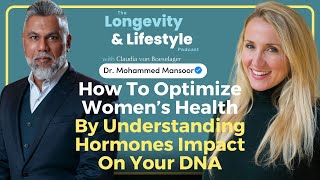
In this Longevity & Lifestyle podcast episode, host Claudia von Boeselager interviews Dr. Mansoor Mohammed, a genomicist and co‑founder of Precision Health Clinics. Dr. Mohammed explains functional genomics as a systems‑level view of the 22,000 human genes, emphasizing gene networks, epigenetic regulation, and the role of hormones as conductors that switch genes on and off. He uses an orchestra analogy to illustrate how hormones (melatonin, vitamin D, insulin, estrogen, progesterone, etc.) dictate the tempo and volume of gene expression. The conversation then shifts to women’s health, highlighting historical under‑representation of women in drug trials, the impact of birth‑control pills that expose the body to continuous estrogen, and how this disrupts natural hormonal cycles and downstream cellular adaptation. Dr. Mohammed discusses estrogen metabolism pathways (2‑hydroxy, 4‑hydroxy, 16‑alpha‑hydroxy) and their genetic/epigenetic determinants, linking them to inflammation, fertility, and long‑term health. He outlines the benefits and considerations of bioidentical hormone replacement therapy (BHRT) during perimenopause and menopause, stressing the need to know an individual’s metabolite profile. Finally, he describes the Precision Health Clinic model: genomic and functional testing, hormone profiling, lifestyle and microbiome optimization, and a structured 2‑3‑month “pit‑stop” follow‑up system designed to rebalance hormonal conductors and improve cellular performance. The episode ends with practical advice for listeners to seek clinicians who integrate genomics, hormones, and lifestyle into personalized health plans.
Chapters
Welcome back, dear audience, to another episode of the Longevity and Lifestyle podcast. I'm your host Claudia von Boeselager, here to bring you the latest insights and learnings on how to optimize your health, your longevity, and living at your best for longer. Thank you for being part of this tribe, and I'd love to always hear from you, so feel free to reach out on Instagram @longevityandlifestyle. My guest today is pioneering Dr. Mansoor Mohammed, a multi-award-winning genomicist. Dr. Mansoor is renowned for his groundbreaking work in medical genomics and personalized medicine. He has reviewed over 10,000 genome profiles and is a sought-after international speaker. He's also the co-founder and chief science consultant of Precision Health Clinics, which uses a personalized functional medicine approach to health using blood tests and genomics. His extensive experience spans founding and leading innovative genomic companies, receiving numerous patents and awards, and contributing to seminal research in genomics. Dr. Mansour is dedicated to revolutionizing personalized healthcare and optimizing health through genetic insights. Please enjoy. Welcome to the Longevity and Lifestyle Podcast, Dr. Mansour. It's such a pleasure to have you with us today.
Likewise, Claudia, thank you for having me on.
So I had the pleasure of hearing you speak live at a talk held in London at the end of last year where there were so many fascinating insights, I said, and also around women's health as well and hormones. So for everyone listening, please stay tuned to the very end because there's a lot of exciting material that is going to be shared. Here today. And I'm so excited to dive into it. And I'd love to start off with functional genomics. What exactly are they for people who might never have heard of this term? And why is it so exciting?
Well, you know, it's the name is on it. It's one of those descriptive names. Yeah. So functional genomics within it carries the meaning that when we take a look at genetics, if we look at genetics from its, its, its academic roots, there's this term called Mendelian genetics, and that's what we all learned in high school or university genetics, the red pea and black pea and the colored peas. And so basically that was a view of genetics that said, here's a gene. A gene is an instruction that does something in an organism. Genes come in different versions. You, an organism, and that's just focused in on the human being, Obviously, as a human being, we inherit 2 copies of each gene, each gene being an instruction, of which there are about 22,000-odd genes in the human instructional manual. That altogether is called the human genome. So we're building up now to the concept of functional genomics. So the genome is the sum total of all of the 22,000-odd genes and sequences that comprise this amazing human operating manual. What makes this manual quite miraculous is that there are two copies of the manual that we inherit, one from mom, one from dad. So all things equal, with rare exceptions, for every instruction, for every gene, we inherit two copies of that gene, one from mom, one from dad. Now, a Mendelian genetic perspective of genetics is that we take a gene, we ask the question, what are your copies, the versions known as the alleles of that gene, cumulatively known as your genotype for that gene? And you ask, here's the gene, here's its job, here's the genotype of that gene, And therefore, what is the phenotype that comes from that genotype? How does that version or collective versions of genes impact the organism, in this case, the human being? That's what we call a very Mendelian genetics view of the human genome. Functional genomics takes that understanding to, as the name implies, a much more functional a much more holistic appreciation of the genome, which is to say, as much as there are 22,000-odd instructions within the human operating manual, they aren't all just doing their own jobs. They're not discrete, separate instructions that don't partake and interact with each other in a conversational manner to bring about the functionality of yourselves. They don't. So this, to say it in a positive way, your genes interact with each other. The instructions from these 22,000-odd genes at any given moment in time, at any given period in your life, those genes are turned on and off and are interacting with each other to give you the ultimate what and how your body works. The functionality of that understanding is what functional genomics is. So to summarize, therefore, in functional genomics, we are less interested in a single gene and its outcome. We are more interested in the gene networks, in the pathways that really define cellular behavior.
And I think that this is such an exciting point because of the impact of epigenetics on the gene expression, right? So could you share a little bit about that? Because I think people are like, oh, they're my genes, I can't, my genetics, I can't change it. But actually there's so much that can be done, right? So maybe you could expand a bit on that.
So there are obviously as our understanding of epigenetics has grown and as with all things in science, we go through a period where There is an excitement about the discovery. Sometimes it's overstated initially because we're excited about it, and then we come back now to a more mature, wholesome, or complete understanding. So to be clear, we— with, again, always there are exceptions to the rule— we can't change the sequence of our genes. That's what we're inherited, that's what we're born with. Okay, and if a gene is an instruction, we're going to have two copies of those instructions, one from mom, one from dad, which may either be the same or they may be moderately slightly different, so that the same job encoded in that instruction is getting done, but maybe one or the other copy from mom or dad may be more optimal in its sequence instruction of getting that job done, and that is embedded in the sequence in the actual gene. So the first state of things is, it is true, you cannot change the sequence, the, the, the optimability or the optimality with which that sequence encodes the job that that gene is meant to do or to accomplish. You can't change that. Epigenetics is the phenomenon, however, of how your genes are turned on and turned off. The factors that allow your gene expression, that's what we refer to as epigenetics. So I always use a somewhat quirksome but interesting perspective. At no point in our existence are all 22,000 genes in our operating manual turned on simultaneously? We would sort of combust if that were the case. We would sort of, you know, spontaneously combust. Meaning we've got this incredible library of genes in every one of our cells, every one of our cells. And let's take a step back because this is another incredible point. That many laypersons and even clinicians fail to appreciate at times. From the cells at the tip of my finger that I don't tend to give much thought to, to the cells of our retina that we're obviously far more concerned about, to our cardiac cells, to our liver cells, to our kidney cells, to our gastrointestinal cells, our brain cells, each of these vastly different cell types with vastly different functions and modalities of working in our bodies, they all have the same operating manual. And the analogy that I use, it's like you've got a university with all these incredibly different departments— the language department, the music department, the medical department, the architecture, engineering departments— but they all have the same library that the students go to. Now, when the student goes to that library from the engineering the library, he or she knows which sections of the library are applicable to the studies that he or she is enrolled in. So likewise, in the cells of our body, it's important to understand that all of our cells have the same, essentially the same genome, the same operating manual, the same collections of dual copies of genes from mom and dad. But not all of our cells, meaning each cell type knows which genes, which instructions are appropriate for its job as a cardiac cell versus a gastrointestinal cell versus a neural cell. So this is the first level of difference in the cells of our body. Now, those genes by sequence connotates or gives the efficiency or the optimality with which that instruction is going to be executed. Said simply, for any given gene, there are more optimal versions of that gene that we might inherit, and there are less optimal or suboptimal versions of that gene. And because we're going to inherit two copies, one from mom, one from dad, we might be the lucky person who inherited two optimal versions, one from mom, one from dad. We might be the less lucky person that inherited one optimal, one suboptimal, and we might do well. We did win the lottery and we inherited two suboptimal versions. That's carved, so to speak, in our sequence. That we can't do anything about. However, where epigenetics comes in now is as we go through our daily lives, depending on the foods we eat, the lifestyle choices that we make, exercise, walking, couch potato, smoking, clean environment, and then of course our environment, and radically importantly, the state and health of our microbiome, and something that we're going to address later in this conversation. All of that cumulatively radically impacts the hormonal health of our bodies. These things, these factors determine when will our genes, the ones that we can't do anything about, the ones whose sequence is set, well, when will they be turned on or turned off? That's epigenetics. So let's quickly give an example. There's a wonderful gene, it's known as the CYP1A2, CYP1 alpha 2. This gene's notoriety, its claim to fame, is that it's the gene that makes an enzyme, and that enzyme metabolizes caffeine. So, here's a gene. Its job is to encode an enzyme, and the job of that enzyme, one of the things that it does, one, it does many things, but it is most known for its job in metabolizing caffeine. Now, that gene comes in two versions, meaning the sequence of that gene comes in two versions. One version of that gene ultimately makes an enzyme that is quite efficient at breaking down the caffeine molecule, at metabolizing caffeine. The other version of that gene is less efficient. Now, if you happen to have inherited the less efficient version of that gene, you will always be a slow caffeine metabolizer compared to someone whose gene is faster at metabolizing caffeine. Your rate at which when you, when you enjoy a cup of morning joe, not sure if that's how it's referred to here, Okay, you have your cup of morning coffee, your kappa. If you're a slow metabolizer by virtue of the fact that your gene sequence is that slower, it makes that slower enzyme, you'll always be a slower metabolizer. However, epigenetically, there are things that you can do that will turn on that gene or turn off that gene. That's where epigenetics comes in. So to summarize, epigenetics is incredibly important because it dictates how we interact, how we use our operating manual. When is that operating manual being turned on, different parts of it being turned on, being turned off? That is obviously incredibly important. And that's the realm of epigenetics. However, that epigenetics does still return to the fact that once we turn on a gene, the version of the gene, the efficiency encoded in the gene is precisely that, encoded in the gene.
Beautiful. Thank you so much for that in-depth explanation of that. And so where I'd like to segue a little bit is into what you also picked up on is hormones and genetics and the role of hormones in the body in general. And I loved your analogy is that they act like an orchestra conductor. Could you elaborate on this analogy and its significance in understanding health? And then we can start talking a little bit more specific— specifically, excuse me, about women's health.
Absolutely. This is, of course, Claudia, the very emphasis of my work now for the last several years. And that is, so very quickly, if we think of, we mentioned these 22,000 genes, and I want to paint a picture for your audience to think of these genes within your cells. Think of your cell as an auditorium, an auditorium where an orchestral play, a really grand, beautiful orchestral play is going to occur. And so you are the participant in this orchestra, your cell is participating in this orchestra, and the instruments on the stage of this auditorium, on the stage of this incredible orchestral play, the instruments on that stage are your genes. So on this stage, there are 22,000 incredible instruments of every variety, from your violins to your, you know, wind instruments to your percussion instruments, and so on and so forth. 22,000 instruments, 22,000 genes on this orchestral stage. Now, the health of your cells, extrapolating on this analogy, is when these instruments play the most appropriate tune for the job that your cell is meant, or your cells are meant to accomplish. And if we quickly tie back in the concept of the quality of the genes. Do you have the optimal version, the suboptimal version? We may not all be born with the best grand piano. We've got grand pianos that can get into the tens of tens of thousands, and someone with a really tuned ear might say, ah, that's not the best quality piano. Ultimately, however, ultimately, we may not have the best quality piano, but we can ensure that we still tune and play the piano that we do have to the best of our ability. So now let's tie in the analogy. Your genes are instruments on this orchestral stage. The health of your cells is determined when those instruments are playing just the right melody, just the perfect melody for the performance of your cells. And like any melody, now we have a beautiful analogy to tie in some of the things we've said before. At no given time, really, does an orchestra have every instrument playing whatever they want to play. That wouldn't be very wholesome, palatable music. It would be rather headache-inducing. What is palatable is when the instruments are playing at the right time, at the right volume, at the right frequency, at the right tempo, that's when you get really an optimal orchestral performance. So we can then say at this juncture, your genes are like instruments on an orchestral stage. The health of your cells are when those genes or instruments are played just right. Here is where hormones come in. And this has been sort of the focus of my work, as I've mentioned, and it's really been a breakthrough. Which is simply this: nothing else determines when your genes will be played and how they will be played and the tempo of which they'll be played and the volume at which they'll be played as hormones. In fact, the very job of hormones is that they are the conductors. Now we can complete the visual. Hormones are the conductors of the instruments, the genes on your orchestral stage. And the way hormones work is this: like any incredible orchestral play, there are shifts in the play. I forgot my music terms, but there are different scores— that's the word— there are different scores through the play's performance. And so when you think of hormones are is hormones come and go being the orchestral conductor. So for example, when you're getting ready to go to bed at night, the hormone conductor that you want taking the stage of your cells, particularly your brain cells, your neural cells, particularly, you want melatonin as the hormonal conductor. So what happens is melatonin is the hormone, is the conductor, that takes the stage and conducts your gene expression, conducts your instrument performance to play a lullaby. Now, that gene expression will be akin to a lullaby to put you to bed. Now, you don't want melatonin being your hormonal conductor at 11 AM in the morning when you need to be in that boardroom. You want to be up, What do you want to be the hormonal conductor at 11 AM in the morning? You want hormonal vitamin D, 1,25-dihydroxycalciferol. You want testosterone. You want thyroid hormones. You want other hormonal conductors that change the rhythm of your play from the lullaby at 10, 11 PM to a marching band to get your cells up and going. When you engaged in a meal and you've taken, you know, you've consumed food within which there's carbohydrates, now what you want is you want insulin coming on the stage and conducting your orchestra so that your cellular performance is appropriate for the fact that there's sugar circulating in your cells. So to conclude with this analogy, and then we'll go on to female health and how this analogy works, it's this. The very job of every single hormone you can think of, from the mundane, mundane in quotation marks, like melatonin, like 1,25-dihydroxycalciferol, vitamin D, to testosterone, to estrogen, to growth hormone, to insulin, all hormones do the jobs they're meant to do by taking the stage of your cellular orchestra, changing the rhythm of your orchestra by being a conductor so that your cellular behavior, your cellular performance changes according to which hormone is the conductor at that given point in time.
So fundamental. I love the analogy because I think it really helps people to understand the correlation between hormones genes and the importance of how they work together. So, um, yeah, thank you for sharing that. Let's jump into women's health and, um, you know, better understanding, I should say, more the neglect of women's health in research. I believe it was 1977 when the FDA actually banned women of childbearing age from taking part in clinical research. It was reversed in 1992, I believe it was, uh, but the gold standard had obviously been set. And you mentioned in your presentation an alarming statistic, um, and if I remember correctly, it that 80% adverse pharmaceutical outcomes occur in women because of the lack of testing, was my understanding. So can you expand a bit about what, what the indication is for women and to help women better understand how to navigate in today's world and not to be part of these 80% of adverse pharmaceutical outcome issues?
Absolutely. Well, the first thing that we've got to understand is more so than men. The woman's body, beautiful, goes through epochs of time that is fairly clear to anyone, which is we have a pre-menarche, i.e., pre-adolescent, prior to a young woman having a menstrual cycle, whether it be 11 years of that, 12 years of that, little less, little more. And in those years, we've got all of these other hormones that are working. Insulin is working from childbirth. We have melatonin is working. But some of the most important hormones, the sex steroidal hormones, progesterone, testosterone, and estrogen, as we all know, in men and women both, those kick in at any substantial level at the time of puberty. Now, when a young woman goes through and she goes into menopause and she starts having a menstrual cycle for as many years now, so we have a first epoch of her life, the first 11, 12 years. Then we have another epoch of her life, i.e., usually 30 years, 30-odd-something years, in which she's menstruating, a little less, a little more, depending on the young woman. And then she goes into perimenopause, into menopause, and those important sex hormones come back down. Now, if you understood what I said in the analogy that hormones are conductors of cellular performance, right off the bat, we understand that in the beautiful, the female body, her cellular behavior, her cellular performance, by dint of the fact that there are these important hormones that are either present in some epochs of her life and not present or not present as much in other epochs of her life, right away we understand that her cellular behavior, her cellular performance is going to be different. And herein is where I want to focus first in the menstruating years, because this starts to answer some of what we are, you know, just horribly when we hear things like 80% of the adverse side effects in any drug that is, that comes to market happens in women as opposed to men. What we've got to understand is this, and I will pose this to your audience. I think we all understand the role of insulin as a hormone that again, as a conductor, modulates our cellular behavior so that we can respond and metabolize carbohydrates and sugars. I don't think anyone in their right mind would say, here's a tube of insulin, I'm just going to inject insulin in me 28 days for the month, regardless of whether I need it or not, regardless of whether I've eaten or not. I think we can assume that we should all understand something unpleasant, quite so, is going to happen to our bodies. Now, let's step back and understand We're taking everything we've built on, the analogy that we've built on. When a young woman is menstruating for the approximately 28 to 30 days of her cycle, estrogen takes the stage of being that conductor. For how many days of the month? How many days, all things equal, a healthy young woman who's menstruating, not on the pill, her natural body, when when she's going through a natural menstrual cycle, all things equal, estrogen is only elevated for approximately 6 to 7 days of the menstrual cycle. Now hold on, what this means is for the 30— 28 to 30 days of her menstrual cycle, only for about 7 days of those 28, 30 days did estrogen take the stage, did estrogen modulate instrument behavior, modulate the cellular performance, and her cells are actually behaving in a completely unique manner because completely uniquely estrogen is the conductor on the stage. For the other 21, 22, 23 days, estrogen is not on the orchestral stage. Estrogen is not conducting the gene expression. So this means for a healthy year in a woman's life, estrogen is only the conductor for 7 times 12— what's that, 84 days of the year, give or take? Should the healthy female's body was designed to have estrogen be the epigenetic gene modulator for 84 out of 365 days. That's how the female body was designed or how it works. Now, by no means am I saying birth control— that is obviously ultimately the decision of the young woman. It can be a godsend for many young women, different times of their life. It's an absolute empowering phenomenon for young women. However, they should at least be alerted to the fact, they should at least be educated to the fact, we should at least appreciate as a society when a young woman, taking everything that I just said, when at the age of 14, because of one pimple on her face, she's put on birth control, wherein now estrogen, an external source of estrogen, has been introduced into her body, not for 6 days of the month or 7 days, but for 21 days of the month. So now for 21 days, a conductor that should have only been conducting the orchestral masterpiece for a short period of the month is now taking the stage, taking over as the conductor, playing a rhythm, playing an orchestral outcome that was only supposed to have happened for 6 days It's not happening for 21 days. And by the way, Claudia von Boeselager, now more and more doctors are telling young women they should actually do away with the bleed-through sort of sugar pill and just go from estrogen to estrogen to estrogen. So I'm in Europe, as you know, I'm actually in the UK. I see many patients in Europe now. And I am aghast by how many 20-something-odd-year-old females, 30-something-odd-year-old females that have not had even a breakthrough period for 5, 7 years because they're taking birth control nonstop. And their cellular behavior, their cellular machinery, their metabolic cascades that were designed to tolerate a cascade for 6 days of the month is keeping that cascade up. For 365 days, year in, year out. It really does not take an astute biologist or clinician to appreciate what are we doing to the metabolic machinery of the body and what's going to happen. This body, this one body that we have, men and women alike, that is designed to tolerate ebbs and flows of different performances Subjected to a performance every single day, year in, year out. What's going to happen to this young woman when she's in her 40s or in her 50s or in her 60s? What have we done to her cellular machinery?
This episode is brought to you by Sunlighten Saunas. As part of living your longest, healthiest life, discover the power of Sunlighten infrared saunas where heat Heat and light combine to support nearly every system in your body. Infrared sauna therapy is a natural whole-body longevity hack that eases the effects of aging with every use. Enjoy improved cardiovascular health, better sleep, reduced inflammation, and a stronger immune system, all from the comfort of your home. For 25 years, Sunlighten has led the way in light science. Their patented heaters deliver the best infrared quality on the market. The M-Pulse Smart Sauna stands out with its advanced technology and customizable settings, offering the most effective infrared experience available. Ready to transform your wellness journey? Visit sunlighten.com and mention code Claudia von Boeselager when you fill out the Get Pricing form to save up to up to $600. That's sunlighten.com and mention code Claudia on the get pricing form to save up to $600. This episode is brought to you by OneSkin. If you're like me, you know the power of feeling confident in your skin, and that's why I'm so excited to share today's sponsor, OneSkin. Their products make it simple to keep your skin looking and feeling healthy, strong, and vibrant without the need for complicated complicated routines. It's all about science-backed, effective skincare. OneSkin's secret is their proprietary OS-01 peptide, the first ingredient scientifically proven to target and reduce aging cells that cause lines and wrinkles and thinning skin. I've been using their products for a while now, and the difference is amazing. My skin feels refreshed, hydrated, and looks younger. But don't just take my word for it. OneSkin has over 4,000 5-star reviews. Now's the perfect time to try it for yourself. For a limited time, get 15% off your first OneSkin purchase using the code Claudia15, C-L-A-U-D-I-A-15, when you check out at oneskin.co. That's O-N-E-S-K-I-N dot C-O. Start your journey to healthier, younger skin today.
As you can imagine, and as you can see, I'm quite passionate about this. And far be it for me to be a male and be passionate about this, but it is something that we have overlooked. And when we start looking at the statistics, we realize that we've been using women, God forbid, as a petri dish for experiments, pharmaceutically and otherwise, and all in the name of, well, she can just stay on this hormone. Again, I want to emphasize to our listener, birth control is the most intimate choice, and it is only the choice of the young woman, no one else. It is a godsend for many different times of her life, but the audience should appreciate that keeping your body under the purvey of estrogen that your body was designed to be under the conductance of for 6 days of the month when you're menstruating, and you do that day in, day out, you cannot expect your body to have the same eventuality, to have the same health metric, to have the same health outcome years into the future. And this is the key. This is something that I hope to educate as many people, as many doctors, and that's what we're trying to do more and more.
Yeah, thank you for your work. And this is so fundamental. So I'm so delighted that you're sharing this with my audience. 2 questions. One, just for clarity, estrogen is present for more than 6 days, but it's when it's dominant, so around ovulation phase. So that's what— whichever hormone is dominant is the conductor then, essentially, even if it could be present. Is that right?
Just from my understanding, it's present but at much, much, much lower levels. So when we look at the 28-day, we have that classic curve, we see estrogen is elevated. So in other words, the hormone taking the stage, so to speak, Yes. So when estrogen says to testosterone, you leave the stage, I'm going to take the stage now. And then progesterone says to estrogen, you leave the stage, I'm going to take the stage now. That's actually what happens in the female cycle. That's why it's a cycle. So hormones can be present, but they have to reach a critical level before they are ushered onto the stage, and then they take their job as the conductor. And then when the other hormones reach their critical stage, the stagehand, you know, we give a little signal to the conductor, says, come on, show off, you've done your job, leave the stage. And then the other hormone comes. This is what's happening constantly. And it is the optimal rhythm of your hormones knowing when to come onto the stage, when to leave the stage. Sometimes, obviously, this is of analogy, as you might imagine, there are often multiple hormones on the stage at the same time. You can have estrogen doing the conduction, and then insulin comes up because during your menstrual cycle, when estrogen is elevated for the days that your cells are under the conductance of estrogen, when you eat, then insulin will also come onto the stage, come on and leave. Vitamin D will come onto the stage and leave. And so on and so forth. Optimal health, Claudia, is when your genome instruments, when your genes are perfectly tuned. The tuning comes from your lifestyle choices, your dietary choices. They also come from the very quality of the instrument, the sequence of the instrument, the sequence of the genes. But it all comes together now when these genes are played properly. And they are played properly when the circadian rhythm, when your hormones come on stage, leave stage, combine on stage at the right time for the right duration. That's what optimal health is. And when you throw that into an imbalance, That's when you enter into other than optimal health. You open the door to illness.
And I'd love to dig into that because essentially by being on birth control, blasting the cells with estrogen for 21 or longer days, up to 365 days a year. I recently had a conversation with Dr. Mindy Peltz. I'm sure you're familiar with her as well. And she was so shocked by the amount of 20-something-year-olds similar to what you're saying are not having cycles anymore. That's even— there's even traces of ecotoxins, microplastics, etc., in menstrual blood. And this is a toxification that women are not allowing their bodies to go through. I'd love if you could expand a bit more on the health implications, what is happening and what is happening also for fertility for women later in life as well.
Absolutely. So again, keeping in mind, and I think it's worth Just to emphasize to our audience here, the potency of what we're talking about, the potency of understanding that your body, your cells do actually physically, you may be looking, you know, a young woman looks at her arms, her thighs and says, well, my body was the same 2 weeks ago as it is now. But at the cellular, if she's menstruating, but you've got to understand at the cellular level, cellular performance can radically change. So very quickly for the audience, let's take a look at something here. Take a healthy young woman who's menstruating. She's not on birth control. She's just going through a natural menstrual cycle. The things that her body are susceptible to, or that she has strengths in, changes between her follicular phase and her luteal phase radically. So for example, by studying athletes, professional female athletes, we know that during the luteal phase the latter half or the latter third, so to speak, of the menstrual cycle. Female athletes, all things equal, eating the same, working out the same, same lifestyle, they are all things equal more susceptible to injuries during that period of time than at any other point in the cycle. I say this to emphasize that while they perceive their bodies as outwardly being the same, inwardly, cellularly, the impact of your hormonal ebb and flow, the impact of your genes being expressed, your instruments playing different orchestral tunes because of the ebb and flow of your hormones radically impacts the health of your body. Everything from your immune functionality to your resilience to things that you otherwise might tolerate, keeping in mind because that's your actual cellular performance is changing. Now, when you understand this, that the body is— I keep using the word design, I mean nothing untoward by it, simply to say that if we look at it in its natural way that it's there, and we understand everything we've said, this ebb and flow, this circular cicadian change, and then beyond circadian, monthly change, and then beyond monthly, seasonal, and beyond seasonal, we have epochs of time. We can appreciate then that the optimal functionality of the body is one that allows for these ebbs and flows. But when we stick in third gear, when we keep the hormonal profile in this— the estrogen profile, for example, or the estrogen-progesterone profile consistent without the natural rhythm, what we do to the rest, you know, for most young women, because they don't understand, and for that matter, surprisingly, many doctors, because they don't understand what we've just clarified, they view estrogen as just this hormone that is going to allow me to ovulate and/or maybe allow me to be pregnant. They don't view it as this global conductor of your genome orchestra. They don't view it— your estrogen levels when you are at different points during your cycle, healthy, completely healthy young woman eating the same, exercising the same, when she's menstruating, her body's response to carbohydrates, her body's response to energy demands, her body's response when she goes to the gym is completely variable depending on where she is in the monthly cycle. So when you, when you, when you're in tune with your body, most young women who are in tune with their bodies understand that, hey, I could eat identically the same every single day of my month I could work out identically the same, I could sleep identically the same, but my body does not give me the same output depending on where I am in my monthly cycle. This is just to emphasize and echo the change of ebb and flow. Now, when we stick with a monotonous hormonal profile, in this case elevated monotonous profile being on the pill, the, the damage that it does to the ability of your cells to adapt, because part of cellular health is the adaptability of the functioning of your cells. When you keep your cells, when you prevent your cells from the ebb and flow, from the natural rhythmic changes, literally functional, metabolically, When you change that and you put this monotonous metabolic equivalence by being on a nonstop birth control pill, even after you come off of it, the metabolic adaptation, the immune adaptation, the aging adaptation can be derailed for many, many years. And now we're beginning to wonder is it even reversible or not?
What about later in life for women? So perimenopausal and menopause, and obviously there's more familiarity and more research coming out confirming the importance of body identical or bioidentical hormone replacement therapy. Thankfully, there was this meta-analysis that recently came out that debunked that was what was previously thought to be the case, that it was dangerous dangerous for women. How should women think about body or bioidentical hormone replacement therapy and what is important? And you shared this in your presentation, how the different pathways are broken down and why it's important to understand these pathways for women to better interpret how much hormone replacement therapy they should be having or not. So could you walk us through that landscape a bit?
Because it's so important. I think one of the things that people should recognize, and the organ should recognize, is that in traditional societies, prior to the advent of external hormones, uh, and hormone mimics such as has been brought about by industrialized society, microplastic, all of these things that mimic hormones. And think about it, if it mimics a hormone, it can sneak onto the stage even though it's not the real conductor, and it can affect the orchestral performance coming from your cells. And think about it, if that performance was supposed to have been designed, that there is supposed to be a particular conductor at particular times, but now we're letting any and anyone sneak on that stage, and now the instruments are going, who do we listen to? Who's the conductor? What's going on? You can quickly realize that the quality of the performance changes. So in traditional societies, when women were not as, you know, always under the influence of all of these different types of hormonimics, uh, women actually were able to go into pregnancy much later in life. In other words, we are seeing a shift societally in the onset of menopause, okay? I say that to say that one of the best predictors of longitudinal health in a young woman are— we know, we know things like how many years did they have healthy menstrual cycles, how many pregnancies did they have, how early or not. In this case, we don't want that menopausal decline to come too early because that sets the stage for the years to come after menopause. What we should appreciate is, and this is where now, because of course I by no means was it ever my intention to say that all hormones are bad, and as I've kept clarifying, by no means am I saying that birth control is all bad, but rather it needs to be understood within the context of the female. So just before we go into menopause, keep also in mind, as you've raised Claudia, that Whether it's an endogenous estrogen or an exogenous estrogen, such as coming in from the birth control, such as even bioidentical, which for all intents and purposes is your endogenous estrogen, when estrogen is elevated in a young woman's body, it obviously doesn't stay as estrogen. It has to be metabolized. And all estrogens are metabolized via one of three pathways. We won't get into the details of it. There are 2-hydroxyestrogen, 4-hydroxyestrogen, 16-alpha-hydroxyestrogen. Simply stated, when estrogen is elevated in the female body, it is metabolized. It must be metabolized before it's flushed out of the body. The choice of which of those metabolites dominates in a young woman is largely genetically determined. And also epigenetically determined. Now, if you don't know your innate tendency of which of these estrogen metabolites your body is innately likely to produce— and by the way, one of those three is considered the more healthy, the 2-hydroxy metabolite. If you're a young woman, you want as much as possible of your estrogens to be metabolized down that pathway? If you do not know, because it's protective. And we can say it the other way, that the other metabolites, particularly the 4-hydroxy metabolite, is pro-inflammatory, quite pro-inflammatory. It retains its estrogenizing ability. So by the way, it's a metabolite of estrogen. But it continues to estrogenize the body. In other words, estrogen has left the stage, but it has this proxy, 4-hydroxy, that stays on the stage and again perturbates the behavior and the performance of the cells. But it also— that 4-hydroxy estrogen produces some really naughty pollution for the auditorium. It pollutes the cellular environment for hydroxy now. So therefore, the young woman whose body genetically, and because of epigenetic factors, her body tends to metabolize estrogens down the protective and alpha-2-hydroxy pathway, for her, being on birth control pill with all the caveats that we've said, will be much less deleterious, much less health impactful, than the young woman, unbeknownst to her, her body is producing tons of 4-hydroxyestrogen, for example. Okay, so this knowledge of the pathways that your body chooses for hormone metabolism is as important when you're menstruating and you're making decisions of birth control And it is radically important when you enter into menopause. Why? Very quickly, and I realize that we're a bit strapped for time here, but very quickly, when a young woman is menstruating, everything that we've discussed, the production of the hormones, it's occurring in ovaries, the metabolism of those hormones, it's occurring in the liver, the production and metabolism your sex hormones during your menstruating years occur in the organs designed for it. When we go into menopause, the production and metabolism of your sex hormones occur in peripheral fatty tissues, most notably breast tissue. Now, your breast cells are not designed to be liver cells, but in menopause, those metabolites, particularly the 4-hydroxyestrogen, which is extremely polluting to your cell, it's extremely pro-inflammatory to your cell, depending on your unique genetic proclivity, are you the young woman that is producing more 4-hydroxyestrogen than not? Then that production, that metabolism if it is happening unchecked in your breast tissue, and God forbid, if you choose hormonal replacement protocols that were unaware of that phenomenon and simply keeps to fuel now this estrogen metabolism that you did not know you were inclined towards that very pro-inflammatory outcome, you can imagine that yet that young woman has a completely different health journey than the young woman who has a more natural inclination to producing 2-hydroxyestrone. So let's tie in a few— tie up a few points. Bioidentical hormone replacement, especially in our societies where young women have been, you know, bombarded with so many different estrogen mimics, and there we're seeing more and more complications associated with the perimenopausal transition because of this phenomenon, bioidentical hormone replacement can absolutely be a godsend for many women. Not just, not just anymore from reducing the symptoms of menopause— that in and of itself is a huge blessing— but from helping to counter the negative impact of the hormones, the hormone mimics and the hormone toxins. Intelligent hormone replacement can be a huge clinical protection from that. But we must still know, and we must still be educated, what is the innate, what's the innate tendency of that young woman's body to metabolize her hormones. And once we've got Once we're armed with that knowledge, we are armed with the ability to really help young women traverse their perimenopausal transition much healthier, retain youthfulness that anyone, anyone is going to crave. We can really help with that, protecting them from some of the health outcomes. And as you've mentioned, now it is absolutely clear not only is the intelligent use of bioidentical hormones safe. It's actually protective when used appropriately. Health is a journey, and like any journey, a journey has 3 components. So you should— every one of us, and I really say this with as much passion as I can, as much compassion as I can, and the empathy that goes with it— we really should equip ourselves with understanding that we're on a journey of health. And like any journey, you've got to know what's your starting point, you've got to know what your destination is, and you've got to have a sense of what's that route, what's the route between where you are and where you want to be. So at the Precision Health Clinics, what we do is we sit with our patients, we listen, we listen so that we can understand where are we picking our patients up from. We need to know for each unique patient, where is their starting point? Because it does me no good to start the journey of a patient from a position that they're not there. In other words, we've not picked up the patient from where they're at. And equally, it does me no good to tell this patient about where I want to take them, even though that's not the destination the patient wants. So we really work with our patients to understand where are we picking you up from, where do you want to be, and what's the most enjoyable, what's the most participatory. We want our patients to participate in this journey. Once we've defined that route, we define pit stops because like any journey, there should be pit stops along the way. And these pit stops are every 2 to 3 3 months. We're checking in with our patients, you see, because as your journey goes along, you get a new vista. Things that you were not concerned about, things that you didn't think about, now you think about it. So we're always checking with our patients. It's another defining feature of what we do here at the Pacific Health Clinics. It's a journey. It's a journey that is broken up into bite-sized, participatory segments or pit stops, and we triangulate between 3 things. We clearly use intelligent genomics, functional genomics, so that we understand the individuality of the patient. We do a thorough analysis of the hormonal profile because, as you've understood now, we cannot expect healthy gene expression, healthy orchestral performance, which equals healthy cellular performance, which equals health. You cannot expect that if your hormones are in disarray. So we do a thorough evaluation of the hormones, we do a thorough intake of the patient— how are they, what are they experiencing— and our goal of the Precision Health Clinic is, in summary, to individually and precisely balance and optimize the conductors of the human genome, whether they be the hormones, but also dietary choices, lifestyle choices, optimizing the microbiome, so that for any one individual, that person, regardless of the genes, regardless of the quality of the instruments on their stage, on their cellular stage, that, that orchestra has the best opportunity to produce the best possible music, the best possible health. That's what we do. That's how we do it. We don't do things where patients have to commit to years on end. The journey is in 2 to 3 month bits, always allowing the patient to see, is this right for me? Always allowing them to reevaluate their journey in periods that are quite, you know, sustainable. 2 to 3 months. Most people will commit to 2 to 3 months. That's why we've designed it that way. And we found the, we found the response to be phenomenal.
Beautiful. What, what are some outcomes people can expect in those 2 to 3 month periods?
You know, the outcomes are directly related to the state of your hormonal profile. And because of the world that we live in and all of these hormonal mimics, to say nothing of dietary choices that might not be the best, to say nothing of lifestyle choices that are completely against the rhythm of the body, you know, something as simple as not having good sleep patterns, all of these things are throwing off our circadian rhythm, which means it's throwing off our hormonal hormonal rhythm. And accordingly, so now what we can expect is— I have been shocked, Claudia, at how many seemingly healthy individuals are coming into our clinics not knowing that their thyroid function is completely off, that their insulin response is already well on its way to being insulin resistant. How many young women don't appreciate that the healthy ratio of the estrogen to progesterone, that you should have a progesterone level that is 1/10 of the estrogen level so that you have a healthy balance. How many young women, because of the abuse of the pill, the abuse of other unwittingly lifestyle choices, are coming in in a completely estrogen-dominant manner? Their estrogen level instead of being 10 times their progesterone levels are 100, 200, 300 times their progesterone levels. Wow. And accordingly, when you've got these hormonal imbalances, there is no way that your body's performance is optimal. So therefore, what can patients expect when we bring their hormones back into balance, whether it be through replacement whether it be through intelligent lifestyle choices, changes, dietary changes, quite rapidly that orchestral performance goes from a headache-inducing, I don't know, whatever is the worst possible music you can think of, you know, with every clashing of bands and drums playing completely out of tune, quite remarkably quickly that some of the performance goes from that headache-inducing performance to the more rhythmic, more controlled, more circadianly appropriate. And our patients report back within a week how much better they feel. And I don't, I don't like overstating things, so I'm not talking about just because what we do. No, I'm speaking about the simple fact of if your body is under the control— these conductors are too much, too little, the wrong times of the day they're present— your genome expression cannot be healthy. And if all you do is you don't change your genes, but you simply optimize when the conductors, which conductors, take the stage of your orchestra when they take the stage, how long they take the stage, your cellular performance quickly goes from headache-inducing to enjoyable. And that's the shift that patients can experience. And I am shocked, I am shocked that in medicine we have lost the caliber of looking, you know, we've got young women coming in with TSH levels of 4.7, actual patients that I saw. And because the— and I don't, I don't like calling things out, but because the NHS still uses a TSH cutoff of 5, which is about as archaic as it gets, meaning when your TSH and thyroid function equivalent to a TSH level of 4.7, your regular doctor will Oh, it's in the range, it's no problem because you're in the range. Your cellular behavior is so completely suboptimal at that level, you can't even begin to expect optimal cellular behavior with a thyroid function at that level. If even you adjusted just that, your cellular behavior radically quickly comes back on track, and that's just but one thing. When you start tweaking these conductors, putting them in at the right time, leaving them on stage for the right duration, the cellular shift in behavior is so actively different that people actually report back, my God, I didn't think, I forgot what it was like to feel this way.
How exciting. And I think that's just such a beauty to remember the body wants to perform. The body wants to be in an optimal state, but we, through environmental and other factors, sometimes need these tweaks to come in. And then it wants, you know, to function in the beautiful way, optimize the health and energy levels of these, these women. So yeah, really phenomenal. Thank you so much for, for all that work that you're doing and bringing this to the world. I think it's so fundamentally important. For my listeners interested in understanding more about functional genomics and women's health, what are some resources, online resources, books that you would send them to?
I don't mean to be exclusionary, but there's so many times that even some of the good books out there can sometimes tend to a little bit of superficiality. I really do. I must admit, I'm quite the stickler on returning to the core pure science of things and not getting caught up too much in the— there is a growing— so what I'll say, I don't— I'm not going to draw this out. What I'll say to our listeners is you're at a time where we understand cellular behavior, we understand genetics far better than we've had in the past. However, equally, there is a growing industry of a fairly superficial use of this information, and that might bring about some benefit. But if you really want to take control of your lives, find a clinician who can understand the need to optimize your cellular levers, a clinician who understands the importance of hormones, the importance of lifestyle choices, choices, the importance of dietary choices, and then someone who can appreciate how those things uniquely and personally impact you because of your genetics. And if you find that, you will have uncovered one of the greatest gifts that you can give yourself in the times that we're in, because after all, health is the most important commodity we have. Without it, we have nothing else.
Yes, health is the greatest wealth. Yes, we're definitely advocates over here. Where can people follow what you're up to? Social media, website, where would you like to point them to?
And we can link it in the show notes. They could see, certainly they can reach out. I love just responding to people, whether they're patients or not, they write. So they can reach me now. It's my sole focus at www.thephclinic, the Precision Health PH Clinic. Singular.com. Our flagships are in Amsterdam, our newest flagship in London. But even if you just write into the info of each of those clinics, address it to me, and I will always do my best by the end of the week, if I'm not traveling, to respond to your questions. And I look forward to hearing from you.
Beautiful. Dr. Mansour, do you have a final ask or recommendation or any parting thoughts or message for my audience today?
Take possession of your health and be a participant in your health journey. Don't just be a passenger in your journey, be an active participant. Surround yourself with clinical professionals who want to participate with you and demand that you participate with them. That's the only time you're really going to be, you know, health is not a pill that you take. Health is something that you commit to, that you're willing, active, and enjoyable participant in. And health is not something you do for a month. It's a lifelong journey. So do things and take steps that you know you can stick with. Otherwise, they're only temporarily, you know, transiently beneficial. So make the small— a small change that you can take and keep with you for a lifetime, so long as it's a good change, is better than a bigger change that you've only done for a month. Take the baby steps that you can stick with and grow with and take more and more with, so that it's something that you are not falling off the bandwagon on. That's when you really have something to look forward to.
Beautiful. Thank you everyone for tuning in and listening. Um, if you've made it this far, and Dr. Munsoor, thank you so much for joining and sharing your incredible insights and your work with my audience today. Hugely appreciate it.
More from Claudia









Can Psilocybin Slow Aging? The Study on Telomeres, Inflammation & Survival with Dr. Louise Hecker

