Gray Hair & Aging: How to Reverse It with Spermidine with Leslie Kenny
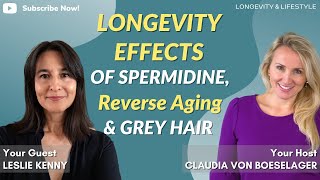
In this Longevity and Lifestyle Podcast episode, host Claudia von Boeselager interviews Leslie Kenny, founder of Oxford Healthspan and self‑described gray‑hair reversal expert. The conversation begins with Leslie’s eclectic career—from managing Disney’s early internet in Hong Kong to becoming the “High Priestess of Sex” in China—before shifting to his scientific journey. A chance meeting with an Oxford physiologist led Leslie to explore spermidine, a polyamine found in all living cells that induces autophagy and modulates six of the nine known aging pathways. He describes how spermidine levels decline with age, how centenarian diets (Mediterranean, Okinawan, Nicoyan) are naturally rich in it, and how supplementation can support immune function, cognition, sleep, hair pigmentation, energy, and heart‑rate variability. Leslie recounts his personal health reversal: after a lupus and rheumatoid arthritis diagnosis at 39, he used intravenous immunoglobulin, lifestyle changes, and spermidine‑based supplements to achieve remission, saving millions in drug costs. He then details Oxford Healthspan’s two flagship products—a wheat‑germ‑derived spermidine blend with prebiotic FOS, and a gluten‑free formulation that adds nobiletin, chlorella, turmeric, and other autophagy‑inducing compounds—explaining the rationale for food‑derived versus synthetic ingredients. The discussion moves to Leslie’s side project as a gray‑hair reversal “agony aunt,” his observations that gray hair signals internal resource reallocation, and the broader Oxford Longevity Project, a free series of webinars featuring experts on autophagy, immune health, brain health, and cardiovascular repair. Rapid‑fire questions reveal Leslie’s morning/evening supplement stack, use of Kaatsu (KAATSU) compression bands, PEMF therapy, and his philosophy of listening to the body’s innate wisdom. Both hosts emphasize patient empowerment, the importance of combining lifestyle, supplements, and emerging technologies, and share resources: OxfordHealthspan.com, Leslie’s New Prime YouTube channel, and OxfordLongevityProject.org. The episode closes with a call to slow the “race‑car” of aging using available tools.
Chapters
Hello, health optimization friends. I'm your host, Claudia von Boeselager, and welcome to the Longevity and Lifestyle Podcast for another longevity and biohacking product series where I invite leading longevity and biohacking entrepreneurs to share their pioneering products, developed to help you optimize your health and your life for longer. Have you ever wondered how to reverse aging, gray hair, improve cognition, and live a long life in peak health? In today's episode, we will dive into the science behind the so-called anti-aging vitamin spermidine, one of the longevity secrets of centenarians and blue zone populations. My guest today is Leslie Kenney, founder of Oxford Healthspan. Leslie is a Southern Californian entrepreneur and graduate of both Berkeley and Harvard whose life was turned upside down when she was diagnosed with lupus and rheumatoid arthritis in her 30s. Today, at age 56, Leslie is living proof that we can get better with age so long as we take responsibility for our health and meet our doctors halfway. Stay tuned to find out how. Also, for you, dear audience, get 10% off today by using the code Claudia10 when you check out at OxfordHealthspan.com. Please enjoy.
Welcome to the Longevity and Lifestyle Podcast, Leslie. I'm so excited to have you on today.
Well, thank you so much. It's really going to be a lot of fun, I think.
I definitely think so too. And you've had quite an incredible journey and career, and you're doing so many amazing things. However, I would love to start with you being named as the High Priestess of Sex in China. Can you tell us some more, Leslie?
Well, so over 20 years ago I was working for the Walt Disney Company in Hong Kong and got put in charge of this non-revenue generating part of the business called the internet. And because I was the last person in, they gave me the role of taking care of the internet in Asia Pacific. And I looked at it and I could not believe what I saw and just thought, this is going to change our lives, the internet. And thought about all the things that it could do. And while I knew that we could stream Disney products over the internet, I knew that was still some way off, and I wanted to come up with an idea that would leverage the innate unique properties of the internet, and those were the anonymity bits of it. So I decided to start an online matchmaking company in China and India and was probably one of the first into China. And the Chinese government said, now wait a second, you're promoting promiscuity here. This is not good. We don't want our young people to meet up. And I said, well, I see your point, but they're going to do this anyway. And they said, well, even so, we control the internet fully. What are you going to do about it? We'll just seize your server. And I thought, well, wait, this could be a win-win here. How about if we put out a great message that goes with this and then everybody who wants to meet someone online will get that great message too. And at the time they were really interested in promoting safe sex. So they said, great, you just do all the safe sex stuff. And I said, no, far too boring. We're going to have to do good sex. And it took me a while to convince them, but they were finally convinced and agreed that in order to attract the bees to the honey, you need to have honey. So you can't just have boring sex, it must be also good sex. So I set about working with a lot of sexologists and experts in India and China, and we also set up a kind of agony aunt column where people all over Asia could write to us with their burning questions about good sex, as well as safe sex, and love relationships and intimacy. And I think it's because of that, having done, you know, thousands and thousands of questions on, you know, acts of intimacy, that I gained the moniker of both the Dr. Ruth of China and The High Priestess of Sex in China. So I like the latter one. Of course, I love Dr. Ruth Westheimer, but The High Priestess of Sex was given to me by the Corriere della Sera, which I think is— I always feel like the Italians, if they say that you're good at something that has to do with relationships, it must be true. Exactly.
Amore, amore, amore. I love it. And so I understand that this actually brought you on to researching the molecules in action during intimacy. What exactly happens there?
Well, if you fast forward another 20 years, I found myself in Oxford, England, about as far away from Hong Kong as you can imagine, and was at a luncheon for New Year's and met a physiologist at the University of Oxford. And he began to tell me about how he had been given the honor to view 30 1,000-year-old scrolls in the Imperial Palace archive in Tokyo. So his former pupil was the Empress of Japan, and she invited him as a physiologist to take a look at these. And they were all scrolls with the instructions on how the emperor could live a very long life.
Longevity scrolls, right?
They're longevity scrolls, exactly, exactly. And one of them in particular had to do with intimacy and long life. And he told me about this, and I said, "Oh, interesting. I wonder if it has anything to do with the Taoist precepts on seminal retention." And he looked at me wide-eyed and said, Oh my God, you're probably the only person in Oxford that I can speak to about this. Maybe the only person in all of Britain. How could that be? But it turns out that it's not your everyday topic, seminal retention. And of course, having been exposed to it for so long years ago, it doesn't have shock value for me at all. It's simply a physiological a fact what happens. So we, Dennis Noble and I, began to delve into this more and more. And he's a pioneer in something called systems biology, where you look at the body as a whole, not just at the heart in a silo or the kidneys in a silo, but as one whole complete system and how something that happens in the heart will have an impact on, say, the kidneys. So we began to look at the act of sexual intimacy as a whole? What are all the things that happen? We knew already from earlier studies that oxytocin, which is the social bonding hormone, that goes up. We understood also that the heart rate between the two lovers would actually begin to become entrained, that the eyes, the gaze, the breath, these things, all three of them became entrained. And then we sort of wondered what happened then. Within the body. And one of the things that does happen is that the man's body is told, okay, get ready for procreation. So upregulate production of, of course, sperm. But one of the molecules inside that, along with vitamin C and zinc and magnesium, is a molecule called spermidine. And there has been other research here at the University of Oxford by an immunology professor, Katchi Simon, and another pharmacist, Ghada Al Saleh. The two of them have done research that shows that spermidine actually reverses the aging process in older mice. And this is very exciting when you think about your longevity as a whole, because there are quite a few people who believe that if we can simply keep the immune system yin, that it has knock-on, positive knock-on effects in the rest of the body. And that's why if you lose that function as you get older, you know, somebody who's 90 gets pneumonia, we think, uh-oh, this could be it, right? And the reason why is that we know that's often a harbinger of poor health systemically. So that's sort of the story of the work that Dennis and I begun to do with looking at these other interesting molecules that the body's internal pharmacopeia manufactures as part of the reproductive act. But if you are like the emperor and you are able to control your breath and you're a man, you may find that you are able to have an orgasm without actually releasing any ejaculate. So you will have produced a lot of spermidine, but it will be retained in the body, and we believe helps replenish the body.
So very insightful tips, but I think it's probably a very challenging task for men. I haven't done— is that part of it?
Monks can do it. I suppose celibacy will force you to do things like that.
Yeah, amazing. So Leslie, let's take a step back and look at sort of your— I mean, you've done so many amazing things, but for to share with my audience as well, what was your journey that made you become so passionate about helping people to transform their health?
Like so many people who go into the health industry, it was having been personally affected by a number of very sad health outcomes, both personally, but also within my family as caregiver to my father from a very young age and to my grandmother as well before she died. And then getting the diagnosis at age 39 that I had both rheumatoid arthritis and lupus, and that there was no cure for the lupus, that for the rheumatoid arthritis, I would be on immune suppressants for the rest of my life. Cycled off of one onto the next until ultimately probably go on to methotrexate, which is a chemotherapy drug. And when you're faced with your own mortality at age 39, and I still hadn't had any children then, and that was my goal. I wanted to have children at that age, right? The biological clock was ticking. And I'd already had IVF doctors tell me I was infertile. And then I had this other doctor tell me, okay, you've got one really not fun disease, rheumatoid arthritis, and you've got this other disease, lupus, and you're never going to get better from it. And there's no treatment really.
So why?
Yeah. And are you sure you want to have children? Because the prognosis given your cytokine levels, your tumor necrosis factor alpha levels, 'Prognosis is not good. You know, you have a good 5 years.' So I had to search, right? It was up to me. And I think that a moment like that can either crush you or it can empower you. The latter is what happened with me. I just decided I've never heard of this illness. Don't know exactly what it means. I'm just going to beat it. I'm just going to do everything I can to make my health better. In every way possible, optimize sleep, exercise, diet. It looks like inflammation is the root cause of all these things. So just reduce inflammation in every way I can, including stress, because that's inflammatory too. And then see what happens. So I did that. And then I also did a new therapy at the time called intravenous immunoglobulin, IVIG. Did 2 rounds of that. It cost about $24,000 to do that.
Ouch.
But I paid off because when I went back to my doctor a few months later, and I had said to her when I got the diagnosis, okay, could it be a false positive? Can we please test again? And she's like, well, it's your insurance. So I came back, I tested again after having done these other things. And she just said, Looks like it was a blip. You don't have these things. That was such a crystallizing moment for me because if I had accepted the diagnosis, if I had done nothing but take the medicine, and I must say medicine has a role, but the patient has a role too.
Yeah.
And if I had only relied on the medicine, if I had not looked to myself for some of the answers, I would not have been able to reverse my diagnoses. It wasn't just one disease, it was two. Both were gone, and we're talking about a few months. So I've tallied up how much those immunosuppressing drugs, Humira, Enbrel, what they would have cost. They're about $5,000 a month, and I would have spent about $1 million US had I stayed on them. So it's Yes, it was $24,000. Ouch. But actually, what a great investment.
Well, hands down. And I mean, that's such an incredible story and I absolutely love that. And I think for so many people, and again, this is also the point, it's not saying that all medicine is bad, but I think it's always to just double-check, you know, is there an alternate route? Like, could I be trying other strategies, protocols in order to optimize myself so that even if I do have to take the medication, it's not as severe and doesn't have such a dreadful impact on my body. So that's such an incredible, incredible example of that. And thank you for sharing your story, Leslie. And I'd love to share also with people from the audience, in case someone is suffering with maybe one of these more harsher diagnosis, right? What was some of the mindset strategies that you used in order to not dwell on the diagnosis, but instead flip to you know, I'm going to solve this?
There were probably two. One was just a Midwestern American pioneering mindset. So my American father was from the Midwest and my grandparents were really can-do people. And you really could tell that their forefathers had cleared the prairies and established homesteads. And they just, you know, there was no other option. I think in terms of mindset, my only other option was there's no cure, you've got 5 years, get ready to die. So when you're faced with that, then you really just go for it the other way. I think at least that's what I did. I do understand that there will be some people who will say, right, the person in the white jacket has said this is so, therefore I must believe it. But having been at the sharp end of the medical stick, both with my IVF treatments, with my grandmother's glioblastoma, her brain tumor, with my father's health problems, I already had lost a little bit of faith in thinking the medical answer is the only solution and already had a belief that there would be other ways to support my body. And as you perfectly said, if I'm going to take medicine, then let's at least prepare the body to handle it better. I did do some visualizations. There is a professor at Columbia University. There's a book on visualizations. I can't quite remember the name of it. It has been decades.
No problem. But what's the professor's name? Do you remember?
You know, I'm going to— we'll have to look it up afterwards. Put it in the show notes. Add it in.
Yeah. No problem.
But there is a book and certainly at the beginning of my treatment, when I was injecting myself with the immune suppressants, they're not fun to inject. You have to inject them into your belly. You will get bruises some days, other days you won't. And so I would always visualize the needle going in like butter. These are these little diabetic needles. So they're not thin, but they are long enough and just try to visualize this being supportive. At the time, I was living in Boulder, Colorado, and I was walking in the Rocky Mountains every day, and I always tried to imagine nature, working in harmony with nature. And that's a very majestic, awe-inspiring place. I live very close to the Rockies there and just always thought there is a power in nature, and if I can harness that power the innate wisdom in my own body's nature, we will solve this problem.
I love that. So beautiful. And so true as well. I mean, from grounding to just taking a walk in nature to clear thoughts, it's just such a powerful free, right? Let's not forget.
Yeah.
It's free. Yeah.
Strategy. And I think you really beautifully harness that visualization and thinking the right way to instruct the body sort of metaphysically, right? To what you needed it to do. And clearly it worked pretty well. So you said within 3 months?
It was between 3 or 6 months. It's been so many years ago now. I can't remember exactly. It was certainly less than 6 months.
Really incredible. So let's jump into all things Oxford Healthspan. Tell us about setting up the company, your mission. I would love to dig into that, Leslie.
Sure. Well, I live in Oxford, England, and people have described it as Disneyland for academics and scientists. It is— it's a magical place, and it's like Hollywood for science. You know, if you're in Hollywood and you go to the Ivy and you want to do a movie, you say, okay, there's a scriptwriter, there's a first AD, there's, you know, the director, and there's the actor, and you sort of put them all together. We do similar things here in Oxford. I can literally, you know, walk down the street— oh my God, there's a great mathematician, he would be great for systems biology and computational biology. There's someone over there who's a wonderful immunologist, and here's somebody who's a great pharmacist, and you kind of pull them together into the orbit of whatever project you're looking to develop. And I had done some other projects before this one, always in the regenerative medicine space, but where I was raising capital for these other companies, and they were always very big, you know, the kinds of things that venture capital companies like to invest in. Through that, I learned about Katja Simon's work and the person who introduced me to her said, oh, she's right up your alley. You know, you're a health coach and you're into all of these, you heal with food and let food be thy medicine. You'll love her because she's working on spermidine and spermidine is in every plant, animal, and human. And, you know, but it'll never get patented and there's no money in it. And Immediately I was attracted to the challenge. I thought, hmm, is that true? Is that a true statement? It's kind of like what Brené Brown says, you know, is that true? That thought you've just had. Yes. Is there really no money in that? It sounds intriguing. So the more that I dug into spermidine and I learned that it not only helped reverse the age of the immune system, but that it could help with cognition, that there had been human trials showing that it improved cognition in those with subjective cognitive decline. That it helped with sleep, that it seemed to help with hair, skin, and nails, that it was very good for bone health, that it seemed to— when it came together with other polyamines like spermidine and putrescine, that it also seemed to help with hormones. I thought, I think this has a place on our supplement shelves. And in particular, the reason for that is that it has the ability to slow down 6 of the aging pathways. And there are 9 in total. And some of them are ones we are pretty familiar with, like stem cell dysfunction, mitochondrial dysfunction, and the fact that it could slow down that, that it would actually help with some of these things got me very excited because there are sort of rankings of different molecules and they show what those molecules will inhibit. And so let's talk about NAD, which everybody thinks NAD is wonderful. And yes, NAD is great. Nicotinamide riboside, NMN, you know, this niacin pathway, niacinamide pathway is great, but it inhibits one of the aging pathways and spermidine and rapamycin both inhibit 6. So I like being a bit of a bargain shopper. I would rather get 6 for the price of 1. Right?
Exactly.
So I looked at this and I thought, this is really quite interesting. And I would never personally take rapamycin because it's a heavy immune suppressant. I've done that before and I'm not going to do it again. Plus there are now studies which show that it reduces hippocampal volume. So definitely not interested in experiencing any of that. So for all of these reasons, I wanted to commercialize spermidine. And that's where Oxford Healthspan came into play because it became the vehicle for this molecule spermidine. And we now have two products. One is a gluten-free spermidine. The other is a wheat germ, defatted wheat germ derived spermidine. And we have other molecules that slow aging that we're going to be bringing to market. The gluten-free version that we've just released also has a molecule called nobiliton, which is part of traditional Japanese medicine. And it turns out to be an autophagy inducer as well, just like spermidine induces autophagy or cell renewal.
And how do they work together? They complement each other, or is it just amplifying the impact?
It amplifies the impact. So Nubilitin comes from a Japanese lime peel. The one that we have is grown on the longevity blue zone island of Okinawa, and we've paired it together with a very specific strain of chlorella. So there are about 100 different substrains of the 3 main chlorella types. And we chose the one that we tested and had the highest amount of spermidine. We put those 2 together and added a little bit of turmeric to reduce inflammation. Spermidine itself will also reduce inflammation. So 2 anti-inflammatories and 2 autophagy inducers in one.
It sounds like quite the powerhouse. Have you done some studies with it or do you have any trials?
So we haven't done any studies with it. We'll probably begin trials with it soon, but That's what it looks like, and you might see those little yellow flecks are the shikawasa, the lime peel. And because of the fact that spermidine and nobiletin have been studied and turmeric obviously has been studied, you know, we haven't done that. If you do go the way of the trials, they can be quite expensive, and we're not a drug company and we don't want drug company prices. So that's something that we have to bear in mind from an economic perspective. But we will try to do some studies, possibly some human trials here, you know, in the next couple of months, we may start those.
I'm happy to volunteer as one of your study participants.
Yeah. Okay.
Sounds like a powerhouse thing. I'm all about getting younger. I now officially have a biological age of 26, so 14 years younger. I'm trying to get to 20 and then keep it there. So.
That's exciting.
I'm on my way. Can you share a little bit more about the mechanisms that are in action? So you said it assists with 6 of the aging factors, but what exactly is happening there? Just so people can have a better granular understanding.
Yeah. Well, it really starts at the cellular level. So the cells are the building blocks of every organ tissue in our body. And we need those to be in tip-top condition in order for the rest of the body to be solid. And inside the cell, you have things like mitochondria, you have proteins, and there are all sorts of ways that the cells can go wrong. So I've mentioned stem cell dysfunction, but also things like repairs to DNA. So your DNA may get damaged. Your mitochondria may get tired or sluggish as they get older. They get replaced less frequently. Because the body does have its own inbuilt kind of oven cleaning system and can normally clean out the damaged mitochondria or the misfolded proteins in the cell. But as we get older, we do that less and less. And scientists have now discovered that that is because this process of autophagy, or self-eating in Greek, which is cellular renewal and repair, that happens less frequently. I'm sure lots of your listeners know about the benefits of fasting and sauna and cold water plunge. All of those things will trigger autophagy as well, but you can do the same with some of the molecules in foods. So I mentioned earlier that spermidine is produced by you, me, our children, our pets, Every plant, that houseplant behind you is making spermidine as well. And it's just that the older that we get, the less spermidine we manufacture. So if you look at the octogenarian or centenarian populations, those healthy populations, they actually have the same spermidine levels as young people, which is interesting.
Yes.
And our gut biomes can actually produce spermidine as well. So we produce in our tissues, in our gut biome, and we also get it from food. As we get older and the tissue production declines, we need to rely more on the gut biome and also on supplementing with food. So these populations often have high spermidine content foods in their diet. If you think about the Mediterranean diet. It has a lot of plant material in it. The Nicoyans in Costa Rica Peninsula, same for them. Okinawa, exactly the same. And then the Italians, the Sardinians, they have cheese as well, and cheese actually has some spermidine in it. The longer the maturity, the higher the spermidine content. So there's something about fermentation that seems to Increase the amount of spermidine. Same in Okinawa with natto, which is a fermented soybean dish.
And kimchi as well is also kimchi, Korean cabbage.
That's right. So I've not actually seen the statistics on how much spermidine is there, but I'm sure that cabbage will have some. It's not going to be the same as, say, mushrooms, shiitake mushrooms, but there will be some there, and the fermentation process will increase that amount as well.
And so with Oxford Healthspan and your products, what you've done is really packaged the best or the level of ratio of spermidine in a tablet form as a supplementation.
Yes. So remember that those centenarians that I talked about in the blue zones, their blood markers of spermidine were just as high as when they were young, which says it's the gut and/or the supplementation, the food that they're taking in is actually allowing them to create the spermidine or to get it into their bodies. So we've taken just food-derived spermidine and we've concentrated it with our original product, which is a wheat germ-derived product. We went to Japan and we got a product that had actually all the polyunsaturated fatty acids removed. Those go rancid really quickly. So the reason why bakers don't like wheat germ in their products is it causes the bread to go rancid on the shelf. I know there are a lot of other products out there that don't do this. I really wanted to remove this because those polyunsaturated fatty acids can actually be incorporated in the outer membrane of your cell, and you don't want wonky outer membranes. You want really symmetrical round cells. So we took that out and we added in a prebiotic, and that is a fructooligosaccharide, which two strains of bacteria in the gut biome love. The Fusobacterium and the Bacteroides bacteria love this particular FOS, and those two strains of bacteria are capable of producing spermidine. So you get supplemental spermidine in the minimum effective dose of 1 milligram, but you also get the prebiotic fibers to potentiate your gut biome's own natural built-in ability to create its own spermidine. So that was product number 1. And then the second product, which is this gluten-free product. Again, we went to Japan. They have really high food safety standards. We looked at all these different strains of chlorella to find one with high spermidine content, but then we also looked at traditional Japanese Kenpo medicine. It's the analog of traditional Chinese medicine, but it doesn't use any metals and it doesn't use any animals. So we looked at that and really liked shikawasa or Okinawan lime, and that has been used for centuries. Probably they didn't know that one of the things that it does is it triggers autophagy, but that is because of this molecule called nobiletin. So we put that in there and then the turmeric. So as I said before, the two anti-inflammatories and the two autophagy inducers and all food-based. I really wanted it to be food-based because there are of course synthetics and they have exactly the same chemical signature. They are a lot cheaper. But if I do this, if I put my hands together, the two palms of my hands together, we would say that my right hand and my left hand look identical. And that's kind of what it is when you take a synthetic and a food-derived molecule. Now, if I were to take a glove that fits my left hand and try and put it on my right, it wouldn't work. And that's the problem, is that sometimes with these synthetics, you actually don't get the same effect as you do with the food-derived because the body recognizes the food-derived like it would the glove to the correct hand. It's almost like a lock and key principle. Just because the key fits into the door doesn't mean that it can turn the lock. So that's my issue with synthetics is that, you know, they don't always work in the same way as food-derived molecules.
Do.
That's why we've chosen to go the clean food-derived way with as few— no flow agents in this one, absolutely minimal binders in this one, because having, you know, basically frittered away 8 of my 9 lives, I can't put any rubbish in my body anymore.
In there as well. I really like the analogy with the gloves as well to just help explain, because I think there's obviously so much marketing out there and push obviously for the wrong reasons why something's okay. But I mean, if just literally from a logical standpoint, of course, something that happens, you know, occurs in nature is going to be a lot better for you than something that's derived in a lab. Right.
So it's very funny because in some ways I think this might be a male-female thing. I meet a lot of men who say, no, chemical is just fine. But this concept is known in chemistry as left and right-handedness. The fact that molecules can mirror each other, but actually they fit differently in the body. So I suppose I've always had such a respect for nature and just believe in the wisdom of nature to bring the body back to balance that I want to give my body only natural things.
I love that. And I think also for people to start retrusting the power of the body to heal itself. Growing up sort of in the last decades, it was very much like you need an external pill or person or whatever to heal you. But just to give your body actually the chance between, you know, sleep, having really good herbal teas, you know, if you have like the slight colds, you know, I have a friend I've tried to talk to a few times but loves antibiotics. And so her first thing, like she has a sore throat, antibiotics. And I just think, you know, there are other strategies you can pursue. And so I think getting to that frame of mind of empowerment, like, let's see how I can heal myself as a first point, and then supplying it with the supplements like spermidine and other nutrients that are really, really good for the body, and then see how far you get. And before then going to the default sort of pill-popping route, if you will. Lesley, can you talk about some conditions that you see have had huge positive impacts from taking spermidine?
So what we've heard from our clients tends to be around more energy, and another one is sleep, and the other would be on, um, beauty front, and then on memory. So I'd say those are the 4 areas where we get the most positive letters in our inbox. And sleep, I'd say, is the most frequent that people say with both products. They don't know why, but on their sleep tracker, whether it's an Oura Ring or a Biostrap or a Whoop— yeah, we're members of the same tribe— that they can see that their deep sleep has been enhanced. Other people who are doing shift work who say that it helps them with that. Those who are trying to work a different time schedule. There was a podcaster named Zora Benhamou, and she was doing a course in Los Angeles but from Spain. And so she had to, you know, basically look at a class at, I think, 12:30 AM Spanish time. And she took primidine throughout and documented it on her feed and just couldn't believe that she was still getting the same amount of deep sleep because traditional Wisdom says that your deep sleep window is between 10 and sort of 2 o'clock, and if you miss that, it's gone. But she was able to time shift, as it were, such that she didn't miss that deep sleep window, which is so important for the glymphatic system to kick into motion to remove the debris from the brain at night. So that's probably number one. I'd say number 2 is— this will sound so funny, but it's around hair. People love their hair. I love my hair, right? We all say that we love it, and yet it's a multi-billion dollar industry.
Exactly.
Beauty is a huge industry, and people will say, my hair is thicker, or my eyelashes are longer, or I used to over-tweeze my eyebrows in the '90s and I don't have eyebrows, and now the look is the thick eyebrow. And now they've come back. Or what else? Oh, hair color, pigmentation. This was quite unexpected, especially among older people, even 90-year-olds, that pigmentation was coming back and that there was new hair growth in these, I would say, much older clients. And that was a surprise. But we do get that it's not every single case. Results are going to vary. We're all bioindividual., but it can happen. And then I'd say energy, HRV improving, and they have the energy and also the mood, the right mood. We think that this is because if you supplement with spermidine, you are conserving the body's own reserves of L-arginine, which is good for the heart and L-ornithine and also SAMe. SAMe is very good for mood. We think that's why people are reporting better energy, better heart rate variability, and better mood.
I think with so many benefits, I think the world population needs to be taking this every day.
Really, the main benefits are the ones that are going on under the hood, and those are the slowing down of the pathways on which we age. And I think those are much more important than any of the individual other benefits.
But I mean, again, I guess it's a compilation of different things, but if people are getting better sleep, you know, they're better mood, they're happier, you know, you show up differently to the world every day as well. Then you're also looking better. So you feel better. I mean, it's just domino knock-on effect as well. Yeah.
Well, it's all about healthspan, right? Who cares about lifespan? Because frankly, if you have a long lifespan, but you are miserable, in pain, unhappy. Who wants to live 10 years like that?
Correct.
Yeah.
I think that people hear longevity and they imagine themselves as like a 90-year-old stuck on a sofa somewhere. And it's, you know, no, it's actually about increasing healthspan, right? So those really good years. And, you know, I'd love to be the 90-year-old that's jumping out of airplanes and climbing Mount Kilimanjaro, right? So let's see. To be continued.
I'm sure you'll make it. You've got the right mindset.
Working on it, working on it. So yeah, we'll see. And I expect to see you there as well, Leslie.
So I'll probably be more on the dance floor.
I'm not really a mountain climbing person, but I'll be on the dance floor as well. I love dancing as well. Now, Leslie, I hear also that you found out about gray hair and became a gray hair expert. So you touched on it lightly, but can you share that story?
So about 2 years ago You know, a friend of mine here at the University of Oxford who had done a master's in education, he said, Leslie, you really need to go onto YouTube and you need to share some of your tips on aging well, say during menopause, after menopause. And I was like, well, I don't know, but he encouraged me so much and just got onto me so much that I finally did it. And I interviewed some interesting people like Charles Brenner, who was the person who brought out nicotinamide riboside. Or Elena Gross, who's a ketone person for brain health. And for whatever reason, people didn't want to watch those wonderful videos. They just wanted to hear about gray hair reversal. Cause I put out a tip about how molasses actually has some nutrients that can reverse gray hair in some people, not in all people, but in some people with certain conditions. And it just opened the floodgates of all these messages from people who had gray hair after a case of jaundice, after drinking too much, after smoking too much, after too much stress, or for unexplained reasons. And I became a bit of an agony aunt for people who wanted to reverse their gray hair. And the more that I dug into it, the more that I began to realize that gray hair is actually, it's a symptom. It's telling us that something is going on inside the body. That is using up our resources that would normally be used to pigment hair, to keratinize it, make it smooth, to make it glossy. Those resources are being allocated away from our hair and being used internally for repair and for something that is of higher priority than our hair. And once I understood this, I began to look at other causes of gray hair. Low vitamin D, low vitamin B12. This is common among vegans who don't necessarily always know that they will need them. Maybe it had to do with low thyroid function, or maybe too high thyroid function. Um, maybe it had to do with H. pylori or Candida albicans infection. Maybe it had to do with liver stress and toxicity because of jaundice, because of alcohol, because of smoking. Because of stress. And so that's become a sort of very fun side project, which is what I would call sort of low-tech, not high science. And then this other thing I have is the Oxford Longevity Project, which is with some, you know, very venerable people around how to age well and bringing breakthrough ideas to the public. But yes, I have these sort of two personas, the YouTube Gray hair reversal expert and head of the Longevity Project.
Well, Leslie, you've had many hats on, so I'm not surprised at all, but I'd love to hear a bit more about the Longevity Project you have. What's going on there?
Well, so Dennis Noble, who's an emeritus physiologist here at the University of Oxford, he's the one who had the honor of teaching the Empress of Japan and getting to see those scrolls. He and I, Sir Christopher Ball, who is the former master of Keble College or warden of Keble College, and Dr. Paul Chen, who's a medical doctor at two of the Oxford colleges. We just had a meeting of minds one day and really felt that as patients, so Christopher and I are both patients. He's a triple bypass survivor, but also a marathon runner. And he and I as patients, Paul as a doctor, and Dennis as a scientist, we just felt that breakthrough science ideas around slowing aging were not getting out to the public fast enough and that they needed to hear about this sooner. So we've now done 3 of these symposia or webinars where we have looked at the idea of autophagy, of cellular renewal, and its place in the aging process, how we can manipulate it to age slower. And all of those are free of charge on OxfordLongevityProject.org. And we look at the immune system. We've looked at brain health with Dr. Dale Bredesen, who I know you've also interviewed before. Yeah. Dr. Barry Boland in Ireland. And then we've had cardiovascular experts, Professor Robin Chowdhury from the University of Oxford, and also Dr. Junichi Satoshima from Rutgers University Medical School. They've spoken about how we can repair the heart. So these are really breakthrough ideas because 20 years ago people didn't think you could do these things. But actually, if we can harness the body's innate wisdom to clean up these cells, to kill off the bad cells and replace with new, we can actually help the body come back into balance and stay young.
And it's so exciting as well, because I think when I was really digging into it, like, why do I find this so exciting? And I think if you can help a human being be at their best, be at peak performance every day, be full of life and happiness and not worrying about doctor's visits, you know, a depressing diagnosis, for example, that, you know, means pills and down a vicious circle. So you free up all that capacity and energy. Then just think of the impacts all these people can make on the world, the positive impact. That they can meet their purpose and passion. And that is for me also part of my mission. Like, how do you impact a billion people to help them live at their best? And what's free up in the world as well in terms of resources, abilities, intuition, creativity, ideas when you're living at peak state. So you're absolutely right in space. Yeah. And I love what you're doing here. So thank you so much, Leslie, for your amazing work.
And likewise, I love what you're doing too. Well, we're on the same reading from the same hymn sheet, as they say.
For sure.
Exactly.
I think after I'll have a few follow-up things for you as well, but before we finish up, I'd love to jump into a few rapid-fire questions. When you think of the word successful, who's the first person that comes to mind and why?
Well, it's going to have to be Denis Noble, the Oxford physiologist. Not only has he been a pioneer in our understanding of the cardiovascular system and a pioneer in systems biology, but he has this amazing joie de vivre. And he's an expert in French troubadour songs. And he sings them, he plays them, he regularly plays at concerts at the Sheldonian here in Oxford, which is one of our main concert halls. He's been on French TV recently, he was on Korean TV before that talking about philosophy. So I would say that looks successful to me. He's really lived life to the fullest and he's 84. Wow. But he has the spirit of a 24-year-old. That's what I think is incredible. He's indefatigable. And he always says to me, Leslie, keep going. I think of him. I just think, Dennis, gosh, yeah, keep going. Because he, he never stops. He always has about 3 books on the go at any one time.
Oh, wow. I love that. Leslie, do you have any particular morning routine or even daily or weekly routines that allow you to be at your best each day?
I do. I do. My morning routine is pretty simple. It probably starts the night before with my bedtime routine, because if I don't get a good night's sleep, the whole morning is off. So I'll say very quickly, my evening routine is glutathione, astaxanthin, progesterone in the form of HRT, magnesium, L-theanine, and spermidine. And I take all of those together with a little bit of melatonin and some thyroid hormone. Sleep, you know, sleep through the night. And then when I wake up in the morning, it's a little more thyroid hormone because I'm a hypothyroid patient. And then I have estrogen, which of course for us women is so protective of bones and brain and heart. So HRT, I highly recommend. And I have all of my supplements already, you know, in little pill boxes for 2 weeks at a time. So I go straight into the hormones. I've already talked about estrogen, thyroid hormone, but I do DHEA, pregnenolone as well, some adrenal hormones. And then I've got supplements for later after I've broken my fast for the morning. I will usually have a coffee, not so dark, with some medium-chain triglyceride creamer and with some collagen and He Shou Wu, which is also good at reversing gray hair. It's a traditional Chinese medicine herb and a little bit of cardamom, cinnamon, and nutmeg into my coffee and some raw cacao. So that's a lot.
Yeah.
And then katsu. I love those Japanese compression bands that go around your arms.
Oh, walk me through that. I'm not that familiar.
Oh my gosh, you need to know about this stuff. Um, katsu, which just means more pressure. It's not like chicken katsu, which is something else.
Like a shiatsu?
Exactly, like shiatsu. So atsu just means pressure, ka just means more pressure. And so imagine having— you may have seen in the gym some of these bodybuilders with bands around their arms while they're lifting. You're trapping the nitric oxide and lactic acid into that limb so that when you actually release it, the pituitary gets a signal that, oh my gosh, you have been lifting really heavy because there's tons of lactic acid, nitric oxide built up here. And as a result, it sends growth hormone that is naturally produced by our bodies, not injected, not $1,000 a month, which our internal pharmacy makes for us for free under the right conditions. That then goes to the site of the perceived injury and it builds up muscle. So it is a really quick and easy way to build muscle, but they have done a lot of work with returning veterans with injuries. And so with someone who's paralyzed below the hips, they can do katsu bands just on the upper arms.. And the injured person will say, you know, I'm regaining feeling in my legs. Wow. There is a systemic benefit and a huge believer in katsu. It does help with HRV. And there are a lot of studies out of Japan on its benefit. As a matter of fact, if you come out of the cardiac surgery ward, you come out of the operating theater at Tokyo University, they put these bands on your arms and the nurse will mechanically pump your arm. To get your body to produce growth hormone and they think stem cells to go and fix the heart.
This sounds amazing. And what type of band is it?
And you wrap it around? I mean, it looks like a thinner type of blood pressure cuff. Okay. And it has a tube in there which has air pushed into it. So it kind of blows up and that is what compresses it so that you don't injure yourself. You don't want a tourniquet there cutting off circulation. It sort of pulses. So it will compress for a certain amount of time and then it releases. And I think that's really the secret sauce of it is that it does that automatically, compression and release, compression and release. But it's fantastic. A lot of Olympians use it on teams all over the world from Michael Andrew, US Olympic swimmer, Bode Miller did it, Todd Lodwick, who was on the US Olympic ski team. Slalom racer, he did it too. So it's very proven and one of my favorites.
Is there a brand that you particularly recommend? So if people are interested, including myself.
Yeah, it's Kaatsu, K-A-A-T-S-U.
K-A-A-T-S-U. Okay.
And that's the brand as well.
And it's— that's the brand. Definitely try it. I will, I will introduce you to the CEO. He's a lovely guy. He's another Southern Californian like me who has a Japanese connection.
Amazing. I love these hacks and things like that as well. And I guess I was even thinking of taking it to another level. If you were to do it in a hyperbaric oxygen chamber, what the benefit might be for that, because you are pushing so many stem cell regrowth. I don't know if it would interfere with the growth factor.
It's funny because I've done a lot of HBOT I've done many HBOT sessions just to make sure that my immune system is in homeostasis. And I never thought to do it at the same time, partly because an electronic device, they don't always let you bring electronic devices. Yeah. And sometimes they do, sometimes they don't. I've never understood that, but yeah, I'm not sure.
On the atmosphere. Yeah. I guess how much pressure you have on the HBOT, right?
Yeah.
Yeah.
I have layered on some of these hacks with each other. You could do the Flexbeam on your tummy while doing leg lifts. I mean, you could do that if you're really short on time. I often layer the AlphaStim with the Sensate. I love those two together. I think they're great and they're both 20-minute sessions. But yeah, I don't know, because when you're in an HBOT chamber, you do get bored. There's not a lot to do in there.
I know I've done meditation sessions or tried to as well.
Exactly.
So I think, you know, if you can optimize your time, yeah, yeah, yeah. Really my A type personality.
You'll have to ask Steve Munatones, who's the CEO of Katsu, about that. Okay. I think in theory, as long as there's no electrical flammability issues, I think you could take it in. Yeah. And you probably don't even need to exercise the biceps. You can just keep the bands on because they will compress and release. And even just doing that without straining the muscles has benefit. So I don't think it will do any harm.
We'll figure that one out as well.
Yeah, we should go into the HBOT chamber together and try it out.
It would be fun. There's one in Halford near here at Human. I've had Dr. E on the podcast as well. I don't know if you—
have you been there? We've got one in Oxfordshire in Abingdon that's run by the Multiple Sclerosis Society. So I, we autoimmune survivors, we sort of stick together. So I tend to go into that one. It's a 6-person chamber, but yeah, I happily go to London.
You're in London, right? London at the moment. Yeah, exactly. Between the US and London. Yeah. Amazing. Leslie, has there been a new belief or behavior that has most improved your life? Over, say, the last 5 years?
I suppose it's that belief is such a personal thing, and I suppose I would say believe in what you believe, right? Don't let anyone tell you what you should believe, especially if you are a patient. Listen to your body, trust its wisdom, trust the innate wisdom. It's sending you signals 24 hours, 7 days a week. No one gets more data about your body than you. So listen to that and allow your body to empower you to do the things that it needs. And for a long time, I didn't share my philosophy, this philosophy, because even with my own family, I think that they have thought I was a bit nutty to believe that my body might be sending me signals about what was going wrong with it. But I've been doing this far too long. I'll be 57 in another 2 months.
Amazing. There's a vitality and health. Thank you. Pages out of your book for sure.
Well, what I can say is that I've had almost 6 decades, you know, to think about this. And I really believe now in the body's ability to speak to us and tell us what is going on. If we just trust the wisdom that it has, we can be on the path to healing.
That's so beautiful and so, so true. And I'm on sort of the path to getting better at that connection. I think that especially in schooling, etc., we're really, you know, taught we're almost two separate people and the brain is in charge of everything, but the body is so much more wise.
Yeah.
Some tools and strategies you use to really connect with your body and tune yourself to what's going on.
Well, I did a course several years ago on something called somatic sensing, which is where you, you really do just almost close the eyes and feel into the body. And I sometimes do a combination of that together with some meditation practice that I learned when I did jujitsu decades ago. Where you're trying to harness the energy of the body and use it, almost visualize it between the palms of your hands, almost to the point where you feel it, and use that to really set up your day, right? And sort of organize it, see it ahead of you, and sort of strategize how you're using this energy throughout the day. So that's probably the, you know, the biggest way that I try to listen to my body. Because if in the morning I discover, oh, there's not a lot of energy here, I'm not feeling, not feeling it, I know that I can't try to do 10 things, that actually this should be a rest and recovery day. Now naturally I'm getting data from things like the Oura Ring or the Biostrap, which will also give me those signals too. But I do try to hone my own body's ability to sense where it's at as well. Amazing.
Leslie, what's been the most exciting purchase you've made over the last 6 months?
Ooh, it's not a purchase that I made, but it's a purchase that a friend of mine made and which I've now been trained on, and that is the Pulse PEMF device. So it's pulsed electromagnetic frequency device. It has a magnetic frequency that you can sort of change the dial on and go quite high up on, and it also has a pulsing frequency, and it is the bomb. It's a really expensive piece of kit. All that they say is that it energizes the cells. I feel it must be doing something else because I feel fantastic when I come off of it. I feel like I'm floating. It's basically a quick way to get that float tank feeling, but in say 20 minutes without having to go into the float tank. And it does have a number of studies showing that it helps with things, anything from mood conditions, such as depression, OCD, anxiety, bipolar, as well as helping the body to heal faster. And the argument goes that if the cells have more energy, they're more capable of doing what they know how to do, which is heal. So again, fitting with that idea that they have an innate wisdom, if we can just give them the right circumstances to do what they already know how to do, that has been really exciting. I am, So happy to be doing some work in energy.
It's so exciting. And as you said yourself, you noticed the difference. And I know some people who had like knee injuries and that were EMF mad and just within record time they had healing. The doctors couldn't believe that they were already so far recovered in such a short space of time. So yeah, what that can do is so exciting.
It has a lot of traction in the equine world, and I always think that if something works Well, for major athletes or for horses, because there's so much money riding on both, then if they feel that it works for them, then it most likely works for the rest of us too. And this does have, as I said, it's got traction in the equestrian world.
So exciting times also that it becomes more readily available also from a price point perspective, I think as well.
It's still pretty pricey. That device is really pricey, but Again, you know, things are relative. When I think about intravenous immunoglobulin, yes, $24K, ouch. But maybe longer-term payoff in the end.
Well, for sure. You're living proof of that. Amazing work you're doing. Exactly. Leslie, what excites you most about the future of, you know, health optimization, biohacking, longevity, whatever you want to call it?
It's really empowering. Patients and the average person. I think that is the missing piece in modern medicine. And as I said earlier, I've been at the sharp end of the medical sausage-making machine as a patient, as a caregiver, and often the patient and empowering the patient is just not part of the equation. I think we have a lot to offer to our doctors, to our own healing process, but we need to be, we've probably felt we need to be given permission by our doctors. So I'm very excited that I see so many new voices like yours, those of people who've been around for a long time, like Samuel Shem, who wrote The House of God years ago, or by people like professors Martin Yule and William Ollier at the University of Manchester who wrote Saving Sick Britain. I feel like all of these voices are converging and saying the patient is missing. We need to empower the patient, and this is where we as a society get better, right? So we need to empower the patient with the tools for healthy aging, and that's what gets me very excited is I think we're now at that place, and I sincerely hope that there won't be cases like my grandmother or my father in the future, that there won't be other children who have to go through what I did, and other patients who won't have to go through, you know, getting the terrible diagnoses that I did, but will be able to work towards reversing their illnesses and finding optimum health.
It's such an exciting time. I think 70% of chronic diseases are now reversible if caught on time. I mean, you said Gail Bredesen on. And, you know, Alzheimer's cognitive decline is a 20-year-in-the-making disease. Yeah. And knowing which markers to test for and keeping on top of it is just so empowering because you can essentially prohibit— you can avoid it. Yeah, totally avoiding it as well. Yeah. Reversing type 2 diabetes and so many other things as well. So it's really spreading the word and knowing that, A, it is reversible and that we can manage it much better, and then B, what the tools and strategies are to optimize things. So absolutely. Exciting times. Leslie, for my listeners interested in understanding better spermidine and what you're up to, what are some of the online resources or resources in general that you would recommend they start with?
Well, let's see. If they're interested in spermidine, they can go to OxfordHealthSpan.com. So spelled just like it sounds, Oxford Health and span like the span of a bridge. If they're interested in gray hair reversal, they can go to Leslie's New Prime, L-E-S-L-I-E, Leslie's New Prime on YouTube. If they're interested in much higher science and autophagy and the idea, the science of slowing aging and some rockstar scientists talking and clinicians translating on how we can use it, then they should go to OxfordLongevityProject.org.
Excellent. And are there some social media ways that people can see what you are up to yourself?
Are you on Twitter or— I'm on Instagram under Leslie's New Prime as well.
Leslie's New Prime.
Perfect.
Leslie, do you have a final ask or recommendation or any parting thoughts or message for my audience?
Yeah, I think the parting message is look at aging as driving a race car and just slow down the speed at which you're going. Take in the scenery around you. Just slow that down. Look at the tools that exist out there to slow down that aging process so that you can simply avoid the diseases of aging.
With those wise, amazing words, thank you so much, Leslie, for coming on today and sharing your wisdom and very fun and incredible journey.
Thank you. Yeah, it's been great fun.
Thanks a lot. Hi everyone, this is Claudia again. Before you take off, would you like to get a short email from me with some short but sweet fun tips, tricks, and updates on all things longevity and lifestyle? This could be cool products that I've discovered, interesting posts or articles I've read, and other fun and helpful things around longevity and lifestyle I've found for you. It's a very short piece of inspiration for you a few times a month. So if you want to receive it, check it out by going to longevity-and-lifestyle.com. That's longevity-and-lifestyle.com. And leave your email to sign up for the next one.
More from Claudia









Can Psilocybin Slow Aging? The Study on Telomeres, Inflammation & Survival with Dr. Louise Hecker

