Healing Chronic Inflammation Through Biological Dentistry | Dr. Dominik Nischwitz
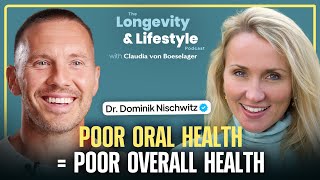
In this Longevity and Lifestyle podcast episode, host Claudia von Boeselager interviews Dr. Dominik Nischwitz, a biological dentist and health optimizers. Dr. Nischwitz shares his personal longevity philosophy—aiming to live to 150 years with a youthful biological age—emphasizing that health, especially oral health, is the foundation for longevity. He discusses how conventional dentistry often overlooks hidden oral issues such as cavitations, root canals, metal fillings, and amalgam, which can drive chronic systemic inflammation, autoimmune conditions, and accelerated aging. The conversation explores practical solutions, including safe metal removal, hyperbaric oxygen therapy, and a 10‑day online course that teaches a mouth‑first approach to health, as detailed in his book “It’s All in Your Mouth.” Both guests compare chronological and biological ages (Claudia’s glycan age of 26 vs. chronological 41) and consider how dental interventions might further lower biological age. Dr. Nischwitz also highlights the importance of community, envisioning a global network of health‑optimizers who share knowledge through retreats, social media, and future technologies. Personal anecdotes—such as his brother’s sleep improvement after cavitation treatment—illustrate the impact of oral health on overall well‑being. The episode concludes with resources (Instagram @DomE1, DNAesthetics.de, Substitution supplements) and a motivational call to start with small steps toward better oral health and a fun, non‑dogmatic approach to longevity.
Chapters
In this world of chronic health issues, it is really important to optimize your health because poor oral health equals poor overall health. It's the start.
Are you ready to boost your longevity and unlock peak performance? Welcome to the Longevity and Lifestyle Podcast. I'm your host, Claudia von Boeselager, longevity and peak performance coach. Each week we explore groundbreaking science, unravel longevity secrets, share strategies to grow younger, and stay up to date with world-class health and peak performance pioneers. Everything you need to live longer, live better, and reach your fullest potential. If you're ready to defy aging, optimize health, and promote peak performance, then visit llinsider.com for more. My guest today is Dr. Dominik Nischwitz, aka Dr. Dom. He's the world's leading biological dentist and is considered a pioneer in the field of biological and holistic dentistry. Dr. Dom is an international speaker and author of It's All in Your Mouth, with the goal of establishing biological dentistry as the new standard for health optimization protocols for all health practitioners and dentists alike, using the term health starts in your mouth. Dr. Dom trains traditional dentists in proper biological dentistry practices and believes that optimal health starts in the mouth. So we are going to start there. Welcome to the Longevity Lifestyle Podcast, Dr. Dom. It's such a pleasure to have you on today.
Yeah, thank you so much for having me. It's my pleasure.
Yeah, and I really want— excited to have you on because we haven't had any guest that is specialized in your area, and it's such an important area. And as you say, health starts in your mouth. So can you explain what you mean by that?
Yeah, basically what it says, like The mouth is the entrance to your whole body. Yeah. Most people talk about gut health, but it actually starts in the mouth. Like, this is the tube. It starts from here and ends over there. So whatever happens there will be like a mirror for your overall health. It's kind of like, yeah, it's like the entrance to your whole body. So that's why it's so important. And like you said, you never had anyone talking about this in your podcast. I'm doing this for quite some years, and I always feel that The mouth is the most neglected area anyways, whereas it's directly connected to your brain and it's super important.
And also it has its own microbiome, right? So people think of the gut microbiome and, you know, I also have clients asking, you know, I want to optimize my microbiome and then they forget about the mouth as well. So I'm excited to dig in. What are some of the common, most common diseases that are caused by poor oral health?
I wouldn't always say cause, but it's big time correlated actually, because cause in medical terms is always a bit complicated. Let's say we are living in an epidemic of chronic disease and for the last 25 years it's like increasing big time. So whatever symptom or name for a symptom you will come up with from, let's say autoimmune issues like multiple sclerosis, Hashimoto's thyroiditis, any thyroid issue, chronic joint pain, chronic joint issues, all these different things, up until neurological issues like Parkinson's, Alzheimer's, or irritable bowel syndrome. So any chronic health issue that you can come up with is usually connected to some sort of things in your mouth because it's a part of your body and not outside body. Even though as a conventional dentist, you usually Yeah, you usually just repair. Yeah. Smile and bites. So any disease or chronic fatigue, whatever you come up with, I will always have a link to your mouth. And this is the important bit. Like the World Health Organization says 70% of all chronic disease start in the mouth. But what they are looking into is only the oral diseases like tooth decay, which is number one chronic disease with 90% incidence. Gum disease like periodontitis and gingivitis. They're not looking into all the repair things we're doing, so they don't even have that on the radar. So in this world of chronic health issues, it is really important to optimize your health because poor oral health equals poor overall health. That's the start.
So can you expand a bit on that correlation? So for people trying to get their head around, like, hang on a second, you know, how does leaky gut and the thing, or even you were mentioning neurodegenerative diseases. How is that linked with oral health?
Yeah, actually, if you understand the whole anatomy of the body, it's quite simple. You have to see teeth are little organs, kind of like your liver or your gut, whatever. It has a lymph supply, blood supply, and a nervous system, an autonomic nervous system. And it's kind of like the extension of your brain, like your eyes. They're directly connected through a cranial nerve. In this case, it's called the trigeminal nerve. So whatever you do, like repair-wise, out at your teeth or on your teeth is in your nervous system. So for example, you put in metals or root canals or any sort of these health killers that I'm always talking about, they will interfere with your whole immune system, with your nervous system, and your whole biology, so to speak, because it's a part of it and directly connected through it. So this is how it's, how it's connected. And the third bit is basically the microbiome, which you already touched on. The oral microbiome always comes first. Basically what you swallow is becoming the gut microbiome later on in this pathway. And the oral microbiome changes through different versions of diet. It changes through dental repair. Like these health killers I'm always talking about. So you just have to understand the autonomic nervous system, the immune system, the lymph system. And if you understand this, then it's just a part of the whole body. It's like if you take a hormone or a pill, you know it will work systemically. So whatever you put into your mouth, like from repair business, it will work systemically. Toxins, chronic infections, and stressors.. It's the same thing that applies there. It's just not used to being seen like this because most of the people out there believe teeth, even dentists, teeth are just fighting instruments. They're hard as stone and they look nice maybe for aesthetics, but that's it. But it's not. It's 32 organs. They're very crucial and they're connected through the whole autonomic nervous system and immune system.
This is really phenomenal because I don't think you're the first person I hear talking about this. So I'm so excited to dig in a bit deeper as well. And I saw also that you mentioned there's a connectivity with migraines and other chronic conditions that people might associate with oral health. So these are— would you say they're quite common if people come with, say, they have migraines? You would look— what would you typically do?
Most definitely. So usually, obviously, our concept of biological dentistry is like the melting pot of high-tech dentistry with functional medicine and health optimization. So it's a little bit more advanced and Obviously, if you already do everything that you teach in your podcast, like everything you can do for longevity, nutrition, lifestyle, all these practices out there, and then you're still not superhuman, then it's at least time to look into these triggers. We're talking about neuromodulative triggers called oral interference. This could be— so I'm always asking 3 questions for the audience. Maybe that's a good one here. So the first question is always Do you have or had amalgam or any metal fillings or implants in your mouth right now? Stand up virtually. Second question is, have you ever had a root canal? Stand up. And the number 3 is always, did they remove your wisdom teeth, which is quite common in the Western world? If any of these questions answer with a yes, here's a big chance that a huge part of your chronic health issues are stemming from these so-called oral neuromodulative triggers. I call them the health killers or the health hazards that are lurking in your mouth that you might not even know about, even though they're there 24/7, stressing your body out and putting it into fight and flight system. So if you understand this concept, you understand how, for example, migraines— migraines is mostly a neurological issue, but there's always a component of toxicity, can be chronic infections, can be immune triggers like cytokines. So imagine you have everything in check, you already do whatever you say, still migraines. So maybe you have an ongoing chronic inflammation in your jawbone that doesn't hurt, it's chronic, and it triggers your nervous system, the trigeminus nerve, to produce a trigeminal neuralgia, which is a huge migraine issue. So most of the time, anything related to migraines is connected to some sort of cranial nerve. And what is the profession that works mostly at the cranial nerve? That's the dentist. So it could be the heavy metal, it could be a mercury problem, could be a cytokine issue like immune triggers or other toxicity that are, that are intoxicating you or stressing you on a subclinical level 24/7 for 10 years, 20 years, 30 years. And you end up having migraines all the time and you maybe can compensate them with doing some sort of detoxification or lifestyle healthy practices. But it doesn't— if it's never going away, there's a big I would say there's a big caveat that maybe you should see a biological dentist to rule out oral interference.
And so in terms of defining biological dentistry, it's looking at the root cause. Is it like functional medicine dentistry? Is that how we would define it?
It's obviously we still in this at this point of time, we still have to have high-tech dentistry repair because so many people have tooth decay. Have had metals in their mouth, have had root canals and all these things. So we need biological approaches, which means we only use biomaterials, no foreign bodies. That would be the first bit. So we need that skill and it combines with functional medicine. That's correct. Which is the nutrition side of things, the preparation of the body with the right nutrients, micronutrients and IV protocols that are designed to systemically help you heal. And number 3, I say health optimization slash biohacking, combining it with this to basically optimize your health. That's it. Like it's beyond, it goes beyond brushing. It's not just brushing and going to the dentist to repair teeth. It's about never going to the dentist again if you had that done at one point. Like nature has it right. Teeth are hard as stone. Your gums won't bleed, but we are not living in a healthy, normal, natural world. It's more like an unnatural, super unnatural world. So this is why this is the next, next, next level, what we do in our clinic there. So yeah, combining it all together to help the patients, that's the goal. As many as possible. Because chronic health issues is insane how big that is. And we all should work together to co-elevate.
Yeah, such an exciting space. So I want to touch on a few things because you listed the 3 areas. That you should stand up or raise your hands if you say yes to, 2 of which. So I've had a canal, I've had a root canal, and I've had all 4 wisdom teeth removed. So tell me what's wrong with these things and what I need to do.
So I believe you're always looking for optimal health, right? So you don't want to have any chronic inflammation in your body. You know that chronic health issues or chronic inflammation is actually killer number 1. So chronic health issue always means you don't feel it. Yeah, it's most likely numbed because your body got lazy and doesn't have a solution. So you just maybe makes the noise a bit quieter.
You adapt to it.
Yeah, you adapt to it. You don't feel it anymore, but it's super connected to everything in your body. So you have a root canal. Do you remember which one it was?
I wouldn't know the name, but top, sort of in the middle on the top left, behind the canine.
Supreme.
At 2 behind the canine.
So this is number— in English is this— in Germany would be number 2, 5. So in English is probably— it doesn't even matter— 9, 10, 11, 12, 12 or 13, probably 13, which is directly connected to your large intestine and lung meridian from a Chinese medicine point of view.
Oh, wow.
Okay. And whatever you experience, is there any chronic health issue that you have, like, for example, neck problems or eyesight or any joint issue, maybe your body is just so optimized that you can compensate it. Yeah, it will always distract your immune system because a root canal is a dead organ. In nature, you're not supposed to have any dead tissue in your body. That was never a good idea. And in every medical department, they would take out anything dead in your body. The only department that allows it is dentistry. Why? Because you don't feel it. You can easily bite on it. But a root canal was once a tooth that was alive. It had its, it had its blood supply, its lymph supply, and an auto— and an immune system. If you look at a tooth from an electron microscopic perspective, like very tiny, you will see that one root is not just this big channel that we fill up as the dentist, like to make you go pain-free, but it has about 30,000 to 70,000 tiny dentin tubules that are connected. And if you add the length of all these from just one root, it's about a kilometer of length. I don't know, it's probably 0.6 miles in English. Where now if there's no more immune system, all the microbes that live in your body, in your mouth, especially the anaerobic bacteria, just jump in there. It's the perfect cave for them and they just live there. Your immune system is too big to go in there, so it can only go around and make like a cyst on top of it to basically help your body with these toxins. But these bacteria living in there producing their metabolites, they eat your oral amino acids and whatever you eat, and then they gas out their metabolites, which are highly toxic products. They are called thioethers and mercaptans. They're toxic. And you can also become immune allergic to it, which means it's a double whammy, even though you probably don't even feel anything related to it. These teeth are very, very important. Any teeth, any tooth is important for your overall health. So it's never a good idea to have a chronic trigger. And obviously we need to do something to restore this as natural as possible. But you have to just understand, if you had a root canal, you had a huge cavity, you probably had pain, massive pain. That's neurological pain, like heavy migraines. You need to have the root canal then. But that's on you because you got it ruined in the first place. Or maybe the dentist was it, I don't even know. Now it's dead. But now we need to have a solution to replace it. Obviously, the natural healthy tooth would be the best solution. It's gone. So we need something more. And this is where we come in with immediate ceramic implants, which is my specialty, to restore it with a biomaterial. Because the only thing I want to do is bring your body back to where it was when you came out of your mom. Yeah, as close as possible. And I don't want to implant anything that is foreign material. And the usual dentist places a titanium implant, unfortunately, yet still yet, because that's the gold standard. But titanium is a foreign particle. That means it again heals with a chronic silent inflammation, chronic cytokine activation, foreign body reaction, whereas the biomaterial you will just implant. And if your body is able to heal, which is again connected to your nutrition and your lifestyle. That's why that is so big with us. Let's say a nice solution that is at least stress-free and you have that area sorted out and then you see what happens within. So you get that neurological trigger out and you will see and be amazed what's happening. Sometimes it's just— I have patients, they say I have nothing, it's all good. But you can see, for example, their deep sleep is just not good enough, or they have no REM sleep, or they need just 1 hour longer sleep. They say, I'm totally healthy. And then after they tell me, oh, ever since I have that root canal gone or that cavitation gone, I only need 45 minutes less sleep, which is in my world amazing because I see, okay, the body needs less to repair, but also just to know there's chronic infections, chronic like immune trigger and nervous system is something I would never want in my body. So that's why we obviously need a solution. And I'm lucky that that is possible these days that we have these ceramic implants. To replace a missing tooth or root canal. And we do that immediately. So that would be the root canal bit. I hope you understand. You can also, if that's too deep or too much rabbit—
100% understand. Exactly. I'm going to look because I do think it is a ceramic implant as well. So originally they filled it, I think, with ceramic and they had the natural tooth. This is done years ago and dentist couldn't believe over the years when I've lived in different places that it still hadn't cracked and that it was still okay. And they insisted on putting a crown on it. So I need to look what they've done since and Yes, you probably have a ceramic crown on top.
An implant is a total restoration of the tooth. So we take out all root canals, incomplete, clean everything, disinfect everything, so that your body doesn't— like, if you take out a tooth, you usually end up having a socket. And what happens if you don't do anything? It collapses. That's called alveolar atrophy. Just normal. You lose bone and you lose bone volume. Height and quality in the first 3 months. That's the usual dental way. And then they think about, okay, now we put in an implant. Oh, we lost bone, we have to rebuild bone. So what we do is we take it out, we clean everything using ozone, taking blood from your veins and spin it to make PRP out of it, whatever we need. And then if it's clean, obviously I place this whole implant, which is a new tooth. Root ceramic in there to stabilize the socket, to keep bone height and quality. And you never actually have a real surgery. We just take out that tooth and you heal and osteointegrate for the next 3 months. Super simple, pain-free treatment. And just too little people do it nowadays, but that's what we teach.
Yeah. Okay. Really exciting. So I'm going to be looking into exactly what mine is. Let's talk about wisdom teeth, because also I know a lot of people have this extracted and it's just expected you have them pulled. So Why should one not have wisdom teeth extracted?
Again, we go back to ideal world. Think about Weston Price. It is amazing. You're probably familiar with Weston Price. He did this amazing experience with nutrition and how these folks grow. And that usually, obviously in the natural world, we are designed to have 32 teeth, which means all wisdom teeth grown out in have space. Unfortunately, in the Western world, because of our lifestyle, starting with the womb, we grow too narrow. So when you then 14, 15 years of age, the dentist tells you on a panoramic X-ray, oh, your wisdom teeth are impacted, they will never have any space, we need to take them out, otherwise you end up having more crowded teeth. So yes, in this case, obviously we need to take them out because if they're impacted, they're becoming a neurological trigger too. But the way how this is done and is most, most likely leads to something chronic again. This is why I always ask the question, have you had your wisdom teeth removed like yourself? So I wouldn't plan your panoramic, see this root canal and draw in ceramic implant. And the second bit would be wisdom tooth area would be red and there's a word on it written called Nico or FDOJ. In layman's terms, cavitations. You might have heard of it, cavitations. So in, in dental university, you never learn about this. It's not accepted yet. We're working on this big time with a lot of research in the background. And basically what happens if you take out these wisdom teeth, most likely in your teenage years, you're not prepared. The only information you get from your surgeon is we're going to take these things out. You need some medication, you will have swollen cheeks like this and you need painkillers. That's it. There's no preparation. You're in growing phase and you probably eat shitty foods because you're not— no, you don't know what to do in the normal world. You just eat the regular standard Western diet. What happens? Your body is not prepared, it's in hibernation mode, so it just works somewhat. It never grows a nice bone. It always grows a chronic, let's say, mushy fatty degenerated bone. That's why the term FDOJ stands for fatty degenerative osteonecrotic jawbone. And this is what usually happens. I would say 98% of all cases out there, they had their wisdom teeth removed, they end up having chronic silent inflammation in their jawbone. And this area, wisdom tooth area, is super extremely important in the meridian system, connected to adrenal glands, small intestine, and heart meridian. So some people have heart issues, palpitations, something like this, or like weird symptoms. A lot of people have just chronic fatigue. They don't even know where this is coming from. And obviously no dentist will look at it because they don't even know about that topic. And at least 50% have thyroid or gut health issues because it's directly connected to the small intestine, which is a big part around here for SIBO. You might have heard SIBO is a big one. So small intestinal bowel overgrowth. Then obviously all the gut problems come with health, come with skin issues, a lot of inflammation. Even women in their older years have like still kind of pimples and eczema. And they already obviously do everything like creams from outside, they eat the right diet, but still doesn't go away, then you know, okay, maybe there's a trigger in my wisdom tooth area. So that's why I'm always saying, okay, have you had your wisdom teeth removed? Because cavitation is a real thing even though it's not yet existing. But for all the medical doctors out there, if you're interested, these cavitations have special cytokines or chemokines which are called RANTES. Maybe it's a bit of a rabbit hole, but I just mention it. RANTES or CCL5, if you just Google Scholar this, maybe also interesting for you. Make a Google Scholar search, which is the PubMed for Google, and just type in RANTES, R-A-N-T-E-S, or CCL5 plus multiple sclerosis, for example. And you will find instantly 3,000 page— 3,000 research papers that look for this. The problem here is medical world looks for RANTES, but they don't know about cavitations. So we again have this thing that dentist and the mouth is kind of like not your body. So biological dentistry integrates the mouth into your body and makes it the centerpiece because it is like the extension of your brain. It's basically working on a brain nerve. So again, chronic inflammation.
This is really fascinating. Yeah. And I mean, there's so many people that say I have chronic fatigue, I don't know what it is. And obviously the body is a complex being, right? With some people think maybe it's due to hormones, stress levels, et cetera. But I think many people don't look to the mouth and don't have dentists that are aware of this either.
Yeah, but if you just touch on hormones, for example, yeah, most functional medicine practitioners will look into your hormones and see, maybe see, oh wow, you have a lot of— you have a high cortisol or a high adrenaline, noradrenaline, you have low serotonin, whatever. So, and oftentimes then prescribe some— maybe they also obviously have wrong thyroid hormones because if you have any sort of stress, your thyroid takes part of it in your sexual hormones too. And then maybe prescribe any natural thyroid things or any bioidentical hormones. But you have to go one step further and look, is there anything chronically inflamed in your body? Because what does it do? It always activates immune and nervous system, activates your hypothalamus. So it's called the stress axis, activates your hypothalamus, pituitary, adrenal gland axis. To produce cortisol. Yeah, stress hormone. At the beginning, it's maybe just adrenaline and noradrenaline. But if it's a long-term chronic health issue, you will produce high levels of cortisol. If you produce cortisol all day long, it's kind of like the body's reparation mechanism. But what it does over time, it depletes the precursors for your thyroid sexual hormones. And this is called something called pregnenolone steal. It's totally normal in, let's say, in the functional medicine we look at this, but most of them don't look at the oral cavity. That's what I say. So they try everything, still not good, even though you already have the perfect regimen. Then it's again time to look for metals, root canals, and cavitations from biological dentist because they could be again, this word, the neuromodulative trigger that is holding you back from the inside because you can hack everything. You know, biohacking is about hacking your environment, Obviously you protect yourself against Wi-Fi, against all these things. But there's one part that you can't biohack, and this is the stuff that you have in your mouth done by a dentist. That's the unnatural bit, the most unnatural bit in your body, and your body has to compensate it. So if you take it out, your body gets in parasympathetic mode, which means out of fight and flight and into healing. That's why this is so critical. This is why if you understand biochemistry, hormones, the whole health matrix. You could put this really in the centerpiece and teach every health coach out there. I don't even care if you're a trainer or physiotherapist or osteopath. I believe everyone who deals with a human being who wants to help optimize needs to be able to learn how to read a panoramic X-ray and look for metals, root canals, cavitations, or ask these questions. Because sometimes you end up having patients, they went to 29 doctors for 15 years, they're still super sick. Nobody helped them. Then they come and see us, and then finally they can start their journey. So it's really that critical.
I'm excited to jump into a few different topics from things that you've mentioned there. But just to get to the bottom of with the wisdom teeth and cavitations, as you call them, how does one solve for that? And especially if people maybe have had their wisdom teeth, let's say, pulled and they were relating to adrenal fatigue or some of the other issues that you've mentioned. What should they do? What are, what are the action items here?
First action item you can do is always optimize your health and do everything already, like change your nutrition, lifestyle, do everything to de-stress your body. Yeah, because then we know the only leftover stressor is in your mouth. But for cavitations or root canals, you obviously need a skilled surgeon at one point that takes it out. It's a very, very minimal invasive therapy if you know the skills. Yeah. Or if you're trained by me, then you know that our goal is not to be an old school surgeon, meaning like huge cut, rough style, like we did our wisdom teeth. The opposite. We do minimal invasive surgeries. We kind of barely touch you and maybe just remove what's, what's dead or wrong and replace it. But in order to do so, all my patients have an onboarding online course where they learn how to optimize their health and nutrition. How to take the right micronutrients, all the different things that you can already start right away. Yeah. So basically just start your health optimization journey and then find someone skilled to remove your metals safely, to know how to remove root canals safely and place ceramic implants and disc cavitation. And we obviously have that combined in a whole clinic setup where we do it all in one. That's why the patients fly in from all over the world because they know, okay, This guy or this clinic is taking care of the whole bit in just one health optimization week. Flying in, we take out all the metals safely, all the root canals, place ceramic implants, do the cavitations, prepare your body 4 to 6 weeks before. During the time you're here, we use hyperbaric oxygen therapy, we use IVs, we use laser in your veins. Whatever you can come up with when it comes to health optimization or cutting-edge stuff, it's all there. Full-on thing, and then you leave healthier with a nice mouth and you just let it heal for the next 3 to 4 months. And then you come back if you need crown work, like the final, the teeth, and that's it. I never want to see you again as a dental patient, otherwise I didn't do a good job. Because you have to understand, you should never get dental repair in the first place. Yeah, you should never have tooth decay anymore. That's all on you. That's all again the lifestyle factor. So this is how we go about it. But unfortunately, there's not too many clinics yet that have the whole— basically no one actually, but we're teaching it.
So this is definitely a model to roll out. You're singing to me as a biohacker, fellow biohacker, having hyperbaric oxygen therapy at the dentistry practice and Vein Treat. I love it. Let's talk about the metals in a little bit more detail for my audience and people who are unfamiliar. I recently had a client who's optimizing everything and she was still experiencing chronic fatigue. And then we got to the bottom that she actually had mercury fillings and that these would have to be removed. So what do people listening who might have metal in their mouth— why? What's going on there? Can you explain the science behind it and the conditions? Yes.
So metal is obviously something that dentists used to still use nowadays to repair teeth because it's just a material that you can work with. You touched on mercury. So if you have any sort of these silver-black fillings, they're called amalgam filling with an M at the end, which are containing 50% of mercury. So, but there's different metals. You can also have nice white teeth and underneath there's a metal fused crown. That means below is metal. You can also have replaced root canals with implants, which are usually titanium. So metals come in various different shapes and forms. And there's 3 health challenges that are always connected to metals. Number 1 is it could be a very strong toxin like mercury. Mercury is the most toxic non-radioactive element known to man, and the main source for mercury toxicity is still the amalgam filling in your body. So this needs to be gone, but safely. So toxicity. But also there's obviously other things— copper, tin, lead. What is this? Nickel. Even nickel. Sometimes you find nickel. A lot of people are allergic to nickel and various different materials that are— none of this material is supposed to be in your body. It's all stuff that you can use for a car, but it's not for your body. You're not Terminator, so you're not a machine. And second one, toxicity number one. Second, there's no particular order. Second would be immune system. Your body can become allergic to any foreign material. Why? Because your immune system is designed to repel invaders. It's kind of like your own army. And if you have a foreign particle, it can be attacked all day long. Number one, almost all people know about nickel. Nickel is number one allergen. But you don't know that nickel is oftentimes in the wires that we use for braces. It's oftentimes even in a titanium implant, like a grade 6 titanium implant has nickel in it. So you install nickel into your system, like in your bone. It's like inside of your body, in the cell. It's really bad. So immune system, you could become allergic. And if you're allergic, that means your immune system is on fight mode all day long, causing havoc. And the problem with immune system is it's not dose dependent anymore. So toxins in the first place are dose dependent. Your body can deal with it and detox it all day long. But immune system, you can only be allergic to just a little bit of a fume from it. So really bad. And the combination, super bad. And number 3 is the one that you cannot, let's say, discuss away these days. We have a world that is loaded with EMF, electromagnetic field, Wi-Fi, 3G, 4G, 5G, probably 6G, radar, all these different things. So our environment is loaded. So if you have any metal in your body or on your body, it is going to be a human antenna. Human antenna. Why? Again, important. Your body is like a battery. We have that current in our cells, which is really tightly regulated. Your whole nervous system works like a battery. So now you place any sort of metal in that system and this will aggravate and make, again, interference. So there's studies showing, for example, if you have a phone call with your cell phone and you have a mercury filling, the electromagnetic waves will lead to more fumes coming out of that mercury filling, intoxicating your brain even more in your nervous system, even more. Or if you have a titanium implant, it will actually heat up. So it will send very sensible, sometimes amplify the electromagnetic field 400 to 700 fold. There's even people out there, there's studies, not studies, empirical data showing that people can, you think about psychosis, can listen to radio stations when they dial in correctly because they have frequency and have different antennas. It's good if you, if you feel that it's a, it's a radio station, it's fine because you can listen to it. But imagine you just now hear noises and voices. You can also become psychotic from this. It's called electrohypersensitivity. So it's really a bad, a good thing and a bad thing to have. And really bad is that no one knows about it and it's mostly woo-woo. If you go to regular doctor, they tell you, oh, this guy is psychosomatic. Go take some antidepressants, but it might be just lurking in your mouth again. So metals, toxins that your liver needs to deal with and your whole body. Deplete yourself, do the thion, all these crucial things. Second, immune system trigger every day, rashes, whatever. You know, when you understand how your immune system works, it's a big stressor. It costs energy. Any chronic inflammation costs 30% of your energy. And number 3, human antenna. So I think I don't want to have that in my body. So how can I do this for my patients? The next thing is you need to have someone, because I'm not here to scare all your fearmongers. The opposite, I give you information out there to help you optimize. You don't jump now to the next dentist and say, hey, drill out all my amalgam. That would be the worst idea you can do. You need to find someone who is a skilled practitioner who knows how to remove mercury fillings or any metal safely. And in the US, there's a group called IAOMT. So dentists can certify through them to become SMART certified. SMART, like intelligent, SMART certified. That means they're certified to remove amalgam safely. SMART stands for Safe Mercury Amalgam Removal Technique. So this is a good way to start, but don't go to your regular dentist. They will just drill it out and make it even worse. Because if you just drill that out, obviously you have way more gassing out of the fumes and toxins.
So that's the tricky or the challenge. If you were— so some people might be like, I'll just go to my dentist. I know him for years. What is the danger? It's the fumes when they drill it out that you would be inhaling, and then it's toxicity that stays in your body.
It's the same thing. So you have a mercury filling in your mouth and the usual dentist— that's what we're taught in university is, oh, that amalgam is a super good filling. It lasts forever. It's almost cheap and for free and super easy to work with. Maybe correct. But every single day, through grinding, chewing, drinking acidic foods, brushing, dental hygienist, you gas out a little bit of that mercury vapor, about 2 to 3 microns, which is a thousandth of a milligram. So it's really tiny and it's— you don't see it, it's odorless, you don't smell it, and it just fumes out. And the problem with this mercury is it's called— so the fume is called Hg0, I don't know how you call it in English, the chemical version. And this goes through all the cells, it goes there, there is no protection and it gets it gets stored mainly in fatty tissue or connective tissue, and then, and then catalyzes make HC2+ out of it. So the half-life now becomes 16 to 32 years if it's in your brain, so you don't really get it out. So you're chronically intoxicating you on a daily basis. And if you want to take it out, obviously with the drilling, you probably 1000x these fumes. That's what you don't want to do. If you want to take it out, what we do is we take— we have a 7-fold measurement system, even including even IVs during it and after it, so that your body really doesn't take anything so that we can take it out without causing further damage. That's the goal. Yeah, that's really important. And obviously realizing now, because I work with thousands of patients for the last 15 years, what dentists almost always forget is the patient in itself. So this is why we make it into a whole week. Means you come once, you stay and you optimize everything. It's kind of like a spa treatment, more like it. Yeah, it's not a regular dental thing. It's more, it's all about optimizing. And then you only have one trip. But usually it's like, okay, you go to take this filling out, then this root canal. So you go to the dentist 15 times, maybe even 20 over 2 years, and it costs so much time and money for the patient. But this is the bit that the dentist always overlooks, that there's also time involved, time issues. So if you have, can If you can set time apart to just do it all in one, get it over with, optimize further, that's the way to go. Because later on, if that's all clean, the root source of toxicity and whatever is out of your system, we will also help you optimize any pathway and then later on even help your body detox with like, let's say, chelation and anything which you don't want to do if you still have that in your mouth because the source needs to come out first. Otherwise it would be like You don't shower yourself if you still have your clothes on. Makes no sense. So don't do any chelation if you still have the root salts in your body. It can actually cause bad havoc.
That's really helpful to know as well.
Don't freak out.
Just info. Well, I love the fact that there's a solution and that's it as well. But you didn't mention gold, and I know some people have gold in their mouth. What is the view on gold?
No, no, no, no metal at all. Not even titanium. Titanium, for example. Is not as allergic. It's still a lot of studies showing that titanium oxide particles, which are very high immune triggers, you will find in local lymph nodes and then they also cause immune issues. So, and gold is actually quite high in there. I think it's, it's gold is on. So nickel number one, then I think mercury, organic and inorganic, then it's already gold. So it's really a high allergic trigger even though it's a precious metal. Yes, maybe for sale as a celery or whatever, but not in your mouth, not in your body. It's not— it's just not there to be there. It's like gets dissolved every single day also into your saliva and then it's like occurring in your body. And obviously it's a foreign particle. Again, immune system toxicity, same applies for gold and tenor too.
What about veneers? And then I'd love to touch on also retainers in general. And also Invisalign is a very popular— I mean, here in London many people running around and obviously it's plastic in the mouth each day. So can you touch on those different areas as well?
Yes, of course. So first of all, veneers is a very high-skilled dental skill, a high-level skill. And the problem with veneers is I'm a big fan of veneers if you need them, because real veneers done by an aesthetic specialist are very thin, like 0.3 to 0.7 millimeters, like really, really thin.. And if you have a good oral designer like a lab guy you're working with, this is all planned in advance. So we will plan your whole smile before and then later on we see, okay, we maybe have to shave a tiny bit off, but usually they are additional. That means you don't hurt anything, you just glue it on. Glue is bad, but you adhesive work on top of your teeth. But in the world of social media and things, people are flying out all over the world to get their nice white teeth and veneers. They're not veneers most of the time. They're most of the time really shaving down your whole enamel, filling your tooth, and you get crown work, partial crown work or whatever. That's bad. This is destroying your tooth. So it's really— you need skilled people. It's not a thing where you should save money on. And I don't even say that everybody who charges a lot is a good skilled dentist when it comes to these things. It's like with every profession. But this is a very minimal invasive treatment. So if you feel that people are shaving down your teeth, like really drill it down, it's not a veneer. It's the crown. And you have to see, this bit is called enamel. That's the hardest part in your tooth. It is the protection. It is hard as granite. And as soon as you shave this away, there's dentin below. Dentin is super soft and sensitive. You basically take the structure away of your tooth, and not a good idea. The best thing is always having your healthy teeth. But I get the vanity. So veneers, if they're done properly, yes., but really, really dig deep into what they're doing. And this is hard, obviously, for a patient to find out. That's always the problem. But it's the same with every profession. So how do you know if this construction worker makes— builds you a good house? Yeah, same. So, but the pearly whites in Hollywood, most likely not really veneers. And if they're veneers, that's not the aesthetic we go for. We go for natural aesthetic, which you don't see that you have it, but A1, like really nice teeth. So that would be veneers. The second question was, I think, retainers.
Yeah, retainers.
Most of the time metal. Take it out. Yeah, it's a metal wire. It also— a bit that I've not touched on is that the teeth and this joint called temporomandibular joint are strongly connected to your whole body alignment and posture, because postural, posturology, and all these teeth move. You know, your teeth move and there are sutures that you're born with, like in the middle of your brain and and your head, like where your whole, let's say, what is the English word for this? The skull plates, they move, they have to move. And there are a couple of them in your teeth. So if, for example, one of them is this one, the lower, lower part in the mid, where do you have your retainer? Right around this one. So you block that movement. So your lymphatic isn't as good. And also again, metal toxicity, maybe toxicity is not too bad in this case, but immune system. And also again, a huge wire in the middle of your central nervous system, like the perfect antenna. Take it out, take a nighttime splint to remove. Or maybe some dentists will even give you a fixed retainer. I personally don't want to have anything, anything fixed. Just like take the splint, like Invisalign after treatment, like the retainer, plastic retainer, put it in and out. Ideally, actually, just to say that on top, using or needing a retainer is actually the documented treatment. Like it's that the treatment didn't work. It doesn't— it means it doesn't work because if your teeth and the posture of your teeth would work, and the bite is correct, the bite itself is the retainer. So if you need a retainer to keep that fixed because they're getting proud again, your orthodontic treatment didn't really work. It's just the documentation of the fail, so to speak. And it's obviously exaggerated, but it is that way.
And so I'm laughing because I do have— I didn't even— I've had it so long I've forgotten about it. I have the metal wire in my mouth behind my teeth. So I need to put it I'm in London.
Yeah, it's quite close. It's only an hour 30.
So exactly. I'm in Germany every now and then, so I'll swing by.
Are you coming to the Health Optimization Summit, which is in London? Yeah, I'm going to speak.
So that's brilliant. Okay, very exciting. So yeah, it's funny, I'm just laughing because I was like, okay, yep, tick the box, tick the box. Exactly. So I need to optimize a few things for sure as well. The thing is, with the plastic of the retainer, is that a concern for microplastics entering the body if you have them in, or what do you think?
I would always say, okay, obviously best would be not, but I get the vanity. And let's say I'm not, I'm not the person who wants to fear you because there's so many different, let's say, bad things in this world. It's about 400 toxins that we have to go through every day. So I just look, okay, how can I compensate for this? Is it worth it? Is it fine? So I would say there's probably 100-fold less risk than the metal retainer. And these plastics that they use, they usually— there's no more monomers, no more soft things of phthalates. They're super hard and they mill it out. So that's a very stable issue. Obviously, probably you, you abrade, it's a bit abrasive, but you will also drink your cup from Starbucks, which has plastics in it. And there's so many things. So I would in this case rather optimize my health to be very good with detoxing and know about it. Than to stress about everything. But then if you're okay with like me having a few crowded teeth, you don't need a retainer at all. That's fine. That's my retention. But if you don't want, then you go with the plastics. So I say it's quite—
it's okay. Okay. Yeah. You have to pick your battles, as they say, right?
I didn't know that saying, but that sounds perfect. Invisalign treatment is perfect. So if you obviously want to have straight teeth, this is the way forward. The only thing I would maybe like to see more often is that orthodontic treatment is combined with a, let's say, a chiropractor or an osteopath. Because again, we're working, we're working with force. So you're forcing not just the tooth. The whole tooth is the whole body. For example, the fascia of this muscle here, masseter fascia, it goes till you, till this tooth, till this foot, like the big toe. From here to there, like crossed over. So if you have tension here all the time, obviously your body will do anything against it. So if you can work with somebody who aligns you all the time, let's say once a week while you do that treatment, it's so much faster and so much painless. And this is just the way that it's not done yet, but this is how we would do it.
I love your holistic approach. Yeah, it's opening clinics around the world. I know, because it's so interconnected as well. And it is. It's so exciting that this is the sort of new frontier of medicine and actually bringing the whole body together instead of the individualized pieces. So I really applaud what you're doing, Dr. Damm. Very, very cool. Thank you. Let's go back to very simplicity and talk about toothpaste and mouthwash. So what are some dos and don'ts here for people listening?
So toothpaste, pretty simple. Go as natural as possible. Number one would be go fluoride-free, but that's not it. So besides fluoride, fluoride is a known neurotoxin I want to avoid. You don't just don't need it. And then obviously what they all put in these toothpastes makes no sense. They put all various toxins in there like titanium dioxide, which is a known immune trigger, triclosan, carrageenan. They even put saccharin, aspartame, all these sweeteners in it. Why should it be sweet? And then maybe even abrasives. So just ditch that regular one and find something that is without it and maybe just based on coconut oil and has some nice essential oils to it and maybe only— so what I would use as a sweetener is xylitol. And if you want an active ingredient, you look for hydroxylapatite, which is the natural thing that is— that makes your tooth hard. And obviously most things that make your tooth hard is your nutrition and your micronutrients. But still, if you want to go from the outside, hydroxylapatite, pretty straightforward. If you don't want to eat it, don't put it into your mouth.
Okay, that's a really interesting way to think about it. Is there a brand? Because I know some people are not up to making their own potions for toothpaste.
Is there a brand? Many more brands evolving right now. I can't personally recommend any brands that I— because it's somehow in UK, some are in US. I just know that most of them approach me and ask me to. So I have my own ideas about a good paste, but there are a couple of more coming out that try as natural as possible. You find it in health food stores. So in London, you probably can go to Planet Organic, Whole Foods, even you will find something there.
Yeah. Okay, cool. So mouthwash. This is something that when I discovered it, I was really helping clients realize this is so potent because they're optimizing gut health, yet they're using these super toxic mouthwashes.
So what's the problem with mouthwash? The most common mouthwashes that you find in your local retail store are like just chemicals. Like this. I didn't want to say the name, but Listerine. You're still drinking Listerine or taking this in your mouth. You crazy? It's super acidic. Like acidic stuff will ruin your enamel. Why would you brush or do anything in your mouth that is acidic besides your coffee that you like, but not that Listerine. And it's not, it's just a ton of chemicals. Just look at the back page. I don't even know all these things. So if I cannot even spell it, I wouldn't put it into my mouth or into my body. It is in your body. And you have to understand, like I said before, the oral microbiome is about 4 to 10 fold bigger and more diversified than the one into your, in your gut. Yeah. And you want to, do you want to sterilize or disinfect this on a daily basis? Like, like the sanitizing things in your mouth, which will ruin your immune system, ruin your nutrient absorption. And also obviously again is another toxin to be dealt with by your liver and your gallbladder and all these things. It's unnecessary. The better solution is coconut oil pulling. Very simple, old school Ayurvedic treatment. I recommend that always in my Bulletproof health, oral healthcare strategy. Coconut oil pulling, it's— you probably all of the— all of you guys have that for cooking. It's extra virgin coconut oil. You just take a teaspoon into your mouth and swish it around for 5, at least to 15 minutes, and then don't swallow, spit it out and don't put it in the sink, spit it into the bin and that's it. You can obviously optimize it. I've— in my online course, there's recipes in it and all these different things that you can maybe DIY an even better version with a few essential oils. But just for starters, use coconut oil pulling. Go into my Instagram feed, there's lots of videos about it. Super simple. And this coconut oil is not acidic. This coconut oil is also antibacterial, antiviral, antimicrobial, and it stores toxins. That's why you want to spit it out. Kills bacteria. So, and also it's way better than flossing. It goes everywhere and cleans and sucks up the biofilm.
So it's really a good strategy. And for 5 to 15—
did I understand minutes? Yeah, a minimum of 5 minutes, otherwise it doesn't make any sense.
Okay.
The only thing is you have to make it into a habit, like with everything, like even the tongue scraping. Just do it every day and then it gets— and then you find how to do it. For example, I personally, my routine is the following: I wake up, then I have a copper tongue scraper and I scrape my tongue. It's like Takes about 10 seconds, like breathe 3, 4 times to get away of this debris and all the bacteria that are in the— was at the ground of your tongue, like the back. Then I personally always start with a concoction of different things that I'm drinking and make sport. And as soon as I prepare my breakfast, I would do coconut oil pulling because I'm anyways in the kitchen and doing something. So I just put the coconut oil in my mouth and work something for 5 to 15 minutes. Spit it out, then I have breakfast, drink my coffee, whatever. And then I wait 30 minutes until I brush. That's it. Wait 30 minutes because you don't want to— as long as there's any acidic foods which maybe, yeah, maybe open up your enamel, so to speak, and make it a little bit more abrasive, you want to wait for your saliva to remineralize and then you brush. Because otherwise you brush away your enamel easier because it's already acidic and opened up.
Okay. Yeah, because I wanted to ask next, sort of what are your key strategies for maintaining oral health? So that would be an optimal morning oral health routine. And what about in the evening? And would you recommend even brushing during the day or—
No, no, no, no. It is always complicated. In my world, everyone is healthy and everyone has the perfect lifestyle like you and myself already. So I'm never thinking about people that are— don't— they don't have it. So obviously if you eat crappy foods all day long, you might want to clean twice a day at least, maybe even 3 times, but that's maximum. So better twice a day and that's it. Like the most, the most important bit is your nutrition, hands down, and the minerals and micronutrients you get through diet and maybe even through supplements. That's number one. If you don't have it, you maybe do a little bit more of the usual oral hygiene tricks they show you at the hygienist. But for me personally, I only do this. That's it. I don't even brush in the evening. That's it. Really? No, I have clean teeth all day long. I eat stuff that makes my teeth clean. Usually the food you chew, and if you chew, that is more hard, then your teeth naturally— if you start obviously eating soft foods all day long that are sticky, you might want to do that more often. What are your favorite foods for good oral health? Just the most basic foods, whole foods that nature provides. You need meats, you need fish, eggs, like all really whole foods, and avoid the processed foods. Like the most important ones to avoid is obviously always sugar, but refined vegetables are really bad, trans fats, um, gluten-containing grains are known chelator, which steals minerals that you might need for your teeth. And usually also say stay away from conventional dairy. Nothing to do with A2 dairy or raw dairy is different because, you know, most people say dairy is important because of the calcium for your teeth. Wrong. Yeah, totally wrong. So I would say you need a few key, let's say, micronutrients that I said is always essential amino acids you need for enzymes and everything. You need vitamin D3, which is actually a hormone you produce in the sun.. This is really crucial to get minerals into your teeth and bones. Vitamin K2, you need magnesium, you need zinc, you need boron, and you need omega-3 fatty acids. So you can optimize your nutrition so you get a lot from it. But I always supplement because it's just a better way forward if you want to be optimized. If you just be okay and sustain, probably don't need it.
But that's not my goal and not my audience either.
Yeah, yeah.
I'm going to help for longer. Which moves on to my next question that if you can live to 150 years old, Dr. Duhm, with excellent health, how would you spend those years of living to 150 with excellent health?
Yeah, obviously I optimize as soon as possible so that whatever I do pays into that longevity. So whatever I want to do is I don't want to lose health in the first place. Every single day, everything I do, as little as it is, should give me a bit of dividend towards optimal health to make me live as long as possible, as young as possible. So basically, I want to be 150, the same as now, maybe gray hair. That's it. I want to do my exercise. I want to have time with good friends and family as much as possible. Actually, that's my main thing, to spend as much as possible time with possible people, with positive people that are like-minded, that have fun, that want to change something in the world. So my goal is to help as many people as possible, and I can't do this on my own. So that's why I look for other health avengers like myself, and I'm lucky to meet a lot of my friends again at the summit and so that we can change it. So I'm all about inspiring by practicing, teaching, preaching, whatever I do, and help many people along the way to really change something. So if I can use that time wisely, have a lot of impact, and obviously I want to have as much time as possible with my family. I've now became a dad again last week, so I've— Congratulations. Thanks. 4 kids now. So I also want to have time with them. So everything needs to be optimized on that space too. And health is first. Always health comes first. Aesthetics comes, follows, and then you stay young. You know how, you know, you know, you can even reverse aging, for example, with hyperbaric oxygen or other things. It's possible. Yeah, but not as long as you have oral interference, then it's difficult.
Well, I have a biological age of 15 years younger at the moment according to glycan age. I'm trying to get it down to 20 years old. And I wonder if we fix some of my dental, dental things that maybe we can hit the 20, 20-year-old mark.
That would be actually interesting. I've never done this connection, but it can be something. Probably not within the first 3 weeks, but maybe within the next 6 months.
What is your regular age then? Chronological? My chronological is 41. My biological age is 26, and I want to get it down to 20 and then keep it there up to life.
That's my goal too. I would say my chronological age is only 25. No question. My biological, I want to have it 25 forever. That's Perfect. I'm 40, by the way, so like, okay, yeah, kind of the same age. Yeah, yeah. So that's a test. It's actually a really good test. I like to do that because obviously all our— all the health of them might— let's say all the health optimizers, like last year on the summit, I asked these 3 questions and every single one in the audience would stand up. So even though all of us do all the good things already, it's still holding them back from the inside because they have been at the dentist. Yeah, you see how much you can. My brother is a good example. He is doing everything. He's into tai chi and, and Chinese medicine and Taoism, all these things for his ear. And he's like, hey, Dom, I'm super healthy, but I have the cavitation. We did that. We diagnosed on the cone beam. Let's see what happens. And he was, for example, the one who said, okay, I need 1 hour less sleep, which is amazing. So he only needs 6:45 now and is more than refreshed. And you can measure this with aura and all these different tools.
Yeah, very, very cool.
Yeah, I think it's amazing and I think it's the most overlooked part, unfortunately. And this is why I'm working even in functional medicine. They don't really talk about these things. They maybe mention heavy metals being an issue, but that's it, basically. And what about root canals? Cavitation? Never heard of it. What about chronic inflammation? Yeah.
What about this? This is the first time I'm hearing about it. So I'm really, really excited to have you on and sharing all of this information as well. And on our journey to increase healthspan for longer as well.
Yes, that's the goal. And then obviously if you do that, you can help more people. I always believe when we heal ourselves, heal others. And that's how my journey started too. Like I was chronic sick already when I was 20. Yeah.
Yeah. I've had also my health journey too. So we learn and we can live to tell the tale and help others to improve their health as well and enjoy life all the more for it.
Right. So exactly. Yeah.
All about enjoying it. Exactly. What excites you most about the future of health, well-being and longevity over the coming years?
Envelope beyond that? What excites me personally is obviously, um, what, what's fun to me is meeting people that want to help optimize the health of many and combine it to make like a global network out of it and help and build communities on retreats. Because I think this is now easily doable with all the technology and all the social media. So I think, and obviously making it fun and easy, not dogmatic and stressy. Like, this is the part. And I think I'm not too big into AI and all these things yet, but I believe we can even— I think we can even do more than 100. 150 should be doable easily. Do you think so too? This is exciting.
This is exciting, which means you and me are both kids right now still, right? I know. Every birthday I'm like, I'm growing younger. This is great.
It's actually going backwards. Changing the mindset. This is also something that's important to me because I want to change the way how dentistry medicine is done totally. To help people see there's so much more potential. Imagine everyone would be like us having fun doing all these things and that it's possible doing fun things like as a kid. How great would this world be? You meet only good people. Nobody's like, oh, what a shitty day. Like, everybody's like, yeah, let's do this together, play outside. And I think that's— it's a bright future. And I'm just— I'm not listening to the negative things.
I don't even care. Yeah, no, but it's important to filter. And at the end of the day, the beauty is that we always have a choice. Right. So we can choose to focus on the negative or we choose to focus on things that are fun, make us happy, and then find the right people around us, the positive people, right?
To— Yeah, exactly. Nowadays we have solutions. That's the most important thing. I can give you a solution. It's easy. You don't have to run around with a gap here or like I destroy everything. So we have good solutions and I believe there's more to come. And if the possibility works in my lifetime that we don't even need the repair business of a dentist anymore, but the dentist becomes a usual, a normal medical expert that treats the whole body by starting in the mouth. That would be amazing. You don't even need to drill, fill and bill anymore.
So, so good. I love your mission. And speaking of fun and toys, you have an interesting— for people watching on the video, you have interesting toys behind you. Can you tell us about your cars and the skateboards?
Skateboard is just me because I'm a skater and this never changes. If you want a skater that never changes. So that started when I was 12 years old, 1995, and I'm still Big fan of skateboarding. I'm still skateboarding myself and obviously with my boys. Cars. I just like cars, but mostly my, my boys build them. So they're, they're all like this one here, for example. This is— I think they're all like 16 plus. And this car built it when he was 4 years old. So, well, my job is done at that field already. So they're already better than me when it comes to these things. But I just like Lego building. And then if it's a nice car, it's even better. So that's it. This is my— this is basically, if you see more, there's lots of turtles standing around like stuff, stuff like this and taking care of me in the back. Teenage Mutant Ninja Turtles. Of course, you know that age. So I was like 6, 7 and I started with karate and there was turtles. So I'm still surrounded by them. I'm a big kid and this is my man cave.
Yeah. Beautiful. Yeah. Happy place. Love it. Yeah. Dr. Dunford, my listeners interested in understanding biological dentistry and oral health for longevity better, what online resources or books would you recommend they start with?
Books, obviously you can start with mine if you want to. That's called It's All in Your Mouth. You mentioned it at the beginning, but I'm about to launch for the first time on a broader community. I launched my online course, which is a 10-day journey to optimal health by starting in the mouth. You will learn everything about the oral health killers, what to do about it, how they might even— what is the solution for it. But you also learn everything about my food design concept, how to learn, learn how to think in nutrients so that you finally understand that it's not about diet, but what you get from your food. Being a vegan or carnivore doesn't even matter as long as you know what to do. You learn everything about micronutrients, about the whole health matrix. So I try to compress a transformational journey of the 20 years I did in 10 days, like in, in, let's say it's about execution that beats knowledge in this case, like execution focus. And this is the onboarding course we do for my clients anyways, but my goal is to help many. So it's coming out. I think we launch it within the next 2 to 3 weeks. So just stay updated in my stories on Instagram would be probably ideal, but this will probably not air, so it will probably air when the course is already existing. So you just go to my Instagram Tap bio, you'll find books, podcasts, resources, my clinic. It's all in there.
I hope so. Yeah, because where can people follow you? Can you share your handles and websites so that people can look you up directly?
I hope you maybe have it in the resources, but in the show notes. Yeah, so the easiest is always my Instagram. The handle is Dr. Dom and the number 1, D-O-M-E-1.. And there is Tap Bio and everything where you can swipe to go to my clinic, which is DNA Health and Aesthetics, DNAesthetics.de, which is the clinical web page. You also find links to my supplement company, whatever you're interested in that helps you optimize your health, which is my supplement company, Substitution, that actually started before my clinic even in 2014, and which is based on all the protocol, like both my bone healing protocol and all these designs. Again, to help many, starting with my own patients myself, like yourself. We always start with us to heal and optimize, and then hopefully we can share and change the world for others too.
Exactly. And we'll link all of those to the show notes in the show notes as well. Dr. Damm, do you have any final ask recommendation or any parting thoughts or message for my audience?
Life is beautiful. It's fun. And the more fun it is if you're healthy. So don't stress about health or anything. Just start, start with it. Do baby steps. Listen to this amazing podcast and all the information. And what I— what, what helped me, what would have helped me 20 years ago when I was chronically sick, to have someone like me. That's why I'm nowadays the guy I needed. And so get in close proximity with other people that have been doing it for a while and know how to optimize health. There are coaches out there that can help you because the internet is— there's too much information nowadays. It's impossible to filter through. You will end up being lost and probably don't even do it. So go to conferences like the summit and listen to these things. But there is a way. Just take responsibility for your health. If you resonate with us and want to become, let's say, 120 to 150 years old by not aging, but with a biological age like Claudia von Boeselager from 20 years old when she's 120. Then that's doable. And I think it's a fun goal to have. And don't be dogmatic about it.
Just start on the journey by optimizing your mouth. Exactly. Phenomenal. Thank you so much for sharing these insights today. Absolutely love what you're doing. And such a pleasure to have you on.
Thank you, Claudia, for having me.
And I'll see you soon in London, right?
Exactly. We'll see you soon.
More from Claudia









Can Psilocybin Slow Aging? The Study on Telomeres, Inflammation & Survival with Dr. Louise Hecker

