Healing Trauma, EFT Tapping, Anxiety & Relationships with Mariko Bangerter
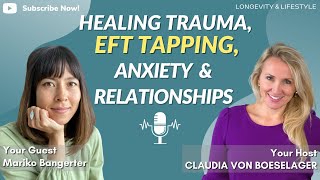
In this episode of the Longevity & Lifestyle Podcast, host Claudia von Boeselager guides EFT therapist and mindset coach Mariko Bangerter through a live tapping session, explores the mechanics of effective affirmations, and discusses the central role of a healthy relationship with oneself as the foundation for all external relationships. Mariko outlines her online coaching model, detailing one‑on‑one programs of 3, 6 and 12 weeks and intimate group courses—"Magnetize the Life You Want" and "Transform Your Relationships"—including how she integrates video exercises and self‑practice tools. She shares vivid client case studies: a woman who avoided antidepressants and rebuilt her relationship, a small‑business owner who shifted from fear of commitment to a thriving partnership and business expansion, and a grieving client who experienced profound emotional release. The conversation turns to what makes a great EFT practitioner (rigorous EFTI certification, methodological thoroughness), Mariko’s own career failures and the power of intention during a financial crisis, and her personal wellness habits such as cold showers, essential oils, and sauna‑like hot baths. Nutrition’s impact on neurotransmitter production and mood is highlighted, along with her favorite quote—"Don’t believe everything you think"—and a closing call to proactive healing of past trauma to enable future growth. Practical resources (mindsetting.co.uk, Instagram @mindsetting.with.mariko) are provided for listeners.
Chapters
Hello, charming listeners, and welcome to the Longevity and Lifestyle Podcast, where I invite pioneers and thought leaders in all things longevity and lifestyle to give us the strategies, tools, and practices to live better and help us reach our highest potential. Today's guest is Mariko Bangertur, EFT or Emotional Freedom Technique tapping therapy expert and mindset coach at Mindsetting with Mariko or mindsetting.co.uk. In today's episode, Mariko explains how by using a combination of the Emotional Freedom Technique or EFT with wellbeing strategies and nutritional support, it can help to overcome stress, emotional relationship and other issues, as well as gain a better sense of self and create positive and lasting shifts in your life. With her history as a chef, Mariko has married her passion for food with her training in nutrition and currently lectures on the Natural Chef Diploma Program at the College of Naturopathic Medicine in London. Mariko's incredible and raw personal struggles and journey brought her to where she is now, helping clients to live their best and healthiest, free from the struggles of negative emotions, and guiding them through relieving their traumatic experiences. In this episode, we discuss the science behind EFT tapping and how she helps her clients to release trapped energy in the body and let go of negativity and trauma. We talk about relationships, both with ourselves and others, in the hope of transforming our lives and living with confidence. Marika also shares her experience of practicing EFT on herself to overcome her own fears, and we have a short real-time EFT session for all to try out for those stressful moments in our day. Before we begin, please subscribe to the podcast to get your weekly dose of longevity inspiration and leave a comment to let me know what you think. I would love to hear from you. Thanks so much and please enjoy.
Welcome to the Longevity and Lifestyle Podcast, Mariko. It's such a pleasure to have you on today.
Thank you so much, Claudia. It's, it's such a pleasure to be here.
Thank you. Mariko, you're doing some amazing work in helping people solve for a major piece of the healthy lifestyle and longevity puzzle around mental and emotional health and well-being. You've had an incredible journey, as we've discussed before, that has brought you to where you are now, helping clients feel empowered, relieve anxiety, trauma, grief, and other life-imparing emotions. But before we jump in, I hear you have a great story about tapping your way out of getting rid of your fear of needles while waiting in a room for acupuncture. Can you tell us about this?
Yeah, sure. I totally forgot about that. But yes, I mean, I've used the EFT tapping tool a lot on myself, of course. But yeah, this specific story, it was just so important for me. It got me out of such a quagmire because I had booked myself in for a series of acupuncture sessions. But my whole life I had had such a major fear or phobia of needles. As a kid, I think before getting a vaccine or an injection, I think I fainted and I've always had the worst fear of needles. And so I was finding myself at the start of my first acupuncture session, knowing that it would really help me, but with this phobia. And so I just remember, yeah, I was just in the waiting room, just tapping on myself and on my fear of needles. And, you know, perhaps I can talk about the process a little bit more later, but that's the amazing thing about tapping is that it is a self-help tool and, you know, you don't need anything else to do it. You can do it at any point. It's so accessible to anyone once you learn the basics. And so I was there in the waiting room. I think I just tapped for 5 minutes on my fear of needles and I was able to then go into my first session and be relatively relaxed. And then because that first session ended up being quite a positive experience for me, it sort of, it then started to rewrite my story around my phobia of needles. And so I was then able to go into the second session, the third session, the fourth session with no problems. So yeah, it was life-changing.
That's so amazing. And I guess it could address any phobia if you're scared of deep waters, spiders, things like that as well.
Absolutely, yeah, absolutely. Actually, working with phobia is something that is very quickly solved with EFT tapping relative to other forms of therapies. You know, phobia specifically is something that I can, and most qualified practitioners can, help someone resolve in usually one session, one or two, really a relatively short amount of time because the more specific the issue is, the faster it is to resolve. So a phobia tends to be, you know, very specific.
Of it.
Yeah.
Okay.
I'm really excited to dive deep into also understanding how that works. But before we jump into that, something you mentioned before that I'd love to ask you about is that you have this amazing view of what a challenge is, and I'd love you to talk about how you perceive challenges. I really liked what you said before.
Well, I think simply put, challenge equals growth. Growth doesn't happen from resting on your laurels in a complacent state. State. I think a challenge is really opening a door of possibility for you to upgrade, uplevel, and evolve. And I think any form of challenge tends to make someone just a richer person, more able to then relate to other humans around the world, and more able to understand human suffering, which is kind of a universal truth, a universal reality. And we have this way of often this dualistic notion of splitting everything into good or bad or right or wrong. And I just think actually we can't avoid challenge in life. And I think it's really sort of a blessing in disguise. It's just a calling, a calling for you to grow.
Yeah, I really like that. And it reminds me a bit of Joseph Campbell's hero's journey, right? That we have this calling and have to face them, the inner dragon, and Pacify the Dragon as well. So I really, really liked that. Moving over to EFT or the Emotional Freedom Technique, would love for you to explain what it is. And can you talk a bit about the science behind it?
Emotional Freedom Techniques is a modality that was created in the early '90s in the States. And it was an evolution of Thought Field Therapy, which is part of a field called energy psychology in which We are using psychotherapeutic techniques, but also acknowledging the existence of and using the body's energy system. So the body's energy field, also known as acupressure point stimulation. So that part of it is pretty ancient. It was used in China, the traditional Chinese medicine for millennia now, and even in other Eastern philosophies, like in Vedic philosophies, they also acknowledge the body's energy system, the meridians. They would refer to it as the chakras. So it's this combination of more contemporary psychotherapeutic techniques and talk therapy, as well as, yeah, cognitive therapy with NLP, so neuro-linguistic programming, kind of laced through it. Whilst stimulating the acupressure points. So maybe that sounds really complicated and convoluted, but essentially Dr. Peter Stapleton— so she's this Australian psychologist and researcher behind the science of EFT. She's also a practitioner herself, but she's done some incredible research in this field to understand why this works so well. She calls EFT part of the fourth wave of psychotherapy, along with techniques like EMDR, in that you can achieve quite profound results in less than 6 sessions, and there's a somatic component to it. So in the whole field of trauma research, you know, possibly with the works of Bessel van der Kolk and You know, he wrote this iconic book called The Body Keeps the Score. And then, you know, there are people now like Gabor Mate who also talk about trauma. We know that the problem with trauma is that it gets stuck in the body. And so any kind of modality that has a somatic component to it that doesn't just rely on the brain and the mind has more profound and effective results. And so with EFT, there is the somatic component because we are gently tapping on the key acupressure points of the face and upper body, just with our fingertips. It's so easy to do and so accessible. But it's doing that as well as talking through the issue in a more traditional talk therapy sense It's both of those things combined that seem to really allow a shifting of any trauma that's stuck in the nervous system, in the body, and also helps us to kind of rewire the neural pathways in the brain related to our thoughts and beliefs that are very, very stubborn and difficult to shift. So again, maybe that's quite a complicated answer. I apologize.
No, that makes sense as well. I'm trying to understand because I've heard that as well, like the body the body never forgets, or the body keeps the score, which you were mentioning there as well. And that trauma gets stored. And I think people think, oh, I've dealt with it, or it doesn't bother me anymore. But sometimes maybe 20 years later, something could trigger and that strong emotion might come back from a past experience. So if I understand correctly, it's a mixture of trauma being stored in the body, but also EFT helps to rewire neural pathways to another modality.
Like, how do you react to something?
It doesn't bother you as much anymore. You're kind of freeing yourself mentally, but also physically, it sounds like. Yes, from emotional trauma.
Exactly, exactly. So for example, when we experience an adverse event, or AKA trauma, or anything that really stresses you out, when something like this is experienced, then there's a whole creation of a set of beliefs that are usually very limiting, a set of thoughts around this issue. So as an example, it could be, okay, let's say that, you know, you're 6 years old and you drew a drawing and you showed your teacher and your teacher said, "That really doesn't look like a person. That's not a very good drawing. Can you try and draw a better person here?" From that moment, you might then create the belief that you're not creative, you can't do anything right, you'll never be good at drawing, You're not good enough, you know, and these beliefs are unconscious. We're not usually aware of them at all, but they will stick with us. They're very, very stubborn throughout life until you resolve or heal that initial trauma. Because until that point, those beliefs make sense. And so this work, using EFT as a technique, is so great at, number one, allowing you to become more aware of the things that are unresolved, that need healing within you, that maybe have been suppressed for so many years, or, you know, you've swept them under the rug. So it allows you to create that awareness, give you the awareness of what needs work. And number two, it allows you to then rewrite that program. To then permanently shift these old and stubborn and hindering beliefs that are not allowing you to progress forward.
You said that sometimes it allows you to find, like, what were these traumas or what were these beliefs, right? So do clients come to you not even knowing kind of why it is? So you help them basically uncover what the underlying belief is? Is that part of your work as well?
Yes, 100%. I would say 50% of the time, clients have a general idea of the type of block they have and maybe an idea of where it comes from. The other 50% of the time, they're unaware. And then of the 50% who do have an idea, I would say even then, what we uncover in sessions usually is quite surprising for them. Something quite unexpected. There's something about, you know, the safety that a therapeutic relationship and a therapeutic space provides that allows things to come up from the unconscious mind to the conscious mind. So when they're there in session and they feel safe, yeah, they have access to so much more data, so much more information than they would normally. So I've had clients who say, I really don't have any memories under the age of 7, but they turn up in a session and we uncover some memories of really early years, like 2 years old in the cot, that kind of thing.
Wow. Okay.
So yeah, and even before 1, a human would normally be able to remember things. Yeah, that's really incredible. It would be really fun. Maybe later we can try like a mini session. I don't know, is that possible if you ever do mini sessions? But for listeners as well, maybe we could try something later?
Yeah, sure, I'd love to. I'd love to do that. Yeah, we could absolutely do like a 5-10 minutes. Okay, great.
So maybe towards the end of our recording, that would be wonderful. I wonder, what are the particular— or are there particular types of areas that EFT is good at treating, and are there any that it's not suitable for?
Yeah, good question. I would say it's good for any kind of mental or emotional block. So any kind of uncomfortable emotion. So whether that is stress, fear, lack of confidence, like I said before, you know, phobias, and also any kind of trauma, even severe or complex trauma, is really effectively treated with EFT. You know, someone who is a qualified and good practitioner and has experience in that. Yeah, so any kind of trauma. And the thing is, I think there's this misconception around trauma in the general public, and I think we always think that trauma has to be big and dramatic, you know, such as a really terrible incident that has happened. But I would say that even minor issues that have left you feeling like you're unable to cope can be regarded as a trauma and also needs that same amount of healing work to overcome. So EFT is really great at trauma, and I would say that's what I mostly help people with. I mostly help people with any kind of anxiety and self-esteem, self-confidence issues. So anyone who's struggling with some kind of block in their life, who—
which is pretty much everybody. I don't think anyone who's figured it all out.
Yeah. And then in answer to your question, is there anyone that it's not good for or anything that it's not good for? I would say I found that with people struggling with things like ADHD or people struggling with focus and attention, yeah, I find it to be a little bit trickier to work with, with people like that. However, I think it's still beneficial. It just doesn't work quite as quickly as someone without ADHD.
Just a question on that. Is it because of the more difficulty in focusing just on, say, the wording of, you know, what you're saying with the NLP? You mentioned you use specific wording around it while tapping. Is that— it's the lack of attention to being able to concentrate on that, is it?
Yeah. For me personally, and again, this might be just a very subjective thing, maybe other practitioners would disagree with me here, but for me, I think it wasn't so much that, it was about my inability or my difficulty in really honing in on and narrowing down their thought process, which is quite scattered and yeah. And I love challenges and I've been in situations and they have been a bit challenging. You know, and like I said, I still think it can be beneficial, but probably not as streamlined.
Yeah, well, as you said yourself before, challenges equal growth. So yeah, so maybe if we speak again in a year, be like, I've got it nailed, I know exactly what to do. Before we jump into your story, which I'm really excited to get to, I wanted to run through a few rapid-fire questions with you and ask if you have any particular morning routine to set your day up as success?
Yeah, so I might fall from grace at this point in the eyes of your listeners, but to be honest, my day-to-day schedule is so inconsistent that I find it quite difficult to establish a morning routine that I can have every single day. But I would say one thing that I do on most mornings is I don't eat breakfast. I tend to not be hungry anyway when I wake up, so It's quite easy to do. So I suppose I am engaging in intermittent fasting.
Is that by choice or it's just that you just don't feel hungry or are you doing it specifically for intermittent fasting?
Yeah, I think a bit of both. Yeah. I think time-restricted eating really does feel good for me. I also don't eat very late at night, so I try to eat dinner around 5, 6 PM and then I find that I sleep better. And so I think, yeah, narrowing the window. Where I'm eating really does resonate with me. I would say the other thing that I do on most mornings is I walk my dog and we live right next to a section of Epping Forest here in East London, where there's, you know, woods and lakes just at my doorstep. So I take a walk around there and that's always very grounding and no matter what the weather is, and there's something about even going out, you know, when it's raining, when it's snowing, when there's ice on the ground, and having that interaction with nature in which it really does bring you to the present moment, make you very aware of the season that you're in.
It's very grounding as well, I guess.
Yeah, exactly. It's very, very grounding. And I try to do something that brings me back into my body. So whether it is a little bit of exercise— I really like HIIT workouts because they're just quick and fast, and they get straight to the point. And then, yeah, and then after that, I definitely— I mean, one thing that is consistent, and it's not just to do with my morning, but this is probably the thing that I recommend to anyone, and I think it's probably the most important thing to do in life, is that when I feel an emotion come up, when I feel I'm stuck with a mood or an emotion that's not optimal, then I address it then and there, or as soon as I can. So if having done all of that in my morning, I feel like for some reason I'm just not in a great mood, then I'll go to the room where I tap, and I just— yeah, I spend a few minutes with myself tapping, and I get to a state where I'm feeling much more energized just by that self-tapping. And it's because it's like You know, whatever mood you're in, let's say there is a scale, like a wellbeing scale of the different moods that you could be in a day. Let's say at the highest part of the scale could be gratitude, joy, deep trust in yourself, a deep sense of peace and acceptance. And at the lower end of the scale, there could be things like jealousy, doubt, anger, fear, worry. If you're at the bottom end of that scale, That is almost like whatever mood you're in colors the lens of the glasses you're wearing through which you're perceiving life that day. And so everything will be colored by that light and that tone. And just by a few minutes that you can invest in yourself to tap on yourself, to just get higher up on that scale, to feel a bit more accepting, or even higher than that, optimistic, whatever, that will completely, and it does, it completely changes the trajectory of that day and of your life, right? And your life is just an accumulation of the different days. And so, you know, it could be that on that day, if you hadn't done the tapping, it could be that, you know, a friend calls you for a favor and you decide not to pick up that phone. It could be that if you did do that self-tapping and you had more energy to yourself and you feel better, a friend calls you, asks you for help, and you're delighted to help them. And just imagine the way in which every interaction with every person transforms as a result of you just investing a little bit of time in yourself. So, you know, this is something I feel like it's almost like a duty in ourself to proactively manage our mental and emotional states. Otherwise, it's just like we go throughout life and we're just bouncing off each other, being triggered by each other, being reactive, you know, because we haven't managed our own base levels of stress and emotions. So I think it's something that we should be learning at schools. I think it's the most important fundamental part of world peace.
Yeah, you know, wow, so profound, and I love that, and I totally agree with you, and I like the idea of the glasses and the way you see the world and totally resonates with me as well. And it would be really cool if you have a little few hacks or what we could do maybe later on in the conversation, just to really help to set up your day as a success. Because a lot of my listeners love morning routines and winning the day. So that'd be really interesting to discuss. Thank you for sharing. Thinking of the word successful, Marie Kondo, who is the first person who comes to mind and why?
Okay, just simply the person that came into my mind— it's not like I spend lots of time thinking about him— was just Tony Robbins came to mind. He just did a little cameo in my mind and I acknowledged his face. But with some of the stories that I've heard from him, you know, what I find very inspiring is the amount of times that he's gained it all millions and then lost it all and gained it all again and lost it all. And this idea of being at peace with the curveballs that life throws at you and just not giving up. And there are so many of his little anecdotes that I find very, very moving and profound. But I don't define success as anything material, really. I truly feel that success is your ability to navigate life in a way that it doesn't pass you by. So your ability to practice being as present and as mindful as possible, to be able to kind of go with the flow of life as opposed to swimming against the current, and the ability and the adaptability to see any experience or any challenge, you know, as we talked about before, that comes your way as a gift, almost with the question, if there were a reason that this experience was coming to me now, what would that reason be? Like, if this experience were really trying to teach me something, what could I learn from this? You know, reframing these situations. And I think that is really what success is, because So many people chase the wrong things and have these goals and desires thinking it's going to lead to happiness. But happiness is really the ability to sit with the present moment and feel gratitude with everything that you have right now, this second, because anything else is just a projection. It's an illusion. It's not there yet, the future. And I think that is very difficult to do. To be mindful and to be present.
Wise words. And I totally agree. And that's actually something I have as part of my goal setting is to really recalibrate too, because there's a sort of very focused on future and planning and organizing to actually recalibrate and bring it back to be centered and to be the joy of the present moment. And so I think that, you know, those that are able to achieve it, and I don't think there's many people who can do that continuously, maybe Eckhart Tolle or people who've had sort of these awakening experiences. But even just experiencing that several times a day. So such wise words. Thank you for sharing that. Mariko, over the last 5 years, has there been any new belief or behavior or habit that's most improved your life?
I would say what's distilled over the last 5 years, and it's something that I had hints of it a while back. But it's now gotten to the point where I'm not surprised by it. I, I fully, fully believe in this. The power of our unconscious desires is something that nothing can trump. So, and I don't mean this just in the sense of manifestation or manifesting what you really desire and things, although, you know, this is an area that I love working with and I love helping people attain, but it's more— it's kind of like this idea of be careful what you wish for, but really be careful. Because I'll give you an example, and I noticed this happening a lot, but it seems to be happening a lot more. It's where, for example, let's say 2 weeks ago I was going through a period of extreme fatigue. I hadn't been sleeping very well, and so it was piling up and I was really fatigued and I was supposed to take a break. I had scheduled a little trip away, but it got canceled. And so I think I was sort of on the road to burnout. And then I still had some work scheduled in anyway, and I totally could have done it. Most of my days were blocked out for this trip I was supposed to take. So the few bits of work that I had, the sessions that I had and so forth, I could have done, but It's true that I was a little bit tired, and I kid you not, every single client that I was supposed to have a session with that week canceled on me.
Wow.
You know, and this was not meant to be.
Yeah, and just the coincidence of that, or the synchronicity— everyone just, oh, could we do it next week instead? Oh, do you mind if I— I'm so sorry, I'm not feeling well. And so it was like, it must have been more of an unconscious desire for me to really just take time out has somehow materialized in all my work being canceled, right? And I think nowadays I find it easier to live life this way. I truly trust what comes. I truly do. Even if it seems at first really disappointing, I just trust it's for the best. Yeah, liberating. Yeah, it really is. It just takes the pressure off. You know. So yeah, I think I really have this deep, deep trust now in life and the way things go.
Yeah. And I wonder, just with the trust piece, do you think that anyone can just be like, okay, I'll just trust and see what unfolds? Or do you think it's because you're quite attuned and you've done so much work on yourself that you now can have that trust?
I wonder.
Yeah, well, I think of course doing this self-development work and always kind of facing your fears head-on as opposed to trying to ignore them or deny them. I think that definitely builds emotional resilience. I think my teen years and my 20s were so turbulent and chaotic, you know, from being completely like having no money at all, like, and having to change careers like 2, 3 times, not knowing what direction I was going to go in all these different things, it kind of— I think that really does build your resilience and the muscles that allow you to overcome most obstacles. And I guess because, you know, I've been through all of that and it just, it always turns out okay. And so I think it's easier to then have that trust.
Yeah, exactly. By putting yourself out there, by trying and realizing, you know, put yourself in the worst case scenario and realize, you know, is it really that bad? Is it horrendous to wear the same clothes for a whole week. I mean, I've never tried it, but I know people have, and they're like, you know, wear jeans and a t-shirt, you know, might be a bit smelly, but it's not the end of the world. So yeah, it's putting yourself out there, and then that builds that trust and that confidence, I guess, as well.
Yeah, yeah.
I'd love to change gears a bit and talk a bit more about your work and also your incredible journey that brought you down this path to EFT, becoming a practitioner and setting up Mindsetting. Can you tell us a little bit about that journey and how that past experiences from growing up, how that brought you to where you are now?
I come from two different backgrounds. So my father is Swiss-French, my mother is Japanese, and they're both expats. So we moved around a lot growing up. I was born in Singapore and then we moved to this tiny village in Yorkshire.
That must've been a culture shock.
It was, it really was going from Singapore. To the grim grayness of York was such a culture shock. I was 5, 6 at the time. I think my mother had it hard, and I remember her saying that, you know, she fell into like a year-long depression from the culture shock and the climate shock. And yeah, and so I think this kind of upbringing of moving from place to place, and also, you know, like when I was in York, we were in this tiny village. I was I was the only mixed-race person there. And, you know, it was like, we were so different, my brother and I and my parents to everyone in terms of what we would eat. You know, my mother would make Japanese food with seaweed and sour plums and blah, blah, blah. And, um, but also the cultural differences, right? Our upbringing, this kind of Japanese sensitivity to and kind of like humbleness or even submissiveness, let's say. So it wasn't just the way I looked that was different, but also very much who I was. And I think not having our extended family there, I felt quite isolated. And I think, to be honest with you, like, my childhood and teen years were pretty— they weren't great. They were really, they were really hard. And I felt lonely for most of that time. And I think This really relates to your question because I guess I learned to sit with and manage my emotions alone a lot, even as a kid. You know, I spent a lot of time in my room reading or writing in my journal. My parents gave me a diary when I was, I think, 7 years old. It was the first diary I had, and since that point I always had diaries, and I really— it was so therapeutic for me. And the other thing is that Perhaps I always knew this, but I felt very different from people also internally. And I think that's to do with being a hypersensitive individual. I would really take things to heart. I just felt things on a very deep level. And so I think as a child, I learned that nobody really understood my emotions very well. They didn't even see that I was suffering when I was. I'm talking about my parents here and friends and things. So again, like, I think I learned to navigate my own emotional landscape, sit with it, understand it. And so as a teenager, well, we moved to Japan and again, I, I had a very, very tumultuous adolescence with extreme social anxiety, depression, And I again felt very, very isolated, didn't really have many friends. I felt very different from my peers of that age group. And, you know, having moved from England to this tiny international school, very sheltered existence in Yokohama, I was kind of a bit more wayward than everyone there. So again, like I didn't fit in. Yeah, it was, it was a really difficult time. I didn't, I couldn't imagine life beyond school years, and, and I also didn't believe, or I didn't feel I had the strength to survive, really. I just kind of wanted to end it all. And, um, I'm so sorry. Yeah, it was horrendous. And I mean, this is maybe a little bit funny, but so at this point as well, I had severe, severe social anxiety to the point where, like, it's crazy to imagine this now, but You know, I remember when a kid would sit next to me, a classmate would sit next to me on my desk, we'd share these desks, and I would be so nervous and so shy of this proximity that my hands on the desk, there'd be pools of sweat from the palms of my hands, and that would then feed into my anxiety and be, you know, I'd be like, oh my God, can they see I'm a freak? And, you know, it's just such a downward cycle. Yeah, yeah, yeah. And luckily, I think, yeah, by the age of 16, 17, I kind of got out of that. And there were also a couple of teachers that I had that I am so grateful to, to this day, who were there for me and saw that I was depressed and just such beautiful teachers who really kind of opened up my heart and taught me, I think, how to love. So yeah, so that's a shout out to Mr. Hunter. Charles Hunter had that effect. And, you know, it'd be things like, I remember this one beautiful moment in which I was sitting alone on the stairs at lunchtime and depressed. I was probably about 14 at the time. And he came and sat beside me and he told me this little story. He said, you know, Mariko, when I was a kid, I remember this one day I was at school and my teacher didn't seem very happy. So I went to the field and picked some flowers. And I put them on her desk and I got back from lunch and I saw that she was smiling and I made her day better. And that made me feel even better too. And he just told me this little story. And I, when I got back from my lunch, there was some flowers stuck to my locker with some tape that he had left. And, you know, yeah. And just, just incredible, incredible human being. In answer to your question, I would say it was that it was this, ability to be comfortable and delve into my emotional landscape to try to understand why I was feeling the way I was. And I developed this practice as a teenager, actually, when I wasn't feeling very well, to replay my day, retrace my steps to understand the trigger, like the key point that changed my mood. And so this identifying of that alone gave me such relief because it was like something unconscious was brought to the fore, to the conscious mind, and just that alone already shifted my mood. And so I think this is why this work now that I do resonates so much, and it did from the beginning, was I love this kind of emotional detective work.
Yeah, so now you do it at a much larger scale. And how did it go from that sort of teenage years to where you are now?
Hmm.
At the age of 18, I left Japan. I left home and I, I really wanted to spend a year in Switzerland. At this point, I was really into the arts, so I wanted to go into filmmaking, but I spent that year sort of painting and developing my painting skills and creating a portfolio. I was very much into expression. So the arts, and I thought film would be the best way of fully expressing one's idea. And so at the age of 19, 20, I then after Switzerland came to London, and I've been here ever since. So I've now been here, what, 17 years. So yeah, I was going down this trajectory. I went to art school here, and I then, I was then en route to trying to establish myself in the film industry, but then I got my heart terribly broken in the industry because I created this one music video for this up-and-coming band. I did it all myself. I filmed it, edited it, and I got the okay from the plugger, MTV2, to air this video that I had worked on for 6 months. I was 21 at the time, and so I was super excited. I thought this might be my big break. And then just before it was going to air, the lead singer of the band decided to pull that video and didn't want to release it. And so that was like at the end of this whole year of me really trying to create a showreel. So at that point I was like, okay, I really need to find a real job in a more stable industry. And that's when probably as a result of, I don't know, being a third generation Swiss kind of working in the chocolate field, my dad also did that and my grandfather also did that. And, you know, maybe there's chocolate running in my veins, but I then started working in this artist's and chocolate shop in West London. Then that set me up on this trajectory of becoming a pastry chef for 10 years. So that's what I did in my 20s. And then what happened was at the end of my kind of stint working as a chef, especially working as a pastry chef, when you're surrounded by sugar, surrounded by these really incredibly comforting foods that don't make you feel great, We know what sugar does.
Exactly.
Right. And having this really adrenaline-rich job of chefing, which is so physically, mentally exhausting. I had a breakdown near the end of my 20s, at the age of 29. It was not only the work that I just— I was never so really passionate about. It's kind of like I fell into it and I just carried on. At the time I was in this relationship, it was a 9-month, extremely intense, quickly evolving relationship that started out as a holiday romance but ended as an extremely abusive relationship.
I'm just saying.
It was, yeah, these two things that coupled that I fell apart and I broke down and I hit rock bottom. This was at the age of 29. And so I was forced to just take a break. I couldn't function at work, so I had to leave it. And I also managed to take a break and just, I put everything, all my stuff in storage without knowing what I was going to do, but I just knew I needed to extricate myself from this relationship and London. And so I went to visit a very close friend of mine for 2, 3 months who happened to be living in the Middle East at the time. And I'm sorry if I'm rambling so much, but no, not at all.
I love it. So please, no, feel completely at ease.
Continue.
So I realize now that that was a period in which I was experiencing post-traumatic stress as a result of this 9-month, very, very, very intensive, psychologically abusive relationship. And I couldn't smile, I couldn't laugh. I was visiting my friends, but I just— I was just like an empty shell with flashbacks, with nightmares, with severe anxiety again. It's like I was scared to go out anywhere alone. I just didn't have any confidence in myself, no self-esteem. And being there in Qatar for 3 months, I didn't know anybody. And also, as a result of this relationship, I had become very isolated from the friends that I had before. So I was very alone again. I was forced to just sit with my pain. Without any distraction because there was no one to distract me. I was mostly just staying at home alone at my friend's beautiful place while he was working, just with my own thoughts and with my own pain. And it was like what some might call, you know, a dark night of the soul. And through that experience of having no distraction but just sitting with my pain, I one day spontaneously started to focus on my breath because that was the only thing I could think to do that would just ease my pain a little bit. So I started focusing on my breathing, and, you know, I hadn't meditated really before. I didn't know much about meditation, honestly, and I hadn't really done much yoga or anything. So just focusing on my breath, and I managed to really, really focus at this time. Then I had this experience in which I felt these waves of energy throughout my whole body, a bit like I was being electrocuted by like a light current. It wasn't necessarily unpleasant, but I had no idea what was going on and what I was experiencing. And, you know, I felt like I was convulsing, but I opened my eyes and my body was still, but I just felt these waves and waves and waves of sensation as if I was just vibrating. And it all accumulated in my heart.. And then I kind of almost thought, am I having a heart attack or something? I just wasn't sure. But I opened my eyes, I stopped this kind of meditative state that I was in, and then that kind of opened up my world and it completely transformed my worldview. I did research and I understood that it sounded like I had a Kundalini awakening, is what they call it in India, which tends to happen as a result of severe trauma. Like, that's one of the pathways., or it could be as a result of Kundalini yoga practices or, you know, different practices like that. Yeah, it sounded like I had a Kundalini awakening. And from that point, I must say that, yeah, I had more and more kind of interesting supernatural or paranormal experiences start happening. And it was this really intensive period of about 1 or 2 years of lots of precognitive dreams, of really acute intuition, of deep healing happening within my dreams. It was almost like I was undergoing this, almost like a shamanic or some kind of healing retreat that I didn't know I'd signed up for. And it resulted in all these interesting experiences and it totally changed my life and it changed my worldview. To incorporate energy, because I understood that what I was feeling with these vibrations was they were energetic. They weren't physical, they were non-physical. So I— yeah, it just totally changed my life. And as a result of that experience, that opened the gateway to my deep, deep, deep healing journey. And then I started learning and training in vipassana meditation. So I went on a couple of 10-day silent meditation retreats that were incredibly challenging and you know, meditating from 4:30 AM till like 9:30 PM. Again, it's that whole facing yourself, sitting with your pain, sitting with what is. That's also when I was introduced to EFT tapping. And at first I was introduced to it by my friend Boris, who just showed me in the park how to tap on myself. And I was like, what are we doing? This feels so random. I don't even understand what we're doing. And it's like I didn't have the larger context or the framework, right? So I didn't understand. But I then, you know, went into a session with a practitioner. And yeah, and it was only a few years later that I truly understood the power of that session and what it did to my mindset. Because I remember going into that session, you know, of course knowing that the abusive relationship I was in was terrible and that I've got to just forget about it. He's not the person for me. It was unhealthy. This is months, you know, months after the breakup. But I went into that session knowing those things consciously, but still feeling like hooked, still feeling like, oh, but we are meant to be together. So, you know, this addictive quality of that relationship was still there. And I walked out of that session feeling like, no, that's not the one for me. A healthy and loving relationship it does exist, it is possible, and I have no idea what's around the corner. Because, you know, going into that EFT session, I just did not believe healthy, loving relationships existed. I just thought that was Hollywood BS, and I just thought, no, all relationships are inherently unhealthy. They just are. And so that 180-degree shift in my mindset from that one 60-minute session, and it just— again, because the modality is so it's deceptively simple, or it looks deceptively simple. It's working on many different layers, and it's working on many different levels. And so to the ignorant eye, it does look kind of bizarre and also simple, but it's really— I think it's working on such intricate levels. And so I walked out of the session kind of taking for granted my complete mindset shift. And it's only like years later that I saw how truly it kind of, it really, yeah, realigned my life actually.
Yeah. Oh, incredible. And what a beautiful, amazing story. And thank you so much for being so raw and sharing that as well, Michael. Really appreciate that. And it's so interesting kind of what life throws up at you and as Steve Jobs says connecting the dots, it's only when you look back at these different experiences that they actually make sense. Like, oh, I see why that happens, brought me to this, and then I do this now. And how wonderful that you're using your experience in day-to-day work and actually helping other people. So in being of service of others, again, Joseph Campbell's hero's journey, right? That's closing the loop and the circle. And I had the pleasure of experiencing a session with you the other day. So thank you again before that. It was so profound that I've heard of EFT and I believe in these things and I sort of wasn't sure what to think going into it, but it was unbelievable, the profound impact, not only of feeling in this very zen, ultra calm state. And I mean, I've done breathwork workshops and, you know, obviously yoga and meditation, things like that as well, but it was just a whole different experience. But what was incredible was the sort of mental clarity, ability to focus. It was so profound, and it carried on for a long, long time afterwards as well. And I'd love for my listeners, just if you could talk about, you know, what typically is it a first tapping session, what does it look like, and what are the different process and steps that you would bring clients through?
Yeah, well, typically with the packages that I offer, there's 3, 6, and 12 week long. So the first session is really about It's getting to learn a bit about the person in front of me. And prior to the session, there's this intake form. So there's quite a few questions that are asked. So I already have a general idea, but the first session, I would say the first part of it is really spent just talking for me to get a bit of a mind map of the issues, the presenting problems, and what the client really wants to get out of it. And just trying to understand the larger context for that, for the problems. Where they might come from and the scope. And then, um, and then it's such an intuitive process that I can't say there's a blueprint for every first session, of course. Also, if it's a single session, which, you know, I don't do too often— I do if there is a very acute and specific issue, like a fear of a future event or a phobia or grief. Also, bereavement is something I tend to be able to work on in one session, but If it is a single session, then it's quite different. I can, I can get straight to the point and I'd like to just kind of throw everything at that session. But if it's part of a longer program, then I'm more interested in finding the different areas that we need to work on and then maybe going to each of those areas in more depth. And so in more depth, what that would mean is to identify if there are any unresolved memories from the past that is creating a present day problem or block. I would then work on— if there's quite a few of these unresolved issues from the past, then I would work on them more generally and then narrow them down and get more specific. So the session would look like my introducing the client on the key acupressure points that we would be working on. It's literally me tapping on those points on myself, and the client copying me and tapping along. So we're both self-tapping, we're both tapping with our fingertips on these acupressure points of the upper face and body whilst talking. And so what this does is the tapping part seems to halt or interrupt the body's stress response. It seems to be working on the limbic system of the brain that decides whether something is stressful or not. So it seems to interrupt that whole response from happening, and in that interruption, we're able to then talk about things that normally would trigger a stress response or fear, sadness, any uncomfortable emotion. We're able to kind of talk about the issue without those emotions overwhelming. Plus, there's this very mindful component to it too, because We're tapping and we're talking as well about the sensations present in our body now. So I'll be asking the client, okay, what's coming up for you right now? What are you feeling? And it might be that, you know, as we're talking about their recent divorce or the recent argument they had with their ex-husband, then, you know, they're noticing all of this tension in the chest. They're noticing some tightness in the throat. They're noticing heat on their face. And we're noticing these sensations as we're tapping. We're also noticing the emotions that come up as we're tapping. But whilst we tap, because we're sitting with and observing and acknowledging what is coming up, those sensations and those emotions just naturally, by default of this practice, subside. That's what happens. And it's like And I think this is the key to any kind of mindfulness practice is that, and you know, mindfulness meditators and Vipassana know this, is that when you sit with something, whether it's a pain, a very physical symptom, you sit with it and you don't react to it, you don't judge it, you don't try to push it away, it will naturally go away on its own. And it's the same with any emotion. But most times we're so quick to suppress it or deny it, or we binge-watch Netflix, or we stuff our mouths to ignore the emotion that we're feeling. But that is, that is how it just perpetuates forever. So the way to truly release and shift or let go of an emotion that feels stuck is to sit with it and feel it mindfully. And the tapping process allows us to do that in a gentle way that's not overwhelming, that's not re-triggering. And there are so many sort of protocols and techniques that we use that we can work on even severe trauma from this gentle, distant angle, you know, because the number one premise is to not re-trigger It's really incredible.
I think a lot of people experience this. Maybe they're going into a stressful situation, be it presenting to the board of their company, to meeting a difficult boss or colleague, to personal situation, or just feeling generally stressed. Maybe we could go through together a mini version of what one could do in this case, and you can maybe talk through what needs to be tapped and maybe even why.
So yeah, I'll just talk about the points first to introduce the points that we work with. Um, so the first one that we tend to work with is on the underside of our hand, like between the knuckle and the wrist.
Yes, sort of meaty part of the back of the hand.
Of the back of the hand. So all we're doing simply is just using the tips of your fingers to tap on the backside of the other hand.
And do you have to tap hard or soft, or does that matter?
I would say it doesn't really matter. It doesn't have to be hard. It really doesn't have to be hard. And you're just tapping just in no order, no, no specific pattern, just tapping lightly. So that's the first point. And this is bilateral, so you can use the left hand or the right hand, whatever works for you.
When you do one, you just stick to one, is it? Or do you, should you swap around? Or just stick to one hand?
I would say that it's completely intuitive. So whatever feels comfortable to you. Yeah. So you're just tapping there on the side of your hand, underneath the knuckle of your pinky finger, of your little finger. And this is usually the point at which we set up the tapping round. And by that, what I mean is that we introduce a statement that includes the issue you're struggling with and an affirmation at the end. So that's the setup statement. The setup statement is the issue you're, you're working with and an affirmation at the end. So we'll go to that next. I'm just going to go to the next point now, and the next is at the top of the head in the center of the crown. So again, just using— yes, exactly. So using either your right or left hand, whichever feels comfortable, just slightly tap With a few fingers at the center of your crown.
So these are meridian points? These are particular meridian points that are the most effective, or how come these are the points that are selected?
Yeah, so these are the endpoints of meridian channels. A lot of them pass through the entire body, and there are also more than these basic ones. I'm just going through the basic ones. And why they're selected? Well, it seems as though the different points do either work directly with specific organs and allow us to release specific emotions. I have a map later that I can talk you through that talks about the different points and sort of what emotions they can help with. Okay. Specifically, the next point we're going to go to, for example, is one of these points. But well, for the next point, it would be the two points at the base of each eyebrow. But I find it easier— and my teacher Peter Don, he would just put all 4 fingers together like, and you could just span that bridge between the 2 eyebrows. Yeah, also tapping on the beginning part, the base of each eyebrow. Okay, so these points, especially around the eyes, are really effective at reducing stress and panic. They're quite soothing. And perhaps there's also something to do with when we were babies and being touched around the face, being touched around the forehead is also incredibly soothing. So just stroking your forehead up and down is an incredibly soothing, grounding, centering thing. So when you're sad, when you're upset or stressed, even just this activating the parasympathetic nervous system. And then the next point after the middle of your eyebrows is on the outside of your eye, on the side, close to the eye socket, or more on the cheekbone? Uh, just literally on the outer edge of your eye. Okay, so but the bone area? Yes, exactly, on the bone area. Exactly. And then the next point after that is under each eye on the eye socket bone.
Okay, and you just do one hand or you do both?
Or you could— yeah, you can do both on all of these points on their face for sure. Or if you don't want to, you can just do one. One does work just as effectively.
Okay.
And then the next point after under the eye is under the nose. And then the next point after that is on the chin, and then the collarbone. So here you can tap all around the collarbone, like on and through the collarbone, on either side.
So through, you mean, or on, or below, or how do you mean through?
Yes, kind of like, I guess, slightly below the collarbone, but also on top of—
on top of. And these are the meridian ends, you said?
So these are Yeah, yeah. And I would, I would say that these ones here— and I, I wish I had an acupuncturist right here right now who could be more specific about it— but I think here it's more that there are so many organs around here, right? There's the heart, the lungs, and then lower below the digestive organs and so forth. So I think also it's about these vibrations that you are kind of sending out to multiple different meridians and multiple different organs. We can't forget that, you know, the endpoints of meridians are also on the tips of your fingers. Yeah. When we are tapping, it's almost like we're sending this tiny electrical impulse to our body. And then the final point that we're going to use will be on the side of your ribs, a couple of inches under your armpit.
Do you go up and down or you just stay in the same—
I just stay in the same place. Okay, so for women it might be kind of on the bra strap. For men, yeah, like I said, it's like 2-3 inches below your armpit. Those are the points that we would just be tapping through as we're talking. And if you skip a point by accident, it doesn't matter. If you feel drawn to tapping on one specific point for a longer time, completely do that, you know. This is an intuitive process and it's important to trust your intuition on this. Okay. Right. So you said you would like me to maybe guide a really quick mini tapping session to deal with the stress of a future event or something, maybe the stress of an upcoming—
Yeah, I'm trying to think of something general that would, you know, most people could relate to, maybe even just feeling stressed and like overwhelmed what's happening or— you know, a certain event or a difficult person, be it a colleague or maybe boss, or, you know, having to present. So maybe somewhere where there's anxiety or stress from overwhelm or too much work.
I don't know. Yeah, perfect. Yeah. Okay, so yeah, let's do that. So this will be really for, yeah, stress and overwhelm, and just to try and shift your mindset a little bit. I mean, that's why I call my business Mindsetting, because we are trying to change the mindset. So, okay, so if you can just take a comfortable seat and start tapping on the side of your hand. Again, that whole point between the lowest knuckle of your pinky finger and your wrist. So just the side of your hand, just start tapping on there with these affirmations that I'm going to say. I'm going to leave a gap, and I'd love for you to just repeat after me and For anyone in the audience as well, if you'd like to change the words a little bit because they don't resonate with you, please feel free to do that. Okay, so first what I'd like you to do is identify out of 10 the amount or the level of stress that you're feeling right now, out of 10, 10 being the maximum.
Well, I'm enjoying very much our conversation, so I'd say it's probably more like a 1, but, uh, Imagine a situation where I'm feeling stressed, so let's say it's a 7 or something like that, right?
So you could say it's a 7. The other thing that you could do is imagine some kind of event in your future that would stress you out, and then you can label how stressed do you feel about this future event.
Okay, so let's say 7.
7, perfect. Okay, so this is just good to do for us to understand objectively, you know, if, if Quantify.
Using, right?
Yeah, improvements.
Yeah. Okay, so even though I'm feeling this stress right now, even though I'm feeling this stress right now, and I feel this tension in my body, and I feel this tension in my body, maybe I can choose to accept myself and my feelings anyway.
Maybe I can choose to accept my feelings and self anyway, and myself anyway.
Yeah, just take a deep breath.
Okay, we're gonna now start tapping on the top of your head at the crown.
Okay, so all of this stress I'm feeling, all of this stress that I'm feeling and tap on the middle of your eyebrows. I'm allowing myself to acknowledge it right now.
I'm allowing myself to acknowledge it right now.
Tap on the side of your eye. I'm also allowing myself to notice it in my body right now.
I'm also allowing myself to notice it in my body right now.
And start tapping under your And just now, just take a minute to notice where any of that stress or tension may be felt in your body. So for you, Claudia, you're thinking about a future event that stresses you out a little bit. For anyone else in the audience, it might just be working on your present feelings of stress. So just if you can describe out loud how the stress feels in your body.
So I typically feel, um, stress in the chest, sort of tightening of the chest area.
Okay, so start tapping under your nose. We're just gonna acknowledge that in a statement.
This tightness that I feel in my chest. This tightness that I feel in my chest. And tap on your chin.
All this tightness in my chest.
All this tightness in my chest. On your collarbone.
I'm noticing it now without any judgment.
I'm noticing it now without any judgment.
And tap on the side of your ribs. All of the stress that I'm feeling.
All of the stress that I'm feeling. All of this fear that I'm feeling. All of this fear that I'm feeling. And tap on the top of your head.
It's okay for me to feel it right now.
It's okay for me to feel it right now. And tap in the middle of your eyebrows.
All of my feelings and sensations are okay.
All of my feelings and sensations are okay.
Tap on the side of your eye.
And maybe I can accept myself anyway. And maybe I can accept myself anyway. Under the eye. Maybe I can accept myself and all of these feelings Maybe I can accept myself in all of these feelings.
Under the nose. And even though it's okay for me to feel this.
And even though it's okay for me to feel this.
On the chin. I wonder if it's possible for me to let this go.
I wonder if it's possible for me to let this go.
Collarbone.
All this tension in my chest. All this tension in my chest.
Side of the ribs.
All this tension in my body. All this tension in my body.
Top of the head. All this fear that I'm carrying.
All this fear that I'm carrying.
Middle of the eyebrows. I wonder if it's possible for me to let this go.
I wonder if it's possible for me to let this go.
Side of the eyes.
Because right now I'm doing this tapping. Because right now I'm doing this tapping.
Under the eyes. And right now, maybe I can allow myself to be fully present.
And maybe right now I can allow myself to be fully present. Under the nose.
So I wonder if it's possible to let go of this tension.
So I wonder if it's possible to let go of this tension. Chin.
I wonder if it's possible to let go of this fear.
I wonder if it's possible to let go of this fear.
Collarbone. I wonder if I could be open to a new perspective on this.
I wonder if I could be open to a new perspective on this.
Side of the ribs. Maybe I could have a whole new perspective on my situation.
Maybe I can have a whole new perspective on my situation.
Top of the head. I'm open to a whole new feeling in my body.
I'm open to a whole new feeling in my body. Middle of the eyebrows.
And even though I'm still feeling some stress and tension—
even though I'm still feeling some stress and tension— outside the eyes—
I'm open to the possibility of feeling lighter and more centered.
I'm open to the possibility of feeling more lighter and more centered. Under the eyes—
I'm open to the possibility of tuning into infinite Solutions.
I'm open to the possibility of tuning in to infinite, infinite solutions.
Under the nose. But maybe I'm still feeling a little bit of fear.
But maybe I'm still feeling a little bit of fear.
Chin.
And that's okay. And that's okay. Collarbone. I choose to accept myself anyway. I choose to accept myself anyway.
Side of the ribs. But I'm open to the possibility of feeling something else.
But I'm open to the possibility of feeling something else.
Over the head. I'm open to the possibility of feeling more empowered.
I'm open to the possibility of feeling more empowered.
Under the eyebrows. I'm open to the possibility of attracting solutions my way.
I'm open to the possibility of attracting solutions my way.
Outside the eyes.
Maybe there are solutions to this situation. Maybe there are solutions to this situation. Under the eye: maybe there are always solutions. Maybe there are always solutions.
To the nose: maybe I can get through this with confidence and ease.
Maybe I can get through this with confidence and ease. Chin: maybe it's possible. Maybe it's possible.
Collarbone: or maybe it's not possible.
Or maybe it's not possible. And that's okay too. And that's okay too. Side of the ribs: but I'm open to the possibility But I'm open to the possibility.
Top of the head.
Feeling differently about this. Feeling differently about this.
And at the eyebrows. I'm open to the possibility of a whole new feeling.
I'm open to the possibility of a whole new feeling. Outside the eyes.
I'm open to the possibility of knowing that I'm powerful.
I'm open to the possibility of knowing that I'm powerful.
Under the eyes: I'm open to the possibility of knowing that I have agency.
I'm open to the possibility of knowing I have agency.
Under the nose: I'm open to the possibility of connecting to infinite solutions.
I'm open to the possibility of connecting to infinite solutions. Chin: Long after this session ends. Long after this session ends.
Collarbone: I'm open to infinite exciting possibilities.
I'm open to infinite exciting possibilities.
Side of the ribs. And I deeply accept myself and my feelings.
And I deeply accept myself and my feelings.
And just take a deep breath. So now, to anyone who followed that, in the audience, I'd love to find out where you are at now between 0 and 10 with your levels of stress or fear or anxiety. Hopefully that would have reduced a little bit, and maybe, you know, if it's still, let's say, 5 or more out of 10, do this 2 or 3 more times and you'll notice that it really does start going down to almost a zero. And the idea is to bring your stress and fear down to a zero.
Of course, I'm at a zero for sure. I'd be probably negative. I'm feeling very chilled and relaxed right now. It's so amazing. Yeah, such a short space of time, it has such a profound impact. And I guess also with the NLP, right? So the neuro-linguistic programming and the wording you're using as well, because there are questions like, I guess, or I choose. So is that how it's set up?
So it's very triggering. Yes, because the thing is The unconscious mind is very, very finicky and can be put off very quickly if you use the wrong word. So oftentimes, affirmations don't work unless they really resonate with you. So this is a really good hack. You know, affirmations are powerful things. One of the simplest ways to reprogram your unconscious mind is by repeating an affirmation. This is how brainwashing works, right? So, repeating positive affirmations is like positive brainwashing. But sometimes, affirmations don't quite cut it, and that's because they don't resonate perfectly. So, a quick hack to better allow an affirmation to resonate with you when you're feeling resistance to it, like when you hear an affirmation, you're like, "That doesn't even feel true. I don't even believe that," then, just make it a conditional sentence. So maybe, or I'm open to the possibility of attracting even more abundance into my life. I'm open to the possibility. Or maybe I am naturally attracting more abundance into my life. Maybe I have all the solutions in me. Maybe it's possible that I can attract all these solutions, you know. So yeah, making it conditional really will resonate more.
So to get the ego out of there, to get to the subconscious.
Yeah, because what happens is if you get that resistance, if you say something that doesn't resonate, then you'll just— you'll lose that rapport, you'll lose that connection.
Yeah. Plus you have such a nice, beautiful voice as well, so it's so nice and calming to listen to. I think that kind of adds up to everything as well. Thank you for walking through that tapping exercise. I'm still feeling very zen and chilled out now.
So thank you.
We continue. I'd love to hear your view on relationships. We touched on, obviously, with personal relationships as well, but I'd love to hear your view on solving sort of your personal relationship, I guess, with yourself, the importance of that in order to have successful relationships in the outside world.
What is your thinking there? Yeah, I think the most important relationship to establish and develop and cultivate is a healthy relationship with yourself. And unfortunately, if you look at the state of the world and all the wars and all the conflict, this is all done by people who have not done any self-development work. It's people who have not actually looked in and tried to heal what's hurting them on an unconscious level.
Or, you know, there's such a good phrase for that: hurt people.
Hurt people. Exactly. Yeah, absolutely. Which is why the people who are constantly doing this kind of work, you know, let's say Buddhist monks, they don't hurt people. They don't even hurt animals for the most part, or even insects, or whatever it is, any living being. And so it's impossible to cultivate a healthy relationship with anyone else unless you do this inner work first, and unless you get to a space of self-compassion and self-love. And I think this word self-love gets bandied about a lot, but— and maybe in that way a lot of people find that it's an abstract concept, but what it essentially is, is accepting yourself for who you are exactly as you are with all your flaws and speaking to yourself like you would speak to your best friend, looking back at your past and any hurtful situations with a lot of patience and a lot of compassion and understanding that anyone who has ever hurt you in the past, it was never about you. It really wasn't. It's, as you said, hurt people hurt people. And so I would say I was only able to enter the first healthy relationship of my life after this intense period of self-development work and healing that I did on myself. Until that point, all my relationships were unhealthy. I was, you know, with emotionally unavailable men. I was in extremely chaotic, high-strung, tumultuous relationships. And then a very abusive one. So it has to start with yourself, because what happens is when you do this work and you go through this healing process, which is— I think especially in the work that I do, it's visceral. There's a somatic component, but there's this visceral letting go, a visceral quality to— you feel different as a result of doing this process. And of course, it goes much deeper than, you know, this the little 10-minute one we just did now, it's a whole different thing. But in a therapeutic context, the healing is— it's so profound that you are changed as a result of doing that. And you develop this understanding of yourself and this kind of forgiveness of yourself and this acceptance of yourself that only— it just naturally extends out to others. Because then you see everyone else as flawed as you and in need of as much compassion as yourself. So that is the key to world peace, is doing this work on yourself, and that compassion will then just naturally extend out to others. It's just the way it goes.
Amazing, so beautiful. And also the freedom it gives you to stop worrying or thinking about issues or problems that you have, and you just have that peace, that inner peace, right? So you can focus that energy on much more exciting, fun things that you could be doing with yourself instead, right?
Exactly. It's so true.
Yeah, I love that.
Can you talk a bit about—
you said you can do different sessions with you and how you see your clients. I mean, I guess with after sort of post-COVID era that you can also see clients around the world. How do you do your different sessions with different people and depending on what they're looking to do?
Yeah, I hold my sessions online And so I use Zoom and there are 90-minute sessions per week, but I have different programs. So my one-on-one programs are 3, 6, and 12 weeks long. So if it's quite a simple issue that needs working on, a small bout of lack of confidence, for example, or a current block, 3 weeks is enough, and then 6 and 12 weeks for more complex issues. And the programs are designed to be quite immersive. So I do the 90-minute sessions one-on-one where we go quite deep into the healing work, and then I offer a session recap with the salient points that we've worked through. And I give clients specific or bespoke exercises to do before we meet next, and these exercises usually are already that, you know, are quite transformational in their own right. And with that, I really get them to practice using this tapping tool on themselves. So I make videos, 10-minute videos, 10-15-minute videos that I ask for them to practice with. So, you know, my main goal is that my clients learn this incredibly helpful self-help tool that they can use throughout life in any situation that's going to cause them stress or any kind of anxiety, discomfort. This tool is, it's a tool that everyone should have in their toolkit.
100%. Sounds like a perfect hack for anyone, for anywhere. I mean, worst case, you're somewhere and you just need to go into the bathroom and tap in.
Yeah, totally. And you know, like, you could have a fear of flying and you're on the plane and at least you can tap on the plane. And I did, I've helped people with a fear of flying and they were tapping before the plane and on the plane and they were able to take a first plane flight in years of having only national holidays because they were afraid of flying and just one session of tapping on that phobia was able to help them.
I have a friend I might refer to you. I'm just thinking of her telling me about her phobia of flying.
Yeah.
And then I have a couple of group programs and these are intimate group programs, maximum of 4 people. They're 6-week, they're life-changing. They're quite full-on courses where I teach people a whole set of tools to change their lives. So the two programs, one is called Magnetize the Life You Want, and it's all about firstly understanding what your life is like right now, where it may be falling behind, and clarifying what you really want if you could consciously create your life, understanding all the blocks you have that are stopping you from getting there, and healing all of those blocks down to the root cause of why you have those blocks in the first place. So there's a lot of healing involved, and then really consciously constructing this life and empowering people with all these tools and mindsets and visualizations to be able to go forth and create this life. And the other group course that I do is called Transform Your Relationships, and it's to help anyone with a repeating pattern of unhealthy relationships or anyone with a fear of intimacy, a fear of connecting with people, a fear of getting into relationships. This is also a deeply, deeply healing course in which we go deep into healing from past relationship trauma, even abusive relationships. I really closely guide people to heal a lot of their relationship-related anxieties with this. And again, it's to, you know, clarify what kind of relationship they do want and to help them with the mindset to be able to do that. So there's two ways.
Incredible.
I do love these group programs too. There's this beautiful energy that's formed in this small group of, you know, 3 to 4 people. Yeah. This synergy, you know, and it's kind of, you can't describe it. This is kind of, yeah.
It's always quite special.
Amazing. How can people find these courses? Everything's written on my website, which is www.mindsetting.co.uk. Whilst I'm based in the UK, like I said, I do online sessions so anyone can join from anywhere in the world. And otherwise, I would say with social media, I think I'm the most active or most regularly active on Instagram. And my handle is @mindsetting.with.mariko.
@mindsetting.with.mariko. And Mariko, for those listeners, it's M-A-R-I-K-O.
Mariko.
Excellent. I guess one question, just out of curiosity, what have been some of the most profound results or impacts you've seen clients experience from sessions with you, be it private or group work, doesn't matter, but where's been some of the most memorable for you?
I would say sometimes, you know, it's these obviously very concrete, visible, tangible changes, but often it's— so I can give you some examples. I remember one of My first sessions with someone actually was this lady that I met through work, and she was about to go back on antidepressants. She was severely anxious and depressed, and she was talking to me about it. And I just asked her, I said, okay, well, maybe today, later on in the day, we could just do some tapping together. It ended up being a 3-hour session, so it was intense. But she was in a situation at the time where she was experiencing extreme insecurities. In her relationship, extreme jealousy with the friendship between her partner and his ex. And yeah, like I said, about to, about to go on antidepressants because she didn't know how to cope and kind of lost in her life in general. Anyway, we did the session and we were out in a park actually because it was just an ad hoc session. And there was this beautiful moment where, you know, well, we worked through the jealousy, we worked through different insecurities, And sometimes there's this moment where you just know that you've said the right thing that kind of opens up a doorway to healing. Like you've just said something and it just— the coin drops. And it's kind of, you know, it happens when, you know, I'm in the flow state and it's not a conscious thing. I just feel like I'm just a channel. But in that moment when we were working together and I said this one thing and just the Tears started flooding out and it was just this look in her eyes, this profound realization. And in that same moment, peculiarly, there was this big white feather that floated between us, just between our two faces, 50 centimeters apart. And it just flipped through and we were both like, wow. And we looked up and there was no bird, nothing. It was just a clear sky. It was so interesting. Wow. Like, oh, what a special moment. Anyway, later after that session, she never went on the antidepressants. Her life started flowing. She started her own business. Her relationship with her partner drastically improved. She no longer experienced any jealousy about his friendship with his ex. They moved in together shortly after. And yeah, it was just, you know, such a beautiful kind of series of changes, I would say. Yeah. Um, yeah, I would say just off the top of my head, I had 3 sessions with a guy who was afraid of commitment in relationships, so he stayed around a lot. We also did one session on abundance as well. He's a very small business owner and kind of feeling stuck for a while. After the series of 3 sessions, shortly after, he got into his first committed relationship. And also incredibly— and I'm not taking credit for all of this at all. I'm just saying it's lovely to see these changes, and who knows how much of a part I played. But, you know, after that, there's this beautiful thing because the session on abundance we did was a very intensive, just abundance, abundance, like abundance mindset session. And, and after that, his products all got found. I mean, he's based here, but found by a Japanese buyer, and they're now selling nationally all over Japan, these Yes, that really like opened up his kind of business and career, which was beautiful. And I would say another one that comes to mind is a lady who was struggling with grief for a few years, so much grief after losing her parents that she just felt such extreme levels of anxiety, and even just the slightest mention of her parents would set her tears off. And yeah, we did one session on that, and I love working with people who've who are struggling with grief, because, you know, underneath all the sadness and the pain and the loss is this very, very, very potent energy, a connecting energy of love. And so if I can help them to just connect to that and the eternal aspect of love— and this is, you know, it's kind of, again, it's a visceral thing, it's an experiential thing that happens in a session. Then the grief just abates, just like this. Yeah. And so she— yeah, after that session, she just felt completely released from the sadness and the loss. And actually, she emailed me to tell me she had this beautiful dream that night, a very symbolic dream of letting go of the baggage related to the grief of her parents and being connected to her parents in that dream. And she just said she woke up the next morning feeling so such relief and lightness and happiness.
And that's so incredible.
Wow.
It was so beautiful. It was so beautiful. And I, I just feel so honored and grateful that people come to see me and that I'm able to help them in this way. I just, I'm so grateful and honored to be part of that experience, honestly.
So yeah. Wow. Really, really beautiful. What in your view separates a good EFT coach from a great one? Particularly for people maybe interested in reaching out and depending on your availability, et cetera, if they were looking for a really great EFT coach, what are things to look out for?
I would say someone who's quite methodical and thorough. I think the thoroughness is key, especially with EFT, because there's so many different aspects to a certain issue. And often if you leave a stone unturned, you don't get full, long-lasting, permanent results. Like, you have to be meticulous with this. So it's almost like having this very logical brain or a way of thinking. However, that might not help in the context of this question. So I would say, you know, someone who's got some good training, certified with EFT International, formerly called AMET, A-A-M-E-T, but now they're called EFTI, EFT International. They really do provide a very thorough and rigorous curriculum. And so I would say that that's already very good training because there are these EFT trainings that are just like a day or two, you know, a weekend kind of course. And I can't speak for all of them, but I would say, you know, the real thorough curriculums that EFTi offers are great, and they teach you really how to work with trauma in a safe and gentle way, uh, and all sorts of complex issues.
Incredible. Okay.
Thank you for sharing that. Changing gears to a couple of rapid-fire questions before we close. Do you have a favorite failure? So by that, has there been a failure in your life, or an apparent failure, I should say, that set you up for later success?
Oh, there's so many failures. Every time I, you know, a career change happened, that's kind of a failure. I think there was a time when I was transitioning from being a chef to doing the work that I do now. Where I really, I had no income and I was also studying. I was studying nutrition at the time. So I was really like in debt and I had no money. And I think there was this one time that I was just so like, I had a trauma response to checking my bank statement or to opening my bank app, you know, honestly. And I had to heal that through tapping, by the way. And so like, it's fine. But it was like literally opening that app of the bank app that would show me my name. It's like, like the heart would pound.
Yeah.
So I think that the loss of all that, all the money, the loss of work, the loss of stability, really not knowing what was going to give me any income in 1 or 2 weeks' time. Yeah. I think that really, it kind of, it put everything into perspective. So now it's like, you know, the challenges I might face are just, I've been through worse. I've been through be worse, and I've gotten out of it. And also, you know, that's another— it was funny because when that happened, I remember just being in fetal position on the kitchen floor crying and just like asking the universe for help. And I think the intensity of that moment and that intention of asking for help— I actually did, I think a week later, I got this interesting job interview to lecture at the College of Naturopathic Medicine, where I do lecture part-time now. So again, that was just another thing I wanted to add to that story. But like intense, intense intention, AKA like a prayer, is, you know, intensified thoughts with intention. They're powerful things. They're very powerful things. And there's a, there's a book called The Intention Experiment by Lynne McTaggart that talks about this. Okay. And all the studies that have been done to show this.
So I do want to empower people to remember the power of their own thoughts. Yeah, thoughts become things.
And yeah, exactly, exactly.
Yeah. What is an unusual habit or an absurd thing that you love?
Hmm, um, unusual. Oh my goodness, I can't think of something right now. I, I think so many things. Like, I, you know, I'm not very normal.
I'm quite So for instance, I have the Japanese acupressure mat, which my family nicknamed the torture mat, which just helps me sleep so beautifully if I've had a crazy day or something, just lying on it for 10, 20 minutes. Any sort of random hacks or tools or items that you just love?
There's so many tools and hacks and things that I use. So for example, essential oils. I love aromatherapy. I love essential oils. I've never plunged into an ice bath or anything yet, but I've been in a cold bath and I do the occasional end on a cold shower and force myself to endure a hot bath before bed, which I find really just tires me out just to kind of replicate the feeling of being in a hot sauna, which really does help me sleep like a baby.
I try my luck with the cold showers as well in terms of at the ends. Just getting colder, but I really find I don't have issues with feeling the cold anymore. I was actually talking this morning with somebody about it who was cold there to stand in the sun, and I was like, it's such an almost foreign concept now to me, whereas I used to have freezing cold hands and feet and things like that as well. So that cold therapy is really, really powerful. Yeah, incredible. Yeah, you touched on food and nutrition, and as I understand, you're quite an expert on this. Do you see relationship between the that we eat and emotions we feel?
Absolutely, definitely. I mean, you know, without a balanced diet, we simply cannot produce the neurotransmitters necessary to regulate our mood or the hormones necessarily, you know. So 100%, the nutrition that we get in the form of the meals that we eat in any given day are the building blocks of these neurotransmitters and hormones. So yeah, 100%, there's no doubt about it. And I think eating, you know, processed fast food or just a diet lacking in the micronutrients, the vegetables and such, really do lead to things like underlying anxiety or lack of energy, lack of vitality.
Yeah, I mean, blood sugar spike and then the crash. And exactly, caffeine as well. Yeah. Are there particular foods foods that are hugely beneficial that you eat yourself, or certain foods for certain moods? Can you even say it like that?
Or also drinks, certain teas? Yeah, I would say I really love— well, I really notice it when I'm not getting enough vegetables in my diet. Like, my body really starts to crave it, and then my body starts to crave like the junk food, like chips, for example, or crisps, you know, potato chips, if I don't get the adequate minerals and micronutrients from vegetables. So I think one group of vegetables that I really start to crave especially are the cruciferous ones. So all the dark green leafy vegetables and the broccoli and things like that. And that is something I really try and have every single day. Spring greens, kale, broccoli. And I love cacao. I love chocolate. So in the form of like even like Chocolate milk. I don't drink milk. I have almond milk or oat milk or something, but something like that, I find it stimulating enough. And so, yeah, I just, I love it.
And it has an antioxidant benefit as well.
So yeah, all these polyphenols and, and I love broths as well. Just easily digestible, just whether they're meat-based or whatever, but yeah.
And so good at healing the gut as well. Or something like that. Yes, slow cooked, which is really incredible. Do you have a favorite quote or piece of advice that has been a real game changer for you?
Hmm. Yeah, I would say don't believe everything that you think. Who was it that said that? And Henry Ford said a similar one, whether you think you can or whether you think you can't, you're right. So Again, it's just bringing it back to the thought and how we have all these thoughts, but sometimes we just give them too much importance. And these thoughts, even if they're stubborn, they can be changed with the right techniques and tools. And I think that's really important. And everything starts with a thought. Like, you know, you said thoughts create things, but I would say even thoughts are already things. So yeah. So yeah, I think the importance of remembering that.
Great words. I like that. So we talked about where people can find you, so on mindsetting.co.uk, and also on Instagram is your main source as well. And this has been just such an incredible interview, and thank you so much. And I love that we could do the technique. I'm still feeling very zen from it as well, and focused. I wonder if you have any parting recommendations or advice or parting thoughts or message for my audience?
Yeah, I would say we are not taught this ever. We're not taught this at school. We're not taught this by our parents, really, unless you're extremely fortunate. And I think that must be less than 0.5% of people on Earth who have really, like, emotionally aware parents. But I think it's so important to be proactive with your healing. And by healing, I mean healing from past trauma or past situations that still leave a negative imprint right now within you. So I think it's very, very important to have one foot sort of facing forwards into the future, planning, goal setting, etc., but one foot has to be facing the past proactively healing from adverse past events, because that does not get healed by itself. It just doesn't. It just stays. It stays and it remains in the form of limiting beliefs or self-sabotaging behaviors, self-sabotaging mindsets, fear, or trauma. And the way to do this is to, yeah, maybe work with someone who you can trust, but it's to really go back into the past, gently leave you feeling upset, but actually leave you feeling peaceful about it and empowered. Yeah. So that healing is so, so important, I think.
And EFT is such a great method for it as well, and quite effective. I guess talk therapy can go on for years and years, and this can be done in a few sessions, you said.
So that's really incredible. Yeah, it is, it is, it really is. And I wish more people knew about modalities like this. So, so thank you, Claudia, for, you know, having me on.
My pleasure. And hopefully all the people who need to hear this around the world will be listening to this as well. So thank you so much for coming on to the Longevity Lifestyle Podcast, Marika.
This has been a real pleasure today.
Thank you so much. It's been such a pleasure too.
Thank you.
Hi everyone, this is Claudia von Boeselager again. Before you take off, thank you so much for listening to the podcast today. I hope you learned as many valuable insights on living better for longevity as I did. I'd love you to join our Longevity Tribe so we we can learn and grow together, as well as hear your feedback. So please subscribe to the podcast and leave a review to let me know what you thought.
Thanks so much and take care.
More from Claudia









Can Psilocybin Slow Aging? The Study on Telomeres, Inflammation & Survival with Dr. Louise Hecker

