Heart Rate Variability, Stress Resiliency & Biofeedback with Hanu Health's Dr. Jay Wiles
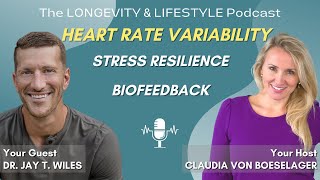
In this Longevity and Lifestyle Podcast episode, host Claudia von Boeselager interviews Dr. Jay Wiles, a psychophysiologist and co‑founder of Hanu Health, to unpack heart‑rate variability (HRV) and its role in stress resilience, health, and performance. Dr. Wiles explains the physiological basis of HRV, how it reflects autonomic nervous system balance, and why a single HRV number is less informative than personal baselines and trends. He distinguishes acute (beneficial) stress from chronic (harmful) stress, describing the sympathetic “gas‑pedal” and parasympathetic “brake” dynamics. Breathing—especially resonance or paced breathing—is presented as the most powerful, technology‑agnostic tool to modulate HRV in the moment. The conversation then shifts to Hanu’s platform, which continuously monitors HRV, alerts users when values dip below their personalized window, and delivers in‑the‑moment biofeedback (breathing, meditation, non‑sleep deep‑rest) to restore balance. Dr. Wiles outlines a typical client journey: defining a resilience goal, establishing baseline windows, receiving alerts, logging context, and training conditioned responses through operant conditioning. He discusses research linking HRV to cognitive performance via the Yerkes‑Dodson curve, noting that moderate stress can boost cognition while excessive stress impairs it. Use‑case examples span executives, athletes, and the general public, with considerations for age, gender, and health status; HRV generally declines with age, more sharply in women, but can be mitigated by fitness and regular breathwork. Dr. Wiles shares his personal path from health‑psychology research, veteran‑focused integrative clinics, and biofeedback certification to founding Hanu. The episode concludes with practical advice: increase self‑awareness, practice brief paced breathing daily, and use Hanu’s tools for continuous feedback.
Chapters
Welcome to another episode of the Longevity and Lifestyle Podcast. I'm Claudia von Boeselager, your host, here to uncover the groundbreaking strategies, tools, and practices from the world's pioneering experts experts to help you live at your best and reach your highest potential. Did you know that stress resilience is linked to heart rate variability, or HRV? Check out today's episode with Dr. Jay Wiles, an international expert in psychophysiology, human stress response, heart rate variability, and co-founder and chief science officer at Hanu Health, to learn all about what exactly HRV is, and why you should be paying attention to it, what your HRV says about your health, stress and its role in managing HRV, ways to improve stress resilience. We also talk about peripheral biofeedback and also Jay's path to becoming a health performance psychologist and so much more. And don't forget to help spread the word by sharing the show with your friends, family, colleagues. The more people who we can help with the message, the better place the world will be. Thanks so much, and please enjoy. Welcome to the Longevity and Lifestyle Podcast, Jay. I'm so excited to have you on today.
Yeah, I'm excited to be here, Claudia. Thanks for having me.
And I'm really excited to dive into all things human stress response, heart rate variability, and what you guys are doing at Hanu Health as well. And I'd like to start with just for people who are maybe not really familiar with what exactly is heart rate variability and why should we be paying attention to this?
Yeah. You know, it's a great question that I always like to start with unpacking it a little bit because heart rate variability at its core is actually quite complex, but we can simplify it a little bit. People should be quite familiar with heart rate variability simply because it is something that is being integrated into almost every single wearable that's out there now. So if you have a wearable, let's say you have Oura or you have Whoop or Garmin or Fitbit or all the above, you're like myself as well, then you're going to come across heart rate variability and a lot of people typically see it as one singular number, but heart rate variability is much more complex than just one singular number. And I'll unpack it. I want to first start off by explaining what heart rate is, which sounds maybe like an oversimplification, but it explains what heart rate variability is in a more digestible manner. So many people are familiar with this idea of heart rate. So when we think about heart rate, if you look at any type of heart rate monitor, you'll normally, you'll typically see BPM or beats per minute. So what we're talking about is an average. So let's just use simple numbers. If someone has a heart rate of 60, then that That means that on average in a 60-second window, which is 1 minute, it beats 60 times. So someone could deduce that if someone has a heart rate of 60, then therefore every 1 second the heart then would beat. And that's actually correct. That's not incorrect, but I would say that it's an oversimplification of what's going on, because if a heart did indeed beat exactly every single 1 second, then heart rate variability would be zero. There's no variance in between the time, which is what heart rate variability is. It's actually the variance or the change in time between successive heartbeats. The reason why this is so incredibly important is because the heart doesn't operate like a metronome. It should not be pacing itself every single 1 second or at any other time of succinct pace. The reason being is because we as human beings, our cardiovascular system, our autonomic nervous system has to significantly adjust to internal and external environment to trillions of processes at any given second. So what we're talking about here is heart rate variability is going to demonstrate at its core adaptability. How well can your autonomic nervous system adapt to its environment? So coming back again to heart rate, which is beats per minute, heart rate variability is always in terms of milliseconds. And when we think about heart rate variability, what we're looking at when we see that number, say it's 100 milliseconds, 100 milliseconds is saying that each successive heartbeat is varying in its time differences by 100 milliseconds. And I think we probably should take time, at least in a little bit, to unpack what that number means and how it relates to you. Can it be related to others? Because that's like all the questions I get is, can we compare to others or do we compare to ourselves? Like, I'm really confused on what to do with this data, but really we're talking about the difference or the variance that happens in between successive heartbeats.
And that's within 1 minute, right? You're looking on an average within a certain space of time.
So it doesn't have to be. So really it's just talking, we're talking about a law of averages. So we're talking about the average variance that occurs, but it can indeed be over a course of a minute. That's normally the generally accepted minimal window for heart rate variability time. But we see that as we open up and broaden the horizon to 2 minutes to 5 minutes, that these numbers don't vary significantly from just that 1-minute reading. So if you're really just looking to get a quick snapshot, 1 minute is about the minimum you want to take. And the reason that you shouldn't do really any less of a window, even though There is some research that says there's a level of evidence saying that you could go as low as 30 seconds. But the reason why 1 minute is a comfortable window is because that gives us at least enough time to look at the potential variants that will occur across the respiratory cycle, because the respiratory cycle, or what we refer to as respiratory sinus arrhythmia, it's the rhythm of heart, that of heartbeat or heart rate that's affected by respiration. That is the most significant influencer of heart rate variability, which is when we take a turn to how do we improve improve or how can we utilize heart rate variability as a therapeutic, we'll always turn to breathing as the main mechanism. But I won't spoil it for everybody too soon.
We'll dig into that in a minute as well. I love that as well. And can you help people understand the correlation between heart rate variability and health and from a larger perspective?
Yeah, yeah, absolutely. So the best way to unpack this is to really just do a quick primer into the field of psychophysiology. So psychophysiology is where I'm an expert at, so that's my subject matter expertise, and that's really looking at the effects or the interconnection. And we could even say the bidirectional relationship between psychological processes and physiology. And at the core, if we think about the central system or the core of that is our autonomic nervous system. Now our autonomic nervous system is a branch or it's a division of our nervous system. So we have our central nervous system, which is our brain and our spinal cord. And then our autonomic nervous system is a part of our peripheral nervous system. So all the nerves that innervate or run outside of the central nervous system can be ran or dictated by this autonomic nervous system. Now, the autonomic nervous system is referred to that because it was once thought that it was just purely autonomic or automatic. And it is indeed, it serves to function all of our automatic processes, breathing, muscular contraction, heart rate, sweating. All of these are actually dictated by this autonomic nervous system. But what we found out in more recent years, and I say recent in the last 50 years or so, which is pretty recent in the span of humanity, uh, is that we found that while we thought that many of these processes were outside of our conscious control, that's indeed incorrect. We can actually control a lot of our autonomic nervous system. And indeed it's quite powerful, or it can demonstrate a health component to that is when we can demonstrate a high level of autonomic control. So back to the autonomic nervous system, there's two distinct branches that we talk about predominantly, but there's really three branches. The two branches that we talk about predominantly are the sympathetic division and parasympathetic I'll explain both of those and how they relate to health and HRV in just a second. The other one is the enteric nervous system. So that's actually our gut. So our gut functions, or it serves actually as a part of our peripheral nervous system and is dictated— its performance, if you will, is dictated by the performance of our autonomic nervous system. But the reason that we don't focus as much on those is because when we talk about stress response and the human stress response, a lot more influence comes from those two divisions, the sympathetic and parasympathetic. So the sympathetic division is our fight stress response, and it's really all about how do we expend energy. And that's really the way I like to conceptualize it. It's not even necessarily as that's the division that's activated when we experience stress. It is true, but more so it's all about how do we activate and engage our energy conserves. And that's opposed, but also complementary to our parasympathetic nervous system, which is our rest, digest, relaxation response, which is all about how do we mobilize and how do we reserve and conserve energy. So these two work in tandem with one another. They are antagonistic, but they're also complementary to one another, which is a distinctive feature. They're not just combating one another, they work together. So when someone is actively engaged in a stress response, that is all about how do we then utilize, how do we then expend energy to help get us out of that situation or adapt to that situation? Stress is good. And I like to really hone in on that. Everybody wants to demonize stress, but at Honu and then within my scientific research, research, and then as a clinician, I always say that stress is your friend. Stress is actually a great thing because if you didn't have a stress response, then you would be eaten by that mountain lion who jumps around the corner because you wouldn't be fearful. You'd go pet it and say, hey there, you know, kitty kitty. And the next thing you know, you're done. So stress is good. It's not the acute stress response that can significantly impact us. It's really the compounding chronic stressors day in and day out, especially when we do not do anything about it. And that's key. And it's really why I built Honu. The One thing that I will say about the stress response is that when we need to engage our energy reservation and we need to absolutely expend that energy, then what types of things happen in our physiology? Cortisol is released, epinephrine is released, norepinephrine is released. That causes another cascade of physiological processes to occur. Our heart rate increases, our respiration increases, and heart rate variability decreases. Is this a bad thing? No, absolutely not. This is a great thing to have happen, but again,, but only for acute short-term periods when it's not needed. And we don't need to activate the sympathetic nervous system and retract or pull away from, or we'd say press the vagal brake of engaging the parasympathetic nervous system. When we, uh, do need to have that happen, then that's great. But when we don't need to have it happen, then we want the parasympathetic nervous system to engage and we want the sympathetic nervous system to come down, at least turn down the dial a little bit. So it's this little bit of cat and mouse engaging at will, the branch of the nervous system. Now again, how does this relate to health? The more chronically we turn on the sympathetic nervous system and relinquish power of the vagal brake, that is the parasympathetic nervous system, the more we're going to have significant increases in norepinephrine and cortisol and epinephrine and dysregulation of blood sugar. All these things can impact this natural inflammatory response that is needed, but not needed to be long-term chronically on.
I love that as well. And I think it's such a great explanation and that people really differentiate between stress. And I like that you say stress is good. And I think that I think people really need to get their head around that, but it's the chronic stress. And I think that people really need to make that differentiation because it's the chronic that leads to chronic diseases and that inflammaging and everything else that we are trying to avoid as well. So it's differentiating between the two. And I also feel like the analogy, if you think about an athlete needs to be nimble, you need to be fast but slow, you need to be able to switch between. And the better you are at flipping between the different systems and you can manage your health and optimize your health as well. And speaking of optimizing, so what are optimal HRV levels and what are some ways to track and improve them?
Yeah, great question. A lot of people ask that because we're so used to being able to somewhat compare metrics. So when we think about, let's think about the most simple one, which for most people would be blood pressure. So blood pressure, we have these static marks, right? They've recently changed over years. It used to be 140 over 90. Let's don't go over that. Now it's 130 over 80, but we had these markers and it says if you're above that and you're chronically above that, not if you shift above that, everybody shifts above that. When you're engaging like in hardcore exercise, your blood pressure's gonna shoot upwards, but we want it to come down. But if you stay up there, well then, okay, now we have quote unquote diagnosable hypertension or high blood pressure. So everybody kind of has the same mark. BMI is another one, which admittedly is a horrible metric for many reasons, but that's another one that's okay. We can make like normative comparisons there. Weight in general, muscle mass, like some of these are comparable, cholesterol, some of these other blood biomarkers. So people are used somewhat to having like a normative comparison. Like I can put myself in like the certain percentile of whatever it may be. HRV is absolutely in no fashion, at least from what we know right now at the recording of this, June 7th, 2022, there's no evidence saying that from a health longevity standpoint that we have any reason to compare ourselves normatively. Now there are normative databases, and if anybody's interested, you can see like, where do I compare? But really, I don't think it's really good to look at those because there are so many variables and factors that influence baseline HRV that need to be accounted for. So we're talking about things like genetics. There's so many scientifically, scientifically validated studies that indicate that there's a strong genetic component to where your baseline HRV score is. Height. People who are taller typically have higher HRVs. I'm 6'5", so I got blessed with the height. And I think genetics as well. Being male. So males typically have a higher HRV. So we can see like all of these components. I think I got all of them. Like it's the genetic component, it's the height, and it's being male. All of these kind of like working my way up. Exactly. So it's all of these factors that we have to take into consideration, which is why at the core of every single type of biofeedback study, HRV study, you do not see any need for us to compare normatively. So just to clarify that speech for you and your listeners who may not be familiar with what we say, normative is referring to the population, or it's referring to being able to compare to others who are like you, whereas really HRV is a self- comparison number. Everything is relative to self, which is why it is so incredibly important for you to know what is your baseline, what is the context of kind of you taking your numbers, and how do these numbers then relate to your response, and then what do they actually mean. So a lot of people will get an Oura Ring, or they'll get a Whoop, or they'll get some other type of metric, Apple Watch, and it's showing them heart rate variability, they find out where their number is, but then they're like, I don't really know what to do with this. And that's why with Honu, we were like, uh-oh, there's a huge problem here. Number one, people don't really know what to do with it. It's just data. And I think that's a really big pitfall to a lot of wearables is that they'll provide you with data and they'll say, yeah, your sleep was crap, or you didn't recover very well. Better luck next time. And we were kind of like, I think we should probably have something actionable that like we can do with this. And so for me, of course, as a psychologist and as a psychophysiologist, I'm going to view it from that lens. And I said, okay, I know that from the tens of thousands of biofeedback and psychophysiological studies that used HRV, like we can use this as a closed-loop system. Number one is to tell people like, here's the state of your nervous system. Here's the state of your stress response. And here are some actionable things that you can do to help you in the moment, but also compound a conditioned response that will really help you to increase your overall resiliency to stress. So that is one thing that I wanted to clarify. Is that when we think of HRV, I like people to think less of here's my HRV. Like, this is what I'm doing for my HRV. We have to take it a step further. Why would you want to do anything for quote unquote HRV? The reason you would want to do something is because you're helping to build fortitude. You're helping to build resilience to your stress response. The body does not know the difference between you running like a marathon, and you sitting there being stressed in a meeting, it experiences that exactly the same, all of the same, maybe not the severity of the response. It could be. And there's some people who will get into a, a conference meeting, a board meeting, and their heart rate will go up to 140, 150. And it looks like, yeah, they're like in a really good steady run, but the body doesn't know the difference. What the body does know is how you react to it, how you respond to it. And so this is why we say, like, when we think about heart rate variability, when we think about stress resiliency, we want to think less about my intention is to increase my value. No, my intention is to really, number one, access or look to see what is my self-awareness of where my mindset is right now. And then how can I then make an actionable approach to change my physiology in the moment that also helps to change my mindset around it? So for me, it's all about how do I use this stress, not how does the stress use me? How does it knock me down and throw me every which way? Because in the It really has. And for a lot of people, it can really shake, rattle, and roll them because stress can just have a chokehold on them. So we think that there's those two things, self-aware awareness, and then self-regulation. Like, what do we actually do about it in the moment? So finding your baseline is incredibly important. So at Honu, the first thing that we do is that we look to see what is your upper ceiling. So where is like your high average, where's your low average, and then what's your actual baseline average. So we basically create this box, like this this window and we say, and we get better with time. So the more data that we get, the more that we can hone in the window, we can broaden it, or we can shrink it down. We know that when people are in a stressful situation, physiologically or psychologically, that heart rate variability is going to significantly decrease. And so when it decreases below that threshold, and this is how we do it with Honu, is that you'll receive an alert. We'll say, hey, something looks like it's going on. We just wanted to check in. And you have the ability to log log. Like, this is what was going on. I was engaging in one— my number one, like, large-scale stress response is anal apnea. That is unconscious breath holding when I'm writing an email, especially if one's a little bit contentious. And it happens to a lot of people. But if I'm holding my breath while writing an email, I'll look on my heart rate monitor. I've got it right now. And as I'm talking and stuff, heart rate goes up, HRV goes down. I'll just see it pull on it, and I'm like, oh, there it is. And that's when I can then engage, and I'm self-aware. I'm engaging in, like, self-awareness. Now let's do do some self-regulation and get myself back up to my baseline range. And really what we say is with HRV, normal is good. Normal is best. We're not trying to say, hey, let me inflate my HRV as high as I can. There is benefit to that. But really when you're experiencing a stress response, it isn't saying, let me go down. I've got my HRV. Let's say my HRV baseline is 50 and it went down to 15. Oh, now let me get it up to 75, 80. That might be really difficult in that moment for you to do. I just want you to engage in some quick breathwork techniques, some biofeedback techniques to just get you back up to your range, to your boxes, your happy place. So that's how we do it at Honu. And really nobody's doing it like that, which is why I've explained it. That's why we built Honu is because we wanted someone to have a reference that acted like a stress radar or monitor all day long, but also a stress coach. We give you something actionable to do in the moment that's accessible to you and is all about training a different response to increase your fortitude and adaptability to stress. That was probably a really long-winded answer for your question. I hope I covered the basis there.
I think it's super helpful as well, because obviously speaking with different people around biohacking and biofeedback and devices, they're like, what am I supposed to do with all this data? And you guys really solve for that and actually proactively help people. So one is the awareness, as you were saying as well, but then, and I'd love to uncover a little bit like the tools and strategies and how you do it at Hanu. Over time you have the window, you have the ceiling. You have the floor, you have your sort of baseline and you see what's going on as well. What are some of the trainings that you offer? And I would assume that some of the trainings are done at a time, not during the board meeting, but in terms of you, you get trained to do it so that when you're at the board meeting, you can then use those tools. So can you walk through a little bit like that client journey and how the training works? And then what are some of the tools and mechanisms that you recommend?
Yeah, absolutely. A lot of it has to do with intention. So the first thing that we want to know is what do you want resilience for? What do you want stress resiliency for? So a good blanket 30,000-foot view type response would be, I want better longevity, better health span. Great, great. Okay. So we'll focus on that aspect. But a lot of people, it's like, I want increased cognitive performance, or I've worked with a lot of business professionals and executives who say, I want less emotional reactivity. Like I fire off the email and then I send it and think, oh goodness, can I retract? I regret it. Like, and that happens so often. Or they think, oh man, I shot some words out of my mouth that I'm I'm not very proud of, or I threw some gestures with my hands at the car next to me when they cut me off in traffic, or I rolled down my window and yelled at them. Like a lot of people like will say like in the moment, it's just like everything takes over, their stress response takes over, anger, aggression, and then they just engage in the behavior. And then when they get home, they think, my goodness, what was I doing? Or if it's like me, it's man, I said that word out loud and my two boys are like sitting behind me. Great example, psychologist, Dr. Jay Wiles. It's like all those things. So how can we then We have an intention of what do we want to do? Increase performance, increase resiliency, just like engage in better relationships. So it starts there. So once we know what you want to get out of this, then we can tailor, we can curate a personalized pathway or journey for you. And I want to speak, I know I'm speaking directly to Honu, but this doesn't have to be done with Honu. The great thing about this is that any type of wearable that you have is going to give you insight into your response. A lot of the wearables are created for recovery, which this is a wonderful recovery tool. I always say that anytime you're not working out, you're recovering. So this can be a beautiful tool for that. But a lot of them, again, they give you one static score that's taken maybe typically overnight, whereas we do it differently when we're actually monitoring you all day long, continuously looking at fluctuations or changes in heart rate variability. So let's say for instance, For instance, a lot of people who are using our platform now as alpha testers, so they're first people on it who are our close advisors, a lot of these individuals just want better overall fortitude and resiliency and want to enhance performance in whatever that they do. So the thing that we'd say is, okay, the best response is that, well, number one, we need to see what are those things that are ticking away at your resiliency. So we have to create better self-awareness. What are those things that are really knocking down your nervous system and it's having a hard time recovering? Recovering from that. So that's key point number 1. Number 2 is that when that experience happens and we alert you to it and you become self-aware of how stress is impacting you at that time, then we always want to follow up. And this is like operant conditioning 101 in psychology. We always want to follow up with the therapeutic or the response to that. And the reason is because we do want to indeed condition a different response. We want to condition a response that is different than what might be your normal response. Maybe your normal response is that you fly off the cuff and you send that nasty email, or you hold your breath during an email. And this, everybody's going to be like, oh, I know what Jay's problem is.
Right?
So we then change that response by putting something else in there. What does that typically look like? We like to use the single greatest low-hanging fruit, which is breathing. So this kind of comes back and I'll give a little bit of the psychophysiology and science behind this. This comes back to, well, what is the single greatest influencer on the human stress response in the moment that can be done anywhere? It doesn't require technology. Technology can be helpful. And I'll talk about that here in a second, but it doesn't require it. It's simply acknowledging kind of the detrimental impact of poor breathing. So breathing thoracically, maybe from the chest, maybe breathing very rapidly. Another big one is mouth breathing is a horrible one. So listen to Patrick McKeown or James Nestor's work on this. It's just simply changing the pace of your breathing. So breathing more diaphragmatically, breathing nasally, and then also slowing the pace of the breathing. What happens is that this causes a cascade of physiological responses that are in favor of you. Number one is it changes what we call the amplitude of respiratory sinus arrhythmia, which is a mouthful, but let me explain what that is. The natural process that occurs when we're breathing is that as we inhale, heart rate is going to increase. And the reason heart rate increases is because now we have oxygen to be delivered to muscular tissue to be used and for our cells to be used. So great. We want it to flood our system really quick. And so the heart rate is going to increase also from a physiological perspective. Uh, when we inhale and our lungs expand, our heart is actually going to shrink and become smaller. So it doesn't have as much room to expand. So it's going to beat faster. As we exhale, what happens is our lungs deflate. The heart has more room to expand, but also too, we now do not have that room for oxygen delivery. So our body and our heart and our cardiovascular system knows that it needs to slow heart rate down significantly because there's not a lot enough nutrients to be delivered at that period in time. As we extend or we lengthen our exhalation. We are also engaging what we call the vagal brake, which is engaging our vagus nerve. This is the 10th cranial nerve. It is responsible for innervating many different organs, including the heart, the lungs, and the gut. And what happens is when the vagus nerve is activated, it also causes a cascade of neurochemicals or neuromodulators to be secreted. The predominant one is acetylcholine. When acetylcholine is activated within the sinus node that significantly slows the pace of the heart. And when we significantly slow the pace of the heart and we feel it viscerally, it has a maximizing calming and relaxation response. So all of this kind of opened up into one sentence would be that as we slow breathing down, we increase the amplitude of heart rate peak to trough, and that causes the relaxation response to engage. Now we are engaging the sympathetic nervous system. So if you heard me, what I said is that as we inhale, the gas pedal comes on, but as we exhale, the brake comes on. And it's actually that controlled modulation— we call this autonomic control— that's what's most important. And that's what causes the nervous system to say, oh, you're in control, you're doing this, therefore I can't be in trouble, I must be in a safe and protected place. And so therefore the brakes come on and feel that sense of calm and relaxation. That's my really long-winded way of saying that the number one thing that we go to is breathing. And how do we include this within our app at Honu? We take you through paced breathing or paced biofeedback. We use what's called resonance breathing. Resonance breathing is actually the most empirically validated form of breathing and biofeedback by the work of Dr. Paul Lehrer. He sits on our board of advisors. So he's really coached us on all the things to include. Include within the application, but it's the way that we maximize breathing. And within Hanu, we actually have a resonance frequency assessment that you go through and you can find what is your maximal optimizing breath rate that will indeed be most effective for you. So we have people do that assessment, go through resonance training. And what you'll see is that wherever your heart rate and heart rate variability is at the beginning of the training, almost all the time within a span of 60 seconds, 2 It can even be as short as 30 seconds, is that these numbers will significantly change. Heart rate will come down, but more significantly, heart rate variability will significantly go up. What's great about this, Claudia, is that it really adds that level of objective data that a lot of people really hope for that really says this is indeed working because it's one thing to say subjectively, like, I feel better doing breathwork, or I feel better doing meditation. Meditation, or I feel better doing non-sleep deep rest. Those are all 3 that we use in our app. I feel better subjectively, but then when you see it objectively, it's like, uh-oh, lightning bolt. Like, now I come back for more and more. And we think— and not to get off on too much of a tangent, but we think that's really a big missing piece, is that a lot of people like will download Calm or Headspace— great applications. I think that they've done a lot of great work. But I think the reason they have so much churn, or they have people just don't use their app that long after their subscription ends, or they don't renew at least, is because number one, you have to set aside 10, 15, 30 minutes to go do it. And then also too, it's think it feels good. Yeah, it seems like it is. But when you add that objective data component, now it's, oh, I can't, like, I'm not, I can't talk myself out of or into thinking this either worked or it didn't work. Like, I see the data change. Like, it's so powerful. And that level of dopamine release that I get from seeing That data keeps me coming back for more and more. So yeah, it's the biofeedback, it's breathing. We utilize meditation, we utilize non-sleep deep rest. So all of those components can be done when someone is experiencing a stress response. But what we find, and this is the best thing I think about what we're doing with biofeedback, what we're doing with Hanu, is that the more and more you consciously train it, like maybe let's say even if you're not experiencing a stress response, but you take time to do you do it, the more and more you find yourself reverting to that and engaging in that behavior when you're not intentionally thinking about it, or it's happening consciously. Like, you look back and say, oh wow, normally that would have really impacted me negatively, but because I've been training and engaging in this conditioned response, I just naturally reverted to it. And I think that's the power of a lot of this work.
I think it's so great as well, and I think it's also having that feedback and data, especially for people who are a bit more data-driven as well, because people are like, oh, I've been meditating and yeah, I feel better. You get to a certain level and then they break off and then they realize, why am I not feeling as good as I used to? But they don't have that feedback, that biometric feedback. I think you combine it really nicely as well. And also, as you were saying as well, it's rewiring the neural pathways. So as soon as you do those certain breathing techniques that you've done and you've practiced, the more you do them, then in these high-stress situations, it becomes default and you're able to kick in with them as well. Absolutely. So it's really exciting that you're able to provide that as well. Let's talk about cognitive performance as well. You were saying that there are benefits also that expand beyond just stress resilience. Can you talk about the impact on cognitive performance?
Yes, absolutely. So there have been so many just fascinating studies on this, just looking at people's experience of stress. How does that impact them from a physiological and psychophysiological perspective? And then how does that translate or impact overall work performance? Or we can even microscopically look at cognitive cognitive performance. So one of the things that we know, which is again, like, I really love this type of research. So I find it fascinating. And since you asked the question, I get to dig in like a kid in a candy store, is that when they've ran— they've run so many different tests that have looked at when someone is experiencing kind of a stressor. So for a lot of times they'll use what's called the Stroop test, which is a highly stressful neurocognitive test where they'll actually show you like the color. They'll show you the word that is a color, like the word red, but it's written in a different color ink, like the word red written in blue. And they'll make you say the name of the color of the ink, not the name of the word. And the brain has a hard time mentally manipulating it. So what does that cause? It causes psychophysiological stress. You got a guy in a, or a gal in a lab coat, like writing down your response, watching everything that's going on. And you're like, oh goodness, I don't know what it is. So heart rate goes up, HRV goes down. It's really bad. It impairs your cognitive performance. So a lot of times they'll do that and they'll see cognitive performance goes way down. When you're in a stressful situation, or they'll stress people out and give them a cognitive performance test. And they'll look to see over time, like when they're not in a stress state, how well do they do on certain cognitive tasks and how well do they not do? We know that as HRV lowers, especially compared to your baseline, you're experiencing stress, that overall cognitive performance will tank. And the reason that this happens is because when you are engaged in a task there, what we call this in psychology and in sports psychology, specifically, there's an inverted shape to you called the Yerkes-Dodson law or the Yerkes-Dodson curve. And what this indicates is that when there are low levels of stress, then performance typically is a little bit lower. As stress increases, performance will increase to a certain point. Once stress gets a little bit too overwhelming, then performance starts to really tank. And we see this curve. Of this Yerkes-Dodson law, we see this in cognitive performance. So when we need to mobilize, when we need to execute, when we need to really expend energy, there's a certain level of that that's really helpful for us. And cognition goes up. What happens? HRV actually goes down during that time because we're amped up. Our sympathetic nervous system's engaged, but our parasympathetic nervous system is also still engaged. And that's one thing to really hone in on is that we're not, it's not just like we have full relinquishing of our parasympathetic nervous system or the vagal brake and the gas pedal's just on. No, we're actually still modulating in and out of them, but the gas pedal's put on a little bit harder and the brake pad's not going as forcefully down. That's a good place to be if we're talking about overall cognitive performance. So that actually manifests in a little bit lower of an HRV, a little bit higher of a heart rate, but better cognitive performance overall, because the brain is one of the first places in under that condition that you're gonna get the most oxygenation, especially in your frontal lobe, which is all about executive functioning and cognitive cognition. And the other thing is that we're gonna see a lot more nutrients delivered to that area, a lot more nutrients delivered to the heart and the lungs. Now, after a certain point in time, when stress is too high, the body is flooded with way too much cortisol, way too much norepinephrine, and way too much epinephrine. Then the problem is that other areas of the brain that are not the frontal cortex, they need energy as well because there's a lot of complexity of what's going on. So a lot of the energy that's that's being funneled to the frontal cortex is actually being pulled into other areas of the brain and throughout other areas of the body, more specifically the heart and the lungs, because we start to get into more of a survival mode where it's like, uh-oh, we need the full brain to be on functioning mode. And, but we need the heart and the lungs to work like now, go. What happens is that cognition then starts to go way down. So it's all about finding the middle of that curve, the middle of that inverted U. Which is the point in time where we say heart rate's up, HRV is a little bit lowered, but cognition is primed. And so when we think about breathwork, there are multiple mechanisms of breathwork that can actually help to do that. So we can actually work in some things like cyclical hyperventilation. We can work in some performance or energy-based breathing that can be really effective. Now there's caveats to that. If you're somebody who has like significant anxiety, panic attacks, PTSD, PTSD, I never ever recommend these types of energy performance breathings because they can actually stimulate more of an anxiety type of response physiologically. So there are caveats to it, but if those are not conditions that you are dealing with and they're not of concern, well then actually there's a lot of benefit to doing some of these more energy and high performance type breathing. One more thing, and then I'll be quiet. So one thing that we've seen, and this is the greatest example that I can use, is like the middle of that curve is like where athletes want to be like that. Is their prime zone, or maybe the executive in the boardroom wants to be in that, right in that middle. They don't want to really teeter-totter too much out of that. And because especially in the direction of being like overly anxious or overly stressed, because performance will sink. They typically don't have as much of a problem of being on the other side of low, low stress. That's going to impact performance, but it can, if you have somebody who's just really so even-keeled that like nothing like rouses them up, but that athlete wants to be there. And the reason being is because again, that is when they have the most control and exertion over the gas pedal and the brake. And when you have crazy good autonomic control, then performance is going to be out the window, off the charts as well. Off the charts would be a better way. Yeah. Out the window. We want it off the charts.
What are some typical use cases? Obviously for like executives, you're talking about professional athletes, but would you recommend this to your average person, if you will, as well, and why? And then my sort of follow-on question to that is around age and male versus female as well.
Great question. Yeah. Let's tackle the first one. This is something that anybody who deals with stress could benefit from now, which is everybody, which is everybody. For us, we realized that like the data, the metrics, the training, It's very popular and exciting for the health optimizer, peak performer, and the biohacker. Like they love this type of thing. But what I think is really important is that anybody who has identified, which would be just about anybody, especially in today's day and age, that stress impacts their overall wellbeing. And that can be relationships. So socially it can be physiologically, it can be spiritually, it can be all these things. If you identify that stress is negatively impacting you, I think this can be really effective. It was once thought not even that long ago that doing things like yoga or meditation, or even like self-hypnosis was like super woo. It was like, oh goodness, that's meditation. That's like for hippies and yogis. Leave me alone. It is so commonplace now. And it's identified in so much scientific literature. You have research coming out of Harvard and Stanford and Yale and Princeton, all these really high-level schools. Schools that are like beating on the drum of meditation. What we like to say, and this is a little bit of a bastardization, but what we're doing is a bit of like breathwork or meditation on steroids. And the reason being is because it's going to give you that objective level of data. And so I think that there's so much value in that because the common day individual who maybe isn't the health optimizer, isn't the biohacker, but is, I've got to do something about stress. Like it is really impacting like so many areas of life. There are a lot of them are gasping. Needs something. And so I think that this can be a wonderful adjunctive to maybe with some of the other things that they're doing. So if you're in therapy, for instance, which is great, like, I do love therapy. I'm a psychologist, so I have to love therapy, but I love it in general anyway. I think that the one problem with therapy, yeah, it's really expensive. It's also too, like, you see somebody, let's say, once a week for an hour. What can you do outside of that window? Because really, that's going to be where the deep work happens. The one hour that you're with your therapist, very incredibly important and valuable, but all the other hours of your week, we want something to be there. So this acts almost like as an extension, as a coach that goes with you all the time. It's like constantly watching and monitoring your stress response, but then also acting as a stress coach or a therapist in a sense with you at any moment. So I think it can be fitting for anybody who's just, I need to take better control of my response to stress. I'm not going to eliminate stress. It's not going to happen. Remember, stress is good. It is your response. It is your mindset and then your response and your regulation of stress. That is the key component. So stress is good. Use it. Have the mindset that you engaging in having stress is a good thing for you. Your body's working. If you're having stress, if you're experiencing what should be a stressor and your body's not responding that way, we've got some trouble. That's actually not a good thing. But if your body's revving up and your sympathetic nervous system is engaging and you're having parasympathetic withdrawal, your body's doing something right for you. It's when it stays on too long. Now we're entering into the territory that it's not super good for you. So that was my response to that. Now, to your second question about age and then gender, this is a really interesting one because when we talk about longevity, now I'm gonna speak more anecdotally, if you will. I'm gonna speak about what I've seen clinically and as a researcher, but then I'm also gonna speak to the science and the research that actually has been had here. What we know is that as we age typically, and these are with standard Americans, that HRV will typically lower. And so one thing that we haven't talked about is all the different facets of HRV and all the different data points. So most people are used to seeing one data point, which is a value that's referred to as RMSSD. That's a statistical equation that's looking at changes in the standard deviations and the root mean squared of standard deviations, too complex for what we're talking about, but it's just one equation that's used. There are other areas of HRV that are of high importance. One would be like the frequency domain numbers and frequency domains are very synonymous from an EKG to an EEG. And what I mean by that is that when you do an EEG, which is looking at brainwave functioning, we can actually take the raw data or the raw electrical output. We can filter that data almost like we shine that data through a prism, and we can look at its component values. What does that look like? It looks like we can look at the power of beta waves and theta and gamma and alpha and delta. We can look at all of them parsed out. We can actually do that with the electrical components of our heart. And so the way we do that is we take the raw ECG data that I've been talking about, we shine it through a prism, we call it a fast Fourier transformation. It's an algorithm that's used, a statistical equation, and we You can look at the component values. We refer to these as the very low frequency band, low frequency, and high frequency. And there is also an ultra low, but the 3 that we look at are very low and high. And we know a lot from research of what power in each of those bands means for the individual. Now linking this back to gender and linking this back to age is that what we know is that the high frequency domain or the high frequency power is almost 100% mediated by our parasympathetic nervous system. So as our parasympathetic nervous system or the vagus nerve withdraws, we see that power significantly decrease. And as we engage in more relaxation response, that number significantly increases, very similar to the RMSSD value that I talked about. We have a baseline of that as well within context. We have a baseline with age. We know that number tends to lower. So we know that parasympathetic response. Response from a numbers perspective typically will go down. HRV will also typically go down. Now it's all dependent on health status and a lot of other variables. People that are experiencing, let's say heart disease, which is again, the number one killer in the world right now, heart disease with someone with heart disease, that number tanks significantly. Now with someone with cancer tanks significantly, that's all about, again, stress on the system, on the physiology. Physiology. It can be due to psychological stress, but we're talking a lot of physiological stress from those types of ailments. So with, when, as people age and health concerns increase, HRV and resiliency typically goes down. Now that happens more so in women than it does men as far as significant goes. But we do know that more men have significant medical ailments as they age than women do. So we actually see more of a significant result in lowering HRV, maybe not at, on a scale as significant as what women do as they age and have health problems, but more so we see it with men because they just typically have more health-related problems. Now, one thing that I will mention about this that I think really interesting is that as I have worked with a lot of high performers and people who are interested in more healthspan and longevity is that these individuals are really able to counteract these results. And I think that this is the beauty and the brilliance of engaging in this practice sooner rather than later is that I'm working with 50, 60, 70-year-olds who are not having increases in overall heart rate. They're actually having increases in HRV and decreases in overall resting heart rate. What is this actually saying? It's saying that this is now impacting their overall physiological, and I would say psychological resilience to stress and is a huge indicator of people indeed increasing their overall healthspan and increasing their overall longevity. So this is not something that we should just naturally say it should happen. HRV should just plummet. Like, you will likely see it go down, but it doesn't have to go down significantly. The biggest thing is that we have to take care of ourselves, do what we can to prevent these things from happening. And then one of the single greatest things that you can do is engage in self-awareness and self-regulation of your response, but also increase your VO2 max, increase overall exercise output. That's a huge one because HRV is significantly correlated with cardiorespiratory fitness. So as people's VO2 max goes up, what happens? HRV baseline goes up as well. So those are some key components that I will say is that yes, the natural course of progression is to see changes in a, in a direction that we don't want to see with HRV. Heart rate, but it doesn't have to be just like other metrics, cholesterol and BMI and blood pressure, all of them.
Yeah. That's so exciting. I think as well, and also for people who are in the sixties and seventies, like you were saying as well, you have the tools that you are and strategies that you're providing on what people can actually do. And then you see the benefit as well, which is amazing. I'm just wary of time and I feel like there's definitely a round, a round two going to go happen, happen here though. But Jed. I'd love just for you to share with listeners your journey. Like, how did you actually get into this? And this is always a passion.
Yeah. It's funny because I definitely didn't have this on my roadmap, if you will. I graduated with my doctoral degree. My emphasis and specialization was in health psychology. So health psychology is indeed looking at the impact of health. So physiological health on mental health and wellbeing. And I wrote my dissertation on looking at the concept of demoralization on individuals with medical ailments. So basically when people receive a medical diagnosis, depending on the type of diagnosis, how many diagnoses, the severity and prognosis of those diagnoses, how did it impact this concept of demoralization? So basically how people felt either helpless or hopeless in regards to the situation. And I wanted to further that research. I got really interested in studying how could we utilize more integrative health strategies, not just psychotherapy, as a mechanism to with that key concept of demoralization. And I started to get really interested in that concept, integrative therapy. So when I did my residency, which I did with the Department of Veteran Affairs, the reason I chose and applied to the residency that I did is because they had an integrative clinic for working with veterans with chronic pain conditions. These are individuals who were prescribed opioid-based medications, but they were looking to get off of them. They're so, I'm sick of it. Like, it's not helping. I'm addicted to it. Give me something that's helpful. So what we did is in this clinic is we helped to titrate them off of their medications through the uses of things like acupuncture, meditation, guided imagery, exercise and movement, yoga. And the other one, which is a concept that I was vaguely familiar with, but not that familiar with, was biofeedback. And I got to dabble in everything, you know, resident, you do everything. But I was most fascinated with this concept of biofeedback. Feedback, because we would go in and work with these veterans. And it looked like we were doing breathwork that was highly tech savvy, which is what biofeedback is. And that's again, a very oversimplification of what biofeedback is, but that's what it felt like. And so I watched what would happen with these veterans. They were significantly changing these biometrics, but they started to say, I don't experience as much severeness and pain. Like the severity of pain is not there. The frequency, the duration. And we published this and we presented this at a very large-scale conference of how we can utilize these integrative strategies. But biofeedback was a predominant one that we used. And I just became fascinated with it because at first I was like, huh, heart rate variability, biofeedback, we can actually do this. And veterans will report significantly less pain. And this, again, this is published research. And so I dug more and more into it and became board certified in biofeedback and heart rate variability. Biofeedback and just started like going down that rabbit hole. And like the rest is just, it spiraled down. Once I got a taste for it, it's, that's all I could eat. Like it was the best thing or it's still the best thing in the world. And, and for me, it's just, again, it's a fascinating thing where I can take the subjective experience of training and therapeutics and bring the objective nature into it. It's marrying it like at Honey, we say if Whoop or Oura had a baby with calmer headspace, that's what we see ourselves And yeah, and the rest just became history. Like I became like just a subject matter expert in this area. All I did was study and I saw the gap in the market that there wasn't anything out there that was really answering the question of how can we close the loop on a system for stress and resiliency and cognitive performance. And here we are. That's the truncated version. A lot of years happened between all that.
I can imagine. I'd love to have you on when you guys progress a bit around to as well, but for my listeners interested in understanding more about stress response and HIV, what would be a good place for them to start with?
Yeah. Yeah. So the best place to go would be Hanu Health and Hanu is hanuhealth.com. Hanu is actually Hawaiian for breath. And so we tied that in. We're based out of North County, San Diego. So we have a lot of Hawaiian vibes there. So we found, we came across the word Hanu and we're like, oh, I love it. It's short, simple, and it's related to what we do. Which is breathing. So hannuhealth.com, we publish 1 to 2 articles each week on this, uh, concepts related to heart rate variability and longevity and stress resiliency and breathwork. So a lot of great info there. We're taking pre-orders on our device. And so our device and system is available for pre-order on hannuhealth.com. So go check it out, see if it's fitting for you. What we say too is this is going to be a really good closed-loop system that acts as a monitor all day for you. But the great thing is like, even if you just want to start in a place where you're just taking time to really focus on changing your breathing and identifying when you're stressed, that's a great place. And then if you want to take it to the next level and really elevate your mental game, then we think Honu is a good place for you. But I try not to act too much like a salesman in this because I really just want people to like effectively experience change by just making simple behavioral habits and behavioral change. But we think Honu can be a be a good kind of push or shove in the right direction. Yeah. HanuHealth.com. Follow us on Instagram or Facebook, social media outlets @HanuHealth. And then my handle is @DrJayWong on Instagram and other places as well.
Amazing. I've pre-ordered mine as well. And Jay, do you have any final ask or recommendation or any parting thoughts or message for my audience?
Yeah, I think that if you can make any change today, it's just increasing your self-awareness. Stress and then increasing your self-regulation. And it's something, again, that it's great to be able to set aside 5, 10 minutes to just engage in breathwork. But if you can just start with 10 to 30 seconds of it, like you're going to see a significant change. And the more and more you do it, the more and more your body is going to condition its response and revert to it in times that you really need it. So your body and your brain is going to thank you just for something as simple as pacing your breathing.
Love it. Thank you so much, Jay. Such a pleasure to have you on today.
Yeah, thanks so much, Claudia. It was great being here.
Hi everyone, this is Claudia again. Before you take off, would you like to get a short email from me with some short but sweet fun tips, tricks, and updates on all things longevity and lifestyle? Style. This could be cool products that I've discovered, interesting posts or articles I've read, and other fun and helpful things around longevity and lifestyle I've found for you. It's a very short piece of inspiration for you a few times a month, so if you want to receive it, check it out by going to longevity-and-lifestyle.com. That's longevity-and-lifestyle.com, and leave your email to sign up for the one.
More from Claudia









Can Psilocybin Slow Aging? The Study on Telomeres, Inflammation & Survival with Dr. Louise Hecker

