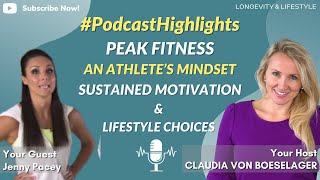
In this podcast highlight, elite fitness trainer and former British bobsleigh athlete Jenny Pacey shares how her background as a sprinter and brake‑woman translated into the high‑speed world of bobsleigh driving, describing the physical demands, G‑forces and team dynamics of the sport. She then pivots to practical wellness advice, emphasizing three liters of daily water intake as a "deposit" to a personal wellness bank, and warning against common energy‑draining habits such as late‑night screen time and poor food choices. Pacey advocates sustainable weight‑training (3‑5 sessions per week) to build muscle, boost metabolism (≈70 kcal per kilogram of muscle), and avoid the crash‑diet failure rate of 83 %. She outlines a habit‑formation framework—21 days to form a habit, 90 days to cement a behavior—covering sleep hygiene (turning off screens at 8 pm), meditation, breathwork, daily nature walks, and simple oral‑care routines. Throughout, she stresses identifying and removing barriers to consistency, whether family, work, or personal perfectionism. The segment concludes with a universal message: be kind to yourself, prioritize personal wellness, and focus on controllable actions that bring happiness and health.
Chapters
You hit the bobsleigh like you're weightlifting, like you're Olympic weightlifting, and you sprint behind it, which I have done for years, like sprinting out the blocks, pushing the sled, and then you long jump into the sled. So the skills transferred really easily for me. And then I bobsledded for 3, 4 years for Great Britain and went from being what's called a brake woman, which is the sprinter or the pusher, and your job is to accelerate the sled Sprint behind it for say 30 meters, long jump in, sit super still. You count the bends as you go down the mile of ice. I pray you don't crash all the way. And then you pull the brakes on at the end of the race to stop the sleigh. So I did that for a year and then I learned how to drive, which is a totally different experience and skillset. You have to learn all the corners of the tracks. You have to learn how to steer, but not oversteer, cuz the less you steer, the faster you go. And you obviously have someone behind you who's your brake woman. There's only 2 in a sled for ladies, but 2 and 4 for men. And that's really in your care because they're praying that they don't crash and you don't crash. So I learned to drive, which was also an amazing experience and a little safer than being a brake woman because, as I mentioned, 90 miles an hour, you sit in the back of the sled with your head between your legs, holding on for dear life. And you have more than 6 G-forces in the back of the sled, so more than Formula 1. Like, can you think of the most amazing roller coaster you've ever been on and like that feeling in your tummy? Yeah. So with that and the compression, the 6 Gs and the 90 miles an hour and the no seat belt, some people actually wet themselves in the back of the bobsleigh. So I was like, right, I'm hopping in the front seat where it's a lot drier and a lot safer. You know, every time you drink 3 liters of water a day instead of, you know, coming training completely dehydrated and wondering why you've got no energy. And on top of that, if your body's not hydrated, it can't mobilize fat from the cell. So a really simple hack for people is just drink 3 liters of water a day. Every time you do that, it's like a deposit into your bank of wellness. And it's the 1,000 deposits you continuously do. And avoiding, you know, the withdrawing. So the withdrawing for me would be, you know, going to bed late, sitting on your phone like swiping through Instagram until 10 o'clock at night and then wondering why you don't sleep very well, um, not investing in healthy whole foods. So if my fridge isn't full of healthy whole foods on a Monday, which I get delivered, then I'm more likely to like nip to the shop, grab a sandwich, and eat crap. So I invest in my fridge, I invest in my week, I invest in my body, my energy. I think what many people don't realize is 83% of dieters fail. So if you start a diet routine or a workout routine in January and it's completely different to your general behavior in life, you are more than likely to stop and fail at your goals unless you create behavior and lifestyle habits. What a lot of people do is look at the outcome. So a lot of people are like, right, I want to lose a stone in weight. And they look at the external long-term goal that's not controllable for them. Whereas if you're like, okay, I'm going to consistently for the entire year go to the gym 3 to 5 times a week and weight train. So I'm going to increase my muscle mass. And if I add 1 kilo of muscle mass, I burn an extra 70 calories a day. If I lose 1 kilo of muscle mass by crash dieting, I reduce my metabolism by 70 calories a day. So instead of thinking I'm going to crash diet, try and lose the weight and then probably put more on afterwards, I'm going to do something that's sustainable and scientifically proven. So say I'll weight train 3 times a week. I improve my growth hormone, I improve my fat burning capability by increasing my muscle mass, and then my muscle mass will start to reduce. Say I plan to go 3 to 5 times a week. It probably means I'll get there 3 or 4, which is a dramatic difference. To once a month or whatever I'm doing at the moment. And then on top of that, if I think about my mental health, so what makes me feel amazing? A good night's sleep. So maybe I'll turn my phone off at 8 o'clock and I won't look at the screen beyond that time. And if I bring in some meditation and start to change the neurology and the structure of my brain, so I can find that peace, tranquility. Much more easily. And then if I added that with a little breathwork, so I brought myself into my parasympathetic nervous system, I've started to change the structure of my body, my cells. I've started to increase my metabolism. Then maybe if I get out, walk in nature once a day, make it a priority. So I brush my teeth every day because I don't want my teeth to fall out. That's a habit I have in the morning, in the evening. Maybe if I made a habit of walking every day, even if it was 10 minutes. On your lunch break. It doesn't have to be an hour. It's just to get out in fresh air. It's shown that nature, the repetitive shape of leaves, is really calming on the brain. And then you really start to change how you feel and exist in your day. And then look at the barriers to what is stopping you achieve— that's 3 goals I've come up with— but say, look at the barriers that's stopping you achieve that. So if you know by 8 o'clock the kids are going to be like running around the house like crazy, then you've got to get ready, you're stressed, you've got to go to school, then you kick into work, you know, maybe you have to get up a little bit early, do an online workout in your living room, invest that 30 minutes in yourself, and then go into your day. Or maybe if you're the person that's trying to please everybody in the office, gets wrapped up in emails and meetings and works through a lunch break, and doesn't even take the time to sit and think about and chew their food, maybe you put some boundaries in and you're like, no, I take my lunch break when I want to. You go for a walk, you eat lunch outside the office and get that chance to just have some time for you. A habit takes 21 days and then it takes 90 days for a behavior to set in. So if you consistently work on your habit with the little things that add up to the stone weight loss, or the little things that add up to the big goal. It's the thousand tiny bits that you do consistently, I think, that add up to the long-term health, wellness, and often weight loss changes. And then you've got to stick with it. And if you could have a message that got out to, say, a billion people, metaphorically speaking, around the world, what would it be and why? I would encourage everybody to be kind to themselves and prioritize themselves and their wellness, and to not always chase the things they're not in control of, but really understand what makes them very happy and what makes them feel the best version of themselves, and then focus and prioritize that.