How To Engage in WEB3 and How Women Can TAKE CONTROL of Their Finances & Investments?
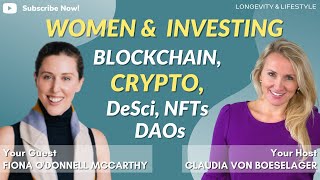
In this episode of the Longevity and Lifestyle Podcast, host Claudia von Boeselager interviews venture‑capitalist Fiona O'Donnell McCarthy to explore how emerging technologies—blockchain, crypto, Web 3, NFTs, DAOs, and decentralized finance—will reshape food systems, health, and global commerce, and why women should actively participate. Fiona shares her personal journey from competitive swimming and a human‑biology background at Stanford to product leadership at Daily Harvest and now a partner at True Ventures, highlighting how scientific thinking and a “work‑backwards” mindset guide her investment thesis. The conversation covers plant‑based and regenerative‑agriculture innovations, next‑generation wearables, and the promise of continuous health monitoring. Fiona demystifies blockchain as a decentralized, distributed ledger, explains digital currencies, DeFi, NFTs, and the evolution from Web 1 to Web 3, emphasizing ownership and community governance. She illustrates DAOs with concrete examples (Unicorn DAO, a DAO investing in female‑led NFT art) and discusses governance, exit mechanisms, and potential for decentralized scientific funding. Practical advice for newcomers includes reading the Bitcoin whitepaper, exploring the Ethereum site, and dollar‑cost‑averaging small weekly purchases of Bitcoin and Ether. For financial empowerment, Fiona recommends building a 3‑6‑month expense buffer, focusing on index fund investing, diversifying with crypto, and treating time invested in startups as a key asset. Throughout, both hosts stress mindset shifts—embracing autonomy over health, confronting fear, and using positive psychology—to support longevity and a longer, healthier working life.
Chapters
Brought to you by GlycanAge. As you know, I'm planning to live well for longer, so having a true measure of my biological age is essential. GlycanAge tests are based on over 3 decades of scientific research and give a true indicator of biological age by looking at your immune system and inflammaging level, all from the comfort of your own home with a simple finger prick test. Once you get your results back, their healthspan doctors guide you on getting on an even healthier path to reducing your biological age through proven personalized lifestyle interventions. All included in the initial price. To find out your biological age and start improving your health, check out glycanage.com.
That's glycanage.com.
And use code Claudia, C-L-A-U-D-I-A, at checkout to get 15% off your order.
This episode is brought to you by InsideTracker. People age at different speeds, and the date on your license may not represent your inner biological age at all. If you're looking for ways to extend your healthspan and slow down the aging process, the keys to health and longevity run in your blood. That's why InsideTracker provides you with a personalized plan to improve your metabolism, reduce stress, improve sleep, and optimize your health for the long haul. Created by leading scientists in aging, genetics, and biometrics, InsideTracker analyzes your blood, DNA, and fitness tracking data to identify where you're optimized and where you're not. For a limited time, get 20% off the entire InsideTracker store. Just go to insidetracker.com/claudia. That's insidetracker.com/claudia to get your 20% off today. This episode is brought to you by Oxford Healthspan. I was so excited to learn about Oxford Healthspan's Primadene Original and Primadene GF Spermidine supplements on my journey to staying younger for longer. And I'm delighted to now share this great longevity supplement with you too. They are the cleanest, purest food-derived spermidine supplements on the market with zero fillers or flow agents. Spermidine has been shown to support cell renewal, cognition, and trigger autophagy, the body's inbuilt system of cellular cleaning and recycling, as well as to improve deep sleep and thicker, glossier hair, stronger nails, and better skin. Most fascinating to me, spermidine also inhibits 6 of the 9 hallmarks of aging. So check out OxfordHealthspan.com and use code Claudia10 at checkout for 10% off today.
Hello, life optimization friends. I'm your host, Claudia von Boeselager, and welcome to the Longevity and Lifestyle Podcast, where I invite pioneers and thought leaders and all things to give you the strategies, tools, and practices to live better and reach your highest potential. How future-focused are you, dear audience? An important part of living well longer, which begins with understanding future trends that will play pivotal roles. So I'm excited in today's episode with venture capitalist Fiona O'Donnell McCarthy to dig into all things emerging technology. Specifically, we dig into how emerging tech will shape the food system, health, and global commerce, what blockchain, cryptocurrency, decentralized finance, or DeFi, NFTs, DAOs, and more are why women should engage in Web3, where to start learning more about crypto, how women can take control of their finances and investments, and much more. Fiona is a principal at True Ventures. For more than a decade, she partnered with founders to drive product innovation and help them to create the futures they envision. Her experience spans product management, strategy, and business development for both consumer and B2B companies. Fiona studied human biology and published research on cognitive development at Stanford University, which influenced her distinct perspective on how technology shapes human behavior and vice versa. She accredits her competitive swimming career, which led her to Olympic trials in 2008, for igniting her curiosity around breakthroughs in human performance and how innovation can bolster wellness. Please enjoy.
So welcome to the Longevity and Lifestyle Podcast, Fiona. I'm so excited to have you on today.
Thank you. So good to see you again.
It's great to see you again as well. And I obviously, for some people wondering, this is Longevity and Lifestyle, why are we talking about finance today? But I think one of the fundamental pieces of living well longer is having the finances to do so as well. And so that's why I'm really excited to dive into a bunch of different areas and about the future of technology and finances and what's happening in the world as well and share this with you, dear audience. So Fiona, I'd love to start with your journey. What were some of the profound moments in your childhood or career that have really shaped the way you view the, the world?
First of all, thank you for having me, and I'm excited to talk more about this topic. I grew up in a small town in Ohio, and I was really academically inclined, but I was also a very serious competitive swimmer. So I ended up attending Stanford University in California, and I was really passionate about this intersection of science and business. So I majored in human biology and then spent my summers working as a researcher in a cognitive neuroscience lab. And at that time, I didn't know anything about finance, Silicon Valley, venture capital, but I just followed my curiosity, which was around how to commercialize some of the insights that were coming out of research labs at Stanford. And I ended up in a class on technology startups. So that class really was a light bulb moment for me. The professor was a serial entrepreneur named Steve Blank who pioneered a framework he called customer development. And to me, I was like, we're taking the scientific method and applying it to business. Like I can do, I know how to do this. Maybe I have business experience that's relevant. But so there was this mindset of developing clear hypotheses about your customers and about the market, and then finding ways to test them incrementally along the way. So that's what I wanted to do after school was take that framework and apply it to early stage startups. So that mindset plus the evolutionary biology that I learned in the human biology program really kind of are the two foundations of what I say some of the frameworks are that shape my perspective on the world. And so the earliest days of my career, the iPhone was brand new. It had just opened up to developers. So I was really focused on how mobile technology was changing consumer behavior, how we shop, how we live, how we connect. And so that passion for emerging technology and human behavior is really what drives me as an investor in early-stage startups today.
What role do you think your competitive swimming has played in where you are also today and shaping your ability to thrive in sort of high-stress environments, right?
Yeah, with competitive swimming, one of the things that's really interesting about the sport is that it's a very clear-cut sport. When I was about 11, I went to Stanford swim camp for the first time, and I just raised my hand and I asked the coach, what do I have to do if I want to swim at Stanford? And he said, you take the hardest classes that your high school offers and get A's in all of them, and you have to have senior national level cuts by the time you're a junior high school. And I was like, two things? I only have to do two things? I love it. And I can swim at Stanford? Yeah. I was like, also don't get in trouble. But like, yeah, I guess if you do those two things, you can probably get a scholarship to swim at Stanford. And so I was like, all right, senior national times are here. Work backwards. What are junior national times? Okay. What are sectional times? Okay. What are zone times? Okay. What are quad A times? I'm like, okay, let's get quad A times and then we'll go from there. So I think that idea of being able to take a long-term vision and work backwards and, and take a big goal and break it down into small pieces. That's something that really shaped me. And then definitely one of them. And then the other is it's really a team sport in psychology, but it's an individual sport in actuality. And so really having to like rely on yourself and trust yourself at the end of the day was another thing that I learned at different points in my swimming career. I was better and worse at, and I'm still swimming competitively as an adult, so I just am a little bit slower, but it's been fun to continue that journey?
I think that it's for me also one thing I interviewed a former Olympic athlete and one of the things she said to me, and as we know, mindset is just so critical. And she said that no matter what, and no matter if you just missed the title by a few seconds, you review your race and what you did really well and you ingrain like, that was really good. That was really good. Even if you lost. And I thought, wow, that was such an aha moment because how many of us in the sort of normal non-athletic world are like, oh, I should have done that better. I should have done that better. And you're beating yourself up. And so I think that that sports training, that athlete training is such a help for mindset. And then that, you know, carries over then into business and day-to-day life as well. That's another example of it. I love the way that at a young age you were already working backwards. Okay, that's the goal. How do I break it down? Where did you learn that from? Are your parents very structured in that way?
No, I was just a very intense kid and my parents really were supportive of all of my mindset, but it definitely was, it came from a deep-seated internal motivation and they always tried to cultivate that. They tried not to be overly involved in my swimming life. My dad and I would travel together. I was one of 4 kids, so he and I would go alone to travel meets. And then they tried not to get too involved and ever cross that line because they always wanted this to be my thing. And I think that was really a gift.
That's really amazing to have parents that are like that and also not to try and bring the siblings all with you the whole time and change the day.
Our family life wasn't built around my swimming career.
Which is typically the case if you have a superstar child. I see this in some other families. So yeah, hats off to your parents. They've definitely figured out the parenting model quite well. You know, let's jump into emerging tech and how, in your view, will emerging tech shape the food system and health and global commerce?
That's great. I think there are really some existential problems that need to be solved within each of those areas. And I view my role as an investor as supporting entrepreneurship and innovation in these areas. And so my role as an early-stage VC now is no longer to solve any of these problems like I did when I was in product leadership roles, but to follow those creative and visionary founders into those spaces and problem areas, and then support them with capital to bring their vision to life. So I think getting into the food space is— I spent my career, 3 years of my career at Daily Harvest prior to becoming an investor, where we were focused on the food system from both the customer experience perspective, but also from the environmental perspective. And so within food, I think we're gonna continue to see a lot of plant-based innovation. In our portfolio at True Ventures, we have portfolio companies that are making plant-based growth factors to produce cell-based meats. One of our portfolio companies, Prime Roots, is reimagining the deli counter with a koji-based meat. So I think there's still a lot more room in plant-based innovation. I'm also seeing a lot in nutrition. Hacking. So we saw innovation in plant-based proteins over the past decade, but I'm seeing more movement in things like engineered carbs, whether it's a product like Better Bagel that engineers a bagel that has the same number of carbs as, as 2 slices of banana, or a company, No Mosu, which creates high-end chocolates without sugar, which the founder as well. So I'm seeing some like nutrition hacking type engineering in spaces beyond protein, which is really interesting. One of the things I think is most important though, is figuring out how we grow our food in ways that are more sustainable and better for us, better for the planet. I'm very passionate about regenerative agriculture. I'm looking for business models that work there, that really drive the right behaviors and incentives. There's a lot that can be done with the data and the capabilities we have today to better understand regenerative farming and to farm at scale in more regenerative ways. So the intersection of data and things with carbon credits, like I think there's gonna be something interesting that happens in the next 5 years.. And I think it has to, it's a really an existential— exactly. Yeah. And then in health more broadly, I think we're poised for a new form factor of innovation in wearables. I think there's been a lot of innovation in wrist-based biofeedback and things like that, or hardware-based biofeedback. We're both wearing different trackers, but I think that we're poised for a new form factor there. What are, what's the next wave? Going to look like.
What do you think it could be? What are you, what are you seeing?
So it's not necessarily something I'm seeing yet, but I think that I'm seeing rumblings of that. We're watching things like continuous blood glucose monitors being adopted in more of the mainstream as a tool for biofeedback rather than a prescription device. And so do we go further along that journey of either implantable or devices that are monitoring our interstitial fluid or our blood in different ways? Are there micro devices that we can use? Are there implantable devices that get traction? I think there's going to be something that changes there, and we're starting to see some of the rumblings of that. But I think that's really another wave of innovation that will likely come in the coming years.
For sure. Because I think it's like any new industry, it kind of blossoms, right? Like a plant or flower. So it'll go, you'll have the extremes and then you'll have a happy medium where people are more comfortable. But I think the transdermal, for sure, there's going to be people implanting. There are already. And then what are the consequences to your health? Like the and cons, et cetera, and what are the mitigants? And there's going to be a bunch of products around the mitigants then as well. Perfect example is your car tells you like 1,000 miles before there's any issue that there's going to be an issue, like deal with it. But the human body, we can tell we're like, oh, I can't even get out of my bed anymore. Let me go see a doctor. It doesn't make any sense. The human body is much more valuable than the car. We don't have the infrastructure, if you will, around it to pick it up. And also the education and like, how do you make it as simple as possible to, and accessible as possible. So economically to reach the masses so that everyone benefits. So I think it's a really exciting space as well.
Yeah. And I think that if you look closely at some of the thought leaders in medicine today, who all of them very well, you're seeing more of a transition towards system-level thinking rather than symptom treatment thinking. And I, I'm hoping that the data that we have access to and the ability to model complex systems like the human body will help us move to more of a systems-based approach to the human body and to treating the human body. Rather than a symptom-organ-treatment type approach.
Yeah, that's the 20th century model, right? The diagnosis and prescription that we see is not working clearly. And so I think there, I see there is this fundamental shift happening. And at the moment with price points, some supplements are super expensive.
Okay.
If you do opportunity costs in terms of investing now versus sick care later, it's obvious, but not for everybody and financially as well. So like, how do you make it more accessible? And I think I implore people to say, It's about prevention. So the sooner you jump on the bandwagon, and I feel like the 20-somethings nowadays are very tuned into this, the ones that I speak to, and very proactive in it. And you can avoid, like, Alzheimer's is reversible. Like, you don't need to have Alzheimer's cognitive decline. Like, a lot of these neurodegenerative diseases, like, you don't need to suffer them. Type 2 diabetes as well. Like, there's so many things that shouldn't even exist anymore because we have the tools. And it's just like, how do you push the adaptation of that to a much quicker pace?
So, right. And how do you make that feel like something that's empowering to people versus making it feel like you're blaming the victim of these things? So I think that psychological shift is so important that this should be seen not as blaming someone for the condition that they have, but rather empowering them with things that they can control and they can do, and that they don't have to turn their body over to the medical system in order to get relief from some of these really debilitating conditions.
Exactly, yeah. And to proactively, you know, look and take steps to avoid it, to do certain tests so that they understand. And I think it's that self-education, right?
And it's exciting.
I think coming out of COVID people have become more scientifically and medically aware and have a better understanding, and also understanding like what implications are. And the more people are attuned to their own body, they realize, okay, my body's telling me something, like this is bothering me, what can I do to solve it? And not just go to traditional methods of, okay, here's a pill, and it's not really helping, but what else could I do fundamentally? But underneath that, yeah, amazing. So That's around health. And any other emerging tech around health or what about global commerce, Fiona?
Oh, in global commerce, this is something I've spent a lot of my career in commerce, both on the infrastructure for e-commerce side and on various consumer brands, both in the health space and the fashion space. And I think what's interesting in global commerce is that the promise of the internet was that you could access any information or any product anywhere in the world. And this led to an explosion of new brands in food, in fashion, content, wellness, and innovation. And that's been amazing. And as consumers, our buying patterns used to be heavily influenced by retailers' decisions about what to carry on their shelves, whether it was the food that we ate or the magazines we consumed, the newspapers we had access to. But today we can find anything we want online. The problem though is now there's a huge number of long-tail brands competing for our attention, and the cost to acquire a customer online for these companies is often unsustainable today. And so this is an area area where innovation is just hugely necessary. And so I love meeting with entrepreneurs who are focused on, on this problem because how do you break through the noise? And as an emerging brand that has an amazing product, actually build interesting market share in a globally competitive online directory of every brand in the world.
So what would be the keys? I guess part of it's also like data and really understanding and targeting that, that customer, or what would you say are some of the—
Well, there's data and targeting, and then that has implications for how we think about our privacy as individuals as well, and what information you want to choose to share with brands and not. I also think there's interesting marketplaces. One that might resonate with your audience is called Bubble Goods, which is basically taking all of these better-for-you brands and aggregating the long tail of these really innovative brands and putting them all on one platform as an alternative, more indie brand marketplace. To choose to purchase from. And so rather than all of those brands having to go out and acquire customers on their own, they're able to aggregate some demand for those, those products. And I've been really, I've been watching them for a long time. There's some Daily Harvest alums building that company, which has been fun to watch.
Really exciting. And I know some of the areas of emerging tech that you're paying most attention to are around blockchain, crypto, and Web3. And I know when some people hear these words, their eyes glaze over.
I don't understand. Not for me. Yeah.
This is all very techie and, but this is the future. And so I would love, and I've heard you explain before, so for my audience, can you share exactly how can people understand blockchain? What is crypto? What is Web3?
So just as a preamble, I think the reason why we have to all not shut down when we hear some of these words or think that's not for me, if we're all going to live substantially longer and we're going to work substantially longer, we We can't say that our last wave of technology innovation that we're going to pay attention to is whatever was happening in my 20s or 30s, and then I'll just ride that till I retire at 50 or 60. We can't do that anymore. If we want to be healthy and productive into our hundreds, if we want to continue working into our 70s and 80s, we're going to have to all be comfortable with the idea of learning new paradigms, learning new technology shifts, and, and not saying, oh, the internet, that's not for me, or blockchain technology, that's not for me, cryptocurrency. I'm just going to ride out my existing 401k, my existing financial strategy. I really think we have to all open our eyes and pay attention to these major technological shifts that are going to impact our lives. And we'll go through more than one of them if our lifespan really does double. So that's the keep an open mind as I go into some of the like details, because I do think we all need to take responsibility for making sure that we're evolving with the world, especially if we're going I'm going to live a lot longer.
So that's my— my 83-year-old father is on WhatsApp and so proud he can do FaceTime and things like this as well. So if they can figure it out at those ages as well, then the younger generations should have no problem understanding. This is just finding a way that it's described that people understand. And you're brilliant at this, Fiona. So how would you break it down?
How I'd break it down is that what's underlying all of these trends, you could call it crypto, blockchain, Web3. There's really two major innovations and one is technological and one is more or social or organizational. So the first is blockchain technology. The simplest way to describe a blockchain is that it's a database of historical transactions. So what's different about a blockchain versus a traditional database is that it's decentralized and distributed. So decentralized means that no one entity controls the data and distributed meaning that there's no one place in the world where all the data's stored. So the chain can run on a network of computers all over the world. And what that means is that today as we live our lives, lives more and more online. There are corporations that are harvesting the data about our behavior and our preferences, and they store it and they monetize it. And in a world that's powered by decentralized protocols, we can design systems where we're more in control of both our digital lives and our financial lives. So some examples, a lot of us are familiar with digital currencies. And so what does that mean? It's, what that means is that there is a borderless, like the digital currency doesn't belong to any one country. It's peer-to-peer. There's no institution sitting in between you and me transacting, and it's native to the internet. It's digitally native, unlike our current currencies. And so you could say, oh, blockchain, that's a bubble. It's a, sorry, Bitcoin, it's a bubble, it's a volatile asset. But if we talk about, do you think a borderless peer-to-peer digitally native currency makes sense? A lot of people will be like, I'm like, yeah, that kind of does make sense, doesn't it? There's a lot of problems. There's some great things about currencies being stabilized by governments, but there's also some downsides to all currency being routed through financial institutions or being owned by a government or backed by a government. So those are some reasons why, despite all the hype around cryptocurrencies, I think the fundamentals are really strong there and the belief in it, I believe, it makes a lot of sense. So that's one. Another is just decentralized finance. So protocols built on top of those cryptocurrencies that provide services you'd normally get from a centralized bank, like protocols that are designed to help you borrow or lend money or invest money to earn interest. That's another example. And then NFTs is another. We've probably all heard of NFTs and we tend to think about it as collectibles or art or pictures online, but it really, what NFTs symbolize is the first model for digital ownership, digital scarcity, and digital provenance that's not managed by an institution, but rather a distributed ledger, a blockchain. So that's what's really interesting about like blockchain.
Can you explain though, for people who might not be familiar with NFTs, because I think obviously in your world you hear a lot about it and it's been talked about for a while, but I know in a lot of other worlds people are like, I saw it in the paper, but I had no clue what it was like. Can you explain what exactly is an NFT and what's the use Yeah.
So an NFT is essentially, so the, the key word here is fungibility. So in a cryptocurrency, one Bitcoin is the exact same as any other Bitcoin. And it doesn't matter what the ID of that Bitcoin is. You can, you and I can exchange a Bitcoin, one Bitcoin for another, and it doesn't matter which one we pick. With NFTs, it's different. So the fungibility, non-fungible token, this is basically a digital representation of something that cannot necessarily be is not one-to-one with, with anything else the way that a Bitcoin might be. So what that means is that it's a way of representing digital ownership. So the first like application that people probably become familiar with is owning a digital collectible, like a CryptoPunk or a Bored Ape or an NBA Top Shot. And so what that— this is a digital record stored on the blockchain and validated on the blockchain of who owns that image. So you can think about all of the other things that you can do with this, like certifying authenticity, representing intellectual property ownership rights. There's just a lot of other things that we haven't fully tapped into yet that this technology can power.
Mm-hmm.
'Cause we see obviously a lot around art and things like that as well, but what is the expansion from there of your NFTs? And maybe we can touch also on what Web3 is versus what was Web1, Web2, Web3. So maybe you can just walk through that journey as well.
Yeah. Web2, Web3. Web1 was really mostly about having a directory online, right? Information is being shared online. You can access it from anywhere in the world. Web2 was much more about connection and the social connection between people online. So social media really was driving a lot of the innovation in Web2 and Web3 takes that combination of information accessibility, social connection, but also introduces the concept of ownership and decentralization into the web. And so for the first time in our lives, we don't necessarily have to rely on these centralized organizations that powered Web2, but we can think about what things might we want to be decentralized, what things might necessitate being owned by the community or owned by the collective rather than owned by an organization.
And I think just to expand a little bit on that as well, because I get asked this as well. So I think for Web2, if you imagine, and everyone has, say, Facebook or Instagram. So especially if that's your business, you're producing a lot of content, you're spending a lot of time and energy, but you don't own it. It's like you're renting real estate that at a blink of an eye, either your followers aren't being shown your content, or they decide to close down your account because of whatever the case may be, and then it's gone. So all your hard work, which might have been, you know, built up over years, is just wiped out automatically. And so Web3 takes, gives the power back to you because you have that ownership and then also in a decentralized way as well. What excites you most about Web3, Fiona?
So I think one of the things that's been really interesting is that second wave of innovation around how people collaborate in decentralized ways. That's been really exciting to me right now. So you may have heard, people may have heard about DAOs or decentralized autonomous organizations that are enabled by blockchain technology. So these are organizations that rather than having a typical executive type function with top-down decision-making, they're community-led organizations where decision-making is defined in code known as smart contracts and decisions about resource allocation and things like that are determined by community voting. So we can, there's a lot of innovation in how DAOs are tackling health, wellness, and science. And the first kind of applications of DAOs were looking at investing and collecting as a community. But we're gonna see this technology and these types of organizations tackle more and more verticals.
Can you give a use case example? Cause I think for some people they mightn't have heard of a DAO and then just trying to understand voting and smart contracts. So I really want to empower the audience to really get their head around this. So can you maybe give one concrete example and like, how does it actually work and how many people are involved and how are decisions made, et cetera?
Yeah. So one of the DAOs that I'm really involved with is called Unicorn DAO. And it's a group that focuses on collecting NFTs by female and non-binary artists. And so right now, less than 5% of the value in NFTs is going to female artists. Artists, and so they're working on collecting the best of that art, promoting it, and increasing the representation of female artists in the NFT space. And so we come together and we have accumulated a treasury of money. And so everyone paid money into the treasury of UnicornDAO. And now as a group, we talk about what investments we might wanna make, what NFTs do we wanna collect, what projects do we wanna support. And the goal is to increase the value of that treasury for all of us. Us, but it's also the mission to support NFT artists that are coming from underrepresented groups. And so that's one really example of a collector DAO or an investment DAO. And you'll see that applied. There's another one called the Lao that invests in DeFi projects. And so that the, the members of the Lao come together, they have a treasury of assets and they can decide, we want to invest in these protocols that are reshaping our, our financial lives.
And how does the exit work from there? So you say the, you're growing the treasury, how does that become, for people wondering, how does that, what's the exit there?
Yeah, so there's, I think this is all really early and still being defined. One of the ways, one of the things that we see is that the value of having a seat in that DAO goes over time. And so there are certain DAOs where now buying into the DAO costs over a million dollars. And so for the people, they might have paid paid, I don't know, $2,000 to join the DAO, and then a couple years later their seat is worth $5 or $6 million in the DAO. Now, that's one of the— that's the high end of the DAO market. So you could think about it as selling your seat to someone else. That's the most logical thing that has been happening. There's also this concept called rage quitting, where basically you can rage quit the DAO and then just your portion of the treasury gets liquidated and given to you. So it depends on how the underlying— again, this goes back to the smart contracts concept where these types of rules are defined in code. And so it's not like the, the organization is just making these decisions on a whim. At the outset, the organization is defining the rules of engagement and how voting works and how joining and leaving works. And so So those underlying smart contracts are transparent and you can, if you can actually digest them, and this is something that I think will change over time and they'll become more human readable, but those smart contracts are transparent to everyone. And so these organizations theoretically are very transparent to their users because their decision-making processes are outlined in code versus outlined in a policy that could change.
That could change as well, but then essentially the members that are setting up the initial DAO need to make very smart decisions because then it's set in stone, right?
Yes, I mean, it could vote to change the smart contract logic at some point as an organization, but yeah, you're right, it does, it does get set, the precedent gets set very early on.
Yeah, so you want people who know what they're doing and yeah, not too optimistic, we don't need to worry about that, and then there's, yeah, things because I think It just is growing so exponentially at the moment that I'm sure there's a few trip-ups and things like that as well.
But yeah. Yeah. And in the sciences, it's really interesting to look at how this can be used as a model of decentralizing scientific innovation. And so the, the things that are being tried right now in that area are related to how do we crowdfund research? How do we get research that this community would like to see prioritized? How do we fund it and make it happen and fund those scientists? And so you could think about it as there are some mechanics around how research gets funded through these types of decentralized organizations. And I think we'll see more and more innovation in that area as well.
It's phenomenal. And I've heard Ariella talk about it as well, that she's in the Vita DAO and it's just 3 steps in order to get yes or no investment approval, which is unheard of normally. Super exciting as well. And why would you say is it so important that women engage in Web3?
Yeah, so I think this is an opportunity because our lives are being reimagined, our digital lives are being reimagined, our financial future is being defined, and this novel organizational structure is being tested. And I think our culture and our world will be impacted by all of these changes. So I want to see more women around the table participating in the creation of that future and in setting the norms of that future. And I think our voices are not loud enough yet. We didn't necessarily get to shape the traditional banking system. We didn't get to participate in the writing of the US Constitution. But what we know from the 2008 financial crisis is that the women, female hedge fund managers outperformed men in that, in that timeframe. And so thinking about that definition of the new financial future and the organization of the future, how do we make sure that it's as representative as possible. And I think one of the things that we need to do for people who are already in this space is lower the perceived barrier to getting involved in this world. So Web3 doesn't just need engineers, but it needs designers, community managers, writers, strategists, economists, now scientists even. So crypto and Web3, it's not just about finance, it's not just about investing, but it's decentralized organizations are tackling everything from art collecting to game development, to pharmaceutical research. And then we're also seeing just the reimagination of how we interact with each other online and how we own our work product online. And I think having women around the table contributing their perspective to that is just absolutely critical.
That's such a nice empowerment there. So for all the females listening, please pay attention. What would be a good place to start, Fiona, if someone's saying, okay, I want to understand this more, where, what are some good resources Yeah.
So I think paying attention to the news about the price of Bitcoin is not super helpful. I don't think that's where anyone should start. I think the number one place to start and where I point everyone is to read the Bitcoin whitepaper. If you Google Bitcoin whitepaper, read the original Bitcoin whitepaper and tell me if you think it's a bad idea. Read it, digest it. It's 3 pages. Tell me that you think this is a bad idea after reading that. I, I think most people who read that, it's not super technical, it's pretty approachable, and it talks about this, this peer-to-peer decentralized currency. And so I think that's really the first place to start, and that's where a light bulb aha moment can happen. The other resource, and again, recommending people go straight to the source here, like the Ethereum website, explains Ethereum. So you can think of Bitcoin as much more just about a digital currency. Ethereum does have ETH, which— Ether, which is a currency of sorts, but it's really much more of a developer platform for developing in this ecosystem. And so those are the two things that I'd familiarize myself with. And then what I did when I got started is I just said, what's a small enough amount of money that would— it would make me pay attention, but it wouldn't change my life if it all went away. And I just started every week setting up an automated buy of Bitcoin and Ether, ETH, every week. And it was a small enough amount of money where it didn't matter if it went to zero or it didn't matter if there was a lot of volatility, but enough to make me pay attention, enough to make me listen a little bit more to the space. And it's really easy to get set up there. And that's probably the, those are the three things I would do, the Bitcoin white paper, the Ethereum website, and then Setting up what I did as I set up a Coinbase account and I just started dollar cost averaging into each of the two major cryptocurrencies.
And then you really see where the fluctuation is coming in as well.
And I don't, I think about it as a 10-year bet. So right now there's a little bit of a crypto downturn. Everything's topsy-turvy in the economic world right now. There's a lot of uncertainty and uncertainty leads to fear and financial volatility. But I, I think about this as a 10-year bet. And so do I believe that there's a role for digital assets to play in our lives over the next 10 years? The answer is yes. I absolutely believe that. And I don't know what that means. I don't know if that means it overtakes the US dollar or it's just another way of transacting. I'm not sure, but I know that this technology is going to be core to our lives over the next decade. And I'm willing to, I'm willing to make that longer-term that.
I think it's so exciting as well, especially where you see what's happening with inflation. And if anyone who has been in a global corporation, if you need to send money to Thailand and then here, it's just, it takes forever. The money could get blocked somewhere. It's really problematic in the traditional financial system, but if you send it in Bitcoin, it's instantaneous.
Okay.
If there's a good process on the blockchain, but within a few hours it's there and the cost is marginal as well. So as you were saying as well, do you understand, do you understand the use case? Space, it just, it to bring your head around that as well. It's just so phenomenal what the potential is. And I was having a conversation with people who are more savvy at this than I am, but even discussing, you know, what's the point in having peripheral currencies anymore when you can just go to that, like the cost of running your own Venezuelan peso or whatever the case may be versus you might have some of the core global currencies and then the rest is digital currencies as well. So I think it's definitely something people need to be paying attention to. It's highly volatile and there are a lot of long tail ones that you need to be more careful of, but I really like your model of just taking, maybe that number is $5 for you, or maybe it's $100 a week or a month or whatever the case may be, but just forcing yourself to pay attention to what's happening and getting exposure to the sector as well. So that's, that's a really great tip. And also with the Satoshi Nakamoto's white paper and checking out the Ethereum website. So thank you for sharing that. Fiona, taking a step back, because we've obviously gotten quite technical around Web3 and blockchain and investing in crypto and things like that as well, but just more in general about women taking control of their finances and investing for the long term, what are some things that you can recommend?
Yeah, I think the most important foundation is that it's like steps to financial freedom and independence. So I think step one for anyone is that before you start investing a ton, before you pay, start paying attention to those, making sure that you have that like 2 to 3 to 4, 5 months buffer, that is, that's financial freedom. If you have 3 to 6 months of your living expenses available to you at any time, like that's really, that's really step one. So reducing debt and making sure that you have 3 to 6 months of living expenses available to you. And I, that was one of my early priorities for my financial future is making sure that that was step one. And then beyond that, I'll think about how to invest, how to create compounding interest, take advantage of growth over time. So I think step one is that buffer, that financial security blanket that you really are disciplined about maintaining because That's financial freedom to be able to walk from a job if you need to, to walk away from a relationship if you need to, to that. Those are critical. And I think beyond that, thinking about how do you put yourself in a position to be able to take advantage of compounding growth over time. And so compounding interest is such a powerful, um, idea. And thinking about how do you put money, take money aside and set it aside for many years. I'm someone who most of my financial risk has been in the equity of the companies that I'm working for. So when it comes to my long-term investments, like my 401k or my IRA, those are pretty, really conservative. I'm not going out trying to pick stocks. I'm an early stage investor professionally, and I still don't pick stocks in the public market. I still am buying the S&P 500, the NASDAQ, like that's my financial strategy because because even some of the best hedge fund managers in the world don't beat the market. Like the market over time, I'm willing to bet on the US over the next 30 years. Am I willing to invest, bet on the top 500 companies in the US over the next 30 years? Yeah, I am. And then I'm also willing to bet on cryptocurrencies over the next 30 years. And so I think that risk diversification is really important. But, and I also, I often tell people that unless you're doing it out of personal passion, personal insight, or fun, I'm not a big advocate for picking individual stocks in the stock market. I really believe that the, the power comes from the compounding growth of a large sector like technology in the US or the top 500 companies in the US. I think that's much more reliable over the long term. And so unless you're a professional investor, Avoid thinking about should I buy and sell Apple stock this year? That's not really core to what I recommend to people.
For sure.
Yeah.
And you talked about diversified risk. And so you said basically you buy the index and then crypto. That's your, is that your spectrum?
Yeah, the index and crypto. And then, but the most significant investments I've ever made are the investments of my time. And so you think about the, I've worked for 6 different venture-backed startups. And so I'm really trading my time for equity in those companies. And that is the most significant investment I've ever made because your time is the most valuable resource. And so I would think about your time as one component of your financial investments.
Yeah, such wise words as well. Not everyone, I think, will have the opportunity to have equity in the company that they're working for. And we see that's a much more sort of Silicon Valley-based based in general, but not exclusively. And so I think for everyone and also for women as well, it's like, how do you then have those investments so that you have that compounding interest and let your money work for you over time as well and grow? Yeah. Thank you so much, Fiona. So I'm going to jump into some rapid-fire questions with you before we finish up. I appreciate we're running out of time, but what— let me start with this one. So in the last 5 years, what new belief, behavior, habit has most improved your life?
So this one is, this one's interesting. The two things that happened in my life that I had a lot of fear around. So I lost my mom at age 31. And I also, I got pregnant and I'm having a baby next month. And so I had a lot of fear around the loss of my parents and I had a lot of fear around like fertility in general. And what those two experiences helped me realize is that that those events came to pass in the way that they were supposed to, whether or not I built up all this fear and planning and mental preparation around them. One worked out, one did not. And I, I, it's really caused me to take an inventory of the fears I have in my life and the anxieties I have in my life and asking, are these serving me? And how might I be able to let go of them and actually just enjoy life more? And I think going through those those two experiences really helped, helped me have a wake-up call around that.
Thank you for sharing that, and I'm so sorry about your mother. And obviously I know you're pregnant, so congratulations. Thank you. What are some of the tools and strategies you use to deal with those— this fear? I, I really like the model, the hypothesis. And then what did you do to overcome the, the fear?
Yeah, I think step one was just actually letting myself feel emotions around those things. I think I had very much the mindset of positive psychology, and so after my mom died, I was like, there were so many good things that came from And blah, blah, blah. And what I learned from that experience is actually just sitting back from time to time and saying, that was actually really unfair and I'm sad and that's okay. And it's let me experience it and release that from my body, release that experience from my body. And so I think a lot of us who are very passionate about positive psychology and wellness, I worry sometimes that maybe we're not letting ourselves feel things that are negative. And so I was definitely. In that case. And so it took me a couple months to go from being like, yes, my mom died, but we're fine, but my family's so close, but we had these great years together. And instead just be like, oh yeah, actually, I can accept that that was just very sad and very unfair, let myself feel that, and then it moved through me in a way.
I think that's such an important thing I'd love to just highlight as well. My mother, also Irish, eternal optimist. Oh, tomorrow's a new day. It'll be fine.
There's no problems. It's all okay.
That my father, born in sort of 1938 Germany, where there was nothing. So like any problem is like, this is not really a problem. And so we'd never talked about emotions at home as well. And I think that's where a lot of illness and disease comes from. If you just suppress everything and it's just sitting with it and it's okay, being okay to cry. And I was always like, you'd hear like the, to a parent to a child, don't cry. And I used to say that to my kids until I realized that's completely wrong. And now I say it's okay to cry, let it all out. And like, how much better do you feel after having a good cry? Like if you actually think about it and just making that okay as well. So I think, thank you for sharing that and being okay to be sad. And just addressing that emotion and letting it process then as well to be free of it also. So that's really beautiful. Fiona, what book have you most—
sorry, I have to repeat this. That should be off.
Sorry. Fiona, what book have you most gifted?
So what's interesting is that when you asked this question at first, I was thinking about the book that had the biggest impact on my life is actually very different than the book that I gift most frequently. Frequently. The book that I gift most frequently is called The Peregrine by J.A. Baker, and it's about this man in England who becomes obsessed with these peregrine falcons that are flying around and just follows them around. And what I loved about the book is that it shows how really, like, focusing can help you see and appreciate the beauty in small things. And so it's a short book, it's really beautifully written. But it shows how everyone can develop their own unique perspective on the world through the things that they choose to focus on. And so in this man's case, it was this bird that he followed around the coast of England for many years. And it's just, I love that idea of what you focus on and what you choose to see in the world and how it shapes your worldview and your personality. And it's just, yeah, it's a beautifully written book.
That's such a beautiful book, and I think that it's so true as well. And I think that's why they say where focus goes, energy flows, right? So the more you focus on one thing— or for example, I think such a great example is you want to buy a new dog and it's a certain type of dog, and all of a sudden you're seeing this dog everywhere. But actually, you're training your brain to look for that dog. So you're actually— the dog's probably was there the whole time, but you never saw it. And it's just the more you focus on the positive or the good things or the things you want to focus on out of choice, because we have choice, we have agency, the more that will develop as well. So, um, very empowering. Fiona, what excites you most about the future of health, wellbeing, and longevity over the coming years and beyond?
I think the high-level goal, which is really how do we have more productive, enjoyable years to spend doing the things we love with the people we love. And what I'm most excited about is working with the visionaries marry entrepreneurs who are, have a unique perspective on how to bring that future to fruition and supporting them with capital and with advice and support to bring their vision to life. And so I hope that we're all living healthy, enjoyable, productive years, many longer, many more years than we are today on average.
So we'll be out partying when we're 100, Fiona.
Yes. Are you?
Yeah.
My goal is to swim in a US Masters swimming championships at age 100. That's my biggest goal in life. I will come watch you, Fiona.
Perfect.
Perfect. I love it. I'll be there. And we'll have a tennis match after. Perfect.
And then we'll play some tennis.
Exactly. Yeah.
Where can people follow what you're up to on social media or websites and what would you like to share with people? And we can link this in the show notes.
So my handle on most things is FODMC. So my initials, Fiona O'Donnell McCarthy. So FODMC. @Claudia von Boeselager on Twitter. I'm also probably best on LinkedIn. Just feel free to connect with me and, and mention that you caught this podcast, and I'd love to connect with like-minded people in the space.
Excellent. Do you have any final ask, recommendation, or parting thoughts for my audience, Fiona?
Ooh, I would just, I would say that one of the biggest psychological shifts that you can make is just really feeling autonomy over your health. And feeling responsibility for your own health. And so understanding what's happening in your body, not turning your body over to the medical system, but really feeling a sense of agency. That's probably my parting words of wisdom that most likely everyone in your audience already feels and knows. But I think that's what— if I could get that message out to the world, that would be the message I'd want to share.
Wonderful. Thank you so much, Fiona. This has been so insightful and so fun. Thank you so much for coming on Thanks for having me, Claudia.
Hi everyone, this is Claudia again. Before you take off, would you like to get a short email from me with some short but sweet fun tips, tricks, and updates on all things longevity and lifestyle? This could be cool products that I've discovered, interesting posts or articles I've read, and other fun and helpful things around longevity and lifestyle I've found for you. It's a very short piece of inspiration for you a few times a month. So if you want to receive it, check it out by going to longevity-and-lifestyle.com. That's longevity-and-lifestyle.com.
And leave your email to sign up for the next one.
More from Claudia









Can Psilocybin Slow Aging? The Study on Telomeres, Inflammation & Survival with Dr. Louise Hecker

