How to Master Stress & Build Resilience for a Longer, Healthier Life with Dr. Stephen Sideroff
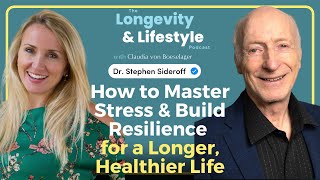
In this episode of the Longevity and Lifestyle Podcast, host Claudia von Boeselager interviews Dr. Stephen Sidoroff, a UCLA professor and clinical psychologist renowned for his work on resilience, stress mastery, and peak performance. The conversation weaves personal anecdotes (e.g., the 2023 LA wildfires) with scientific concepts to illustrate how chronic stress hijacks the body’s energy, accelerates aging, and fuels "autonomic dysregulation syndrome." Dr. Sidoroff reframes stress as a useful tool that must be kept within a personal "stress sweet‑spot" (the inverted‑U curve) and redefines resilience as the ability to "bounce forward"—learning the right lessons from stressful events rather than merely recovering. He introduces his framework of the Nine Pillars of Resilience, offers a free self‑assessment booklet, and highlights practical habits: daily journaling, HRV/Oura monitoring, gratitude practices, growth‑mindset reframing, and purposeful physical activity. The discussion also covers neuroplasticity, the power of reshaping internal dialogue (the "healthy internal parent"), and the role of neurofeedback in rewiring brainwave patterns, with examples from addiction recovery and chemo‑brain patients. Throughout, the tone is conversational yet evidence‑based, emphasizing actionable steps to reduce chronic activation, improve heart‑rate variability, and ultimately slow biological aging, as illustrated by Dr. Sidoroff’s own 20‑year younger biological age. The episode ends with resources for listeners: the book The Nine Pillars of Resilience, an online assessment, a new course, and recommendations for neurofeedback providers.
Chapters
Hey there, I'm Claudia von Boeselager, a former investment banker turned entrepreneur, longevity coach, biohacker, and mother of two. Once burnt out and overwhelmed with chronic health issues, I've transformed my life and helped thousands of people do the same. I've even reduced my biological age by 17 years. Yes, I'm 26 again. Now I'm here to share the tools, strategies, and inspiration to help you live healthier, happier, and longer. On this podcast, I interview world-leading experts in health, biohacking, mindset, and performance, and share personal stories and learnings to bring you the latest insights and tips. Think of this as your go-to space for real talk about all things health and optimizing your life. Ready to unlock your best self? Let's dive in. This is the Longevity and Lifestyle Podcast.
My guest today is Dr.
Stephen Sidoroff, a UCLA professor, clinical psychologist, and world-renowned expert in resilience, stress mastery, and peak performance, something I think we all need. At 77, he's still mountain biking and rollerblading, proof his methods work. His latest book, The Nine Pillars of Resilience, reveals how to master stress, slow aging, and thrive in life. Today we'll explore the science of resilience, turning stress into a strength, and staying sharp for life. Please enjoy.
This episode is brought to you by Timeline powered by Mitopure. For me, staying active and energized as I get My health and well-being is a priority, and Timeline's Mitopure has been a game changer. I feel stronger during workouts, recover faster, and have sustained energy throughout the day. I'm excited to share a bit more about Timeline with you. Mitopure has been a must-have in my daily routine that's helped me feel my best. What makes Mitopure so unique is how it works at the cellular level. It contains urolithin A, a powerful postbiotic that renews your cells by clearing out damaged mitochondria, your cell's energy source. The results? More efficient cells, and I see noticeable benefits in my energy, resilience, and recovery. Plus, it's backed by years of research, so I know I'm supporting my long-term health. If you're ready to feel the difference, Timeline is offering 10% off your first order. Just go to timeline.com/claudia. That's timeline.com/claudia.
Today.
Welcome to the Longevity and Lifestyle Podcast, Dr. Sidorov. Stephen, it's a pleasure to have you with us today.
Thank you, my pleasure to be here. Looking forward to our conversation.
I'm very much looking forward to it. I've had some definite personal challenges over the last weeks, and so this comes very timely at dealing with stress. But I know in the wider world how many people are suffering with uncertainties, anxieties, stress, and even yourself being based in LA. So maybe you could share a bit how that's been for you when these terrible LA fires were happening in January?
Well, we all have opportunities all the time to use our resilience muscle. But I had a particular instance over the last month where I was out of the country, came back on the 11th of January to the fires and to my neighborhood being right in the line of those fires, Topanga Canyon. Everybody in my area was evacuated, so I couldn't go home, and I could just sit, watch on TV what was, what was transpiring. And it's the kind of thing that moment by moment it goes, and the wind blows in one direction, you feel, oh, it's gonna miss my house, and then it blows in the other direction, you go, oh no. And so I was experiencing all of these different feelings from relief to despair. And during that process, one of the things that I realized was that when I went into the place of despair, I stopped myself and I said, wait a second, your house is still standing and it may not burn down. Okay. So our range of possibilities, which we all have in life. There's always this range of possibilities of how something can happen, turn out. And I stopped myself and I said, okay, if it burns down, that's going to be terrible, but I don't have to go through that experience until and if it happens. And that was an important moment in how I was dealing with my experience. Because from then on, every time I noticed that I was going in that direction, I would stop myself and say, it hasn't happened. There's a good chance it won't happen. Let me focus in that direction. And that's really a key lesson for all of us. In so much of our lives, because we can always go in those two different directions. What can go wrong? What can go right? We could start the day worrying about what will go wrong or what will go right. And where we place that focus directs the energy of our bodies. And so my fire, my house burning down doesn't have to trigger my stress response. Just thinking of it as a possibility triggered my stress response. And so if we multiply this throughout the day of all the things that we think of that can go wrong or the problems, we realize how much we are continually in our day triggering the stress response. Now, we don't have an unlimited amount of energy. And our bodies are always making choices. Should I send my energy to my muscles to prepare for fight or flight, which is our stress response, even though— and this is so important— even though while that remains our stress response, which was appropriate for hunter-gatherers, our environment has gone so far beyond that where Rarely is the fight or flight response appropriate. So we build up this tension in our bodies to handle a danger, and then we have to hold in that energy. So again, when we think of something stressful, or even if it might happen, our bodies go into that. Our bodies send its energy into fight or flight. But where does that energy come from? Well, We take it from perhaps the kidneys that require energy to purify our blood or other biological maintenance and healing mechanisms. We have— the body has two choices: fight danger, protect, or heal, grow.
And we make too many decisions in the direction of defend and protect., and with that, essentially taking the opportunity from the body to be healing and repair at the same time, right? So this is with the, you know, in stress response, the inflammaging that we have because of this chronic stress fatigue. So I'm very excited to dig into many of these different topics today. And Stephen, as someone who has studied stress and resilience for decades, if you could gift everyone in the world one new mindset shift or habit to transform, how they would approach stress. What would it be and why?
Yes. So what's very important to realize, because people have a lot of resistance to dealing with stress, and there's a good reason. Stress is not just bad. In fact, I've redefined stress, our stress response, as a useful tool because it helps us focus and helps us mobilize and motivate us. But the key is you have to find your stress sweet spot. Okay, so people are probably familiar with this curve that goes like this, as we call it, an inverted U curve, where at low levels of activation, we don't perform at our best. We don't have the motivation, the focus. We need stress to function and perform at our best. But there's this window in that curve in which we function at our best. And when you extend your stress beyond that, performance and health go down. And that's what happens with most of us for the reasons I just outlined a few minutes ago. We go into the stress response too often, too intensely, and for too long a duration, and we wind up beyond that stress sweet spot. So The first important recognition is it's a useful tool, but you don't want to go beyond your stress sweet spot. In fact, that's one of your goals. What is my stress sweet spot? Am I in it or have I pushed beyond it?
How can you tell?
Well, the other lesson and the other redefining that I've done is We talk about resilience as the ability to bounce back, and I've redefined it as the ability to bounce forward. In other words, when you encounter any kind of stressful situation, you want to learn the lessons from that experience. So the other day I had a client who always worried about taking a test, and, you know, for days before her exam, she'll worry. The night before, she'd get very poor sleep. She'd take the exam and she feels like she didn't do well on it. And then I said to her, well, tell me, how do you do on your tests? And this was the kicker. She said, well, I always get A's. And that's when I realized something that we all do and we all have in common. She worried and worried, was anxious leading up to the test, and she got A's. Her brain put those two things together. When I worry, I get A's. She didn't get A's because she worried. She got A's because she worked hard, prepared well. And that was the work we did, was to disconnect those two and show her that it's her ability and her hard work that got her A's. After a while of this retraining, she stopped being anxious leading up to it because she made the real connection. She bounced forward. This is a lesson for a lot of people to learn. We've made that connection, whether it's worry, starting the day and thinking about what can go wrong, and then at the end of the day, whew, Nothing went wrong. Okay, well, learn the lesson that things are most likely to go well, not the automatic connection that you made, which is when I worry about the day, when I think things are going to go wrong, things turn out okay. That's the unconscious conditioning that we're all subjected to. So the learning the new lessons, the correct lessons, bouncing forward is so important to resilience.
That's such an amazing concept of really just— would you recommend every evening that time of reflection? Like, what is the lesson in the day? Like, where was I anxious? Where was I stressed? Was there, you know, the saber-toothed tiger there where I really needed to be stressed? Or was it a, you know, imagination that something could potentially go wrong? What's the lesson? And that's the bouncing forward. Okay, next time that happens, I'm going to use it to my advantage. I will decouple those old neural pathways. Is that what you recommend to do? To figure out—
In fact, I really encourage anybody and everybody to use a journal. And at the end of the day, sit with that journal and do just what you were saying. How did my day turn out? What did I do right? But also to look at the the situations in which you responded with a stress response. And in the peacefulness of the evening, where you're not stressed, you can look at it more clearly. Because when we're stressed, it actually causes us to not think as well. Yeah, you can say to yourself, look, I reacted inappropriately over here. The next time that happens, I don't have to get so worked up as I did today. So yes, reflection, journaling is very important to consciously live your life.
I find it really helpful. And I think a great tool for people listening is the 5-minute journal, which is a gratitude practice, but it also gives you time to reflect what went well, which a lot of us forget to actually focus on, and then how How could I have made today even better? And I love the wording because it's framed in a positive way. So it's like, well, this didn't go well. And if I see correctly, you're wearing an Oura Ring, which the new updated version shows you the markers where you were stressed during the day. So it's kind of fun to be like, ah, yes, okay, I see the correlation. Okay, my HRV dropped there, my heart rate went up. So you can better understand your markers to reflect on that. So yeah, love that concept. And the 2024 study revealed that 43% of adults feel more anxious than they did the previous year, up from 37%. So I think in, you know, today's fast-paced world, if you had to point to one systemic issue, be it cultural, biological, or psychological, that is wrecking people's health and performance, what would it be? And maybe what are some steps to, you know, start counteracting it?
Well, I actually identify 3 systemic structural. One I've just talked about, which is conditioning. But I want you to, everybody, to think about all the successes in your life. And I guarantee that all or most have been associated with stress, an important meeting, an important test, an important presentation. All the hallmarks of success have been associated, have been associated in our life with stress. So again, our brains have put those two things together. Okay. One of my early mentors, a pioneer in neuroscience, Donald Hebb, said neurons that fire together, wire together.
Wire together. I love that expression.
We have to realize that we are biased to look for stress because it's been associated with success. So that's the first thing. The second I also touched on, which is biological. We have a stress response that's not fit. It's not a fit for our environment. And so we overactivate our bodies, fight or flight, when all we need— and this I work with a lot of professional athletes on this. What we need is a calm focus. You want to be focused, but you could be calm in the same moment that you're focused. Your body doesn't have to go along with your cognitive focus. But the third thing that's so important is that the way we learn to use our stress response is in our childhood environment. And so the lessons of childhood are survival lessons. And so they go in very deep. And these lessons, these messages that we get as a child typically result in more stress as an adult than we need. And this is the result of feeling like I'm not good enough. It's the result of feeling like something's going to go wrong, or we grow up in a dangerous environment. We again, conditioned to expect danger. And so we're always looking for the danger and whether it's there or not, we think it's there. And so our body's activating. So again, intentionality, where we place our focus is so important. And we have to catch ourselves in catastrophic expectations and say, no, it hasn't happened. Like I did with the fires. I'll plan for if something goes wrong. But once I do planning, any additional focus in that direction is worry and it doesn't serve us. I'm going to consciously go over here to positive and positive potential outcomes. And which I did during the fire, I said, I'm going to focus on it's not going to reach my house. They're going to stop it. Beforehand, which is what happened, fortunately for me. But I didn't waste any of my energy with some expectation that never happened.
And I think this is so critical because the amount of people who have stress for fictitious events, myself included, I've had phases and it's almost like a downward spiral, right? That as soon as you really start going into that vortex, unless you're able to check yourself, and obviously you are an expert on Hang on a second, I know my teachings, I know my tools, I will not do that. Um, but I guess number one is the awareness, right? And then number two is then reframing or refocusing, you know, can I control it, can I not control it, what do I focus on? Let's focus on the positive until it happens and then take steps accordingly. So I think that's such a powerful, uh, teaching. Uh, I really, really enjoy that. In your opinion, Where does the world, the modern world's relationship with stress go so wrong? Is it a matter of biology failing to adapt, cultural, something deeper? Why are we so in this stress pandemic with just the mindset going in the wrong direction? Or is it because we're overwhelmed with all these stimulation?
What's happening? I think it's all of these things. It's not just one. You know, the the complexity of life, the way that life seems to keep speeding up. Even if you think about that as a metaphor, life's speeding up, we're trying to keep up with life. And that, you know, time pressure is a key source of stress for everybody. And so that's happening. You have all of the background dangers that are not part of our immediate life, but are part of the environment in which we live. Climate change. We are witness to what goes on throughout the world. So a bus goes off the rails in India, we get it on our news. Because news people like to portray disasters. So we're faced with this all the time. And even if we don't consciously have a reaction, our bodies absorb all of this. And that's very important. You know, the uncertainty from a political perspective, the uncertainty from an economic perspective, all of these are in the background But we absorb it unconsciously. And so we have to be very conscious about being resilient. It's not, you know, automatic takes us in the wrong direction because we're faced with so much, including in our own lives. You know, we all have concerns about finances. We all have concerns about our health and the health of the people we're close to. And anytime someone close to us gets sick, it's another source of worry, which is a form of stress. And so, yes, people need to have a plan, an approach to be more resilient. It won't happen automatically. The ways that we're conditioned, we have to learn new and healthier responses. And that's why I wrote my book. Because I wanted to give people a handbook. One of the people that reviewed my book, Michael Ovitz, said that it's a brilliant book. It's a handbook for living your best life. And that's how I wrote it. It's not something that you sit down and read the whole book. It's something that you pick up, you read 5 pages, and it gives you something to focus on today that will help you be more resilient.. And you do that each day.
I'd love to dive into the book, right? So the 9 Pillars of Resilience, where you lay out the blueprint for thriving amidst life's challenges, which, as you said, we all have. Yet to meet a person who has no challenges. If someone wanted to evaluate their balance across these pillars, where would you suggest they start? And which pillar do you find most surprising or overlooked?
Well, my book contains, and I will make it available to all of your audience, my resilience assessment booklet, which describes all the 9 pillars, but it has a questionnaire that a person can take, can self-score, and derive their personal resilience profile along my 9 dimensions. That's always— the starting point is always, where am I now at the start?
Where's the baseline? Yeah, exactly.
I know. So my areas of strength and what are the areas that I need more work on? So that I present in the beginning of the book also to help people get a sense of where their strengths are, because you want to lean on your strengths. You want to appreciate those strengths. You want to realize, hey, there are areas that I am good at. As we then look at the areas that we need to grow in. And that is my fifth pillar, mental balance and mastery, which includes a growth mindset, which means that any shortcoming you notice within yourself, you don't just go, oh, I guess I can't do it, or I'm not good at that. A growth mindset is Okay, I'm weak in this area. What do I need to do to get stronger in this area? Let me engage in a learning, training, growing process to get better at that. And it's also a positive mindset that I've been talking about where you acknowledge what can go wrong, but you spend your time focused on what can go right. If it's— if going right is a possibility, you want to focus on that possibility.
Beautiful analogy with your house, right? And the fires to focus. It's still standing. Let me be grateful that it's still standing. I can't predict the winds. I don't know what's happening, but I will focus on the best case of that as well. And for some people listening, they might say, this sounds good, but I'm in such a stressful situation. There's so much going on. I can't see the wood from the trees. How do I basically start on the path to moving forward and breaking free from this day-to-day constant anxiety and battle? What would you recommend in more extreme circumstances like that?
Well, one of the things that I say to everybody, and everybody falls into this category, is wherever you're at, there's always a best way forward. Wherever you're at, there's always a best way forward. And you, when I, when I say that and a person says, oh, that immediately has us pointed in the right direction because now I'm looking for that best way. Okay. So that's what I would say to people in the most difficult of circumstances. You know, one of the things we learned, you know, listening to the losers of the Super Bowl What they would all say is two things, actually three things. Yes, it hurts, but I need to learn the lesson from this experience, and then I need to move on. And those are important lessons for all of us, no matter what's going on. You know, even when you lose a person, someone close to you dies, Those three things still apply, and finding the best way still applies. Now, for people in those situations, it probably begins with allowing yourself to go through a grieving process. So if you're in difficult circumstances, grieving, feeling whatever pain you're going through, is part of the process. You want to digest those feelings. You want to allow them to move through your body, not push them down, not ignore them. Because when you push them down and ignore them, they stay there, and then they unconsciously direct some of your behavior, but unconsciously. You want to feel whatever you're feeling. There's no right or wrong with your feelings. They're all just like if you're hungry, there's no right or wrong with hunger if you haven't eaten for 4 hours or 5 hours. You experience them, you let them move through your body, but then you have to let go of them. Then you have to say, I've felt these feelings, now I need to move on. A lot of people just keep recycling the same feelings over and over again because The loss or the mistake they made is too painful to fully acknowledge. And so we unconsciously feel like if we keep going over and over it, we're not fully having to deal with the results, even though the results are there. So there's no good way of doing that.
Can I ask a question on that? Is there a certain time, like when When, when do you, or how much time do you give yourself to sit with the pain, to process the pain versus then moving on and not recycling it? Is there any sort of formula or advice or guidance around that? Because I think many people would be interested in understanding what is okay to feel the pain, how long, and when do you move on?
Very good question. Very good question. And there isn't one answer to it for two different reasons. One is we're all different and, and different people need different amounts of time to really go through that process. But the other thing is there are different levels of, of, of, you know, disaster. There are different levels of mistakes that have different levels of consequences.
This episode is brought to you by the Longevity and Lifestyle Insider. Would you like to get a short email from me with top tips, insights, and strategies to help optimize your health, life and happiness. This could be interesting posts or scientific articles I've read on life and longevity optimization, cool biohacking or lifestyle products that I've discovered, and other fun things to help you be at your best. It's a very short piece of inspiration, so if you want to receive it, check it out by going to llinsider.com. That's llinsider.com, and leave your email to get the next one.
So there are all these variables that make it different from one thing to another. But I, I will say that if we focus on taking the time to fully feel the pain, the, the anger of the loss, then we will know when we're starting to just go through it over and over again. And I would also say that when we make a mistake, there's a process we go through that helps us move on. It's okay to be angry with yourself and express that anger toward yourself if you make a mistake. You want to be careful though that in expressing that anger, that you're not putting yourself down. You're not calling yourself names. 'Oh, you're stupid,' calling yourself, 'Oh, I was stupid.' Never call yourself names. Never put yourself down. That is undermining. You want to express the feeling without being undermining, which makes it more difficult to get it correct the next time. So you express the feeling, then you learn the lesson. If the mistake has a cost, You want to balance that out with a lesson to be learned. This is bouncing forward so you do it better the next time. And that's key. And then once you do that, you let go.
Letting go. That's a good point as well. I think, is it the neural pathway that's just used to looking for the pain? I know so many people, you know, have the resentment or, you know, they're like, well, if I don't, I can't just pretend everything's okay. You know, you hear comments like that from some people. It's still there or it still bothers me.
Me.
Is that a sign that they haven't processed the pain fully, that they haven't sat with it fully? Maybe they should journal more? What would you advise if people feel like, you know, it can't let go?
Well, it's either that or— now here's something very interesting. When we have the tendency to focus on what can go wrong, or if we dwell on the negatives, we literally sensitize our brains to look for the negative, to react to the negative. If, on the other hand, we train ourselves to focus on the positive, we literally rewire our brains to focus on the positive. This is the basis of neuroplasticity, how our brains are amazing at change, but we have to want the change and we have to direct the to change, because our childhood patterns also have a gravitational pull, and they're very powerful. So we have these two opposite forces, the gravitational pull of our childhood lessons and the brain's capacity throughout our lives of neuroplasticity. So what I tell people is when you come across a challenge, it's like you're coming up to this forest, right? And the forest has this one path that's a well-beaten path. And we automatically start going down that path because, well, of course, it's a forest and there's the path. The problem is that path is not going in the direction you want to be going. That path is not leading to success. It's not leading to your health. And so with this awareness, We got to pull out our machetes and go over here and start hacking away down a new path. And literally hacking away a new path. In our brains, we're wired to go down what's familiar, what we've conditioned ourselves to go down. And we have to make this extra effort. First, we have to be aware as we approach the challenge. I'm not going to go, I'm not going to think what can go wrong. I'm not going to think this is going to be difficult. I'm going to think it's possible. And I'm going to figure out the right way, as an example. That's going over here and hacking a new path. Now, the more you are consistent in doing this, hacking this new path, and the more you're consistent at saying, no, I'm not going to go down the old path, you begin creating new pathways in your brain, Claudia. In fact, this conversation you and I are having, this conversation we're having is long enough if people are impacted that people during this time of our conversation, new dendrites are starting to grow in our brains. It is amazing. That's neuroplasticity in action. But the key is you have to do it consistently. You have to do the new consistently. You have to hold the intention. And what's most, most important and difficult is you have to say no to the old way. One of the ways that I help people to do this is my first pillar of resilience, My first pillar is— first 3 have to do with relationship, but the first one is your relationship with yourself. Again, childhood lessons, right? So we all need to start paying attention to what our internal voice, what I refer to as our internal parent, is saying to us. You're not going to get it right, or you may make a mistake, or people are not going to like you, or they're going to judge you, all of these things. And I guarantee anytime we're upset about anything, we can trace it back to one of those messages from that voice. And so I say to people, we have to develop, literally, again, neuroplasticity, develop a healthy internal voice, internal path, internal parent, that comes from a place of love, compassion, acceptance, support, self-care, and joy. Those are the characteristics. So that's the model. Everybody can compare how they talk to themselves with this model of a healthy voice, with the goal to be saying no to anything that deviates from these qualities and then speak from this place. And every time you say no to the old voice and yes to this healthy voice, you are hacking down a new pathway in your brain.
It's becoming more and more trodden, right? It's becoming the default pathway after a while. Yeah. Is there a time? I mean, some people say if you repeat a habit over 21 days, I've heard different numbers, if someone is really focused on this, and I know it's hard, everybody's different, and everyone has different belief systems and pathways. But in general, would you say, you know, if you master this skill over a 21 or 30 day period or 60 day periods, you know, you've got it done? Or is this something just you have to remind yourself every single day? And one day you'll wake up and it's habit? What would you say?
You know, someone asked me, someone came up to me in one of my seminars and said, You know, I've been working on this, and does it ever get easier? And I said, yes, yes, it gets easier when you, when you come, when you speak from the healthy parent, where that, when that becomes easier for you to do. The easier that becomes, the easier your life becomes. And so it's a gradual process. What gets a lot of us stuck is that under difficult circumstances, we go back to the old pattern. And when we go back to the old pattern, it reinforces that old pattern. And so it's a combination of variables that the more you go to this healthy internal voice and follow some of the other lessons of my 9 pillars, the more you're creating the new pathway. And the more you do that, the easier it gets.
You've coined the term Autonomic Dysregulation Syndrome. Could you break it down for us, not just in terms of what it is, but also the hidden ways it may be affecting our daily lives, relationships, and long-term health?
Yes, absolutely. So we talked about the stress response. The stress response is the activation of one of the two branches of our nervous system. Our nervous system is so beautifully designed. It has the stress response that activates us to danger, and then it has the parasympathetic recovery response to restore all the resources used up during the stress response. These two branches of our nervous system are designed through the evolutionary process to be in balance and to stay in balance. Okay. But think of your day, think of your typical day, and think of all of the situations that trigger your stress response. And now think of your typical day and think of all the situations that trigger, I'm safe, I can let down my guard, I can recover.
Probably not enough of the parasympathetic ones.
So that gives you the picture of what we face. We're continually activating and we're not giving ourselves and our bodies time to recover. So we activate and activate and activate. And, and very quickly in our days, we've stretched the resources of our bodies. That has various biochemical and physiological consequences that lead to speeding up the the aging process that lead to the disease process, to the point that we estimate upwards of 80% of doctor's office visits are due to this dysregulation, what I refer to as the dysreg— autonomic dysregulation syndrome, because it's a pattern that gets developed over time in all of our lives, this imbalance that I'm talking about, that leads to all kinds of other physiological and biochemical consequences.
A study published by BMJ Mental Health found that adults with the highest levels of mental resilience had a 53% lower risk of death. So it's resilience is they're not just thriving, but they're actually living significantly longer. If we reverse engineer this finding, what are the most high-leverage ways people can start building their longevity through mental resilience today?
Well, that is a great study and highlights how stress affects the rate of our aging. Last year, I— there's now a way that you can get your biological age. So you can actually, you can actually find out how fast or slow your body's aging as opposed to your chronological age.
Yeah, I've done one.
So I did this last year. And so my book is based on what I believe is the best way to live your life. And I live my life based on, based on that. My biological age came out 20 years younger than my chronological age.
Amazing.
Which test did you take, if you don't mind?
It was TruDiagnostic. Yeah. In fact, I'm about to do a study where we're going to give my resilience questionnaire to people who have already gotten their biological age, and we're going to see if the people who score the highest show the slowest aging. So I'll let you know when we get the results of that study. But I believe I'm curious. Yeah. You'll find that that is the case.
Yeah. Well, because stress equals inflammation, right? We know the inflammaging and inflammation is the fundamental for chronic disease and many different dysregulation in the body. So, you know, we know that there is that system. So if you can solve upstream for what's going on, it will allow downstream things to function better. So brilliant study. I'm excited to hear about it.
And it points out for all your audience, The more you learn to be resilient, the more you learn some of the lessons that we've been talking about, you all can actually slow your aging process. What a, what a great goal, right?
What an incentive. And you're such an inspiration at that as well. I'd love to understand some of your strategies because at 77, still mountain biking, still teaching, still doing so many wonderful things. What are some of your secrets and practices that you could share with my audience that you do to be in such a peak state?
There's a lot. A lot of it has to do with how you think. And I, one of the things that's very important to me in my life is that I keep challenging myself to do the things that I did when I was younger. So I still play ball. I still rollerblade, uh, mountain bike. I still jump into the ocean. And, you know, sometimes I'm not as— I'll go down to the ocean, for example, and I'll take a lounge chair and I'll sit in the lounge chair. And when I was younger, no sitting in the lounge chair. I just run into the ocean, right? But now I sit in the lounge chair and I think, do I want to go into the ocean? But it's so comfortable here. The water's cold. So, but then I do what I encourage everybody else to do. A lot of times when we think of a goal, we focus too much on the obstacles rather than really focusing on what it will feel like if I achieve the goal or be in the goal. And so I say to myself, you know, 30 seconds after you're in the water, it's going to be comfortable. And I use that to get up and run into the— run in, or maybe not run into the ocean, but I get in.
You run in, I'm sure, Stephen, you're running in.
But again, it's mindset. It's mindset. And even if you can't run, you walk briskly. If you can't walk briskly, you get out and you walk. And I think it's so important to get out into nature. I think it's important to be connected to nature, what's natural, rather than what we're mostly engaged in, which is a computer monitor, our cell phones, walls, and buildings. Be out in nature. Hear birds chirping. Hear water rushing. All of those things have a positive impact on us. But perhaps most important, and I haven't touched on this, and it's very important too, relationships. Relationships are so important because they give you the opportunity for human contact, for letting down your guard, taking in love, taking in appreciation. All of these positive emotions literally have a positive effect on our physiology. You talked about heart rate variability. We know that when we go into a positive emotional state, such as gratitude, that we enhance the heart rate variability pattern, meaning when we breathe in, our heart rate goes up. When we breathe out, it goes down. And the healthier the person, the more we have this, what we call coherent pattern. When we go into a negative emotion, anger, frustration, and we look at the heart rate variability pattern, we find it's chaotic. Okay, so our emotions have this direct impact on our physiology. Now, the interesting thing about that If you and I were in the same room together one day, if you and I are in the same room together and I measured and I monitored your brainwaves, I would pick up my heart rate pattern in your brainwaves.
Wow.
Could you expand on that? Well, our hearts are powerful engines that put out signals that are powerful and powerful enough that if you're close enough to me, you will pick them up in your brainwaves. Wow. Now, go back to my last comment, where if I'm in a positive emotion, I have this beautiful coherent heart rate pattern. If I'm frustrated, angry, or worried about something, or not fully present, I'm going to have this chaotic pattern. And notice, you're going to pick that up in your brain, not consciously, but it's going to be there. What effect does that have on you, these two different heart rate patterns?
I mean, one is you feel calm and relaxed and in pleasant company. And the other one, you feel a bit agitated and trying to figure out why and don't like the energy of the person and want to run away.
How many of us have had those different experiences of feeling so comfortable with some people and uncomfortable with others?
So, oh, that's fascinating. And I'd love to also touch on neurofeedback, which I find very interesting. And it's also transformed addiction treatment. How do you see it shaping the future of resilience training? And is it something your average person could incorporate into their life today?
We've done a lot of talking today about conditioning right now. Patterns get set up because we go do the same thing all the time, like the stress response. We condition to the stress response. As a result of our lifestyles, our brains go into a rut. They go into rigid patterns. There's flexibility, but when you're consistent in your thinking and behavior, your brain goes into a rut. Neurofeedback is a way of literally monitoring your brainwaves with electrodes on your scalp, feeding that information back to you, and feeding it back in a way where we can put in bar graphs different components of your brainwaves, patterns, such as the frequencies, alpha frequencies that are calming, low beta frequencies that are focusing, theta frequencies which have different purposes, but can cause us to be less focused, less present. Okay. And we could literally, through the movement of these bar graphs, which is done in real time, feeding back to us what's going on in our brains, we can literally shift our brainwave patterns into a healthier, better pattern. So we published a study back in 2005, in which we did a particular neurofeedback protocol with a group of drug addicts, recovering drug addicts, and we got phenomenal results. We found that they had double the rate of abstinence 2 years later. We helped them work through and heal some of their traumas. More recently, I published a study where Women who have had cancer, breast cancer, gone through chemotherapy, have what's referred to as chemo brain. So chemo brain is a condition in which people are in a cognitive fog, have very difficult, great difficulty with cognitive functioning, as well as sleep problems and other problems. And we worked with a group of recovered breast cancer survivors who said they've lost their lives because they can't focus, they can't concentrate. They had high-paying jobs and they had to quit for these reasons. One said, I can't read a novel because I lose the thread of the story. And we did a neurofeedback intervention with them. And all of those women said they got their lives back. And now we looked at their brainwave patterns and the neurofeedback, almost the before had tremendously damaged brains from an electroencephalographic perspective. And after the treatment, almost completely normalized their brainwave patterns. So again, the power of our brains for healing, tremendous power. If these women with such deficits can recover, that potential is there for everybody.
That is really fascinating. I like to do— I find this area very, very fascinating. And I have a few different neurofeedback devices that I use and that I try. The latest one is the NeuroVisor with the pulsating light. And there was very promising research out of MIT last year that it was even clearing amyloid plaque from the brain. And so they're looking into it further, what can be done also with FDA approvals for— my mother sadly suffers from dementia, so this is part of a topic close to my heart. For people interested in neurofeedback, and you know, there's different EEG devices on the market and BrainTap and different ones, is there anyone that you would say is good to start with for your average person to help train neuroplasticity, essentially?
Well, I've worked with a few. I would, I would recommend, you know, one, there's a company called Thought Technology. It's a Canadian company. They're one of the largest and oldest companies. I would suggest people reach out to them for what they have available or for even a conversation about options and choices.
Okay, wonderful. So I'm just looking at the time today. It's flown by. I have many, many more questions, but I'm wary of, of your time, of course, and I want to respect it. It's been such an inspiring conversation. For listeners interested in diving deeper into resilience, stress, where can they find your book and more information on this topic? Where would you send them?
My book is available in bookstores. If you go to a bookstore, it's not there, ask them to order it. But it's also available online at Amazon and Barnes Noble. And any place where you get books, it's available. The Nine Pillars of Resilience: The Proven Path to Master Stress, Slow Aging, and Increase Vitality. You can go to my website, drstephensidoroff.com. There you'll find a lot of useful tools. You can get free my resilience assessment booklet. And you can read about the 9 pillars, and you can take your own test and determine your strengths and weaknesses. Also, I have a number of other of my talks on that website and other information, including a new online course that they can get on From Stress to Success.
I love it. So we'll link all of those for people listening in the show notes just for convenience as well. Stephen, do you have a final ask or recommendation or any parting thoughts or message for my audience today?
I will. I would say that if you're struggling, it's not your fault. It's very important to not blame yourself for having difficulties at the same— because of all the structural issues I have talked about. Right. But at the same time, You have to have that growth mindset. You have to say, okay, here's where I'm at. How do I move forward? What's the best way to move forward? My book is a good, a good first step. There are a lot of other ways to move forward, but you can't say I can't. You have to focus on what do I need to do to get better, to improve. And then once you do, remember the healthy internal voice, which comes from that place of acceptance.
Don't judge yourself in that process. Self-compassion. Love it. So, so important. Thank you so much for sharing your wisdom with us today. It's been very, very helpful personally also to me. Thank you also, dear audience, for tuning in. Make sure to subscribe and share and look forward to speaking again soon.
Hi everyone, it's Claudia again. Before you take off. Would you like to get a short email from me to you several times a month with top tips, insights, and strategies to help optimize your life, health, and business? This could be interesting posts or articles I've read on life and longevity optimization, cool biohacking or lifestyle products that I've discovered, and other fun things to help you be at your best. It's a very short piece of inspiration for you, so if you want to receive it, check it out by going to llinsider.com.
That's llinsider.com and leave your email to get the next one.
More from Claudia









Can Psilocybin Slow Aging? The Study on Telomeres, Inflammation & Survival with Dr. Louise Hecker

