How to Optimize Morning Routines: Remix as Trailblazers Share Their Top Tips to Win the Day Everyday
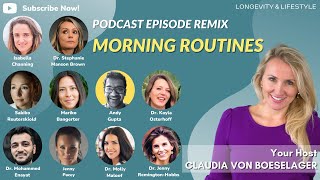
In this remix episode of the Longevity and Lifestyle Podcast, host Claudia von Boeselager brings together a diverse panel of pioneers—including yoga founders, biohackers, physicians, coaches, and entrepreneurs—to discuss concrete morning‑routine habits that support longevity, peak performance, and mental wellbeing. Each guest contributes a personal routine, ranging from short seated meditation, breathwork, and Kapalabhati, to intermittent fasting, cold showers, nature walks, HIIT, yoga, journaling, and emotional‑state tapping. The conversation highlights why timing (cortisol curves), environmental exposure (cold, sunlight, nature), and nutrient timing (supplements, protein‑rich breakfasts) matter for cellular health, mitochondrial biogenesis, and hormone regulation. Throughout, the episode integrates sponsor messages for Oxford Healthspan’s spermidine supplement, InsideTracker’s blood‑DNA health platform, and The DNA Company’s personalized DNA‑based longevity testing. The overall message is that a consistent, adaptable morning ritual—tailored to individual physiology and lifestyle—can set the tone for a winning day and long‑term health.
Chapters
Hello, optimization friends. I'm your host, Claudia von Boeselager, and welcome to the Longevity and Lifestyle Podcast, where I invite pioneers and thought leaders in all things longevity and lifestyle to give you the strategies, tools, and practices to live better and reach your highest potential. Today's episode is an in-between episode on morning routines. Reaching peak performance in all areas of life means having optimized daily routines. So today's episode is a remix of my guests Isabella Channing, founder of The Shack Yoga, Sakiko Reuterskold, founder and CEO at NOMOSU, Dr. Mohammed Enayat, founder of Human Wellness Clinic, Dr. Stephanie Manson-Brown, co-founder of The Science of Aging, Mariko Bangertor, mindset coach at Mindsetting. Jenny Pacey, celebrity fitness trainer and former Olympian. Andy Gupta, founder of Anyone Can Invest Now. Dr. Molly Maloof, CEO of Adamo Bioscience and Stanford University professor. Kayla Osterhof, founder of Herb Biorhythm and CEO of BioCurious. Dr. Jenny Remington-Hobbs, coach and leading human behavior expert. See the description below to learn more about the episodes. And if you want to learn more about optimizing your daily routine, check out longevity-and-lifestyle.com/sneakpeek, S-N-E-A-K-P-E-A-K, and sign up to get the training with the key tools and strategies to allow you to show up at your best every day. Please enjoy. This episode is brought to you by Oxford Healthspan. I was so excited to learn about Oxford Healthspan's PrimaD. Original and Primadene GF Spermidine supplements on my journey to staying younger for longer, and I'm delighted to now share this great longevity supplement with you too. They are the cleanest, purest food-derived spermidine supplements on the market with zero fillers or flow agents. Spermidine has been shown to support cell renewal, cognition, and trigger autophagy, the body's inbuilt system of cellular cleaning and recycling, as well as to improve deep sleep and thicker, glossier hair, stronger nails, and better skin. Most fascinating to me, spermidine also inhibits 6 of the 9 hallmarks of aging. So check out OxfordHealthspan.com and use code Claudia10 at checkout for 10% off today. This episode is brought to you by InsideTracker. People age at different speeds, and the date on your license may not represent your inner biological age at all. If you're looking for ways to extend your healthspan and slow down the aging process, the keys to health and longevity run in your blood. That's why InsideTracker provides you with a personalized plan to improve your metabolism, reduce stress, improve sleep, and optimize your health for the long haul. Created by leading scientists in aging, genetics, and biometrics, InsideTracker analyzes your blood, DNA, and fitness tracking data to identify where you're optimized and where you're not. For a limited time, get 20% off the entire store. Just go to insidetracker.com/claudia to get your 20% off today.
That's a nice one. Yeah, I do seated meditation and I do 10 minutes. So 10 minutes, I remember thinking, God, I should be doing more than 10 minutes. 10 is really for beginners, but I have found that for me right now, at least raising two little kids and running the wellness center, that if I add more or I make it too hefty of a goal in the morning, that it either won't happen or I won't really have a winning— as you said, to have a winning day. Yeah, it won't. I'll be rushed. And, you know, I go from this wonderful hour and a half personal practice to rushing my kids into school or getting breakfast ready. So I do 10 minutes. I wake up after a shower, sit in a seated meditation, and before I start, I do a little Kapalabhati, so a little breath work for like maybe 30 seconds of that or a minute. And then it's 10 minutes on my little— everyone says, you know, they're wonderful apps, and I actually haven't used one yet, Insight Timer and all these things, but I just use my little crystal bells timer, 10 minutes already set. And I have my meditation cushion, which really makes such a difference. And I just sit in the little space I created in my bedroom, and I do 10 minutes is really just try to quiet down and slow down and clean out almost all of the static or noise or any sort of buildup from mental energy that just lodges in throughout the night. And sometimes if I have a little more time, I can add another 5 minutes to it, which is really manifesting or visualizing and really creating in sort of mental imprint what either I want my day to look like, or sometimes I'll even have love-based emotion words that I'll use to create an intention for a period of time that I'm in. So it can even last for 3 months, or this month, or 6 months that I'm really cultivating, whether it's clarity, or, you know, confidence, or ease, or gratitude. Or I'll find words that are resonating with something that I feel like I'm really ready to generate more of in my life. And so I'll just put a lot of energy—
follows thoughts—
I'll just try to really put my mind into good use. So it's like, yeah, get it out and then focus it, because really we get to choose our thoughts. And so spend even if it's just a minute after the meditation to say, okay, what quality of thoughts do I want to have? How do I want to guide my thoughts? So that my day can follow that. And so that sort of usually is some sort of intention setting for either the day, as I said, or the moment of time that I'm in.
Yeah.
Yes.
A couple of things I do, basically I fast, so I don't have breakfast and that is not necessarily a circadian rhythm optimization thing. It's just that I like to be social and have dinner with friends and so on. So in order to get that sort of 16 hours of not eating, it's easiest for me to skip breakfast. And the first thing I do is a bit of yoga, which I've been doing since I was a teenager because I had an Indian family friend who had a yoga— like nobody heard of yoga at that time.
Wow.
Amazing.
He gave me a routine and taught me and, and I've been doing it ever since. So I do about 20 minutes, 15, 20 minutes of yoga and then I meditate. For about 20 minutes. So that's my morning routine.
It depends on my state, on how I'm feeling and how I want to feel. So most mornings I start with some nice, just simple breathwork, some box breathing. I try to get out into nature and do a little bit of grounding, skipping for 5 minutes. I don't do anything too aggressive. It depends if I have the time as well. Sometimes I'm at time poor. Especially with the launch phase right now, then I have to deprioritize my morning routine or limit it, which is not always a great thing, I know. But so for me, what works is breathwork, cold shower, trying getting outdoor whatever the weather, bit of skipping, get my heart rate going. Then I'll come back and do a cold shower and start my day. I try not to look at emails straight away. Everyone says that, you know, I think that's a really good practice, trying not to look at my emails.
Creativity killer.
Yeah, yeah.
And if I sometimes even taking the train into work, I will have my notebook out and just be journaling, preparing for the day, reflecting on the day that went, at least once a week. That's some of the things that I do.
Yeah, that sounds like, uh, not every single day.
Yeah, there are elements of that I do every day.
Yeah, no, exactly. And I have a particular morning routine, and I really notice if I don't, for whatever reason, manage it or do it, what difference in the day.
And it's almost like you become addicted to actually doing it because it just sets you up to win. So I love that.
So that's a great question. Actually, my morning routine has changed significantly since the pandemic. So before March 2020, I pretty much didn't have a routine because I was traveling so much. And so I'd be in a new place every couple of weeks and living out of hotels. And so now I've been grounded since March 2020, and it's something I've really actually embraced, and I've surprised myself at how adaptable I am to a new routine and actually setting down proper routine. So I start the day now with walking the dogs. It's something that is a really important focus for me and, and really gets me off on the right grounding because I think being in nature is, is incredibly important for me. And there's lots of different studies that have demonstrated that can have a positive impact to your general wellbeing and health as well. And I think there was a recent study that looked at and I can't think of the group off the top of my head, but they looked at even 10 to 15 minutes being in natural spaces improve your mood as well as focusing on some of the psychological markers, like improving blood pressure and heart rate. So that for me is really key. And I also start the day with a cold shower. And there's again, growing evidence to suggest that this may be linked to mitochondrial biogenesis. And so basically what that means is it's by increasing the, the cell's energy demand that you're actually triggering off increase mitochondrial activity, which then will help with the overall health of the cells. So that's something that is for me an important— I know you're a big fan of biohacking as well.
And so that's been an experiment for me to see if there's any improvement.
And I have to say, I think generally my health is good. I don't know whether that's linked or not, but it's something that I've been reading more on that to incorporate that into my daily routine.
Yeah, so I might fall from grace at this point in the eyes of your listeners, but to be honest, my day-to-day schedule is so inconsistent that I find it quite difficult to establish a morning routine that I can have every single day. But I would say one thing that I do on most mornings is I don't eat breakfast. I tend to not be hungry anyway when I wake up, so it's quite easy to do. So I suppose I am Engaging in intermittent fasting. Is that by choice or it's just that you just don't feel hungry or are you doing it specifically for intermittent fasting? Yeah, I think a bit of both.
Yeah.
I think time-restricted eating really does feel good for me. I also don't eat very late at night, so I try to eat dinner around 5, 6 PM and then I find that I sleep better. And so I think, yeah, narrowing the window where I'm eating really does resonate with me. I would say the other thing that I do on most mornings is I walk my dog and we live right next to a section of Epping Forest here in East London, where there's woods and lakes just at my doorstep. So I take a walk around there and that's always very grounding and no matter what the weather is. And there's something about even going out when it's raining, when it's snowing, when there's ice on the ground and having that interaction with nature. In which it really does bring you to the present moment, make you very aware of the season that you're in.
This episode is brought to you by The DNA Company. Have you ever thought to yourself, when will I die? I know it's a touchy topic, but the reason we don't want to talk about it is because we feel powerless. Powerless is a sense that we can't do anything. Turns out that it's only partly true. While you can't predict the day you will die, you can prevent it from happening sooner than later. Knowing that your DNA isn't rigid but can, like light switches, be turned on and off based on things that you do is really empowering. So, you ask, how do you turn off the bad genes? This is exactly what The DNA Company figured out. Through an advanced DNA test, they can tell you exactly what genes you have and what supplements, diet, lifestyle, and environment are right for you, giving you the exact information needed to keep those bad genes turned off and optimize your health for longer. Importantly, your data is encrypted, anonymized, and never sold. Join the 5,000+ executives, professional athletes, and biohackers and visit thednacompagny.com/claudia. That's thednacompagny.com/claudia for $50 off your advanced DNA test today.
It's very grounding as well, I guess. Yeah, exactly. Very, very grounding. And I try to do something that brings me back into my body. So whether it is a little bit of exercise, I really like HIIT workouts because they're just quick and fast and they get straight to the point. And then yeah, after that, I definitely— one thing that is consistent, and it's not just to do with my morning, but this is probably the thing that I recommend to anyone, and I think it's probably the most important thing to do in life, is that when I feel an emotion come up, when I feel I'm stuck with a mood or an emotion that's not optimal, then I address it then and there, or as soon as I can. So if having done all of that in my morning, I feel like for some reason I'm just not in a great mood, then I'll go to the room where I tap, and I just, yeah, I spend a few minutes with myself tapping and I get to a state where I'm feeling much more energized just by that self-tapping. And it's because it's like whatever mood you're in, let's say there is a scale, like a wellbeing scale of the different moods that you could be in a day. Let's say at the highest part of the scale could be gratitude, joy, deep trust in yourself, and deep sense of peace and acceptance. And at the lower end of the scale, there could be things like jealousy, doubt, anger, fear, worry. If you're at the bottom end of that scale, that is almost like whatever mood you're in colors the lens of the glasses you're wearing through which you're perceiving life that day. And so everything will be colored by that light and that tone. And just by a few minutes that you can invest in yourself to tap on yourself, to just get higher up on that scale, to feel a bit more accepting, or even higher than that, optimistic, whatever, that will completely— and it does, it completely changes the trajectory of that day and of your life, right? Just an accumulation of the different days. And it could be that on that day, if you hadn't done the tapping, it could be that a friend calls you for a favor and you decide not to pick up that phone. It could be that if you did do that self-tapping and you had more energy to yourself and you feel better, a friend calls you, asks you for help, and you're delighted to help them. And just imagine the way in which every interaction with every person transforms as a result of you just investing a little bit of time in yourself. This is something I feel like it's almost like a duty in ourself to proactively manage our mental and emotional states. Otherwise, it's just like we go throughout life and we're just bouncing off each other, being triggered by each other, being reactive because we haven't managed our own base levels of stress and emotions. So I think it's something that we should be learning at schools. I think it's the most important fundamental part of world peace.
Yeah.
I often wake up earlier than I would like to. I could sleep, I think, till 9 o'clock every day, but my life does not allow that to happen. So I usually wake up to an alarm, and I've trained myself, my first thought to be, today is going to be an amazing day. And at the end of our bed, we have this piece of art that says happy. It's by an artist called Romeo Britto, and it just makes me smile. He's super fun and colorful and really cool stuff. I have actually something I have love and laugh in the kitchen, so they're just little bits that make me smile. So I kind of wake up, my first thought is, today's gonna be an amazing day. I have a little smile at my happy picture. I always have a shower. I shower so many times a day, it's ridiculous. But start with a shower, do my makeup, do my hair, have breakfast. Oh, and a cuddle of my new puppy. Congratulations! So for breakfast, I normally start with lemon water. They're my supplements. Then I usually have papaya, which is great for your microbiome and gut health. That's the first thing that I eat with some chia seeds on top. And then I usually have 4 scrambled eggs with some coconut oil and a cup of tea and then a cup of coffee. And then I'm still a bit like a schoolgirl as well. Part of my routine, but night routine, I put all my Lycra— I'm in Lycra Monday to Friday. I put that out the night before. So like everything's ready so I can hop out the shower, moisturize, get like all my clothing on, and then finish my breakfast. And then I'm either online to do training sessions or I'm out for a client or going to give a motivational speech or whatever it may be. So that tends to be my morning routine. And then at the weekend, so I kind of am disciplined and dedicated and on it Monday to Friday afternoon. And then usually Friday afternoon and all weekend, I just do a bit more as I wish. Like, I wake up at 9, I order croissants from the bakery around the corner, we sit and have coffee and cake in the morning. I'll go for a dog walk, go for lunch. So it's about balance for me, but I've got everything usually locked down in the week, and papaya and eggs are key to my morning.
Oh yes, it's a new thing. And it's since I've taken this step towards doing something on my own that I've been able to bring this routine in. And there are two joys in life for me, and they're simple. I like keeping things simple. It's making my morning coffee with my wife and enjoying that morning time with my kids, with my wife, enjoying that morning coffee with her, and then taking one of my kids— depends which one on the day— to school. And the drop-off time, drop-off and pickups, I like to do both, are one of my most cherished times in the day. And I really, really enjoy it, holding their little hands, walking with them, hearing whatever's on their mind. And quite often it's hilarious, or them practicing the words to a Peppa Pig song or Sophia the First song, and I love it. And when I start into my goofy dance along with them, sometimes they'll encourage it, sometimes they'll shush me and ask me to be quiet. But those are my favorite morning routines.
I definitely have a morning and evening routine for sure. Morning, I wake up and I lay in bed and do some meditation and body scanning and just like, sometimes I'll just like purposely go back into my dream state for lucid dreaming. But most of the time I'm like laying there doing a body scan. I wake up usually around 6:30 and 7, I'll make either like a half-caf coffee or a matcha or a Mud Water I've been really into lately and read the Wall Street Journal. I really love reading the Wall Street Journal because it's just like so interesting to see what's going on in the world. And then I'll go and ride my bike to the gym and lift weights. And I do lift weights about 4 days a week these days. And I'm biking right now every day. And I just have noticed such a difference in my energy levels by cycling. I've really fallen in love with it in the last couple months. So those are like sort of non-negotiables. And then I'll take my supplements when I get back. From working out. If I'm lifting, I'll definitely get protein-rich breakfasts in. And if I'm not lifting and I'm just cycling, I might delay breakfast an hour or so. But generally speaking, I'll eat breakfast around 9-ish. And then I used to do a lot more fasting, but because I'm doing so much exercise, I'm doing a little bit less fasting, but I still fast at least 12 hours a night, sometimes longer, sometimes 14. I'll take my supplements after breakfast and I will shower. And start my day.
Yes.
And I actually have 4 different morning routines for each phase of my cycle, of course. But consistently, my morning routines typically include some kind of mindfulness practice. And I always start my day slow, even if that means it's got to start slow within a 5-minute period or it's got to start slow within an hour or 2-hour period. I always start slow, meaning that first of all, I don't wake up to a cortisol-inducing alarm. I usually, if I have to set an alarm, then I will do it to some kind of something that's more soothing like music or chimes, something like that. And then I don't just hop out of bed and I certainly don't hop on my phone and start checking my emails right away because all of that will spike your cortisol and cause cortisol dysregulation, which by the way, cortisol regulation is intimately tied with insulin regulation and hormonal production or production of estrogen and progesterone. That can be something for another day, but it's really important to have healthy cortisol function, meaning that your cortisol shouldn't peak until, you know, later in the morning. And then from that point, it should steadily decline. And so having a morning routine that will support that natural cortisol curve is really important. Any time throughout the cycle.
I think it has been an iteration. As with all these things, we never nail it. You know, we never get there. We're always learning, adding in new things, overcomplicating, then throwing the baby out with the bathwater. But how we start the day, it's just the most important thing. You know, you wake up every morning and you are pretty much in your beliefs. You know, you're coming through this quagmire into an an altered reality because, you know, sleep and wake are different states of consciousness. And what you do in that waking up time, how you set the day up, and whether you're getting into a creative orientation about trying to connect with what your intentions are and what you'd love to create with the day, or you're getting into a fixing orientation, focusing in on all the problems, all the things that are not going right. I think it starts right up front. So for me, I wake up and I get straight into cold water. That is the thing. I literally walk out of my bedroom in my very normal teenage grump, and I throw myself into some very cold water. And there's nothing quite like that for some state changing. And then it's a little bit of breathwork, and this is all, you know, quick and user-friendly. I think all the things that I use are designed for busy people who are generally parents who are working or trying to build something. And as you well know, there's a fine balance of quite how much time there is in the day. So I do cold water swimming, I do some breathwork, I then do a very brief sort of yoga routine that is out on a patio that looks over our amazing view. And that in itself, we live in very big nature, and that just connects me in with everything. And that start of the day, you know, with looking over nature. And I listen to— I know this is strange, but I listen to like really evocative electronic music whilst I'm doing my yoga. It's quite— I'm a yogi, and I dance, and I really get into it. So I'm moving, and it doesn't take very long. And from there, I orientate myself I connect in with my true nature and that there's nothing to fix. And I get into that energy and then I connect with what I love. And as you know, the programs that we create, you end up by the end of having a set of choices that you make about who you are and where you're headed. And so I make my choices with a lot of emotion. Sometimes I shout them, sometimes I scream them, sometimes I dance to them. And By the time my daughter wakes up, and that really doesn't ever take me more than half an hour at max, and I can definitely do it in 15 minutes, I'm ready to rock. I'm in my heart, I'm energized, and it doesn't matter what kind of a funk I woke in, and it doesn't matter what kind of temper tantrum she might throw. I'm there. I'm like, okay, here we are, alive.
Hi everyone, this is Claudia again. Before you take off, would you like to get a short email from me with some short but sweet fun tips, tricks, and updates on all things longevity and lifestyle? This could be cool products that I've discovered, interesting posts or articles I've read, and other fun and helpful things around longevity and lifestyle I've found for you. It's a very short piece of inspiration for you a few times a month, So if you want to receive it, check it out by going to longevity-and-lifestyle.com. That's longevity-and-lifestyle.com. And leave your email to sign up for the next one.
More from Claudia









Can Psilocybin Slow Aging? The Study on Telomeres, Inflammation & Survival with Dr. Louise Hecker

