How to Optimize Your Health & Reverse Aging Naturally with Peptides & Bioregulators with Nat Niddam
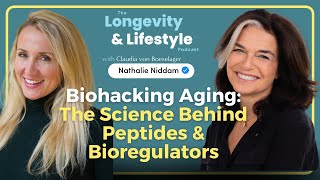
In this episode of the Longevity and Lifestyle Podcast, host Claudia von Boeselager interviews biohacking expert Natalie Niddam. Claudia introduces herself as a former investment banker turned longevity coach who has reduced her biological age by 17 years. After a brief sponsor read for Timeline’s Mitopure, the conversation moves into Natalie’s background – a holistic nutritionist who entered the biohacking world via Dave Asprey’s Human Potential Coach program and later discovered peptide bioregulators. Natalie distills longevity into three pillars: metabolic health, lifestyle (exercise, sleep, nutrition) and the spiritual/mental component (joy, inner work, trauma processing). They debunk the myth that aging can be stopped, emphasizing that the rate of aging is modifiable. The core of the interview is a deep dive into peptide bioregulators. Natalie explains that bioregulators are tiny (2‑4 aa) proteins discovered in Russia decades ago that act as epigenetic switches, entering the cell nucleus to up‑regulate protein production and rejuvenate cells. She contrasts them with longer‑chain conventional peptides (e.g., BPC‑157) that act mainly via surface receptors. The discussion covers the most studied bioregulators – pineal (Epitalon/Endolutan), thymus, blood‑vessel, cartilage, liver – and how they can be stacked. Use‑case examples include biological‑age reversal measured by DNA‑methylation clocks, accelerated recovery in COPD patients, and immune restoration after radiation therapy. Natalie outlines practical considerations: sourcing from Profound Health (UK) for natural, animal‑derived bioregulators, the distinction between natural (extracted from porcine/bovine tissue) and synthetic versions (e.g., synthetic Epitalon), dosing differences, and delivery formats (sub‑cutaneous injection, sublingual spray, capsules, transdermal). She notes regulatory hurdles such as the FDA’s ban on Epitalon in the US. Beyond peptides, the duo discuss mindset and community as essential longevity factors. Natalie stresses inner work, trauma processing, gratitude, and surrounding oneself with like‑minded people. They share personal motivation rituals (daily movement, breathwork, sauna, vibration plate) and rapid‑fire favorites, including a fascia‑release tool (Kineon Heal Plus) and a music‑driven boxing wall for neuro‑motor training. The episode ends with practical advice: start with one small habit (e.g., improving sleep or breathwork) and build gradually, and provides Natalie’s contact points (Instagram, podcast, website, Longevity Community).
Chapters
Hey there, I'm Claudia von Boeselager, a former investment banker turned entrepreneur, longevity coach, biohacker, and mother of two. Once burnt out and overwhelmed with chronic health issues, I've transformed my life and helped thousands of people do the same. I've even reduced my biological age by 17 years. Yes, I'm 26 again. Now I'm here to share the tools, strategies, and inspiration to help you live healthier, happier, and longer. On this podcast, I interview world-leading experts in health, biohacking, mindset, and performance, and share personal stories and learnings to bring you the latest insights and tips. Think of this as your go-to space for real talk about all things health and optimizing your life. Ready to unlock your best self? Let's dive in. This is the Longevity and Lifestyle Podcast.
This episode is brought to you by Timeline, powered by MitoPure. For me, staying active and energized as I get older is a priority, and Timeline's Mitopure has been a game changer. I feel stronger during workouts, recover faster, and have sustained energy throughout the day. I'm excited to share a bit more about Timeline with you. Mitopure has been a must-have in my daily routine that's helped me feel my best. What makes Mitopure so unique is how it works at the cellular level. It contains urolithin A, a powerful postbiotic that renews your cells by clearing out damaged mitochondria, your cell's energy source.
The result?
More efficient cells, and I see noticeable benefits in my energy, resilience, and recovery. Plus, it's backed by years of research, so I know I'm supporting my long-term health. If you're ready to feel the difference, Timeline is offering 10% off your first order. Just go to timeline.com/claudia.
That's timeline.com/claudia.
Claudia, C-L-A-U-D-I-A.
Today.
Welcome to the Longevity and Lifestyle Podcast, Natalie. It's a pleasure to have you with us today.
Thank you so much for having me, Claudia. It is so nice to be here, and it's great to see you again. It's been a while.
Exactly, it's been a while. So very excited to have you on the show for the first time, and hopefully we'll do a round 2 at some point too. For people unfamiliar with your work, Natalie, can you give a brief introduction to yourself for my audience?
For sure. So I, right now, I host a podcast myself called Longevity with Natalie Nidam. So we're, you know, Claudia and I are kind of compatriots in this in this space. And I, I was— I started off as a holistic nutritionist and got interested in the whole biohacking movement. And so I probably— I started off as a holistic nutritionist. You know, I kept— it's funny how you lose track of time. I think I used to— I was so used to saying, oh, 5 years ago, well, maybe it was 8, maybe I think it might have been 10, but now I realize it was 12 years ago.
Time flies when you're having fun, right?
Oh my gosh. And so much has changed, right? So Anyway, so I went back to school full-time to do this nutrition thing. And then, I very quickly got— actually, when I went in there, I was already following guys like Dave Asprey, Robb Wolf with the paleo diet, Mark Sisson with his work. Like, at the time, those were the big names, right? And Dave, obviously, is still a very big name. But very quickly, I kind of fell into this idea that nutrition's great, And it, on its own, it's not enough. And so, I started to kind of start looking for more. And back in the day, that was when Dave Asprey launched his first Human Potential Coach training program. And so, you know, I'm the kind of person, I made the decision to go back to school to study nutrition inside of a week. I made the decision to join his course inside of 24 hours. And I'm sitting there, I had never spent so much money on anything in my life. "What have I done?" And I was so worried that I had just spent thousands of dollars to learn about the Bulletproof Diet. But as it turns out, it was a really, really powerful program. I don't know where it is these days, but at the time, it taught me a lot about coaching. It taught me a lot about helping people to get through the stories in their head that was getting in the way. We forget, right? We tell people, "Do this, do that, do the other thing." Meanwhile, a person's walking around with a whole set of preconceived notions about themselves, which if they haven't dealt with, they can't do the work anyway. So I did that and then I fell across this whole world of peptides and peptide bioregulators. Probably now I should probably add a year to whatever I'm going to say. Let's say 6 years ago, 5 or 6 years ago, I got really fascinated. And, you know, then I started this Facebook community, which really blossomed. And then I started the podcast and here we are.
Beautiful. Thank you so much for the summary. I know, and the time that does fly, it's wild. I mean, I, you know, now I probably need to also add a couple years. So it's been sort of 12 to 14 years since my first sort of introduction to biohacking back in the day was, you know, called different things. And I, I remember launching the podcast when I was discussing longevity in 2020, and people are like, how do you spell longevity? You know, now everyone's like, oh, I'm all about longevity, always.
Yeah.
Back then people were like, you know, how do It was so funny. So, Natalie, can you share a little bit of the following? So you're dedicated to helping people thrive well into their 50s and 60s and beyond. If you had to distill longevity into 3 key pillars, what would they be?
Good question. I think, you know, I think it would be, and in no particular order, it would be metabolic health, being metabolically healthy. It would be having a solid lifestyle that encompasses like the, the exercise and sleep. And this is my way of getting 10 things into 3.
Perfect.
You're like me.
I'm like, how do I pack in the maximum?
Yeah, how do I pack it all in? And then number 3, which I think is the piece that so many people forget or don't put enough importance into, and that is the It's, it's the spiritual piece. It's the joy. It's the— it's your approach to life. It's dealing with your stories. It's dealing with your history. It's, it's finding that inner peace that allows you to approach all of these things with joy. And this is where I'm seeing— and we are all seeing it, I think— we're seeing a disconnect, right? Like, we see— there's one person in particular in our space who's taken on this challenge of, I'm gonna live to 180— I don't know what his number is— and spends his days monitoring and measuring and taking supplements and doing the things. And I don't know this person personally, so I could be dead wrong here. But when I look at the person, when I hear the person speaking, I don't see, I don't experience, I don't feel any kind of joy coming from them. And I don't know anything about the relationships, but I suspect that singular focus is approaching the body in a very conventional way where, you know, we can, you know, like in medicine, we chop it up and we look at what's broken and we fix it and we slap it back together again and then it'll be great.
Yeah.
But you forget about the person.
The holistic. And yeah.
Yeah.
Have you seen the documentary? So I'll just name it. It's Bryan Johnson.
I actually haven't.
Have you actually seen the documentary?
No, I haven't. I have, you know, I watch so little TV.
I don't even own a television, but I do have an iPad.
You can watch it on your computer.
Exactly.
Yeah, because my friend Andrew Steele was interviewed as part of it as well. So I was like, okay, I have to support Andrew. Let me check it out as well. And what I thought was very interesting were one thing that Brian said is that because of his past trauma, he wants to not have the mind involved and just have the body doing. And I was like, how interesting, because my philosophy is 180. And I think a lot of people I was chatting with, I think, you know, as well as Jean Fallacara about this, and we're both like, you know, it's all about, you know, nurturing the mind and then the body goes with it. Right. But Brian seems to be the opposite. But he, in the documentary, which, you know, maybe worth checking out, but he has a very strong relationship with one of his sons. And so it was a little bit more the humane side, which I feel like obviously when he speaks at the conferences and stuff where we're at, that it doesn't necessarily come across just because of his personality type as well. But yeah, exactly.
So, um, but I think we would probably agree that it's dealing with that trauma that he's going to have to do.
100%, right? It's all—
it's the very work for all of us. It will be the one thing.
Yeah.
That could be— and I mean, you know, maybe, maybe physiology can overcome psychology, who knows? But I don't— I suspect not. And I suspect he would get such a better result to lean into that trauma, to resolve it, to come to peace with it, like whatever it looks like for him. I don't know what it was, so I can't even begin to imagine. But I think that that's maybe a mistake that many people will make, right? I mean, on the one hand, because people are performers and performance-driven, they're like, I don't have time for that stuff. And men are actually really good at doing this, but some women too, where they wrap it up, they roll it up into a little ball, they stick it into a shelf and they're like, you're over there.
That used to be me. Yeah.
And so, and we don't recognize that that shelf is not, there's nowhere you can put that, that is not somehow going to inform your subconscious. That is not somehow going, like your cells in your body, their vibration is affected by the sum of all the parts. Yeah. Right.
Yeah, I mean, The Body Keeps the Score, right? You know, the great book around this too. And I think it's such a key component. I've had like, you know, Dave, Dr. Dave Rabin and things like that on the podcast as well. We've discussed this, that you have to process the trauma. And I feel like that's the triad for longevity is the body, mind, and spirit. And some just biohacking, focusing on the body. Some are like, okay, some brain stuff, but that spirit piece is key, right? And includes also like being, you know, self-love, which for a lot of people is very difficult, and then on to feeling connected and, and part with others, which we know from Harvard study is the key to happiness and, and longevity, right? So yeah, 100%. Amazing. What's one common myth about aging or longevity, Natalie, that you wish more people understood?
Common myth, um, well, the, the myth of you feel this way because you're old, right? The notion that there's, you know, you can look up 60 and this is what 60 looks like, 70 looks like this, 80 looks like this, 90 looks like this. I think that if we've seen anything, if we're looking around, the myth that you, things will change as you age. There's no doubt about it. Of course, we will age.
How—
and, and one myth is that you can anti-age. Right now, that's not a thing. Time is passing. You're, you're gonna age.
One-way ticket.
Yeah, but how you age will be entirely dependent on the decisions that you make. So it's never too early to start and it's never too late to begin. Yeah, obviously the earlier that we begin, the easier it is, the more we can accomplished, let's say. But I think that someone right now who might be listening to this podcast, who might be in their 60s, who's feeling kind of horrible and their metabolism's a mess and they, they're achy. And I mean, the world is filled all the— and you can find them on social media. The world is filled with people who decided, I'm done, this is over. I'm going to make these decisions and I'm going to live my life differently. I'm going to prioritize myself. For some people, it's an event that helps them to do it. In other people, it might be doing that inner work that helps them to release all of this inner stuff that I'm not worthy or whatever it is that you're walking around with. And that decision, and it's never too late.
That's a great reminder. Yeah, thank you.
You're welcome.
I'm excited to dive into the peptide revolution and bioregulator peptides are one of the most exciting breakthroughs in longevity science, and can you explain what they are and how they differ from traditional peptides?
For sure. So the bioregulators, I mean, it's interesting that you refer to them as a breakthrough because I think in the country where they were discovered, they're not, they're old news.
100%. Exactly. Yeah.
I mean, this is science that has been studied in Russia for 3 to 4 decades. It's, it's, this is old news for those folks.
Yeah. Thank you for naming it as well. It's funny cuz you see them in the Western media and they're like, oh, breakthrough, da da da. It's like, actually, no, this is the normal way.
Yeah. You know what? Give credit where credit is due. Politics aside, you know, you can think what you want and believe what you believe. The reality is that this very brilliant man at a very young age was tasked with a big job by the military in Russia. And he discovered these tiny little proteins that act as epigenetic switches in the body. So, bioregulators, and we call them peptides because as soon as you string together a bunch of amino acids, we call it a protein. And if it's small enough, we call it a peptide. Now, I recently said on a podcast that it was 50 amino acids or less, and some guy on social media said, "That's not true. It's 100 amino acids or less." I'm like, potato, potato. I mean, you call it— it depends who you talk to and what their definition is. Fact of the matter is they're small proteins. So, the conventional— the peptides that people might be more familiar with, which is the BPC-157 or thymosin beta-4 or TB-500, those are longer chain peptides. So, those fall in the 50 and under kind of amino acid chains, they act more like signaling molecules. And so, very often, they'll have receptors on the surface of a cell. That doesn't mean that they won't necessarily affect genetic expression. They will, but they will do it as more of a part of a signaling cascade. With the bioregulators, because they're only at most, I would say, you know, now there's talk that maybe there's a couple of bioregulators that are 5 amino acids or 7. But if we're gonna be purist and stick with, Cavinson's work, it's 2 to 4 amino acids. And what it is about these guys is they can— they're so tiny. And because of the charge that they carry and a whole bunch of other really technical biochemical reasons, they can get across the cell membrane of the wall of the cell. They can get across the wall of the mitochondria, not the mitochondria, sorry, the nucleus.
Okay.
Right. So they get into the nucleus of the cell. What lives in the nucleus is your DNA.
DNA.
And there they are able, and the way the DNA and proteins work is when you match up opposite ends of amino acids, they work as pairs. There's something about the bioregulator that allows the histone to unravel. It allows the DNA to unravel just so. And now we get the binding of the bioregulator to the DNA. And what that does is it upregulates the production of proteins and those proteins, which, the cell may not be making as efficiently or as effectively because it's aged or maybe that DNA, the DNA's no longer working as efficiently. The cell now is able to rejuvenate and restore function from within. The bioregulators are the ones that are commercially available, the natural bioregulators. There's about 21 of them, which is not to say that that's all there is. Even back when, Cavinson was alive, there was talk that he'd identified over 50. And there are now people that are building on his work that are discovering more. So it's really exciting, but they are typically associated with specific glands and organs. Right now, a year or two ago, I would've said to you, they are specific to a gland and to an organ.
Okay.
I think that there's a bit more nuance to that because I know that in the case of the pineal gland bioregulator, for example, it actually has effects on the thymus gland. It has effects on the heart. Like, it seems to have—
which makes sense as well.
Yeah.
So interconnected, going back to our original point. Yeah.
Yeah. So it seems to have more. And now, is that true of the cartilage bioregulator or the liver bioregulator? Maybe not so much. Those may be more specific, but it seems that there's definitely, you know, more halo effects on certain bioregulators than others. They also work together. Interestingly.
So you can stack them as well. Let's talk about some use cases. I think people listening will be interested to understand, like, you know, how can I use them in my life? What should I do? Like, where do I get them? Like, how does this work? Natalie, tell me more.
So, so definitely there's, there's, there are actually endless use cases, right? So the thing that people talk about a lot might be biological age reversal. Now, this is the person who said a minute ago, anti-aging's bullshit. But, sorry about the potty mouth, but it's not that, and biological age reversal is not, it's not that you're not aging, but what you're doing is you're rejuvenating. Like, imagine if you could rejuvenate your parts, right? Imagine that you have a car and the tires are wearing out, and imagine that you didn't necessarily have to go out and get new tires. Maybe there was a way that you could restore the tread on the tires.
Mm-hmm.
Right? As they're wearing out. That's really the idea of the bioregulators. With biological age, there are a couple— there's now an increasing number of labs that will run tests that look at DNA methylation patterns on your DNA and will say to you, Claudia, you are on paper 45 years old. And actually, the way— if we look at your— just looked at your DNA, you're showing up as a 36-year-old. Right.
Yeah.
Um, or, you know, so-and-so, you're 45 years old and news is not as good in your case. You're showing up like a 70-year-old. And so what does that mean and what do you do about it? So the bio-reg— so number one, you change your lifestyle. If you're, if you're the 70-year-old in a 45-year-old body, you start really thinking about your decisions, right?
Yep.
And you start to think about Okay, maybe that bottle of wine every night is not so smart. And maybe, you know, deluding myself into thinking that all I need is 3.5 hours of sleep every night is not so good. And thinking that, you know, the less I use my body, the longer it'll last, not so good either. So, you know, but I take a lot of vitamins. Yeah, no, it's not gonna work. So, so that person's got some work to do. The person who is younger than their age is doing, obviously doing a lot right. I do believe that there's a genetics piece to this as well. There's a really interesting study that was done called, the only thing that's coming into my head right now is Grimace. There was the Dunedin, the Dunedin PACE study where they followed, it was New Zealand and they took a bunch of small children and they followed, I think they're still following them to this day. And what they discovered is that actually, early childhood events can very much affect how we age.
So environmental events, a divorce of parents, things like that. Trauma. Okay. Yeah.
Trauma, that kind of thing. Now, it doesn't mean that you can't reverse them. It doesn't mean that you can't change that outcome, but it does set you on a certain trajectory. Anyway, getting back to our bioregulators, if they can, they've been shown, and there's a couple of physicians out there doing studies here, where using the bioregulators judiciously over time can help to reverse that biological age when we're looking at biological age based on how our organs are aging. Right. So number one, there's that. Number two, in a lot of the research that was done in Russia, they would often pair the bioregulators with conventional medicine.
Hmm.
Right. So this is an interesting concept because in our space, so often we'll take conventional medicine and we'll literally throw it under the bus. We're like, it's drugs, it's bad, it's horrible. It's, you know, and look, there's a lot about conventional medicine that could be better. I'm not gonna lie. But sometimes if you have an acute condition, maybe, and maybe this is where, you know, where conventional medicine maybe is going to evolve is that the drug is a really good intervention in the short term. But if we don't, and we know this, if we don't address the underlying mechanism of action here, If we don't fix the problem that's driving it in the first place, all you're doing is using a drug and the downstream effects are that you've affected other pathways. Now you're gonna need other drugs and it's a never-ending cycle.
Right.
With the bioregulators, there was one study where they were studying people with COPD, so chronic obstructive pulmonary disease. And when they—
inflammation. Yeah.
Mm-hmm.
Yeah.
And so when they paired, when they did the conventional treatment to help these people draw breath. I mean, they need to be able to breathe.
Yeah. Important. Right.
But then they paired it with certain bioregulators, which in that case, I think they may have been using the— there's a lung bioregulator and probably a thymus bioregulator. You know, they might, they probably paired a couple of others. I might throw in the blood vessel bioregulator just to improve blood flow. But they found that the people who got the bioregulators with the treatment had a far better and faster outcome than the people who only got the conventional treatment.
I love this because I feel like this is almost where alternative longevity medicine could almost meet sort of traditional medicine in terms of pairing and having exponential results. And then you're repairing the system while treating the acute issue. So yeah, excellent point.
Really interesting. It's supportive, right? There's another one where there's an immune bioregulator. Now this is a synthetic one and we can get into the differences between the, the natural ones and the synthetics. But there's a synthetic bioregulator called— I call it Vilon because I'm French, but, you know, people call it Vilon. So V-I-L-O-N. Your computer will autocorrect it to violin. I'm telling you right now, just so you know. So when you've written something and it says violin, you'll know it's Vilon. But Vilon was used, interestingly enough, in people who had had radiation therapy for cancer. And it helped after the fact to re— to restore their immune system. Ooh. Right. And so we know, so again, we, we know with cancer, I mean, this is a big deal. I'm never going to tell anyone that bioregulators are gonna treat your cancer.
Mm-hmm.
But if you, let's say, have to have conventional treatment because that's the way we're gonna handle the tumor load, where we kind of drop the ball after that is we don't do anything to repair the body. And we know that chemotherapy and radiation, as effective as it may be to kill the cancer cells, it's going to go after healthy cells as well. Well, what if we spent some time on the other side of the, of the treatment to help the person's immune system to come back online so that maybe it can, it can reclaim that vigilance and that ability to say, oh, you're not, you don't belong here and get rid of it.
I love that. Yeah, I have a couple of friends unfortunately had to go through chemo, so I'm definitely going to be recommending that. Thank you for sharing. Natalie, if somebody is new to peptides, where would you say they should start with? Most conventional doctors are probably not that familiar with it. And then I'd love to touch on after the sort of natural versus synthetic peptides as well. But what's the— what should be in the minds of people listening to this that are new to peptides? Where should they start with? What would you recommend?
This episode is brought to you by the Longevity and Lifestyle LL Insider. Would you like to get a short email from me with top tips, insights, and strategies to help optimize your health, life, and happiness? This could be interesting posts or scientific articles I've read on life and longevity optimization, cool biohacking or lifestyle products that I've discovered, and other fun things to help you be at your best. It's a very short piece of inspiration, so if you want to receive it, check it out by going to llinsider.com. That's LLinsider.com and leave your email to get the next one.
You mean in terms of a peptide?
Correct.
Yeah. So I will say to you what I say to all the people who ask me this question is it depends. Yeah, it depends on what you have going on. It depends on your current state of health. It depends. It depends on a lot of things, right? So if we're talking about bioregulators and let's say you said to me, you know what, Nat, I just like, I'm fairly healthy. I mean, look, lots of things could be better, but I don't have any major issues. Correct. I really would be interested in just helping my body to give it a little boost to kind of help it to age better. Right. So, excuse me. There are 3 bioregulators that I think, and that have been identified. It's not just my thinking. It's, you know, I've, I stand on the shoulders of giants. Like at the end of the day, I wish I was a researcher. I wish I'd been in the lab when this stuff had been discovered, but I wasn't. So from what I've learned, read, and gleaned and seen, I would put together a triad that is the pineal gland bioregulator, the blood vessel bioregulator, and the thymus gland bioregulator. And I'll explain to you why. The thymus gland is your gland right here in the middle of your chest. It is the seat of your immunity. We know that our thymus gland starts to involute as of the age of 30. And so, you know, it's not really— by the time we get older, even in our 40s or beyond, it's not working as well as it could be.
Right?
And we need those immune cells to be active. We need the natural killer cells. We need the T cell. We need all the different cells in order for our immune system to respond properly to whatever we're facing. And so, the thymus gland— and what takes people out down the road is either an overactive or an underactive immune system. Right? It all boils down to the immune system. If you have inflammation, if you have Neuro, whatever it is, the immune system is playing a role and a very important role. So the thymus gland would be a gland that I would pay some attention to. The blood vessel bioregulator. Well, nothing good will happen in the body if we can't get nutrients to the tiniest little blood vessels to the cells and remove waste products. Of course, we have the lymphatic system that's important here, but the blood vessels are critical. And what the, what the Blood Vessel Bioregulator helps to do is it helps to restore the integrity of the lining of the endothelium, the lining of the blood vessels. So, and there's some really interesting work there as well. Some really interesting papers that talk about the value of the Blood Vessel Bioregulator playing a role with other bioregulators and maybe even drugs in cardiovascular issues or in blood pressure issues or Even brain issues, because what often happens with the brain is we have reduced blood flow, the neurons start to die, all kinds of things start to happen. So, blood vessel, so we can think clearly, so we can move clearly, so we can heal, so all of the things can happen. And then, the pineal gland, saving kind of the best for last, is that tiny little pine-shaped gland in the center of your brain that, I mean, if you think about it, it's crazy. It runs the show. Like, how does like this tiny little pine nut thing run the freaking show? This is where really, I think, for those of us who thinks that health is nuts and bolts and doesn't have spirit or something else involved, like, think about this, a tiny little pine shape structure in the center of your brain that drives It normalizes your melatonin production. It regulates your circadian rhythm. It actually has an overall kind of balancing effect on the endocrine system. It actually affects your immune system as well, immunity. It activates an enzyme called telomerase. Well, telomerase is the enzyme that kind of restores and maintains the length of the telomeres on the ends of your DNA so your DNA can keep replicating. I mean, like it's pretty nutty.
Master control.
Right? And there's a lot of people believe that there's a piece of spirituality to the maintenance of that, that gland, that little tiny structure. And so, and it can calcify over time and somehow the pineal gland bioregulator helps this to restore function and form to this structure, to this gland. So, those would be, that would be, that's like my holy triad. If you push me up against the wall and said, only 3, that's it. That would be the 3. I wouldn't even try to sneak another one in, although, you know, it's a little bit like picking your favorite child, right? Like, really, you're going to leave the heart out or the liver or central nervous system?
Yeah.
Not.
But there you've got the 3. Okay. So for people listening, right? So they're okay. I know what I should be starting with. Where do I go? Who do I discuss this with? Um, maybe they flagged it with their primary care physician who's like, this isn't something I look at. Yeah. So where should people be looking? And then also let's discuss synthetic versus the natural-based? Mm-hmm.
So, okay. Well, I mean, I'll give myself a shameless plug. I do run a community called the Longevity Community on a platform other than the horrible Meta world. And, and in there I have a, I have a course I'm running, you know, a year bioregulators program for certain members who wanna take that on. And I do a fair bit of education there. There's podcasts. If you're a physician, you can— there's people like Dr. Melissa Peterson has the Human Longevity Institute. And I think they're starting to do a lot of education around the bioregulators there. I mean, bioregulators is still very new in this, in our part of the world. And so, to get formal education in it is pretty tricky. There's— so, but where you would buy them, so where I would get my bio— is that what you're asking kind of? Where you buy?
Well, both. So this is very helpful in terms of education and then also for purchasing as well. Yeah.
Yeah. And so, and definitely there's more, there's an increasing number of practitioners, health coaches, whatever your case may be, who are integrating these into their practice. You know what? I don't, I mean, look, where I buy them is I get them from a company called Profound Health. They're based in the UK. And the reason why I choose them is because they, they've now started manufacturing their own natural peptides. And unlike virtually any other brand you can find out there, I think they're the only ones that you can say have full transparency on what's in that capsule, where it's coming from. And not only that, in order to be FDA compliant, so hopefully by the time this airs, They will be shipping to the US out of the US. In, in, in, in going through the, the insane process of becoming FDA compliant, they've had to analyze every single bioregulator that they manufacture to understand exactly what's in there. And they themselves have learned stuff about bioregulators just by going through that exercise. And actually that segues beautifully into the conversation of natural bioregulators versus synthetic.
Yeah.
So what the natural bioregulator is, which is what they sell, and what's amazing about the natural bioregulators is you're actually getting, you're extracting the bioregulator from animal tissue. So the bad news is it's an animal product for people who are very focused on not using any animal products. But for people who are okay with that, what that means. And it's mammalian, right? Now there are, I mean, there is a line of bioregulators that's derived from fish skin that's come out. And I think it's just a different, it's gonna offer different signaling qualities. I don't think it's better or worse. I think it's just gonna be different. But going back to this, these are porcine derived. So originally they were bovine, somewhere along the way, in the motherland, somebody decided that they wanted to switch to porcine. That may or may not have made it onto the flyer box. Regardless, I don't, you know, I don't know what they're using now, but I would say with Nature's Marvels, we know what's in the capsule. What's really interesting about the Natural Bioregulator is that you're not just getting the 2 to 4 amino acid sequence. You're also getting kind of like this cohort of supporting actors. And so, when I was learning about bioregulators originally, what they would say is that the natural bioregulator seems to take a little bit longer to take effect, but once it has, the effects last longer.
Ooh, good to know.
The synthetic bioregulators is where, you know, the scientists, researchers have identified that 2 to 4 amino, like that, that amino acid chain. So for the pineal gland bioregulator, for example, that one is called Epitalon if it's synthetic. If it's natural, it's called Endolutan. And this is really important because for the longest time, people used Epitalon for both. And the challenge with that is that the dosing for Endolutan is 10 milligrams a day, but the dosing for the synthetic Epitalon is 100 to 1,000 micrograms a day.
Big difference.
And so you had all these people using 10 milligrams a day of Epitalon and you still do. And it's, and I'm not gonna say that it's necess— I mean, I don't know how good or bad it is. You can get away with it, but you don't need to. And it may be overkill. So I don't know that there's a study out there that says, okay, what happens when you use 10 milligrams of Epitalon a day. There's studies, research that shows 100 micrograms to a milligram. There's studies that show 10 milligrams of the natural, but they don't, you know, you don't have the other one. In any event, with the synthetic, it's like a bullseye. So it's going straight for that DNA. It's doing the one thing and that's all it's doing. So it's much faster acting. It is, it can be much more helpful maybe for people who have a lot of autoimmune issues or sensitivity issues. And I would say that there's very few cases of negative side effects, even with the natural, but for people who just really need a much faster effect or maybe are highly sensitive, the synthetic might be the better idea. Those have to be synthesized in labs. Typically they are, they can be administered by subcutaneous injection, but because they're so small, you have a lot of new products come out. You've got sublingual sprays. You're seeing them in capsules. You're seeing them in transdermal products. Like it's, I think we're at a point now where people have kind of caught onto this and they're so fascinated and they're like, okay, nobody likes needles. Some people, it's like a hard no. So how else can we make them available to people's systems? The challenge is that in the States, the FDA has put epitalon on the no-fly list, which is Fascinating to me. So none of the other bioregulators are there, just that one.
Hopefully to be reversed. Yeah. I heard something about Merck and developing their own patentable version of something, but I don't know how true that is.
Let's see. But it would make sense, right? Because think about what we talked about, what Epitalon does. If a drug company could harness that, modify it as they did with GLP-1s and market it, holy crow.
Yeah, that's big. Of course, they're— follow the money, right? Like, who benefits from this, right? So yeah, let's see what's happening now, uh, with the, the change of administration and if some things start opening up around peptides as well. So that was really very, very helpful to understand. And would you say in terms of delivery mechanism, subcutaneous injection, oral, etc., is there any ones that are better than others? Would you recommend, like, what, what do you take?
Both, depending on the situation. It depends. I mean, I'm sorry, and that's the worst answer, but it really kind of depends. It depends on personal preference. Now, again, if you have someone who's vegan and will not touch animal products, then obviously the synthetic is a great solution. If, I mean, you know, if you want to stick to, I mean, I was going to say, if you want to stick to the original research and science, the natural is going to be the way to go. But I think that, that Cavinson also did studies on the synthetics on, because in a way that allowed him to see what exactly does this one thing do, right? Without, without the, the entourage, if you will, of all the other actors that come along with, and I will say that in the natural, there's no identifiable protein from the animal left. So for people, You know, like there's no— it's like kind of like, I don't know if you've ever used Master Amino Acid Pattern, like the essential amino acids. Like MAP is derived from fermented beans and they extract the amino— there's no bean protein left when you get to the supplement. So this is the same principle. There's no— they're harvesting really what they need, but they're not taking the animal product with it, or the animal protein rather. I would say that if you wanna be a bit of a purist, I would go to the naturals. There's a really interesting researcher by the name of Dr. Bill Lawrence who is doing a lot of, he's doing an extended, like 4 or 5-year longevity study now using the natural bioregulators almost exclusively. And he was working with Dr. Cavinson until a couple years ago when Dr. Cavinson passed away, unfortunately. And he almost exclusively uses the natural bioregulators. So, and the nice thing about the natural is you don't have to worry about who's making them and did they get it right? Because the bioregulators are actually very hard to synthesize. Like if you think about, there are two bioregulators, I think it's thymogen and viloin. I think it's those two. I could be wrong. They're two amino acids. They're the same two amino acids, but they act differently because of the way that they're oriented in space as a 3D molecule. So, it's actually really, really, really hard from a biochemistry perspective to manufacture them. So, it adds a layer of complexity. You have to be really careful where you're getting them from and that they actually know what they're doing and testing their products.
Very, very helpful advice. Yeah. And if people have questions, then just leave comments and we can try to get to them as well. Um, so thank you for that. Let's move over to mindset. Nadiya, I'd love to touch on this with you. So mindset for a long and vibrant life. And as we know, and we, we've been discussing that longevity isn't just physical, right? It's mental and emotional too. So what would you say, or what would your be your advice as to which mindset shifts are essential for thriving as we age?
Mm, that's such a good question. Wow. I'm gonna have to use that question. Um, I think that, I think a mindset of, so there's a couple of different ones, right? Number one, doing that inner work that we talked about earlier, understanding yourself, coming to peace with yourself, doing the work to identify what are the stories that are not, that may not be serving you, that you're carrying with you in your life, doing that work, is literally a non-negotiable. And it doesn't mean that bitter people and people with a lot of stuff don't live long because they do. But to have that quality of life, that vitality, to make it worth living into your 90s and beyond, if that's your goal, coming to a sense of peace and acceptance and gratitude and joy I mean, think about it. It's going to put you in a position where not only are you in a better place for yourself, but you're able to show up so beautifully for the people around you. And the next one is community, right? Is surrounding yourself with people who share your same values, who share that kind of openness of spirit that allows so much joy and gratitude and abundance into your life. And that is a mindset because when I say abundance, I don't mean that you get all the things that you want necessarily, but you're seeing the world, you're seeing that your cup is half full. You're seeing that if this didn't work out for me, there will be something else. And so getting into that space where I think it boils down to a certain degree of equanimity and with a big dose of joy and gratitude in there.
Beautiful. You've interviewed so many experts on your podcast. What's the most impactful piece of advice you've heard? That has changed the way you approach health and longevity?
I think it's what we've just talked about. I think, honestly, I think that there's no one supplement that's gonna do it. I will say that learning about the bioregulators changed my own trajectory in a big way. Like professionally, personally, for my health. Like, you know, my parents take them. Like, it's that whole thing.
Everybody benefits.
Everybody benefits. But I would say that this conversation that we're having, the conversation that's now emerging increasingly around the self-work, around, you know, connecting— and you don't have to be religious, but whatever it is, I think there's a— whether it's an energy or a power, however you want to define it, how whatever resonates for you, you know, there's— or it's a higher sense of yourself, whatever the case may be. It's understanding that there are forces greater than ours that are around us, that surround us, that we can access, that we can tap into for what we need. But doing that work on ourselves, getting to that place of equanimity and joy and gratitude and an abundance mindset in the space we're in, being always open and curious and resisting the temptation to kind of plant a flag on one thing and say, I'm gonna die on this hill because this is what I believe, you've just completely killed science. You've literally completely killed science.
How do you stay motivated to continuously optimize your health, Nat? And do you have any rituals or routines that anchor you?
Um, I— well, what do I— how do I stay motivated? It's, you know, it's It's a little bit like changing your diet. It becomes a state of being. It's just what I do. And it doesn't mean that I'm rigid in my supplements. There's days I don't take supplements. There's times, I mean, 90% of the time I take my supplements on a trip. Sometimes when I'm on holidays, like on a real holiday, yeah, I, they stay home, right? Or they stay in my bag, even worse. But for me, it's this— I think it's— it comes down to this, this just this love of life, right? Like, I love my life. I love this life. I love what I do. Like, I'm really fulfilled by, by what I do. I adore— like, I feel so blessed to be able to do what I do and call it some kind of job. Like, I don't even feel like it's a job.
Exactly.
Right? And so it's— and the idea that I'm able to share information with people that can help them in some way in their own journeys. And I'm sure you get these too. Like, we get emails from people, people reach out to us. I almost kind of can't believe it sometimes, right? And it's not that we gave them a recipe to be healthier or better. It's that we opened a door for them that they stepped through and they, and it took them to that next person or that next practice or that next thing that allowed them to, to make, to make progress in their own journey. So that's what really kind of keeps me going, honestly. And then, and, or drives me, it does not even keep it, keeping me going implies I want to stop. It's just, that's what drives, propels me. Right. And then in terms of my own practices, Like right now, it's about the big picture for me. So, it's about keeping myself moving, keeping myself connected. Like for a while there, I almost lost touch with my family because I was so busy and so focused on my career. So, kind of taking a breath a little bit and reminding myself that we need all balance in all places. And The people that are nearest and dearest to me really count in that equation. Like, I can't just expect them to sit around on the sidelines waiting for me kind of thing. And, you know, just stopping every day and during the day and moving my body and taking a breath and recentering. Those are, you know, those are probably my rituals. I mean, I could talk to you about my sauna and my vibration plate and getting to the gym every morning, you know, as many mornings as I can at 7 AM. Because if it doesn't happen at 7, it's not going to happen.
I know the feeling as well. Yeah, no, but beautiful. Thank you for sharing. I think it's that being in service and having a why that's bigger than yourself, where really what I notice from people, from myself as well, like people are going, how do you do this? And so much or whatever. And it's like, it's not even about me. I've just, this is what I love. I'm curious. I'm constantly learning new things. It's such a gift. And exactly something people call a job. I don't feel that this is a job.
No. No, not so much.
It's so much fun. Can I ask you some longevity rapid-fire questions, Nelly?
Fire away. I hope I have answers for you.
Amazing. They're not too scary, I think. So let's jump in. So besides peptides, because that would be the obvious one, what's a surprising biohack or longevity tool that has had the biggest impact on your health, or a big impact, we could say?
I'm looking around, like, I have so many biohacks here, it's insane. Actually, one of the things, like, one of the things lately, and this is a new thing, and this will evolve over time, right?
Of course.
But some, I just got sent this really low-tech tool that I've been using every night that is making a huge difference in my mobility. And it's from a company called Kineon. And it's, and I don't even think it's on the market yet. It's called the Heal Plus. Have you seen this thing?
Kineon rings a bell. I don't know, was I speaking to somebody or whatever, but maybe you can share with my audience.
Yeah, I'm going to show it to you. So Kineon is well known for the Move+, which is this little red light laser device, which is really interesting because you can use it on a knee, on a shoulder, but you can also use it around your neck to irradiate your carotid arteries. But this new little thing that they've come up with, this is called The Heal Plus.
Ooh.
It's, it's probably silicone or rubber or something. But what you do with this is you use it as a fascia release tool.
Ooh. I need that for my foot.
Your foot. And so your fascia is really fascinating. So I've had a lot of, you know, I've had some knee pain because I've really stepped up my workouts. Well, I've noticed that if I, if I put this down on the ground and I put my calf on it, and just let the weight of my leg, it hurts like crazy.
Wow.
For the first couple of minutes. And then eventually the fascia releases and guess what? My knee stops hurting.
Wow.
And so this has been the coolest. It doesn't, you don't even have to plug it in. It's not particularly, you can travel with it.
It's not heavy. You can travel with it.
I mean, this is a little heavy, but you know what I mean? Like, so, so I don't know if that's the answer you were looking for.
No, but that's, that's really cool. I'm, I'm like, I need to get one of these. Because I have, yeah, with my foot from some injury, just like this plantar fasciitis thing that's really annoying and it goes and then it comes again and it goes and comes again. But what's actually happening there? It's just because of these certain trigger points in that?
So here's what is really interesting. You know, we all worry about our bones. We worry about our muscles. We worry about tendons and ligaments and circulation and nerves and this and that. What we forget is that we're wrapped in this organ. It's, as of 2018, now defined as an organ called fascia. And fascia is this wrap that wraps your whole— and it runs from the tips of your toes to the tip of your head. And interestingly enough, in a conversation I was just having with this doctor that I was interviewing, he said, you know, a lot of people come in here with a headache and they'll be shocked to find out that it has something to do with their foot because the fascia gets bound. It gets dehydrated. It dries out. If you have an injury, you can have adhesions. You have energy gets trapped in fascia. The chi, the energy meridians that traditional Chinese medicines work with run through the fascia and they come up in those trigger points through the fascia. And so, if you can keep your fascia kind healthy and flexible and hydrated and moving, everything else underneath it works better. And so sometimes, quite often, a muscular injury or imbalance or a tendon or a ligament problem, it originated in the fascia. And so if we can release that fascia, the whole body grows. And if you think about it, as we age, when we shrink, it's that, that shrink wrap that's shrinking.
It's like the vacuum is sucked in and then taking up the life of it. This is really interesting. Okay, got to check these out as well. Really, really exciting. Um, and this ties a bit into what's been your most exciting purchase in the last 6 months, because I know you didn't buy that. So, and let's say $100 or $200 or less. Um, we love specifics.
What did I actually go buy? There's something I'm forgetting, because I know I bought something thinking, I can't believe I'm buying this, but I did. Um, what did I buy? I mean, you know, again, like, we're, we're very fortunate that we don't often need to buy much.
Yes.
Um, I got a really nice pair of shoes the other day. I know I bought something. I mean, a couple of years— a year ago I bought a— I kind of— I finally broke down and bought a vibration plate, but I've since then been, been gifted with a Power Plate, which blows it out of the water.
So I'm What did I buy?
Kettlebells. I bought kettlebells and I bought, okay, this is hilarious. I bought one of these. So for a while I was doing these boxing workouts at a gym and I moved away from that gym. And so I don't box anymore. And I was kind of sad because there was something about boxing that really kind of worked. It just made me happy, right? Which never hitting a person, only hitting bags. And so, I actually bought— I don't know if you've seen them on Instagram, but it's like a wall. It's a thing you install on your wall and it has— I think it's got 6 or 7 lights on it and the lights work. They play to the music and then you punch the light as it lights up based on the music. It's so fun.
This sounds great. And can you use like your knee as if you were kickboxing as well?
Well, not if you're— unless you're very, very flexible.
So it is, I guess.
And it's flat on the wall. So you wouldn't, you know, you wouldn't be able to kind of hit it with you.
I mean, you might be—
you could do a round kick. Yeah, I know you could do a sidekick. But good workout. But definitely. And so it works on your reflexes. And it's fun.
And for my kids as well, it's like if you're stressed from school or something. What's the name so we can link it in the show notes?
Oh, so I got the cheap version. There's an expensive version and a cheap version. I went, I bought it from this company called Megelin. M-E-G-E-L. I'll look it up and I'll send it to you. You can put it in the show notes.
And it's called like a boxing wall unit.
I don't even know. Trust me.
I just put it into Google here. I found a few things. Megelin music box machine with boxing gloves. There we go.
Okay, cool.
Amazing.
I figured I would, I would get like the low end before I invested in the higher end just to make sure that we were going to use it.
I know, because how many devices and things do we have that's just going to end up in the graveyard? The waiting room, I should say.
Yeah, the waiting room. That's it. Well, in the gift room, sometimes it gets gifted to someone.
Very, very true. If you had a magic wand and could solve one age-related challenge instantly, Nat, what would it be?
One age-related challenge. You know, if I was going to do a physical one, it would be inflammation because I think that it would solve, you know, from an upstream to downstream effect, it would help to solve so many different things. But based on our conversation today, I think that it would have to be mindset.
Beautiful. Can you imagine everyone had this like insane beautiful mindset walking around, the world would be a different place, right?
And not only that, but people wouldn't— would get out of their way. They'd be like, I'm not— you know, they'd be like, oh, I'm not— I don't eat those foods not because I'm depriving myself, because they don't make me feel good. Yeah, how much would change, right?
Oh my goodness. Yeah, let's see, maybe one day.
That wand.
This has been such an inspiring and informative conversation. That's— and for listeners wanting to dive deeper into peptides, longevity, optimizing their health, where can they find you and see what you're up to. And we can link everything in the, in the show notes.
Thank you so much, Claudia. This has been a great conversation. I really enjoyed it. Um, it's, um, so you can find me on Instagram at Natalie Nidim, um, just my name. You can find my podcast, the Longevity with Natalie Nidim podcast. And then you can also, if you go to natnidim.com, which is my website, which is completely getting revamped right now. So please forgive me for the website. It's there, but you can sign up for my newsletter and also learn about the longevity community and joining that community, I would say, would enable us to connect directly. I teach some stuff in there. I do live Q&As. I bring in experts, all the things.
Beautiful. Do you have a final ask recommendation or any parting thoughts or message for my audience today?
I think my only parting thought is if you are don't know where to begin, and if you're sitting there going, okay, this is all really great, but this is all really overwhelming, just start with one small thing, whatever that may be for you. You know, if you know that you— that sleep is your problem, sleep is the thing that if you can start to improve your sleep, it gets a whole lot easier to do everything else. It gets easier to make the decision to go for a workout, go for a walk, to make the right— a better choice with your food, to stick to a plan. Everything gets easier when you're rested. So if you can work on that sleep piece, or if you feel that, you know what, I'm so anxious I can't sleep, so maybe where you begin is learning how to balance your nervous system, maybe through breathwork, or it could be really simple. It could just be a box breath a few times a day to help you to bring your system into alignment. But the basic message is one small thing. Like, try— I think the mistake that we all see people make, which is it's got the best intentions. People are like, "Okay, I gotta change my diet. I gotta start moving. I need to go to the gym. I need to do all of the things. I need to do all these things." And within like 3 days, they've completely— the wheels have come off the bus. Rust that they didn't even bolt them on, right? So pick one thing, start with that thing, and when you feel that it's become a lifestyle instead of a job, you're ready to bring on the next thing. So you can start stacking.
Love that. Thank you so much for joining us, Natalie. It's been an absolute pleasure. And thank you to your audience for tuning in. And don't forget to subscribe, share, and leave a review, um, if you enjoyed today's episode. Thanks again.
Thank you, Claudia. It's been great.
Hi everyone, it's Claudia again. Before you take off, would you like to get a short email from me to you several times a month with top tips, insights, and strategies to help optimize your life, health, and business? This could be interesting posts or articles I've read on life and longevity optimization, cool biohacking or lifestyle products that I've discovered, and other fun things to help you be at your best. It's a very short piece of inspiration for you. So if you want to receive it, check it out by going to llinsider.com. That's llinsider.com and leave your email to get the next one.
More from Claudia









Can Psilocybin Slow Aging? The Study on Telomeres, Inflammation & Survival with Dr. Louise Hecker

