How to Overcome MENTAL HEALTH Challenges with Psychedelics and Ketamine with Dr. Julia Mirer
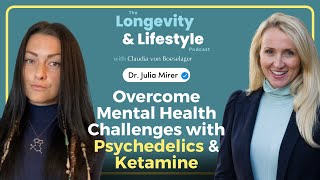
In this Longevity and Lifestyle Podcast episode, host Claudia von Boeselager interviews Dr. Julia Mirer, a former pediatric resident turned consultant in psychedelic medicine. The conversation begins with a discussion of the mental‑health crisis among adolescents, linking rising suicide rates and loneliness to the advent of social media (citing Jonathan Haidt’s data). Dr. Mirer explains why she moved into psychedelic‑assisted therapy, describing the current state of the field: a post‑2020 surge of interest, FDA fast‑track designations for psilocybin companies, and the distinction between ketamine‑assisted therapy (a Schedule III, insurance‑covered option) and high‑dose psilocybin trials. She highlights a landmark psilocybin study that avoided suicidal ideation and emphasized robust facilitator support. The core of the interview focuses on preparation and integration: 80 % of benefit comes from pre‑session education and post‑session community work, with analogies to gardening and the importance of “tilling the soil.” Dr. Mirer advocates for integration circles, coaching, and nurse‑led support rather than solely physician‑driven models. She details emerging adolescent ketamine programs (IYAKAP), the need for parental involvement, and the potential of micro‑dosing psilocybin as a safer alternative to current pediatric psychopharmacology, critiquing SSRIs and their side‑effects. The discussion expands to neurodiversity, suggesting psychedelics could help autistic or highly sensitive individuals reframe social cues. Personal insights are shared: the impact of DBT for highly sensitive people, embracing uncertainty, and practical habits like journaling and mindful scheduling. The episode concludes with rapid‑fire questions, resource recommendations (using NCBI searches), and Dr. Mirer’s social‑media handles for further learning.
Chapters
Psychedelics is like 10 years of therapy in one session. Yeah, if you've done 10 years of therapy at some point, so you know how to compare it and you have some kind of tools coming in, and you may be coming in with a messy toolbox of self-help and previous therapist insights, your own insights, and then you go into the session and it's like you come out with this organized toolbox. The session doesn't solve all your problems. But it helps you organize the tools that you already have in a way that you know exactly which tool to use for which problem. And so psychedelics are not a magic bullet, but they are an opportunity to actually show up for yourself, to actually realize that you have the internal resources to handle whatever comes, because life is going to still keep coming.
Welcome back, ladies and gentlemen, to another episode of the Longevity and Lifestyle Podcast. I'm your host, Claudia von Boeselager, here to bring you the latest insights and learnings to improve your health, live a longer and happier life in the meantime too.
Before we dig in, I just want to take a moment to express my deepest gratitude for each and every one of you. Your unwavering loyalty and dedication mean the world to me. Thank you for tuning into the episodes, for sharing your feedback, for being part of this amazing tribe and wanting to improve your life and your health for longer.
Please make sure to subscribe to our YouTube channel or our Apple Podcasts and Spotify, wherever you check out this episode.
We'd love to hear from you. It also enables me to bring you more free content from amazing speakers. So having your support in that way would be hugely grateful. Again, so grateful for you as this community and tribe keep growing and growing around the world. Thank you. My guest today is a dear friend, Dr. Julia Meir. Julia is a consultant in the field of psychedelic medicine, which serves as a vital bridge between Eastern and Western practices. During her second year of pediatric residency in Harlem, New York, she recognized the limitations with the current healthcare system and made a bold decision to step away from her program, embarking on a journey to explore alternative healing modalities. Julia, it's such a pleasure to have you back on the Longevity and Lifestyle Podcast. Thank you so much for coming on today.
Thank you so much for having me back.
My dear friend, I'm so excited to have you here. And just for my audience to know that Julie is one of the wisest people I know and she asks the best questions. So now I am the one who gets to ask a few questions, but love her insights and depth. So excited to have you with us today. And I'd love to start with a little bit of a different question. And there's no right or wrong answer, but what is some recent insights or breakthroughs, be it in health or otherwise, that you're most excited about? And why?
Okay, so it's, it's a little, uh, grim, the part that stand out to me, but it was Jonathan Haidt. He came out with a new book called The Anxious Generation, and he gave a talk about it ahead of time, and he presented this data. You know, we keep blaming COVID for the deterioration of mental health in adolescence and, and teens and, and kids in general. And he puts up a graph and he shows that the real difference in mental health started in 2012. And he shows that from 2012 to 2013, suicide rates in girls ages 10 to 14 went up by, I think it was 300%.
Wow.
In, since 2012. Yeah. And he said, do you know what changed? Social media came online. Wow. Yeah.
Wow.
And my interest, you know, since the last time I was on, has started to shift towards adolescence. And so all of this information that I've been coming across is really pointing to the fact that, like, there's, there's this thing that we've given to kids at a young age, and we as adults have a hard time managing our emotions in response to social media. Now imagine if you're a developing brain that is exposed to the same thing. Yeah.
Wow. Super impactful and so scary.
Is there—
did he mention, is there any difference between like the type of social media or interaction with it? Is there like a how to manage it? Did he do any— was he just stating sort of the statistics or was there also like how to manage it in today's world? Is there any advice?
So I'm guessing that the book that I'm gonna start reading will have some of this information. And in his talk, he did say, he's like, you know, it's really tough to tell a kid to regulate their social media use on their own.
Mm-hmm.
You could try to put limitations. Um, and this was in, I think something he mentioned, but it was my niece that said, you know, I don't love TikTok, but that's how my friends communicate with one another. And if I don't keep up with the videos, I don't know what they're talking about. I was like, okay. And so Jonathan Haidt actually says a few things. He said, one, maybe we don't give this to kids who are under 16 years old. You know, the same way that we hear our kind of parents talk about when I was a kid, I could drink and drive and it wasn't a problem because there was no laws. And he's saying maybe, you know, we're going to look back at this period of time, be like, We gave what to kids? And then the second thing he said, you know, it's, yes, you can have the schools that have rules about having phones, but it's really the parents, the group of parents that have kids who hang out. They just have to agree. They're like, okay, I'm not going to give my kid mine. And then I'm not going to give my kid mine. So that when your kid comes home and asks for a cell phone, and they can no longer use the argument that everyone has one. It's like most people have one is a weaker argument.
And I think that's a real key. I think there's two points in there what I've observed. Obviously I have a 10-year-old who is very keen and like, when am I getting my phone? And I was like trying to support her understanding the risks of it. And I think what you said is that when the group of parents find a consensus together, and I think that is super essential because it's really tough if it's just the one and you don't want your child to feel left out. And like you were saying, your niece said like she has to keep up with her friends. But if it gets to a certain place where like the majority of the friends don't have it, then it's, then it's okay. And, you know, as a 10-year-old, and even though the school where my daughter is, like, there's, they're not allowed to have phones, but there's still 2 kids my daughter of course knows in her year that have a phone, you know, and they're like, wow, they have a phone. And I said, it's not that exciting. And then the second part though, is that, and I'm speaking to myself here as much as anyone, We're role models. They are observing and seeing exactly what we're doing. And I've been trying more and more not to carry from room to room this phone with me, which is just so pathetic. It's so sad. It's like you've got your watch and you have your phone, like whatever it is, and just to leave it behind and to focus on being more present. And I think it's having that awareness and then actually practicing strategies to not be Oh yeah, let me just finish the message before I do this or that. They see that and they're like, oh, if you place so much importance on it, even more than spending time with me, then of course I'm going to do the same.
So yeah.
And I'm speaking to myself here as much as anything as well. Yeah.
I noticed my dog. So we know that dogs kind of are in tune and all of these things. So I noticed on my walks with my dog, if I had my phone out, all of a sudden I'm walking, walking, walking, and I feel resistance, and it's my dog that just stops in her tracks and looks at me. And when I put my phone away, she's happy again. We're playing. And I'm like, are you telling me I'm not here? Like, and this is a dog, and kids pick up on everything. Yeah, yeah.
And then knowing that limiting beliefs are set between the ages of 0 to 7 approximately. So if it's they're not good enough, you know, for our attention or whatever as well. So anyway, there's a whole cascade of issues that we're setting up as well. So I'd love to tap on the psychedelic-assisted therapy. And for people who perhaps didn't hear our first conversation or are new to the space, and, you know, are like, they've heard some things, obviously, there's a huge momentum happening. But perhaps before we dig in, could you first explain why you decided personally to move into this side of the spectrum of medicine and the space, and maybe give also a little overview of what's happening and what is psychedelic-assisted therapy?
Okay. So I, I like to say that this industry isn't going anywhere. It's here to stay, but it's also not going anywhere fast.
Mm-hmm.
And in 2020, we saw this big bubble. Everybody was excited. They're like, oh, we're gonna get this across the finish line in 2 years, 3 years. And now 4 years later, we realize that it's not really the case. Mm-hmm. But it has created a lot of interest. It's created a lot of research focus and the FDA keeps fast-tracking, which means it, it kind of pushes forward research. Mm-hmm. In new, new drugs that are being developed that are psychedelic drugs. And it's really promising because a lot of the studies show that things like treatment-resistant depression, major depression, eating disorders, traumatic brain injuries, these are all conditions that are not really well managed right now. Mm-hmm. And people are throwing around the word cured, throwing around the word remission, like all of these things. And it's, and it's amazing. And at the same time, it's disorganized. Mm-hmm. And so, you know, we have ketamine-assisted therapy, which is a legal option. It is in the US a Schedule 3 drug, which has been around since the 1960s. It's been used for anesthesia, for pain, and now in the last 5 years it's really been pushed forward for mental health. Mm-hmm. And in the US there's one form of ketamine that is covered by insurance, but everything else is out of pocket. Mm-hmm. And this means that these are expensive treatments and there's also not a lot of standards out there. So you have kind of like the wild, wild west. At the same time, you have the research world that is getting very excited because we had a landmark study with psilocybin that I had the privilege of participating as one of the sitters during the study. And it showed incredible results. And one of the, I think, most important parts is, you know, in, in clinical trials we look to see is it better than placebo? Is it better than the standard? And the standard of care currently, especially for mental health, includes drugs that create so many side effects that it actually worsens the quality of life. So you take antidepressants because, you know, you had a loss in the family, and now you're not sexually active with your spouse because you don't have that libido anymore. Or, you know, you take an antidepressant to help you with something that's going on at work, and you're not able to connect as well to your children.
Mm-hmm.
And when we look at psychedelic trials, yeah, sometimes those study, depending on how, like what dose they're using, it looks similar to the outcomes in, uh, regular mental health treatments. However, the quality of life is higher because they're more connected to people. They're less affected by their environment in a negative way. They're able to still have the range of emotions that is part of being human. Without blunting things, and they're still getting improvements in their mental health. So I think to me, like, at the early stage, this will be a big differentiator that will push this again, keep pushing this forward. And that's like the above-ground psychedelic world right now, as it stands. Yeah.
And you mentioned the landmark study. Can you elaborate a little bit on that? And what was so groundbreaking and exciting about it?
So this was, uh, one of the two companies that were granted breakthrough therapy designation by the FDA back in, I believe it was 2019. Mm-hmm. And, uh, two companies working with psilocybin. And the first study came out for a different company and had some results and there was actually some, um, downsides in their study. But then when you look, compared to the study that I'm mentioning right now, the results didn't have the same negative side effects. So the first one, there were some, I think it was suicidal ideation. And then in this one it wasn't. And we, the reason why I think it's special is because it wasn't just about the study, it was the way that the organization supported the facilitators, the providers during the study. So we would sit with our participants, but then twice a month we would sit with all other people in the country working on the study and share our insights, share our techniques so that nobody felt alone in this very novel world. And I think that translated into patients. Mm-hmm. Um, so, so that was one thing and the other— it was a fairly large compared to other studies, was about, I think it was 100 people. Um, it had 50% of it was women, which is also great. And they're actually going to be doing a 1-year follow-up, so we'll see what that looks like. But when I was in the study, just witnessing people completely shift in that one session, we had one woman who couldn't tell her story without crying, couldn't say hello without crying. Mm-hmm. I spoke to her a year later. I could still hear her smile on the phone.
Oh, wow.
Beautiful. Yeah. And I think the most important part that I started to pay attention to was that people, the mainstream especially, loves to say that psychedelics is like 10 years of therapy in one session. Yeah. If you've done 10 years of therapy at some point, so you know how to compare it and you have some kind of tools coming in. And you may be coming in with a messy toolbox of self-help and previous therapist insights, your own insights. And then you go into the session and it's like you come out with this organized toolbox. The session doesn't solve all your problems, but it helps you organize the tools that you already have in a way that you know exactly which tool to use for which problem. Mm-hmm. And so psychedelics are not a magic bullet. But they are an opportunity to actually show up for yourself, to actually realize that you have the internal resources to handle whatever comes, because life is going to still keep coming.
That's so powerful.
And yeah, what I hope is that we start changing the narrative around it a little bit, because a lot of that— the participants in that study, they came in, they're like, okay, so this is going to change my life, right? And it's like, okay, expectation setting. Everyone has a different experience. You may or may not see, you know, whatever it is that's gonna come up. And it's all about, and this is how we talk about it, it's all about what you do with this in the weeks to come. What do you do with this experience? What do you do with these insights? And that integration part is crucial. It's the difference between a good trip and a bad trip. Even, you know, for people that know about this recreationally, it's like you have a bad trip and you go talk to someone about it, you could really process some of the kind of the, the stuff that's going on in, in your mind, the stories you've been telling yourself, the biased beliefs. Mm-hmm. Without integration becomes an experience that just fades away eventually, maybe within knowing a little bit more than you're ready to know and whatever comes with that.
I love that. And I, I, from, you know, speaking with you and others in the space as well, like the importance of integration, it's like, you know, the tip of the iceberg is the actual experience and the rest of the work is, is what's, what's after. How should people considering looking at this and just thinking, okay, I just do one session and I'll be fine. How should people think about integration? How does one integrate correctly? What are some resources, tools, strategies that you recommend?
So I'd like to say that integration starts with preparation. And 80% of any psychedelic's benefit, I really think it's part of it is the preparation with education beforehand and then integration, especially with community that speaks the same language afterwards. It's like 20% is the medicine, what's your diagnosis? Like, I, I don't think it's that as important as the rest of it. Mm-hmm. And so with prep, there's a num— an integration. I'll just preface this with It can look like anything. It could look like, you know, yoga. It could look like self-help books. It could be a therapist, a good friend, like many options. Mm-hmm. But something that forces you to sit with the material more. Mm-hmm. And for preparation, you know, there's, there's an element of curiosity that's important before you go into this. Mm-hmm. And we see with ketamine, because it's a legal option, especially with the nasal spray, which is covered by insurance, it's a low barrier for entry, low-ish. Mm-hmm. And because it's a legal option, it's not like a psychedelic that people historically have had to seek and find and explore in, in foreign countries. Mm-hmm. This is available at your local ketamine clinic. Mm-hmm. And people that come in and prepare for the sessions do a lot better. But when you're coming in from the standard medical model of, okay, I've been on this drug to do this, this drug to fix the symptom from that. Okay, so this is gonna be the next drug that I'm just gonna take and it's gonna make me feel better, right? Mm-hmm. They're not doing as much prep work. And the prep work to me, I'll use a gardening analogy. It's like tilling the soil. Mm-hmm. During your dosing, you can plant some seeds. Mm-hmm. But then after your dose, you have to water, water the seedling, put it into sunlight, nourish the soil. And otherwise, yeah, maybe something grows, but it won't be as luscious as it could be. And so for the prep part, it's maybe it's exploring some assessments. Like there's the Adverse Childhood Events. It's a quick little questionnaire online and you can see how, oh wow, I did not know that divorce is considered an adverse childhood event that could have contributed to some of my uneasiness or some of my mental health problems. Um, there— so that's like a test you could do to kind of normalize that traumatic things happen as a kid. And it doesn't have to be the big T traumas. Trauma can be any negative experience that happens in a state of relative helplessness. So as a kid, you're just relatively helpless, so it's okay. So tripping in front of your crush was way more of an impact on you than you thought it would be. That's okay. Just normalizing these things. Yeah. Um, there's another book, uh, Adult Children of Emotionally Immature Parents. Normalizing, like, hey, you know, even though your parents— yes, they didn't hit you, they didn't do that, but you have emotions. They weren't validated. You never learned how to manage them. So now you have a diagnosis of borderline, um, you know, like things like this. So exploring within, um, IFS, Internal Family Systems, is another really great, um, line of, of therapy— or not line, but, uh, a school of therapy techniques. So that's been used a lot with psychedelics, and it's kind of learning, okay, what are the parts of myself that I want to work on, work with at talks about exiled parts. So those are things that we've repressed. Sometimes it's that emotional part that we repress, so we become very angry instead. So like really starting to, like I said, till that soil. And the— I'll just go on to talk about the integration afterwards. You work with that material again. So in your session, maybe you remember something that happened as a kid. Maybe it was that moment that you tripped in front of someone, and you can kind of be like, it's okay. But when you come out of it, it's like, okay, here's how that has affected me in the past. I didn't try out for my kind of school theater or like whatever it is. Mm-hmm. Here's how it affected me in the past. What am I gonna do now? Mm-hmm. And I'll go on to say that I think this is where my personal curiosity started to come up as to who's the best person to integrate after a session. And we historically, when a new medicine comes out, we're like, oh yeah, the doctors, they're first, first in line to prescribe this. And okay, that, that's great. But as a doctor, you're trained to not let a person die. And so in a session, let's say with ketamine, when a person is screaming, I'm dying, it's very likely that the doctor with their training goes and takes a medicine as a, you know, a rescue medication to to stop the trip. You know, they give them medicine to stop it. But that's part of the process. So you actually need someone that's maybe not trained that way, who can hear this person screaming and dying, sit down next to them, hold their hand and say, lean into that. Very different mindset.
Yeah.
And so I started thinking like, okay, I think nurses will be really great. They're just, they're caring, caring. They're really really good for our patients. They always have been. I think that there's gonna be a huge opportunity for coaches. And it's not just the run-of-the-mill coach that, you know, got a certificate and I'm ready. It's like, no, coaches that have been informed on how to work with psychedelics. Mm-hmm. Because, you know, therapy helps, like, here's life, all this chaos. And therapy helps you get to point A. Mm-hmm. I have a friend of mine that, that told me this, Hadass. And therapy, yes, it's very useful in helping you understand, okay, I had a narcissistic mother. Okay, this affected me in this way. But then you kind of get stuck in that story. And when you get stuck in a story and telling that same story, you start to have this negative bias and you start looking for all the other kind of signs that you're being triggered in this area. Mm-hmm. And so I think especially with something as transformational as psychedelics, you have to, you have the opportunity to really start moving people past those therapy hurdles. Mm-hmm. And, and this is not to say that people with severe trauma, I think therapy's very important. They, they sit, they process it. Like, I'm not saying, um, that I think, uh, coaching as an adjunct Mm-hmm. Once that initial story is kind of, uh, made clear to the patient. Mm-hmm. Yeah, they get to point A from the chaos, but coaching gets you from point A to point B, and point B is where life happens. Mm-hmm. So I think, and that's why I'm furthering my training to understand, okay, what is the best program that I would recommend? Mm-hmm. And how do we get these people into the clinics, into the post-retreat, um, kind of world, and start helping people process these things so that they don't need to have session after session after session. Help them make the most out of every session, especially while it's still so, it's so expensive. Yes.
Oh, beautiful. Because currently the model is that they're left to their own devices. They do, let's say, 6 sessions, and then there's no follow-up, is it? They're kind of left to figure things out. Okay. Yeah. So I mean, super essential.
And I think that there's, there's an element of when I zoom out and I talk to a lot of people who have companies in this industry, and one of the interesting things I recently heard was with one of the home ketamine companies, which is a whole other story, um, they made integration circles. So Uh, an integration circle is essentially you have many people from different stages of their journey that can hop on to a call with a facilitator and process what, whatever is coming up for them. Mm-hmm. And they made this part of the standard package and then they made it available long-term and people just didn't show up. Mm. Even though it was free and available. And when you look at, um, what's happening in the world, there was a recent survey done, and I think it was like, uh, 147 countries, that found a quarter of people globally would rate themselves either lonely or very lonely. And the highest number was in people— it was in adolescence, uh, and young adults. It was like 19 to 25, I think, which is the first time this has happened in history, that this age group feels more lonely than adults. Yeah. So we have this loneliness epidemic. The Surgeon General in the US said that loneliness is as bad or worse, I'm not sure how they got these, but as bad as smoking like 2 packs a day or 15 cigarettes, something with smoking in that it's a public health emergency. And to me it's like, okay, so there's this loneliness epidemic. And then people are offered an opportunity to connect in a group and they don't wanna do that, but then their mental health continues to either, you know, plateau or get worse. Got it. Yeah. So there's actually a company I'm working with right now to figure out how do we get people to the point where they at least experience the benefit of these integration circles. Mm-hmm. And so that they can be interested, cuz we saw this in our clinic when we open up our doors to just have people who've been through the program come together, they're like, First of all, just being here is reminding me of the healing that I had. Second of all, it's so great to connect with other people who speak this language. Yeah. Because most of the time, if you're a 55-year-old businesswoman who came in for ketamine treatment for depression, it's unlikely that your family also can engage in dialogue around the ineffable. So having a place to go talk about it, like I said earlier, it, it helps you sit with the material. It helps you relate to others. It makes you see that, oh wait, we're— we have similar experiences, different context, but that feeling of loneliness is the same, or that feeling of imposter syndrome is the same. And to me, that I think is the big, um, kind of missing piece right now, just that standardized— not standardized, but, uh, standard of care, both groups.
Yes. And reminding people that the gold is in there because, I mean, we know that one of the keys to happiness in life and later in life and longevity found by the longest running study out of Harvard from 1938 is relationships and feeling connected. And we as humans don't survive very long when we're disconnected. And you're talking about this loneliness pandemic. So it's interesting that while we crave it and we know it, there's some systems in place, right? Limiting belief, whatever it might be that is inhibiting people to make it a non-negotiable. And maybe that's part of that coaching to explain, like, you mightn't want to show up, but you need to show up. And that's going to make the difference. And it's going to give you an opportunity to be with the like-minded people, to sit with it and to help that integration and processing the trauma, the experience and the insights that can come out of it. And that's where the gold is, I guess, as well. So Yeah, up to you now, Julia, to help make this a reality.
This episode is brought to you by Air Oasis. If you want to start breathing in cleaner indoor air, let me share a product with you that I love called iAdapt Air Purifier by Air Oasis. We breathe 2,000 gallons of air in each day, and poor air quality is linked to many chronic health conditions. IAdapt Air's unique combination of medical-grade filters and other technologies reduce airborne and surface-borne contaminants such as mold, pollen, pet dander, viruses, bacteria, smoke, and dust. Check out Air Oasis's iAdapt Air by going to airoasis.com/claudia today.
I'd love to touch on teenagers and young adults and psychedelic-assisted therapy. Obviously, for some it's a bit controversial and what's this, but we've discussed this obviously offline several times or many times as well. And maybe you can share where your curiosity to dig into this area originally came from, or what is it stemming from? And discuss a little bit what's, what's, what you're thinking is in this area.
So it was actually some, I started paying attention to this, I think it was August in '22, where I came across an article in the New York Times that talked about this teenage girl who left high school on 7 different medications. And, you know, I was in pediatrics. I remember how we diagnose and how we treat. You know, you have somebody that has to have had symptoms by age 7 for us to diagnose them with ADHD, at least back then. I think now it's younger and younger. So you put a child that's energetic on a stimulant, kind of help them regulate for the next few years. And then teenage years start to come online. All of a sudden you got some hormones, some brain changes, and they become very emotionally labile, like the ups and downs. You're like, oh, you need a mood stabilizer. And after the mood stabilizer, sometimes there's a dip. You're like, oh, gonna treat me for some depression. And the depression turns into a manic swing, like the treatment for depression's bipolar. Oh no, it's bipolar. So there's a few problems here. One, we are piling on medication without removing one at a time. So the, like, the most important thing to see if the drug's working is to see if it's working on its own. We just tend to like pile things. Mm-hmm. The second thing is when you As an adolescent, you are trying to figure out who you are in the world. You're looking for an identity. There was a term that I came across called— there's Munchausen by proxy, when somebody kind of, you know, injects a kid with things to make them appear sick so they could keep going to the hospital. Munchausen wasn't do that to yourself. And I heard Munchausen by internet, which referred to TikTokers who don't have bipolar but start to present this persona and create all of this. And so you have kids, one, they get a diagnosis and they start to consume, again, social media, all this information about what it means to be bipolar. When you assume this is an identity, especially this young, you're actually robbing yourself of the impetus to try to work on yourself. Oh, I'm just this way because I'm bipolar. I'm just this way because of my ADHD. I'm just this way because of my depression. The flip side is they also go online and get themselves a diagnosis. So before any doctor sees them, they're like, oh, this sounds like me. So then they start to identify with it and they start asking for medications. So there's like really warped thing happening where it's, it's like they're, they're taking this on as their identity and running with it. And the— for like thinking about all of these things, I mean, my niece is 17 years old, so she shares some things with me about like what she sees going on. And I started thinking, I'm like, okay, these kids are seeking for a sense of who they are. Mm-hmm. Psychedelics can do that. And I'm not here to say, oh, we need to just blast them off into outer space. Like, that's not what I'm thinking. So I have two thoughts about it. So one, like, one thought is kind of the what's gonna happen with ketamine. So ketamine has been used in the pediatric ER. We love that. It's a really good drug to use. We don't have to intubate the kids. And then I think in the last 6 to 12 months, certain insurance companies, malpractice insurance stopped covering children like ketamine for under 18. So there's a group of about 70+ providers, Adolescent Young Adult Ketamine Assisted Psychotherapy. That's the group name, IYAKAP. And this year we're like, okay, we gotta put out position statements to the American, like, Pediatric Association because this is not some— something's off. There's not enough information maybe, but we're here to inform them. And the reality is that if you can offer someone like late teens, early 20s, an opportunity to disconnect from all of their biased beliefs, just temporarily. And that's what ketamine can do. I think that's why ketamine is so effective in removing suicidal thoughts. It's the only drug shown to stop suicidal thoughts in their tracks within 40 minutes. Wow. And when you think about the suicide rates in young adults increasing, I think, again, really important use case. Mm-hmm. But if you can give a kid an opportunity to disconnect from that, they might actually connect to some deeper part of themselves. Mm-hmm. That they can then carry into their college years and beyond. Mm-hmm. If you let a kid leave high school believing that they are manic depressive who is dependent on their medication for survival, mm-hmm, you've robbed them of their life force. Yeah. So that, that's the ketamine part. And so the IACAP group, there's a few of us that broke off to build a program where it's group therapy. It's 8 weeks for the kids, and we're gonna see exactly what the dosing is gonna be, but we're gonna do a group ketamine for them. Mm-hmm. The flips, the, the fun side of this is that the parents have to go through this as well. Mm-hmm. Maybe not necessarily with the ketamine, but they have to go through this 8-week program so that the kids are speaking the same language as the parents. Mm-hmm. And this idea came up because I would come across parents are like, I'm willing to do anything for my kid except for my own inner work.
I'm fine. I'm fine. Exactly. I don't know where my kid got this from. I have no idea.
And that's why I really like that book, Adult Children of Emotionally Immature Parents, because it normalizes certain things. When you're a parent, you're like, why do I keep doing this thing? It's like, it's okay because you learned it here and here's what it meant. When it happened to you. Um, this isn't what we're giving to the kids because we don't, we don't need the kids reading about this before the parents have a chance to process theirs because we're, we're kind. Um, but the goal there is to really test this theory. Does group therapy work for this population? Does bringing the parents in improve the dynamic at home? Because they're only with us for 8 weeks, or they're only in treatment for 3 to 6 weeks. What happens afterwards is way more important And unlike adults who have autonomy, they could leave their job, they could leave their spouse after ketamine treatment. Kids can't. Mm-hmm. They're, they're stuck with the family dynamic for the next 2, 3, 4 years. Mm-hmm. And so to me, that, that part of it, the family part of it is crucial. Mm-hmm. And so that's all with ketamine and I'm excited about that study and I'll let you know how that kind of goes later this year. But the other thing that I'm really interested about is microdosing of psilocybin. And the reason why I think that parents— parents' buy-in is the most important right now is because I think of the, um, Charlotte's Web, which was a cannabis oil. Cannabis was illegal. These parents took a risk They got this oil for their daughter. They had twins. One of them was developing normally. The other one was having 300 seizures a day. Mm-hmm. They used cannabis oil, improved her seizures. She was able to start developing normally, and they screamed this at the top of their lungs, pulled on the heartstrings of Americans, and then science started to pay attention. Mm-hmm. I think we're gonna see something similar for psilocybin microdosing. Mm-hmm. And I'm not, I'm not a zealot. I'm not here to say that this is for everyone. Absolutely. I'm just looking at the data and the data for very high doses of mushrooms, cuz it's about 2.5 to 3 grams equivalent during the clinical trials have shown incredible safety. So safety, efficacy, but focusing on the safety. If we, and then with microdosing it's a 10th of that dose. Mm-hmm. So more likely to be even more safe. When we look at the current standard of care for children, there's a few things that really stand out. One is SSRIs have never really been shown to be effective as a single drug. Uh, like it's usually in, in, in addition to something else that it will work. In this age population, in the adolescent population. It's never been shown to work. And yet every time a new SSRI comes on the market, they study it in children. And this gives the company a 6-month patent extension, but they know that it's probably not gonna show anything. On top of that, we knew that Prozac had risk of suicide like increased suicidality, especially in this age population since the '90s. Wasn't until 2004, I think, that the black box warning came on. And so when you look at the data, and this is why I actually started an Instagram account to start posting some of the things that I'm reading, because I want parents to be informed about what is the standard of care and what this causes. You have things like sexual dysfunction in adulthood from treatment Oh, with antidepressants as a kid, you, any issues around weight gain, it only exacerbates things for especially the young girls who are on Instagram and seeing unrealistic expectations of life. Yeah. And so for me it's like when we compare microdosing to what we are currently doing, mm-hmm, I think that it's gonna be safer. Mm-hmm. But it won't come from clinical research first. It won't come from like this medical top-down thing. I think it's going to come from parents sharing their anecdotes and letting— like, and, and for me it's like, how do we create a container for them to share all of this together and then bring this to the people who need to hear it? So that's something that I'm also excited about, and I'm hoping that the Netherlands can do something sooner because there the truffles are legal, but that's kind of where, what I, what I hope will happen with Charlotte's Web trajectory.
Yeah. Thank you for sharing that. And I think it's important to take a step back and realize like these prescription medications for a teenage brain, I mean, they say that the brain only fully develops by the age of 25. So putting on these pretty hardcore chemical with implications for other parts of the body. And those longitudinal studies, what happens in 60 years if people are on these, these medications for, for extended periods of time? For people listening and maybe cautious, like, oh, well, you know, psilocybin is damaging or worried about what could happen. What would you, what would you say to that with psilocybin?
So there's, so we have the microdosing and then we have the high doses. So I'll stick to the microdosing for right now. The, the things that I've heard is like, oh, but what about a schizophrenic break. So at this point, I'm not 100% certain that somebody who's predisposed to a schizophrenic break wouldn't experience one as a result of a tragedy in the family, a severe breakup, like anything that could be that, um, volatile. Triggering. Yeah. And I'm also not here to say like, oh, but it's totally good. Like, we, we simply don't know. Uh, there was a recent, um, publication. It looked at twins who had predisposition. This is not the best study. It was not an IRB study, but it, it was an interesting kind of, uh, presentation. They looked at twins and they looked for psychotic symptoms, and the ones who reported use of psychadelics in their past actually had less symptoms. Hmm. And I think it all depends on how this is, uh, presented, whether it's to the child or to the adult. If you take a small amount and you realize like, oof, my body doesn't really respond well to this, don't take more. Mm-hmm. What happens for a lot of people is they experience this release of like relief from stress a little bit, or a new perspective on life. And if you're stuck in an old story, having a new perspective could be a lifeline because you could follow that on your own moving forward. I think the, in terms of side effects, it's like maybe a little bit of a, like a feeling of like hypoglycemia. Not necessarily that that's what it is, but it's just kind of this little dip. For some people, it can just enhance their senses a little bit. Mm-hmm. And for somebody who's been affected by bullying, it might help them kind of contextualize it and be like, you know what, that bully is probably suffering too. Mm-hmm. And forgive. And I, I think it was Dave Asprey that said that psychedelics are basically forgiveness drugs because they allow you to forgive things and release whatever, uh, hold that has on you, psychological hold and physical sometimes. Mm-hmm. Um, so I don't know if that answers the question fully or if you want me to elaborate a little bit more.
No, I think that that's really powerful. And, and I think one thing in my sort of years of, of looking at different, um, optimization and healing and, and, um, different modalities is the power of forgiveness and understanding that actually you don't even need to let the other person know, but it's like removing a negative charge within you. And obviously there is that Hawaiian— I don't know how the opo— well, I won't say the proper Hawaiian version, but it's like, I'm sorry, please forgive me, thank you, I love you. And just repeating that again and again, and it just frees up you physically from holding that negative spark, that negative energy, and just forgiveness. And then you feel so much lighter and just letting go. So what you were just saying there really resonated. And if then for some people that's allowing that negative charge to transcend, to release, right, through the microdosing of the psilocybin and whatever it might be, I mean, what a gift of just being light again and not all this heaviness that we concoct for ourselves as humans, right? So really powerful, really exciting.
I think that a particular population are, you know, call them what you want, either on the autism spectrum or highly sensitive people, but people who love purely, they believe in justice, and they don't quite understand why people are the way they are. And to me, imagine being a teenager who's trying to figure out teenage dynamics Mm-hmm. From a much more aware space. It's like you're observing this and you're like, why did they do that? Mm. And then you, like, these kids, they want to engage and they don't quite get it. And so now what happens? They get bullied. Their mood deteriorates. They get diagnosed. A lot of times diagnosis is missed for autism. Mm. And it's diagnosed as something else, treated as something else. And I think with There's a book, there's an organization Aaron Orsini has, Psychedelic Autistic Community, and he has some books about this. But essentially, like, if you can help this population who probably has incredible skills, incredible talents to share with the world, for sure. Like, my belief wholeheartedly is that people with autism are not here to be fixed. They're here to show us what's broken. Yes. And that's probably why they thrive in nature. And the world is overstimulating to us. We just learn how to filter it, but it doesn't make it any less overstimulating. Audio, like pollution, like all this stuff. And if you can help this population understand that there's nothing wrong with them, maybe even help them understand social cues a little bit differently, it can help, especially if you, again, integrate, keep working with the material, it can help create new programming for the brain that allows them to engage in the world in a way that supports them connecting to their, like, bigger purpose or something like that. And this, I think, is going to be incredible for society, let alone just kind of any particular population.
Claudia von Boeselager: I love that. And I love the fact that neurodiversity is coming more and more to light. And I think also acceptance. I mean, I'm definitely in the neurodivergent group as well. And I think it's a lot of reframing and understanding that the brain's just wired differently. You see things, you interpret things, feel things differently. And we're all unique at the end of the day. So it's not even about labeling or whatever it might be. But I think it's acceptance of, okay, this person just, you know, ticks like this and they do it like this way. And it's about being curious to having different opinions and views on things and just open to different ways of being and functioning as well. So, yeah, Julia, I'd love to ask you some rapid-fire questions before we finish up today.
You up for it?
I'd love to start with what has been the biggest challenge you faced in the last, say, 5 years, and how did you overcome it?
The biggest challenge is more personal. It was not realizing how— it was not realizing how certain ways of thinking was affecting my day-to-day life. And, you know, we joke about how relationships are a mirror and they bring up things and all that. And I, I had this in my head. I'm like, oh, I'm a very aware and very wise person and all that. But then there were these moments where I, I would get triggered and I didn't know how to really navigate it as smoothly as I thought I did. And what helped me was this book, uh, DBT, dialectical behavioral therapy for highly sensitive people. Hmm. And it was like that final little thing. I mean, leaving residency 6 years ago was huge. Mm-hmm. Uh, that was a big transformation. And just this last little adjustment, um, really helped me change how I show up in the world and how I react to the world. And it's just been such a freeing experience. There's so much peace inside. It's almost unfamiliar.
Oh, nothing to work on.
The brain's calm.
Oh wow, I must check this book out. Love it.
I recommend it for just anyone. You know, there was one thing I'll say from the book that was really big. It was talking about how the subtle cues that you're triggered— we usually think of triggered as when, oh, there's an outward expression of our disappointment. But it's like when you have a judgment about someone or when you have this feeling that you know what someone's intention is, you've just been triggered. And so learning to recognize it at that point and reroute is very different than that point getting to a physical reaction to then have to wait for the physical stuff to kind of move through you.
So love it. Julia, what new belief or behavior or habit has most improved your life?
So the new belief is that— so we talk about certainty. People want certainty. And I was like, imagine if we knew how everything turns out, how boring life would actually—
yes.
And so feeling playfulness around uncertainty has really improved again my day to day.
I love that. I had a download on Saturday. Let's see if I can remember it. The quality of your life is a direct reflection of 3 things, and I'm trying to remember the 3rd one, but the 1st one is the quality of the questions you ask. The 2nd one is the amount of time you spend outside of your comfort zone. And to be continued what the third one was, because I don't remember this moment, but I wrote it down somewhere. Um, and it's just knowing, it's like being comfortable with the discomfort because that's where the work is and that's the, the fringes of, of existence and not being too comfortable. So love it.
Um, the, what you just said just made me think of our conversation about imposter syndrome and it's like if you're in comfort zone, yeah, it's great, you don't feel imposter syndrome. But maybe imposter syndrome is the sign that you're exactly at your growth edge. Love it. And so to be there and enjoy that sign that you're there, to rewire it, I guess, right?
A lot of this is just rewiring what are you making it mean, right? And if you're making it mean like a negative thing, imposter syndrome, or what about what if it means you're in the right place? You feel uncomfortable, great, you're, you're exactly where you need to be.
Exactly.
Julia, what have you become better at saying no to? Distractions, maybe invitations, and maybe what realizations or approaches helped?
Um, saying no to plans that I set up a long time in, like, um, set up long in advance because I really started to pay attention to my body and be like, okay, I could either force myself and go to this where I'll show up at 20% and end up at 10 by the time I'm done. Or I could recharge and then show up for whatever day fully the next day. And I'm very lucky that I'm surrounded by people who don't take offense to this. It doesn't happen all the time, but it's such a relief to be able to rest when the body really calls for it. Um, and I give the same kind of permission to anyone that makes plans with me. And you know this, it's like, if you change your mind last minute, let me know.
And I love you. What has been your most exciting purchase in the last 6 months? And we love specifics— brand, model, where can people find it?
Oh, in the last 6 months, it was a little, little bit longer than 6 months ago, but bike, the Mach Wheel. I feel so green taking my bike to the clinic on Fridays, and it's incredible. It's like goes 30 miles an hour, up to 60 miles. So it's an— especially here in Florida when the weather's always nice, great alternative to commuting.
Beautiful. What book have you most gifted?
Eastern body, Western mind.
And why?
So it was very interesting for me, coming from a pediatric background, to see the book outline the development of the chakras, like our energy systems, from right before birth to age 20-ish, and then how you kind of revisit the cycle again every 20 years or so. So you work on those parts. And it was fascinating because it put the development of the chakras in context with certain psychological phenomenon and certain parenting techniques that we think is totally normal. And it's actually, well, it affects this chakra in this kind of way. But it was a beautiful merging of East and West that I was able to really internalize and has guided so much of how I view conditions. Nothing is concrete, but it, it creates a much more kind of three-dimensional image of what's going on.
Love it. What's been one of the best or most worthwhile investments you've ever made? It could be investment of money, but also time or energy.
I'm in a transformational coaching program called Being True to You, and it is even more about learning yourself, I think, than it is about learning how to coach. And when it comes to coaching, I think that is the very important part. You have to know yourself, you have to know your triggers, you have to know where you're out of alignment in order to be able to show up for a person and not start guiding them, teaching them, and just actually being there with unconditional positive regard and supporting them, whatever their journey looks like. So I'm, I'm still in it, and I, I would recommend this to anyone who's ready to do it, who's ready to do the work. Yeah.
What advice would you give to your 20-year-old self, and what advice should be ignored?
So I would tell myself, take notes on certain key things. No, I think I would tell my 20-year-old self, journal. I did not take that on until much later in my life. And I remember this one moment I had where I was like, okay, let me journal while I'm having this emotion. I'm journaling. And I actually wrote in my journal, is this seriously working right now? Because I was like, this tool. Um, so that, and then the, you know, it, it's hard for me to say what advice I would ignore. Mm-hmm. Because when I left medicine, I realized how every decision was important to get me to where I got to. Mm-hmm. And so I thought of like, okay, the advice that I wouldn't listen to is like, you know, go to med school. Going to med school, going through residency, all of that gave me the language of physicians that allows me to speak to them at their level now. Mm-hmm. Saying the same stuff as the hippies a lot of times, but the way I'm delivering it is cuz I've been there and I know what they taught us and I really, you know, I, I, I think I would still want that advice. Mm-hmm. Yeah. I'm where I'm supposed to be. Perfect.
If you could, metaphorically speaking, get a message out to a billion people, what would it say and why?
There's that quote that says, every single person you meet is going through something you have no idea about, so be kind. Mm-hmm. I think we're all so quick to judge someone, react to someone, say something nasty, all that. And if we can just pause, it helps both people. You're not hurting the one in front of you, and you're also not creating that like intense energy inside. It's the difference between getting mad that someone cuts you off on the road and being able to say, what if they have a loved one in the hospital? And so if we could all do that a little bit more, I think we would be in a different place. Yes.
Yeah, reframing things, very powerful. As we close today, Julia, what— where would you send people to learn about, understand, maybe an online resource, maybe books about psychedelic-assisted therapy and, and the space in general to get a better understanding?
So because there's so much information, I think there was like 1,000 articles that are just like on psychedelics in the last, however many years since the '70s, but like it's still a good amount. There's a technique that I like for Googling where I'll put in the psychedelic and the condition, let's say ketamine for depression, and I'll put a comma and then I'll write NCBI. I, because then it brings up all the medical articles. Mm-hmm. So otherwise you could get ketamine and depression. You have a bunch of these op-eds and like New York Times, but then here it brings you straight to the science. And I think this is really valuable for anyone who wants to talk to their physician about this. Mm-hmm. They, you know, doctors think like we're trained, you know everything. And so then when you bring them new information that they don't know, it's actually an assault to our sense of self as this knower of all things. And if you present it as a data, like as a piece of data, they're much more likely to then go and do their own Google search. So I think that's a, that's where I would say would be the best place to start.
Wonderful. And where can people follow what you are up to? What are your social media handles? And you mentioned also the one on your books and what you're reading, and we can link everything in the show notes for people.
So my, um, my LinkedIn, I'm active there. And on Instagram, like I said, it's Mirror Notes. Uh, that's where I post some of the information that I come across. And there's a few books there in the highlight reels. Uh, and then those would be the, the best places to find me.
Beautiful. Do you have any final ask or recommendation or any parting thoughts or message for the audience today?
Keep listening to this podcast. No, because everyone that I, you know, throughout our, like, the psychedelic industry, when I share your podcast, they absorb this information and they love it because these are physicians, these are people who are starting to think outside the box, and the content that you offer helps fill the gaps where our medical training failed us and our psychedelic training fails us. Uh, not necessarily fails us, but what, where the gaps in knowledge exist. And when you have brilliant minds that start to listen to this podcast, they start to make connections between the supplements with the sleep and the psychedelic and how could this work together. And I do think that the future, uh, is emerging of psychedelics and longevity in some complementary way because if you do psychedelics and you're like, I actually like life and I like myself to live longer. Exactly. It's a very different game, um, when, when people are disengaged with like their life and want vitality, they want quality of life. And so yeah, I, I highly recommend your talks.
Thank you so much. Um, and as I, you know, in the conference in Miami in, in November where I spoke, it was about the triad for longevity and it's the you can optimize the body, important, optimize the mind, also very important. But you need to look at that spirit piece too. And I think it is so fundamental and so essential, like we were just saying there as well, that if you're burning inside and have all this unresolved trauma and super unhappy with yourself, like, what's the point of trying to live to 100 or whatever that number might be for you? You don't want to. But when you find that there is a bigger purpose, and if you can heal that trauma and you have a big purpose in this world, then you want to— you're excited by passion and doing amazing things. So Here's to more of us, uh, we're doing the work, finding our passion and purpose, and, and living a long time doing so, right?
Beautiful.
Thank you so much, Julia, for coming on today. It's been a pleasure as always. And thank you everyone for listening, um, if you made it until, until here.
Much love.
More from Claudia









Can Psilocybin Slow Aging? The Study on Telomeres, Inflammation & Survival with Dr. Louise Hecker

