How to Transform Your Brain with Light and Sound Therapy with Garnet Dupuis
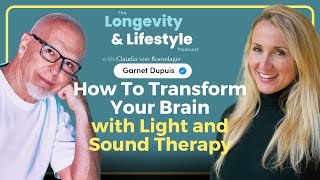
Garnet Dupuis created NeuroVisor, a light-and-sound platform designed to shift brain states and raise neural variability, a marker of cognitive health. He argues adult brains stay plastic and capable of change, and that his technology offers controlled brain engagement without drugs. The conversation covers neuroplasticity, dementia prevention, and the risks of over-engineered biohacking.
Chapters
Welcome back, dear audience, to another episode of the Longevity and Lifestyle podcast.
I'm your host, Claudia von Boeselager, here to bring you the latest insights and learnings to improve your health, your longevity, your life, and happiness for longer. Thank you so much for being part of this tribe and wanting to be at your best each day. I'd love to hear from you, so feel free to follow us on Instagram @longevityandlifestyle.
My guest today is Garnet Dupuis. He is a pioneering figure in the field of brain wellness technology, particularly known for his work with NeuroVizr.
I've been using it recently and absolutely love it. So I'm very excited for this conversation. It's an innovative platform that utilizes psychoactive technology that combines light and sound stimulation to influence various mental processes, including perception, cognition, and mood. Garnet aims to bridge ancient wisdom with modern scientific advancements, creating a holistic approach to wellness. With a career spanning over 50 years, he has developed methods and devices that enhance human potential by exploring the interplay between light, sound, and consciousness. His latest project, the Lucid Algorithm, aims to revolutionize how individuals interact with their mental states through tailored light and sound experiences. Through his efforts with his projects, Garnett is not only pushing the boundaries of what is possible in brain wellness technology, but also offering accessible solutions for mental clarity and personal development. Please enjoy. So welcome to the Longevity and Lifestyle Podcast, Garnet. It's such a pleasure to have you with us today.
Okay, well, you know, I'm happy to be here. I've been waiting.
You know, Thailand and I'm in cold London at the moment. So I'm quite jealous.
We scheduled this some time ago. And I have it on my whiteboard. I'm a real visual guy. And I'm waiting for like erase and then erase. It's getting closer and closer to Claudia von Boeselager.
It's like Christmas countdown.
Yeah. Well, okay. Fair enough.
Hoping with the same joy. So I'd love to start off with Garnet about your personal journey and how did you get into this field that I just find so fascinating? And what sparked that initial interest to really go deep into new technologies around brain wellness?
I think it would've been more of a decision to not do it than do it. Mm-hmm. Um, so it's not like how I got into it. It's like I have found no way to get out of it. And I'm being partly playful, partly honest. Um, I'd say that, uh, in honesty, again, it's a little romantic to kind of reflect on your past. Uh, but I can say that I've I think I've always, not I think, I know that I've always had a kind of a relentless appetite for the divine. I don't know what to call it. Sacred, special stuff. I don't know. It is the North Star for me. And I've had repeated continuous good fortune. And part of that good fortune has been to not do things that would have taken me away from that. Of course, I've screwed up all over the place. That's not—
we're human.
Let's not get too, like, mythic about the whole thing. But, um, yeah, I think that, um, let's call it consciousness or the divine or something, uh, that it is, um, to me, the, the, the core fascination and, um, I would say even the core purpose.. And if I can be involved in that, then I'd say that is a kind of, kind of a confidence enabler that I'm kind of doing the right thing. And I think there are lots of different versions of the right thing, as you are doing the right thing. But to make it personal, that's been the journey. You know, I've been a Hmm, a sincere spiritual practitioner. Not quite sure what that means. You know, raised a Canadian farm boy, a very classic Roman Catholic upbringing. I'd say that Roman Catholicism gave me an early sense of the mysterious and the moral, which is a good framework. There's a lot about the religion that is not so conducive, but, you know, to have these at that time, the Latin Mass and, you know, this whole, this specialness, you know, that there was something special that was different than ordinary life, at least ritualistically, theatrically. And I felt, um, I felt good to want to know it. So that, and you go all the way through everything else to here. That's the executive summary of my journey. It's something like that. Beautiful.
And so how did that, or what was the path? What were the life events that brought you more into, I guess, that brain wellness, brain technology light? Would love to hear more about that.
Okay, well, the short story again, because we can always make our life quite a long story, but that I think two things that I can recall back, you know, I'm a little bit older than you, which means that there's more calendar there. I entered university in the late '60s and everything that you might have heard is probably true. And the, I was again, you know, the appetite for the divine, I'll call it that. There was very little resource at the time in the late '60s, '70s, you know, that period. And I looked, you know, books, there were like, you know, the spiritual bookstore, you could, you knew it was there, you could smell it a block away from the incense. And it was about the size of a parking space, not parking lot, parking space, because there weren't enough books. And anyway, cut that. I figured I'm going to start with the body because I don't know, but, you know, I was a psychology major and that was a big disappointment. And, you know, that, okay, what, you know, you read William James' Varieties of Religious Experience and you try to figure out what in the world Blavatsky was talking about. A lot of books have no idea. That, okay, I'm going to start with the body. The body's here. I'm going to start with that. And then I'm going to graduate from the body into the mind, and then eventually from the mind into the spirit. And like a rocket taking off, SpaceX— well, bad example because they retrieved it, but you drop off. I would drop off the body, then I'll drop off the mind, and I'm going to be out in the distant space with just the spirit. And, um, that was a good motivator. It proved not to be true that the body stayed and then the mind connected with the body and then the spirit connected with the mind and the body. So I kind of ended up holistic. So that was one point is I figured I have to start with something. I'll start with the body and it never left. Hence spirit, soul, mind, brain, everything. It's just one thing. Second, more about the technology. I do remember a night, an evening, there was a band playing, and of course it was fabulous music invented at the time, and with no social media, you know, LPs, and we would try to, because there were psychedelics as well, you know, surprise. And so you take an overhead projector, you take it from the media department, nobody's looking, and you shine it on the band and you put food coloring and oil on the overhead and then you have plastic and you have this like, happening, you know, on and behind the band. Which was pretty cool, sort of. It was a simulation. It was not a stimulation. It was a simulation. Then, and I was unprepared for it, somebody hit a strobe light. And when that strobe happened, there was an immediate state shift that was significantly different than just the oily colors on the band and the wall. And I had the distinct recognition of what a simulation is and what a stimulation is. And I thought, wow, what can, what can move my mind so quickly, like in an instant that can be turned on and turned off. So I ended up with a big, actually it was a duffel bag. Full of strobe lights, black lights, anything anti, anything I could find. I was either the most welcome guest or the terrifying arrival at, in the dorm room or at the party because, you know, most everybody at the time, if you're enjoying the evening, it was either weed, which is less controversial now, or some psychedelic, still, but, you know, so mixing an appetite for the divine with state changes of mind that somehow involve a technology has pretty much been the imprint of the journey.
I love that, that these freak circumstances or, you know, someone probably just turned it on and thought, oh, let's see what happens. But how that then triggered you, that inspired you, right, to go down that rabbit hole.
So what has triggered or inspired you? This is like, this, this is a, we got to, it's a give and take conversation.
It's a give and take. And I think, I mean, yeah, so happy, happy to share as well. I think my audience will know, listening to me for a while, or if somebody's new, obviously, then, then not so much. But I think for me, I've always been fascinated around my mother has a medical background, you know, since I was a little girl, my mother would never let me go to a doctor's appointment without a list of questions, which means I had to always research like, what am I doing with this? It was always kind of that. Thinking, tuning into self, understanding, uh, what is going on. Um, and then I think from the health optimization space, I, I used to just kind of cut myself off from— it was just very cerebral, uh, A-type, had to be perfect.
Um, I told you, start with the body. I told you.
Yeah, exactly. And I just— cutting off the body, even just literally just the, the mind. And, and, you know, going from there and pushing yourself so hard that, uh, and thinking, you know, I can sleep when I'm dead. And, you know, back in my 20s, I could manage on 3 hours.
That's a, that's a horrible line, isn't it?
I can sleep on that. Now I'm just like, so shame, shame, you know. But we learn, right? We learn from our experiences. And, um, you know, I had 3 master's degrees and ended up in investment banking working 100+ hours a week. And, you know, thinking, you know, is this supposed to be it? Like, is this somehow some total disconnect to purpose and impact, etc.? And went into, you know, being a tech entrepreneur and doing different ventures and was interested in sort of the biohacking, health optimization side of things too. But as different circumstances in my life, including like with my, my mother, um, she got dementia and started to deteriorate, um, you know, getting out of a toxic marriage at the time, different things like that too. I think that you need certain triggers to bring you down a more spiritual journey, right? So where you start kind of realizing that there is more to self, more to life, more to impact. And I truly believe in like, you know, for me there's the triad of longevity, right? So there's different people have different definitions.
Okay, I'm going to— I have to I'm gonna stop you right now.
Yeah.
Let's jump on that because when I looked at the podcast, a longevity thing, and I thought, hmm, we'll probably have to talk a little bit about that, about this long life thing. And then you mentioned, and I'm sorry to hear your mom with dementia. And I've heard a stat, you know, it was on the internet, so it's gotta be true, right? That, um, that in industrialized countries, persons between the age of 80 and 85 have— this is the stat, it's dramatic. I'll assume it's reasonably correct. Persons between the age of 80 and 85 have a 50/50 possibility of some degree of dementia.
Yeah. I mean, they call it a senior moment and things like that too.
Yeah.
Yeah.
Little euphemisms like that. So what do you think? Uh, I'm not really a big proponent of extreme longevity. Um, you know, I'm 75, so, so far spring chickens, spring chickens. Well, yeah. Cluck, cluck, cluck. But so the, this issue. Of longevity, which tends to be principally somatic in characterization. What about the cognitive element of that? And I mean, it's like you're 82, happy birthday. Let's flip a coin. 50, you know, heads, you're okay. Tails, you've got dementia.
Yeah. I mean, but what starts with an 8, what you think starts at 82 actually started in your forties.
Well, that's a very early dementia. So that's an outlier, but okay.
The inflammation, let's say, in the body, the buildup, right? A lot of these diseases are 20-plus years in the making and we don't tackle them on time. And so part of what I'm, you know, love to inspire people is, you know, how do you step into the highest version of yourself today in body, mind, and spirit so that you can live like that as long as possible? And then at the end, you want to kind of go like, oh, died in their sleep, whatever that age is. For some, it might be hitting 90, another might be, you know, 100. It's not about the length in terms of that longevity. It's more living the fullest life that you can already today and not going down the route of chronic disease and illness that is so prevalent. I mean, my father also has cancer and countless relatives have had TIAs, you know, sort of mini strokes and different things like that as well. And it's just so sad, not just for the person, but for everyone involved, for the whole family. And it's so needless as well. So it's explaining, you know, and letting people know there are different modalities, there's different things that you can be doing already today. A bunch of them are free, other ones don't take much time, like the beautiful NeuroVisor, right? Um, which I'd love to get into more as well, by the way.
Nice plug.
You're very welcome. Yeah, because I love it. I haven't— since I've got it, I'm obsessed with it. I got it, so very much enjoying it too. And so, yeah, to answer your question.
Okay. Well, those are all nice things and I agree with them, by the way. Then there's, you know, the you and me, the real life that we live and the people that, you know, X, Y, Z. I guess to turn this in a certain direction, what can technology do that is positive? Because there are lots of opinions about what technology is doing negatively. What can technology do positively? And, you know, the phrase, I don't, I didn't make it up. I borrowed it. I don't know from where, but biophilic technology, biophilia, love, bio, life, life-loving, life-supporting technology, not biophobic technology, like all the movies, but the, the biophilic technology. And I look quite a lot at this extraordinary mood-regulating psychedelic thing called music. Music, psychedelic meaning mind-manifesting. And I've noted that there was no saxophone music before the saxophone instrument, that the musician may have had a feeling that they wanted this in-your-gut kind of you know, slightly raunchy, but real kind of rough, but smooth syrupy-like, but they only had a trumpet or a flute. And no matter what they did, they couldn't get it to be what they wanted. So a guy named Adolph Sax, I've actually researched and I was like, who made the saxophone? So he did. And now we can have saxophone music. So I think for us to design technology based on an actual appetite of something that we want and need and use that to design the technology, as opposed to designing technology just because you can and you wonder, oh, what can I do with it? You know, I worked with some Russian stuff in the past, very, very amazing neuroadaptive regulating technology. And, and we, you know, at one point it was like, oh, we've got these new features in it. And we, and the engineers put it in and we said, well, I mean, I'm making it very broad, we and who. We said, well, great, you know, what does it do? And they said, we have no idea. We thought you would find out, but we, we decided that we could design it and put it in there. So to me, that's kind of the blind way of approaching things.
Yeah.
Um, and because you've mentioned it, the NeuroVisor, which is this light and sound brain engagement device, has come out of my appetite. And the appetite is this relentless appetite for the divine, to go back to that phrase. Maybe that's a little overstated, but there's an appetite. That I have for specialness, for the extraordinary. You know, if you have a choice, some people say we have choices about everything. I'm not sure. But if you have a choice, you want to go to the movies, do you want to see an average movie or an above-average movie? Would you like to see an extraordinary movie or a kind of an ordinary movie?
Well, you're always going to go for the best, right?
You kind of want that. Now, you know, if our life is a series of mountains with peaks and valleys, in a 1,000-mile mountain range, all the peaks combined might only be 5 miles of peaks. And I'm playing the analogy a little bit. For as many peaks there are valleys, so most of our life, it seems, to follow the visual, we're either going up the mountain or down the mountain. And to have an easier access to extraordinary qualities of consciousness can enable the aspects of life that are more ordinary to still be special.
Can you explain that more? Can you explain that more? How it makes the ordinary parts of life more special.
Yeah, that having enough time spent in extraordinary states. Now, I've been a lifelong meditator, you know, very sincerely attempting my, you know, first Hindu guru, you know, ashrams, the whole thing. And then a Korean Taoist teacher, that's like 10, 12 years, 10, 12 years. In the past 30 years or so with a Tibetan Dzogchen teacher. And I have a very high respect for tradition. I'm kind of a conservative guy and I respect teachers. Okay. So what I've noticed is that the peak experiences, by their very nature, I suspect physiologically cannot be sustained for a very long period of time. They're very high energy states. They're amazing, but they're also quite demanding. So do I keep on changing? Like, if I'm in the— because I also live in the mountains, I can't always be on the peak. I don't want to be in the valley, although sometimes I am. But what I noticed that I mean, to follow the image, most of the time you're either climbing up or climbing down, which is like most of your life, you know, most of your days, like my days, are filled with rather ordinary experiences. Mm-hmm. But the peak experiences, and I think weirdly also some of the valley experiences, can be harvested in such a way that the ordinary may not be extraordinary, but it becomes increasingly more special. Hmm.
You know, so by accessing the peaks, you're elevating the valleys, essentially.
Something like that. But we can play with the with the image, but the point that for those of us, my early impressions of spirituality was going to be all, you know, Dakinis and rainbows and, you know, multidimensionality flights through the cosmos or something. And there have been a few of those, I'm pleased to say, but it's mostly the, and the lows as well, because I've had a good number of those, like any life. That the combination of those peaks, and then when the shit hits, pardon me, when you're in the bottom of the valley, that they can work in such a way that the, the, the average aspect of your experience becomes increasingly more precious, becomes more special. And that I think is a good game plan. And that's the thing with the NeuroVisor is pursuing brain physiology in such a way that you have a chance to keep on doing these well-controlled kind of brain resets where you move up into higher entropic states, higher levels of brain signal variability, where you let go of the certainty, and you're susceptible to novelty, to imprinting specialness that exists there, and then letting the brain cool back down to a more ordinary state, but it's gained evidence, it's gained information that the ordinary state normally doesn't give you. But you bring it back home. It's the hero's journey. You gotta go all, I mean, you, that's it. I mean, it's duh. Beautiful.
No, but for you it's not, but for many people they don't hear your wisdom, Garnet, so.
Well, you know, I mean, nothing new under the sun, some people say. I don't know. You know, I had the great good fortune of spending the birthday, turned out to be his last birthday, with Buckminster Fuller. And it shocks me that there are some people that don't know who he was. It's like, come on, guys, you got some history here. But anyway, he's a remarkable man. The, the prototypical forgetful genius scientist type. There's so much there. But anyway, so it was a small thing. There were about 7 or 8 of us at his home. And, um, a few things stood out, but one was I gave him a gift. Like, what do you give the guy? So I gave him this brass Chinese character you could either put on the wall, by the way, it's still in my office. Or you could put it on the table as a tea caddy, because he and his wife used to drink tea every morning. So I still, there are tea stains on it. I said, Bucky, here, here's a birthday present. So he was 83. And, um, he said, oh, what does it mean? I said, well, Bucky, it means long life. That's what the character is. And he looked at me right away. He said, long life. What good is a long life? If you don't do something good with it. Great. So thank you, Bucky. And so about longevity, and by the way, they had a knock on the door and a traditional, I don't know, you know, a singing telegram, right? So this really cute girl with the classic outfit, you know, does this whole thing, singing telegram at the door. It was fantastic. His response was, to climb up on top of the baby grand piano and sing and dance a jig back to her.
Back to her.
Back to her. Yeah. So what a character. Longevity. I think we're at a great point. I don't know if it's great, but we're at a point where I'll frame it like this to borrow from the gay community, that I think it's time that consciousness comes out of the closet.
Yeah.
Yeah. And we see that academically.
Right?
What do you think? Is it time for consciousness to come out of the closet? And what does that mean to you?
Yeah. So I feel that there is a fundamental shift of consciousness on the planet. I think COVID was a real inflection point. I think some people went into crisis and fear mode and was very exposed to media and just believing things. And I think other people were like, you know, wait a second, this doesn't feel right. What else could this mean? What else could be happening here? What else do I want? And, you know, across the board, speaking to different people in different spaces, different industries, there's, you know, saying from people not willing to work as hard or as long anymore in, you know, big corporates to completely leaving that shifting to wanting to be more free, to have more time for self, to meditate, to find themselves, to be at peace and just not accept the status quo, what we are told to do anymore. So I feel that there is this beautiful sort of awakening almost, right? Anywhere in the world, in different places, to wanting things in a different way. Yeah, you're laughing.
So is this the dawning of the Age of Aquarius?
You're like, I've heard this before.
Well, you know, That's the point. You know, as I said about the age thing, to me, a lot of this is kind of the sequel.
The sequel, part 2.
Kind of the sequel that, you know, the late '60s, you know, a few of us were there that are still alive. That, and I'm not playing the age card, by the way, that, but it was, it was a big change. It was everything that you said, slightly different words were being said then that we don't have to work in a corporation and we don't have to wear deodorant. I lived in a house with a number of friends and this one woman decided, you know, oh, you know, I'm not going to shave my legs and I'm going to grow my hair and I'm not going to use deodorant because it's aluminum. And the whole house smelled like her. It was horrible.
There are other ways. Yeah.
Yeah. Okay. Okay. Okay. My point being, the, um, the great, it seemed like that was, uh, a time of awakening, you know, that it was anti-war in the streets. It was free speech. It was a women's movement. It was desegregation. It was a gay movement. All of these things were happening without social media. It was all interactive person to person. Hence it was in the streets.
Yeah. And interesting also with psychedelics, right? And psychedelic compounds and the finding of self. And now we're having the renaissance of psychedelics again.
Renaissance is a lovely word for it. Okay. Okay. And then also, it was the birth of the health food store. Right? And the spiritual bookstore.
That was the size of a parking lot back then.
Believe me, if you weren't eating a lot of wheat germ every day, it's amazing that you're still alive because, you know, and lecithin and, you know, and of course alfalfa sprouts, you know, alfalfa sprouts, lecithin, and wheat germ. You got it. I mean, you've, you've nailed health and longevity and it's natural.
Well, exactly. Exactly.
Okay. Yeah. So I'm playing with you because it's fun. And, but I do wonder what, what sense of, I don't even know where I'm going. I'm just enjoying our time together. But do you feel there's a kind of, like, do you know enough of the history of this to know what will work and what won't work? Because there were successes and abject failures as well. Uh, we're imprinted with a lot of those values now. But do you feel that you, because I see you as a leader, I see you as an influencer, because I think you are, do you feel well enough educated or informed so that you're not leading your people, you know, those that listen to you blindly based on a naiveness Or do you feel seasoned enough to see the yeses and the nos? I'm really fascinated by this issue as a whole.
Hello, sweet friends. The most exciting time of year is almost here. Black Friday and the holiday season. It's the perfect opportunity to give the gift of health to yourself and your loved ones. I've curated an exclusive selection of the best longevity and health optimization tools products I personally love and trust, all available at special Black Friday prices. From essential biohacking tools to transformative wellness products, these deals are simply too good to pass up. So visit LLGiftGuide.com now to uncover these amazing offers. But hurry, they're only available for a limited time. These offers are perfect for enhancing well-being and make thoughtful gifts for those you love. And you can share the website link with your nearest and dearest, so they might know what's on your holiday wish list too. Take this opportunity to improve your health, boost your energy, and embrace a longer, more vibrant life. Visit LLGiftGuide.com, that's LLGiftGuide.com, now before these amazing deals are gone. This episode is brought to you by OneSkin. If you're like me, you know the power of feeling confident in your skin, and that's why I'm so excited to share today's sponsor, OneSkin. Their products make it simple to keep your skin looking and feeling healthy, strong, and vibrant without the need for complicated routines. It's all about science-backed, effective skincare. OneSkin's secret is their proprietary OS-01 peptide, the first ingredient scientifically proven to target and reduce aging cells that cause lines and wrinkles and thinning skin. I've been using their products for a while now, and the difference is amazing. My skin feels refreshed, hydrated, and looks younger. But don't just take my word for it—OneSkin has over 4,000 5-star reviews. Now is the perfect time to try it for yourself. For a limited time, get 15% off your first OneSkin purchase using the code Claudia15 CLAUDIA15 when you check out at oneskin.co. That's oneskin.co. Start your journey to healthier, younger skin today.
Very good question. A lot of responsibility behind it as well. So firstly, I would say the more I know, the more I know how little I know. And obviously it's not my post and I'm an eternal student, and which is why I love to have conversations with amazing experts in different spaces as well. I think that the body, mind, and spirit are very, very complex. I don't think any human will ever get their head around everything that there is to know as well. Um, and this is also where I think that yes, there is certain science, certain modalities of thinking that are, uh, that resonate with, um, truth with, um, that. But everyone is also different, and which is why I firmly believe, not only, you know, as a caveat with some recommendations that are made on the podcast from different experts, you know, do speak with your medical professional, but also to regain and empower oneself, to regain that inner trust. You know, does this resonate with me? Is this what my body needs? Is this something that would work with me? I mean, we were joking before about the keto diet. This was, you know, an earlier version of myself.
That's your wheat germ. Phase.
The wheat germ version. Exactly. And I was like, this is great. But obviously as a female and a very complex female hormonal system, that at certain periods of the month everything was great. And then other words, it would really like no energy and you'd be exhausted. And I, you know, I was just telling Claudia, if I'm going for a liver scan after deliverance, um, out of curiosity, but just to see, you know, what implications this might have as well. So I think that A, we are human and we learn as we go along. But B, it's to empower people to tune into themselves as well and not just blindly, oh, my teacher, my doctor, whoever told me. It's like, well, what feels true to me? Like, what does my body actually need? And I feel that there is so much wisdom, innate wisdom, but we need to relearn how to tap into that and understand. Not saying that we're going to become the guru of everything, but Um, yeah, I think Claudia, I think that sounds great.
I think it's a lot of nice stuff. All right. Uh, I really do. And, um, I love the play element in getting to know somebody and, uh, in this case, getting to know you. Mm-hmm. Um, I've heard it said that, uh, you know, the, in, in a chain, you know, it's the weakest link. That breaks the chain. So relying on all those things, positive, where there's strength, where do you feel— trying to shape the question— where can what you say, which is all good and positive and real, where can it screw up? Like, what— where's the caution in that so that, that the weakness you know, the Achilles heel, famously, the unknown weakness. Where, like, what's the, even with all that good stuff, which I applaud and I agree, what does a person need to be aware of or cautious or, you know, like, ah, shit, never thought about that. I'm sure you did. Like that thing.
Uh, okay. And then we're going to switch back to neuroplasticity and go back into the work that you're doing as well. But I—
Listen, we can do this thing again. All right.
Yeah, yeah, yeah. This is, this is fun. Flipping it around. I love it.
There's no rule.
There's no rule. We only have to do it once.
Now it's beautiful. All right.
So I think I'm looking at it from different perspectives. There's one is like the biohacking perspective, right? And it's like, how do I optimize my day? Okay, I'm going to get up and I'm going to do my breathwork first and I'm going to do this. And so it's, it's the Achilles heel in that is that you're over-engineering everything, that you're missing the point because you're taking the joy out of life. Teacher, teacher, teacher. By killing yourself. Good.
Can I tell you my definition of a biohacker? And they're all my friends and I speak at the conferences, I think, and I've said this before, so no one's gonna like be shocked. I think my definition, and I own it, of biohacking is a social media supported, technically advanced narcissism.
It does get very narcissistic because you're like, I don't have time to even talk to you because I have this in my schedule.
And like, okay, so thank you. Keep going. I've asked you a kind of a tough question. Where can things screw up? And you're pointing out over-engineering can be a screw up. Keep going. I'm fascinated.
And I think it's missing the joy, right? And then it's just becoming very much the body focused and optimizing the body, et cetera, and missing that. That joy and human component. I think that there's also a spiritual Achilles heel component with the spiritual bypassing, which I'm sure you've come across the term as well, where, you know, we can make light of— no, it's not for me, definitely not for me. But yeah, I feel like it, you know, it's people who are discovering, you know, more spirituality and things too, that all of a sudden they're like, oh, but I can't even exist in society. And I think that the the beauty, but also the challenge is to combine living in day-to-day life, not shutting it off and just saying, I say no to this. And I don't want to be involved in, oh, these people are bad because they're living a normal, average life, whatever you want to call it. The normies, right? Exactly. Whatever you want to call it as well. And I feel like it's understanding that we are such complex creatures that there is always something to learn and to improve. But For me, my thing is, you know, how do you help others? How do you give back? It's not about you. Yes, I have moments I'm thinking about me or my kids or my family, whatever. It's like, yes, of course. But I firmly believe that the true happiness in life is when you can give from the overflow of your cup and help others in a greater way to, to create impact. And that's, I think, the beauty of a lifetime, or this lifetime, or any lifetime, essentially.
Where do you assign authority? Like, who do you listen to? Who, you know, your new life coach?
That, you know, the answer is everyone, Garnet. I've lived in over 9 countries around the world. I've, I'm proud to say I have a very broad spectrum of friends from every walk of life. And from every single person I meet, I can learn something. And I am very humbled by that and I'm very curious and I love to learn. And so therefore I don't have, you know, the one person. And I think for everyone also listening, like, that's the opportunity in life is what is it that you could learn from the person serving you the coffee or here, or that's standing beside you in a line or whatever it is as well. And that we have that social connection interaction again, it's like, you know, there's maybe a reason why this persons come knocking on your door or whatever it might be. Right. So are you a mom? Yes, I have 2 kids. Yeah.
You have 2 kids.
How old are they? Yeah.
8 and 10. 8 and 10. Oh, that's right in the pocket. Yeah. Things all ease up in about 12 years or so.
How many kids do you have? No, I think this is a— I'm really loving this age actually as well. And they know about my work. The challenge for them is that they know too much about unhealthy foods. My daughter was telling me last night that she was asking the lady in their school kitchen what type of oil they use for cooking the food and if it was a seed oil. And the woman was quite flustered. And so she had to then go get her colleague. She's like, why do you want to know? She was suspicious. And she's like, oh, I'm just curious. She's 10. And the woman said, we use sunflower oil. And so she just wanted to report to me, but she knew well enough to not criticize them that They're unfortunate using seed oil, but—
Do you think women have an advantage over men because you get to be— you bear a child and generally rate— do you think you have an advantage over— do you have an advantage over me? Excuse me.
We are all created equal, Garnet. We all have our strengths and we all have our weaknesses.
You could consider politics, by the way.
I'm known to be diplomatic. I think that is from my international background. All right.
So, um, this is sort of going all over.
I think, yeah, I'd love to tune back in in the time that we have to find a way to turn it. Yeah, exactly. So, well, thank you for the tangent, but it was, it was very fun.
It's not a tangent.
We'll have to do it. We'll have to do part 2 of our conversation as well. Um, but I'd love to tap back into neuroplasticity and people perhaps listening who are not that familiar with it. What is the Why is neuroplasticity so exciting, first of all, and then why is combining it with light and sound, what you were doing with the NeuroVisor, so fascinating and so empowering for people to understand?
Well, I think, you know, one of the responsibilities of science is to prove when science is wrong. And one of the things that science proved to be wrong was the longstanding concept that the adult brain reaches maturity and then is not capable of any further dynamic positive change, that you've only got a certain number of brain cells, brain neurons, they're going to die one by one, and you're screwed. That kind of position was radically changed with the concept of neuroplasticity, meaning that to some degree, with the proper forms of stimulation, your brain and even mine at a more advanced age still has the ability to change in a positive way. So, the simple statement that I say is whatever the state of your brain today, it can be better tomorrow. Now I'm not claiming by how much or in what way, but it can be made better. And I think we've learned a tremendous amount from somatic experience. Usually we call it exercise that, that even a mature body can be made better functionally with some amount of focused, targeted change, exercise. And it doesn't have to be a lot. Now, what goes along with that, and you did it very early on, but I didn't point it out, is that we've, we've kind of thought that up here is not the body. The body is from here down. And guess what? Uh, our brain, yours and mine, is physical. It's as physical as your heart, as your spine, as your hamstring muscle and ways that can be better understood. It is possible to engage the brain in a training exercise-like fashion so that the brain starts to perform better. So neuroplasticity, guess what? It's what we know about our body and realizing our brain is physical. And everything we do with our body is also being done with the brain. Right now, this is what a brain looks like. It looks like this. It doesn't, it isn't just this thing under hiding in here. This is the brain. So expanding our understanding from what we do know into what we think we don't know. Well, guess what? It's not that different. So how do you train or exercise the brain? Well, the principles are rather well known with the body as a whole, that you have to bring your attention into an action. And that action needs to be what's called marginal demand, just a little bit more than what you're normally able to do. Not a lot, just a little. If you can lift 20 kilos, I'll give you 21, not 30. So bring in the attention, marginal demand, an open-minded willingness. It's not like, I hate this shit. My husband's making me do it, but I'll do it anyway. No, it's like, okay, I'll give it a chance. You don't try to prove it wrong. You give it a chance. Those are 3 things, focused attention, marginal demand, and an open-minded willingness. The fourth thing is the secret sauce. If you've got the fourth, all those three are like exponentially better. It's a very complex neurohormonal state, but if you can have that, it works better. It's called enjoy. If you can enjoy it, yeah, everything works better. So this is the rather crude but factual design principle of something like the NeuroVisor, or specifically the NeuroVisor. It uses light and sound, not for brain entrainment, if you know what that is. It's not the frequency following response. It's actually the dynamic frequency response. I've had to make up a new name, so it's called brain engagement. It engages the brain in incremental neuroplastic change. Two kinds. One I call a brain break, which is like, I just need something. You know, I'm so, I'm a very conservative, boring guy. I don't drink alcohol. I don't smoke cigarettes. I don't smoke weed. I don't do psychedelics anymore. You know, it's like, ah, what do I do? Well, I'm pointing right now. You can't see it. I, a couple of months ago, I bought this awesome automatic massage chair, you know, a whole thing. It's pretty damn good. It's pretty damn good.
Can you do that while doing the NeuroVizr?
You can do that, but you know, I try to achieve the most doing the least. I'm not like, ah, I have a very low threshold for excitement. So a little well done goes a long way. So one way to use the NeuroVizr is what I call a brain break. That if you just need a short-term state shift, It does it. And then you, there are a lot of sessions to choose from. And the other is a little bit more long-term planning. It's trait shaping. So short-term state shift, long-term trait shaping. Because in neuroplasticity, you can have just synaptic activity that is neuroplastic, but is very short-term. Easy come, easy go. But hey, that's not a bad thing when you're having a hard time. You know, if your back hurts, you do a couple of back stretches, you feel better, that's great. But don't think that that's going to create long-term low back health if you got a back problem. Sure. So the, the second, the long-term is a high-energy brain reset. And that's where it gets a little bit more technical where low brain state variability, signal variability, like there's heart rate variability. Yeah.
Let's talk about brain, brain signal variability. This is—
yeah. Brain signal variability is where it's at. This is what's happening right now. Before we thought that regular heartbeat was really good. Now we realize, oh, it's really regular, but I have a heart attack. That you have to have this subtle variability between beats. What is that? That's actually the immediate adaptive response of the autonomic nervous system. It's keeping you alive by always adjusting slightly. Well, the brain is that 10 times more.
10 times more. Just to pause 1 second on that. So for people to understand, with heart rate variability, you want higher heart rate variability. So you want the ability to adapt for the heart rate to speed up, but also to calm down. In a very flexible, elastic way. And so just from a heart perspective, how does that apply to the brain and different brain waves, Garnet?
How does that work? Well, it's more than brain waves, although they're involved. That to go back to the heart, or as an analogy, I want my car engine to be very regular when the pistons are going up and down. I don't want a little, little, little. I want it to be very like that. We've made the mistake of attempting to apply the physics of mechanics to living organisms. And living organisms are fuzzy and noisy. They're always, we're always dancing away from entropic death. We know it's called the far from equilibrium state that you think you want balance. No, you don't. Balance is called you're dead. It's an entropic, you know, stabilization, like it's called flatlining in more than one way. So we're always cheating death, I guess you could say, by having this variability, this ability to always be working at actually a somewhat imbalanced state with the rest of things. You know, my body temperature inside should not be the same body, the temperature of this room. Okay. So if you imagine that our brain, I won't tell the whole story, but imagine a cloudless sky on a full moon night with no wind after a fresh fallen snow. And you're walking in, because this is my experience, you're walking in this field at 2 AM, the moon is there, and the field of like no footprint, it's like you're the first being ever to walk there, is shimmering with kaleidoscopic billion trillion zillion diamonds of pink and green and blue and everything like that. It is just shimmering, shimmering. Our brains are like that. Our brains are shimmering with activity. And, you know, when you talk about a brainwave like 40 Hz, everybody's excited about 40 Hz. 40 Hz doesn't exist. That's a mathematical lie of convenience. 40 Hz In the brain, once in a while it hits 40 Hz, but usually it's 40.673225499, depending on how many decimal points, 39.6722244. You know, it's like, ah, it's too many decimal points. Let's just average it out. It's close enough. So variability exists at about, well, right now, 10 different aspects of variability, not just frequency variability. Network variability, amplitude variability, whole brain variability, that this is the jump into an understanding that we've run away from because our science has been too mechanical. Biological systems are very noisy, very dirty, very fuzzy. Why? Because they are doing this to stay alive. Against a complete entropic plane of death. So knowing how, if you imagine that your brain and mine, this is a crude analogy, but it's a 20-story building right from the lobby all the way up to the penthouse, 20 floors. We have an elevator that goes up and down. The low floors signal stability, order, predictability, repeatability. And the top floor, the penthouse brain flexibility, signal stability, signal flexibility, very loose, very variable, filled with a lot of possibilities. So we own that whole building. We go up and down the elevator to engage with experience. Generally speaking, the adult brain without any additional influence reaches its peak of having the elevator move up and down at around mid-forties. 6 months ago, MIT released a gorgeous study on this point. They have a lovely graph, starts at 0, goes to 90 years old, and you see this arc going up at the acme around 40, mid-40s, and then a very predictable decline down, back down to 0 again. The aging brain fundamentally loses the ability to go up and down the elevator, it tends to stay in the lower floors. And it is rock solid measurable. It's not that sophisticated. You can do it with good algorithms in EEG. So, and by the way, if there is dementia, that fall is precipitous. So Uh, the last point that I'll make is in that building, all 20 floors are yours. Where do you put your home? On which floor do you live? What's your default floor? What would you guess?
I would almost wonder, would it be different depending on the person and the need for safety versus the need for opportunity?
Well, okay, it's modifiable, but guess what? As humans, we have a rather stable internal temperature, right? In Fahrenheit, 98.6. So sorry, that one doesn't work.
What would you guess? In the middle? Or is it towards the safe team?
Yeah, I'm, I'm native Canadian, so I always go for medium. You know, small might be too little and large might be too much. So just give me a medium, like for a soft drink, right? The, okay, again, as an analogy, so don't take this literally., but your home ideally is on the 15th floor because you have to be closer to rapid spontaneous adaptation that if you're halfway, it's too far to get there. You want to be closer, but you do want to be able to take the elevator down on demand. However, and it's got a gorgeous name, Claudia, it's a gorgeous, like Claudia, it's a gorgeous name. Uh, they call it the sweet spot of criticality. Oh, interesting. Yeah, like critical from physics is like when water changes to ice, that's at the critical point for phasic change. So all of this, the ability to move up and down variability is a measure of criticality. And the place, your default, I say where you want to live, where you, you know, when you go and kick back, is at a higher level of variability. And it's called the sweet spot of criticality. So my goal is with the NeuroVizr as one example of a technology that is non-drug and non-invasive to be able to, one, exercise that ability to move up and down, to bring you safely up into the higher floors like a psychedelic does, but without all of the control issues of a psychedelic. And to move you down again so that you have this chance to create not only brain breaks, which are very relieving and attractive, but a more progressive plan for a longer-term trait shaping by going up, spending time, and coming back down. And it's crazy. I'm, I'm assertively pursuing this of being able to measure because everybody wants to measure everything these days. It's like, you know, you know, let me see, you know, how well did I sleep? Let me check. You know, how funny was that joke? Let me check. So the, the importance of, because this is our authority now. I asked you earlier about authority. We have a, a relationship, a love-hate relationship with science. It lends authority. Like you're going to go have somebody look at your liver. They're not going to like, do a pendulum over your liver, although that could be good. They're going to do some kind of, you know, assessed metrics. Yeah. So it's kind of like that. And I'm responsive and respectful of your hour limit because according to my timepiece, we hit there. Sadly, already.
Time flies when you're having fun, Garnet. So I would love to have you back for round 2 because there's So many questions I still have that we haven't had a chance to dig into, but it was such a joy and conversation to speak with you and get to know you as well.
Before we sign off, by the way, I'm happy to come back.
Yes, I know. I'd like to invite you for round 2, so we'll have to make you wait too long. Too long. No, and not so long. Exactly. We'll organize that for my listeners and people watching interested in understanding mental health, neuroplasticity, light therapy for the brain as well. Where would you send them to? Is there any online resource or books that you would recommend they start with?
Well, sure. I mean, there's my website, neurovizr.com. V-I-Z-R. It's a sound-alike. Don't misspell it. V-I-Z-R. Yeah, I mean, it's loaded with stuff. If you happen to have a NeuroVizr, we're just launching now a community circle, which is a whole platform. And I think we just went hot today with the first course that I designed for basic concepts. It's written stuff and I also talk a lot. So you can, that's that. I think that, you know, Norman Doidge, D-O-I-D-G-E, D-O-I-D-G-E, Norman Doidge, psychiatrist, he's written Some few books on neuroplasticity and the brain, and each chapter is a kind of short story. So you can read almost any chapter in any order, uh, The Brain That Can Heal Itself and so on. So Norman Doidge, a little dated, but highly accurate and very inspiring. Uh, I would say that. Um, and wait for our next podcast. Exactly.
For our round two. Exactly. Well, we'll get into even more of the weeds, which I love. Where can people follow what you are up to, Garnet, and your work? What would you like to share with people? And we'll link everything also in the show notes.
Well, I think this new circle, community circle, is probably— the website is a website, and it's really great, and it's got a ton of stuff, The Circle is meant to, to create a community access, a multi, multi-vectored access point with a lot of stuff. So, you know, of course right now it's a community that we're building with people that have the NeuroVizor. So that's a limit. You know, I've been on a bunch of podcasts. You can search around. I don't know. I mean, come on to Chiang Mai and we'll have coffee.
What can I say? For tea, right? Yeah. Garnet, do you have a final ask or recommendation or any parting thoughts or advice for my audience?
Oh, I mean, come on, be kind.
Yeah. Beautiful. Thank you so much, Garnet, for coming on today. I look forward to our round 2, and thank you, dear audience, for tuning in. Yeah.
Claudia, thank you very much. You were very flexible and open-minded and heartfelt.
It's all my NeuroVisor training, Garnet.
Oh, is that it? Okay. That's it. But, you know, I appreciate that because, you know, I said to a person in my office here, I said, you know, communication is not sharing concepts. Communication is sharing a connection. And You know, I, today I feel in good part because, uh, you know, we're new to each other. I wanted most of all for me to experience a connection with you. And I feel that. And, um, you know, again, someone said to me on the comment, they said, you know, well, it's like this thing, you know, you can't talk unless you have a connection. So first connect. And talk, and I feel delightfully connected with you, Claudia von Boeselager.
Beautiful. Well, thank you, Garnet. That's such an honor. I love connecting also with you and our beautiful conversation. It was lots of fun. I loved it was turned around in the middle and stuff too. So it was a very beautiful conversation. And I'm excited for round 2. So I look forward to catching up again soon. Until then. Beautiful. Thanks so much. Bye.
Thank you.
More from Claudia









Can Psilocybin Slow Aging? The Study on Telomeres, Inflammation & Survival with Dr. Louise Hecker

