“Illness Is Optional” — Naveen Jain on AI, the Microbiome & Why DNA Is NOT Your Destiny
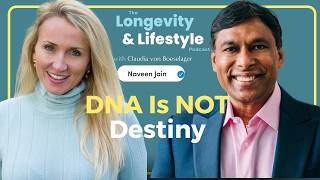
In this episode of the Longevity and Lifestyle Podcast, host Claudia von Boeselager interviews serial entrepreneur and Viome founder Naveen Jain. The conversation weaves together personal purpose, the science of the microbiome, and the role of artificial intelligence in scaling precision health. Jain opens with a provocative claim: 99 % of the genes influencing our bodies come from the trillions of microbes that inhabit us, not from our inherited DNA, and therefore chronic disease is largely a matter of daily choices rather than genetic destiny. He outlines a three‑question framework—Why this? Why now? Why me?—that guides his entrepreneurial ventures, from moon mining to health tech. Jain explains how falling costs of sequencing (from $1,200 per sample a decade ago to under $5 today) and computing (from $47 per analysis to under $1) have made it feasible to digitize the human body, creating a “digital twin” that can be continuously monitored. Viome’s Full Body Intelligence test combines saliva, finger‑prick blood, and stool samples to assess 100 million biomarkers, using AI trained on a curated set of 100,000 high‑quality research papers. The platform delivers personalized nutrition, supplement formulations, and lifestyle recommendations, with reported clinical trial outcomes such as a 0.42 % A1C reduction in pre‑diabetics and significant improvements in IBS, depression, and anxiety within 90 days. Jain emphasizes that microbial function—not merely organism presence—is the key driver of health, illustrating how Akkermansia can be beneficial or harmful depending on its metabolic activity, and how oral microbes can trigger systemic inflammation via toxins like gingipain. The discussion touches on intermittent fasting, noting mixed evidence and recommending a moderate 12‑14 hour overnight fast. Scaling is achieved through fully automated labs and AI‑driven manufacturing pipelines that can produce individualized supplements at mass‑scale across global locations. Jain also addresses AI concerns, stressing that AI learns from human‑curated data and that “garbage‑in, garbage‑out” is mitigated by CLIA‑certified consistent lab results. He envisions a personal health AI agent that integrates wearable, sensor, and clinical data to act as an administrative assistant, reminding users of dietary choices, flagging health anomalies, and coordinating care. The episode concludes with Jain’s motivational advice to dream big, view failures as experiments, and continuously measure biomarkers to iteratively improve health.
Chapters
99% of all the genes that are in our body don't come from our mom and dad. Despite us have a tendency to blame our ancestors for all the problems we have. If I get sick, I get heart disease, my first reaction is, I have bad genes. It's my damn ancestors that are causing me all these problems. Instead of say, it's not my genes, it is my choices. That I make every day that is causing me to develop heart disease. So blame your choices. Don't blame your ancestors. And that's the theme.
Hey there, I'm Claudia von Boeselager, a former investment banker turned entrepreneur, longevity coach, biohacker, and mother of two. Once burnt out and overwhelmed with chronic health issues, I've transformed my life and helped thousands of people do the same. I've even reduced my biological age by 17 years. Yes, I'm 26 again. Now I'm here to share the tools, strategies, and inspiration to help you live healthier, happier, and longer. On this podcast, I interview world-leading experts in health, biohacking, mindset, and performance, and share personal stories and learnings to bring you the latest insights and tips. Think of this as your go-to space for real talk about all things health and optimizing your life. Ready to unlock your best self? Let's Let's dive in. This is the Longevity and Lifestyle Podcast.
My guest today is Naveen Jain. Naveen is a serial entrepreneur, visionary technologist, and an ambitious thinker shaping the future of human health and longevity. He's the founder and CEO of Viome, an AI-driven precision health platform that analyzes the microbiome, human gene expression, and food responses to deliver personalized nutrition and lifestyle recommendations aimed at preventing, and potentially reversing chronic disease. Naveen is also the founder of Moon Express, the first private company authorized to harvest resources from the moon, and serves as vice chairman of the board at Singularity University, as well as a board member of XPRIZE Foundation.
Across space exploration, artificial intelligence, molecular biology, and education, Naveen is driven by one core mission: to solve humanity's biggest problems at scale. Scale, especially the global epidemic of chronic disease, by reimagining how we understand food, health, and human potential.
His visionary leadership has earned him honors including Entrepreneur of the Year and Most Creative Person.
Please enjoy. Naveen, welcome to the Longevity and Lifestyle Podcast. Such a pleasure to have you with us today.
Well, Claudia, the pleasure is absolutely mine, and what an honor and a pleasure to be speaking with you.
Honored to have you on. Naveen, you've launched companies, from landing on the moon, mapping the human microbiome. What is something about you or your mission that most people still do not know?
I think, you know, for me, it is about doing things that make you jump out of the bed every day you wake up in the morning. And this is my message to everyone who is listening to it, that find something that you're willing to die for and then live every day for it. That whatever that purpose in your life is, it doesn't have to be the same that everyone else has. It has to be something that means something to you. What are you going to dedicate 10, 15 years of your life to say, this is the problem I want to solve. I wake up in the morning thinking about it. I go to bed thinking about it. I cannot wait to jump out of the bed when I wake up in the morning because this means a lot to me. And once you do that, everything falls in place. And I think it doesn't have to be about solving the world hunger. And I'm not saying that we shouldn't, but it has to be something that's meaningful to you that you want to solve.
I love that. And I think it's very important. I talk a lot about people understanding their why and their purpose. And typically, it's something greater than themselves. And you're giving back to humanity. How did you find your whys in life? And you've had, obviously, multiple whys.
And I think, Claudia, every time I start any company, And I think everyone should do that. I have a framework that I use for myself. I ask myself 3 questions, right? Why this? Why now? Why me? And why this is a really simple thing. You start backward and say, God forbid, I am actually successful in solving the problem that I set out to solve. Whatever that problem is, would it help a billion people live a better life? And the reason for that is not because you're a philanthropist. It is the most capitalist thing to do. Because if you can build any product, any service that can help a billion people live a better life, you in fact can create a $100 billion company. But you never wake up in the morning and say, what should I do to create a $100 billion company? Making money is simply a byproduct of doing things that improve people's life. In other words, making money is like having an orgasm. If you focus on it, you're never going to get it. So just enjoy the process.
Great analogy. I love it. So you said your real focus isn't obviously the technology, but rewriting how humanity thinks about health. Where did that conviction come from?
So here I was, as you mentioned, building a company to mine the moon for helium-3 for building the fusion reactors. And we became the first company ever to get permission to leave Earth orbit. We in fact got President Obama to sign into the law, it's called Space Resource Act of 2016, that anything we bring back, We as a company will own it, not the country. And we became one of the 6 companies to get $2.6 billion NASA contract to land on the moon. And I was feeling absolutely on top of the moon. And then my dad was diagnosed with stage 4 pancreatic cancer. And it really changed my way of thinking that here I'm thinking that we can colonize the moon and Mars for humanity to be a multi-planetary society, yet The people on Earth are suffering every day. And it wasn't, you know, obviously, as a stage 4 pancreatic cancer, there was not much we could have done. He was given a few months to live and that's all he got. But it got me thinking that it wasn't really the cancer that caused him to lose his life. I had taken it for granted that as he was aging, of course he has diabetes. He's, you know, he's in his 70s. Of course he's got diabetes. Of course he's got high blood pressure. He's taking his blood pressure medicine. Of course he's got heart disease. He's taking stutter. It is something just happens because you are aging. And then I went back and start to think about, wait a sec, there can't be anything in the human biology because at the end of the day, we are a biochemical, electro-biochemical body. If we can understand what is the biochemical activities happening inside our body, we should be able to diagnose this disease early. We should be able to prevent them from happening and God forbid outright reverse them. And that should be a really simple thing to do because these, the underlying technology is now getting smarter and smarter. The sensors and all the stuff is getting smarter. The AI is coming along, and we should be able to solve this problem. And the fortunate thing about chronic diseases is that it doesn't happen overnight, unlike the infectious diseases, right? You don't say, hey, Claudia, I think we were going out and having a dinner last night. I think I might have caught diabetes. Right? You don't catch it.
Thankfully not. Thankfully not. I'm grateful that it doesn't happen like that.
Yeah.
And that's my point. That's the fortunate part is that these diseases don't happen overnight. It takes them 8, 10, 15 years to develop these diseases. That means there is fundamentally the changes that are happening inside your body that you should be able to measure and understand and actually do something about it. And that was the fundamental thesis behind my starting VYOM. And then obviously, you know, look at the second part of my equation was that we realized that if we can solve this problem, that says we can in fact understand what is changing at a molecular level, at a biochemical level in the human body that precedes the onset of a disease, that precedes the progression of these diseases, that would it help a billion people live a better life? The answer is yes. 8 billion of us. I mean, every one of us is gonna suffer through this if we don't solve this problem for our fellow humans. So we said, good, check mark, that part is done. Now the second part, why now? And why now really comes down to is what had changed in the last 1 or 2 years, but more importantly, what do you expect to change in the next 3 to 5 years that will allow you to solve this problem at scale in 3 to 5 years, and this problem could not have been solved 5 years ago. So that means, are you intercepting tomorrow's technology to solve tomorrow's problem, or you're using yesterday's technology to solve tomorrow's problem? And if you do yesterday's technology, by the time you're ready to scale, someone comes along, uses the latest technology, and basically you completely get disrupted. So here I'm thinking, okay, to solve this problem, you have to digitize the human body. So this analog body that we have can be created digital twin. Can we digitize this human body? And we see the cost of digitization or sequencing is coming down. So when we started the company 10 years ago, you know, cost of doing a single sample sequencing was, you know, $1,100, $1,200. And we said, look, you can't help a billion people with that. But look, it used to be, you know, tens of thousands of dollars and millions of dollars, and it's coming down. And I think in the next 3 to 5 years, it will come down to $100. And today we sit here, we can do that for $4.73.
Wow.
Right? So even though we were 10 times optimistic, we were still 20 times pessimistic. And that's the beauty of these exponential curves that most people miss out because human mind cannot think exponentially. It thinks linearly. That's how we evolved. Now, the second part was cost of processing this massive amount of data. We realized it's going to be, we won't have access to supercomputer. So we fired up the AWS and we actually start doing the processing. It cost $47. Took a deep breath. My God, that's a lot of money. But look, cost of computing is coming down, cost of processing, cost of storage. I think in the next 3 to 5 years, this cost will come down to $10. And today we can do that for under a dollar. Yeah. So it is just mind-boggling. Exponential, right? And AI, there was no doubt in my mind that if we start with the AI 10 years ago, it'll continue to become better, faster, cheaper, that it is going to be there. And there was no one, no doubt. And we said, look, the timing looks really, really good. If you can answer the last question, which is why me? And why me is not about, about me. It is about what questions am I asking that are different from what everyone else in the industry is asking? Because the questions you ask are the problems you solve, right? So changing the question changes the problem. It changes the solution, right? So I can give you two examples and I'll come back into that in terms of how we looked at this market. So today we have 8 billion people on planet Earth. And if you say, look, what if there are 20 billion on planet Earth by 2050? How would we solve world hunger? And, you know, most people will tell you that, hey, That means we have limited resources. We have to grow more food. We have to figure out how to increase the crop, how to get more food to be produced. How do we reduce the wastage? Because there's so much food that gets wasted during transportation. We gotta figure out the solution for the transportation. Maybe we need to grow the food close to where people are. And they will focus on that rather than anyone asking, hey, why do we eat food? Because when you ask the question, why do we eat food? And you say, We need energy and we need nutrition. What are the different ways can you get energy? And suddenly you wide open that problem to the solutions that were never available to you if you were simply thinking about growing more food. So changing the— simply asking the question, why do we eat food? Now we have 10 solutions. Could we do photosynthesis? Could we do some genetic engineering like bacteria that grow in the radioactive nuclear waste? We can now find different solutions to solving the problem of feeding 20 billion people than simply growing food.
And I might add to that, Naveen, as well as also understanding what is the optimal fasting, intermittent fasting to nutrition protocols for people so that they're not overeating and they're eating what serves them when it serves them as well. So then you would also reduce all the waste or excess consumption as well.
And we can go back on that. I'm going to come back to this intermittent fasting since you mentioned, and I know it is a controversial subject, but there's enough research have come out. Especially on the associative side. They did a very large research about 130-some people, and they saw that people who actually do the intermittent fasting, their all-cause mortality goes up. They die sooner.
I would say that it depends. I've had Professor Sachin Panda, who I'm sure you'll know on the podcast as well. It depends what you would define as intermittent fasting. So I think the rule of thumb across the board, what I hear from many experts that have been on the show, 12 to 13 hours to 14 hours overnight, considered intermittent fast, is fundamental for the body. And stop eating 3 hours before bedtime. Would you agree?
So I would agree with you on the 3-hour part. And when we come down to longevity, we can talk about that. So yes, we agree on not eating 3 hours before you sleep. And in general, you would still sleep for anywhere between 6 hours to 8 hours. It will come back. Is it really needed 8 hours? So you don't need 8 hours. And what really matters there, but If you do that, you're looking at about somewhere between 10 to 11 hours. That is how body was designed. But when people go 16, 17, 18 hours is where the problem starts to happen because now you essentially have a 6-hour window and that is fundamentally what body is not designed to do. But, uh, coming back to the why me, we looked at the problem in the human biology and noticed that everyone in the industry wanting to focus on understanding your genes, your DNA. And it was absolutely believed 10 years ago that if I know your genetic material, your genes, that's the software of your life, we will be able to understand what is causing you to be sick. Now, not being a scientist and not being a doctor has an advantage. I get to ask really dumb questions, right? And that is to me, Claudia, why The biggest disruptions happen from a person who comes from outside the industry, who is naive, asking those questions that no experts have ever asked. Because experts take the foundational knowledge for granted. And the foundational knowledge is, unless you challenge, you cannot be 10% better, right? And that is a fundamental problem. So here I am, and I'm thinking, I don't understand this DNA thing, but can you answer my one simple question? If I do my DNA test today and if I gain 200 pounds, has my DNA changed? And the answer is, of course not. Well, now if I become diabetic, it must certainly change. No, it doesn't change. Well, if I have depression, anxiety, and have a heart disease, it's still the same DNA. Well, what happens after I die? Well, 100 years after I die, you can still look at my DNA, still the same, just like DNA of dinosaurs. Well, if DNA can't even tell you you're dead or alive, how will it ever tell you, are you healthier or sicker? So that can't be the problem issue. So if you're telling me the chronic diseases are developing in your body and your DNA is not changing, how measuring DNA will ever help you solve this problem? And to me, it was so obvious, whereas everybody looks at me, what are you talking about? Of course DNA matters. But it doesn't matter when it comes to these chronic diseases. Of course not, right? And the second part of the puzzle was, That 99% of all the genes in our body don't come from our mom and dad. They come from these 100 trillion microbes in our gut, in our mouth, and all over us.
Can you say that again, Naveen? Because that is so profound. I think for most people, the first time I heard it was a real pen drop. So could you just repeat that, please?
99% of all the genes that are in our body don't come from our mom and dad. Spite. Us have a tendency to blame our ancestors for all the problems we have. If I get sick, I get heart disease, my first reaction is really, I have bad genes. It's my damn ancestors that are causing me all these problems. Instead of saying, it's not my genes, it is my choices that I make every day that is causing me to develop heart disease. So blame your choices. Don't blame your ancestors. And that's the thing.
Such an important point. So I hope everyone heard that. All right. This is so fundamental. Okay. So please continue.
So the reason is that these 100 trillion microbes in your gut and your mouth, they produce somewhere between 2 million to 20 million genes compared to only 22,000 protein-coding genes in the human DNA. Think about that for a second, right? So these microbes are not parasite. And somehow people think that, hey, if these microbes are the one that causing me all the problems, why don't we just kill them? Right? We take antibiotics, we throwing the bazooka and the nuclear bomb inside your body, and boom, they're gone. Right? Now, what happens is, as we were evolving together, the nature realized that human body is so complex, it has to do so much. Instead of doing all the stuff ourselves, What if we can form a symbiotic relationship with all the organisms that are already there, and they already know how to process these different biochemical activities? And if we can co-opt them, then together we can become a, what I call, a superhuman or super biology. That means we become an ecosystem rather than individual self. We become a walking, talking superorganism. So we are an organism that is a superorganism that consists of hundreds of trillions of these microbes and the human cells sprinkled all working in symbiosis together. So much so inside our human cells, forget these microbes for 30 seconds. Even inside our human cell, we have these organelles. One of them is called mitochondria. What is a mitochondria? It has its own Genetic material. And it's believed it is actually an ancient bacteria captured inside our cell that provides the energy to the human cells. So these bacterial DNA inside our cell are the ones that are actually providing the energy. So think about it. Without them, we don't exist. And this creation of symbiotic relationship is what people forget. Now, just to tell you that how important it is when the baby is born, especially through natural birth, and we can talk about the C-section, what happens there. In a natural born, when the baby goes through the birth canal, that actually is the first seeding of these microbes that the baby gets. In the first week of mother's breast milk, this primarily is oligosaccharide, which is a fiber. That cannot be digested by the human body. Think about that for a second. So nature just created an offspring, and nature is saying the best way to actually grow this offspring is to feed them, not feed the offspring. These fiber can only be digested by the microbiome in the body. These microbes actually ferment this fiber, and in turn, they release the short-chain fatty acid. In turn, they release the butyric acid, the propionate, and and acetate. In turn, they release the vitamin that our body needs. And suddenly our microbiome are now training our immune system. What is a friend? What's a foe? What is good? What is bad? The baby doesn't have the immune system that comes pre-trained. And this training is happening by our microbes because we as human body is like a donut. There is a tube that goes through us and the tube is tightly sealed. And these microbes, 70% of our immune system is along our digestive tube. Think about that. 90% of the serotonin is produced in our gut, not in our brain. Now, all these immune system and our microbes are constantly interacting together. And when they are in symbiotic relationship, it is constantly keeping the body healthy, telling the immune system, now is the time to attack. Now is the time to inflame. Now the time to chill down. Yeah, there is All good here, right? And they are working together. When this relationship breaks down and we no longer have symbiosis and we have dysbiosis is what causes the body not to be at ease. And we call that dis-ease, which is disease. So disease is nothing but body is no longer at ease is because the symbiotic relationship is no longer working well.
And can you talk about some of the triggers for that? I know you're continuing.
Of course. Of course. Yeah, of course. So I think now coming back to it, it turns out as I was learning about that DNA is not your destiny, what is actually these genes are expressed. That means your genes don't change, but your gene expression is always changing. So understanding how the genes are expressed and what causes them to change their expression. Similarly, if you were to look at research today, there are at least 100,000, if not million research papers out there that show that your microbiome, your oral microbiome, your gut microbiome, what they produce is directly connected to Parkinson's, Alzheimer's, cancer, every cancer, even the cancer therapy, whether it works or does not work depends on your microbiome. So they did the research. Where these patients had melanoma, they gave them immunotherapy. It worked for about one-third of the people and two-thirds it did not work. And they took the fecal matter from the people where the immunotherapy worked and transplanted them into the other people and the immunotherapy started working. So think about simply changing the microbiome.
It's really powerful. I've had Dr. William Li on and he was talking about this study as well. And they found that people where it worked was they had Akkermansia. Which is interesting also with GLP-1, right? It produces the GLP-1 naturally in the body as well.
So I am going to actually contradict. Yeah. And here's why. It is not the presence of this organism, whether it is Akkermansia or any other organism. And this was the biggest mistake the microbiome community was making that we set out to solve. Just like we realize it's not the DNA, it is the RNA. That matters. Same thing happens in microbiome. Even though we know the microbiome is very important into metabolic health, you mentioned GLP-1. It is important to your cardiovascular health. It's important to your mental health. So all of the gut-brain axis, your depression, your anxiety doesn't start here. It starts in your gut. Right. And we can come back in a second here. Now, interesting thing is when we know that microbiome is important, every microbiome company was making the same mistake that Dr. Lee mentioned. They focus on understanding what organisms are in Claudia's gut, what organisms are in Naveen's gut, what organisms are in your mouth. It turns out the same organism can do something good in one environment, and the same organism can be toxic in a different environment. No different than a human being. You take a person, put them in a good environment, good behavior. You put them in the bad environment, the bad behavior. So, Akkermansia can be good or Akkermansia can cause MS. So, if you were to Google Akkermansia and MS, you will see the MS that most people who get MS have high presence of Akkermansia. It's not the Akkermansia. What is really interesting is, is Akkermansia producing butyrate or is Akkermansia actually releasing the toxins? So, when the environment becomes toxic, each organism tries to protect itself. And the way it protects itself is to release more toxins to kill the other microbiome. And we become the casualty in their war. Right? So think about 84% of you, the human beings, have P. gingivalis in our mouth. Only 16% will ever develop periodontitis. And the only reason that periodontitis with inflammation of the gut happens when P. gingivalis is it starts to express something called gingipain. Gingipain is the inflammatory toxin that causes the gums to be inflamed. And when that happens, now the bacteria no longer have the tight seal. Now they're going into the blood and your immune system is inflamed and your constant inflammation is causing your organs to age. And that's the reason your oral microbiome, in fact, can cause diabetes, heart disease, Alzheimer's, and many types of cancer. In fact, you know, going slightly tangent, when you drink something sweet, your oral microbial activity actually sends a signal to pancreas, something sweet is coming. It starts releasing the insulin. And now the body is pumped with insulin. And when you eat a fruit and the sugar, it binds to the glucose and it shuttles it out. We as human beings, being as dumb as we are, we take diet soda, we take artificial sweetener. Body doesn't know what to do with it. Your oral microbial activity says, release insulin. And insulin says, there is no glucose here for me to bind to. And now you become insulin resistant by drinking diet soda. And that's the thing is, people don't understand that these things are constantly communicating. Your oral microbial activity, your oral microbiome produces nitric oxide. That is actually good to dilate your vessels. That gets good for your heart disease. And incidental benefit is sexual health, right? It is just good. It's basically a natural Viagra. Same thing, cancer. Many types of cancer, including colon cancer and IBD, is actually formed by an oral microbial activity that is a Fusobacterium nucleatum. When it starts to actually express the two transcripts, the FAD2 and FPA transcript. Those two transcripts are toxins that causes the inflammation in the gut lining. So it is not the Fusobacterium nucleatum that's bad. It is commensal most of the time, unless it finds in the environment where it is releasing these toxins. And that's what causes you to develop the inflammation. So going back, it is not the organism, but their activity is their expression of their genes that causes the humans to actually get into this part. So yes, it is Akkermansia when it is actually not doing its job is what causes that things to happen. But when it's releasing the butyrate, that butyrate increases the production of GLP-1, and that is good for you.
Jumping in quickly, it's Claudia von Boeselager. I absolutely love bringing you these conversations for free each week.
Week.
And I can do that thanks to the generous support of our sponsors. These are brands I've personally vetted and believe in, and I think you'll love them too. Supporting them means you're also supporting the show and your own longevity journey. Thanks for supporting them. Now here's today's sponsors. This episode is brought to you by Kineon. When it comes to longevity, it's not just about living longer. It's about staying active, strong, and pain-free as you age. And that's exactly what the Kineon HealthPlus Pro helps you do. It's a wearable red light and laser therapy device that works at the cellular level to reduce inflammation, ease pain, and speed up recovery naturally. I love that it helps support your body's own repair process, not just mask symptoms. It's portable, easy to use at home, and trusted by athletes, biohackers, and health enthusiasts who want to keep moving and performing at their best. If you're ready to move from pain to possible, head over to kineon.io/claudia. That's kineon.io/claudia to get 10% off your Move+ Pro.
So the environment is so fundamental as we're hearing from you here too. And people listening are probably like, okay, well, how do I know if I have a bad environment? How do I optimize the microbes to make sure that they're functioning as they should and not producing toxins.
And this is really interesting. So as you can imagine, so we started a company to understand all of this. So we launched this thing called Full Body Intelligence, Viome Full Body Intelligence. You can go to viome.com and get this. The first thing you will notice is imagine a world where illness is optional. We didn't say imagine a world there is no illness because I don't have a power to keep you healthy, but I can give you the information that you need for you to be healthy. And that means choices you make every day are your choices. Inside that, there are in fact 3 tests. It's saliva. You give us a spit of your saliva, give us 4 drops of your fingerprint blood at home, and a touch of your stool. We now look for 100 million biomarkers, and then we take those 100 million biomarkers, then we use AI. We have now done Claudia von Boeselager 1.5 million tests. We have now analyzed 400 quadrillion biological data points. Right. We can now tell you your biological age, your cognitive health, your heart health, your oral health, your gut health, your immune health. And if you want to be really nerdy with me, we will tell you your uramic toxin production, your homocysteine production, your, you know, LPS production, your sulfite production, your uric acid production. And based on that, we can now say, hey, Claudia, don't eat avocado because your uric acid production is too high, is going to turn into gout, and you're going to end up having inflamed joints.
And I love avocados. That would be quite traumatic, Naveen. Hopefully that won't be the case.
It is good for some people and it is bad for some people. Right. And same thing is broccoli, cabbage, Brussels sprouts can be good for you. Or they can harm you if you have high sulfide production. Everyone thinks the spinach is good for everyone, or almonds are good for everyone. These foods are very high in oxalates. And if your oxalates are not being degraded by your microbiome, you end up getting a kidney stone. So we cannot tell you, hey, eat this food. Here is why. This is the score it is going to improve. And here is the science paper to learn more about it.
Amazing.
Or eat this food. Here is why. Here's a score syntax and here is a science paper for that if you want to learn more. And then we walk you through everything, how to make recipe only using the foods that are good for you. If you are at a restaurant, you take a picture of the menu. We can say, what are that item that actually you need? And then we actually make— tell you what nutrition your body is lacking. You need 22mg of lycopene every day. Take 79mg of amylase every day. Take 36mg of elderberry every day. And we walk you through every vitamin, minerals, herbs, digestive enzymes, food extracts, amino acids. And we custom formulate for you only with the ingredients that you need in the dosage you need. There is no premade formula. There is no premade capsule. We actually have a compounding pharmacy that makes it for you every single month.
Amazing.
These are my capsules.
Yeah.
So tell us about— so this is manufactured on— it was made for me 10 days ago. So every month I get them made for me. These are my probiotics and prebiotics for my gut, right? These are my oral lozenges for my adjusting my oral microbiome. And if you can see, this is my name made for me. And then we also have personalized toothpaste for morning and evening for your oral microbiome. And here's very interesting. We did double-blinded placebo-controlled studies. That show in 90 days, not some 9 years, in 90 days, if you take the personalized supplements and personalized nutrition, people who were pre-diabetic, their A1C came down by 0.42 and they became healthy. People who had IBS, 15% of the population who suffers from IBS, those people, 64% of the people who had constipation became healthy compared to 10% on placebo. 57% of the people who had depression and anxiety became healthy compared to 28% 88% people on placebo. This is using food as a medicine, right?
Love it.
And what is amazing in last one week is if you've been listening to the FDA Commissioner, Dr. Amicari, he's been talking about it's all about gut health. It is about feeding the right food for your gut.
And you're living there.
It is your gut microbiome. The food is the medicine. And I was thinking, oh my God, is FDA really going to put the F into FDA now? It used to be all about drugs and he's talking about food. Did you know F stands for food.
That's a good one. Exactly. The FDA's put the F in the D-A again. You're like, this is great. They finally caught on, Naveen. They finally understood.
So now my journey. So here I am. If you look at my pictures from 20 years ago, you will see me inflamed. I was overweight. I was, in fact, had every possible sign that by the time I turned 60, I would be a couch potato. My 23andMe told me that I have an APOE4 variant. That means I'm going to have dementia and Alzheimer's by the time I turn 60. By the time I turned 60. Now, here I am today. I'm 66. Last— I do my brain MRI every year. I do my full body MRI, my prostate MRI. I do my cognitive test, my hearing test, my smell test, my VO2 max, and I measure every biomarker and everything, right? Last year alone, my hippocampus increased by 8%. So not shrinking, it increased by 8%. So basically, it's really about bringing the right nutrition to your brain. So it is. So I've been measuring everything in my body. So I look at what you need and we constantly adjusting and feeding the brain. So constantly changing my nutrition, constantly changing my supplements and keeping my body healthy. Now, you know, Vyom told me that I'm really, really young. And I honestly thought, you know, these guys are simply doing it because they want a bigger bonus. And so I went, I'm a nutcase. So I went and did a third-party biological age test from GlycanAge. So in fact, I don't know if I can share with you or not.
What's your GlycanAge result, Naveen? Mine is 18 years younger. But for people who have not met Naveen or experienced Naveen in person, he jumps around the place like a spring chicken. So, and he's 66.
18 months ago, I did my GlycanAge test. I was 33. At that time, I was 64 chronologically. So I was 31 years younger.. And I did my test again last week. And 18 months later, how much do you think I've aged?
You have decreased your age by another 5 years?
And another 1 year. So 18 months later, I am now 32. I mean, think about that for a second.
I mean, you'll be in diapers soon.
I mean, no, no, no, no. We can't have that. I cannot go— I cannot be—
20 is my goal.
I'm 26.
I'm trying to get down to 20.
So, amazing. 30s was my best time of my life. I want to stay in 30s.
Perfect. I know. And that's the gift. And I think that's what makes it so exciting is that it's possible, right? And you said, like, you had issues before and you were able to reverse them.
And that's my point. At any age, I want people to know when you are healthy at 20, you will be healthy at 50. If you are healthy at 50, you will be healthy at 70. If you're healthy at 60, you'll be healthy at 80. So the point is, it doesn't matter when you start. You need to start your journey now. And if you can look, I started my journey 7, 8 years ago and look at how much my body had changed. And I was, you know, I had very high LDL. I had very high, you know, very high triglycerides. I mean, all my biomarkers were all out of whack. Just, you know, I did the test because the results came out 3 days ago. On my blood test, my total cholesterol is 140. My LDL is now 70. My HDL is 60. My triglycerides are 54. And I'm looking at every biomarker. My A1C is 5.2. My fasting insulin is 7.2. I'm literally— every biomarker, I look at the stuff and say, I'm in a I have perfect health. There is nothing that I need. And by the way, every time things go slightly off. So for example, my vitamin B12 was high. I start to cut down my vitamin B12 and it start changing the thing. My omega-6 went up, my omega-3 didn't. So I started double the omega-3 and cut down my omega-6. So I'm constantly— because you can't improve something unless you measure it. So my philosophy is if you can measure it, you can improve it.
So Naveen, for people listening, because obviously you love all the data and all the rest of it too, and this is your life, right? And this your business. For someone who might say this is a bit overwhelming, I don't see myself doing a test every 3 months. What is the journey you would recommend people that are interested but a bit cautious to get them started?
So I think you should start with the biome journey and if you can afford it, do every 6 months. If not, do once a year. And I really think the reason is we published a paper about 3 months ago that shows that every 6 months your gut microbiome changes enough that foods and the supplements that were good for you may no longer be good for you. So you need to readjust because your body adapts and changes. And if you don't adapt and change, pendulum swings the other way and you really need to be in the middle and you need to get the right place and it's going to constantly swing back and forth. So you have to keep adjusting it. So some people say, well, do I have to do it all the time or am I done once I do it one time? It's like saying I worked out last year, do I have to work out again or am I done for life now?
You got to take care of it. You got to adjust as well. And I think that's such a fundamental point because I talked to some people that like, I take 100 supplements a day. For like 10 years. I'm like, you have to cycle these things. You need to see what your body actually needs. So you need to do the diagnostics in order to be able to do so.
I mean, my point is don't treat your body like a black box. What is interesting is just like there is no such thing as universal healthy food, what we learned, Claudia von Boeselager, was there is no such thing as universal healthy supplement, right? You may have heard that people say everyone should take NAD+. Well, guess what? NAD+ is good for some people. And NAD+ does what? Increases the mitochondrial biogenesis. That means you have now going to have higher oxidative stress, higher cellular senescence, and by the way, progression of cancer. It actually can get your cancer to progress faster. So that is something people don't understand. Don't take Akkermansia willy-nilly, think it's going to help you because it can actually harm you. And so any supplement you are taking, ask yourself, what is it doing in my body? And if you don't need it, it is only harming you because your body has to spend energy trying to get rid of it, right? It's not just an expensive pee. It is actually an expensive energetic thing. Your kidney, your liver have to detoxify the stuff you just put into your body, right? And that's the reason the simple thing, if you can just remember, is anytime you hear everyone should take this, unless your name is everyone, just don't do it.
Run the other way. Run the other way. I wanna touch on AI, molecular biology, and scale as well. So with AI now capable of analyzing billions of biological data points, as you've shown, Yeah. How close are we to making precision nutrition scalable at a population level, do you think?
Well, we are doing it now because remember that once you automate something and you use AI to actually analyze all the data, we built the AI 10 years ago. We didn't become an AI company because AI is a fad. We had no choice. The head of IBM Watson Research joined my team 10 years ago. The guy who developed the technology, actually the underlying technology to analyze the RNA of microbiome and RNA of human genes, came out of Los Alamos National Lab. This was a 10-year, multibillion-dollar project that we have an exclusive license for. That person who developed the technology is my chief science officer. So my point is, we have been analyzing the things, and what we did is we built a custom machine that has these bins. Let's assume you're making a supplement for Claudia. It has a barcode. It says Claudia's supplement is in this jar, is going to make a powder right now. It comes along. It says Claudia needs 22 milligrams of this. It's in the bin number 10, and it goes, gets the bin number 10, and it automates the whole thing, makes the powder, shakes it up, goes to encapsulation machine, puts them in the capsule, goes to a sachet machine, prints the sachet, puts your name, manufacture date, and ships it out to you. Now that machine can make the same thing million times, or it can make the million different things every time. It doesn't care. It is exactly the same thing. So to scale You have to automate. So we automated our lab. We have no human beings in our lab. And this is why automation and AI allows you to scale very fast. Once you come out of our lab, it goes to the cloud and our AI does all the analysis. There is no humans reading your data. And this is the whole beauty of the thing is by automation and AI, you can take it to the mass scale. And these labs are fully automated. I can put one in Singapore, I can put one in India, I can put one in China, I can put it any country. It's a very low capex and we can build the lab everywhere. Same thing with the manufacturing. The same machine can go anywhere and now you can have custom manufacturing anywhere you want.
Some people obviously would be cautious when they hear that. What are some of the concerns in terms of AI and healthcare more in general, not necessarily to your lab, but just in general with AI? Don't even need a human in the equation anymore.
And I think first of all, you have to remember Remember what AI does. AI is only learning from humans. So when we say humans are not needed, AI is standing on the shoulders of these great humans who have done the millions of research papers. It is actually reading those millions of research papers every single day. More research comes out than human brain can read in 24 hours. But guess what? AI can in fact read that. So what we're doing is the AI is constantly learning from humans, not making up its own knowledge. So when I say humans are not involved, humans are in fact involved in doing— in the foundation and all the work that is being done. They're just not doing what I would call the manual work of doing things that humans cannot do well. There is no human I know of that can read 100 million biomarkers and say, Claudia, do this. Because human brain wasn't designed to read 100 million things and remember them, right? But AI is really good at doing that. So humans do what humans are good at. What we are good at, and then AI does what AI is good at. And it's really that going back to the symbiotic relationship that really is formed. The beauty of the other part of the AI that is really problematic is it is the garbage in, garbage out. That means if you are taking the data from public databases, like, you know, from hundreds of public databases and using AI on it, the problem is every lab has this own method, and there is a bias in each method. And when you're combining the things together, what happens is the lab differences end up showing as if that's a biomarker for a disease. And the reason we ended up building our own lab, our own CMS CLIA-certified lab, so CLIA allows us to guarantee that same sample, if you run it 5 times, 10 times, you're gonna get the same results. And the same consistent result is coming in for every sample. So our AI is getting the consistent data for it to learn. And now it has learned from 1.5 million tests. So every person who comes in now is benefiting from everyone who came before them, and they are contributing to every person who comes after them. And this ecosystem is what makes it so powerful. Now imagine in the next 5 years, we're going to have 10 million, 20 million, 100 million people. The AI is going to become so good. That it will be able to get better and better and more and more precise. And as we add more data, so for example, now in addition to just Viome data, we can ingest all of your wearable data. So I know when you're not sleeping well, and I can adjust your supplement and diet. When I know you're doing strength training, I can adjust your supplements and diet. When you're doing aerobics training, I can adjust your diet and supplements, right? So I'm constantly becoming your personal health AI agent that's guiding you, telling you what's happening in your life. If you do a blood test, put the blood results and we incorporate that into our guidance. If you are going out and doing VO2 max, give that to us. And if you do a full body MRI, upload that and we take that into account. So essentially we are constantly adjusting to what's happening in your life. You tell us, hey, last 2 days I've been feeling bloated. Great. Let me change your diet and let me change your supplement next month and see how that works.
Amazing. I want to dig into that, but Just curious around the research that is being ingested in REDD, because as we know, not all research is created equal. Not all studies are done correctly or the same way. Absolutely. How do you set up those guardrails to make sure that the AI is not training on something that would not be considered gold standard?
So this is really what we do. So we look at the quality of research. What is the size and size where it is, which publication it's published on. What is the actually the reference data and underlying data? What is the p-value? Is the p-value really low or a p-value not low? That tells you how statistically significant it is. What's the delta? Is it done on mice or is it done on humans? And we take all of that into account and then we in fact curated 100,000 out of the 100 million papers, we curated 100,000 papers that are high quality that we use in our AI.
Okay, so thank you. And then I wanna discuss discuss about the idea of the agent, and obviously people— yesterday I was interviewed for a documentary, said, what do you think 10 years out? I said, let's talk about 5 years because AI is so exponential. So this idea of having this personalized agent and you can upload all your data and your wearables, et cetera, how does it currently look with Viome, with that agent, and where do you see that developing in the next 5, 6 years?
I mean, ultimately, think of an agent as a good administrative assistant. Assistant who remembers the things that you've told them to do. So, you know, more often than not, it's not inventing things. It's not going out and doing different things other than reminding you and taking care of the things. So, yes, I don't think there's going to be a day where it says, I looked at your Wyom results and I don't think you're supposed to eat ice cream. So I threw all the ice cream from your freezer box. I don't think that's going to happen. But every time you go to the fridge, it'll remind you that it's not good for you. But if you do crave, take a small spoon of it. And so yes, the humans will still have agency. I don't think the agency is going to— is given only in a limited sense. These agents will have a limited agency and there is going to be something called orchestrator. And that orchestrator could be a human being or it could be an orchestrator, could be an AI agent that we trust and we give it a specific permission that you can only do this, right? And that orchestrator job is to say, okay, now go look at all my data, look at all my recommendations, make sure you get all the food delivered to every day, look at the recipes, make sure that my cook knows all the recipes that need to be done, make sure that all of my daily data from my Oura Ring, my Eight Sleep, my Withings, all of the wearables is being fed into it. And is there anything Is there anything when you're analyzing my smart toilet, is there anything you learned today from my urine, from my fecal matter that I need to worry about? When I'm, you know, out there in front of a mirror, it is constantly analyzing my body and saying, all right, see a new mole here. You need to make sure I measure the size is 0.02. And by the way, I've been watching it for the last 60 days. It has not grown. You don't need to worry about it. It is totally fine. Or it is actually growing. I made the appointment with Dr. Blah, dermatologist, and I really think I need you to check this thing out. Or having— or can you take this device, put it there? I don't think it is cancerous, but if you don't like it, you can get it removed. But we have determined that it's not cancerous. Right. So all these devices at home are going to constantly be analyzing everything. And by the way, this is not science fiction. I use a, you know, urine scanner. So I have a device like uScan. Every time I pee on it, it measures things. It's going to get more and more sensors in there. Smart toilets are going to start getting more and more sensors there. Mirrors are going to get more and more sensors there. My scale is now measuring, you know, not just my weight, it measures my muscle mass, my, you know, muscle fat, my heart rate, my heart rate, EKG. And, you know, it is going to start measuring more and more things. And all of the data is daily is coming into your personal health AI agent. So you don't have to worry about all the things. It will notify you and say, Claudia, nothing of concern for you enjoy your life, or I am monitoring the things. There is some small concern, but don't worry about it. I'm monitoring it and I'll let you know if there's any concern here, but here are the 3 things I'm really monitoring for you right now.
So do you think it's a gift of giving people more time and less anxiety because they don't need to do that brain bandwidth thinking essentially?
A lot of fear around AI exists. And I think this fear comes from the fact that every time there's a new technology, we always had that fear. Go back to the printing press. When the machines came out and people said, you mind, I don't have to by hand do this. What will happen to all the artisans? And, you know, point is, every time when the computers came out and say, oh my God, there's gonna be mass layoffs and the people aren't gonna have any job because computers are doing everything. And every time the technology has come along, allows humans to move up and do the things that they always wanted to do but never had time to do. So humans will become really good at doing the things that humans do in terms of figuring out what is the purpose of their life. What is it that they want AI to be doing? Because at the end of the day, AI doesn't know what makes us happy. We will figure out what makes us happy and we'll get AI to do the things for us to make us happy.
I love that. I had this conversation with somebody the other day because I don't know if every single human on planet Earth at this moment knows how to leverage AI. AI in order to use it as a tool in order to step into their purpose and what they're doing. So for those people who are maybe looking at it as looking into the abyss, what would you encourage them to know about embracing AI, embracing their health, and improving it so that they can be in the best version of themselves?
And I think what's interesting is once the technology becomes good, it becomes so much part of our life, we forget it is a technology, right? So when people say, would you want robot in your house? And people say, no way in hell I want a robot in my house. Then I remind them, you know, dishwasher is a robot, you know, the washing machine is a robot, right? So point is, they became so ingrained into our culture, we don't think of them as a robot. And you know, today we still vacuum by hand, but we have Roomba and others. I mean, someday it is going to be vacuuming and people are not going to think of them as a robot, right? So these things becomes more and more integrated. You know, someday you'll be able to to just have something that cooks the meal for you. And people are gonna say, it is just natural. Of course that is, there's no robot here. And so point is, I would say is look forward to the amazing life that's ahead of you rather than worrying about it. Use them as a tool to make your life better. I use AI every single day for something in my day, whether it is writing sometime email, sometime I get this long document and I'm I'm not reading this document. I shove it down an AI and say, can you give me a 2-paragraph summary of what is it? What is this document all about?
I'm respectful of your time, Naveen. Where should people follow you, learn more about your work? Where would you like to send them to? And we'll link it in the show notes.
Absolutely, Claudia. They can always go check me out at vyome.com. That's V as in Victor, I-O-M-E dot com. Or they can find me on Instagram, LinkedIn. Please send me a message. I look forward to hearing from you.
And Naveen's very responsive, by the way. I'll let you all know. So what's the single most important shift you want our to make today after hearing our conversation?
I would say two things. Dream so big that people think you're crazy. Unless you happen to be a crazy person, then all bets are off. But really big, so big. Dream so big when you tell someone what you're gonna be doing, people think you're crazy. And second, never be afraid to fail because you only fail when you give up. Everything else, simply an experiment that gives you a way to learn and take the next step. So just think of everything you're doing as an outcome A and B. It's not a success or failure. Success and a failure. When outcome A happens, you do C. When outcome B happens, you do D. When you do D, the next outcome tells you what to do. And everything is simply a stepping stone. So don't think of success and failure. Think of them as experiments. And one day you're going to find yourself doing things that you never thought was possible.
Amazing. Beautiful. Thank you so much, Naveen, for making the time to come on. Thank you, dear audience, for tuning in today.
Hi, everyone. It's Claudia again. Before you take off, would you like to get a short email from me me to you several times a month with top tips, insights, and strategies to help optimize your life, health, and business. This could be interesting posts or articles I've read on life and longevity optimization, cool biohacking or lifestyle products that I've discovered, and other fun things to help you be at your best. It's a very short piece of inspiration for you, so if you want to receive it, check it out by going to llinsider.com. That's llinsider.com, and leave your email to the next one.
More from Claudia









Can Psilocybin Slow Aging? The Study on Telomeres, Inflammation & Survival with Dr. Louise Hecker

