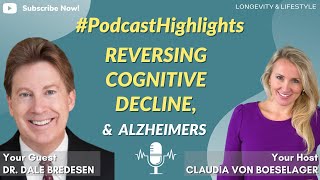
In this interview highlight, Dr. Dale Bredesen argues that Alzheimer’s disease can become an optional condition if a prevention‑first, early‑reversal strategy is adopted. He describes a 20‑year pre‑clinical window and proposes a “cognoscopy” screening for anyone over 45, likening it to a colonoscopy. Bredesen critiques the current monotherapy, pharmaceutical‑driven model, calling it ineffective and profit‑focused, and calls for a new type of physician who integrates molecular biology with holistic, multi‑modal treatment. He outlines a tiered public‑health pyramid: a simple, low‑cost prevention program for the mass population, followed by increasingly intensive testing and personalized interventions for the smaller subsets who show early symptoms, ultimately aiming to keep most people out of nursing homes and reduce the $350,000 average lifetime cost of Alzheimer’s in the U.S. He frames this as part of a broader 21st‑century medical shift to address complex chronic illnesses (e.g., ALS, macular degeneration, lupus) through massive data on small cohorts, with the ultimate goal of a global reduction in dementia burden.
Chapters
Alzheimer's disease is now becoming optional. This is a disease that, as you know, comes on for about 20 years between the beginning of the pathophysiology and the diagnosis. If everyone gets on either prevention or early reversal, virtually no one need to be concerned about this. I got a call from a woman who herself had just been diagnosed with Alzheimer's disease. She had called her friend to say that she was going to commit suicide.. And so this woman came out and we spent 2.5 hours going through all this stuff. She took 'em back to her doctor and she said, I can't believe it. I'm back at work. My memory's better than it's been in 20 years. So I hung up the phone and I turned to my wife and I said, I think we're on the right track. In the long run, we'd like to have everyone on prevention. Just like we all know that when we turn 50, we should get a colonoscopy. And actually my wife and I had his and hers colonoscopies on, on Valentine's Day. How romantic. Yes, we decided, look, let's, let's get this over with. Anyone who's 45 or over should get a cognoscopy because this problem is really a disease of the really late 30s, 40s, 50s. And it's just that you get the diagnosis 20 years later. The average cost in the US for someone with Alzheimer's by the time you die is $350,000. A lot of it's because of nursing homes. Let's avoid that. Let's keep you out of nursing homes. Let's make sure that you do very well. What started out with medicine, with academics, with neuroscience, became politics, pharmaceuticals. It became a huge industry. Drugs for Alzheimer's sell multiple billions of dollars per year to do virtually nothing. Medicine in the 20th century was about what? What is it? We learned to make a diagnosis. Is it Alzheimer's? Is it Parkinson's? 21st century medicine is completely different. It is about why it is. Saying someone has Alzheimer's is like in the 1600s when we would say people had fever, they died of fever. Well, wait a minute, fever due to what? Let's quit denying the truth. Let's look at what actually causes cognitive decline and let's address the things that cause it. The way we're being treated now is it's a monotherapy, it's monophasic. It's going to be the same thing forever. What? It's uniform, the same for each person. Really? And it doesn't address what actually causes the decline. Traditional Eastern physicians did not know anything about RNA or DNA or molecular biology or large data sets and all that. The traditional Western physician would understand DNA and RNA and things like that, but would focus on one thing. They would say, aha, it's misfolded proteins. We're gonna give you a prescription. But the reality is we now need to train a new type of physician that combines those two. If you don't get on prevention, please get in as early as possible for prevention. People will say, oh, you came in early, it's not Alzheimer's yet. Well, why would you want to wait for it to be Alzheimer's? Just like prediabetes, you know, again, they used to say you either had diabetes or not. Of course, now we recognize before diabetes is prediabetes. Before diabetes, you often have some insulin resistance. So this is a spectrum. Why would you wait? You know, get started early. We need to change the classical thinking about this, the way we think about these illnesses. We can learn the most, especially in these impossible illnesses, these illnesses that have been so difficult to treat, things like ALS and things like macular degeneration and things like that. Instead of getting large numbers of people with tiny datasets, we want to have massive datasets on tiny numbers of people. We got rid of the diseases of the 20th century, which were the simple ones. With things like antibiotics and public health. We will get rid of all of these diseases of the 21st century. This is everything from lupus to rheumatoid arthritis to schizophrenia to Lewy body to Alzheimer's to Parkinson's to ALS. These are all complex chronic illnesses. We can see them coming. You can look at the right things and you can now deal with it. The arsenal for these things is huge if you know what to do and how to use it. This is like a pyramid. What we're gonna do is take the large number of people at the bottom of the pyramid and get them on a very simple program for prevention. Now, some of those will fall through the cracks, right? So now you'll have something like 5 or 10% of people that will say, oh, wait a minute, I, despite those things, I'm beginning to get symptoms. Okay, we'll then do the next level of testing. This is the way you make it efficient. Okay, they'll have additional testing. Aha, now we'll see for most of those people, It's this gene or it's that thing, or it's this infection that you had, or you've got a lot of toxic exposure, or you do poorly with toxins. Those people will mostly be helped then by the next program. Now, a small number of those people, and you just go on that way. So after a couple of increases, now there would be a tiny number of people that will actually have to be inpatients. That's the way to make it so that it's efficient and yet gets a global reduction. So our goal is a global reduction in the burden of dementia.