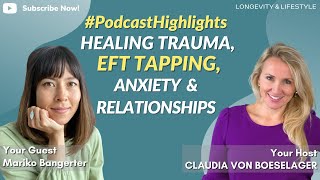
In this interview segment, Mariko Bangerter explains Emotional Freedom Techniques (EFT), a therapeutic modality that blends contemporary psychotherapeutic approaches—including talk therapy, cognitive techniques, and NLP—with the stimulation of body’s acupressure points. She describes how gentle tapping on specific facial and upper‑body points, combined with verbal processing, can interrupt the limbic stress response, release trauma stored in the nervous system, and help rewire neural pathways. Mariko shares her personal history of severe social anxiety, depression, and hypersensitivity during adolescence, which motivated her to become an EFT practitioner. She outlines a typical session: introducing acupressure points, self‑tapping together with the client, and using scripted tapping statements that progress from eye points to collarbone and ribs, encouraging openness to new feelings, agency, and self‑acceptance. The process incorporates mindfulness by asking clients to notice bodily sensations and emotions as they tap, allowing those feelings to subside without being re‑triggered. Mariko emphasizes that cultivating a healthy relationship with oneself through such inner work is essential for broader societal well‑being, arguing that many conflicts arise from individuals who have not healed their internal wounds.
Chapters
Emotional Freedom Techniques is a modality that was created in the early '90s. We are using psychotherapeutic techniques, but also acknowledging the existence of and using the body's energy system. So the body's energy field. So it's this combination of more contemporary psychotherapeutic techniques and talk therapy as well as, yeah, cognitive therapy with NLP, so neurolinguistic programming, kind of laced through it whilst stimulating the acupressure points. I mostly help people with any kind of anxiety and self-esteem, self-confidence issues. So anyone who's struggling with some kind of block in their life, we know that the problem with trauma is that it gets stuck in the body, any kind of modality that has a somatic component to it, that doesn't just rely on the brain and the mind, has more profound and effective results. With EFT, there is the somatic component because we are gently tapping on the key acupressure points of the face and upper body. Doing that as well as talking through the issue in a more traditional talk therapy sense, seem to really allow a shifting of any trauma that's stuck in the nervous system, in the body, and also helps us to kind of rewire the neural pathways in the brain. As a teenager, well, we moved to Japan, and again, I, I had a very, very tumultuous adolescence with extreme social anxiety, depression, and I again felt very, very isolated, didn't really have many friends. Yeah, it was, it was a really difficult time. I didn't— I couldn't imagine life beyond school years, and, and I also didn't believe, or I didn't feel I had the strength to survive, really. I just kind of wanted to end it all. And, um, I'm so sorry. And at this point as well, I had severe, severe social anxiety to the point where when a classmate would sit next to me and I would be so nervous and so shy of this proximity that my hands on the desk, there'd be pools of sweat from the palms of my hands. And that would then feed into my anxiety and be, you know, I'd be like, oh my God, can they see I'm a freak? And, you know, to be honest with you, like my childhood and teen years were pretty— they weren't great. They were really hard. And I felt lonely for most of that time. I guess I learned to sit with and manage my emotions alone a lot, even as a kid. You know, I spent a lot of time in my room reading or writing in my journal. Perhaps I always knew this, but I felt very different from people also internally. And I think that's to do with being a hypersensitive individual. I would really take things to heart. I just felt things on a very deep level. And so I think as a child, I learned that nobody really understood my emotions very well. They didn't even see that I was suffering when I was. I'm talking about my parents here and friends and things. So Again, like, I think I learned to navigate my own emotional landscape. The session would look like my introducing the client on the key acupressure points that we would be working on, me tapping on those points on myself, and the client copying me and tapping along. So we're both self-tapping, we're both tapping with our fingertips on these acupressure points of the upper face and body. Whilst talking. And so what this does is the tapping part seems to halt or interrupt the body's stress response. It seems to be working on the limbic system of the brain that decides whether something is stressful or not. So it seems to interrupt that whole response from happening, and in that interruption, we're able to then talk about things that normally would trigger a stress response or fear, sadness, any uncomfortable emotion without those emotions overwhelming. Plus, there's this very mindful component to it too, because we're tapping and we're talking as well about the sensations present in our body now. So I'll be asking the client, "Okay, what's coming up for you right now? What are you feeling?" And we're noticing these sensations as we're tapping. We're also noticing the emotions that come up as we're tapping. But whilst we tap, because we're sitting with and observing and acknowledging what is coming up, those sensations and those emotions just naturally, by default of this practice, subside. The way to truly release and shift or let go of an emotion that feels stuck is to sit with it and feel it mindfully. And the tapping process allows us to do that in a gentle way that's not overwhelming, that's not re-triggering. I'm open to the possibility of a whole new feeling.
I'm open to the possibility of a whole new feeling.
Outside the eyes. I'm open to the possibility of knowing that I'm powerful.
I'm open to the possibility of knowing that I'm powerful.
Under the eyes: I'm open to the possibility of knowing that I have agency.
I'm open to the possibility of knowing I have agency.
Under the nose: I'm open to the possibility of connecting to infinite solutions.
I'm open to the possibility of connecting to infinite solutions.
Chin: Long after this session ends.
Long after this session ends.
Collarbone: I'm open to infinite exciting possibilities.
I'm open to infinite exciting possibilities.
Side of the ribs. And I deeply accept myself and my feelings.
And I deeply accept myself and my feelings.
And just take a deep breath. So now, to anyone who followed that in the audience. I'd love to find out where you are at now between 0 and 10 with your levels of stress or fear or anxiety. I'm at a 0 for sure.
I'd be probably negative. I'm feeling very chilled and relaxed right now.
It's so amazing. The most important relationship to establish and develop and cultivate is a healthy relationship with yourself. If you look at the state of the world and all the wars and all the conflict, this is all done by people who have not done any self-development work. It's people who have not actually looked in and tried to heal what's hurting them. It's impossible to cultivate a healthy relationship with anyone else unless you do this inner work first and unless you get to a space of self-compassion and self-love.