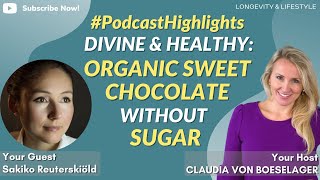
In this interview, Sakiko Reuterskiöld recounts a pivotal supermarket encounter that sparked her curiosity about sugar’s toxicity, then describes her personal three‑week sugar‑free (including fruit‑free) diet that dramatically improved her energy and wellbeing. She explains, in lay terms, how fructose uniquely disrupts satiety hormones—suppressing leptin and raising ghrelin—leading to increased hunger and reduced fullness. She details the metabolic pathway of fructose: intestinal absorption, liver processing, and conversion into triglycerides, linking this to elevated heart‑disease risk, insulin resistance, chronic inflammation, and stress‑induced fat storage. Drawing on her dissertation research on fructose and atherosclerosis, she highlights epigenetic effects where fructose turns on fat‑creation genes and turns off fat‑burning genes. Sakiko discusses the difficulty of creating genuinely sugar‑free baked goods, the emotional challenges of taste differences, and the perseverance required to develop successful products. Throughout, she emphasizes empathy for people experiencing metabolic and endocrine dysfunction, noting how hormonal cues can trap individuals in a cycle of overeating and inactivity.
Chapters
I have a memory of being in the supermarket in London, in Sainsbury's, and this lady was looking at me as I reached out for the sugar package for doing baking, because I love baking. And she looked at me, she's like, that stuff is poison. And I looked at her and I was like, whatever. And I brushed it off.
Crazy lady.
Like a year later, I was deeply into sugar science and I couldn't believe how it's not neutral. It's, you know, actively toxic is a very inflammatory word, but I really feel it's on that.
But it is.
Yeah, I agree. Harmful to the body, um, actively harmful, not just neutral.
So I went on a sugar-free diet, like really no sugar and no fruit even, for 3 weeks, and everything improved dramatically. And I felt better than I'd ever felt in my life before because my whole life I've had a bit of sugar every day. I think it's normal for us in this day and age to have that experience. And so having this incredible sustained energy, I never knew that was possible to feel that reborn. Yeah, it was amazing. And I was so happy, but then I realized like, oh, I really miss chocolate. And so that's when I started doing research and, and then I found I could make initially chocolate chip cookies that were healthy and genuinely sugar-free, honestly sugar-free, and tasted good.
Of all the food ingredients and food items we eat, sugar and in particular fructose is the only one that does not activate our satiety hormone, which is leptin. So it actually suppresses the effectiveness of leptin. So the leptin that's secreted in your body when you eat doesn't work with fructose. At the same time, fructose actively increases the hunger hormone ghrelin. So on both sides, it makes you more hungry and it makes you less full. So result, you keep eating whatever, not necessarily sugar, but whatever you're eating, you're going to eat more of everything if you're on a high sugar diet, on a high fructose diet. Like the most important toxicity factor basically is that the nature of how fructose is metabolized is quite special. When you eat fructose, it goes into your gut and some of it is absorbed through the intestine. And if there's a lot of it at one time, especially some of it eventually gets processed by the liver, which is your detoxification organ. And in the liver, it goes through this pathway that basically the end of the pathway, the steps through the metabolic pathway of fructose ends up in triglycerides formation. This is a typical test that doctors do. They check your triglyceride number. And you want that number not to be high for many reasons, including heart disease, which is the biggest killer of human beings. Still, heart disease kills more humans than cancer and all of these other chronic diseases put together. Inherently in the fructose metabolic pathway, the sugar metabolic pathway, is the creation of fat. So the end of that pathway ends in triglycerides. But also insulin resistance itself, which is caused by excess sugar intake, is a condition where you're going to be storing storing fat more. So just getting into that condition is a setup for storing more fat. So you don't want to get into that condition. The other point is that the fructose is very inflammatory and also promotes chronic inflammation. And that also is a state of stress. And when the body is stressed, it stores fat. So when the body senses that there's something stressful in the environment, and that can be signaled to the body by the food you're taking in, or the lack of certain foods. So if you're not taking in enough omega-3 healthy fats that are essential, for example, or you're lacking some key nutrients, your body's going to think you're in a deprived state even though you have enough, plenty of calories. If you don't have the right micronutrients, you will be in a stress state and you will store and retain fat. And the other key point to point out is I did my dissertation thesis on fructose and atherosclerosis, which is basically heart disease.. And I saw during that research that fructose turns on genes and turns off specific genes. So there's this thing called epigenetics, which is the turning on and off of genes based on your environment or diet. And fructose epigenetically turns on fat creation genes, fat production genes, and turns off fat burning genes. So again, this like super combination, which is likely to cause you to gain fat or store fat. It's really hard to fight against our natural feelings of hunger and fullness. Like, they're so natural and they're so strong. And so we don't need to be counting calories because those hormones, like, work for us and make us eat a generally reasonable amount that keeps us at the right weight. So it's only when we have this really high-sugar diet, which, as I mentioned, makes you hungry, makes you less full, that it's so hard to fight against those urges. Like, you just You can't. And when people are in the state of obesity, then the endocrine system is dysfunctioning and they literally feel really hungry a lot of the time. Their body tells them, don't move too much. You know, you need to stay still because you're in a sort of dangerous state. So that means they sit and they don't exercise. But these are hormonal urges that are really hard to fight against. So, so we have to be empathetic when you're getting in this metabolic dysfunctional state, endocrine disfunction state, it's really hard to come out of that. So you really— I had a lot of times where I was just crying, like, so sad because I didn't feel it was tasty enough. Or, you know, I— one friend said, like, no, I still get this different taste. This doesn't taste like sugar. And I, I went through a lot of failures on that front until I got here. But I'm so happy that I went through them. And I guess I learned through this whole process, that you, if you really believe and have hints along the way that it's something is possible, that just you should persevere, persevere, persevere.