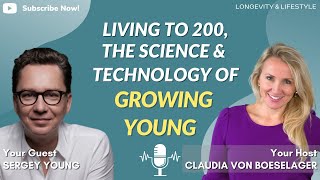
In this interview highlight, longevity investor Sergey Young recounts how a personal health scare—high cholesterol—sparked his deep dive into longevity science, leading him to lower his cholesterol, help friends detect early cancers, and inspire a mission to improve one million lives. He describes founding the Longevity Investment Fund after collaborating with Tony Robbins and Peter Diamandis, aiming to back entrepreneurs who can transform "sick care" into preventive, healthy‑age care. Young predicts that consumer wearables will become personalized medical devices and that the biggest healthcare players by decade’s end will be tech giants like Google, Amazon, Microsoft, and Apple. He emphasizes extending the healthy, productive portion of life rather than merely adding frail years, and flags social, ethical, and inequality challenges. His 12‑month resolution is to create a virtual avatar of himself for conference speaking. He highlights three breakthrough areas: gene editing/therapy, a future class of “longevity pills” that target aging processes, and organ regeneration via lymph‑node‑based liver growth (LightGenesis), which is moving toward human trials. Throughout, he stresses personal responsibility for health and the urgency to act now.
Chapters
Our longevity journey and our interest to help always start with the personal troubles. You have a wake-up call. It's usually significant deterioration of your own health or the people that you love. For me, it's actually started with high cholesterol. Doctors told me I need to take medication every day till the rest of my life. I thought, like, you know, I'm a healthy man. Why would I need to take medication every day for another 40 years? So I started to discover this whole world of longevity and taking care of my health, and I was pretty successful. I decreased my cholesterol in the course of 4 to 5 months. I started to share this experience. I just pushed a lot of my friends to do their health checkups, medical screening. Some of them discovered early-stage cancer. They fully recovered because it was caught at such an early stage. They all call me up and said, Sergey, you saved my life. After you got a few calls like that, you're like, oh my goodness. Well, this is exactly— I'm a lifesaver. Yeah, this is exactly why I was born. And this is what I can do for the world. I thought, okay, I'm going to change the life of 1 million people. So then I met two guys, Tony Robbins and Peter Diamandis. We actually working together in the context of XPRIZE Foundation, launching global technological competition to solve world's biggest problems. I decided if I want to change the space, I need to set up a relatively small— so I set up Longevity Investment Fund. So we're supporting entrepreneurs, scientists, innovators who basically would like to change the current state of the healthcare, which some people, you know, call sick care, and bring the best, you know, from the science and from technology to extend healthy and happy portion of our life. Just believing that you are younger makes you younger, just having your target age radically below that you are today, you just discover a completely different version of yourself. You're just full of energy, full of dreams. And every morning I wake up and I have 3/4 of my life ahead of me. There's so many things I can do in this world. All these Apple Watch, Fitbits, Whoops will become our personalized healthcare devices. I think with addition of like measuring glucose in the blood and measuring our blood pressure in the next couple of years, it's going to be 90 to 95% of the indicators that we would like to measure on a regular basis. And Apple Watch has already saved so many lives. The change in healthcare will come not from old players doing kind of new things. The change in healthcare will come from the new players. Doing completely new things from disruption. Like, so the biggest healthcare companies on Earth in the end of this decade gonna be called Google, Amazon, Microsoft, and Apple. A lot of people think that living longer means being older for longer. People think that we gonna add 5, 10, 15 years right in the end of their life when you are in extremely fragile state and you need to receive a lot of support. Well, this is not true. What we're working on is extension of the healthy and happy period of our life, like inserting 10, 20, 30 years right in the middle of our productive age. We have created the science and technology to extend our life, but we haven't created life that we want to extend. And like inequality gap or bad relationship with Mother Nature, our social constructs, the social moral that we have today in this society. Are really huge obstacles. My resolution for the next 12 months is actually creating my virtual avatar of Sergey Yan. We're going to work together for like 3 to 6 months until he's going to be capable of doing exactly the same thing that I'm doing. Oh, I love it. That's exciting. So like he can speak at the conferences, doing Q&A. I decided today or in 3 years from now, you will not be able to tell the difference. Yeah, that's for sure. And when people ask me, like, what are the most exciting developments that you see in the space, I'm always talking about 3 things. One is gene editing and gene therapy. First time in human history, we have an ability to amend our genetic code, and we can help so many different people to live healthier and happier life, to improve the quality of their life. Second is longevity in a pill. If you go to the pharmacy today and you'll ask for a pill against aging or age-related diseases, they would think you're crazy. They would send you to cosmetics or supplements. In 5 to 10 years from now, we're going to have a special, like a separate category of drugs. And these drugs will really focus on fighting the aging processes inside your body and therefore decreasing your risks of facing Alzheimer's, diabetes, cancer, heart disease. And this is 90% of the deaths happening after 50. The company that we invested in called LightGenesis, and they're using our lymph nodes to regrow organs inside our body. So they take like a donor liver and help not one recipient, but they help 50 to 75 people. Just splitting this in a number of small nucleus, they put very simple laparoscopic operation, put it inside our lymph node, and then in the course of 3 to 6 months, our body regrows a new liver. They've done trials already with mice, dogs, pigs, and primates. And early this year, they received FDA authorization to start human trials. So they're starting human trials in November this year. So this is not science fiction. This is what will happen. I think in the US only, we have 117,000 people on the waiting list to receive their organ transplants. 17 people die every day because they couldn't really wait for their organ anymore. And it's again, everyone helping one recipient, which is very inefficient. And like liver transplantation is $600,000 to $800,000 surgery. I was 18 years old. I was first year student. I was just sitting in the corridor of my university and I felt really sad, like world was falling apart. I've seen the guy who was like a 5th-year student and he saw me and like, well, what's up, Sergey? And I just start complaining like, well, this is bad, this is not working, this is bad, this is awful. And he was looking at me and said, well, you know, Sergey, what is the most important thing in life? To take full responsibility for your own life. There's so many things that we can do with our body and mind. Today with the means that we already have. So you don't need to dream about something happening in medical science in 10 or 20 years from now. The time to take back control of our health and responsibility for our health is today.