Jean Fallacara - On How to BIOHACK Your Way to Better Health
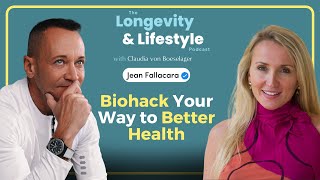
In this interview, host Claudia von Boeselager (Claudia) talks with biohacker, neuroscientist, and entrepreneur Jean Fallacara about his philosophy of freedom, the biological potential for humans to live up to 130 years, and why modern life shortens lifespan. Jean emphasizes stress reduction through meditation, mindfulness, breathwork, and spending time alone, and critiques reliance on external bio‑hacking devices, arguing that internal practices are more powerful. He describes how moving to Miami—sunlight, warm climate, relaxed dress code—boosted his happiness and dramatically lowered his biological age as measured by GlycanAge and True Diagnostic tests. Jean outlines his daily routine: warm lemon‑salt water, hydrogen water, 20‑minute stretch/yoga, 20‑minute meditation, flow‑state work blocks of 90 minutes, calisthenics, and occasional use of brain‑stimulating tools (BrainTap, NeuroVizr, Halo Neuro) that he now largely outgrows. He discusses creating flow state via breath patterns, music, and neurostimulation, and mentions micro‑dosing as a way to access theta brainwaves and enhance neuroplasticity. The conversation shifts to his entrepreneurial background—disruptive ultra‑low‑temperature freezers with AI‑based failure prediction, and his current venture Lifespanning Media, a platform that uses an algorithm to give personalized, affordable bio‑hacking recommendations and aims to democratize longevity. Jean reflects on his high IQ (167), the challenges of giftedness, ADHD, and the need for constant novelty, and he shares his vision of a future where preventive health, happiness, and community replace the sick‑care model. The interview ends with practical advice: live in the present moment.
Chapters
Non-negotiable is only one thing, freedom. That is non-negotiable at all.
So I have to ask you, what does freedom mean to you?
Oh, beautiful. Freedom means for me the reason I left corporate America after I sold my company. The ability to think and do whatever you want without having to be judged or be controlled or asked for. Of course, we all have responsibilities in life, but this is part of life. But I mean, like, the freedom of thinking is the most important one. When you have the freedom of thinking, you can achieve everything you want.
Are you ready to boost your longevity and unlock peak performance? Welcome to the Longevity and Lifestyle Podcast.
I'm your host, Claudia von Boeselager, longevity and peak performance coach.
My guest today is Jean Fallacara. I had the pleasure of meeting Jean recently at the Live Long Summit. I've obviously followed his work for many years in Palm Beach, and we were both speaking there together. Jean is a visionary entrepreneur, neuroscientist, and biohacker with an IQ of 167, and I'm going to be asking about this, and a background in AI, VR, and biotech. He's a disruptor in longevity exploration. From founding Z Sciences to leading Lifespanning Media. Jean's mission is one we both share, to democratize human longevity. Jean, it's such a pleasure to have you with us today. Thank you for coming on the show.
Such an honor for me. Thank you for having me. Um, I've been following you for many years as well, uh, your work, always impressed. Your new project is fantastic. Um, I think it was meant to be one day that we would end up by being on podcasts, on mutual podcasts. And in person. It was awesome to finally meet you in person in West Palm Beach, definitely. And yeah, you know, I think that everything happens for a reason in life.
So this is true. And this is part of my, my learning. And I share this also with my audience sometime. I'm a recovering perfectionist, A-type, Jean. So I'm learning how to surrender and be in the flow and just trust that the things that are supposed to happen happen when they do. So it was divine timing that we met there in Palm Beach, which was great. And I'd love to start with a question, Jean, of something you just mentioned before we went online here, is that our bodies are made to live to 130 years old. Can you expand on that?
Yeah, science, biology in, in, in deep. If you look at how many times your cells are programmed to multiply and regenerate and before getting into senescence. The average account on that is like if you were in a perfect environment with no stress, which causes oxidative stress and inflammation, causes like senescence of the— of your cell, overall inflammation, your body, your cell would definitely be able to keep going without losing any aspect of their potential up to 100. And some people say 115, some people say 125. I'd like to say 130, make everybody happy there.
150, why not? We can say—
yeah, well, Dave Asprey last week told me 180, and I was just, oh, okay, yes, of course, because he wants to have the biggest number.
Sergey Young is in 200 now, so Sergey is trying to, trying to beat him, right?
Yeah, yeah, yeah. But the Sergey's 200 is different because he thinks, uh, the Sergey's perspective is using some sort of avatar allowing us to live that, that long. But to go back to our topic here, it's our biology that is designed like that. And we do a poor job as humans on this planet to make people live at an average of 80 years old. I would say like 78 is for men and 82 for women. What are we doing so wrong? And that's the principal question. It's not about like trying to add technology and changing the biology or biohacking, as we could say. It's more like putting people back on the right track, the natural way that it should be. And it could be like some sort of cheesy or holistic, but think about it. Remove the stress from this planet and people will live longer. And we're looking for capitalism and creating wealth. Each year is a humongous amount of money that is created by extending just one year of everybody's life.
Yeah, so I love what you said there, um, of, you know, people realizing to get onto the right path, right? And obviously reduce stress. But what are some of your favorite tips and modalities to do this? Um, as we know, life gets more and more stressful, and this little thing that we carry around with ourselves is a big trigger, right? Um, what are some practices or things that you recommend to help align and reduce stress?
I think, you know, one of the best practices that should be implemented and even in education for our kids is meditation. It helps you to, to put everything back in perspective. Why are we stressed? We are stressed because of things we've said yesterday and because of thoughts we have for tomorrow. But when we are in the present moment, We have no stress at all. Meditation brings you there in a way or the other. And I do practice meditation a lot. I do practice a lot of, you know, those monk practices.
Which one do you do? Do you have a favorite one?
All of them. And I just— mindfulness meditation is the easiest way to do it and it's accessible to everyone. But Above that, one of the best things I like to do is being with myself. So many people avoid to be with themselves. They can't be more than 10 minutes. There's a study on that. So you put people in a room and you tell them, okay guys, you're going to be alone with yourself. Most people say, yeah, I'll do that. Then they go in the room. There is just a seat where you can sit, no table, no phone, no music, no TV, nothing. You just have to sit there and talk to nobody. And after not even 11 minutes, 90% of these folks left because they can't stand it. I can stay 2 hours with myself. I love it. It's just like, it's so much getting your brain connected with your body, this proprioception that is so important, like feeling every single part of your body, how they behave. So, and it's better than meditation. So that, that puts your stress really down. Of course, breathwork is the key. It starts from there before even meditation. And then you could go with modalities. I love using BrainTap. I love using NeuroVizr, Neuronic, all these brain tools that put you— even Muse is a good one before sleep. But those, I would say, are artificial. And we underevaluate the power of our own brain. So we're taking tools to compensate what we cannot do by ourselves. And we should put the effort into first doing things by yourself.
100%. And I was thinking about this myself because my default is the external. So I have, you know, these different devices and I'm like, I have to do a BrainTap session later and then you do this. And I was like, you know what, I'm actually going to— this was yesterday. I was like, I'm going to just sit with myself 30 minutes on the timer. And it's funny because I love the quote is whoever mentioned it, but it's when you think you don't have 30 minutes to meditate, you have to. Meditate.
Exactly.
Because you're so stressed and you're like, no, there's no way I can do it and I have to do all these things. And it's like, okay, something's totally wrong in this equation here and go and sit with yourself. And what I hear from, from people, they're like, but it's so— people who are not trained and don't have a regular practice, how do you drop in? How do you do that? So what, what modalities do you use? Is it through the breath? Do you do a body scan?
Yeah. Well, the first step is definitely to, um, master your breath because it starts from there. The connection, the body-brain connection starts from your breathing. You can control the rate of your heart. And when you're anxious, if you start doing simple things like box breathing or 6-8, 6-7-8 or 8-7-6 or 8-5-2, whatever, let's make it simple. Deep breaths, double inhale if you're really, really, really stressed, hold for a bit, release longer than you inhale, and you pace down. When you pace down, it's fairly easy to put your focus by closing your eyes or by looking at some things on a fixed point, and then it goes by itself. It's natural. It's a natural process of our brain. Modalities help you to get there when you're like ADHD, like I used to be.
But I have tendencies to entrepreneurs, right?
Well, that's the thing, you know, and I think it's, it's a quality. It's a superhuman power at the end of the day. I like what you were saying about the, do I have time to do my brain type? Do I have time to do that? It's actually my I'm finishing my second book about that. Yeah, I want to tell people that from the extreme biohacker that I've been for over 10 years, extreme, like putting everything I need to wake up in the morning, put my face onto red light therapy, do brain tap, do neurovisor, do cold plunges, blah, blah, blah, blah, blah, blah, blah. And then at the end of the day, you turn and you're just like, Oh, I just forgot to live.
I was like, am I actually happy doing this?
Yeah, I'm surviving. I'm extending my life, but I'm not, I'm not living it.
Miserable and like not eating anything and exactly forgetting to laugh and have fun. What made you change? What was the shift? What did you see? Um, and what were the steps that you now, or what, what have you incorporated since into your daily life?
I would say more awareness. I'm lucky enough today to say that I'm at the highest stage of enlightenment in my life, a state of sadness that is over 100%. Nothing bothers me. And Miami helped me to do that. I moved to Miami a year and a half ago. And it was like some sort of a click in my head that made me realize that our environment is probably the most important factor that contributes to your wellness. And we forget that. So we compensate by using tools and modalities and techniques and all these things, but we should address the first thing in place, environment. If you set your environment properly and you put it as the way your body feels it. And it's personal, of course. But Miami for me is like, I don't like to be dressed up. So I like to be on t-shirt and shorts, or even no t-shirt at all. I like to be outside and train. Yeah, that's it. And I like to see the sun in the morning. I like to see the sun in the day. I, despite I lived in Canada for a long, long time. I hate the cold when it's not a cold plunge. So being in Miami, I've said those things that I'm just happy every day, every minute of my life. I'm pinching myself to realize that, is it that true? I'm here. I live here. And that puts my mind in a mood and in a perspective of well-being. And I— and then everything falls into its own place. And I don't need modalities, and I don't need to go to hyperbaric chamber to improve my health. I don't need to force myself to think. I don't need even red light that much because the sun is already full of red light. And in— and you know, I like that as well because I'm a scientist, but I realized that my biological age was like 20% down when I was in Canada. He went down to 30% when I, after 10 years of biohacking, and it was steady 30% below my age for about 10 years. I moved to Miami and I'm down to 50% of my age. There is a reason there.
And so I would be curious, and A, which test did you take? And B, but B, What do you think were the contributing factors? Is it happiness? Yeah.
Happiness. Joy of living. Joy of living. Definitely. It's the factor. Joy of living gives you the ability to process food way better than when you eat and you're stressed. You don't, you don't crave sugars. You don't, I don't know, the behavior puts you in a track where I used to drink way more wine than I do today. And today I'm just like, I have a glass of wine per day, red wine. And I'm just like, I can't go above that level. It's too much. I don't feel it. So joy of living, happiness, like you wake up and you are happy. You're literally, I'm happy. I'm happy every minute. And when people ask me, how are you today? I have two answers. One is like, better would be a sin. Or my second is, how do you think I can be? I live in Miami.
And it rhymes even. And my heart with Miami as well. That definitely has a soft spot. I love it. The vibe, the water, the ocean. I'm definitely a water person. So maybe let's see what the cards have to say.
Oh, the test. Oh, yeah.
Which test was it?
Sorry for that. The test was True Diagnostic and GlycanAge. But you know what, I'm suspicious on everything. So I've run tested— test several times in, in a row, not waiting 6 months or 1 month or whatsoever. Like you do 2, 3 tests in 1 week and you see if they are like, steady. Yeah. GlycanAge is my favorite.
Your favorite. Yeah, because I'm also very happy with GlycanAge because it puts me at 26 years old. So I was like, I love GlycanAge as well. No, I know quite well. She's been on.
Yeah, they're cool people.
You know, I think it's also good because the glycans, they don't change day to day. It's more of a slow movement around it as well. Right. So over, I think, several weeks or even like a month. So I've had people like, oh, you know, clients are like, I can't, I can't take it. I'm sick today. I'm like, it actually won't make that much of a difference as well.
Different. But so if you come to Miami, you're going to go down to 20.
I'm going to be 15 at some point.
Oh my God.
What are we going to do? No, I love it. No, my goal is to be 20 and then live to 150 in a 20-year-old body, Jean. That's, that's my goal.
Beautiful.
Let's see.
Beautiful. You're going to make it.
Thank you. Well, some tips and advice from you, I'm sure, as well. I'd also like to share and ask you about recently being selected, Jean, as one of the top 30 most disruptive entrepreneurs in the world, together with the likes of no less than Elon Musk, Mark Zuckerberg, Jeff Bezos, and more. Can you tell us about your journey to this point, and what were some of the pivotal moment— moments along that journey that created this reality for you?
I think I was born as disruptor because I've always had this, uh, quote even on my LinkedIn profile before. It was like innovate, create, or disappear. And I think that our life is made for that reason. Like everything I do need to go against the flow because chaos creates harmony. And so it started back when I was working on technology and my company was making ultra-low temperature freezers. For biomedical application. And Harvard lost specimen about autistic research, brain specimen. And I was working on a technology at that time, and I was just like, that is not possible that we're spending so much money in research and we manufacture have no capabilities of helping those researchers to make their samples safe. So short story, in the past freezers were made to cool down to -80. One compressor was going down to -40, one compressor -80, and I invented the technology that was able to use only one compressor to go down to -80. And when Harvard Maycomb lost those samples, I go like, I'm going to use two of my compressors and I'm going to disrupt this world and I'm going to put a backup into a system so people will never lose again their system, their specimen. And then on the top of that, we created an algorithm that was actually forecasting if a failure would happen in the near future of these freezers. So our freezers were like completely failure-proof. And that valued me as a disruptor once. And then I kept going my whole career. I disrupted the industry of creating successively 7 other products in that vein in in the biomedical space. And I'm doing the same with lifespanning. When I saw biohacking, the word being used wrongly, I love biohacking, but it's the interpretation of the word. Wording biohacking, it's a negative perception. And I was just like, we need to change that to change the perspective of what it is and what we're doing so people can understand and make it mainstream. So I invented the word lifespanning.
It's great. I like it. Yeah, it makes sense.
It's just like, it's simple. And then I was like, a Monday morning, I was going like every morning, I go on my terrace and I look at the ocean and I'm stretching and having my water, lemon, salt. And the phone rings. And there's people on the phone telling me, hey, 'Have you seen that thing? Wikipedia is putting you in the top 30.' And my first question was like, 'Oh, what rank?' And I was 29, I think. And I was just like, 'Okay, I'm not last. I have space to go to the first place.' It's the top 30 in the world, Jean. Come on. It's in the world. Yeah. Yeah. I was, I was just like, okay, top 30. And then I realized that it was like really something cool because true, the 30 people that are named there are like super famous people and me.
Not and you, but for people, you know, wanting to better understand, how would you describe the big message or the big innovation that, that put you there with the likes of Elon Musk and Jeff Bezos? What do you think was that pivotal, pivotal moment or thing that you were doing?
Yeah, I really think that it is the twin core that put me there because it was really a breakthrough technology. Imagine a car— well, Tesla did the same. Imagine cars working on gas and then they turned to be electrical. So imagine freezers working on two compressors and then working on one single compressor using natural gases that was like completely different and disrupting the industry. And the system behind it to forecast future was never made before. We're talking like almost 20 years ago. And today we're talking about artificial intelligence and machine learning, but it was already machine learning at that time. We were doing algorithm learning from the past, measuring pressures and currents and variations in a mechanical system. And we're telling people, wow, if your voltage on your building is like so shitty, your freezer is going to die in 3 months. And, and so that was the disruptive part of it. And I think that it's a big value. It, of course, it's in the medical, biomedical field, so it's not like, like, uh, in for everybody, like I was, I don't know, invented the chicken with 3 legs, but Yet, yet, Jean.
Next year I want to see it. Okay. We'll see what's coming. Beautiful. So, Jean, you are one of the pioneers in biohacking and lifespan extension. And so what does a day in the life of Jean Fallacada look like? What are your favorite tools or your week that you do? What are the non-negotiables and what are the ideal ones that you would like to add to it?
I love that question. Non-negotiable is only one thing. Oh, freedom. That is non-negotiable at all.
So I have to ask you, what does freedom mean to you?
Oh, beautiful. Um, freedom means for me the reason I left corporate America after I sold my company, the ability to think and do whatever you want without having to be judged or be controlled or asked for. Of course, we all have responsibilities in life, but this is part of life. But I mean, like, the freedom of thinking is the most important one. And unfortunately, corporate America lacks to offer that to their employees and bosses and managers or whatsoever. When you have the freedom of thinking, you can achieve everything you want. And that's the thing. I think that freedom of thinking guides you to your life, your achievement. Like, I wake up in the morning, if I feel working, I'm gonna work. If I don't feel working, I'm not gonna work. I'm gonna go work out and I'm gonna go under the sun to clear my mind. And when I'm ready for that, I'm gonna work, but I'm gonna work on flow state. Our society, our economy suck today for that reason. We ask people to be 8 hours in an office and they achieve a job that can be done in 90 minutes. That's what I do.
And emails. Beautiful. And I would almost say what it sounds like is though that you have practices in place so that it's allowing you to think, but you have certain modalities so you know, okay, it's not just the freedom to think, but the freedom to think in certain phases, right? So flow state was something I dug into last year as well. How to declutter. I'm currently listening to Indistractable as well. And, you know, how, and again, this comes back to what you were saying initially about like looking within, like being able to think and think your own thoughts and not just negotiating like, oh, what was that person saying the other day? And then, and then I think though, it's the thinking, but then it's taking action on the idea or the thought that transpires. What is that?
What is exactly what you define? It's creativity. Kill creativity in our society. When we raise our kids, we tell them, stop being ridiculous, stop playing, stop doing that. We should never do that. We should leave kids free of playing dumb and stupidly because that is creativity. And in the adult world, How many people lack creativity? You see the creativity only in the artist world, which is ridiculous. We need creativity in science. We need creativity in everything because this is what creates, once again, chaos. And chaos is required for harmony.
And out-of-the-box thinking. Okay, so we got to the non-negotiable. The non-negotiable is the freedom, which is also a big thing for me. And maybe just to add my view, I heard this once and it really stuck with me, that freedom is the ability to have a choice and to say no to the things that you don't want to do. And I really like that.
Yeah, it's the best definition.
And so tell me, what are the optional things that you still like to do because they serve you?
I like to work because work stimulates neuroplasticity. I'm a big fan of brain. I like to work out. It's part of me. Some people say, Dave was telling me, I work out 20 minutes a week and I have great results. Yeah, that's cool. But me, my workout is my therapy. I need that not to build muscle, I need that to clear up my mind. Yeah, exactly. Align myself and have this creativity boosted. So I couldn't work— workouts 20 minutes a week wouldn't be sufficient.
This episode is brought to you by Air Oasis. If you want to start breathing in cleaner indoor air, let me share a product with you that I love. Called iAdapt Air Purifier by Air Oasis. We breathe 2,000 gallons of air in each day, and poor air quality is linked to many chronic health conditions. iAdapt Air's unique combination of medical-grade filters and other technologies reduce airborne and surface-borne contaminants such as mold, pollen, pet dander, viruses, bacteria, smoke, and dust. Check out Air Oasis's iAdapt Air by going to airoasis.com /claudiatoday.
What does your workout look like?
I'm kind of a gymnast guy.
So I'm so impressed, by the way. And if no one has seen Jean and what he's able to do, and I once upon a time, a long time ago when I wasn't as tall as I am now, I was a gymnast and I could do my handstand and cartwheel and that's about it. So how have you managed to stay so flexible and mobile and strong all these years? Have you just continued it or?
I'm sorry, you know, I started calisthenics only 5 years ago. Before, I was doing body workouts. And before that, I was lifting weights. When I got my daughter, I stopped, I gained a bit of weight. But it's all dedication. And, and the energy you put into it is like if you work— I don't like to say by passion, but it is kind of similar. If you work out by passion, it's a natural behavior. That becomes part of you. And then it's— it increases time after time. Most people are not patient enough to see the results. So they give— they give up or they drop what they're doing too fast. I've been persistent. And today, I love what I'm doing. I agree, it's super impressive. And I love to show off that way because it's a girl's trap.
So you do this and I was like, wow, show me too, Jean.
I go to the beach, actually, you know, I do the test. I go with friends and I go like, okay, time it. I start doing my movement and we time the, the, the, how long it takes to have girls putting their towel just around me.
So funny. And this is Miami for you, I guess, as well. And what is the, what's the record? How many, how many seconds?
How many girls? How many seconds?
How many seconds does it take?
It could be as soon as I take my t-shirt off.
No wonder you're so happy in Miami, right? But I think that it's super important. I've had Dr. Kelly Starrett, who I'm sure you know, on the podcast as well, and that mobility piece And I was just with family last week and my father's 85 and I just see how stiff he's gotten. You know, even he's still driving his car, but like, I don't know if he can fully see if there's cars coming or not. And if you don't use, you lose, right? And so that ability to just know that it's not just for the now, but it's, you know, changing the trajectory for the years to come then as well. And that strength. I was talking to somebody about the gymnastic strength training as well, where they do what's called, I think, the human flag.
Oh yeah, I do that. Yeah.
Yeah. Yeah. And at one point, I'll find maybe this year, next year, that will be my goal to be able to do that too. So let's see.
Yeah. Yeah. Flag and planche. Planche is definitely the hardest one. And flag is the second hardest one. Yeah, those movements are fantastic. But you know, Claudia, here's the thing, I think like, Somebody said when you get old, when you stop moving, it's not you stop moving and you get old or something like that. It's like as soon as you stop moving, you get older. Matter of fact.
Yeah. Yeah. 100%. And I noticed as well, like if, if there has been phases where I wasn't going to the gym as regularly and I'm also one, like I like to work out just for working out. It's not for anybody else, whatever. It's I feel better. But when I had phases where I didn't, then like my shoulder was stiff and then this was bothering and I felt like, gosh, I'm getting so old so fast. So 100%. And I think we're made to move. We're made to be walking around.
Yeah.
And they say like, you know, sitting is the new smoking. And here I am sitting in a chair right now. I need to get one of those walking treadmills.
Like my desk is, goes up and down and my chair as well. Yeah.
Yeah.
I'm trying to work. I don't sit much. You sit 8 hours. I sit probably an hour and a half, maybe 2 times an hour and a half per day on my desk. I'm trying to avoid that as much as possible.
No, I try to stand much more as well. I have the stand-up desk and I was like, why didn't I get this before? Like, how did it take me so long to get it as well? And but I want to hear more about the, the other biohacks. We got to the exercise part as well. You said you wake up in the morning, you have your lemon water. Is it in warm water, cold water? And what type of salt do you use? We love details.
Yeah. Himalayan salt. And actually, I'm waiting for a sample of some very interesting salt from the desert of Africa. But lemon, salt, warm water, not cold. Sometimes I put some apple cider vinegar into the lemon water. Yeah. Yeah.
And how does that taste?
I'll try that tomorrow. Yeah. And then, but I drink and hydrogen water as well. Like, it it's really like I'm going to take my lemon salt and water, then I'm going to go for a good amount of hydrogen water. And I'm trying to get my, my water intake in the morning, because I know that it's not on purpose to have it just before going to bed. It's not going to help you. But if you hydrate yourself in the first few hours of your life, of your day, it gets better in your body for sure. Then I'm going to go outside on my terrace here and stretch. It's so important. Every morning I do 20 minutes easy of stretching yoga, kind of. And then I never compromise on this 20-minute meditation that it's part of my morning setting up my goals for the day, my actions, my motivation and everything. And then it's been like an hour and a half or something. I'm going to look at my phone, but never before. And my phone is off actually. And it's, it's always, it turns off at 10 PM. It goes on at 9 AM. I don't want to see that phone in between these moments. They are for me, they're for my sleep. Sleep. And then depending, as I said before, I'm going to either work or work out. It depends on how my brain was from the day before and the recovery and my sleep and everything, because I like to work in flow state. I don't— I never exceed an hour and a half of work. It never happens to me. And even writing my book, it's by batches of 90 minutes.
How do you do that? How do you set yourself up? I know, and I can never pronounce his name. It's Mikhail Selalela.
I worked with that guy. Yeah, yeah.
The researcher of those states. So sorry for butchering his name. I know he's passed on, but there is certain modalities to create flow state. But how do you, for you, create it? Do you put on certain music? Do you have certain environment?
Yeah. Environment is a big— has a big influence. And, you know, the music has a big impact on your brain. Music helps flow state. Today there is research that shows that music and sound, so both stimulation sounds, light and sounds, not music and sound, light and sound stimulation can trigger your flow state a bit quicker than just music and breathing. But the combination of that, it's been a learning process for me. At the beginning, I was putting music and binaural beats, then I gave up on binaural beats and I was more on high level of BPM with a certain breathing according to the music that I was listening, and that triggered my flow state. Then as a biohacker, I was among the first beta testers on the— what was the name— neurotranscranial direct stimulation, electrical stimulation on your brain to put you like it's a prime. And Dave Asprey was on the same thing with me at that time. And Halo Neuro was the name. So yeah, they shifted to research only and they work on Alzheimer's now only. But I'm a big fan of these things. And today I'm going to use Neuronic or the Neuragen or BrainTap, mainly at night BrainTap, but NeuroVisor could help me to go on flow state. But honestly, Claudia, I don't even need them anymore.
Anymore. It's just like, got it down.
Yeah, I go like, okay, I'm going to be on flow state. Boom, I'm on flow state.
Okay, wow, that's amazing. And do you think that thanks to all the practices you've done over time, right?
Yeah, it is. Yeah, neuroplasticity is phenomenal for that. It's like you teach your body to use the neuron the right way and to make those, those pathways. You know, when you start learning something, it's hard. And after a certain time, it becomes so natural. That you don't have to think about doing it. And those are years of practice. Definitely, I cannot say, no, I was born like that. It's not true.
I just heard something this morning. I was listening to a podcast you'd be interested in that children are in theta brainwave states, and correct me if I'm wrong, this is what I heard, until the age of 7. That's why if they see, hear, or experience something, it sticks straight away. That's why we get these limiting beliefs, unfortunately, right, as well. Whereas with adults, we move out of that theta state and we're not in there. So I wonder if we can get into the theta state, if we can expedite the reprogramming of the neural pathways.
Yeah, we can.
I was like, how can I apply this in day-to-day life? I don't know.
Yeah. Yes, you can using those modalities, but I'm going to be blunt and I don't know if that is, it can be censored or not, but microdosing is a fantastic tool for that.
Yeah, yeah. Does microdosing activate the theta state?
Yeah. Well, you activate actually so much connection in between parts of your brain that are not supposed to connect in the regular mode of functioning that yes, it activates that.
Yeah, for the neuroplasticity. Because even when Dr. Del Brito, when he was on the second time as well, neuroscientist for those who's not sure who I'm referring to. He's doing research out of Los Angeles now at the Pacific Institute of Neuroscience, where they're actually looking also for dementia and Alzheimer's patients or anyone with neurodegenerative diseases about adding microdosing to the treatments because of the impact on neuroplasticity, which I think is so exciting. Whatever it takes, honestly, I mean, as many know in my audience—
it doesn't create— it's not chemical that that you put into your body, like some sort of adaptogens. And I, I, I, I like it. Uh, I like— I do microdosing as well. It's, is something that is part of my life, and he actually brought me a lot of empathy that I may not had before, and that, that compassion that I, I have now comes different from— I never been on ayahuasca and all these things, but I attribute that either getting older, wisdom, or maybe microdosing, or a mix of both.
Of both. I think, yeah, I think our priorities as we get wiser over the years, right, also shift from, you know, not sweating the small stuff, as we're so much stressed before, to realizing actually this doesn't matter, it's quite trivial. So I actually think it's like we move from the FOMO to the JOMO, the joy of missing out and realize that there's so much more depth to things as well. So yeah, it's an interesting journey. So I was so impressed also, Jean, to read you have an IQ of 167, which is 7 points higher than Einstein.
Yeah.
What is it like growing up with this level of intelligence? And has there been any situations where you found it a disadvantage or a bigger challenge?
As a kid, yeah, definitely. It was super hard. Was really a struggle. You're not understood. That's the problem. Even today, I'm not understood.
I understand you. Yeah, but that's someone else's interpretation, right? So again, it doesn't really matter. It's just how they interpret it, right? So, but share more. I don't want to ask you.
When you're a kid, you spend your days and time learning, feeding your brain all the time. That's all I've done. And I still do it today. I don't have TV. I don't watch TV. I read only scientific publications. I don't read novels and stories. I read things that are bringing food to my brain. So the disadvantage of that is you are perpetually thinking of some things that could create stress. So until you master that part of self-awareness and control of your thought, it's a struggle. ADHD was really hard for me. I couldn't cope with school. You know what? I have a ton of diplomas, but I couldn't cope. With school. That's the paradox. It's just like, for me, going to school was a burden. When I got my bachelor, I was actually expelled from school. And 10 days before getting into the exams, I just took all the books, read them and learned them. And in 10 days, I was ready. And I was— I ended up to be the first, like, with mentions. And it was the same for master in genetics. And it was the same for everything. And recently, when I went back to the MIT, I started and I was crying because I didn't understand one freaking word they were saying about artificial intelligence and programming and all this thing. But I ended up the session to be again first. So that's the beauty of using that IQ in, in, in, in the appropriate perspective is like, I'm a fast learner. I, I connect dots faster. But it's a burden because sometimes you're not understood for real. And you want to express something that is so logical for you and people are just like, what the hell are you talking about? And you're just like, that's simple. And then you don't say that's not that simple.
And what gift has it given you? To have experienced the frustration? Like, what have you learned from that experience? Not from the positives, right? But from the challenges. What do you think was the biggest gift in there for you?
Well, I've, I just realized that I have no limits. I, I can, I can learn and do anything I want. I was in biotech. I loved it. I was in neuroscience for a while. I was in genetics, immunology, of course science, but then artificial intelligence, virtual reality, no secrets for me. If tomorrow, well, when I shifted to media, for me it was a new world. Today it's almost like too easy. So everything seems easy after a certain time. I like the challenge of getting into those patterns. The only problem I have is like because of these, of this, I get bored so easily. It's so fast. And it's, it's hard in relationship as well. Like you have many people that you meet that are super cool. And then as soon as you know enough, it's, I'm less that, I'm like the vampire. I know enough and I need new blood. So yeah, I need to shift friendships and people around me so they don't stay. And, and it must be hard sometimes. So I probably hurt feelings in a way or the other. But at the end of the day, I'm super happy to be who I am. I don't have any fans. I'm a fan of myself.
Beautiful. And that self-love piece, I think, is so critical. There was some statistic that I think 90% of people wouldn't say that they they love themselves.
I adore myself.
No, but I think it's such an important piece to be compassionate about other people is to learn, right, that self-love piece. And, you know, that sort of genuine from the heart, less ego, right? As well. And what would you say is some of the things you're most excited about, obviously, with the Lifespanning movement that you're starting and working with now in the media? But what are some of the projects that are getting you most excited for the next while?
Well, I think that life in general is beautiful and the future is beautiful because the kids that are coming after us are way more intelligent than we are, way more instructed, way more passionate, creative, and they have this empathy that our generation just off. That's one thing that makes me happy every single morning I wake up. Then on the professional side, yeah, Lifespanning is, is a beautiful project because I've dreamed about giving knowledge and wisdom and tools to the world. Like, you know, in the biohacking industry, what I I was really concerned about was the fact that it became a cultish movement dedicated to the elite that have money. And even if I'm part of the 0.1%, I feel completely unfair that someone that has money will live longer than someone that doesn't. If you take the money out of the game in this mathematical model, both should have the same chances. And I'm here to solve that problem.
I want to educate people for those who can afford those extreme amounts of cost that, that is at the moment currently the model and like, how do we shift to it? And that's where I think AI comes in, which is really exciting. And can you share a little bit more about the work that you're doing to make it more accessible to people?
Yeah, so most people in the long run, because I've been in biohacking for so long, they come to me and they go like, hey, Jean, what should I do? Where do I start? And so at the beginning, I was just like, well, social media is packed with information. And now the shift is that they come to us and they go like, yeah, where do we start? What do we do? How can we improve our life? What is the basic principle or basic routine I should implement in my life? And the opposite of this positivity is like, I went on the internet and it's so packed with information that are contradictory. And you don't know who to trust. You don't know who to listen to. You don't know what to believe. And if I listen to these guys, I'm supposed to take 200 supplements a day and I'm listen to that guy, I'm supposed to put my ass on red light every morning. Should I really do that? And then we're just like, okay, we need to solve that problem. So we are coming on Lifespanning and Biohackers Magazine with a marketplace platform where you step in, you tell your age, weight, height, sex, and you answer a couple of questions. And we're going to tell you, okay, we have created an algorithm that will tell you, if you keep going that way, you're going to live up to 82. Now, how much time you want to dedicate to your life improvement, lifespan, and healthspan? And of course, it's always the money factor. And we don't want the money factor to be limiting in a way or the other. So we said, you can start at $1 a day, and you can go up to $10,000 if you want. But with that, let's say you come in and you say, I want to dedicate 30 minutes of my day, and I'm going to put $100 in my health every month. We're going to come up with the right advice on, in terms of supplements and modalities and things like that. And we're going to make all modalities affordable enough to people. They don't have to spend $1,000 upfront to get one piece of that equipment or that. So we're going to make it easier. And accessible. And at the same time, everything backed up by neuroscience and science in general will provide all the protocols that are really proven today to help you achieve that in simple words, not scientific words. Yeah. Yeah. And then if you say, wow, I love it, I'm going to increase my time and put 1 hour our algorithm will tell you, hey, from 82, you're up to 92 today. If you keep going that way, it's positive. So we want to educate people to pay attention to themselves. That's the only way. I don't believe in magic pills. And this is what everybody is trying to do in this world, trying to offer magic pills, saying, oh, he's— here is Spermidine, here's rapamycin. That is not true. You can use those pills for as they are, but they're not going to help you.
They're not going to move the needle. Yeah.
No, no.
Yeah.
And so it's all education.
No, I love that. And it sounds really exciting. So thank you for sharing that. And I'm excited to watch the progress as you, as you build that out. But I think that this is what people think, A, that it's super expensive, but some of the best biohacks are free. Sleep.
Yeah, completely. Breath. Completely.
Meditation. Fasting.
Yeah.
So it's like, you know, what's the price? Okay, I've got $0. Like, you can do all of these things already. Sunshine, laughter, being with friends, right? Like all these beautiful things that we used to do so well and then we just got so distracted and it's just going back, as you said as well in the beginning, to remembering like what is the things that bring us and joy is such a big thing. And that joy and play.
If you, yeah, that's what I was saying in West Palm Beach is like we're telling you take this supplement, do that, do this and that. But we forget like if you don't have that baseline of what you just said with all the free things, the sunlight in the morning, the salt and water and whatever, breathing. You can add and pile as many as you want on top of that. It's like you're building zero. You're, you're not building anything. But if you have that baseline is 90% of what you need to score and to keep going and the 10% missing are help from supplements, modalities, and all these things. But why this 10% cost? Costs 90% compared to the 90% that doesn't cost a cent. Yeah, it shouldn't be. It should be— people should know.
Yeah. And, and prevention is better than cure, right? Because obviously, if you are down, chronic, uh, disease, then it's like it's getting very expensive and people are like, oh, there's $100 and stuff. And yes, I understand, and everyone has different budgets and, and, and possibilities. But if you think about the cost of fixing your health later, I feel like, I mean, I unfortunately with my mother now in a nursing home, we just see in like the horrendous cost. And even when I go to the gym in Naples, I'm kind of listening to the conversations is like, oh, I was at this doctor's visit and I need to go see this doctor. And it's all about the doctor visits. And I was like, imagine being in your 80s and not talking about any doctor's visit because you do your annual checkup or whatever it is, right? You know that you're in peak health. Maybe you don't even need to do then. And you just change the conversation. I almost imagine either you have other fellow sort of biohacking lifespan optimization friends, or you have to start, you know, getting a much younger friendship base that's not talking about aging issues, right? Yeah, as well. What are you most excited about in the health and longevity space over the next while, Jean?
That, yeah, that this movement is changing. You know, everybody's always saying like our health system is broken and blah, blah, blah, blah, blah. Our health system was designed this way, point. And it works. It works the way it was designed. It works. It's efficient enough. But the beauty of what is happening today is like people now are aware that you don't want to be in the sick care system, but you want to be, as you said, in the preventative way of treating yourself and preparing yourself to live longer and better and healthier. So this is the fascinating shift that had happened in our society thanks to COVID. It's unfortunate that it is COVID, but it is true that it's coming from there. And the COVID made people first cleaner, they realized that germs exist. And second, they made them aware that socialization is important, but your time with family, your time with yourself is way more important than your job. So at the end of the day, it shows exactly what the movie with Brad Pitt was showing at that time, don't you remember, Fight Club? You're not your wallet, you're not your car, you're not your business card, you are you. This is where we are today. People realize that they are them. And I'm, I'm, I'm super happy that it's happening this way. And I'm super happy that like people like you are changing the way that the healthcare is is going to be in the future.
Yeah, yeah, yeah. No, beautiful. Yeah, I feel there's this planetary awakening happening around the world. We were speaking recently with the Singaporean government that are looking to do things. I mean, all around the world, people are choosing a different way, a better way. And I think it just starts off with curiosity, like, hmm, I wonder, can I do this in a different way? I'm questioning, okay, my whole family have, you, you know, has had cancer, etc. Like, is there another way? Can I choose a different path? And then the beauty— when this is why I get so excited about it— it's like, imagine like we're all stepping up into this beautiful health with like energy and doing what you love and being in flow state and all the rest of it. Like, how cool is the planet going to be?
Like, I want to have a party.
Imagine.
Yeah, yeah. Everybody will be happy. So happiness will bring joy to everyone and, and relationship. You know, this is the beauty of my It's people are happy here in Miami. I've never had as many friends as I have here in, in this city than in my entire life in any places I lived before. It's, yeah, it's because people seems to be happy enough to be open enough to talk, to share, to, and it's a joy of sharing information. And every time you go somewhere, you meet with someone and you talk with someone and it's always cool. Yeah. So if the world was like an exponential projection of Miami, yeah, cool.
Exactly. And then having cool plans. So a dear friend is the former director of brain imaging at the Amen Clinics, Dr. Kristen Willameyer. We have a plan in 2072, Jean, you're welcome to join us. We're going to be dancing on the tables in Mykonos for her 100th birthday. So this is 2072 Mykonos.
If I can be shirtless, I'll come.
Of course, Mykonos, everything goes. Mykonos. Amazing. As we finish up today, Jean, such a pleasure to have you on, but where can people find where you're, what you're doing, what you're up to? Where would you like to direct them?
I think the easiest way is to go on my personal website that has all the links to everything, jeanfalakara.com. From there, you can can go to my Instagram if you want to see my movement in gymnastics and calisthenics. It's quite impressive.
I recommend it.
Thank you. And my LinkedIn is professional portal as well. Then of course, biohackersmag.com. We give free subscription to people these days, so they can go there and just like get the magazine for free. We're covering the VASPR event with Dave on the COVID for next month. So it's going to be a big a big one. And we just had Jim Quick this month.
So I love Jim Quick as well.
Yeah. I love that boy. Yeah.
Honestly. I love his story as well. And for people who haven't checked him out, there's Limitless, the book. And he just last year, there was, he brought out the advanced version of it as well. And it just goes to show that I love what he says as well. There's nothing like, there's no such thing as a bad memory. It's just an untrained memory. And what's possible as well. So I can still remember the 10 periodic tables. I know you can anyway, but from his analogy of the visualization. So yeah. Oh, it's amazing. It's really, really cool.
And thank you for having me here.
No, such a pleasure. Do you have any final ask or recommendation or any parting thoughts or message for my audience today?
Yeah, I would say like, one advice Only one. Live in the present moment. That's it. If you have that, everything is going to be okay.
Yeah. Yeah. Beautiful. Life is a series of nows, right? Yeah. Beautiful. Thank you so much for your wisdom and sharing and everything that you're doing, Jean. It's such a pleasure to have you on. Thank you.
My honor. Thank you so much for having me.
Merci. Thank you, audience, for listening.
Too.
More from Claudia









Can Psilocybin Slow Aging? The Study on Telomeres, Inflammation & Survival with Dr. Louise Hecker

