Know Your DNA Health with Harris Khan of The DNA Company
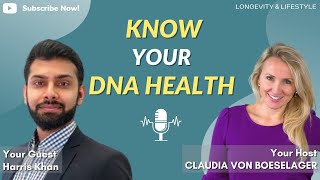
In this episode of the Longevity and Lifestyle Podcast, host Claudia von Boeselager interviews Harris Khan, co‑founder and Director of Product Development at The DNA Company. The conversation introduces the company’s lifestyle‑genomics platform, explaining how DNA acts as a manual that can be “switched on or off” through diet, environment, and behavior. Khan provides a lay‑person’s genetics 101, emphasizing that gene variants affect enzyme efficiency and that while the genetic code itself is immutable, gene expression is modifiable. He discusses core anti‑aging levers—adequate hydration, quality sleep, and efficient detoxification pathways (methylation, glutathionation)—and links these to specific genetic pathways. The dialogue delves into sleep genetics (BDNF variants, circadian timing, vitamin D metabolism), gender‑specific hormone genetics (estrogen vs. androgen production, estrogen‑metabolite toxicity, BRCA context), and how these influence health outcomes, body composition, and disease risk. Khan outlines The DNA Company’s consumer workflow: a saliva kit, a 4‑5‑week laboratory analysis, six digital reports covering mood, cardiovascular health, nutrition, hormones, sleep, and inflammation, plus a personalized AI‑generated podcast. He highlights the company’s behavioral‑change framework (partnering with BJ Fogg) that translates genetic insights into sustainable habits, using habit‑stacking and mindset reframing. The episode also covers ongoing data privacy (HIPAA‑compliant, anonymized aggregation) and the live‑updating nature of the digital reports. Finally, a discount link for listeners is provided. The interview blends scientific explanation, practical health advice, product description, and promotional content.
Chapters
Hello, longevity friends. Your host Claudia von Boeselager here, and welcome to the Longevity and Lifestyle Podcast and another longevity and biohacking product series where I invite leading longevity and biohacking product entrepreneurs to share their pioneering products developed to help you optimize your health and your life for longer. My guest today is Haris Khan, co-founder of The DNA Company. I feel very lucky to get to meet some exceptional companies that I believe are real game changers in helping people exponentially improve their lives, and this is one of them. What's so exciting about knowing your DNA? It's knowing that your DNA isn't rigid but can, like light switches, be turned on and off based on the things you do, which is really empowering. Every cellular process in your body is instructed by the 22,000 genes that make up your genetic code. The DNA Company have figured out through their advanced DNA test exactly what genes you have and what supplements, diet, lifestyle, and environment are right specifically for you. That way you can keep the bad genes turned off and optimize your health for longer. Think preventing disease, slowing aging, and optimizing performance. Harris holds a Bachelor of Science and Honors Biomedical Sciences from the University of Waterloo. After completing his undergraduate studies, he pursued postgraduate studies in pharmaceutical research and development before gaining employment at Apotex Canada's largest generic pharmaceutical company in the formulations development department. Harris was a key member of the team that tested initial formulations for drugs in their infancy stages. He went on to co-found The DNA Company, where he established an ISO 7 GMP-compliant nutraceutical compounding facility. He currently serves as the Director of Product Development, where he oversees the entire life cycle of The DNA Company's suite of products and services. In this episode, we dig into Harris's background and the mission of The DNA Company, the science behind how our DNA can be adapted and optimized, the process behind it, the benefits of health optimization, including the anti-aging benefits, male versus female health implications, detoxification, as well as the best strategies people can do based on their DNA results to optimize their health for longer. And also for you, dear audience, The DNA Company is offering my audience $50 off your advanced DNA test by going to thednaccompany.com/ Claudia, that's the DNA company, c-o-m-p-a-n-y.com/claudia, C-L-A-U-D-I-A, today. Before we begin, please hit subscribe to the podcast to get your weekly dose of longevity and lifestyle inspiration. And I'd love if you wanted to share it with those you love. I'd also love to hear from you, so please leave a comment below and let me know which part of the episode you liked most and what you'd like to hear more of. You can also reach out to me on Instagram @longevityandlifestyle. Please enjoy.
Harris, welcome to the Longevity and Lifestyle Podcast and specifically to our Longevity and Biohacking series. It's such a pleasure to have you on today.
Thank you so much for having me, Claudia. Pleasure to be here.
A real pleasure.
Yes.
Can you give for my audience a brief background to who you are, Harris, and what is The DNA Company?
Yeah, absolutely. So obviously, you know, my name is Harris Khan. I am a co-founder and the Director of Product Development at The DNA Company. The DNA Company is an innovative provider of lifestyle genomics. What we focus on is helping individuals understand the power of their DNA, the power of their genes, and how the variations or changes in their genes influences their health and wellness outcomes. And that can be a broad range, a very wide range. In fact, you know, it can influence anything from your mood and behavior, your personality type. To your diet and nutrition choices, to your cardiovascular health, to sleep, and to your hormones, for example, and even your anti-inflammatory response. So DNA is like a manual for the body. The body is a machine. The DNA is the manual. And we help consumers, we empower consumers by teaching them how the versions of genes that they carry in their DNA ultimately influence their health and wellness outcomes. And then, of course, the most important thing is What do they, or what can they do to optimize those health outcomes so that they extend not only their lifespan, but their healthspan? So they're living healthier for a longer period of time.
Yeah, no, longevity and lifestyle, we're all about increasing healthspan as well. So I'd love to dig a little bit more into the science behind it and how it is actually possible to activate some genes and others not to manipulate, if you will, in a positive way and to optimize. Performance and general health?
Sure. So we'll do a little bit of a DNA 101 or genetics 101 just for the consumers to understand from a surface level. You know, genes are instructions. Really what they come down to is they have an instruction. So the gene often codes for an enzyme, and that enzyme completes some sort of process in your body, whatever it is. There's a process that that enzyme needs to do, and the gene tells the enzyme, or it creates the enzyme that either does that job very fast, at a normal pace, or slower than normal. Really, that's how it is, right? And depending on which variation you have in some of these genes, the outcome of what you're trying to do can happen at a faster rate, at a normal rate, or at a slower rate, or maybe at a more optimal rate or not so optimal rate. And when we're talking about variations in genes, the big difference here is we're not diagnosing you with a disease, right? That's the important thing. People think that, oh, DNA testing, you're looking for a mutation, you're looking for some sort of diagnosis or, you know, some sort of diagnostic test. That's not what we're doing here. All we're trying to understand is, based on the versions of genes you carry, are there processes in your body that aren't working as efficiently as normal, or are they working very efficiently? And then what does that mean for your health and wellness, right? So once we learn the version of the gene you carry, well, then we can go back and say, well, okay, what are the non-genetic factors that are happening in my life that can, you know, improve the expression of this gene? So you can't change the genes you're born with. The genes that you get the day you're born, right, that you've received from mom and dad, are the genes you're going to have the day you die. For now, we don't know what the future holds, but for now you're going to have the same genes. But what you can change is how those genes are expressed, right? So the best analogy for this is, you know, in a game of poker, you're dealt a deck of cards. You can't control the deck of cards you're dealt, but you can control how you play them, right? And if you're smart, you can, quote unquote, bluff your way through victory. So there are things, in fact, you know, your diet, your lifestyle, your environment. These are all things that can impact genetic expression, right? So where do you live? Do you live in a crowded downtown city, the downtown of a city, or do you live out in the countryside? Well, the amount of toxins and exposure to smog and pollution is going to be different for two people, right, depending on where they live. And smog, pollution, and toxins can impact how genes are expressed. Similarly, the foods you eat contain nutrients that can influence how a gene is expressed. Certain nutrients in food can temper or slow down genetic expression. Others can exaggerate or speed up. And so it brings up the interesting point that, you know, is there really a diet kind of that works for everyone, or is it more about building an individual diet that works for you based on your genes? And we definitely believe it's the latter, right? So there's no one diet that fits all, or one exercise that fits all, or one lifestyle that fits everyone. Everyone has to build the diet, the lifestyle, and the environment that is built upon their genes, because that's what's intrinsically unique about them. Objectively, that's the most unique thing you carry is your DNA. So if you're not personalizing to your DNA, there's nothing more that you can personalize than your DNA. So that's our approach to health and wellness.
It's so helpful and also so exciting. What's with like precision medicine and allowing people not just to better understand themselves, but actually to be able to do something about it and optimize about it? Can you talk about some of the benefits in terms of, you know, the health optimization, anti-aging? Are there differences between men and women, for example? What about detoxification? Could you walk through them?
Yeah. So, you know, people talk about anti-aging all the time and it's a huge business and everyone wants to live not only longer, but they want to look younger as they're doing it. And from a DNA perspective, we believe in anti-aging from the inside out, right? So a lot of anti-aging is about creams and all these things. But really, if you understand your genetic predispositions, you can make lifestyle and dietary and environmental changes that are going to optimize your internal body processes. Now, if I had to give the top 2 biohacking anti-aging hacks of all time, it's drink more water and sleep more. 100%. The longer you sleep and the more water you drink— water is the best detoxification we own. There's no detox juice that works better than water. As long as you're drinking enough water, your body already has the internal processes to use water as a medium to remove toxins from your body. But you need to make sure that you're getting enough of it or you're getting into dehydration and all these issues. Now, cellular processes related to detoxification like methylation and glutathionization. Glutathione is the most abundant molecule in our body after water. It's the most powerful antioxidant we produce, and its efficiency, the efficiency in which it completes the process of removing toxins from your body and sending to the liver, is genomically influenced, right? It's influenced by genetics, by genes that determine how efficient it is. So when we talk about anti-aging, obviously the one thing we want to make sure that we're doing very well in the body is detoxifying ourselves of all the toxins we're facing. You know, think about where we live and our lifestyle. We're sedentary, we're sitting down all the time, we're not eating as well. Even when we're eating well, you know, we have all of these funky ideas about eating well, right? So intermittent fasting— how many people will intermittent fast and then gorge when they can break their fast, right? And that's You know, those kind of things can influence our detoxification. And processes like glutathionization, which are so important for your body, happen most at night, right? So they're happening during the period of time that we're going to sleep. And of course, the lifestyle in the Western society is we usually stay up pretty late. We're up till like 12, 1 o'clock. Sometimes we're working, sometimes we're stressing. We're not getting enough sleep. So anti-aging-wise, things like Ensuring you're getting enough water, which is a simple thing to do, ensuring you get enough sleep, which is a simple thing in theory to do. Those are some of the best anti-aging hacks we have that don't cost us a dollar, right? They don't cost us any money. But if you're knowledgeable about— hold on a second, why do I need to sleep so much? Well, because if I sleep, the detoxification process in my body works better. Like, I have more opportunity to clean myself of toxins. When you tell someone that, they're a lot more motivated to sleep because now they're just not being told, oh, you got to sleep more. Yeah, I've heard that 1,000 times. No, you got to sleep more because the anti-aging processes in your body can't work unless you get enough sleep. It's about changing that mindset and causing that frame shift in really understanding at the genetic level why it's so important to do the things that we've heard are so important for us.
Out of interest, Harris, and thank you for that explanation, but is there information around people who are able to sleep less? I mean, I'm talking about 6 hours and there's genetic some people who need to sleep more.
Yeah, there is definitely variations in the number of hours people sleep, but what is important is people are getting into that deep rested sleep. So sometimes there are some people, for example, people with low levels of BDNF, which is genetically influenced. If you have a certain variation in the BDNF gene, even if you get 7 to 8 hours of sleep, it's difficult for you to enter that rested sleep, which is when the detoxification processes occur. So you might sleep 7 to 8 hours, and you wake up thinking, gosh, I didn't get the deep rested sleep. You know, I'm so tired, I'm still fatigued even though I slept 7, 8 hours. Whereas others, they've figured out their cycle so perfectly, they've understood how their cycles work in those 90-minute kind of periods that they get 3 or 4 of those cycles and they're like, yeah, I'm good after 6 hours, 6 and a half hours of sleep, I'm feeling refreshed, right? And the key here is It's not only important how much you sleep, it's when you sleep. For most people, it's more important that they sleep before midnight than it is that they sleep 7 to 8 hours. So sleeping from 2 to 9 AM, right, 2 AM to 9 is 7 hours of sleep. But you're going to feel worse and the activities in your body are not going to perform as well compared to if you slept at, let's say, 10 PM and you woke up at 4:30 or 5 AM. Right. And there's a lot of value. People don't realize this. From a genetic perspective related to vitamin D, which is such an important hormone and molecule in our body. Vitamin D controls— people think it's just a vitamin. Vitamin D is one of the most important hormones in our body because it controls mood and behavior. It controls sleeping patterns. It controls hormone production. It controls your anti-inflammatory response. And we've seen that when individuals are up right before sunrise and they're visually looking at the sunrise, their vitamin D receptor is activating.. And so their vitamin D processes are getting ready to activate. But if you're sleeping through that sunrise and you're waking up when it's already the daytime, you've kind of missed that golden opportunity. Right. So genetically, there's individuals who produce less levels of vitamin D. Right. So they do. Yeah. So you don't convert your vitamin D into an active form as well. Other people, they don't transport their vitamin D. So the thing to remember is vitamin D, the area where you absorb it on your skin isn't where it's actually used. It needs to go traveled through the body and there's a little bus. You can imagine a little bus, a protein bus that transports that vitamin D. If you have a variation in this gene that's controlling the transport, that's suboptimal. Well, you're not getting your vitamin D where it needs to get in your body to activate that vitamin D receptor, to activate that anti-inflammatory response, etc. And people think, well, I'm just going to dose myself with 5,000, 10,000, 50,000 IU of vitamin D. Hoping that they're going to shock their system. And people don't realize vitamin D is actually toxic. There is such a thing as vitamin D toxicity. And if you're not transporting your vitamin D to the site of being used because vitamin D, you can't pee it out, it's fat soluble, it's not water soluble, you're actually going to have a buildup of vitamin D in your body. So you would be hurting yourself and putting yourself at risk by doing something that you think normally is a good thing. Why should take more vitamins and more supplements, right? This goes back to that same thing. It's not about Well, let me just go on Dr. Google and figure out what I need to do. It's about knowing exactly what your genomic profile is so that you're doing the things to ensure you're optimizing your genetic potential, not creating suboptimalities. So for a person that has poor transfer, for example, they just have to split their dose, right? So instead of taking the 5,000 at once, you take 2,500 in the morning, 2,500 in the afternoon, and now your body has the opportunity to use all of the vitamin D.
That's such an excellent explanation, Harris. Thank you so much. And I think this is so critical, and I'm really excited with what you guys are doing and to get this out into the world, because I feel like this is totally the future of healthcare and really healthcare versus sickness care. Is there a difference between men and women? What do you see typically in trends?
Yeah, so the important thing to realize, and you know, when we speak men and women, males and females, we're talking about biological gender, right? So being really focused around, well, okay, the XY versus the XX here. And the reality is males and females produce different levels of sex hormones, okay, estrogens and androgens. And the males produce higher levels of androgens in general, females produce higher levels of estrogens. But within their respective genders, there are variations in the levels of both of those sex hormones, right? So androgens are like testosterone and dihydrotestosterone, right, which is like a super testosterone. And then estrogens are estrogens. Now, for the females, the most important cascade for them to understand is how much estrogen am I producing as a female? And then more importantly, from a health outcome perspective, what is happening to my estrogen after it's produced, right? So the key thing here is estrogen is metabolized into estrogen metabolites, these molecules.. And when a woman is menstruating, when she's in her menstrual years, the metabolism of estrogen happens in the liver. And the liver is kind of like the garbage processing facility. That's where, you know, you deal with all the toxins. Now, some estrogen tablets are toxic. They're inflammatory, right? They can actually cause a lot of health concerns like endometriosis, PCOS, fibroids, heavy menstrual bleeding, you know, tenderness in your breasts. It deals a lot with breast health. And so for women, A big part of their longevity is knowing what's happening to their estrogens, because that's going to influence their risk for certain health outcomes. And what we do here at The DNA Company is we identify what is your predisposition, your likelihood that you're going to produce both androgens and estrogens, and then what is the likelihood of producing toxic or inflammatory estrogen metabolites versus healthy estrogen metabolites.. And then how does your body deal with those metabolites? Right? Because if you're producing this genetically and you're producing these inflammatory metabolites, well, does your body have the tools to fight off those metabolites, to deal with them before they can cause problems in your body? So from a female perspective, that estrogen metabolism is very important from a longevity perspective because estrogen metabolites end up breaking into free radicals, oxidants, and quinones. And oxidants are the most potent aging toxin in our body. Free radicals, those oxidants, those reactive oxygen species, those are what cause the wrinkles and the aging and the mitochondrial dysfunction. And so if a woman is able to understand her hormonal profile, she can start making decisions from a dietary, supplemental lifestyle perspective that's going to keep her risk of estrogen toxicity and inflammation at a lower level than normal. And of course, beyond that, the levels of estrogens versus androgens in both males and females influences your body type. So if you're more estrogenized, more estrogen dominant, you're going to have a much more fat-friendly kind of physique, right? So there's going to be more curvature in a female, there's going to be larger breasts, wider hips. It's focused more on that fertility aspect of females versus you have the androgenized female who you know, has a smaller breast, the narrow hips, the more lean and muscular body frame, it's easier for her to put on the muscle. But she, because she has high levels of androgens, well, maybe she's missing some menstrual cycles. Maybe she's dealing with PCOS. Maybe she has excess body hair. She's thinning from the top of the hair. The different levels of androgens and estrogens in your body actually influences that body type. Right. And so now if I'm going to try to build a dietary and exercise protocol, I need to know what your hormone profile looks like first, because I can't be giving a person who is estrogen dominant an androgenized-based workout because it's not gonna— it's not gonna work for them, right? With males and females, for example, I'm an estrogen dominant male. I have more estrogens than androgens for the average male. Well, the reality is I have to work twice as hard in the gym, and I have to be there twice as long as maybe Jason Statham, right, who is a much more androgenized, you know, the typical, the crazy jawline, the bald head. That's a much more androgenized person. That kind of person can put on muscle much faster than me. In both males and females, we see this. So definitely the hormone profile plays a huge role in the difference between males and females as it relates not only to longevity but just general health and wellness.
That's really, really powerful. And I wonder though, for many women, especially, you know, in a certain period, if they're taking hormone replacement therapy, or for example, they are even just taking contraceptive pills or whatever, what sort of implication do you see for these women?
Right. So you brought up a very important point here. And look, the reality is hormones operate like a cascade. So you can imagine a waterfall kind of falling in and it's filling up a bowl., right? And there's different bowls. There's a bowl for estrogen and a bowl for androgens. And when that bowl gets full, then it starts to metabolize itself. Well, if you're an estrogen dominant or estrogen toxic woman, you've got high levels of inflammatory estrogen metabolites and you start ingesting more estrogens in your body, guess what you're going to produce more of? You're going to produce more of those inflammatory metabolites, right? So you will see, and this is why there's so many stark differences in the people's response to estrogen contraceptives. To hormone replacement therapy. One woman says, oh, I started taking estrogen, you know, the pill, and I feel great. I feel like my periods have returned to normal. Well, it's likely that that woman was androgen dominant, did not produce enough estrogens, and the introduction of estrogens into her body has helped balance her profile. Other women start taking the pill and all of a sudden their mood is completely off. They're getting into depression, they're gaining weight, they're having painful periods. All of these things start happening to them. Well, yeah, because she's more likely an estrogen dominant or estrogen toxic woman. The other big concern is as women get into their older years, 40s, 50s, 60s, start entering to the perimenopausal, menopausal, postmenopausal phase. You have to understand that estrogen metabolism in the menstrual years of a female's life happen in the liver. However, as that woman enters into her perimenopausal and menopausal years, The estrogen metabolism shifts from the liver to areas of adipose tissue. And guess where some of the most estrogen-receptive adipose tissue areas are in the female body? The breasts. Which is why you see an increase in the risk of breast cancer in females after the age of 50. So now the question comes, well, okay, in the media and stuff, we always hear about the BRCA gene, the BRCA gene. Oh, I have the BRCA gene. First of all, All of us have the BRCA gene. If I didn't have the BRCA gene, I would be dead. The BRCA gene is a very important gene in everyone's body, right? I liken it to the fire truck. Okay. So when a woman says, oh, I have the BRCA gene, what she's really trying to say is I have a mutation in the BRCA gene, right? So the BRCA gene is a fire truck and its job is to put out fires. When you have a mutation, the wheels of the fire truck are missing. So the fire truck can't go where it needs to go to deal with the fire, but nobody is asking the question, well, what caused the fire in the first place? And for some women, for some versions of breast and ovarian cancer, it's those toxic estrogen metabolites that started the fire. So it is possible for a woman that has the mutation of the BRCA gene but is intelligent about her genomics and she's addressing the source, there's going to be no risk. She's going to completely minimize risk. And vice versa, someone can have the normal version of the BRCA gene, but because of diet choices, lifestyle choices, she is increasing or exaggerating her expression of certain genes and she's creating more of those inflammatory metabolites. She can still go on to develop breast cancer. Right. So these are the sort of intelligent conversations we have with our patients, with our consumers, and help them acknowledge and understand why it's so powerful, why it's so important for someone to understand the genomic profile. Before they start to make any changes to their dietary or lifestyle or environment or exercise methods. Because otherwise you're putting yourself at potential risk and you don't even know.
It's really powerful because also I know I have a single copy of the APOE4 gene, which is the Alzheimer gene, if you will. But I'm very much aware, you know, that I would generally have a 30% lifetime chance of getting Alzheimer's if I do nothing about it. But that's the power of awareness personally, I think, but also be knowing which lifestyle interventions are needed in order to maintain that. And frankly, I'm not worried about it, but because there are certain tools and strategies. So what would you say, Harris, are some of the 3 most powerful or helpful strategies that your consumers and clients have used to optimize their health?
The important thing here is whatever we tell people, the science that we have, the insights we have, they are unique to us. You know, we've spent decades of research developing these insights. But the recommendations are surprisingly very easy and simple to implement. And that's the whole point. We don't want to overwhelm our consumers. Well, they got to go on this crazy 90-day protocol where they're fasting or they're just, you know, they're climbing mountains to get better. No, it's just becoming a lot more intelligent with the choices that you're already making. Right. So number one, just really focusing on improving that sleep by being intelligent about it. So proper sleep hygiene. Right. Getting those blackout curtains, ensuring the temperature is a little bit lower than normal in your bedroom, aromatherapy, smelling nice in the bedroom, right? Avoiding digital screens at night. Don't take your phone to the bed with you, right? These are important little habits and strategies that we recommend. Here's the important thing. The difference between us and any other DNA company— it's not just the insights. Yes, we have the insights, but eventually companies will have the insight. The difference that we pride ourselves on is imagine that you went to a mechanic with your car and your mechanic checked out your car and then they gave you a book and said, here's everything that's wrong with your car. And then they sent you off on your way, right? Or they said you should change your oil filter twice a year, whatever it is, right? Well, you'd be like, well, hold on, I didn't come here just for you to tell me what's wrong with my car. I came here for you to fix my car. And what we find is more often than not, people do a genetic test and they get this big long book and there's all these recommendations. They're like, I don't know what to do with this. The difference between us is we employ scientist-developed behavioral change. So we've partnered with scientists like Dr. BJ Fogg out of Stanford University to develop behavioral change recommendations to teach people how to sustainably build actionable, valuable habits into their life that actually focus on optimizing the genomic potential, right? So very simple example, if you have a genetic predisposition for low levels of vitamin C, a doctor might say, you know, you need to take more vitamin C, or you need to start eating oranges. But let's say you've never eaten oranges in your whole life, like you've never thought about picking up an orange, right? If I tell you you need to eat more oranges, that's not helpful. But if I say, okay, look, the reason why we want you to take more citrus fruit is because you don't transport your vitamin C well enough, that's going to impact your immune system. Now I've educated the consumer. So, okay, they see the value. Then I'm going to ask them, do you like any citrus fruit? Here are some examples: guava, oranges, you know, kiwi. And someone might say, you know, I don't like oranges, but I really like guava. Great. So we're going to focus on helping you eat more guava, and we're going to start with the first week. I want you to just take the guava and leave it on your bedside table every week so that when you wake up in the morning, you see the guava and you become used to it. Week number 2, I want you to cut that guava so that when you wake up in the morning, it's cut, it's ready for you, you're going to eat it. And slowly and surely we build habits that become part of your daily life so that, you know, we're not going to be with you forever. We're going to be with you for a few weeks, but you will have strategies in your life that you'll use for the rest of your life. That's going to add that 10, 15, 20 years to your health span, right? So the habits that we teach people are simple enough to implement, and we build on those small goals, and we're really focused on changing the mentality that I'm on a diet, right? Or I am on this kind of protocol, because that in and of itself symbolizes something temporary. If I say I'm on an intermittent fasting diet, it sounds like, well, how long am I on it? 30 days, 60 days? And then what, do I go back to my old routine? That's not the point, right? Rather than saying I'm on an intermittent fasting diet, why don't you say I am an individual that only eats between the hours of 12 to 8 PM? You see how I've changed the frame shift? It's not about being on a diet anymore. It's about, this is who I am. I only eat between 12 to 8. And now the great thing is you've removed the stress of having to hit this goal, right? This goal, I have to lose 10 pounds in 60 days because I got a wedding or whatever it is. Like, there's the stress, and that stress impacts a lot of people. And when they don't hit these crazy goals, you know, you'll see it every January. I'm gonna get a six-pack in 3 months, right? They haven't worked out in 40 years, and this New Year's resolution is they're gonna have a six-pack in 3 months, and then they don't hit it, and then they feel dejected, and it's like a self-fulfilling prophecy. So what we say instead is, don't focus on the time or the thing, focus on the frame shift, the mentality within you. I am a person that doesn't eat sugars on Mondays, Wednesdays, and Fridays. Let's say that's your thing. Great, start somewhere, but make it part of your philosophy rather than making it a temporary thing. Change those words because those words are very powerful. We are psychologically influenced human beings, so we are influenced a lot by the things we see and things we say. So talk to yourself from a mentality of I'm changing the person I am rather than I'm doing this diet or I'm on this protocol.
That's such an essential and tremendous extra benefit that you guys actually offer to give that level of service, because I think that that's where people trip up. They're like, you know, well and good, I have this, but what do I do? So you actually really go the extra mile there. Harris, can you walk someone through the different stages? So say they go onto your website, The DNA Company, how does the whole process work so that people can really imagine how to work together with you?
It's a really simple process. You know, if you're a consumer anywhere in the world, we ship worldwide. So there's no real issue with where you want to receive the product. If you're used to DNA testing, it's a simple tube. You'll unscrew the tube. It's saliva-based, so you're really going to spit in the tube. You know, yes, for some people it might be difficult. So, you know, bite on your cheeks, think about lemons or steak or your favorite food, and you'll get that salivary gland kicking in. We'll collect about 2 milliliters of saliva. You'll press the preservation fluid. It'll preserve the fluid. Now, the fluid is stable for months or weeks. So if you're out in Australia and you're shipping it to us, don't worry about it. That stuff is stable for many months. In fact, once we receive your sample, we'll have it processed at one of our labs. The whole entire process from the day we receive your saliva kit back in our facility, it's about 4 weeks, right? 4 to 5 weeks. We do the testing, we'll get the reports generated, and then you'll actually get access to a personalized portfolio, like a folder portal where you'll be able to access your results. They're digital reports, they're beautifully designed. There's 6 reports that we start with for the DNA 360 product, and that includes your mood and behavior profile. So You know, how do variations in my genes influence neurotransmitters that's influencing how I find pleasure or sadness or anxiety? There is the cardiovascular profile. So we're looking at things like ApoE, for example, like your inflammatory profile. We look at anti-inflammatory response. We look at diet nutrition. So how do I deal with fats and carbohydrates and sugars? And what's my risk for type 2 diabetes or insulin resistance? We look at hormones, which I give a little bit of information about. And then finally, we look at your sleep profile. Really understanding how the genes in your body influence your overall sleep profile. So you'll receive 6 beautiful reports. You'll also receive, you know, something cool we did was we actually built out an AI-influenced podcast platform. That's your personal podcast. So what you'll receive with your reports is a literally personalized list of each version of the gene that you carry. So it'll be like, Claudia, you carry the version of, you know, the AA version of the COMT gene. Here's what it means for you and here's what people with the AA version tend to have. So we find that that's really cool because it's like, hey, this is about me, this is my personal sort of instruction. Granular. Yeah, it's very much about me. And it gives people that— like, people think about, well, what does this COMP gene do in my body? And people are asking that, but they don't know how to get that information because if they type that on Google, they're like, I don't know how to read all these articles. So we make it really simple and say, here's what your COMP gene does, here's why it's important, right? And we did it in a podcast so that you don't have to watch a video. You don't have to read anything. Just plug it in. You're on, you know, on the train, the plane, you're traveling. You can listen to your podcast. So everyone gets the podcast. They also get the 6 systems that I described when they do the test. And the whole process takes about 4 to 5 weeks, as I said. And we also have, you know, coaching programs. So if people want to say, hey, I want to invest in kind of bringing on a health coach to teach me all these behavioral change techniques that you guys have been discussing, great. We have coaching programs. We have an entire Genomic Mastery program that'll take you from A to B as it relates to genetics, make you a genomic master in terms of your own genome. So there's a lot of support that we offer. It's not just about doing a test and getting a report.
It's about really equipping a consumer with the tools they need to optimize their health and wellness. And do you recommend clients to come back after, say, 6 months or 12 months and check in and see how things are?
They absolutely can. We're available anytime. You know, they can always book additional coaching hours with us. They can, you know, book additional programs with us, even if they just want to give us a heads up. We find that a lot of our clients and consumers end up having great relationship with us just because they love the information that they've had. They'll be like, oh, hey, Harris, you know, we spoke 6 months ago. Here's what I did and here's how it changed my life. Great. We're happy to, you know, to give any further advice as necessary. So we pride ourselves on being a company that works closely with our consumers. Because their success is our success. If we're helping individuals optimize their health and wellness, they're coming back to us and saying, hey, this is working. The data even that you provide. So let me just make a quick comment about data because people are always concerned about privacy. We are a privacy-first company. We have no intention, nor is it in our business practice or business model to sell anyone's data. And to be honest, the data that we receive and that we collect cannot be used for any purpose anyways. It can't even be used for insurance purpose anyways. People like to think that, oh, I'm giving them my genetic data. Well, the reality is, if you're using Facebook or Instagram or you're using your phone and you're on Google, you've given away a lot more data than you realize. But as it relates to genetic data, to make the point clear, we are HIPAA compliant. We have no desire to sell your DNA data. It's not in our benefit. However, what we do do with your data is we anonymize it, we aggregate it, and then we use that to determine trends and improve healthcare. Right. So you're part of the largest in vitro study, the largest ongoing study to improve and optimize personalized health. And I think that's cool. Right. So my data goes in, it's anonymized. Nobody can tie it back to me. But the data feeds into a platform that's identifying trends that we can't currently see. Supercomputers are working to identify, hey, we've noticed that 60% of people with this gene at this age and do this in their lifestyle, well, they see an increase of 3 years or 4 years on their lifestyle over time. Like, that's valuable information that we then provide to you. And because our reports are digital in nature, they're actually live products. So what'll happen is, imagine, you know, you get your phone, you get a little update that, hey, you've got to update to the latest version of your iPhone. Well, we're going to do that with your genome. Hey, we've updated new data into your platform, and you know, you've changed from good to optimal because we found more data. So great for you. Or there's something that we want you to pay a little bit more attention to. So having that, it's like, wow, like my product is always new. It's up to date. When I add new genes, that information gets uploaded. You don't have to purchase that. It's a free of charge update that you're just getting this new updates, new behavioral change recommendations. So we find that people derive a lot of value from an initial purchase, and that's what we're focused on, giving you the best possible value for your investment.
Really exciting, Harris. Is there any parting message or recommendation that you would have for the audience?
If people really want to learn about it, obviously, Claudia, we're really thankful that you kind of invite us up here and we're honored to be here. And so we did set up kind of a little bit of discount for your followers and your users. So what I'll do is I'll direct your listeners to www.thednacompany.com/claudia because that was the best link we thought would be helpful. So that's www.thedna company, C-O-M-P-A-N-Y dot com slash Claudia, C-L-A-U-D-I-A. DIA, and we've put together a little discount for your listeners to take benefit of if they'd like to take the test.
That's wonderful. Thank you so much, Harris. It was great to have you on today, and keep up the amazing work.
Thank you so much. Take care. Hey everyone, it's Claudia von Boeselager here. Before you take off, I hope you enjoyed the episode and learned as much as I did. If so, please hit subscribe so you don't miss out on our next episodes. I would also love to hear what you thought, be it your favorite part, quote, or other feedback from the episode. So please leave a written review on Apple Podcasts or on social media. And if you think this episode will help someone in your own life, share it with them. Together we can change our own lives and the lives around us for the better. Until next week, goodbye, farewell, and choose to live well.
More from Claudia









Can Psilocybin Slow Aging? The Study on Telomeres, Inflammation & Survival with Dr. Louise Hecker

