Lifelong Cognitive Health with Brain Mapping & Neurofeedback with Dr. Andrew Hill
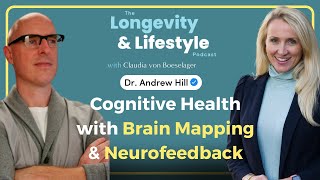
In this Longevity and Lifestyle Podcast episode, host Claudia von Boeselager interviews Dr. Andrew Hill, PhD, founder of the Peak Brain Health Institute, to explore how quantitative EEG (QEEG) brain mapping and neurofeedback can be used to improve cognitive health across the lifespan. Dr. Hill explains the concept of brain training as a way to gain agency over regulatory brain functions—attention, stress, sleep, sensory integration, social processing, speed of processing, and seizure/migraine susceptibility—by first mapping a person’s resting brainwave patterns (alpha, beta, theta, SMR) against age‑matched norms. He describes the practical workflow of a QEEG (gel‑filled cap, 15‑20 min setup, eyes‑open/closed recordings, performance testing) and how the resulting heat‑maps guide personalized neurofeedback protocols that use operant conditioning in a closed‑loop game‑like interface. The discussion covers typical dosing (3 sessions/week, 20–50 sessions for measurable change), evidence from early animal work (Sturman’s rocket‑fuel cats) and clinical studies (Peniston’s alcohol‑relapse work), and a wide range of applications—from ADHD, PTSD, anxiety, and substance‑use cravings to migraine, seizure resistance, creativity, immune modulation, and age‑related cognitive decline. Dr. Hill emphasizes the importance of customization, ongoing coaching, and safety monitoring, noting that side‑effects are usually transient and signal how the brain is adapting. He also addresses age considerations: neurofeedback can be applied from infancy (with age‑appropriate QEEG databases) through adulthood, but in late‑60s+ neurodegenerative changes may limit reversibility, though slowing progression is possible. The episode concludes with a forward‑looking view on integrating brain‑mapping data with metabolic, sleep, and lifestyle metrics via AI‑driven health assistants, making personalized brain health management accessible without requiring multiple PhDs. Practical details about remote versus in‑person training, equipment logistics, and how to get started with Peak Brain are provided.
Chapters
change happens, shift happens. People's suffering is not as permanent as it usually feels. Uh, you didn't always feel this way, you won't always feel this way. And so if you're not satisfied, especially with these regulatory features of stress, sleep, attention, speed of processing, social integration, sensory processing— if you're not comfortable with how those things are operating, those things are changeable. They change probably to pinch up this way so you're suffering. You can learn how to change them.
Are you ready to boost your longevity and unlock peak performance? Welcome to the Longevity and Lifestyle Podcast. I'm your host, Claudia von Boeselager, longevity and peak performance coach.
My guest today is Dr. Andrew Hill. Dr. Hill is the visionary behind Peak Brain Health Institute and has pioneered a groundbreaking approach to brain training services. As many of you know, this is a topic close to my heart with my mother and her dementia and figuring out how do we optimize our brain before it's too late. And he holds a PhD in cognitive neuroscience from UCLA and has extensive experience in the field of neurofeedback and qEEG, which we're going to dig into today. Dr. Hill an expert in functional brain health and performance optimization and has lectured on neuroscience, gerontology, and psychology at UCLA. Welcome to the Longevity and Lifestyle Podcast, Andrew. It's such a pleasure to welcome you on today.
Oh, thanks so much for having me. I appreciate it.
Yeah. So I'm excited to dig in and maybe even just for people listening, you know, what is brain training? People know to go to the gym for workouts, but like, how do you work out your brain? What is that?
Yeah. So a lot of the particular technique that I use is called neurofeedback, which is brain training of the actual brainwaves, the EEG, the electricity you make. But broadly, the perspective is one where you can sort of look at some of the machinery, some of the physiology inside your skull, inside your central nervous system, the same way you might look at your blood lipids and go, oh, I better back off on the Ben Jerry's or whatever your favorite flavor of ice cream is. Um, the, the goal of doing brain training, I think, is often, it often starts with developing that perspective of agency of, well, what is happening instead of it being a diagnostic label. Oh, I've got this particular, you know, sort of psychology-defined bucket or this thing happening to me or this label applied or, you know, then you're entering into a landscape of treatment only and you're entering into a landscape of sort of the things that are attached to that particular diagnosis. And while there's room and even need for that in psychology and mental health and wellness, it's not the only way to think about what's going on in your body, or in this case, your brain. So I like to first, you know, when going after brain training, think about the fact that these are actually resources you can train. At least there's about 6 or 8 sort of resources in the brain or features that are meant to adjust, meant to train sort of in response to how they're being used. They're meant to be efficient, but also to minimize pain, maximize gain, rest well, do all the things that humans are supposed to do. And you can think of these resources as the kind of secondary or regulatory phenomena. There's primary phenomena in the brain, which is like the eyes producing vision in the visual tissue, sort of a direct connection, or auditory producing sound in the auditory tissue. It's a direct connection primary tissue, but then you have these other tissues whose job it is to manage the behavior, the functional behavior of the system at a large level. And if you go to the top part of the brain, the cortical areas, you can start to look at different resource modules or networks and might be a little more practical. Things like attention or various types of stress response or anxiety. Or sleep regulation, sensory regulation for sensory integration, filtering, social cueing, social context, speed of processing, and then sort of keeping things stable, resisting migraine phenomena, resisting seizure phenomena. Those are all the sort of regulatory aspects. And not only can you sort of get a change in those things by exercising them or shaping them based on behavior, you can actually assess them. You can look at someone's brain and say, ah, your speed of processing might be a little iffy because your alpha waves are running slow. Or, oh, look, you've got tons of alpha or theta on circuits involved with pumping the brakes and staying focused. You're not doing that so well. You might have some impulsivity or some inattentiveness tendencies based on the brain. And if you also measure someone's performance, executive function, attention performance, Alongside a brain measurement, you start to develop this perspective where you can outline phenomena and say, oh, look, your executive function is doing this, brain's doing this. That often means X, Y, and Z. Is that interesting? Would you like to change it? Do you know what's going on with your resources? Does this make sense? Does this fit your perspective? And so brain training and broadly QEEG, which is what I'm getting into now, quantitative EEG or brain mapping, is this process of starting to metaphorically peel back the mystery a little bit and figure out what might be happening in these regulatory features. So, if your attention, your stress, your sleep, your ability to suppress seizures or not have migraines, even some pretty subtle things you can get into with brain mapping and brain training. But I would say brain training comes out of the perspective of brain mapping often, which is understanding this thing we carry around on top of our shoulders at a more nuanced level than the sort of philosophical and psychological levels we sometimes apply to these things. So kind of high level.
I love it. And we're going to dig into a bunch of things there. So step one is the brain mapping. And I'd love to, if you could share what exactly does that entail? I think people probably have like a visualization of being plugged into thousands of wires coming out of their mind in some lab. Like it sounds scary, it sounds complicated. But with anything around longevity, health optimization, I would say my clients, like, we have to establish a baseline. And obviously for your brain, this is establishing the baseline, right? So can you talk about how that baseline is established and why people shouldn't be fearful of it but embrace it instead because of, you said there's hope in terms of there's training as well. So can you walk through that experience?
Sure. So it's not that hard to get your brain mapped. It's a little bit messy. But it doesn't hurt or shouldn't hurt. It's over in about half an hour to 45 minutes, and at least the actual brain map part, the EEG. So a brain map is an analysis of an EEG. An EEG is your brainwave sort of making millions and millions of different little firings all the time. And we have a cortex or the bark, the surface of the brain that has these columns of tissue that will fire and burst in different frequency ranges. A couple times per second is called delta. Beta, 10 times per second, 10 Hz is called alpha. So those are communication features, informational flow features that these little bits of cortex can do. And they tend to hang out and rest or have certain tuning modes that you might carry around most of the time. So you can look at things in the EEG, the electricity you're making in momentary events, like you saw something interesting and so your brain had a little interest wave or an attention wave about 300 milliseconds after you see something interesting. Or you can look at the background features like how fast are your brainwaves or where are the resting patterns. And you can— these same sorts of things you would look at in like a sleep study. If you were having apnea or trouble with a sleep phenomenon, sleep quality, you might stick a bunch of wires to your head and sleep with them all night long. So those are all EEGs, just measuring the electricity your brain is producing. But in QEEG, in quantitative, we're taking a cap and putting on the head and squirting it full of gel. And it's got 21 holes in it plus some ear clips. So it's not a huge number, but that's enough to get a good reading, so to speak, of the different areas. And takes about 15 or 20 minutes to fill the cap with gel. If you have lots of braids or natural dreadlocks, having lots of thick hair makes an EEG really easy, actually. I'm bald, right? And it's really hard to get a clean EEG on me. Because the scalp is thicker and has more oily layers, and also there's no padding. So any little pulse that happens in my scalp tends to get picked up as fake or false, you know, artifact data. It looks like, it looks like delta waves, but it's really a heartbeat contaminating. EEG is hard to measure. It's very tiny amounts of electricity inside the skull, the scalp, the meninges, all this fluid and layers. And every time electricity passes out through one of those layers, it's filtered and dampened. And so it's very tiny amounts of electricity you can measure. So it's all about getting good connection. And we these days use caps unless you have thick dreads or braids or something, then we'll use individual wires like old school EEG. And you stick on or fill the cap about 19, 20 locations plus some ear clips. And then you sit still for 10 minutes with your eyes closed and about 10 minutes with your eyes open. And your brain is mostly doing the same thing in terms of where the general patterns, the fingerprints of EEG waves are. This circuit's making a large amount of theta. This circuit's making a low amount of beta, something. And these don't necessarily, these patterns don't necessarily mean a whole lot by themselves. People are really complicated and really weird. So good job. Be weird. Like, just looking at your brain, right? Yeah. So one of the things we do with qEEG is we first take your resting baselines, your eyes closed and eyes open data, and we compare it to normative age-matched samples, big databases of thousands of people with a sort of arbitrary mathematical representation of your age. And we look at how unusual you are compared to that population metric and develop a bunch of heat maps and bell curves and say, look, here's all the quirky stuff. Here's all the interesting things. Here's the places in which you are not typical. But again, Nobody's average, and the goal is not to say, why aren't you average? The goal is to sort of look through the features that stick out, the biomarkers or phenotypes, and say, you know, here's one that's often interesting and here's what it can mean. So again, brain mapping or qEEG is not diagnostically valid because people are so unusual. There are some features in the EEG that rise almost to diagnostic level. The classic one is a high amount of theta relative to beta. Theta is sort of lubrication in circuits and beta is activation. If you have a lot of theta to beta ratio on the parts of the brain involved with controlling behavior, you get something called ADHD, at least that's how we label it, where it's disinhibited or hard to sustain your attention under low load, which is impulsive or inattentive respectively. So you can look at these resting patterns of your brain compared to the average person and say, hmm, interesting things. And then we also do the world's most boring 20-minute attention test. For 20 minutes, we have you do what's called a go-no-go or a continuous performance task where you click on a mouse when a 1 pops up and you don't click on a mouse, in theory, when a 2 pops up and you alternate auditory and visual trials and it's very slow. 1, 1, 2, again and again. And so for about 15, 20 minutes you sit there and do that. And of course you drift and miss the 1, click inappropriately on the 2. It might be auditory or visual. You might be able to tease apart aspects of stamina or consistency or get some other subtle aspects. You're really exploding this idea of executive function into more than a dozen different sub-aspects of things, not just the overarching label, if you will, of the problem. And again, compared to age-matched samples. So I can tell somebody, oh, yes, you are having an executive function difficulty that's at the level of ADHD or something, even though the goal is not necessarily to get to that. Diagnostic. I mean, ADHD behavior or performance distractibility, inattentiveness shows up from classic ADHD in the brain. It also shows up from concussions or post-COVID fog. It can show up from anxiety, especially stress and fatigue fighting each other, driving the car around with the e-brake rubbing and your foot on the floor. Looks a lot like ADHD, but it's usually anxiety and fatigue kind of fighting. Leaving you brittle and reactive. So you can look at a brain at rest and say, here's a bunch of features in your brain and look at performance and say, here's your performance and start to model, start to outline phenomena. And that's what brain mapping is, is you sort of sit down with data and walk through it and start to see these emergent phenomena, these patterns that you have, the meaning you make starts to attach to them. Oh yeah, that thing there, that makes a lot of sense to me. Wow, that sounds just like me. Oh, that? I'm not sure. And so your neuroscientist's job is to walk through and teach you to read data. Your job is sort of to extract that, oh, these things are the parts that are most important or most interesting. And then, as you were saying, there is hope because if you see things in a resting EEG, especially these regulatory features of attention, stress, sleep, speed, sensory, social, these things you can generally shift pretty reliably. The field of neurofeedback, which is the brain training part, was sort of discovered a bit accidentally in the mid-'60s. There's a couple different people doing work in California, both I think in Southern and Northern California in the '60s. And in Southern California, Dr. Sturman, Barry Sturman at UCLA, was examining how dangerous rocket fuel was by exposing cats to rocket fuel because I guess astronauts were getting sick and hallucinating. Having some issues breathing in vapors. So it was a toxicity study done in '60s animal research, and Dr. Sturman was exposing cats to rocket fuel and watching symptoms emerge. And of the 32 or so cats he ran, 8 of them refused to have seizures and were these ultra-stable cats that weren't showing toxicity events when the other 24 cats were having seizures 40 minutes in. These 8 cats 2 hours, 2.5 hours in, we're just starting to show something, which is very kind of striking to Dr. Sturman. So he was trying to figure out if he discovered a new breed of cat or something. But no, it turns out he'd done another experiment with those cats 6 months prior where he taped a little eyedropper into their cheek. And whenever they made a certain brainwave that cats make a lot of, he squirted chicken broth into their mouth, little repetitive reward. Ooh, interesting. And so just for a couple of days, trained some brainwaves essentially using something called operant conditioning or reinforcement learning and saw the change, documented it, put them back in the subject pool. And months later, these cats had seizure-resistant brains. So he took an associate who was a research assistant or something, and she had medication-uncontrolled seizures. Tens of seizures every month and on big drugs back in the '60s, Mebaral, Tegretol, Dilantin, big heavy-duty neuroleptics that are hard to manage and they were not controlling seizures. And they trained her with an audio feedback machine off and on for a year and then she went off all of her meds and was seizure-free for a year. So that was the start of the field of neurofeedback clinically as we do it now. And that frequency that cats make Humans also make, it's called sensory motor rhythm. And so the core in some ways of a lot of neurofeedback still. So SMR, sensory motor rhythm, is a brainwave you make on the strip of tissue that runs ear to ear, the sensory motor strip. So there's two adjacent strips of tissue just in front of the midline, the central divide. You've got the descending information, motor control down into the body. And just behind that central divide, you have the ascending sensory information. In general, the things in the front of the brain are about more inside self and the self doing things. The stuff in the back of the brain are about the outside world. So all the sensory, the visual, the emotional, the attention tracking things are all in the back. And the more purely emotional internal thoughts holding things in your mind are in the front. And you can start to see these things on a brain map. So if you look at someone's brain on a brain map, and you see, for instance, that their front midline, the anterior cingulate, is running lots of beta waves, you would say, oh, hey, your anterior cingulate's pretty hot. Often, because the anterior cingulate's a little CEO whose job it is to say, think of this, do this, think of this, we care about this, we care about this. Often beta waves mean that you're kind of stuck doing that, and that can mean you're perseverating or obsessing a little bit. Someone starts laughing, oh my gosh, or their spouse in the background starts laughing usually. So we have this ability to not sort of say diagnostically, oh, you have OCD, but to sort of say, oh, do you have a bit of a steel trap mind that tends to get stuck? And both can be true. You can have diagnosed difficult clinical level problems, or you can have a resource that's cramped up. The line between those is pretty shallow, pretty hard to spot. Also, it can be both. You can be both a CEO with a high-powered brain and have OCD, and it can be a useful set of resources in certain environments that have cramped up a little bit and hard to shift in others. Same is true of ADHD type folks. When they have a low stimulus environment, not the most effective control over executive function. But you put somebody with classic ADHD in a high stimulus sport crisis, high pattern matching, high dynamic information environment, and they're going to perform better, dramatically better than the average person. Who has typical, quote unquote, executive function regulation. So all this to say, you can look at resources and say, hey, here's your performance, here's your brain, let's start demystifying it and painting out these phenomena for you. And then, as you alluded to earlier, there is hope. You can exercise these things with what's called neurofeedback, and I can explain the technique in a second, but essentially the hope is, or the The promise, the wonder of neurofeedback is with these classic regulatory features, especially things like attention, sleep, anxiety, you can train the brain to the tune of about one standard deviation on a bell curve every other month, every 20 or 25 sessions, training 3 times a week. You can iterate change. So you get someone who's severely ADHD or has classic PTSD phenomena, isn't sleeping because of a decade of drinking. And you train them for a couple of months, 20 sessions, 30 sessions, 40 sessions, and the difficulty just starts dropping away. And people feel neurofeedback in 3, 4, or 5 sessions typically. So it's not this delay. For most things in psychology, you do a lot of work slowly and you gradually change.
Years and years.
This is sort of like, okay, I'm not feeling it. Okay, wait, wait, wait a minute. Huh? That was interesting. A few sessions in, you're like, well, I'm kind of feeling something, and then it wears off. One of the things people are often first wondering about neurofeedback or worried perhaps is like, I don't want to stick wires to my head and change my brain. Neurofeedback, most forms of neurofeedback are transient initially. There are forms that are mildly invasive. There are microstimulation forms that do zap you, but most forms of neurofeedback do not. I would say 95% of the field is a passive practice where the basics of neurofeedback are you just measure the brain in real time. You stick a couple of wires on those circuits involved in executive function. You measure the amount of theta, which is disinhibition. You measure the amount of alpha, which is being in neutral, and you measure the amount of beta, which is sort of voluntarily pumping the gas on those circuits. Circuit on the left is the vigilance stabilizer, keeps the spotlight clear, bright, and on the road. It also keeps you deeply asleep at night, so it maintains the mode you're in. And the circuit on the right is a supervisor who walks around saying, are you sure you want it? No, no, no. Okay. No, no, no. Uh-huh.
Yep.
And pulls back and pumps the brakes gently everywhere so you can kind of keep the machine on the road. So if you measure these alpha waves and theta waves moment to moment and measure these beta waves moment to moment, they fluctuate. And whenever they happen to briefly move in the right direction, and simply applaud that with a bit of auditory feedback or visual feedback. So you sit and watch a game, and whenever your brain happens to make a bit more beta and a bit less theta, then the game starts to run faster. Pac-Man eats more dots, your car smashes more zombies, some beautiful music starts to play. And then a couple of seconds later, your brain moves in the wrong direction, and for the workout anyways, and the game slows down or stops, and your brain says, hey, I don't like no stuff. Where's my stuff? I want some stuff. And a couple seconds later, it happens to move in the right direction and the game resumes. The brain goes, oh, okay, interesting. And I do say brain, not mind here because it happens within the first 5 or 10 minutes. The brain starts to yoke, starts to react to the information. Oh, interesting. Oh, beta waves are being rewarded. Oh, alpha. Oh. And you can see it in the brain. This is actually what I did a lot of my dissertation work on was, well, what is happening in the moment of neurofeedback? How does the brain know Which brainwaves you're plotting? Yeah, you're measuring them. Yeah, gameplay is happening, but where's the closed loop? How is the brain actually figuring it out? So I looked at what's called an evoke potential, a momentary event in the brain. And you can see within the first 10 minutes, the brain is creating a change in potentials in the frequency you're plotting. Right after you plot, it goes, whoa, and creates a little burst of the frequency or a dip in the frequency in the way in which you plotted it. So you have this information loop created and the mind doesn't really participate all that actively, at least at the beginning, because you can't feel your brainwaves. So you're sitting there going, really, this Pac-Man stopping and starting is training my brain? Puzzle pieces falling away occasionally, that's doing something. But the brain's hearing, good job, brain. Good job, brain. Good job, brain. Nope. Good job. Good job. Good job. Good job.
Nope. How interesting.
Such a shift.
Super interesting. So can you see, or could one see then, like new neurosynapses being formed in that place? Because it's realizing the reward mechanism is this way and that quickly.
You would see synapses if we could image real synapses in real time. You would see them changing or strengthening. Neurons will change the strength or the likelihood of firing between two synapses, and they'll also create new synapses. Cells can send out new processes and create new connections. We can't really image in real-time living tissue at that level to know what's happening. You can do some things in dishes and look at stuff on microscopes to know how learning occurs. This is how we know it's happening. But in terms of humans, there's been a couple of studies looking at neurofeedback, single-session neurofeedback will create some really interesting effects. There's a couple of studies looking at what are called motor evoked potentials, which is when you take a coil, a magnetic coil, and you zap the hand area on the motor cortex and it causes the hand to jump when you zap it with magnetism, little magnetic pulse, motor evoked potential. And there's a couple of studies showing that if you do neurofeedback, a single session for 24 hours, you get this really reduced threshold of activation where it takes much less energy to cause the brain to react and change. So it's a sign of plasticity. Yeah. So you're getting this measurable, from neurofeedback, this measurable boost of plasticity that's pretty high for a chunk of time. So when we're tuning these individual circuits, that's wonderful. You get specific effects. You'll feel the effects afterwards, you know, subtly, and then it kind of wears off initially. But you're also getting global effects on plasticity. So all the time someone comes to me for difficulty with brain fog, let's say, after a brain injury. And then I got a call from their physical therapist saying, what are you doing to my client? She came in without a cane today. Her balance is better. Her spasticity's down. And I wasn't necessarily working on those things. I was working on the tinnitus or the brain fog or the word finding issue or the sleep onset difficulty or whatever, the executive function issue from from the aging, whatever it is. And other things start to change because your brain is sort of in control of it all. So as you boost the plasticity, other stuff starts to get in. So I get reports from teachers where kids are learning better. I get reports from therapists. I get reports from spouses that their husbands are being nicer and therapy's working better. Whatever you did last week, do it again. You brought me flowers.
Oh my gosh. You can like start programming things in.
Well, you can get access to flow states, and that's— it's done for, uh, sort of therapeutic, if you will, healing, you know, trauma intervention work, as well as creativity. There's a, there's a moment, um, as you're falling asleep where the mental mind, if you will, starts to drop away, and the awareness, the insight, the access is suddenly there. And that's when you have the world's best idea, and You write the best script and you solve world hunger, and then you fall asleep and, "Wait, what did I remember last night?" Right? So, that's the hypnagogic access moment where you're really shifting to the edge of consciousness. And, you can train yourself to do that to get access to that state using technique called alpha-theta neurofeedback where you bring yourself to that edge of consciousness and then hold yourself there for 20, 25 minutes. Wow. And stuff starts bubbling up. Insight, access, consciousness, awareness, access to your emotions, being able to talk about how you're feeling. It also seems to bring up T cells pretty dramatically, creates a deep relaxation response. That's not going to be a permanent effect. Most things in neurofeedback are permanent eventually because your brain is practicing these states all the time. But there's evidence in alpha training that you can bring up T cells, CD4+ cells in immunocompromised populations pretty powerfully. And it's got to be a relaxation response caused by that hypnagogic sort of state access. So just a sampling of the ways you can go in. You can modify these executive function things or the stress response features or things that are a bit more esoteric, like creativity or your immune function a little bit.
Intuition, things like that too. I've done alpha brainwave training. I have also the BrainTap, so I do different things with that. But do you do then Customized brain training protocols for the patient depending on what comes up, or what do those protocols look like?
Yeah, so I sit down with people and, uh, go over QEEGs and performance testing with them. And again, I teach them to sort of read data and they tell me what is important. So I'm very goal-focused as opposed to let me fix you, you know, focused. Uh, it's not about my judgment of these resources. It's really about the person's perspective on what is most important in the data they're looking at, or what can they describe about their function. You can't always see things. You can't see a lack of creativity in a brain map, but you can describe that you want access to creativity, and then I know to build in some flow state type protocols. So it ends up being a mix of, hey, let's understand you from your brain. That will frame, maybe highlight some goals you already know. Usually brain mapping and performance testing tells you things you already know. That's when it's in the Sweet spot. Oh, yeah, that. I care about that. Okay, great. Now, go after that. And generally, I build plans, workout plans essentially, which can include a handful of different locations on the head, different frequencies to train. And this is very much like personal training where you iterate through different interventions and adjust. You don't just give a particular neurofeedback protocol and train that way for many, many times. Learning will slow down at best, and at worst, you might cause some trouble if you don't change the workout. I mean, imagine doing nothing but bench press all the time in the gym for 2 hours every 2 days. You would eventually have trouble with those resources. And the range of goals is, again, really set by the client, but includes all those regulatory features, generally executive function, anxiety and stress features, sleep, sensory, social, speed of processing, and then migraine, seizure, brain fog, creativity, all that kind of stuff. Also, there's a fair amount of use in the field. I have some good experience with this, although it's not a very large amount of my client base these days with substance use disorder. The same technique of alpha theta, the creativity work, powerfully reregulates alcohol cravings and the inability to downshift after years of drinking.. So those dry drunks who have been sober for 10 years but are still nervous and shaky and can't fall asleep, the brain is hot. It's in solid locked up beta. It's very glutamatergic because it's never really been able to make all that GABA again that alcohol had been replacing. And so these people are shaky on the edge of a cardiovascular crisis or an anxiety attack, can't fall asleep, and their brains look like a resting pattern of hyperactivation, hyperarousal. For decades sometimes. But you can exercise the alpha theta resources and bring up that downshift, that GABAergic ability to sort of soften. And after a few months of neurofeedback, folks are able to fall asleep at will. Wow. Relax if they feel like it. Cravings go away. I think the research on alcohol by Peniston, Eugene Peniston, and showed that this research was done in the '60s and '70s and the '80s sort of concurrent with Sturman discovering SMR training. We had Joe Kamiya doing work at, I think, Berkeley, maybe UCSF on alpha training in humans, which is relaxation. And soon after, you had people doing work around meditation, alpha, alpha theta, long-term meditators, et cetera, throughout the '70s and '80s. So that's sort of this end of the field. The alpha stuff came out, converged with the interventions of the manipulation of the bands like the SMR and thetas and things and became this technique to create massive creativity. And Penniston's work, I think, showed that the 1-year relapse rate for alcohol is reversed. The all-intervention, if neurofeedback is added, it's a 25% recidivism or relapse rate for alcohol. And if neurofeedback is not in the mix, it was 75% is the standard statistic. So pretty big impacts on things like acquired difficulties from alcohol. So these are all the different resources you might want to go after, but I don't know for you if the drinking's a problem or if the cannabis is or if you're too anxious or you love being kind of high-powered and a bit stuck in your head. So I walk through data without too much judgment and help people figure out what might be interesting, and they tell me what's the most important stuff. And then from there, we iterate. So I mentioned earlier, you feel neurofeedback, but it takes about 3, 4, or 5 sessions, and usually you're like, hey, wait, huh, am I feeling something? Not sure. And then it wears off and you Pretty sure you imagined it. And you repeat it and it happens a little stronger. Oh, wait a minute. No, this neurofeedback stuff. Oh, I feel calm. Oh, I feel focused. Maybe. Huh. And then your sleep is different that night, perhaps. So you start to have this opportunity to examine the post-training effects, kind of like you worked out at the gym and then later on you're like, oh yeah, I feel great versus I can't pick up eggs. They're all over the floor at the supermarket because my arms are noodles. You kind of get a sense of the resource and then it starts to become this different relationship with your brain because you feel your sleep, your stress, your mood, your attention, your focus, your energy shift a little bit and you go, huh, hey, I like that. More of that, please. And then you build a workout around that experience you had and tune the neurofeedback a little bit and get a different effect. So it's mysterious, but not blind. You sort of are very quickly validating what you're getting. Refining what effects are emerging, trying different workout protocols, tweaking them, adjusting them. And over a few months, you move your brain. And we map the brain again every couple of months, every 25 sessions or so. And that's about the range you can see, typically about a standard deviation of change in executive function or anxiety features in the brain. So enough to really get a sense of your goal shifting. And that also gives us an opportunity to refine the goals and you to come up with a different sort of set of perspectives. Often the really big important things you have been wanting to solve for a very long time are changing so much a couple months in that your goals are changing and your idea about what you want to do for another month or two is changing. And I say that because you often have to do about 3 or 4 months total to get to really a permanent place. It doesn't happen instantly. It doesn't build up right away. It's closer to exercise than it is to medication. But as you do it, the brain takes over. And so somewhere around 30, 40, maybe 50 sessions, you've reached that first real stopping place where the resources will likely support you unless there's something pushing back against it. New mold exposure, new concussions, that kind of stuff will erode stability. Or if you have a lot of damage, a big seizure disorder, or maybe a lot of need, big developmental difficulty, then 3 months or 4 months won't be enough training. You might want to do 6 or even 12. But for classic stuff like ADHD or PTSD or cravings for alcohol or sleep issues, uh, 3, maybe 4 months of neurofeedback, 40, 50 sessions is sort of the classic dosing, if you will, to have that kind of trajectory where you end up, uh, in a different place.
So exciting. So thank you for sharing all of that. Is it, um, you said like 30, 40 sessions, um, over several months? So is it at the beginning, you do once a day, twice a day, and then you, you know, pace it differently, or how would you recommend, I think, for people interested in, in looking into this, just to know the time commitment, and how it's done, and it's in person, I assume, or, or is there, is there also remote training?
So we recommend doing it 3 times a week as a nice sweet spot. Mm-hmm. The learning seems to be maximal for the sessions you get. I think 3 times a week is about twice as impactful as twice a week.. But 4 times a week is only slightly more impactful than 3 times a week. So Peak Brain, my, my company, has locations around the world. Most of the bigger training offices are in the US, although we have some small pop-ups in Stockholm and London as well as the, the offices in the US. But only about 20% of our clients train from our offices. Mostly we do remote neurofeedback where we send out equipment and do brain mapping remotely and then teach people to stick some wires to their head for the neurofeedback. So, I mentioned the cap for the brain training, for the brain mapping. The qEEG uses the cap. Brain training or neurofeedback doesn't typically use a full head cap. I mean, you can, but it adds a lot of complexity without a lot of benefit. So instead, we use a 1 to 4 channel training where you stick some ear clips on and you might put 1 or 2 wires on for that day's exercises. Then you set up some software. So, it's not that complicated. And we have people in our offices train 3 times a week and get the effects they're trying to get. And nice linear change for the first few months, and we can map it. We can really shepherd a lot of shifts. Folks that are training from home, why don't you train more? You have the gear, you have the brain, you have the goals. We have coaches on 7 days a week, 12 hours a day for you. Can jump on, help you place a wire, troubleshoot some software, kick windows when it was trying to do an update or maybe remind you to fill out your sleep surveys because we haven't seen from you or heard from you in 3 or 4 days because that happens. So it's this coaching process we provide where the coaches are on a private chat and able to have this real-time, hey, thanks for that sleep survey. We think that new thing you did might have been too pushy because you cleaned your house and couldn't fall asleep after it. Let's back off a little bit and try a slower beta and some of this as well. If you notice that's in the chart now, try it. Let us know if you need help setting up.. So you get this real-time support where you can gently push your brain, index the effect, and then with some support, know what the next step is. Because doing neurofeedback is not hard. Knowing what to do is. So anyone can buy a kettlebell or a weight machine, but getting in really good shape takes some functional use of those techniques in a very particular and tailored way. So I encourage folks who, especially who have really complicated stuff going on, getting an assessment done, a brain map done, digging into tailored neurofeedback, working to do iterative work that's about your goals and your brain instead of a one-size-fits-all kind of magic box is the way to go. There are some of those out there in the marketplace. They don't work super well and they can cause harm. At best, they don't work optimally. You're going to get the most change. And at worst, you might be trained in the wrong way for you and have side effects start to emerge. And that can happen in neurofeedback. You can get side effects the same way you get side effects when you work out the wrong way in the gym. You know, if your shoulders hurt too much, maybe the seat height was too low in the press machine. And that kind of thing happens in neurofeedback where you're like, oh, you're a little bit wired after that session or kind of tired, or your sleep maintenance was interrupted. Hmm, okay, beta waves aren't tuned for your alpha waves, you're too pushy, something. And so you learn gently early on the process what works for somebody, and make small adjustments and try some stuff and get better effects. So these side effects are transient, they're self-limiting unless you continue the neurofeedback, and they're informative about your brain. Because we don't want to believe all the ideas we had about you doing brain mapping. We want to believe what you notice and experience as you move towards your goals. So that does take a little bit of attention. That's what our coaches do at Peak Brain, is spend all that time saying, hey, how you feeling? How was that new session? Did you like it? Ooh, sorry, your mother-in-law's a jerk. Here's a protocol for when people are being mean to you and staying with you in your sort of brain landscape so you can develop goal progress, but also we can be a little responsive to the day-to-day suffering and support you might need with stress and fatigue and other kinds of resources you're feeling.
This episode is brought to you by OneSkin. There is nothing like the feeling of being confident in your own skin. That's why I'm excited to share about a skin longevity brand I love called OneSkin. Their products make it easy to keep your skin healthy while looking and feeling your best. No complicated routine, no multi-step protocols, just simple, scientifically validated solutions. The secret is OneSkin's proprietary OS-1 peptide. It is the first ingredient proven to switch off the senescent or aging cells that cause lines and wrinkles and thinning skin. I've been using OneSkin's products for a while now, and I'm hooked. My skin looks refreshed and revitalized each morning. But don't just take my word for it. OneSkin has over 4,000 5-star reviews. And was recognized by Fast Company as one of the most innovative brands in 2024. For a limited time, you'll get an exclusive 15% off your first OneSkin purchase by using the code Claudia15 when you check out at oneskin.co. That's oneskin.co and use code Claudia15 to get your 15% off.
Andrew, I'd love to understand, is this for all ages? So is this also for kids? As we're hearing more and more, there's more incidents of, you know, ADHD and autism and OCD and different things coming up as well. Or, you know, maybe just being diagnosed where it wasn't diagnosed. I don't know the exact— I've seen different research pointing to different things. So is it also for children? And then even looking at the other end of the spectrum, people maybe with early onset or even early stages of dementia, cognitive decline, is this also a really helpful tool as well?
So could you talk to about that? Sure. Yeah. So the developmental perspective, the short answer is on the low end for kids, there's no limit. We have QEEG databases, comparison databases as low as 6 months of age. So if you need to see what's weird in a kid, you can. Often my colleagues and I will say, if someone asks me, hey, what age do you start working? I'll say 4. Because at 4 years old you typically have enough observable behavior, often language, so you can have the person to be being a participant in the process. Oh, I like that. Oh, I felt tired or whatever. But I've worked with plenty of kids that, um, parent whose parents have just discovered that the kid is autistic, just gotten that diagnosis at 2 years of age, and they're bringing a baby in saying, oh my gosh, my toddler is not making eye contact and has sensory issues and is starting to stim. Can we work? Can we work? Can we do something? Yeah, probably. It's not quite as straightforward as a kid who can put up with every aspect of it. We don't do attention testing for kids below age 7. It's just too much. They just don't like it. Also, the behavior is too variable below age 7 for attention. And it's often hard to get a brain map done. A cap on the head for a kid who's screaming and stimming can be really hard, but not impossible. You'd be shocked at what kids actually occasionally put up with, especially a new environment, a new person. Kind of be tolerant for a little bit sometimes. And the neurofeedback actually feels kind of good. And you can do the neurofeedback in a way that's appetitive or interesting for a kid. So if you've got some nonverbal kid who won't put up with anything, you can play that same movie they want to watch 1,000 times a day on the screen as the feedback and make the screen dim or stop and start the movie as the feedback if you want. Not the best way to do neurofeedback. Movies are kind of weak. Socially loaded stimuli is kind of a weak way to do neurofeedback because social engagement breaks implicit learning, and neurofeedback is a process of implicit learning versus voluntary control. So if you load up all the social information processing, you can impair the sort of involuntary aspects of learning. But for kids that will not sit still and got to watch My Little Pony 1,000 times, It gets them to sit there and then the training starts to happen and it builds on itself where they get better motor control, executive control. So you don't have to be verbal for neurofeedback to work. It was discovered on cats. Cats are really bad instruction followers. This is not a voluntary process. It works if you're in a coma. One of the great people in the field, who died recently a couple years ago, Margaret Ayres, last decade or two of her career was spent on coma bedsides doing neurofeedback to change the coma status successfully often. So you can do all kinds of interesting things by involuntarily shaping the brain activity because the brain likes to learn. This is no different than a baby flopping around who does a random baby push-up and goes, whoa, I can see 12 feet, holy cow. And then 20 minutes later, the brain wants to see more. You do the pushup. You don't think left arm, right arm, wrists. You just do the thing. The neurons all fire in that unique conformation. And the same thing happens if you're a little kid who's sitting there watching a computer screen, and whenever your theta goes down, the game starts to run. The kid sits there and relaxes and watches it because if they move too much, it interrupts the signals, the game stops. They learn to sit still. And then the different brainwaves start to get trained and it creates this engagement. So at the young end, it's actually really easy. And you can also train teenagers who don't want to be there, who sit on their phone the whole time and, "I'm fine." You can train them too. They get some changes. "Wow, my team was very nice yesterday. That was great. What'd we do?" And then elders, I would say it's a complicated story. If it's actually age-related deficits and it's probably, if you're north of You're late 60s and it's an age-related illness. If it's one of the big 4 or 5 things we tend to be concerned about with regards to the big diseases of aging, meaning all of the dementia-bearing phenomena, diabetic phenomena that are quite strong, cancer that's quite strong, these are the big ones. And all of them to some extent are driven pretty dramatically by metabolic dysregulation. So I know you've had Dr. Dale Bredesen on the program talking about, I assume, the Recode program and metabolic health and those 37 factors you can actually steer and measure in the metabolism to move yourself away from that phenomena. So dementia is age-related cognitive decline that's pathological. It's a metabolic phenomena, 20-year phenomena. But it's not a disease phenomenon the same way as an infectious or an injury phenomenon is. And you can steer it in the other direction often, at least potentially for mild phenomena and pre, if you will, Alzheimer's phenomena. Does look like you can address those metabolic factors and steer someone away. So if someone came to me in their 70s or 80s and said, look, I'm getting some dementia, well, half the time they're actually wrong. Half the time they're having word-finding issues and they're really concerned about dementia. Guys, word finding issues, delayed recall for words and names and tip of the tongue stuff, that's not actually dementia and it's not your memory. If you're having trouble finding words, it's not your memory, it's your speed. It's the speed of processing. It's a handoff thing. Your brain's pretty good at storing language and handing it up to you when you require. You're not always that good at grabbing that information and stitching it into sentences and dropping it out your mouth. So. When you're having word finding issues in your 50s or 60s, it's almost always because you're having a speed of processing issue. And if you look at why, you can often see things like the quality of deep sleep has gotten thrown off, and that's essentially driving around with the e-brake rubbing, or handbrake as you guys might say across the pond. So again, all of this is to say you can look at the phenomenon and go, hey, wait, here's the thing. And so I would send someone to the Apollo Health program to have that metabolic screen done if they had actual age-related cognitive stuff. And I might be more of a coach and less of a neurofeedback provider in thinking of ways to address other stuff, other interventions or other ways to go after healing. For instance, if you do respond, let's say, to exogenous ketones, well, that means that you still have intact neurons because one of the big things that happens in dementia is the neurons become insulin resistant. But they're insulin resistant with spared ketone metabolism. So you can take somebody who's actually got cognitive difficulties, and if you supplement exogenous ketones, ketone shakes and things, especially the esters, and you get a brightening, a lightening, a clarity, a sort of a reverse sundowning phenomenon where they seem to get better. Well, that means you've got some intact cognitive resources if you could feed the darn stuff.. And of course these same folks who are getting disorganized cognitively are often usually having, you know, of course there's memory issues, there's usually irritation and anger. Mm-hmm. And carb cravings because the brain is insulin resistant. So if you see that phenomena or you can get a little bit of behavioral hack in and make your grandma protein rich, you know, ketone rich smoothies and you get a lift, well, okay, now you can pursue the Apollo Health program to get all the factors screened, but now you have maybe a window of going lower carb, moderate protein, higher fat. And elders don't absorb protein especially well anyways, so you often have to go up higher and higher in protein than you might think you would for a kid or a younger person. So if you're already having trouble with age-related cognitive decline, it's truly pathological. The neurofeedback doesn't have enough neurons to work on. So it'll keep the plasticity high, but it's not probably going to reverse the syndrome. I have a hunch that it will slow down things like Alzheimer's, but I don't think once you develop symptomatic, significant symptomatic aging phenomena, the other big one being Parkinsonian phenomena, to unpack that one for a second, and of course there's dementia and Parkinson's, but to unpack the the incidence of Parkinson's showing up, it sort of tracks the same thing that happens in Alzheimer's, where it's probably a 10 or 20-year phenomena, probably 10 years for Parkinson's, 20 years for Alzheimer's. But it seems that the reason that this is a useful thing to unpack is it demonstrates the fact that the brain is not a bunch of switches. Parkinson's is a difficulty in dopamine, the same way memory and dementia is a failure or an issue in choline or acetylcholine. So dopamine's involved with movement as well as attention and a bunch of stuff. And deep in the brain, the basal ganglia is a circuit of movement structures that kind of zip around movement in a little track. And when those circuits get dysregulated, one of them stops getting timed well, you get a bit of like a timing issue, and then you get tremors and other Parkinsonian phenomena. And that's a dopamine dip, essentially. You have a dopamine— one of those circuits down there is called the substantia nigra. The pars compacta of the substantia nigra, the dense part of the black stuff, is what produces all of the dopamine in your brain. And some of it's used there. A lot of it's sent out into places like the frontal lobe where it's used for other stuff, for learning. But if you dysregulate, if you damage the basal ganglia that produce dopamine, they start to die. Chemical insults, other insults we aren't sure about can create damage in those tissues and they start to produce less and less dopamine. But Parkinsonian symptoms don't show up right away and you can lose, you do lose something like 75% of your dopamine production before you get any symptoms at all. Wow. Does this mean that the first 75% of dopamine was irrelevant? Not really, but it does mean that your brain doesn't care about the absolute level of any neurotransmitter. There's no such thing as a chemical imbalance in the brain unless you're basically on the edge of death and you're having a metabolic crisis or something. There's no such thing as a chemical imbalance. Parkinson's is a failure of the dopaminergic systems broadly, not the amount of dopamine. And dementias are a failure of midtemporal tissues, hippocampal tissues, perihippocampal tissues, et cetera, not just the level of acetylcholine. So this is why I drew people's attention to the idea that speed of processing is not dementia because you can think about the different tissues. There's the hippocampus, there's the parahippocampus, and memory is used differently in different structures. And you get sort of signature issues. You can have really big problems with your hippocampus having degraded dramatically and still have no problem with word finding. So those two things are not necessarily yoked all that well together. Language production is not really a memory thing. It's in the front left corner typically, not really in the mid-temporal lobe. And you end up with intact language processing if you're fast enough and rested enough, even if you don't have any idea who the president or your kid is, word finding can be totally intact. So word finding is not a concern, doesn't lead to dementia, but it does usually mean you have some suboptimal brain fog, sleep quality, something, and it's probably worth addressing. Just like body fat, getting pudgy, losing muscle mass, losing bone mass. These are normal things that are not pathological, the sarcopenia stuff, but they're also things you probably shouldn't tolerate. And you can work against those trajectories and end up getting better or at least flattening trajectories so you don't degrade. That's why I frame my answer about age into this late 60s and 70s, because before that, you can probably improve trajectories, work on a particular problem, address stuff really pretty well. Things remain really plastic in body and brain up until, I would say, late 60s, even sometimes later. Have a healthy body generally. If you've been smoking and drinking your whole life, you won't get to your late 60s remaining plastic and fresh. But if you're reasonably careful and healthy, then even if you're not in every way, you can still do some damage control in your 60s, but it's really hard to do in your 70s. So any big change of health status, body fat, blood sugar status from about the mid-60s on, any change at all predicts that you're going to have a lot of difficult health ahead of you and probably some death. So you basically want to go into your mid-60s to late 60s with all the resources you got dialed in as much as you can because it's kind of tough and kind of stressful. If you're really heavily overweight at 70, enjoy it. You're going to be that way. Don't lose 50 pounds, 80 pounds, at 70 unless you're having— unless there's other reasons to do it. Because a big stressor like that actually would predict many more health crises by causing changes in your 70s that way. You can't really handle the disruption of systems in the same degree, and they're a lot harder to go after.
So for everyone listening, now is the time.
Now is the time. Exactly. Right. The best time to start exercising was yesterday.
The next best time is, is today. Yeah. Yeah. So as we finish up today, what trends and developments are you most excited about in the neuroscience and neuroscience for longevity space?
Yeah, I mean, just, just the idea that we can get a blood test. Dr. Brett does his work on the Recode program and we can understand these metabolic phenomena. You know, I, I taught gerontology for 11 or 12 years at UCLA and I had a, a whole course sequence on the diseases of aging and the cognitive impact and brain aging. And when I started teaching that course the first 2, 3 years, that week or two, those were somewhat somber at the very least weeks and with some heavy topics. And then as I got into that later decade I was teaching there, I started seeing all of these metabolic biohacks coming out and what became the Recode program. So I had a very different perspective and that's, I think, a very big thing for giving people agency to take actual control. I mean, you know, our grandparents didn't look at their triglycerides or our great grandparents. You know, our parents now, ourselves, you know, we're looking at sleep hacks and we're measuring bone density, and we have all these other different things we go after. I think that what I think we need to do, I think we will do, we're about to do is bring all of that information together. I coach an awful lot of people, not just on brain, but on general performance and optimal wellness. And I hear an awful lot of people frustrated they can't take their list of supplements, symptoms, complaints, goals, interventions, and share them with their team member reliably. I mean, I have tools for sharing things and doing coaching, but they can't take their sleep logs and give it to their medical doctor in a way the doctor actually wants to look at or can look at. And I think that's, as these platforms are integrated, we'll also, we'll get sort of intelligent agents. I think we'll be able to test our interventions just like we can look at our genes and say, ah, this drug or this B vitamin is not great for you, but this one probably good for you based on MTHFR status or something. Examples like that. We're going to pull huge databases of ourselves our QEEGs, our sleep logs, our substance history, our workout history, when we meditate, what we're eating, what supplements. I think we'll be able to start taking that and essentially running intelligent agents against it. Okay, here's a new study that just came out suggesting here's a new compound. How does that look against me? And have sort of a machine learning fit made against my own health status or goals. I think that's where we're going. This idea that individualized or personalized medicine is the old last decade buzzword. There's something else that's going to replace it, which I think is going to be almost like a health assistant or a performance assistant who is an avatar that models all the data that's accumulated. I mean, as it is now, I'm a sophisticated consumer of medical and psychological and and science information. And there's a lot out there. Even my own health status, it takes me a year sometimes to get an answer to things. And I understand more about the brain and the body than most people, I think. And I still run into doctor who just doesn't have curiosity or isn't kept up on research. Or what I'm finding these days is doctors often don't have any ability to really do things outside of their narrow area of interest. Oh, that's another specialist. Go see someone else. And there's not this continuity, this bucket where they know all the things, and that creates, especially in aging medicine, creates polypharmacy and drug-drug interactions and people doing all kinds of— and I think that stuff's going to go away. I think soon we'll get to the place where a drug-drug interaction is not going to happen because of course you're going to register all your supplements and medication. Maybe your phone just going to know because the pill bottle came from Amazon and it's going to register the supplements you took when you order that. Who knows?
But there'll be some way of Bringing it all together.
Bringing it all together in a way that doesn't require you to have two PhDs and an MD and then get a research grant to manage your health. And I think we have more tools now available than we use because we haven't brought this stuff together effectively, which is why people like me and Peak Brain have jobs is to help you navigate some of the complexity.
I love it. Yeah. No, and my other company, Athena Healthspan, we're building something along this line, focusing first on clinics to help bring it all together and also to interpret, all this wearable data, it's like the so what. And exactly, because medicine is siloed, longevity science is typically siloed as well, but we're holistic beings. And as you said as well, like, you don't want to have to have a double PhD and an MD to be able to interpret all the information. And that's where I think the exciting point of technology is, is to assist clinicians to better interpret the data and understand, okay, for you specifically, like, we need to do this protocol. Versus the next person or even your twin might need this tweak because of XYZ.
So it's true. Yeah, I'm very excited. Twins, just as an aside, identical twins don't always but often have the same brain patterns. Interesting. I would say it's like maybe 90% of identical twins, you're like, wait, is this the same brain? Oh, no, it's not actually. Wow. And the other 10%, they look like just another sibling or another family member, which is some similarity, You actually can see the same resting brain patterns in twins a lot of the time. Wow. Exciting. Wow.
Interesting for studies as well, right? That's right. Andrew, where can people follow what you're up to? Where would you point them to? Websites, social media handles, et cetera.
And we can link them in the show notes. Yeah. Folks can check us out at peakbrainla.com or peakbraininstitute, which is the same thing,.com. Most of our socials are Peak Brain LA because we started off in Los Angeles. But we're also in New York City, St. Louis, Orange County, California, London, and Stockholm. And if you're not in one of those cities, we have partners in Australia and a few other countries, and we work with folks remotely. So depending on your goals and needs, we can send you hardware and software and work with you virtually. We have clients in like 30 countries right now. So check us out at Peak Brain LA on the socials or peakbraininstitute.com. You can find me and a bunch of podcasts at andrewhillphd.com. And yeah, come ask your brain questions and come get a brain map and let us explain a little bit of the mystery that is you.
Exciting.
Andrew, do you have a final ask or recommendation or any parting thoughts or message for my audience?
Only thing I would say is, which sounds somewhat banal, but change happens, shift happens. People's suffering is not as permanent as it usually feels. Uh, you didn't always feel this way. You won't always feel this way. And so if you're not satisfied, especially with these regulatory features of stress, sleep, attention, speed of processing, social integration, sensory processing, if you're not comfortable with how those things are operating, those things are changeable. They change probably to pinch up this way. So you're suffering. You can learn how to change them, be it meditation or nootropics or sleep hacking or exercise or tailored work like neurofeedback or psychotherapy or some really cutting-edge intervention we'll come up with next. The point is that you can learn a lot more now about yourself than at any point in history, and you can do so much more now than we ever have with a lot more control. So don't just suffer in silence. Don't be overwhelmed, as overwhelmed. If you can look at the machine, figure it out, just knowing how it works suddenly makes it a lot harder to be overwhelmed or shamed or guilty. Oh, just in my head.
Don't worry about it. So very exciting. Thank you so much, Andrew, for coming on today and sharing about this important supercomputer we have between our ears and what we can do to tweak it and fine-tune it.
Right. So thank you so much.
Oh, thanks for having me.
Appreciate it. Pleasure.
More from Claudia









Can Psilocybin Slow Aging? The Study on Telomeres, Inflammation & Survival with Dr. Louise Hecker

