Living to 200: The Secret & Technology of Growing Young with Sergey Young
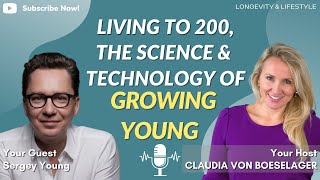
In this Longevity and Lifestyle podcast episode, host Claudia von Boeselager interviews longevity investor and author Sergey Young. Sergey shares his personal health awakening (high cholesterol in 2014) that sparked a mission to extend healthy lifespan for a billion people and ultimately live to 200 years. He describes founding the Longevity Vision Fund ($100 million) to back startups tackling age‑related disease, and his work with the XPRIZE Foundation to launch an Age‑Reversal XPRIZE that will use regulatory‑approved interventions and biological‑clock biomarkers to prove age‑reversal in a 12‑month trial. The conversation moves through lifestyle‑driven age‑reversal (exercise, diet, sleep, supplements) that can shave years off biological age in weeks, the expanding role of wearables and continuous glucose monitors, and the psychological dimension of “thinking and growing young.” Sergey critiques common myths about aging, outlines the nine hallmarks of aging, and emphasizes that no single silver‑bullet exists. He warns that the biggest future barrier is ethical and regulatory acceptance rather than scientific capability, and calls for recognizing aging as a disease. The episode also covers his new book, The Science and Technology of Growing Young—its purpose, audience, and key messages—plus his daily routines, productivity habits, and a personal mantra of taking 100 % responsibility for one’s life. Sergey highlights three near‑term breakthroughs he finds most exciting: gene editing/therapy, longevity‑specific pharmaceuticals (e.g., metformin, rapamycin, AI‑designed drugs), and organ regeneration via bioprinting and lymph‑node‑based liver regrowth. He ends with a call to action for listeners to take control of their health and explore the resources he provides online.
Chapters
Hello, charming listeners, and welcome to the Longevity and Lifestyle Podcast, where I invite pioneers and thought leaders in all things longevity and lifestyle to give us the strategies, tools, and practices to live better and help us reach our highest potential. Today's guest is Sergey Young, longevity investor, founder of the Longevity Vision Fund, and author of his just-launched book, The Science and Technology of Growing Young. Sergey is a true visionary and innovator in the longevity space with big goals to live until 200 years old and help over 1 billion people to extend extend their health and lifespan too. Sergey's inspiring story has led him to become one of the leading names in driving the transition from reactive healthcare and often unhelpful pill prescription to seeing aging as a disease in itself, something that we all have a choice over and can change using actionable and enjoyable tips and hacks. With his broad understanding and experience in the field of finance, business, and health, Sergey's multidisciplinary perspective has shaped the way he views the world as a space of potential and innovation. In this episode, we discussed the exciting technological advances in artificial intelligence, Sergey's inspiring goals and objectives in the future of age prevention, how to maximize creativity and innovation, the importance of responsibility and accountability in your own life, and much more. Before we begin, please subscribe to the podcast to get your weekly dose of longevity inspiration. I would love to hear from you, so please leave a comment to let me know what you think or reach out to us on Instagram.
@LongevityAndLifestyle.
That's @Longevity, L-O-N-G-E-V-I-T-Y, and A-N-D Lifestyle, L-I-F-E-S-T-Y-L-E. Please enjoy.
Welcome to the Longevity and Lifestyle podcast, Sergey. Such a pleasure to have you on today.
Hi, Claudia. Hi, everyone. I'm so excited to be here with you today.
Thank you so much. And I believe we share a very exciting view about the transformational future of longevity. So very excited to dig into that and I'd love to start with your mission, Sergey, and that's probably one of the most ambitious missions on the planet, but I love that. You're a longevity investor and a leading visionary in the longevity space, and your incredible mission includes to extend the healthy lifespan of at least 1 billion people. Can you tell us a little bit more about that?
Well, where do I start? I think the journey, like our longevity journey and our interest to help, always start with the personal troubles. That's the unfortunate reality of like so many of us. You have a wake-up call. It's usually significant deterioration of your own health or the people that you love. So when you like discover this thing called health in the world. So for me, it's, it's actually started with high cholesterol, like a problem back in 2014. And I was kind of okay with that, but then doctors told me I need to take medication every day to the rest of my life. And this is where I felt really uncomfortable. At this time, I think I was 43 back in 2014, and I thought like, you know, I'm a healthy man, why would I need to take medication every day for another 40 years? At this point of time, I thought I'm going to be living somewhere around 80, 85 years, right? Right now it's much more ambitious figure. So I started to discover this whole world of longevity and taking care of my health. And I was pretty successful. I decreased my cholesterol in the course of 4 to 5 months. I started to share this experience. And frankly speaking, what I did, I just pushed a lot of my friends to do their health checkups, medical screening. Some of them discovered early-stage cancer. They fully recovered because it was caught at such an early stage. And unlike 20, 40 years ago when cancer was kiss of death, today, I mean, you can recover if you caught it at stage 1. And for some of the cancer types, recovery rates are anywhere between 93 and 100%. So they all call me up and said, Sergey, you saved my life. After you got a few calls like that, you are like, oh my goodness. Well, this is exactly— I'm glad to hear that. Yeah, this is exactly why I was born and, and this is what I can do for the world. So my background, I'm from very poor family. I was born not in the middle of nowhere, like in the end of nowhere. My hometown was closer to Japan rather than to regional capital Vladivostok in the former USSR. And I had to work like through all my life after I turned 17, studying full-time and working full-time. And if you do it for decades, you're going to think the money is your ultimate measure of success. And you start— yeah, it's almost like professional or career deformation. So these few things and cases actually put me up on the right trajectory, and I thought, okay, I'm going to change life of 1 million people. So then I met two guys, Tony Robbins and Peter Diamandis, and they both are very ambitious. So we actually work together in the context of XPRIZE Foundation, launching global technological competition to solve World's biggest problems. And in particular, Peter was like, Sergey, just $1 million? Why is that?
You're missing a few zeros.
Yeah. And so I just added 3 zeros to that. And this is great. And it feels great to dedicate a lot of your time and actually money and other resources to that. But also, I think having such an ambitious mission gives you always like the impact filter. So when you're trying to do something, you're trying to maximize your impact. That's been actually a healthy paradigm to live with. And I really enjoyed my last few years. So I decided if I want to change the space, I need to set up a relatively small investment fund. So I set up Longevity Investment Fund. In financial industry terms, $100 million is not a lot, but for longevity it's a lot. So we're supporting entrepreneurs, scientists, innovators, who basically would like to change the current state of healthcare, which some people call sick care, and bring the best from science and from technology to extend healthy and happy portion of our life. So that's the story.
Amazing. I really, really love it. And I've just spent actually a weekend with Tony Robbins. I did a world summit.
Oh, really?
Virtually, digitally. Yeah, exactly.
He's an amazing guy. He's in the book as well. He was one of the big supporters of my mission and what we do in this place. And this whole Sergey Young thing was created just following his example and the example of Peter, people who dedicated themselves to changing the world, helping others to become like a better version of themselves. And once you start to give more rather than take, your life will be completely different. So that was my learning. I'm so happy I did that.
Yeah. So incredible. And I spent my weekend also through this. I follow Peter's work as well. And you know, what's the moonshot? How do you effectively— Yeah.
Yeah. Well, That's my moonshot. Yeah.
Yeah.
So really transformative purpose.
Really love it. We share that as well, Sergey. Amazing. And I'd like you to just touch a little bit more into the XPRIZE, your development sponsor for this. Maybe you can explain to people not familiar with the XPRIZE what it is, which I think is, it's a really fantastic thing and what you're looking to achieve.
It is. So XPRIZE Foundation is the foundation. I think we started 1996 or so with the first competition, but like, What it does, you take certain amount of money from someone like in two cases, for example, it was Elon Musk. So you take $15 million from Elon Musk, you go to the world and say the first team who's going to bring solution to this particular problem will get this prize. And then you have 2, 3, 400 teams from 50+ countries competing for the same prize, but bringing different innovations, interventions, discoveries, technologies to solve any particular problems. And the first XPRIZE we actually know today is Virgin Galactic. The first XPRIZE competition was to create private spaceship who would twice within the week will go to the space and come back to Earth. Yeah. Then Richard Branson, who was one of the supporters of this XPRIZE competition, bought the design of the spaceship for Virgin Galactic and created $1 billion+ business on the back of that. And we've done many things with many famous people. The largest XPRIZE competition we actually launched early this year, 2021, and it's called Carbon Removal XPRIZE. Elon Musk gave $100 million to create the technology to utilize CO2 from the atmosphere and convert it to the minimum viable product. So that's just a lot of fun. And I always had a dream to do age reversal XPRIZE to create the same competition, but in the field of age reversal to promote development of different science and technologies to fight age-related diseases. So first time we spoke, I think it was back in 2018, we spoke with Peter and Peter was like, you know, Sergey, we've been discussing this for 12 years. We were not completely successful. I'm not sure if this is possible. And I was responding. It was right after Peter's presentation at one of the seminars. And I'm like, Peter, you are like the last man on earth. To tell me that something is impossible.
Exactly.
Yeah, you're right. Speak to you guys in the field and let's see if we can come up with something. So I've sponsored development phase of it with my personal money for the last 2 years, and right now we're about to launch competition. So what winning team would need to do is to demonstrate the age reversal effect of lifestyle change protocol or intervention or the drug or the technology or scientific discovery that they will test on a group of people in number of particular countries. And it should be regulatory approved. So it shouldn't be something risky, which goes against the authorities and the approved practice as well. And what we're gonna do, we just use a number of biomarkers and it's basically biological clocks. To measure biological age of, you know, all these people right in the beginning of this 12-month trial and right in the end. And we have a lot of beautiful minds on board in the design team, like David Sinclair, the author of Lifespan, a professor in Harvard Medical School, our very good friend and supporter George Church, the man behind human genome sequencing, Steve Horvath, inventor of the first biological clocks. Epigenetic books, uh, in 2013. So it's a beautiful team, and with their input and help, we've managed to design the competition which still fit the regulatory environment, because the risk of this experiment is extremely high because we're talking about human lives. But we still would like to move it. We're gonna launch the XPRIZE end of 2021, early 2022. And we're currently in discussion with few sponsors to support this competition. But overall, it's been exciting journey and there's so many things that we can do today in the course of 8 weeks of change in physical exercise protocol, diet and supplementation. Oh, it's sleep as well. 3 things.
Sleep. Yeah.
Big thing. And they've managed to reverse aging by 3 years. In the course of 8 weeks. So it's incredible. Yeah, well, it's amazing how many things we can do with lifestyle changes, just simply pushing, you know, all these 3 dimensions. And I'm a big fan of it. Like, I mean, you obviously need to stay on longevity bridge before near horizon of longevity innovation will bring us all these technologies that we're investing in in the next 5, 10, 15 years. But like, even today you can reverse aging and you can be younger. And I love that.
I really love it too, and I'm living proof, if you will, because I, 2 years ago, also, as you said, everything starts with a health experience, had, you know, bad health. And I recently did my GlycanAge test, which is also a biological test, and it came back as 11 years younger than my chronological age. So I was very excited about that. And now I'm challenging myself to see if I can get to sort of 15+ years younger. Let's see. I'll be growing backwards as Benjamin Button. Did as well. But I think that that's the beauty of it, right? So there's small hacks that you can do that everyone can do, obviously depending on the medical condition and obviously consulting with their physician beforehand, but to completely change your life. And I think, you know, if people really think about what is the alternative, you know, taking a pill every day for your life. I've had a doctor tell me that I have chronic asthma. I don't have asthma. And was giving me 3 different steroid inhalers to take every day for the rest of my life. And It's just incredible. And, you know, there are many wonderful doctors out there, and there are many wonderful things as well. But this is also my remit as well, just that people really understand and love having this conversation, that there are alternatives, and they're fun, they're easy, they're social. You can do it with friends, you can do it with family. It's simple. You just go to your local supermarket, or you can order it online. You know, it's not like life-changing, really difficult things. They're just little tweaks and hacks that make such an impact.
I agree, and it's so enjoyable. In the end of this 1 or 2 years, you're full of energy, you have a lot of plans and a lot of dreams. I'm a big fan of psychological aspect of aging as well. There were a number of studies which says just believing that you are younger makes you younger. And there's a chapter— well, it's actually a subchapter in my book called Think and Grow Young, which covers the psychological aspects of that. So like just having your target age radically below that you are today helps a lot. So like my mantra, I'm 49 and my mantra, I'm going to be living 200 years in the body of 25-year-old man.
I love it.
And like I was experimenting with this for a month and in the end of it, you just discover a completely different version of yourself. You just, you know, full of energy, full of dreams. And every morning I wake up And I have 3/4 of my life ahead of me. There's so many things I can do in this world. So it's been beautiful.
I love it.
I think I need to maybe make my goal a bit more ambitious. I'm at 120 and people already look at me like I'm crazy. And you're to 200 years old. So I'll see you on the other side.
5 years. Yeah. It's completely irresponsible promise today. Like the oldest person on earth, she's been living 222 years as a beautiful French woman. She died back in 122. She had a lot of funny stories in her life. Your life. So again, it's in the book as well. But nevertheless, I do believe that we shouldn't be looking at the past to draw the aspiration for the future. And obviously with all these breakthroughs that are already available or will be available in the next 5, 10 years, we'll break this sound barrier of 122 years, like the maximum lifespan on Earth, and it's going to be longer or significantly longer for all of us. So like 200 years is just a way to catch the conversation and attention of the public. My favorite piece of the book is actually bonus chapter, like what you can do today. Like in majority of cases, you start this conversation and people, oh, Sergey, my mom told me that. Okay, so you need to excite people about technological breakthroughs, like how the future will look like. And then gradually you just come back to today saying, Well, how about changing your life today? And I thought it's just a little bit more efficient communication strategy rather than discussing the diet, physical exercise, and meditation from the first minute.
Yeah, perfect. Let's talk a little bit more about your book, The Science and Technology of Growing Young. First of all, congratulations on writing a book. Not everyone gets that far, so really fantastic. And I also love the title. I think it sums it up really nicely. What was the purpose behind writing the book? What was your vision when you sat down to start writing it?
Yeah, so, well, a number of things. One, in Longevity Vision Fund, we're looking at 200 companies a year, and we allow to the labs, to the minds, the thoughts of entrepreneurs and greatest scientists. And I thought, I just need to share it with the public. It's such a unique access that we enjoy through our fund. And again, there are very few funds investing in longevity technologies today. So it's a very rare knowledge and I wanted to share it with the audience. So that's number one. Number two, longevity became such a confusing information space. I think it's always been like, but recently it's been a problem. Like today you read you need to do your stem cells injection like immediately. And then tomorrow you read, well, it's FDA hasn't approved that, so you just need to wait. It's very risky. And then this happens with everything, like putting butter in your coffee. Coffee is right or wrong, like blueberries are great. And then next week blueberries are eroding. It's toxic. Yeah, it's toxic. And the acid from the blueberries erodes your stomach from inside. So a lot of people just going into default mode, like if this is important enough, this will find me through the medical system. Otherwise I'm not going to bother because it's really confusing. So I thought I just need to bring a more balanced view because we have a lot of brilliant scientists in our scientific advisory board or in the companies that we're investing in. We have like access to the best technologies and I'm doing a lot of experiments. I'm not a biohacker, actually. I'm pretty conservative guy, but like whenever I have access to something really modern, you know, I'm just Doing that.
Jumping on it. Yeah. And, uh, you're one level down from the biohacker. We have to coin a term, Sergey.
Yeah, yeah, yeah, yeah. That, that's true, by the way. And I kind of thought, well, this is what I need to share with the public. And I also do believe that we are so focused today on like a negative side of the healthcare system today. So we actually forgot and we don't really take time to celebrate, you know, all these advances. Like, well, think about gene editing and gene therapy. 30 years ago, it took 13 years and $3 billion in the US to sequence the human genome. In fact, they actually wanted to stop the experiment after the first 2 years because they managed to sequence like 1% of the human genome. So they quickly calculated that, well, it's going to be, what, 100+ years to do that. And funny enough, and luckily, the computing power has been more and more affordable and the cost of it has been democratizing itself. And they finally completed it. Well, these days you can sequence human genome, like the most important parts, in the course of a few hours, and it costs $200. Or 30 years ago, the gene editing in the form of, well, almost like the only technology which was available these days, which is CRISPR, like genetics scissors, it's been available only to the people who had like nothing to lose on this planet. They were terminally ill. They were about to die and they become like the only people. Yeah, the guinea pigs.
Yeah, exactly. Like a last resort experiment.
Well, right now we are participating in a gene therapy experiment on a global scale. I do believe it's a positive experiment, but like Moderna, AstraZeneca, well, these are all the outcome of gene therapy. So that's amazing. And this is what happened in the last 30 years. And it's going to be more and more like our variables. I'm like full of variables. I'm streaming.
I've got the trackers. Yeah.
Our ring here, continuous glucose monitor.
Levels Health. Okay.
Yeah.
I've got those as well.
And so like, if we are taking care of our cars with computers, with sensors, our body and our mind are much more important. We should do that. So then watch the wearable space. All these Apple Watch, Fitbits, Whoops will become our personalized healthcare devices. And I think with the addition of like measuring glucose in the blood and measuring our blood pressure in the next couple of years, I think Samsung Watch already launched this feature and it's going to be 90 to 95% of the indicators that we would like to measure on a regular basis. And Apple Watch, just, I'm fascinated what Apple is doing in the healthcare space. It's already saved so many lives and it's going to continue. And I do think that the change in healthcare will come not from old players doing kind of new things. The change in healthcare and our ability to manage our health, to extend our healthy and happy life will come from the new players doing completely new things, from disruption. Like, so the biggest healthcare companies on Earth in the end of this decade going to be called Google, Amazon, Microsoft, and Apple. I'm not the biggest fan of big tech. I do think there's just a lot of ethical issues around their domination in so many parts of our life. But like, if you think about healthcare, I mean, we would need to have disruptive forces to change that. You know, otherwise we will continue to use this symptomatic, reactive, not digitalized version of healthcare. Like in US, 60% of the data transfer among different healthcare providers, not within one, but like among different healthcare providers, is done by fax. When was the last time you actually seen fax machine? Yeah, I don't—
we used to have one at home. My parents did.
Oh really? Okay.
Uh, But it doesn't make any sense. I agree. I mean, why aren't hospitals completely digitalized? I mean, just think of the whole process optimization, what can be done. But having the records and someone who's lived in 9 different countries and I've seen doctors around the world. Yeah, I have medical reports from Madrid. I've got different ones from the US. You know, this is all me, right? Why is it not in one dossier? And I think that there's such great optimization potential there because our health is also what our historical levels were and where we are now. Right. You need that benchmark. So I think that, yeah, as you're saying, there's such exciting things. What are some of your favorite devices? So you pointed to a few that you're wearing.
Yeah. For me, I, I'm experimenting with continuous glucose monitor and I'm pretty healthy in this kind of regard. I was just trying to manage the risk, but I really enjoy just literally measuring the impact of different food and drinks, which it has on my glucose level. And some of the realizations, I know it sounds naive for the average human being, but like, You always put like vegetables and fruits in the same category. It's like Mother Nature produce, it's super healthy. But like my reaction to fruits like watermelon, melon, even to papaya, you know, some other things, it's just enormous. Like the spike is just really enormous. So I'm really overreacting.
And it's so individual, which is so— it's so amazing to be able to see it as well because the next person, it might not have any impact.
Oh, exactly. Yeah. So it's not generic advice that you can read in a book and like implement as well. So this is my second week with Whoop, with device from Amazon. The functionality is pretty much similar for like Oura Ring, for Apple Watch, for Fitbit. I've been experimenting a lot with the Fitbit before it's been bought by Google a year or year and a half ago. And I do think Whoop has amazing algorithm in terms of your feedback, like a daily strain, like the quality of your sleep, et cetera. So I'm, Or partly it might be the case that it's just really new device. So I'm not used to that.
So it's more exciting.
Yeah. But actually what I do like about Apple Watch and things like Garmin or Fitbit, it does have display. And the beauty of wearable is not only like measuring your different health indicators. Like you can do it with a lot of different things, even going to the lab, but like the beauty of constant feedback. This is amazing. And obviously, like, to close my circles and, you know, do 10,000 steps a day is pretty important. So it's always stimulating me to live like a healthier version of that. So you're in UK today, right?
And I'm in London today.
I was really fascinated by Vitality UK insurance company when they're using Apple Watch and the algorithm and your, you know, specialized health improvement program to, well, I would say completely transform your health. I even did an interview with Adrian Gore, the man behind, the founder of Vitality and many great companies. And he had an interesting story when they started in South Africa. I think it was right post-apartheid time. They didn't have access to like medical devices, to the healthcare, to medication. And like the only option they had, it was just, you know, people changing their lifestyle, like their physical activity profile and the diet and the sleep. And this is where this whole story from Vitality came from. But I mean, you would be amazed. I spent half a day with Vitality UK team 2 years ago, and when I started to read the book, you'd be amazed how many things the person can do in terms of like making the positive change to their physical activity profile and their diet for free. Cup of coffee from Starbucks every week and 2 tickets to cinema for 2 weeks. And I'm, you know, this is amazing. Like, we humans, we're so responsive to these small incentives and this is great. And so the beauty of the wearables, it always gives you incentives like sense of completion and satisfaction when, you know, all circles are done or you, you know, fulfill all the objectives of the day as well. So that's— I'm like super positive about this whole thing. The only area of our health, which I still haven't discovered in terms of the power of wearables, is our brain work. You know, obviously I'm still in the beginning of my discovery journey in this field, and I used for quite a while Muse, actually Muse 2, like a device which scans the, your brainwaves and give you feedback. But yeah, when you meditate for quite a while, And it's been beautiful. Like, they found the most amazing way to give you feedback when you meditate, because when you meditate, like, how you want to receive feedback? Like someone slapping your shoulder, like, well done, Sergey, go.
Yeah. I think people just base it on the feeling afterwards, but to have the actual brainwave feedback.
Like what they do, like, just, they just, it's done through the sounds of the nature. So if you're doing like a great job, you can hear like a bird singing. And it's so beautiful. And if you're doing like a really bad job, it's like thunderstorm, like it's rainy, it's windy. Well, that's amazing. And I've done a number of neurofeedback sessions, which is much more like a medical intervention type of exercise. But I do think that in the next 2, 3, 5 years from now, we're going to see more wearables which can catch even like brainwork portion of our health indicators as well. So I'm waiting for that.
Yeah, it's super exciting. And it's actually an area that I'm looking at myself. I just did the DeSilva brain training about accessing the alpha levels and then the theta endings as well. But you know, to have that feedback, I haven't tried yet the 40 Years of Zen. I don't know if you've done that neurofeedback.
Yeah, I know very well personally Lana and Dave Asprey and yeah, I'm dreaming about this and well, this is like What was that? I think it's 40 hours. Yeah, it's 40 hours for like, it's 5 or 7 days program. Yeah. They do it on a beautiful facility and it was just like 40 hours of neurofeedback. It's been amazing. Like, so I've done 10 sessions, 45 minutes each of the neurofeedback and I really felt different. Like I'm super energetic person. I'm like here and there, I need to do this and this and after that you really feel like you're just— I mean, yeah, but you're like in it then. Yeah, you're just reflecting, you know, you're looking at the beauty of Mother Nature or the city you're living in and enjoying your time. Yeah, it's, it's been beautiful. My only problem is like if you go to and see Lana and Dave and you do like this 40 Years of Zen program, you need to switch off your phone for at least 5 days. And this is what I—
that was your biggest challenge?
Yeah, yeah, yeah. Like, I mean, it's still my biggest challenge because with, you know, private activity portfolio that I run here in Europe with Longevity Vision Fund, with Age Reversal XPRIZE, with writing the book, promoting the book. It's never a new story. And then on top of it is my family life and my 4 kids. So I'm like, you know, it's pretty difficult to disengage myself for this. But I've done like a smaller version of vipassana, like silence meditation for 3 days, and it's been really amazing. But you always like, in the end of these 3 days, you always feel like, oh my goodness, I wish I be here for like 10 days rather than 3 days, but even like the practicing silence with zero access to social media and your phone, it's been amazing transformation. I think we all, it all comes back to the premise that there's so many things that we can do with our body and mind today with the means that we already have. So you don't need to dream about something happening in the medical science. In 10 or 20 years from now. The time to take back control of our health and responsibility for our health is today.
And we have a lot of tools to be able to do that as well, which is really great. Let's talk about aging and some of the hallmarks of aging. There's people who say it's a natural process. You're supposed to die, you know, at a certain timeframe, obviously, unless something happens. So there are, you know, naysayers in the space as well. Can you talk a bit about the hallmarks of aging and about some of myths and limiting beliefs people have around longevity and the space?
Well, first of all, we were looking for the unified theory of aging for decades, and we haven't been really successful. The outcome of that is aging process is such a complex process within the human biology field that it just— well, it's not really very unlikely. It's impossible that it's going to be one theory or one hallmark or one kind of reason for aging and age-related diseases to develop itself. So we always would need to look at combination of the things. That's like a one takeaway that I want everyone to have from this conversation. Like there's never going to be like a silver bullet solution to aging or fighting age-related diseases. It's always going to be complex of the things that you would need to do on many levels. So then I think it was back in 2013 when this research publication came up and there was a suggestion to look at the 9 different hallmarks of aging. I'm not going to cover all of them, but what are the most important things that we can learn from it? Well, one, some of the aging processes that starts in our body when we are 40, 45 years old, there's a number of scientists who said the aging starts from the day that we're born. But like, I think aging manifests itself after you finish your reproductive mission in life and you kind of took good care of your kids. And in evolutionary terms, I think it was always around 35, 40 years old. So this is where it starts from evolutionary perspective. So like 30 or 40% of what is happening with us in the aging field is genetically predetermined. So in some of the cases, you can be really unlucky in genetic lottery. In some of the cases, you can be like super lucky in genetic lottery. Like if you look at the centenarians, people who live 100 years and beyond on this earth, and they've done a lot of genetic studies of these people, in 70% of cases, their longevity has been genetically predefined. So we already know 3,000 genes within our DNA which are responsible for the aging processes in our body. They call longevity genes, and they're more expressed, they're more healthy in the DNA of centenarians. Well, that's why when people tell me, well, my granddad, he lived 200 years and he was smoking all the time and like drinking alcohol, I'm always saying we have a wrong model of successful aging in the form of centenarians because with lack of medical tools in the last 100 years in comparison to today, like the only way for you would be like to live longer is just not to damage yourself in terms of not to putting yourself in a dangerous environment, but, you know, rely on your genetic setup. So 30 to 40% is genetically predefined. Then that means that for 60 or 70% of things, you can actually influence the aging processes in your body. We are at the point of our evolution when we still cannot really reverse aging significantly, but we can influence the pace of the aging processes in your body. And it relates to a lot of different things like what is happening within your cells, right? Like mitochondria, do they have enough energy to support your cell work or do you have healthy metabolism? And your body has this enormous ability to take out senescence like a dead cells from outside your body, not to create the waste inside your body. And some of them, these hallmarks, has highly scientific explanation. Like our DNA has got these protective caps called telomeres.
Telomeres. Yeah.
Telomeres. Yeah. And in the process of division of cells, the telomeres, they become worn out. So that's one of the hallmarks of aging and telomere attrition. And that means that some of the studies and some of the research which is done today in aging space is actually focused on looking at this effect. So that's like why we age. But there's a bigger problem that I always face when I speak to the audience, and we're actually full of pretty bad myths about aging and our ability to fight it. So number of things. And actually, this is where I start my book, just to tell people like The way we see aging today is wrong. It's like really very old way to think about this. One, a lot of people think that living longer means being older for longer. So people think that when we talk about life extension and even if we talk about healthspan extension, which is healthy portion of your life, people think that we're going to add 5, 10, 15 years right in the end of their life when you are in extremely fragile state. And you need to receive a lot of support. You're almost like a burden for your family. Well, this is not true. What we're working on is extension of the healthy and happy period of our life, like inserting 10, 20, 30 years right in the middle of our productive age, anywhere between 25 and 45, depending on your take on that. So that's important. The second piece, people are concerned about overpopulation of Earth. Like back in 1950, we had only 2.5 billion people living, like a population of the planet. Today it's somewhere around 8 billion. Yeah, we're approaching this figure and we always have this like resource constraints in our head saying like, well, where are we going to find the energy? Where are we going to find the food to feed all these people? And my answer is very simple, like I'm not really concerned about the energy because of development of renewable energy space, and the cost of it is just decreasing exponentially all the time. And food-wise, 45% of the food in the US goes to waste every day from supermarkets, from households, from restaurants. It's just we have enough resources on this planet to feed everyone. Yeah, the problem is we are really inefficient in terms of distribution of these resources. And basically I think in 10, 20 years from now, the biggest constraints to life extension is not going to be science, is not going to be technology. It's going to be human ethics and regulation. And this is— that's why I'm really concerned about our ability and desire of this world and the society that we created to embrace the idea of living healthier and longer life. As I've just done a TEDx talk on morality of immortality, it's actually the name of the final chapter in my book. And what I'm saying, and we have created the science and technology to extend our life, but we haven't created life that we want to extend. And like inequality gap or bad relationship with Mother Nature, our social constructs, the social moral that we have today in this society are really huge obstacles. Like think about our social contracts, all of them, like retirement, marriage, career. Was created, what, 100 years ago when average lifespan on Earth was somewhere around 35 years. So, you know, obviously, like the whole concept of having one career is outdated. And yeah, can I have as many careers as decades in my life? What about marriage? So two-thirds of the marriages go through divorce in the first 5 to 7 years. This is ridiculous.
This—
and we need to be more creative about the way we help people to be more responsible as a couple, like kids raising partnerships, like whatever the forms that we will create. But right now it's all binary. I'm either like, you know, free and eligible or, you know, I'm married. We are lucky one. You know, I'm happily married. But like, I see a lot of people who just like really changing their life for good or for bad. Or this whole concept of retirement and full-time job. Mm-hmm. If you listen to Dan Buettner, the author of the book about Blue Zones, he says that 2 most dangerous years of your life is the year of your birth, because we still have pretty high infant mortality for this world, and the year of your retirement.
Mm-hmm.
Because I mean, if you retire and then you lose a lot of social realization opportunities. A lot of relevance, just like a cohort of friends and colleagues.
And mental challenge as well, right?
Yeah, yeah, yeah, of course. And your ability to like to share your wisdom. Well, in majority of cases, I'm either working full-time and then I'm retired. This is awful. You know, we're living in a world of flexible working models. We just need to embrace that and use it as well. But I can go on and on about the ethical side of it. In fact, if you ask people in the US and UK, two-thirds of the people don't want to extend their life. And that for me was the most shocking piece of research I've ever seen. And this is why, you know, I'm always fascinated by how our logic works. So we really hate the idea of living longer on this beautiful planet.
I love it. It's so interesting. And I wonder where you think the next big changes have to come. You talked about regulatory before, you know, is this a governmental thing? How do you see that movement happening in the right direction?
Yeah, well, first of all, this is gonna happen whether we want it or not.
Mm-hmm.
But will it happen in a way which is society friendly? Well, this is the question that we need to solve. Like the science is progressing, technology is progressing, so There's just a lot of things happening today. Then whose job is that? When I started to work in longevity space, I always thought it's like a government job. The problem of longevity and healthcare and the government is that government is always busy with things which are both urgent and important. Health is always important. But never urgent. So health always gets deprioritized in the government agenda, with only exception of 2020, of the COVID year.
Yeah.
And, and like last year, 2020, we managed to go through such a transition which would not be possible in the course of 20 years of our usual life in terms of regulatory changes and in terms of approval, changing the rules of the trials. Testing capabilities, quarantines. I mean, it's been amazing. Moderna vaccine has been developed in the course of 2 days. Well, obviously it was just a lot of— it's almost like decade plus of preparation and work before that. But like, we managed to sequence genome of this virus in the course of few days, and it's happened in China, US, UK, Europe, Russia, Australia. Like, it's just been enormous. Or telemedicine, Pre-COVID, 20% of doctors were kind of okay with the concept of telemedicine, but it was not their like a favorite way to deliver the services and help to the patients. And in so many countries, including the US, you had so many obstacles to use telemedicine. COVID, a few months, and then like 50% of the doctors use telemedicine. This is brilliant. And well, again, that's unfortunate reality. We start to move when we receive shock, and I don't like that, but I just don't see any other way to go around this. And well, that's why I'm not really hopeful about the government. Government's job is to provide regulation and change regulatory context. And the biggest thing which governments can do all around the world is recognize aging either as disease over important risk factor. Like after we reach 50 and with every year we age, our chances to get 4 killer monsters, which is cancer, heart disease, diabetes, and neurodegenerative disease, increase exponentially. And right now, if I'm going to be working either in research or in business development in trying to fight aging, I couldn't really get IP for my discoveries. So my investments will never be paid off. That's why longevity is the field for crazy guys like me or the scientists or entrepreneurs. And we need to create sustainable economic and regulatory model to support investments into aging. Just for comparison, our research and development budget for cancer every year is $80 to $100 billion every year. Like longevity field is 2 $4 billion a year, almost like, what, 2%? And this is not fair. This is counterintuitive. Well, this is the biggest change that we're fighting for. But I'm not complaining. I mean, there's so many things that we can do today and we're doing that. But if you think about where is the inflection point, what can change our ability to live longer, healthy and happy life? Well, that's recognition of aging as disease or as an important risk factor. And creation of economic and regulatory models to support investment in fighting aging and age-related diseases.
It's such an exciting time in this space. You know, I've had some interesting guests on as well. And, you know, even with Dr. Dale Bredesen, who has a protocol now for reversing Alzheimer's and cognitive decline, I think when people begin to really understand and realize that most diseases are preventable and reversible if you catch it on time, like you were saying with getting the test with cancer, you know, Alzheimer's is a 20-year disease, right? If you caught it on time, you you don't need to get it as well. And I also think that there is this fundamental shift in awareness happening from 20th century medicine where you just diagnosis and then you just take a pill to actually what is the root cause almost for me going back to sort of Eastern medicine, right? So solving for the root cause. And it is, as you said, a complex system. So it mightn't be just one issue. It might be actually 10 underlying ones of different degrees. And if you solve for all of them, it's done, you're solved. And you've touched on a point before, which I think is so interesting. The power of the human body and of the mind as well to actually cure itself and to be given the nutrients it needs to actually repair itself as well, to remember how amazing we are as human beings and what we're able to do. So, so many exciting things to talk about. One thing, just to change a little bit of gears, I'd love to understand better. You're obviously high energy, high power, and 20 different things, at least if not 100 things at the same time. How does your day start? So what is your morning routine to set yourself up for success?
Yes, so I'm doing a number of things. First of all, I'm trying not to plan a lot of things for the morning because we have this tendency like wake up and just run into certain activities. So, and you know, I have a lot of kids, so I'm really enjoying my time in the morning with them. So that's one. Two, I'm trying to spend at least like 10 minutes on my own to do different activities. It can be reading, meditation, just even like planning for the day. And I always plan like it's 1+3. I need to have something. 1 stands for— it's called killing blue monster. Like some of the activity that you must explain, Sergey. Yeah, yeah, yeah. It's like, which means like there's always the thing that you don't want to do. You're just like really delaying day by day and like, you know, Yeah, you're gonna hate the idea, push it over on the to-do list. Yeah, so you need to start with this, and then obviously like 3 things that I wanted to push through the day. So like by the end of the day, I'm busy man, like so many of us, you're gonna know that you address, you know, all your priorities. But really the moment of silence and physical exercise is important. For 5 to 6 days a week, I have 1 hour of physical exercise. It's either stretching in the form of yoga or Pilates or, you know, more cardio exercises that I do. And I kind of like that. Well, first you need to take care of the body and then your mind can work, but not the opposite.
I agree as well. Is there any particular form of meditation that you do?
So I tried a lot of different things.
Yeah.
What it comes down to is people will ask me like, what is the school that I need to take on? Many, they're like, what is the best device for meditation or the best music? I actually believe that humans You know, don't need anything to meditate successfully, probably with exception of, uh, kind of silent room and some time for yourself. But even like with all the kids that I have at home, I still manage to meditate even in this noise. So basically my advice is not to start with something really long, even like 10, 12, 15 minutes every day is much better. And when you try to dedicate like an hour to learn and meditate, because then it's just very difficult to squeeze out like 1 hour from your life. So that's one. Two, it's literally like sitting down and just calming down your brain with— you can either do it with the power of thoughts or with a particular mantra or the music or the activity. So this can be done as well. And I also think, and you just touched on the example of like Eastern and Asian wisdom, and approach. I think we need to redefine what we call meditation. Like in Japan, like walking through the forest or in the park, observing, you know, plants, birds, and the mother nature is also the form of meditation.
Mindfulness.
Yeah. So like, you know, it just, I mean, I'm living next to the forest and to the river. So when I have time, I just go outside the house and walking in the forest, having my own thoughts. And it's a form of meditation as well.
Yeah, it's amazing.
Yeah, one of the best teachers I had on meditation, he's like, Sergey, when you have time for yourself, well, this is the meditation. This is where meditation starts. Like, you know, have a little bit of time reserved for yourself, 10, 20, 30 minutes, and like fill it with the activity when you're not surrounded by the people but you're just on your own. That's the best start.
That's a really nice thing to say. And for my dear listeners, it also means without any devices. Because the device does not mean that you're by yourself. I think people forget that, like, oh, finally I can check my Instagram or whatever. And it's actually having time with yourself. Completely agree. And, you know, speaking of which, something that I'm getting better at is the power of saying no, right? So, or the art of saying no, I should say. How are you at that, Sergey? How do you organize your time? How do you say no to certain things in order to say yes to others?
Well, that's probably one of the most difficult issues I've ever faced and I'm facing in my life because I'm experiencing such a huge demand for me as a person, someone who can share a lot of interesting and important things. Well, first of all, you need to have like an objective or a mission in life because then you can measure this against any demand. Like, is it related to my mission? Would it help me to realize my mission? And as well, and when I talk about mission, it's actually your contribution to the world. It's not like, you know, I want to become billionaire, like, will this guy help me to become billionaire? Money and personal wealth is probably important resource but would not really make you happy. And so that's kind of one, you need to have something in your mind and in your heart to measure against. So that's one thing. Second is really about being proactive. You know, I'm like So this 5 to 10 minutes that I spend thinking like, what are the one thing that I need to solve today rather than just delaying all the time and 3 priorities that I need to complete today. If you have it, it's just much easier for you to organize your day. My resolution for the next 12 months is actually creating my virtual avatar of Sergey Brin. So I'm actually, I'm starting from September, I'm working on that. We're gonna work together for like 3 to 6 months until he's gonna be capable of doing exactly the same thing that I'm doing. Oh, I love it.
That's exciting.
So like he can speak and at the conferences doing Q&A as well. But like, this is just a crazy idea. I'm not sure if I will do it.
How do you think your audience will like that? They're expecting Sergey and it's avatar Sergey.
I don't know. Like hopefully we actually, it's, I decided today or in 3 years from now, you will not be able to tell the difference. Yeah, that's for sure. So then when I'm saying no, I'm always explaining the logic and linking this to some certain human values. Like someone just wants to spend like 30 minutes with me over Zoom and I'm like, you know what, I'm a father of 4. I'm working on this mission-driven work to bring affordable and accessible version of healthcare to the world. It's really unfortunate I couldn't really dedicate this time. So at least people kind of feel that it's not like you just don't want them in your life. You have something to concentrate on. And also like having a time when you can work with your smartphone or with email rather than looking constantly is great. I'm reading the book now called Deep Work, I think, and it's a book that has been quoted by Greg McKeown in his Essentialism book. It's like One of the best books I've ever had in my life. And all of the major things which has been created in this world has been created in a time of dedication of deep work when people went kind of silent for a few days, weeks, or even months and working on something in a total immersion field where the deeper brainwaves are accessed. Yeah, exactly. Yeah. Like right now, like pre-invention of smartphones. Our attention span was somewhere around 15 seconds, and the fish in the bowl attention span is 9 seconds. After we invented smartphones, our attention span on average is 8 seconds. Even like fish in the bowl is like, is an example of concentration in comparison to all of us, and it's bad.
It's horrendous.
I don't know if you read the book called Why We Sleep by Matthew Walker. Yeah, it's an amazing book. I've changed my view on sleep and importance of sleep after this book. Yeah, back in 2019. So, and for my book, The Science and Technology of Growing Young, I've done 50— sorry, 5-0— 50 interviews. Like, I even discuss human avatars and the ethics of the future with Peter Jackson, creator of Lord of the Rings, Avatar movie, and Hobbits as well. So I sent a note to Matthew Walker, say, Matthew, can I interview for my book, and I received auto-reply, and it was really amazing. Well, dear someone, I'm on my creative sabbatical in 2019 and 2020. Please send me email early 2021.
Wow.
Oh my goodness, this is great. I love it. Yeah, like, this is the— well, obviously it's an extreme, but it's just, you know, example of dedication and concentration. And my mission is to change 1 billion lives. So I couldn't really afford just like do it in a really narrow manner. I always need to think like I need to reach maximum people to engage them, to push them to take care about their own health and health of the people they love.
Yeah, I absolutely love that. And I think I still have to do this properly, but taking a digital detox, right? So even just a few days or even getting in the habit of one day a week and just shutting off the phone as well. And then also working with brainwaves. And I think for people to be aware of, and especially where the future is going, right? I mean, I've got children 5 and 7 years old right now. What's the workforce going to look like? You know, what do they need to really learn? They don't need to be memorizing things anymore. It's creative thinking, right? It's public speaking and honing in on those skills and realizing as human beings, where is our value added versus an AI, right? Like you're talking about the avatar and it's around the thinking piece. And why aren't we taught more thinking at schools, right? Like, why don't we practice these things a bit more? Because this is really where we are exceptional as humans, and this is where creativity and innovations come from. So I think there's a huge piece around that as well for the future of education, but also on realization of, you know, what do you have to contribute to the world in terms of your creativity, your own ideas?
So yeah, well, it's this amazing white paper written by Peter Diamandis. You can download it from his website. It's called Changing the Way We Educate Our Kids. Peter Diamandis for the audience. It's been amazing. I'm rereading this every 3 months.
I've read it. Yeah. I love it.
I have a lot of kids, but it's just like the whole model of learning and success that we had in our mind and in our life is irrelevant for our kids. So right now when they ask me something, they're like, well, daddy, do you know like how this works? I'm like, I don't know, they're looking at me like, just Google that.
Yeah, my kids are even talking like, hey Siri, or hey Google, what is the answer to this? You know, they kind of skip over and mommy knows a few things, but not everything as well. Yeah, exactly. And I try to remind them the importance of being creative and thinking outside of the box, because an AI hopefully won't surpass us on that one just yet. What has been a favorite quote or piece of advice, Sergey, that you've received that was a real game changer for you?
Yeah, I'm not sure to what extent it's gonna be like relevant for everyone, but I was 18 years old, I was first year student, and again, I was like from very poor family and I was just sitting in the corridor of my university and I felt really sad, like world was falling apart. You know, I had, you know, such own issues in my personal life, which is not unusual for like 18 years old boy. Yeah. And I needed to take care of my financial agenda. Things were not working well in university with my friends as well. And I've seen a guy who was like a 5th-year student and he saw me and like, well, what's up, Sergey? And I just start complaining like, well, this is bad. This is not working. This is bad. This is awful. And he was looking at me and said, well, you know, Sergey, what is the most important thing in life? And I was looking at him like he was the God. I thought, okay, I'm about to listen to him, right? Something like a real wisdom. Like things will change my life, which are actually true in the end. And he was looking at it like, the most important thing is to take full responsibility for your own life. And I know it's like, sounds completely obvious, but it was not really obvious for me, which was 18 years old. And then I basically thought, well, we humans, we delegate all responsibility for like bad things and good things to the external environment. So after this discussion, well, it's been, what, 31 years since that. My rule is I'm taking 100% responsibility for everything happened in my life, even if this is other people done something good or bad to me. Like, I'm taking responsibility that I haven't recognized the risk there, or I afford myself to demonstrate very unnecessary emotions, or I was not resourceful. Stage. Like, so my mind in the course of last 31 years became super creative of finding the way to interpret every situation in my life with a situation where I'm 100% responsible.
That is really amazing advice. And I think a lot of people live in this victim state where it's someone else's fault or something has been, you know, done by them. And as Tony says, you know, life happens for you and not to you, right? So to actually see what could be the silver lining in a situation and also what was your contribution, right? So somehow you manifested that as well. So that was a wise fifth-year student. I don't know if you've gone back and thanked him for this advice, but it clearly changed the trajectory of your life. So very exciting. I'd love to talk about what you think are some of the most exciting breakthroughs happening in the longevity space. What gets you really excited in the morning when you think about it?
So if you think about, like, obviously there's a lot of things that you can do today. That's why the bonus chapter of the book is actually twice as long as any other chapter in the and it's dedicated to 10 longevity choices. But then the major part of the book is dedicated to the near horizon of longevity. And this near horizon, these are technologies and pieces of science which will be available to us in the next 5, 10, 15 years. This is very exciting. This is where we invest through Longevity Vision Fund. And when people ask me, like, what are the most exciting developments that you see in the space, I'm always talking about 3 things. One is gene editing and gene therapy. First time in human history we have an opportunity, we have an ability to amend our genetic code, and we can help so many different people to live healthier and happier life, to improve the quality of their life. So this is amazing. And again, the recent discoveries and advancements in the vaccine space against COVID is a clear example of that. Second is longevity in a pill. If you go to the pharmacy today and you'll ask for a pill against aging or age-related diseases, they would think you're crazy. They would send you to cosmetics or supplements. But like 5 to 10 years from now, we're going to have a special, like a separate category of drugs. And these drugs will really focus on fighting the aging process inside your body and therefore decreasing your risk of facing Alzheimer's, diabetes, cancer, heart disease. And this is 90% of the deaths happening after 50, 50 years old. And we already have few candidates for longevity in a pill, for anti-aging drugs like metformin, the old diabetes drug, or rapamycin, immunosuppressant, or it can be a drug developed by artificial intelligence. Together with human intelligence. I'm very excited about this whole thing. And the third thing is organ regeneration. Coming back to my earlier car and old car metaphor, one of the reasons why cars last that long is that we can always replace like an engine or any other parts of the car. And I do believe that the same thing will happen with organs inside our body. Our body is much more complex. I'm simplifying the things. There's just a lot of systems like liquids different levels of organization of the body. But like organ replacement and organ generation is very important. And there's so many things happening in 3D organ bioprinting or recreating organs from different biomaterials, like from animals. Pigs are actually the most genetic, similar to us.
Yeah.
And like 99% of DNA, I think, is there. The company that we invested in called LightGenesis, and they're using our lymph nodes to regrow organs inside our body. So they take like a donor liver and help not one recipient, but they help 50 to 75 people. Just splitting this in a number of small nucleus. They put very simple laparoscopic operation, put it inside our lymph node, and then in the course of 3 to 6 months, our body regrows a new liver.
Wow.
Which support the function of your liver, which is not working today. Well, this is amazing technology. They've done trials already with mice, dogs, pigs, and primates. And earlier this year, they received FDA authorization to start human trials. So they're starting human trials in November this year. So this is not science fiction. This is what will happen. I like— and if you look at organ transplantation field, well, it's just really inefficient and difficult. Like, I think in the US only, we have 117,000 people on the waiting list to receive their organ transplants. 17 people die every day because they couldn't really wait for their organ anymore. And it's again, one donor helping one recipient, which is very inefficient. Now, like, liver transplantation is $600,000 to $800,000 surgery. That's just a huge disruption that they can bring to the space. So These are the 3 fields that I'm most excited about in terms of, like, changing our ability to extend our lifespan and healthspan.
Really such an exciting space. Sergey, thank you so much for all your time. Before we jump, when is your book coming out? I've pre-ordered it on Amazon, but for our listeners, The Science and Technology of Growing Young, when is it coming out? Where can people find it?
Yeah, so the easiest way to buy it on, like, on every, you know, book selling platform like Amazon or whatever you like. It's called The Science and Technology of Growing Young. The publication date is August 24th, so it's extremely close. And book is already doing great. So it's already number 1 on Amazon in 3 categories: prevention, longevity, and aging. And it's almost like unbelievable for the new book, which still hasn't been published, to be so popular.
I know. How does that actually work?
Yeah, no, like just on the number of pre-orders. And like in bestseller list, the book is actually competing with the books which are already on sales today. So that's amazing. And we put together a brilliant offer for someone who will buy the book. You can go to sergeyjang.com, to my website, and you'll receive more and more access to free content like Longevity Video Academy, where I made 12 10-minute videos to explain like different sides of longevity. Both in terms of science and technology and current lifestyle changes, what you can do today, and couple of other things. So I'm looking forward to sharing the book with the world. And as my publisher said, Sergey, hopefully it's gonna be very powerful book. I want to change the world and book is just one of the tools.
So exciting. And where can people follow you? You mentioned sergeyyoung.com, social media.
Yeah, it's easy. And, and there you can find my social media tags as well.
And those as well. Sergey, do you have a final ask, recommendation, or any parting message for my audience?
Yes, yes, I do. It's time to take back responsibility and control over your health. It's extremely important, and there's so many things that you can do today. I just want to encourage you to start this amazing journey of discovering the world of human biology and your own health. Stay healthy and happy.
Thank you so much, Sergey, for coming on.
My pleasure.
Hi everyone, this is Claudia von Boeselager again. Before you take off, thank you so much for listening to the podcast today. I hope you learned as many valuable insights on living better for longevity as I did. I'd love you to join our longevity tribe so we can learn and grow together, as well as hear your feedback. So please subscribe to the podcast and leave a review to let me know what you thought. Thanks so much and take care.
More from Claudia









Can Psilocybin Slow Aging? The Study on Telomeres, Inflammation & Survival with Dr. Louise Hecker

