Mario Chomorro International Day of Happiness #104
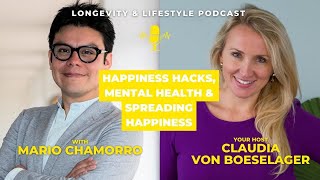
In this Longevity and Lifestyle Podcast episode, host Claudia von Boeselager interviews Mario Chamorro, a United Nations Ambassador for Happiness. Mario explains his personal definition of happiness as tranquility and a lifestyle that supports longevity through balanced health, relationships, and purposeful work. He recounts how a simple bar‑room experiment in Boston sparked the creation of the UN International Day of Happiness, leading to the Gross National Happiness concept from Bhutan and the 2012 UN summit that established March 20 as the global celebration. Mario introduces the DOSE framework—dopamine, oxytocin, serotonin, endorphins—and shares daily practices to activate each chemical, including to‑do lists, hugs, gratitude, and physical activity. He details his habit‑building system: weekly planning around health, relationships, and work, using calendars and a 10,000‑step goal that evolved into half‑marathons and a bucket‑list volcano climb. The conversation also covers his whimsical use of costumes during remote work at Coursera, his personal journey from a small town in Pasto, Colombia to Columbia University, Wall Street, and tech education, and his recent pivot to a mental‑health startup aimed at democratizing access in Latin America through media and technology. Mario shares leadership insights—empowering others’ superpowers—favorite quotes, books (The Daily Stoic), rapid‑fire advice for youth, and his online presence.
Chapters
Are you as happy as you could be? I'm your host Claudia von Boeselager, and in celebration of the International Day of Happiness, my guest on the Longevity and Lifestyle Podcast today is Mario Chamorro, a United Nations Ambassador for Happiness who has spread smiles across three continents and swapped stories with politicians, former guerrilla combatants, and countless community leaders. He shares on why it's so important to get your daily dose, D-O-S-E, of happiness and how to do it, and so much more. Please enjoy.
Welcome to the Longevity and Lifestyle Podcast, Mario. It's such a pleasure to have you on today.
It's my pleasure to be part of your podcast. I have it in my background.
I can see it there. Thank you. Mario, I'd like to start with why happiness is such an important passion project for you, or way of life I should say, and why happiness, um, in your view is also so important for longevity.
Happiness is important for me because I believe it's a good way to live our lives. When you prioritize happiness, you develop habits on your day-to-day that lead you to be in a more happier mood. And I would say like for me, happiness is mostly tranquility. For me, happiness is not being super optimistic. Happiness is a lifestyle to be at ease, So that's what happiness is to me. And to build this lifestyle on a day-to-day basis is one of my priorities because by doing that, it's how I find meaning in my life. And that's why happiness is important to me. The second part of your question is, the legitimacy is because by building a lifestyle where you prioritize happiness, that makes you do things such as build habits around taking care of your health. Taking care of your relationships, and doing work that matters to you. And when you have balance between those three, you have a better longevity. So for instance, one of my goals is to climb the volcano from my hometown for my birthday number 80. I am 41 right now, and I just climbed the volcano probably like 4 months ago. I know like I need to be in shape in order to do it. That's why by prioritizing this, I can reach my bucket list goal of going to the volcano on my birthday number 80.
I love it. And part of my goals is to be the 90-year-old that goes skydiving. I think I want to also maybe climb Kilimanjaro, but maybe climbing a volcano would be fun as well. And just having tons of fun because I think when people think of longevity, they think like, oh, I don't want to be in ill health and sitting on a sofa for another 20 years. That's not interesting. Actually, what I want is to live really well, right? So it's increasing healthspan of the healthy years. So you can do cool things like climbing a volcano or jumping out of airplanes or whatever it is that you might want to do, or just even playing tennis or something, maybe a little bit more normal. Mario, you were part of a group of happiness activists who created the United Nations International Day of Happiness, March 20th. Can you talk about how this came to be and what was the idea behind it?
That was a fun experience which started back in year 2010 when I walked into a bar. This is not a joke. Just kind of like, that's the typical thing, right? In Boston. And then I saw a lot of people who were sitting in this bar were kind of sad. You had couples on tables that were staring at their cell phones. They weren't talking to each other. So then I asked a friend of mine like, hey, what do you think makes these people happy? And she said, hey, Mario, you always have busted nose, right? Like this one. And you always have Sharpies, so why you don't go and ask them to write anything that makes them happy? So I said, that sounds fun. I went through every single table in that bar, like, hey, my name is Mario, can you please write anything that makes you happy? And hopefully if someone is listening to us right now, they will write. Actually, Claudia, if you can also like write something that makes you happy, that'll be fun.
Sure. Oh, I have a long list. How many things should I write?
Oh, as much as you want. If you want one so you can share with your audience.
Okay, so on my list I've got my kids being silly, sunshine, the ocean, sunsets, laughing, friends. And that was the beginning of my list that I just did in however many seconds.
Great. So sunshine, friends, laughing, being silly.
I like to be silly.
That's good.
Yeah.
That's important.
Yeah. Don't take myself very seriously.
That's good. So by asking that simple question, couples start holding hands and, or having conversations. So when I saw all that impact of just such a simple thing, my friend turned back to me and say, hey, how about if you collect 3,000 of these Post-it notes and build an art installation? So I said, really fun project. So the following day I went to the Boston Commons. Boston Common is kind of like the main part. In Boston, and I start asking strangers to do the same exercise of what makes you happy and then to take a picture of you. So I collected 3,000 Post-it notes in 2 weeks. I had my first art installation, and I'm not an artist, to be fair and to be transparent. But during that installation, like, people start interacting with that installation. So it was really powerful to see people just writing their message of happiness. So I built a website and I start doing that exercise almost on a weekly basis. Long story short, in a year and a half, that project went to 30 different countries. So we had people doing, asking people on the street, uh, on things such as in Tahrir Square during Arab Spring in Egypt, uh, a woman was doing that project, asking people what makes them happy, or a 7-year-old girl in Saudi Arabia, or an artist in Kenya. So that was really powerful. So in one of these exercises, I was asking people in the streets of Cambridge, Massachusetts, and I met this guy who, his name was Nima, and He was the advisor for the King of Bhutan. So he asked me like, what are you doing this? And I said like, you know, I believe in happiness. So he shared the story about his king, how the King of Bhutan asked people of their, you know, their country of Bhutan, what makes them happy. And that's how they built the Gross National Happiness. That was the very early beginnings of the Gross National Happiness. For those who doesn't know what is the Gross National Happiness is, so Every single country measures success based on gross domestic product, GDP, which is the amount of services and products that a country produces in 12 months, within one year. So in Bhutan, they had a different vision. So they believe in happiness and it should be a more holistic measurement. So it's not only like the amount of goods and services, but it's also to take things in place such as the environment, time with family, and others. So this country is only like 1 million inhabitants, the population country. But became very famous because they managed their economy based on happiness. So when he shared that example, I got really excited. And that's how he ended up inviting me to the first summit on happiness at the UN back in April 2012, where ministers from or secretaries from 65 different countries gathered to talk about how to implement happiness in public policy. So my friend Nima, he said, hey, Mario, it will be good if you share your project with this group of, you know, like policymakers. So during that summit, I shared this project that I to share with you. And at the end of this summit, one of the ideas about what to do together as a group of, you know, like optimists and happiness activists was to create a day of happiness. So that's how I ended up getting involved with other individuals on the creation of the International Day of Happiness. So I remember partnering with Jamie Elyon, who was probably the main spokesperson, and also with the ambassador for Iraq. Hamid Al-Bayati. He shared with us that his commitment with happiness was very high because when he was part of like the regime of Saddam Hussein, he got tortured by Saddam Hussein. And he said like the only thing that helped him to survive and to overcome those challenges was his thoughts about happiness. So that's why he felt in debt with happiness. And so he helped us and we convinced 83 countries to sign up this proposal. So that's how March 20 became the International Day of Happiness under Ban Ki-moon's direction.
Such an incredible story. Okay, how is it celebrated? What is the typical celebration for the International Day of Happiness?
I believe a lot in social movements and social movements need things such as one, a powerful story. Two, you need ways how to connect one member with another member or with the movement itself. And three, you need a lot of either, I guess, like colors or things where you can connect with each other, kind of like it's part of the tribe or it's part of the community, right? So we thought that yellow was kind of like the color for this particular community. So we light up the whole Empire State Building in yellow. I remember Pharrell Williams was there. And also we light up the Coit Tower here in San Francisco in yellow to do kind of like a cross-pollination happiness, yellow illumination, and the tallest building in Bogotá as well to complete the triangle. But other than that, we built a lot of activations on happiness, like in several countries. There is a very great organization in the UK called Action for Happiness. They became the leaders on creating all these activations during the International Day of Happiness. So yeah, UK was extremely important.
I love it. So, Mari, can you tell us a bit about the scientific and the biochemical effect of happiness, smiling? And we know about serotonin, but can you just dig in a little bit deeper why physiologically also happiness is so important?
Sure. So back in the day, we call it like the happiness dose. D-O-S-E. D comes from dopamine, O comes from oxytocin, S comes from serotonin, and E comes from endorphins. So those are like the four main chemics that are part of our brain that gave us this feeling of joy or happiness. Dopamine, it's interesting, but can be activated a lot with things such as a text message. That's why kind of like the cell phones have been developed to release dopamine in our brains, which is really bad. It's also like the sense that we have when we finish a task. So that's why, for instance, every morning on my morning rituals, I write, I don't know, like the 3 important things that I want to do during the day. So for instance, today swimming was one of them. So when I completed swimming, you know, I feel good. So that's dopamine. Oxytocin is more external because it can be activated, for instance, when you hug. Someone. So when you hug your kids or your partner or your friends, try to give a meaningful and very present hug. And S comes from serotonin. I think that also is related to more the exterior. For instance, um, let's say your daughter just graduated from kindergarten and you felt so proud about her, right? So it's not related with you directly, you didn't finish kindergarten, but it's someone else who achieved something and you feel this sense of like, you know, good. So also like things such as thoughts of gratitude are super important. And again, it's not only about us, but it's also like about people, either that we know them or we don't, right? So if you close your eyes and like think about like things that you feel grateful for, or kind of like how do you feel proud about others, that's how you can activate it. And the last one is endorphins, which comes from kind of like running, walking, working out. So those four are some of the key chemics that are in our brains that help us to activate happiness. And we can practice them on a daily basis. Again, I just gave you a list, you know, like dopamine, make a list of things that you want to do. Oxytocin, just go and hug someone. Serotonin, close your eyes and just feel like pride for someone that you love. And endorphins, go for a walk or just do 5 pushups or something like that.
I'm curious, Mayu, is your daily to-do list based on the dose? So do you have to take a D and an O and an S and an E each day?
That's a good one. Actually, it's funny, but I was just thinking about it. I do build habits based on 3 things, on health, relationships, and work. So on a very voluntary basis, I ended up activating the 4 of them. So again, this morning, you know, like dopamine, the first thing that I did this morning was to write things that I want to achieve during the day. Oxytocin, I went for a walk with my wife and we hugged for like 5 minutes or so because we always do morning affirmations. This morning was as the universe conspires in your favor. You try to see it, you know, like very meaningfully. And the S, we always do with my wife also, like, what are the 3 things that you feel grateful for every morning? And then there are things I went swimming. So yes.
Wow. You got your daily dose of happiness. Amazing. I hear that it also sometimes involves wearing costumes. Can you talk about a fun story I hear you have on wearing a costume at an important work event?
So I, yes, I, and in fact I have a kind of like Ninja Turtle next to me. See, I do love costumes. First of all, I believe in a world where whimsy and imagination are the norm, or I dream with a world where whimsy and imagination are the norm. So costumes is a funny manifestation of that. So when the pandemic started, the company that I used to work with, Coursera, which is an online education startup, as many companies, we went to work Online, right? We all started working remote from our homes and kind of like it's hard to maintain the culture from a place that now that is remote work, right? So I remember just missing that culture of like whimsy that Coursera had and, you know, it was fun and it was quirky. And so we had all hands meetings or town hall meetings twice per month with the whole company. So as a joke, you know, one day I started putting— actually, I always have here kind of like I have my Mario hat, right? So I came out like that, and then I turned and I found a mustache. So I became kind of like Mario, right?
You're just missing the wheel.
Yeah. So then I got a lot of like internal messages like, oh my God, that's really fun, uh, you should have another costume next day. And Next town hall. So I did that and I had ended up having a different costume and then starting feeling all this, you know, like the culture that we have at Coursera. So I ended up having more than 40 costumes. Um, yeah, it's funny because actually, okay, I have a picture here. So it became a thing at Coursera. So then, you know, like, uh, I, we had our own Slack channel and people were, you know, like sending me ideas about what costumes should I wear. So the office in India, one day they say, hey, you know, we have Gandhi Day. It will be very meaningful if you dress up like Gandhi. So I shaved my head and I became Gandhi. And just by doing that, then I started, you know, like having emails from coworkers that I never knew. I ended up speaking for 5 minutes to 1,000 people, right, in different costumes. Very serious comments or very serious questions. But people used to come with their kids, you know, and just to watch like why Mario was going to dress up like that day. So that became kind of like a family tradition. So my wife helped me to do the makeup, or, and my mom was always like, what's going to be the costume for next week? And I think like that helped us to navigate the pandemic in a more whimsical way.
How amazing, Mario, to be such a spreader of joy. I mean, just think of the ripple effect that you had 1,000 people on the call, but then their families were involved. They were bringing their kids. I mean, you became like the highlights from the company town hall. To check out which outfit you would do. I think the more people who wouldn't take themselves so seriously and you have to have a bit more fun, I think we would all be laughing much more of the time. I love your attitude. And Maria, where did all this joy, I should say, start? Were you the happiest baby in Colombia? Maybe you can talk a little bit about your childhood and growing up beside a volcano in Colombia and your journey to where you are now, and if there were any particular learnings or insights that most impacted you along the way?
Yeah, one of my mentors, I mean, sorry for what I'm going to say, I'm going to curse, but he used to say that even pretty flowers grow from shit. I think like a lot of difficult moments build character. That is me, right? But as you said, I come from like a small town in Colombia called Pasto, and my mom was always very kind of like work-oriented. My dad was more like the loving guy that used walk on the street and everyone hug him and just love him. So I had like this weird combination of, you know, like hustling, working really hard towards your goal with this heart with legs that always walks around and just smiles. And I think as a result, it's me. So I developed this huge entrepreneurial drive thanks to my mom and her love to do good for the world. So she used to work with unprivileged kids. And I think she was a very purpose woman still. And my dad was just mostly kind of like, be silly and just make fun of yourself and just enjoy life. So I think that that's part of me. I moved to Bogotá when I was 16. I went to do my college there. Against all the different odds and funny things, I moved to the US in 2004. I didn't speak English at all, didn't have any money, and didn't know anyone. And I'm really good at making friends, so I ended up making friends and they persuaded me to apply to Columbia University. And then I ended up working on Wall Street until the financial crisis happened. Then I moved to Boston and in that moment it was 2009 and I started building one of the happiness projects that I just was mentioning earlier. Because I thought, especially after the economic crisis, I say like, hey, you know, it's important to find purpose. I remember staring at the buildings in Wall Street saying, hey, How is it possible that all these, you know, like larger organizations are only related to either finance or consulting or oil or stuff like that? When would be the day where an organization that is devoted to do good for the world will be also financially important? So I had that thought back in 2008 and just 5 months before Coursera, where the company that I used to work, which again, the main mission of Coursera was to democratize education, which means to make education from places such as Stanford, Yale, Columbia University, and so on, available to anyone, went public. So that was a really powerful moment. I said, you know, like it took me probably like 12 years to get there, but it was a really good sign of the world is changing and it's possible to live well by doing good.
I love that. And I love your vision of having the most successful or a very, you know, successful company that is just doing good all day, every day, and not to be one of the major global leaders. So maybe in our lifetime, what do you think? How long is it going to take for that to happen?
Now with access of technology that we all have, I believe it's going to happen sooner. I mean, again, Coursera was a B Corp, which is this standard in the US of companies that are like really strong social standards that went public, and that already happened. And as well as Coursera, there are many companies that are doing financially super well with a very social mission. So I believe access to technology is the game changer. Technology and the internet became the game changer to make this ideas of doing good, living well by doing good.
Let's talk about habit building. You touched on it before, how you structure your day and certain habits for success and for happiness. Can you talk a bit about that?
Sure. I think I like have some good example here. So I build my weeks every week based on 3 things. Again, at the beginning I mentioned that it's for me, happiness is a lifestyle to be at ease. A lifestyle means a bunch of habits. So the habits that I built on a weekly basis are 3. One are habits around health, which means mind, body, and food. The second one is relationship, which means the first one is relationship with myself, the second one with my partner, and the third one with friends and family. And the last one with work, which is first one is our 9 to 5, which is our main job. The second one is our side projects and the last one is to learn. So every Sunday at the end of the day, my wife Lara and I, we sit for probably 30 minutes and we plan the whole week around these 3 buckets: health, relationships, and work. So let me show you like, this is for instance how my schedule looks like. So it's very key to be super intentional because if you're not intentional with the things that matter to you, is really hard that they're going to happen. So in order to be intentional, the system that helps me is to place activities on my Google Calendar because I know if they're in my calendar, it's very likely that it's going to happen. So with Lara, we do like, as you see, like in this picture here, we put it on the living room, on the calendar that we have, and then we put it on the Google Calendar. So green is health. So you can see like the different things that I have in green, such as meditation, running, biking. So on relationships, we have like a biweekly date with my wife. Yes, we live together and so on, but we do space for like really, really meaningful connection. Or we also have, okay, this week we're going to spend time with friends and work. You know, it's also important. That's how I build habits on a weekly basis. And when I start asking myself about which habits should I build is basically things that really matter to me is a combination between the things that matter to me with things that I can control. And in the middle is where I am really focused on because Again, probably 98% of things that happen to me are totally outside of my control. So being aware of that is really important. So I really focus on things that matter to me and I can control. So as a result, for instance, you know, like during the pandemic about this habit building and health, I challenged myself with my wife to walk 10,000 steps per day. So we have our Garmin watch or any watch. So we started doing the 10,000 steps. That helped us to connect more, to spend more time together, but also to be away from our cell phones or computers. And thanks to that, uh, some days I was running out of my 10,000 steps, so I needed to run and I hated running, but I started running and then I fell in love with running. So then I started running half marathons and so on. So that's like whole compound effect, right? 10,000 steps can sound a lot, but maybe it's not a lot. But thanks to that, you can like start building beautiful habits.
Uh, I love that. And I think for people to also realize it's a springboard, right? Because people think, well, you know, I'm never going to run a marathon. But it's like, no, you don't need to run a marathon if you're mainly sedentary. You know, start with 10 or, you know, even 1,000 steps and you build up the strength, you build up the momentum, and then all of a sudden the half marathon is possible. And then who knows, you might even go for the marathon. And at 80 years old, you're climbing a volcano, right? And it becomes more and more realistic. And you're like, you know what, actually I can do it. And it's exciting because you're achieving these really big goals that you previously never thought possible. Mario, you celebrated your 40th birthday last year, and I heard you got an incredible gift from your wife. Can you tell us a bit more about that?
Yeah, she surprised me a lot. I don't know if it's called like the midlife crisis or so, but I was thinking a lot about, hey, turning 40, my goodness. So I remember that I even did a presentation to my board of directors. I always have like a personal board of directors. So I used 4 slides, each slide, it was for for every single decade in my life. So I had like from 0 to 10, then to 20, 20 to 30, and so on. So I had key learnings, so highlights and lowlights for each decade actually. And then I was telling Laura, hey, it's crazy to think that my life can be summarized in 4 slides. So probably I only have 4 more slides and that's it, you know, I'm out. Suddenly Laura came out on my birthday day with this beautiful song called Cui de Corazón Grande. Cui is a guinea pig. You know, it's like this guy. So it is the main animal in my hometown, and a lot of friends call me Cuy. She partnered with another good friend of mine who's a fantastic musician, Juan Andrés Ospina, and they wrote this beautiful song that summarizes my life in a song. Instead of like 4 slides, summarize my life in 4 minutes or 3 minutes.
Yeah, but I mean, it's now there for eternity, right? This beautiful song about your life. So that's really beautiful.
That's what I told my friend, he made me immortal.
Immortal, exactly. And 200 years, they're going to be wondering, who is this Mario? Or, well, you're already famous with your International Day of Happiness. So let's see what the next years will bring you.
So I cry a lot when I hear that song. I probably cried like 25 times. And actually, my 41st birthday was only like 2, 3 weeks ago. And I went to my family. So we play that song and we blast that song and we dance that song with my parents and my in-laws like many times. So that was really fun.
Oh, you made it back down to Colombia?
Yeah, it was my bucket list to get together with my in-laws and my parents after the pandemic, and that was very powerful, very special.
And have your special song playing as well. How beautiful. I'd love to jump into a few rapid-fire questions, Mario. Thinking of the word successful, who is the first person who comes to mind and why?
One of my friends and mentors, his name is Pablo Calderón. We call him Dumba. For me and for my wife, we believe success is to live life on your own terms. So this guy, Dumba, he's brilliant. I mean, he has, on the science point of view, he has a PhD, blah, blah, blah. But then he also found out how to, very early, to discover like cryptocurrencies. And he has been doing great on that field, but most importantly, he lives life in a very simple way in the middle of nature in Colombia. And his daily or weekly projects are things such as I'm going to grow, to harvest like 1,000 trees. So that's what he did, like with his own hands, he planted 1,000 trees with an indigenous community. Or so those are kind of like his kinds of projects and he writes every day poetry and so on. And he has a beautiful heart. So it's this beautiful combination between heart, brain, and being very present. So, uh, yeah, that's to live your life in your own terms.
I love the combination of the cryptocurrency. So in essence, because of, I guess, financial markets are, you know, fiat and crypto, right? But then the contrast with the pure nature and poetry, it's so interesting, but yet makes total sense, I think, as well. And then just him finding his peace and harmony as well. So I like your definition of success, and I completely agree with you. The ability to say no to the things you want to say no to and have time for the things that really matter to you. So thank you for sharing that. Mario, do you have any particular morning routine to start your day as a success? I mean, you mentioned some of the things you do with your wife. Um, are there any other particulars that you do every day?
For me, mornings are the one that I love the most because it's kind of like Mario time. And I'm truly convinced that, uh, if I'm able to do those 2-3 hours of morning routines, I will be way more effective at work, at everything that I have to do. So I try to wake up at 6:30, so I meditate for 30, 40 minutes. Actually, I just came out of Vipassana, like this 10-day silent retreat. It gives you this really powerful technique. So meditation is the first thing that we do. Then we go for a little walk with Laura. We live next to a mountain, so we go there for another 20 minutes. During our walk to the mountain, we don't talk about work. We just talk about things that we feel grateful for. And we do one daily affirmation, 1, 2, 3 daily affirmations. On our way back, I start movement. So I either go running or swimming or biking or anything. And then I just prepare an amazing breakfast and I have my beautiful coffee. So yeah.
I'd love to jump into your, the retreat you just did, the silent retreat. Can you talk a little bit more about that?
Silent retreat means no talking at all. No cell phone, no reading, no writing, none of that. It's a very powerful detox because we are hyperconnected right now. And it is basically to learn a technique called Vipassana, which doesn't have to do anything with religion. It's mostly a technique, but it's very powerful. And it's also donation-based. So the whole business model is pretty beautiful. At the end, you just pay what you feel that you want to contribute so someone else can do the retreat after you. In a nutshell, it was kind of like an Ironman, but for meditation. It's intense. If you go there, don't think that you're going to Wow. Relax. It's intense.
What information did they actually give you to prepare for it? I actually, I've never done something like that. I know a few people who have. I'd love to just dig into your experience a little bit, sort of your expectations before you went and then how that journey during the 10 days was. And then what were your biggest ahas and learnings from those 10 days?
I didn't get any preparation, to be fair. You know, I was told like, hey, you know, if you're going to meditate for 11 hours per day, you should start meditating at least for like 30 minutes. And I didn't. I guess again, like the physical part was intense because again, you're sitting and meditating for such a long period of time, which I'm not used to. I think nobody's used to, unless you are a yogi or a big meditator. But I think it's available to anyone. You don't need to have like any level of expertise. You don't need to be, you know, like a particular age or gender. No, it's pretty open to everyone. What did I learn? So again, like this technique is meditation technique is really powerful. So when I left, I was gonna like, oh, I do feel like, you know, good. But, um, days or weeks later, actually, now that I was visiting my parents at the end of my visit, my mom came to me and said like, hey, you were really tolerant this time and you were really patient this time. Thank you so much for being tolerant and very present and loving. And that was kind of like, okay, that was the result of vipassana, right? Kind of like used to, you know, like make you react really strongly before. Um, now it's a bit different. So I think that was a beautiful gift.
Did you say you didn't have any meditation practice before jumping into 10 days of vipassana?
Well, I mean, I had like the regular Headspace that you go once in a while, or, you know, kind of like 5 minutes. 10 minutes, but not a very disciplined practice of, you know, like 1 hour per day or something like that.
And is this something you think you would continue? I mean, just to keep the benefits, are you kind of addicted to it now?
Not addicted, but it definitely grounds me a lot. So if I sit for an hour to meditate or for 30 minutes, my day is different. I feel it. And it's a technique that is based on listening what you feel instead of what you think. It's not kind of like guided meditation. It's just like you and your feelings and just learn to feel because because we as humans, we were trained to think from our brain. So we rationalize every single thing, right? From like, oh, that's green, that's blue, or 1 1 2. But no, we haven't been trained on feeling. So when you're like, oh, this is a feeling, okay, and it's not good, it's not bad.
And not judging it as well. And it's an area I find really interesting. I've never done 11 hours straight, but, you know, I think sitting for an hour, it's sort of after the 35, 40 minutes when the real magic happens, right? That's when you get into this kind of attuned state. And it's so powerful, as you said yourself, what your mother commented, the sense of being more intuitive, the presence. Dr. Mark Atkinson has a great expression that you're not in the cave, the prefrontal cortex, you're actually in the ocean. And so the body is just so wise and there's so much knowing there. So yeah, it's an area I find really fascinating and I'm also on my journey to discovering more and more. So thank you for sharing that. Mario, is there an unusual habit or absurd thing that you love?
Hmm. Nature. Going to the mountain is so powerful. Like when I was, I don't know, like 12 years old, I remember this story that my mom shares that I went to my mom and said like, hey mom, stop paying my high school because I lost everything. I should not go back to school. And then my mom said, how about if you go to your mountain with your dogs and When you come back, we'll make a decision. I said like, yeah, let's do it. So I went to the mountain and again, since I've been 12 years old, you know, like I go to the mountain, it grounds me and it teaches me. And then I come back with a different mood. So I really try to go to the mountain. I don't know, like 3 times per week at least. And when I'm feeling lost or I don't know, like overreacting or so on, I just go to the mountain. So yes, going to the mountain or going to nature is a habit that grounds me and I love. Other than that, customs is funny, but I think nature is amazing.
It's a big thing. Yeah, exactly. Into ground and also the movement, right? So you're releasing hormones and things as well. Mario, how has a failure or an apparent failure set you up for later success? And do you have a favorite failure of yours?
Many, a lot. A story of, it was December 24th, 2004. I was parking cars in Boston. And a lot of friends were trying to persuade me to apply to a master's program at Columbia University. And I thought my self-belief was like, hey, you know what? This is for rich people. This is for smart people. That's not for me. So I keep parking cars. And when I was parking cars, a car came to the restaurant that I was doing the valet, and they had a sticker on the back that said Columbia University. So I always tend to share my dreams with a stranger, so I told the driver, hey, my dream is to study in that university. So he looked at me and said, hmm, my daughter's going to Columbia University. I don't think you can make it. So in that particular moment, I, I say, what? I think I can do it. So that day I built that confidence to really put serious on learning English and to apply to the school and so on. So I applied and a few months later I got accepted. I found the same guy probably like 4 months later or 5 months later in the same restaurant because I was keep parking cars there. Uh, and when I saw him, I thank him because I told him, if you weren't told me that I wasn't able to get into this university, I wouldn't build the confidence to do it. So thank you so much. So that's a, that's a good story that I remember about like the power of no and how a failure can, you know, like basically give you lots of leverage, but I could easily have taken then such as, he's right. That's not for me. And I mean, don't pursue my dreams, but I'm glad that I had a different attitude.
Oh yeah, exactly. And that gave you the motivation. And two questions from that. One is why Columbia? Why was that? And I mean, you were in Boston, right? There's Harvard, there's amazing universities in Boston as well. So one is, I guess, to understand why was Columbia so fascinating or why were you focused on that? And then two, what did the guy say when you told him that you had applied and actually got in? And thank you for telling me I wouldn't get in because now I got in. What was his reaction?
So why Columbia? I was very interested in the energy markets back then, and I found this program at Columbia that combined energy markets with policymaking, which was two of the things that were close to my heart. And also because it was based in New York and I was very curious about New York City. And what this guy said, he was speechless. He was like, oh, I'm sorry.
So don't be sorry.
Yeah, no, no, I was really casual. Like, thank you. Thank you. Thank you.
Yeah. Really cool. Do you have a favorite quote or piece of advice received that was a real game changer for you?
Yes. The obstacle is the way. That's a, that's a good quote. I think it was coined by Marcus Aurelius. So what stands in the way becomes the way. I believe that's a good quote. That I'd like to remember because we'll find obstacles in every single aspect of our lives, in our relationship, in our partners, in our work. I don't know, like when we're trying to develop any habits, you want to go for a run and then it's raining and you're like, ah, okay, I'll do it tomorrow or anything. Right. So I believe like the obstacle is the way. So whatever stands in the way becomes the way. So, uh, I think that's a good reminder.
I love that quote. It's also facing the fear and going through it. And, you know, Joseph Campbell's work, I'm sure you know, the hero's journey, it's pushing through is exactly— and I think even Tony Robbins has a thing that the biggest challenge you're facing is actually the most important one. That's the thing you need to focus on, the one thing, and not just push it aside. So Marcus Aurelius summed it up very nicely with the obstacle is the way. Mario, in the last 5 years, what new belief, behavior, or habit has most improved your life?
Habit that has improved my life? I would say the 10,000 steps. It could be, you know, like, could be 5,000 steps, but, uh, that helps me to go out and walk And that walk brings me to nature or brings me to conversations or brings me to reflection or brings me to important things.
Just the 10,000 steps, I like that because now you said you're running half marathons because of the 10,000 steps, is that right? Wow, so one step it started and then 10,000 and now marathons, I love it. Let's talk about mental health, Mario. You've now made a move on to a new startup in the mental health space. Can you talk about your view, and especially coming out of COVID where I think honestly that's the biggest pandemic we're going to have and are having is mental health issues that so many people will and are suffering from. Can you talk about your experience with mental health coming out of COVID and why you decided to do a startup in this space?
Sure. So mental health, I believe right now we're in the mental pandemic. The pandemic basically accelerated the impact of on mental health around the world. So we can see, you know, like dramatic numbers such as 800 million people committing suicide per year, like 300 million people suffering of severe depression in the world. In Latin America, the consumption of antidepressants have tripled down. So there's a lot of very dramatic impact of mental health. And I believe the problem is not going away. The problem is just getting bigger. So you can see also like different conversations, you know, on politics about it, on media. So there was the record number of articles in media about mental health in history happened just like 2 months ago. And also you can see market reaction. So in the first quarter of this year, like $900 million were invested in newly startups on mental health. So I believe definitely we're in the mental pandemic. And it's time for governments, companies, and universities, organizations, and individuals to really, really, really pay attention to mental health. So even if the size of the problem is as big as I just described, one of the very challenging parts is it's really hard to talk about mental health. It's hard to talk about it with your family, with your friends, with your coworkers. So the level of stigma is very high, and breaking through that stigma is something that is really challenging. So yeah, in a nutshell, I believe it's a big challenge that the world is facing right now. And it's a cultural time right now just to do something about it. But on the bright side, I also believe that opened up lots of conversations. And I believe, you know, like, it's crazy to think, Claudia, that there is no one word that defines that you're healthy on mental health, or neither in English or Spanish. So if I ask you, hey, Claudia, are you healthy? You say like, yes, but you're referring to your physical health. Through your mental health, right? It basically affects all of us. So it's a good challenge, but I see a lot of hope there. People are paying attention to their mental health.
That's amazing. Are you able to talk already about what you're planning on doing with your new startup in this space?
Yes. So that's a beautiful problem or beautiful challenge to solve. And I want to be able to create a platform that can democratize the access of mental health starting in Hispanic America or in Latin America, and then moving across other geographies. So right now, I left my last job at Coursera like 3 months ago, and we are in our journey to build a model that can help us to democratize that mental health access, as well as we did at Coursera with education. I want to do it now with mental health. So putting together media, because I believe, again, stigma is a big challenge. I believe media is a big tool, a powerful tool to influence behaviors, and that's combining really good art and design. And on the other hand, knowledge using technology by combining science and engineering to be there to build a good solution. So hopefully in a couple of months, I can, you know, like share this platform with you, Claudia, and with your audience and just to see, hopefully that will help you or any of your audience.
I would love that. Such a worthy cause and so important as well. And I think to your point around stigma and especially depending on which country and culture, But I really feel it's so important for people to talk about it. I mean, I had phases also with postnatal depression and things like that as well. And I grew up with, you know, you have to put on a brave face and you don't talk about things. And I think that the more you open up, the more other people realize it's actually okay to talk about it. And by talking about it, in essence, a problem shared is a problem solved. I could imagine in Latin America that, you know, carrying more stigma maybe than in other places. So you have maybe a bigger challenge than other places to discuss it, but are you using some of the strategies and tools that you've seen in the US or how is your strategy on helping? You said using media, and is it courses or how are you going to structure this?
Yeah, on the media side, it's definitely using courses, but it's also used creating really good content on topics such as how to manage a panic attack or how to deal with a panic attack or how to, or what is depression or how can you prevent depression or how can you deal with OCD or how can you build habits to do X, Y, and Z. So that's part of the content side. So it's about like body, mind, and soul. And on the other side, we're going to be developing tools to address some of those challenges.
Really exciting. Thank you for sharing that. What in your view separates a good leader from a great one?
Hmm. I think a great leader is someone who can— I mean, for me, a leader is just like someone that empowers other people to do what they're good at. Uh, so part of it is just to identify what are like those superpowers that people have and somehow to give them the confidence and guidance for them to use those superpowers to support any cause that is greater than them. So it's basically to unleash these superpowers or to unleash, yeah, unleash these beautiful skills and powers that people have. So I think that that's a leader, someone who empowers others to, to achieve like a better version of themselves.
I agree. Before we finish up, Maya, a few rapid-fire questions. What has been your most exciting purchase in the last 6 to 12 months? I love specifics, brands, where you bought it.
6 to 12 months. Um, I, okay. I'm like, I'm like turning now. I think kind of like my iPad because now I'm like taking lots of notes here and I'm drawing and I'm constantly, you know, like I used to do that on notebooks, which is great, but I ended up losing all those notebooks and not having track of like the ideas pages and so on. So I've been using this app called Notability and it's amazing just kind of like to do drawings, to grab ideas, to take notes. I think Notability probably instead of like the iPad, Notability has been the best purchase that I have done over the past 6 months.
Thank you. Because I haven't tried that yet. Thank you for sharing. Do you have any particular books, documentaries, or movies that you feel people must watch?
Books? Yes. Part of my morning rituals, I read the Daily Stoic by Ryan Holiday. So it has 65 daily meditations. And again, it's one page. It's just like sometimes it's only like one paragraph that like for me, Stoicism is something that is a very powerful tool and it's a philosophy that is really pragmatic. So I love the practicity of it. So each meditation gives you one specific reflection for one day and it will take you only like 5 minutes, but I think I like that so powerful. So that's the book that I would suggest. And in terms of like movies, one of my favorite movies is Big Fish with Ewan McGregor. And it's about a relationship of like dad and son and just sharing the stories about life in a very whimsical way. And again, I believe in a world where whimsy and imagination are the norm. So that movie. Kind of like represents that.
I love it. What book have you most gifted? The Daily Stoic. In the last 5 years, what have you become better at saying no to, like invitations or distractions, and what realizations and/or approaches have helped?
It's hard to say no for me. I have found myself as a, you know, like to have a lot of like people-pleasing challenges. So it's hard for me to say no, but I've been start saying no to things that, that I don't feel good. I mean, it's not to please people, but if I'm not like really feeling it, I can just say no. And the realizations that I have from those actions are that, you know, we should be guardians of our time. And when we guard our time, it's good because time is the most important asset that we have. I mean, You can buy anything, but you cannot buy time.
Yes, exactly. Such wise words. Mario, metaphorically speaking, if you could get a message out to 1 billion people, say by writing in the sky, and a billion people could read it, what would it say and why?
What makes you happy? It will be a question. Perfect. And it's a question that I asked to 200,000 So if I can do like the billion, yeah, what makes you happy? Because I believe people should prioritize things that makes them happy or, you know, things that matter to them. But I don't think nobody will say like, for me, it really matters to have a Ferrari or to be a big CEO.
I agree. Mario, what advice would you give a smart, driven high school student about to enter their next phase of life, be it college or work? What advice would you also recommend they should ignore?
Advice I should give is probably like read about Stoicism. That's a good tool to have. It will help them in their relationships with their families, with their partners, also at the work, but also at life. And it's all about like seek virtue and to seek meaning in our life. So I would say like read Stoicism is probably like a good advice, something that I would have loved to, to find earlier in my life.
And the other one was like something that What would you recommend that they ignore?
They ignore the naysayers. There always are going to be naysayers. There always are going to be bullies. There are always going to be divas. So ignore them, you know, like take no as a powerful force, as a leverage.
I agree. And also I see no as a yes later on. So if you really want it, you just come back at a better time in a reframed way. And often it turns out into a yes. Yes. So I agree. Mario, where can people learn more about what you're up to on social media or websites? And what would you like to share with people?
Um, I think my personal site, which I don't update often, it's called mariochimoro.co. And the other one is my Instagram is easy. It's Mario Chimoro. I intentionally deleted Instagram 2 weeks ago and it's giving me much more time again, talking about like be guardians of her time. But when I'm back, I guess I post things there.
Do you have any final ask, recommendation, or parting thoughts for my audience, Mario?
I think, you know, I mean, remember like the little graphic that I share about where you can start, you know, like things that matter to you with things that are under your control and in the middle is where you can focus. You should focus. I mean, things that are under your control, plus things that matter to you.
Thank you so much, Mario, for the time, the inspiration, the incredible work that you're doing, sharing that with us and the world. I really, really appreciate you coming on today. Thank you so much.
Thank you, Claudia.
Appreciate it.
Hi everyone, this is Claudia von Boeselager again. Before you take off, would you like to get a short email from me with some short but sweet fun tips, tricks, and updates on all things longevity and lifestyle. This could be cool products that I've discovered, interesting posts or articles I've read, and other fun and helpful things around longevity and lifestyle I've found for you. It's a very short piece of inspiration for you a few times a month. So if you want to receive it, check it out by going to longevity-and-lifestyle.com.
That's longevity-and-lifestyle.com.
And leave your email to sign up for the next one.
More from Claudia









Can Psilocybin Slow Aging? The Study on Telomeres, Inflammation & Survival with Dr. Louise Hecker

